Coast Guard Cutter Valiant Returns to Jacksonville After 60-Day Patrol

The Coast Guard Cutter Valiant conducting flight operations with Air Station Miami MH-65 Dolphin Helicopter in order to qualify flight deck team members mid-May 2020, in the Caribbean. U.S. COAST GUARD

JACKSONVILLE — The crew of Coast Guard Cutter Valiant (WMEC-621) returned home to Naval Station Mayport, Florida, June 22, after completing a nine-week patrol conducting operations in the Windward Passage between Haiti and Cuba in support of Coast Guard 7th District and Operation Southeast Watch, the 7th District said in a release.  

Coast Guard Cutter Valiant patrolled over 11,000 nautical miles in the Caribbean, working closely with the Navy and Coast Guard cutters Diligence (WMEC-616), Resolute (WMEC-620), Kathleen Moore (WPC-1109), William Trump (WPC-1111) and Raymond Evans (WPC-1110). 

Valiant increased Coast Guard presence along the northern coasts of Haiti, Dominican Republic, Cuba and the Windward Passage, working to prevent an anticipated surge of illegal immigration and human smuggling amid the COVID-19 global pandemic. Throughout this patrol, Valiant served as the Cutter Tasking Unit, directing all Coast Guard assets supporting Operation Southeast Watch in the Windward Passage. In order to deter an illegal exodus from Haiti, Valiant maintained an overt presence by frequently transiting the Canal de la Tortue, a heavily trafficked, deepwater passage between the Tortuga Island and the Northern Haitian coastline.    

Early in the patrol, Valiant conducted vital training with two MH-65 Dolphin helicopters from Air Station Miami. The first evolution involved a vertical replenishment between the cutter and an airborne helicopter and aided in the qualification of Valiant’s flight deck crew as well as two pilots for shipboard operations in preparation for hurricane season. The second evolution included multiple day and night touch and go landings, as well as a helicopter in-flight refueling, ultimately leading to the qualification of numerous crew members.  

Valiant unloaded nearly 14,000 pounds of cocaine and marijuana and nine detained suspected drug smugglers during the patrol. The contraband and detainees were seized by multiple Coast Guard and Navy assets and transferred to other Coast Guard cutters for future disposition stateside. 

Valiant also assisted in the transfer of a Coast Guard 45-foot Response Boat-Medium (RB-M) from Coast Guard Sector Miami to Coast Guard Sector San Juan. The Valiant crew took on the tow of the RB-M from Coast Guard Cutter Diligence in the Windward Passage and towed the vessel the remaining 360 nautical miles to Sector San Juan, saving the Coast Guard over $100,000 in shipping costs. 

“Valiant’s crew has a unique ability to be at their best in the most challenging of times, and this patrol was no exception,” said Cmdr. Matthew Waldron, Valiant’s commanding officer. “Demonstrating exceptional fortitude, they adapted and overcame all challenges associated with the worldwide pandemic to safely conduct a two-month patrol in the Windward Passage. Using overt presence to deter migrant departures from Haiti, we prevented attempts of dangerous and illegal maritime voyages to the Bahamas and Florida. The crew’s efforts proved highly effective, as migrant departures from Haiti were kept well below historic norms during this period, allowing first responders in the U.S. and the Bahamas to focus on pandemic response efforts.” 

The Valiant is a multimission 210-foot medium-endurance cutter. Missions include search and rescue, maritime law enforcement, marine environmental protection, homeland security. and national defense operations.  


Coast Guard Cutter Vigilant Interdicts Approximately 6,800 Pounds of Cocaine

The Coast Guard Cutter Vigilant crew seized a total of 122 bales of cocaine in back-to-back interdictions of go-fast vessels just off the coast of Limon, Costa Rica, June 15, 2020. U.S. COAST GUARD

CARIBBEAN SEA — The Coast Guard Cutter Vigilant (WMEC-617) crew seized a total of 122 bales of cocaine June 15 in back-to-back interdictions of go-fast vessels just off the coast of Limon, Costa Rica, the Coast Guard 7th District said in a June 19 release. 

The forward-deployed Coast Guard MH-65 Dolphin helicopter crew aboard the Vigilant successfully disabled the first go-fast vessel and observed the crew throwing packages overboard. 

Once on scene, the boarding team discovered four people aboard and recovered 77 bales, or approximately 4,200 pounds, of cocaine from the water. Immediately following the first interdiction, the helicopter crew and a separate cutter boarding team were vectored to a 34-foot go-fast vessel with five people aboard. 

The helicopter crew successfully disabled the second go-fast vessel and also observed the crew throwing packages overboard. Vigilant’s boarding team arrived on scene, apprehended five people and recovered 45 bales or approximately 2,600 pounds of cocaine from the water. 

The cocaine recovered during both interdictions has an estimated wholesale value of approximately $118.3 million. The nine people will be prosecuted by the Middle District of Florida and the seized contraband will be transferred to the Drug Enforcement Administration. 

“Every high-speed interdiction of drug-laden vessels presents unique challenges, so for us to simultaneously interdict two overpowered go-fast vessels in the middle of the night is extraordinary,” said Cmdr. Fred Bertsch, commanding officer of the Vigilant. “I am very proud of our crew and could not have asked anything more from them. These efforts, combined with those of our partner agencies and nations, will help ensure stability in the Western Hemisphere.” 

Once aboard a Coast Guard cutter, all detainees receive food, water, shelter and basic medical attention. Throughout the interdiction Coast Guard crew members were equipped with personal protective equipment to minimize potential exposure to any possible case of COVID-19. No detainees were reported to be sick or to have any COVID-19 related symptoms.  


Littoral Combat Ship USS Kansas City Joins the Fleet

Cmdr. William Dvorak, executive officer of the Navy’s newest littoral combat ship USS Kansas City (LCS 22) salutes Cmdr. R.J. Zamberlan, the ship’s commanding officer, during a reading of his orders during the ship’s commissioning ceremony. The Navy commissioned LCS 22, the second ship in naval history to be named Kansas City, via naval message due to public health safety and restrictions of large public events related to the novel coronavirus (COVID-19) pandemic. U.S. NAVY / Mass Communication Specialist 2nd Class Alex Corona

SAN DIEGO — The U.S. Navy commissioned Independence-variant littoral combat ship USS Kansas City (LCS 22) June 20, Littoral Combat Ship Squadron One Public Affairs said in a release. 

The Navy commissioned Kansas City administratively via naval message, due to public health safety and restrictions of large public gatherings related to the COVID-19 pandemic and transitioned the ship to normal operations. The Navy is looking at a future opportunity to commemorate the special event with the ship’s sponsor, crew and commissioning committee. 

“This Independence-variant littoral combat ship will continue our proud naval legacy and embody the spirit of the people of Kansas City,” said Navy Secretary Kenneth J. Braithwaite. “I am confident the crew of the USS Kansas City will extend the reach and capability of our force and confront the challenges of today’s complex world with our core values of honor, courage and commitment.” 

Vice Adm. Richard A. Brown, commander, Naval Surface Force, U.S. Pacific Fleet, welcomed the ship that brings capabilities to counter diesel submarine, mines and fast surface craft threats to the premier surface force in the world. 

“Like other littoral combat ships, Kansas City brings speed and agility to the fleet,” said Brown via naval message. “Congratulations to Kansas City’s captain and crew for all of your hard work to reach this milestone. You join a proud surface force that controls the seas and provides the nation with combat naval power when and where needed.” 

Tracy Davidson, the ship’s sponsor, offered congratulations to everyone who played a role in delivering USS Kansas City to service. 

“I am so proud of USS Kansas City and her crew, and everyone involved, for all the tremendous work they’ve done to bring this ship to life. Their dedication to our nation and the Navy is very much appreciated,” Davidson said. “I am privileged to be a part of this ship honoring Kansas City and look forward to remaining connected to USS Kansas City as her legacy grows, wherever she may sail.” 

Kansas City’s commanding officer, Cmdr. R.J. Zamberlan, reported the ship ready. 

“The caliber of crew required to prepare a warship entering the fleet is second to none,” Zamberlan said. “This is even more impressive aboard an LCS, where every member of the minimally manned team is required to fulfill multiple roles and excel at all of them to get the job done. 

“This crew has exceeded expectations in unprecedented times and I could not be prouder to be their captain.” 

Kansas City is the 11th of the Independence-variant to join the fleet and second ship to be named for Kansas City. The name Kansas City was assigned to a heavy cruiser during World War II. However, construction was canceled after one month due to the end of the war. 

The name Kansas City was also assigned to the Wichita-class replenishment oiler AOR-3 in 1967. This ship saw service in the Vietnam War and Operation Desert Storm and was decommissioned in 1994. 

The littoral combat ship is a fast, agile and networked surface combatant, and the primary mission for the LCS includes countering diesel submarine threats, littoral mine threats and surface threats to assure maritime access for joint forces. The underlying strength of the LCS lies in its innovative design approach, applying modularity for operational flexibility. 

Fundamental to this approach is the capability to rapidly install interchangeable mission packages onto the seaframe to fulfill a specific mission and then be uninstalled, maintained and upgraded at the Mission Package Support Facility for future use aboard any LCS seaframe. 


AARGM-ER Components Pass Critical Design Review

Advanced Anti-Radiation Guided Missile image. NORTHROP GRUMMAN

LOS ANGELES — Northrop Grumman Corp. recently completed its critical design review (CDR) following successful design verification tests of key components for the U.S. Navy’s Advanced Anti-Radiation Guided Missile-Extended Range (AARGM-ER) program, the company said in a June 18 release. The AARGM-ER program is leveraging the AARGM program currently in full-rate production. Design verification tests of the AARGM-ER rocket motor and warhead along with the CDR verified subsystem- and system-level performance. 

“Rocket motor design verification tests represented a significant knowledge point and milestone for engineering and manufacturing development,” said Gordon Turner, vice president, advanced weapons, Northrop Grumman. “These tests were important to informing the critical design review and verifying performance of the missile.  With our government partners, we are aggressively focused on achieving ‘speed to fleet’ while holding to program cost objectives.” 

Design verification tests of the rocket motor were conducted at extreme cold and hot temperature conditions and successfully demonstrated required propulsion performance. Testing of the warhead successfully demonstrated lethality performance. AARGM-ER is being integrated on the F/A-18E/F and EA-18G and will be compatible for integration of the F-35A/B/C. By leveraging the AARGM program, the AARGM-ER program with the new rocket motor and warhead will provide advanced capability to detect and engage long-range adversary air defense systems. 


Navy-Coast Guard Team: 4 Interdictions in 4 Days

The Arleigh Burke-class guided-missile destroyer USS Lassen (DDG 82) with embarked U.S. Coast Guard (USCG) Law Enforcement Detachment team conducts enhanced counter-narcotics operations in the Caribbean Sea, May 26, 2020. U.S. COAST GUARD

CARIBBEAN SEA — The Arleigh Burke-class destroyer USS Lassen (DDG 82) and the Freedom-variant littoral combat ship USS Detroit (LCS 7) with embarked U.S. Coast Guard Law Enforcement Detachment (LEDET) teams disrupted a combined 112 bales of suspected contraband worth over $79.6 million from May 24-27, the U.S. 4th Fleet/U.S. Naval Forces Southern Command Public Affairs said in a June 19 release. 

While on routine patrol May 24 and 26, Lassen, along with embarked helicopters assigned to the “Proud Warriors” of Helicopter Maritime Strike Squadron (HSM) 72, made two separate interdictions. 

Lassen was able to intercept the vessels with coordination of the ship’s embarked LEDET and Lassen small boats. The embarked helicopters onboard were instrumental in ensuring the compliance of the go fast vessels (GFV) until the small boat teams arrived to achieve positive control of the vessels. 

“It has been an absolute pleasure serving onboard USS Lassen,”  said Lt. Kevin Painten, officer in charge, U.S. Coast Guard LEDET 403. “The crew is unmatched in professional expertise and combined with the LEDET and HSM-60 airborne use of force capability.” 

“Lassen is making a large impact in the SOUTHCOM [area of responsibility],” Painten continued. “This most recent interdiction is just one of the many examples of how Lassen and the embarked LEDET are combating transnational organized crime.” 

Additionally, on May 24 and 27 Detroit made two separate interdictions: 

A U.S. Navy maritime patrol aircraft, assigned to the “Tridents” of Patrol Squadron VP 26, spotted an additional GFV, Detroit was vectored for a long-range intercept. Upon intercept, Detroit employed one of its embarked helicopters, assigned to the “Sea Knights” of Helicopter Maritime Strike Squadron (HSC) 22, to provide over watch and ensure compliance while the embarked LEDET on Detroit small boats achieved positive control of the GFV.  

Lassen and Detroit recovered 70 bales of suspected cocaine totaling an estimated 2,009 kilograms, worth over an estimated value of about $76 million. 

Additionally, Lassen recovered 42 bales of suspected marijuana totaling an estimated 2,086 pounds, worth over an estimated value of approximately $3.6 million.  

“I could not be more proud of the Sea Devils onboard Lassen.  Lassen continues to excel day-in, day-out,” said Cmdr. Judson Mallory Lassen’s commanding officer. “This most recent success is a testament to my crew’s dedication, focus and self-sufficiency, supported by their seamless integration with our Air Detachment and the embarked USCG LEDET.” 

USS Lassen and USS Detroit are deployed to the U.S. 4th Fleet area of operations conducting U.S Southern Command and Joint Interagency Task Force South’s enhanced counter drug operations in the Caribbean and Eastern Pacific. 

On April 1, U.S. Southern Command began enhanced counter-narcotics operations in the Western Hemisphere to disrupt the flow of drugs in support of presidential national security objectives. 

Numerous U.S. agencies from the Departments of Defense, Justice and Homeland Security cooperated in the effort to combat transnational organized crime. The Coast Guard, U.S. Navy, Customs and Border Protection, FBI, Drug Enforcement Administration, and Immigration and Customs Enforcement, along with allied and international partner agencies, play a role in counter-drug operations. 


DoD Acts to Shore Up Shipbuilding Industrial Base Amid Pandemic

Austal USA’s shipyard in Mobile, Alabama. AUSTAL

ARLINGTON, Va. — The Defense Department is taking more actions to shore up the shipbuilding industrial base, among other industrial sectors, the department said in a June 18 release.  

The actions, made under the Defense Production Act Title III, are designed to “help sustain and strengthen essential domestic industrial base capabilities and defense-critical workforce in shipbuilding, aircraft manufacturing, and clothing and textiles,” said Lt. Col. Mike Andrews, Defense Department spokesman, in the release. “These actions will help to retain critical workforce capabilities throughout the disruption caused by COVID-19 and to restore some jobs lost because of the pandemic.” 

DoD made a $50 million agreement with Austal USA, a shipbuilder in Mobile, Alabama, “to maintain, protect, and expand critical domestic shipbuilding and maintenance capacity. These investments will have long-term benefits for U.S. Navy shipbuilding while accelerating pandemic recovery efforts in the Gulf Coast region,” the release said. 

Austal is the builder of the Navy’s Independence-class littoral combat ships and Spearheard-class expeditionary fast transport ships. 

In addition, DoD entered into a $55 million agreement with W International, based in Goose Creek, South Carolina, “to maintain, protect and expand critical domestic industrial base capability for the U.S. Navy nuclear shipbuilding industry. These investments will have long-term benefits for Navy shipbuilding while accelerating pandemic recovery efforts in the South East region of the United States,” the release said. 

W international is a fabrication corporation “that provides manufacturing, custom fabrication, project management, tooling and engineering services to clients in the aerospace, defense, automotive, energy and commercial industries,” according to the company’s website. 

In both cases, the DoD actions are being taken to “ensure critical capabilities are retained in support of U.S. Navy operational readiness,” Andrews said. 


F/A-18F Crash Only Second Navy Aircraft Lost So Far in 2020

An F/A-18F Super Hornet, shown here in January 2020 as it lands on the flight deck of the aircraft carrier USS Gerald R. Ford (CVN 78), was the second Navy aircraft lost so far in 2020 during a sortie from the USS Theodore Roosevelt. U.S. Navy / Mass Communication Specialist Seaman Jesus O. Aguiar

ARLINGTON, Va. — The crash of a Navy F/A-18F Super Hornet strike fighter on June 18 was only the second loss of a Navy aircraft so far in 2020 — or in fiscal 2020 as well — according to an unofficial count.  

The F/A-18F lost on June 18 crashed into the Philippine Sea during a sortie from the USS Theodore Roosevelt. The aircraft’s pilot and weapon system operator were rescued by an MH-60S helicopter from Helicopter Sea Combat Squadron Eight (HSC-8), according to a release from the aircraft carrier. 

The F/A-18F was assigned to Fighter Squadron 154 (VF-154), according to a source.  

“The incident occurred as the F/A-18F Super Hornet assigned to Carrier Air Wing 11 was conducting routine pilot proficiency training. The incident is currently under investigation,” the carrier said in its release. “Both aviators were assessed by the medical team on board Theodore Roosevelt and are in good condition.” 

The other loss in 2020 so far was an MH-60S operating from the 7th Fleet command ship USS Blue Ridge on Jan. 25. The helicopter crashed into the Philippine Sea and all five personnel on board were rescued. 


Navy Won’t Restore Relieved Captain to Command of COVID-19-Stricken Carrier

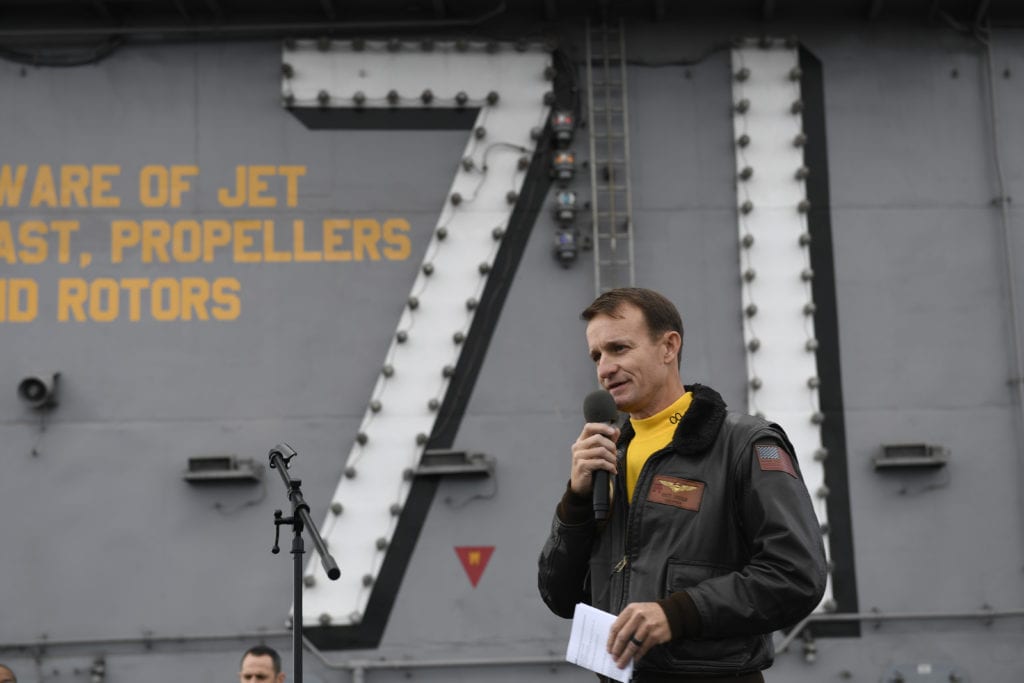
Capt. Brett Crozier, commanding officer of the aircraft carrier USS Theodore Roosevelt (CVN 71), addresses the crew during an all-hands call on the ship’s flight deck. Theodore Roosevelt is conducting routine operations in the Eastern Pacific Ocean. U.S. NAVY / Mass Communication Specialist 3rd Class Nicholas Huynh

ARLINGTON, Va. — Capt. Brett Crozier, the embattled former skipper of the first U.S. Navy warship to suffer a novel coronavirus outbreak at sea, will not be restored to command of the aircraft carrier USS Theodore Roosevelt, top Navy leaders announced June 19.

Chief of Naval Operations Adm. Mike Gilday and Navy Secretary Kenneth J. Braithwaite announced the decision at a Pentagon press briefing on the results of the USS Theodore Roosevelt Command Investigation, begun April 2, the day Crozier was fired. The investigation was conducted by Vice Chief of Naval Operations Adm. Robert Burke.

Gilday said he would not reassign Crozier as the commanding officer of the ship known as the TR, “nor will he be eligible for future command. Capt. Crozier will be reassigned.” Gilday also said the promotion of Crozier’s immediate superior, Rear Adm. Stuart Baker, the Theodore Roosevelt Carrier Strike Group commander, to a second star was being put on hold “pending further review.”

Braithwaite, who was sworn into office just three weeks ago, said he fully supported the report’s findings and recommendations and “I am satisfied that it was conducted in an extremely thorough and fair.”

Gilday conceded that he previously believed that Crozier should be reinstated after conducting an initial investigation following Crozier’s removal, but a wider investigation had a much deeper scope.

“It is my belief that both Admiral Baker and Capt. Crozier fell well short of what we expect of those  in command,” he said. “Had I known then what I know today, I would not have made that recommendation to reinstate Capt. Crozier. Moreover, if Capt. Crozier were still in command today, I would be relieving him,” Gilday added.

Crozier was relieved of command April 2 by then acting Navy Secretary Thomas B. Modly after a March 30 letter that Crozier wrote to top Navy officers and fellow naval aviators, pleading for faster intervention from his superiors to assist his crew, was leaked to a San Francisco newspaper.

In the letter, which was sent, unencrypted, via email, Crozier expressed alarm over the slow pace of disembarking his crew at Naval Base Guam while the coronavirus spread rapidly on the ship, also known as the TR. Publication of the letter in the San Francisco Chronicle sparked an outcry and worldwide media attention over Crozier’s actions and the fate of the carrier’s crew.

Eventually, 1,100 of the TR’s nearly 5,000 crewmembers, including Crozier himself, tested positive for COVID-19. Only a fraction required hospitalization, but one Sailor, Aviation Ordnanceman CPO Charles Thacker Jr., succumbed to the virus.

Crozier was hailed as a hero by his crew — who were seen on video cheering for him as he departed the ship in Guam — while others criticized him for circumventing the Navy’s chain of command. Modly said Crozier was not fired in retaliation for his letter but because the secretary had lost confidence in the captain’s leadership. Crozier, he said, had allowed the complexity of the COVID-19 challenge “to overwhelm his ability to act professionally, when acting professionally was what was needed.”

However, Modly complicated matters by flying to Guam, to defend his actions in an April 6 profanity laced address to the TR’s crew. Modly called Crozier “too naive or too stupid to be the commanding officer of a ship like this,” according transcripts of recordings of Modly’s remarks made by several of the carrier’s crew.

Less than 24 hours after the speech, Modly issued an apology to Crozier, the Roosevelt’s crew and the Navy, and offered his resignation to Defense Secretary Mark Esper, who accepted it.

Gilday directed Burke, the vice CNO, to investigate the circumstances and climate of the entire Pacific Fleet affecting the chain of command. Previously, Gilday spoke of “a potential comms breakdown, wherever it occurred,” adding “we’re not looking to shoot the messenger here, we want to get this right.”

The completed report was delivered April 24 to Modly’s replacement, acting Navy Secretary James McPherson, who directed Gilday to conduct a second investigation, saying he had “unanswered questions that the preliminary inquiry has identified and that can only be answered by a deeper review.”  

COVID-19 was detected on board the aircraft carrier in late March, 15 days after the TR made a port call to Da Nang, Vietnam, the Navy announced March 24. Stopping at Guam for a scheduled visit on March 27, Crozier began disembarking crewmembers as the number of Sailors testing positive continued to rise. Finding suitable accommodations for thousands of personnel on the island was a slow process.

In his letter, Crozier said the carrier had inadequate space to isolate or quarantine Sailors. “We are not at war. Sailors do not need to die,” Crozier wrote. “If we do not act now, we are failing to properly take care of our most trusted asset — our Sailors.”

Testing the entire crew for COVID-19 was completed in mid-May and they began returning to the carrier in waves after 14-days’ isolation and twice testing negative for the virus. Despite those efforts, at least 14 returning Sailors tested positive again for COVID-19. Following a bow-to-stern deep-cleaning process by about 700 crew members, and recertifying aviation activities for its Carrier Air Wing 11, the TR left Guam and resumed it mission on June 4.


HII Awarded $145 Million Advance Procurement Contract for Amphib LHA 9

An MV-22B Osprey lands in April aboard the amphibious assault ship USS America (LHA 6), the first of its class. Ingalls Shipbuilding has received another contract modification for long-lead-time material and advance procurement activities for the fourth ship of the America class, LHA 9. U.S. Navy/Mass Communication Specialist 3rd Class Jomark Almazan

PASCAGOULA, Miss. — Huntington Ingalls Industries’ Ingalls Shipbuilding division has received a third contract modification from the U.S. Navy for $145 million to provide long-lead-time material and advance procurement activities for amphibious assault ship LHA 9, the company announced in a release. This modification brings the total advance funding for LHA 9 to $350 million. 

“This advance procurement contract will help protect the health of our supplier base and strengthen our efforts to efficiently modernize the nation’s amphibious fleet as we continue to build amphibious ships for the Navy,” Ingalls Shipbuilding President Brian Cuccias said. 

Ingalls is the sole builder of large-deck amphibious ships for the Navy. The shipyard delivered its first amphibious assault ship, the Iwo Jima-class USS Tripoli (LPH 10), in 1966. Ingalls has since built five Tarawa-class (LHA 1) ships, eight Wasp-class (LHD 1) ships and the first in a new class of amphibious assault ships, America (LHA 6), in 2014. The second ship in that class, the Tripoli (LHA 7), was delivered to the Navy earlier this year. Bougainville (LHA 8) is under construction. 


Block III Super Hornets Headed for Navy Flight Tests

F/A-18 Block III flight test aircraft F287 makes its first flight in May. Boeing has delivered the first two Block IIIs to the U.S. Navy. Boeing

ARLINGTON, Va. — Boeing has delivered the first two Block III Super Hornet strike fighters to the U.S. Navy. The aircraft, an F/A-18E and two-seat F/A-18F, will go through comprehensive testing by Navy air test and evaluation (VX) squadrons over the next year.  

VX-23 at Naval Air Station Patuxent River, Maryland, will receive the F/A-18F (the 287th built) aircraft for “shore-based carrier testing” and will be used for testing of hardware and aeromechanical aspects, the Program Executive Office-Tactical Aircraft (PEO(T)) said in a June 17 release. 

Once that testing is completed, the F/A-18F will go to VX-31 at Naval Air Weapons Station China Lake, California, to complete Bock III testing. The F/A-18E (the 323rd built) will go to VX-31 for software functionality and network architecture testing. 

The Block III Super Hornet features several major structural and mission system improvements over the Block II, Jennifer Tebo, Boeing’s director of development for F/A-18E/F & EA-18G Programs, said in a June 17 teleconference with media.  

The Advanced Cockpit System includes replacement of a set of displays with a single large touch-screen display for improved user interface and display of the Common Tactical Picture, the PEO said. 

The Advanced Network Infrastructure will have 17 times the computing power of the mission computer of the Block II through the Distributed Targeting Processor Network and Tactical Targeting Network Technology (TTNT). 

Tebo described the TTNT as a “big data pipe — low latency, high-data” for better situational awareness. The infrastructure will be open to accept third-party applications for “speed to the fleet with urgent needs,” she said. 

The Block III Super Hornets will feature an improved radar cross section for better survivability. 

The most distinguishable characteristic of the Block III is the addition of streamlined, low-drag conformal fuel tanks to the upper wing and fuselage junctions. These will be optional for use and will enable the Super Hornet to carry 3,500 pounds more fuel, reducing the need for underwing external fuel tanks and freeing up the pylons to carry more weapons. 

When delivered, each Block III will have a service life of 10,000 flight hours, far more than the 6,000 hours of a Block II strike fighter. 

“In addition to the Block III delivery, Boeing will also perform service life modification (SLM) to hundreds of Block II Super Hornets, to extend their service life and integrate Block III capabilities,” the PEO said. “SLM is key to building the capacity and capability to ensure the Navy has jets ready to fight into the mid-2040s.” 

Tebo said the SLM will extend the life of Block IIs to 10,000 hours and that deliveries of Block IIIs converted from Block IIs will begin in 2023 and continue into the mid-2030s. 

Tebo said the Block III Super Hornet made its first flight on May 14. Delivery of 78 full-up production Block IIIs is planned to begin in mid-2021 at a rate of two per month through early 2024. 

“The first squadron deployment of Block III Super Hornet is anticipated in mid-2023, with a plan in place to have two Block III squadrons, composed of new production and Block IIs that have undergone SLM, accompanying each carrier air wing by 2027,” the PEO said in the release. 

“Now it’s up to our test squadrons and our integration team to verify requirements are met and ensure the engineering behind the Block III is validated prior to full-scale production and delivery of the Block III to the fleet,” Capt. Mike Burks, F/A-18 E/F deputy program manager, said in the release. 

“These new capabilities are essential for ensuring we maintain the tactical advantage in the Great Power Competition,” Capt. Jason Denney, the Navy’s F/A-18 & EA-1G Program Manager, said in the release. “Block III production and SLM for our Block IIs also demonstrate contracting efficiency and solid partnerships with industry — an all-around win for the Navy, for Boeing, and for the warfighter.”