ATI, NAC Partner with Naval Surface Warfare Center Indian Head to Tackle Energetics Challenges
SUMMERVILLE, S.C. – Advanced Technology International (ATI), in partnership with the National Armaments Consortium (NAC), has signed an agreement to develop the Naval Energetic Systems and Technologies (NEST) Program. The NEST Program is a collaboration executed under an Other Transaction Agreement (OTA) with the Naval Surface Warfare Center Indian Head Division (NSWC IHD) to address the most significant energetics-related challenges facing the Navy and Marine Corps.
This effort is critical in enabling the Navy, Marine Corps and the entire Department of Defense to address current and future threats in the surface, subsurface, air, ground, littoral and expeditionary environments. The partner organizations will foster a collaboration among the engineers, researchers, and technologists at NSWC IHD and NAC’s 900+ members from industry and academia. The OTA has a term of six years with a four-year option.
“ATI is delighted to continue its longstanding partnership with the National Armaments Consortium in executing this important Naval Energetics Systems and Technologies Program,” said Chris Van Metre, CEO and president of ATI. “NAC members have a proven history of delivering innovative energetics technology solutions and eagerly anticipate the opportunity to continuing doing so in support of NSWC IHD.”
“The NAC is honored to partner with ATI and the Naval Surface Warfare Center Indian Head Division to develop a collaborative partnership focused on solving the biggest energetics challenges facing our nation,” said Charlie Zisette, NAC executive director. “Our members look forward to working with the incredible workforce at Indian Head to accelerate the development, adoption, and deployment of energetics-related technologies to provide our warfighters the decisive edge on the battlefield.”
The NSWC IHD is the Navy’s premier organization for ordnance, energetics and explosive ordnance disposal (EOD) solutions. Its workforce provides energetics R&D, manufacturing technology, engineering, testing, manufacturing and fleet support. Energetics are used in propulsion systems and ordnance, and include explosives, propellants, pyrotechnics, reactive materials, related chemicals and fuels.
NSWC IHD’s capabilities address all aspects of the energetics technical discipline including basic research, applied technology, technology demonstration and prototyping, engineering development, acquisition, low-rate production, in-service engineering/mishaps, failure investigations, surveillance, EOD technology/information and demilitarization.
General Dynamics Delivers First Knifefish Surface MCM UUV to U.S. Navy
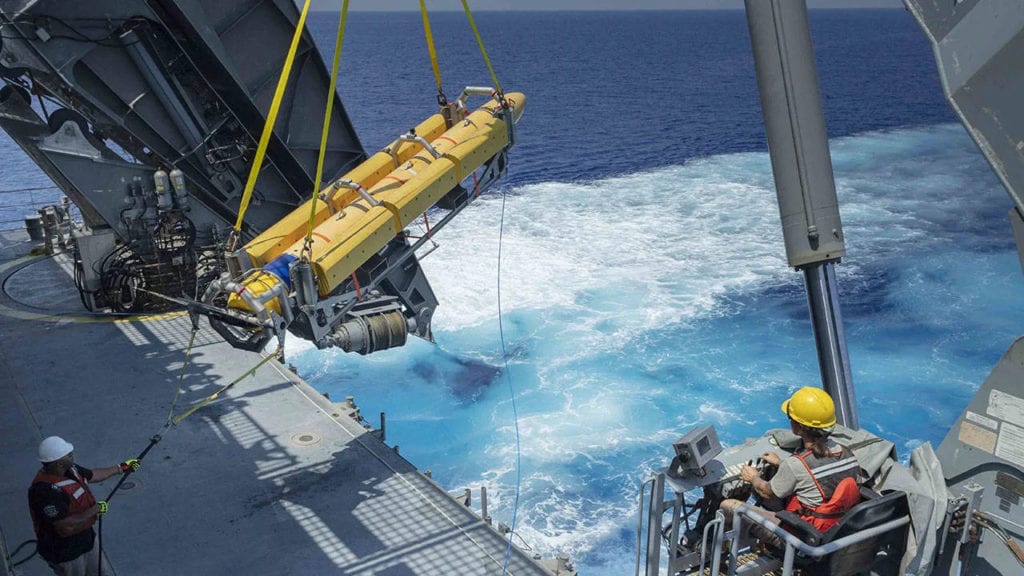
The first Knifefish surface mine countermeasure UUV system has been delivered to U.S. Navy six months after final acceptance tests were completed. General Dynamics Mission Systems
QUINCY, Mass. – General Dynamics Mission Systems recently delivered the first Knifefish surface mine countermeasure unmanned underwater vehicle (UUV) system under a contract awarded by the U.S. Navy on Aug. 26, 2019, the company said in a March 18 release.
The contract, awarded immediately after a successful Milestone C decision and approval to enter low-rate initial production, calls for the procurement of five Knifefish systems (10 total UUVs) and support equipment.
Knifefish is a medium class mine countermeasure UUV intended for deployment from the Navy’s littoral combat ship and other Navy vessels of opportunity. Knifefish will reduce risk to personnel by operating within minefields as an off-board sensor while the host ship stays outside the minefield boundaries.
“Together with the U.S. Navy’s Program Executive Office for Unmanned and Small Combatants, our Knifefish team has worked to deliver critical mine countermeasure mission capabilities to protect our Sailors,” said Carlo Zaffanella, vice president and general manager at General Dynamics Mission Systems. “We designed Knifefish using an open architecture concept that can be quickly and efficiently modified to accommodate a wide range of missions.”
General Dynamics Mission Systems is the prime contractor for the Knifefish program. The company designed the tactical UUV using an open architecture concept that can be quickly and efficiently modified to accommodate a wide range of missions. The Knifefish SMCM UUV is based on the General Dynamics Bluefin Robotics Bluefin-21 deep-water autonomous undersea vehicle.
Navy’s Future Carrier Air Wing Could Reach 40% Unmanned Aircraft, Use Manned/Unmanned Teaming, Admiral Says
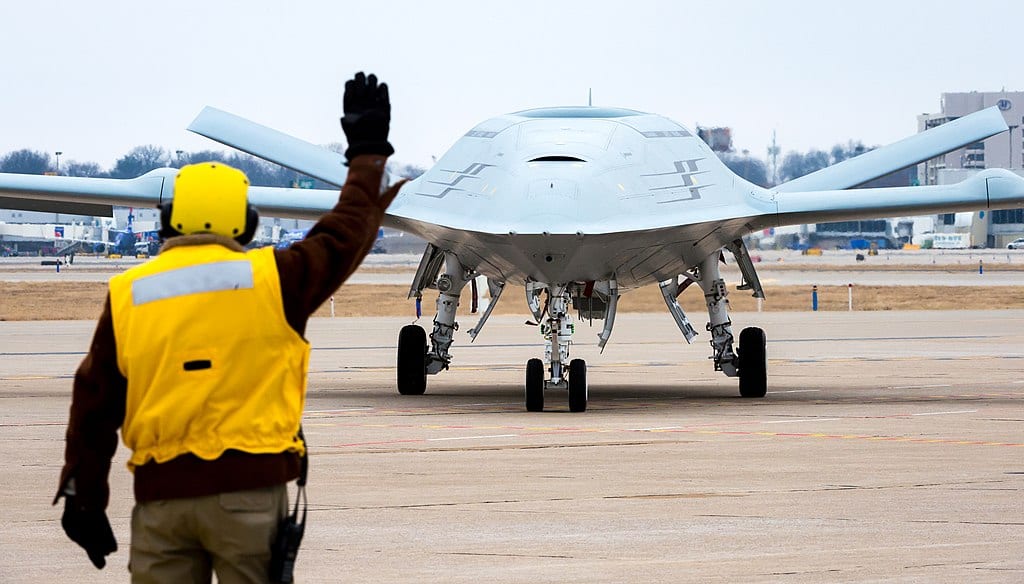
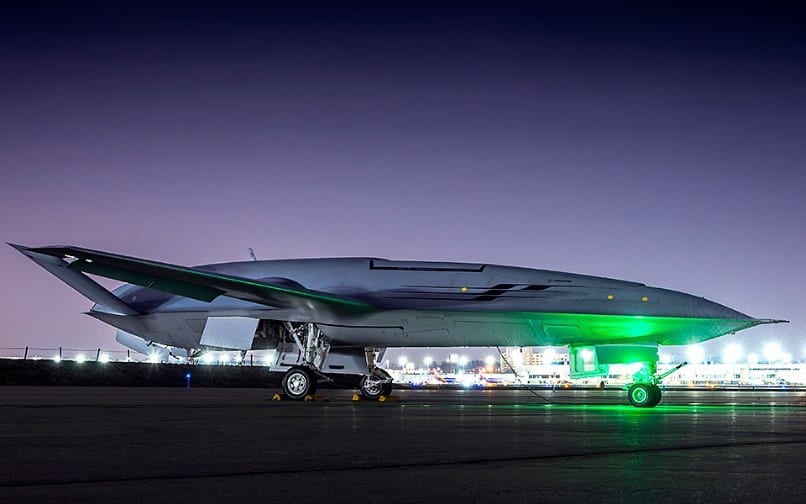
Boeing conducts MQ-25 deck handling demonstration at its facility in St. Louis, Missouri, in 2018. U.S. Navy / Boeing
ARLINGTON, Va. — The Navy’s forthcoming fielding of its first carrier-based unmanned aircraft could presage a much larger UAS presence in the future carrier air wing, a senior admiral said, and may include manned/unmanned teaming.
The MQ-25A Stingray UAS now being tested by Boeing and the Navy is designed to be a tanker for aerial refueling of other carrier-based aircraft such as the F-35C Lightning II and F/A-18E/F Super Hornet strike fighters; EA-18G Growler electronic attach aircraft; E-2D Advanced Hawkeye battle management aircraft; and CMV-22B Osprey carrier on-board delivery aircraft.
“The MQ-25 has great promise for us,” said Vice Adm. James Kilby, deputy chief of naval operations for Warfighting Requirements and Capabilities, testifying March 18 before the Seapower and Projection Forces Subcommittee of the House Armed Services Committee. “Our initial focus is to introduce this platform and get it introduced into the air wing where it can serve its role initially in tanking and limited ISR [intelligence, surveillance and reconnaissance]. But what we are focusing on is launching, landing, moving it around on the deck, bringing it up, taking it down to the hangar bay, how do we position those assets, how can we support the air wing.
“So, step one: get the fighters out of the business of refueling fighters and use the MQ-25 to do that, initially close aboard the carrier but eventually at range,” Kilby said. “But there is some payload capacity in that vehicle that we think has great promise for us. So, I think initially we would transition to ISR but in an air wing of the future view … we think we could get upwards of 40% of the aircraft in an air wing that are unmanned and then transition beyond that.”
Kilby said the logical step would be, “crawl, walk run, figure how to handle it within the air wing, let’s move to ISR, maybe electronic attack, strike, and then other things as complexity grows across that mission set. The MQ-25 most certainly will provide promise to us because perhaps it would exceed the endurance of a maned aircraft.”
The admiral pointed out that while there will be a control center on each aircraft carrier for unmanned aircraft, the Navy’s aspiration is for manned unmanned teaming in the future so that manned aircraft could control unmanned aircraft.
Navy’s Orca XLUUV to Have Mine-Laying Mission, Adm. Kilby says
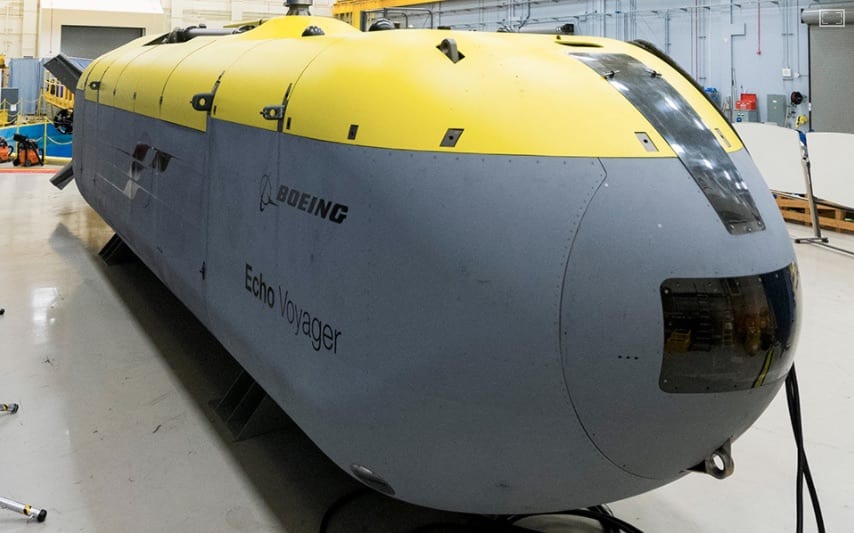
Boeing’s Echo Voyager, forerunner of the Orca extra-large unmanned underwater vehicle, or XLUUV. Boeing
ARLINGTON, Va. — The Navy is planning on mine laying as the initial mission for the Orca extra-large unmanned underwater vehicle (XLUUV), a Navy official said.
“The XLUUV is a migration from the Echo Voyager from Boeing, with a mission module placed in the middle of it, to initially carry mines,” said Vice Adm. James Kilby, deputy chief of naval operations for Warfighting Requirements and Capabilities, testifying March 18 before the Seapower and Projection Forces Subcommittee of the House Armed Services Committee. “We are pursuing that vehicle because we have operational needs from a combatant commander to go solve this specific problem.”
The Orca, five of which are being built by Boeing, will be an open-architecture, reconfigurable UUV that will be modular in construction and have a modular payload bay. The XLUUV core vehicle will provide guidance and control, navigation, autonomy, situational awareness, core communications, power distribution, energy and power, propulsion and maneuvering, and mission sensors. The length will be greater than 80 feet. The Orca, too large to be carried by a submarine, will be pier-launched.
“We need to get that initial prototype built and start employing it to see if we can achieve the requirements to do that mission set,” Kilby said. “If we can’t meet our milestones, we need to critically look at that and decide if we have to pursue another model or methodology to get after that combatant need. In the case of the XLUUV, we haven’t even had enough run time of that vessel to make that determination yet. Certainly, there [are] challenges with that vehicle.”
The Navy is developing new types of mines: the cylindrical-shaped Clandestine Delivered Mine and the Hammerhead, an encapsulated torpedo designed to lie in wait for submarines. The capsule for the torpedo would be anchored to the ocean floor, much like the Mk60 CAPTOR mine of Cold War vintage that housed a Mk46 antisubmarine torpedo. (The CAPTOR was withdrawn from the Navy’s inventory in 2001.) The Hammerhead is designed to have modular architecture to allow for technology insertion.
Panel Examines Strategic Balance: Is the Navy You Have the Navy You Need?
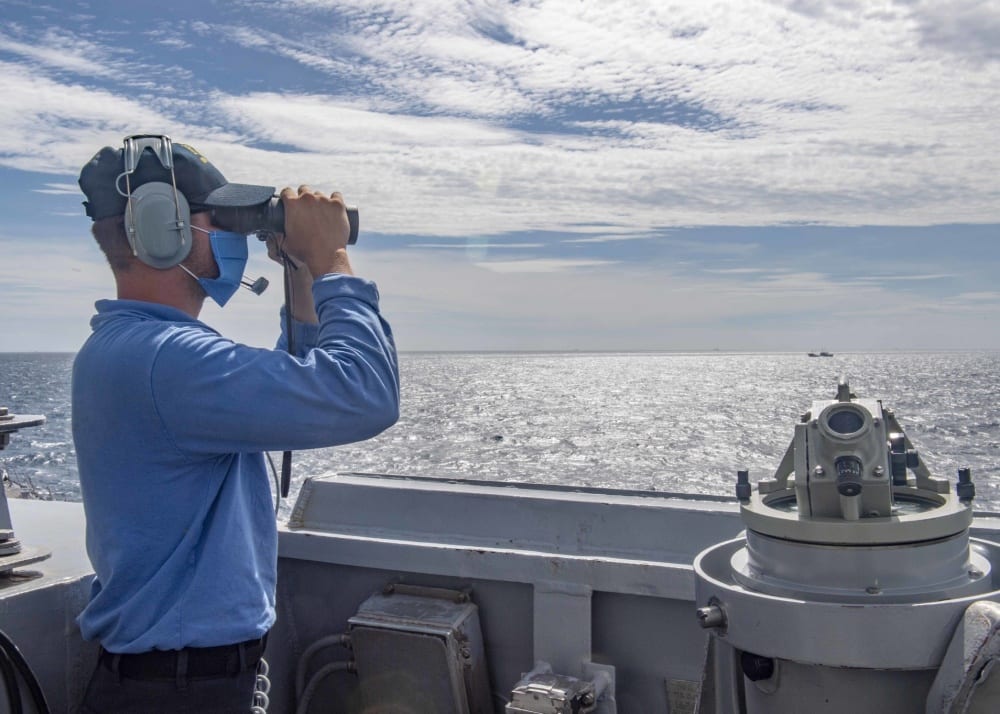
Seaman Zachery Douglas, from Dansville, New York, looks through binoculars on the bridge as the Arleigh Burke-class guided-missile destroyer USS Mustin (DDG 89) conducts routine operations in the Taiwan Strait. Mustin is forward-deployed to the U.S. 7th Fleet area of operations in support of security and stability in the Indo-Pacific region. U.S. Navy / Mass Communication Specialist 3rd Class Cody Beam
A March 16 webinar on “Maritime Competition and the Maritime Strategy,” hosted by the Center for Strategic and Budgetary Assessments examined several recently published papers dealing with maritime strategy, the role of the U.S. Navy and the composition of peacetime and wartime fleets in the current era of great power competition.
The virtual forum featured leading international security scholars, each of whom has contributed to a recent special issue of the journal Security Studies (Volume 29, Issue 4), as well as several companion pieces from a recent series published by War On The Rocksentitled Maritime Strategy on the Rocks.
The discussion was moderated by Evan Braden Montgomery, CSBA’s director of research and studies, who was also one of the authors in the collection. He was joined by panel of experts, including Jonathan Caverley, professor of strategy at the U.S. Naval War College; Fiona Cunningham, assistant professor of political science and international affairs at George Washington University; Peter Dombrowski, professor of strategy at the U.S. Naval War College; Erik Gartzke, professor of political science at the University of California at San Diego; Jon Lindsay, assistant professor at the University of Toronto; Paul van Hooft, senior strategic analyst at the Hague Center for Strategic Studies; and Sara McLaughlin Mitchell, professor of political science at the University of Iowa.
Also participating was Dr. Doyle Hodges, executive editor of Texas National Security Review, who served as curator and editor of the series.
The papers focused on the Indo-Asia-Pacific region, which is primarily a maritime theater. The authors looked at how naval officers and scholars think about the INDO-PACOM maritime domain, and noted that they often viewed things quite differently.
The authors commented on the new tri-service strategy, and the distinct strength that of each of the three sea services bring to the security calculus. They also noted the U.S. is basically providing presence far from home, while China is essentially defending what it perceive as its home waters. As such, the U.S. cannot face China alone and requires commitments from allies and partners in the region. In the Taiwan scenarios, however, the authors debated whether other countries would join the U.S. in coming to the aid of Taiwan if China were to invade.
Beyond simple territorial disputes, the authors examined various triggers and thresholds that have led to armed conflict in the past, including resources like fisheries and oil and gas.
The panelists debated the right mix of ships in the Navy fleet, and the relative merits of highly visible platforms as a form of deterrence, like carrier strike groups, and those less visibly but perhaps more potent, like ballistic missile submarines.
There may be reluctance to take the risk of fully committing very expensive platforms. Less expensive platforms are more affordable and can be built in larger quantities, but the ships need to be credible. Furthermore, ships that are good at fighting might not be so good at preventing combat, or performing missions short of combat.
The panelists talked about how China’s strength exactly targets U.S. weaknesses, and that the U.S. today must go to greater lengths to be reassuring to allies and a deterrence to adversaries.
Navy MQ-25A Basing Assessment Finds No Significant Environmental Impact
The MQ-25A Stingray carrier-based unmanned aircraft system, which will be home based at Naval Base Ventura County, Point Mugu, California. Boeing
ARLINGTON, Va. — The Navy has released a final environmental assessment (EA) and Finding of No Significant Impact for home-basing the MQ-25A Stingray carrier-based unmanned aircraft system at Naval Base Ventura County, Point Mugu, California, the Navy said in a March 17 release.
The proposed action is to establish facilities and functions at NBVC Point Mugu to support home basing and operations of the MQ-25A Stingray. Under the proposed action, the Navy would home base 20 Stingray systems, construct a hangar, training facilities, and supporting infrastructure, perform air vehicle maintenance, provide training for operators and maintainers, conduct approximately 960 Stingray annual flight operations and station about 730 personnel, plus their family members.
The Stingray will enhance aircraft carrier capability and versatility through the integration of a persistent, sea-based, multi-mission aerial refueling and intelligence, surveillance, and reconnaissance UAS into the carrier air wing, the Navy said. The Stingray will extend the range and reach of carrier air wings on the West Coast to meet current and future threats and enhance refueling and intelligence, surveillance, and reconnaissance capabilities in support of national defense objectives and policies.
Based on analysis presented in the environmental assessment, which has been prepared in accordance with the requirements of the National Environmental Policy Act, and in consultation with the U.S. Fish and Wildlife Service and California Coastal Commission, the Navy finds implementation of the proposed action will not significantly impact the quality of the human environment. Therefore, an environmental impact statement is not required.
The assessment prepared by the Navy is on file and interested parties may obtain a copy by downloading it from the project website: https://www.nepa.navy.mil/stingray.
Italian Navy Commissions New Logistics Support Ship
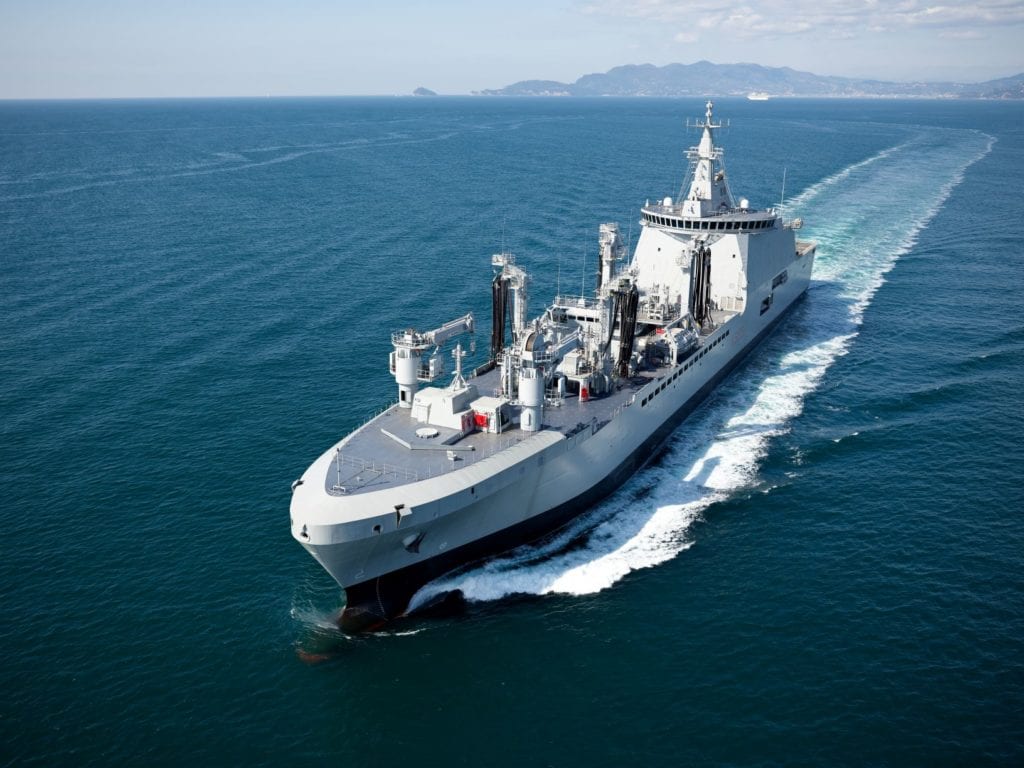
The Italian navy’s newest logistics support ship, the ITS Vulcano. Fincantieri S.p.A.
The Italian navy commissioned its newest logistics support ship (LSS), the ITS Vulcano (A5335) at a ceremony at the Fincantieri Naval Integrated shipyard in Muggiano, Italy.
The 633-foot (193 meter), 27,200-ton LSS can replenish a surface ship task group and transfer cargo to other auxiliary vessels, including diesel fuel, jet fuel, fresh water (including the ability to produce fresh water), spare parts, food and ammunitions, as well as perform maintenance and repairs at sea repairs for other vessels with integrated maintenance workshops. Vulcan replaces ITS Stromboli, and carries significantly more fuel and JP5.
The ship has a crew of 235, including troops, special teams and medical personnel. The LSS has can carry eight 20-foot container living modules or other modular units.
According to a statement from Fincantieri, the LSS is a dual-use vessel, meaning it can be used for traditional replenishment of underway naval forces with four alongside refueling rigs and one astern refueling station, or support humanitarian assistance, disaster relief and other civil purposes. Vulcano’s hospital is equipped with surgical rooms, radiology and analysis rooms, a dental facility, and hospital beds for up to 17 seriously injured patients as well as an additional eight patients in the clinic area.
The statement also says the LSS has a reduced environmental impact thanks to a state-of-the-art CODLAD propulsion system which generates lower levels of pollution emissions. The ship can shift between a high-powered diesel for speeds up to approximately of about 20 knots, and electric motors using diesel generators for slower speeds (around 10 knots).
Vulcano was fabricated in three different Fincantieri yards. The forward section of the vessel was built at Castellammare di Stabia Shipyard in Naples, while the aft section was built in the Riva Trigoso shipyard. The sections were assembled at the yard in Muggiano, near La Spezia, where the ship underwent harbor and sea trials for final delivery.
The Vulcano project is the basis of the “Flotte Logistique” program, which includes the construction of four LSS for the French navy through an Italo-French consortium between Chantiers de l’Atlantique and Naval Group under the Italian-French LSS program led by OCCAR, the Organisation for Joint Armament Cooperation. The construction of the forward sections of these ships has been commissioned to Fincantieri, which last month has laid the keel of the first vessel at its shipyard in Castellammare di Stabia in Naples.
In addition to the LSS, the Fincantieri’s Muggiano shipyard is also building the Landing Helicopter Dock Trieste, due to be delivered next year, as well as seven Multipurpose Offshore Patrol Ships, which will begin entering the fleet beginning this year.
Coast Guard Cutter Douglas Munro Returns Home from Final patrol
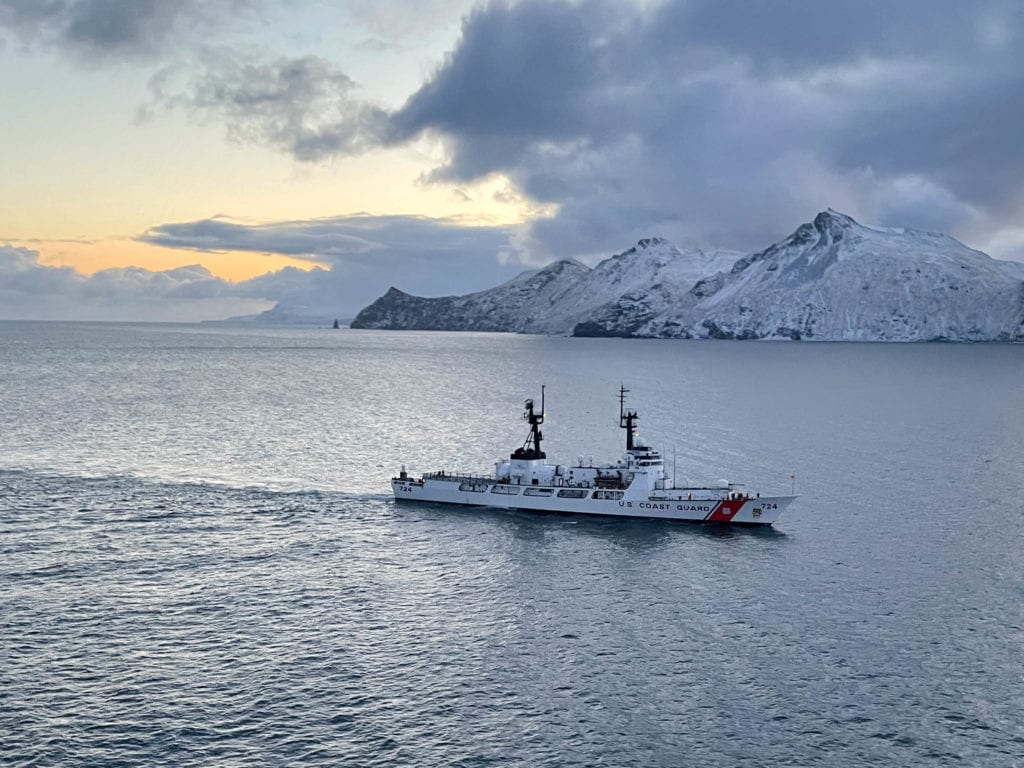
The Coast Guard Cutter Douglas Munro (WHEC 724) is pictured during their last Bering Sea patrol, in which the crew conducted boarding evolutions of the fishing fleet and were available to respond to search and rescue cases in March 2021. The Douglas Munro is the last operational 378-foot Secretary class cutter and will officially be decommissioned on April 24, 2021. U.S. Coast Guard courtesy photo.
KODIAK, Alaska — The crew aboard Coast Guard Cutter Douglas Munro, the service’s last operational 378-foot, high endurance cutter, returned home to Kodiak, Alaska, on March 13, following a 49-day deployment in the Bering Sea, the Coast Guard 17th District said in a March 17 release.
While deployed, the crew of the Douglas Munro and its embarked MH-65 helicopter aviation detachment from Air Station Kodiak safeguarded the $13.9 billion Alaskan fishing industry and provided search and rescue coverage in an area spanning 890,000 square miles. The crew conducted multiple fisheries boardings, ensuring compliance with commercial fishing vessel regulations that ensure crew safety and the sustainability of fish stocks.
In addition to the operational challenges the crew faced in the Bering Sea, the COVID-19 pandemic required the crew to abide by strict health protection precautions and COVID testing regimens prior to the start of their deployment. While making a logistics stop in Dutch Harbor the crew received their first doses of the COVID-19 vaccinations.
“This has been an extremely exciting and rewarding patrol as it is the end of an era for not only this cutter, but also for all the 378s that have served the Coast Guard since 1967,” said Capt. Riley Gatewood, the Douglas Munro’s commanding officer. “The legacy of Signalman First Class Douglas Munro lives on due to the hard work put forth by the many crew members who spent time away from loved ones to accomplish Coast Guard missions aboard Douglas Munro. It is a great honor and privilege to serve as Commanding Officer of the Coast Guard’s last 378-foot, high endurance cutter.”
Commissioned Sept. 27, 1971, Douglas Munro was named in honor of Signalman First Class Douglas A. Munro, the U.S. Coast Guard’s only Medal of Honor recipient, killed during the Guadalcanal Campaign of World War II on that same date in 1942. The ship is scheduled to be decommissioned later this year. Douglas Munro’s legacy will continue with the National Security Class Cutter, Coast Guard Cutter Munro, homeported in Alameda, California.
Adding to the Fleet: Navy Evolves to Counter Changing Threats
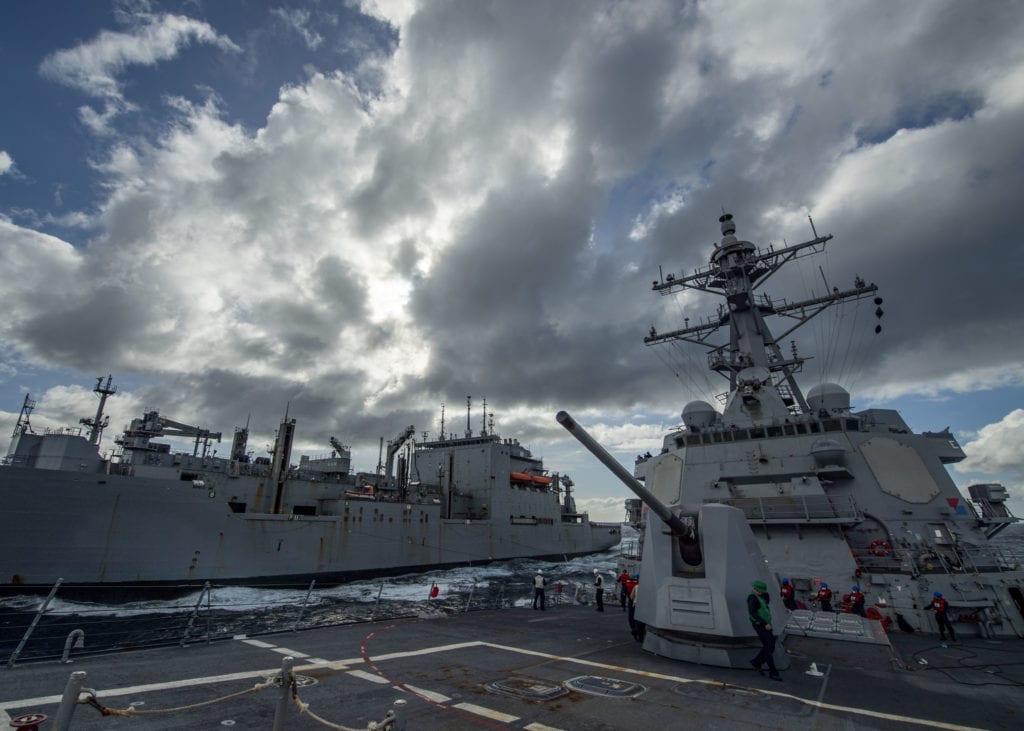
The Arleigh Burke-class guided-missile destroyer USS John Finn (DDG 113), front, transits alongside the Military Sealift Command dry cargo and ammunition ship USNS Matthew Perry (T-AKE 9) during a replenishment-at-sea Feb. 4, 2021. John Finn is on a scheduled deployment to the U.S. 7th Fleet area of operations. As the U.S. Navy’s largest forward deployed fleet, with its approximate 50-70 ships and submarines, 140 aircraft, and 20,000 Sailors in the area of operations at any given time, 7th Fleet conducts forward-deployed naval operations in support of U.S. national interests throughout a free and open Indo-Pacific area of operations. U.S. Navy/ Mass Communication Specialist 3rd Class Jason Waite
Last December, then-Navy Secretary Kenneth J. Braithwaite announced plans to bring back the U.S. Atlantic Fleet in a name change that was a deliberate message to the world — in particular the near-peer competitor nations of Russia and China as well as U.S allies — that the Atlantic Ocean and Arctic region were no longer quiet naval backwaters but areas of intense U.S. geopolitical focus.
The previous month, Braithwaite also announced plans to establish another numbered fleet for the Navy — the U.S. 1st Fleet — adding it to the seven other numbered fleets that are the main operational arms of the U.S. Navy. The service, which waged the Cold War with only four numbered fleets, has added three numbered fleets since then.
Chief of Naval Operations Adm. Mike Gilday said on Jan. 11 in a webinar of the Surface Navy Association convention that then-President Donald Trump signed off on Braithwaite’s proposed redesignation of U.S. Fleet Forces Command as the U.S. Atlantic Fleet. A timetable for the change has not been announced, but Fleet Forces Commander Adm. Chris Grady is “putting together an implementation plan for my review,” Gilday said.
Venerable Pedigree
The original U.S. Atlantic Fleet has a long pedigree that began in 1906, when the North Atlantic Squadron and South Atlantic Squadron were combined. The fleet existed in various forms until 2006, when the chief of naval operations renamed commander, U.S. Atlantic Fleet, to commander, U.S. Fleet Forces Command, which assumed the duties of the former fleet plus the mission of the former commander, Fleet Forces Command, which was “to serve as the primary advocate for fleet personnel, training, requirements, maintenance and operations issues,” according to the Fleet Forces Command website.
Sailors who had served in both Atlantic and Pacific Fleets often expressed the notion that the two fleets were like two different navies in their policies, traditions and the way they operated. The role of Fleet Forces Command in part was to standardize administration, manning, training and equipping across the entire U.S. fleet.
The move to the return of the Atlantic Fleet moniker was deliberate. Braithwaite announced the redesignation plan Dec. 2 during testimony before the Senate Armed Services Committee’s Readiness and Management Support sub- committee, noting the changing world requires the Navy to evolve to meet the threat.
“Our existing structure operates on the premise that we still live in a post-9/11 state, where NATO’s flanks are secure, the Russian fleet is tied to the pier and terrorism is our biggest problem,” Braithwaite said. “That is not the world of today. As the world changes, we must be bold, evolved and change with it. Instead of perpetuating a structure designed to support Joint Forces Command, we are aligning to today’s threat.
“To meet the maritime challenges of the Atlantic theater, we will rename Fleet Forces Command as the U.S. Atlantic Fleet and will refocus our naval forces in this important region on their original mission, to controlling the maritime approaches to the United States and those of our allies. The Atlantic Fleet will confront the re-assertive Russian navy, which has been deploying closer and closer to our East Coast with a tailored maritime presence, capability and lethality,” Braithwaite said.
“It underscores the importance of the Atlantic in a way that the title ‘Fleet Forces’ doesn’t,” Gilday said. “It actually is a testament to recent tangible decisions that we made to increase our power in that body of water, to include bringing 2nd Fleet back, standing up SubGru 2 [Submarine Group Two]. It will also include standing up [NATO’s] Joint Force Command Norfolk, which is focused on the Atlantic. In a day and age when the homeland is no longer a sanctuary and homeland defense is at the fore of every plan the combatant commanders have put together, the name ‘Atlantic Fleet’ always carries some gravitas with respect to defense of the nation.”
He noted the complexity of the redesignation, saying the command “also has responsibilities as a component [command] for [U.S.] Northern Command and the Eastern Pacific that extend up to the Arctic as well as their role as component of the [U.S] Strategic Command. They really have a global responsibility with respect to the command and control of our SSBNs [ballistic-missile submarines].”
Grady seconded the complexity in a Jan. 13 webinar at the convention, noting the “downside “might be that we would lose emphasis on what we do for the homeland.
Indeed, I control forces in both the Pacific and down south [in U.S. Southern Command area of responsibility]. So, we will balance all that, and in the end the name change is an important branding opportunity, and we will move out on that.”
“We are walking through this very methodically and deliberately before we finally execute,” Gilday said.
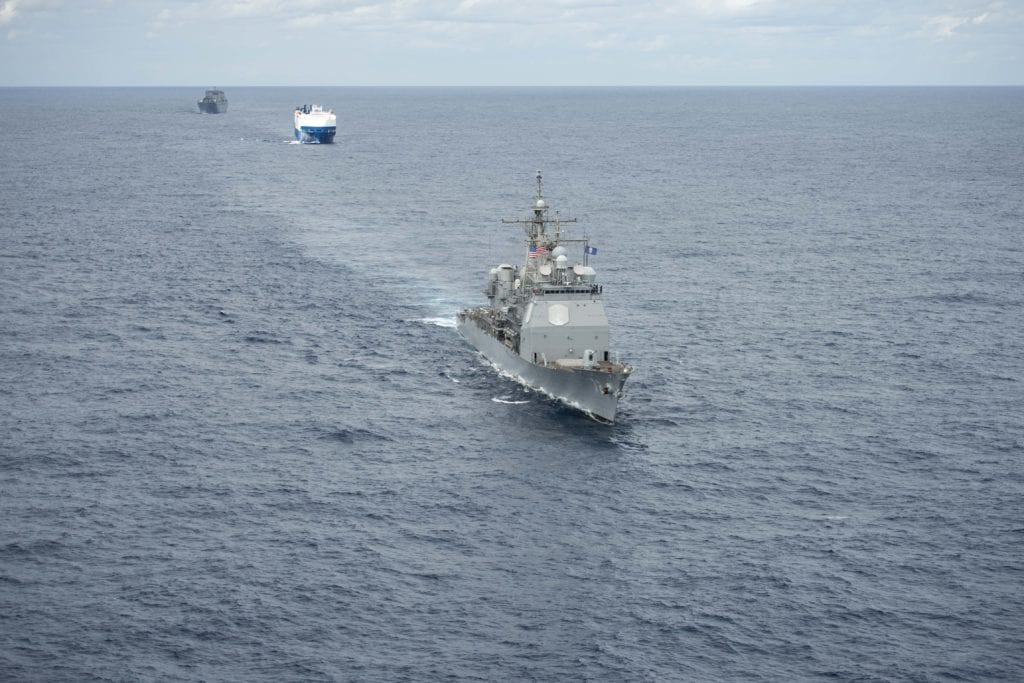
A convoy of the Ticonderoga-class guided-missile cruiser USS Vella Gulf (CG 72), right, MV Resolve, center, and USNS Benavidez (T-AKR 306), part of the 2nd Fleet, steam in formation in this 2020 photo. U.S. Navy / Mass Communication Specialist 3rd Class Andrew Waters
U.S. 1st Fleet Returning?
Braithwaite, noting the increasing Chinese hegemony in the South China Sea, the increasingly close relationship of the U.S. Navy to the Indian navy and the expanse of ocean covered by the Japan-based U.S. 7th Fleet, proposed a new fleet to cover Southeast Asia and the Indian Ocean, an area of extensive shipping traffic vital to world commerce.
“If we’re really going to have an INDOPACOM [U.S. Indo-Pacific Command] footprint, we can’t just rely on the 7th Fleet in Japan,” Braithwaite said during a Nov. 17 to webinar of the annual symposium of the Naval Submarine League. “We have to look to our other allies and partners like Singapore, like India, and actually put a numbered fleet where it would be extremely relevant if, God forbid, we were to get in any kind of a dust-up.”
Braithwaite proposed the new fleet be designated the U.S. 1st Fleet, a resurrection of a fleet staff which formerly was based in San Diego and disestablished in 1973 when the U.S. 3rd Fleet was established in Hawaii. (The 3rd Fleet headquarters later was moved to San Diego.)
He mentioned Singapore as a possible site for a headquarters for the U.S. 1st Fleet. The Navy has a logistics group staged there and has forward-deployed littoral combat ships to the base. As an alternative, the 1st Fleet staff could be “more expeditionary oriented and move it across the Pacific until it is where our allies and partners see that it could best assist them as well as assist us.”
“The establishment of 1st Fleet is still in development,” said Capt. Jereal Dorsey, special assistant for Public Affairs for the secretary of the Navy, in a Jan. 29 statement to Seapower.
“Establishing a new fleet dedicated to the Indian Ocean is a good idea,” said Bryan Clark, a senior fellow at the Hudson Institute. “India is a longtime maritime power that is modernizing its fleet and growing its cooperation with the U.S. Navy and the rest of the ‘Quad’ [Japan, Australia, United Stated, India]. A key question for the Navy to address is the area of responsibility for 1st Fleet. Incorporating East and South Africa in 1st Fleet rather than Naval Forces Europe and 6th Fleet, as they are today, would be a good idea because in many cases these countries have stronger ties to Asian countries than to Europe.
“I think including Australia or Southeast Asian nations under 1st Fleet would, in general, be disadvantageous because of the numerous maritime cooperation initiatives underway between these navies and those of the United States and Japan. However, the fleet has to be based some- where, so Myanmar, Singapore, and Malaysia could be included in 1st Fleet if the fleet were based in Singapore.
“The more important issue is whether 1st Fleet will have a substantial naval presence or any permanently assigned ships. Every other fleet has both. Adding a 1st Fleet but then only deploying forces to it in transit or for exercises may defeat the purpose of having a dedicated staff focused on the region. When the LCS [littoral combat ship] is ready for more sustained deployments, the Navy could implement the rotational crewing concept it intended in Singapore, providing assigned ships to 1st Fleet that would change out every year to 18 months. To increase presence, DoD [Department of Defense] could adjust its Central Command footprint to use locally based air, ground, and naval forces to deter Iran and allow other ships to deploy more broadly throughout the Indian Ocean.”
Changing Realities
The expansion of numbered fleets since the Cold War may seem counterintuitive with the much-shrunken size of the U.S. fleet since 1991, now roughly half the size in terms of numbers of ships. During the Cold War, the 1st and later the 3rd Fleet covered the Eastern Pacific, including the antisubmarine patrols to counter the patrolling Soviet ballistic-missile submarines off the U.S. West Coast. The 7th Fleet covered the Western Pacific and Indian Oceans. The 6th Fleet patrolled the Mediterranean. The 2nd Fleet covered the North Atlantic Ocean.
Since the end of the Cold War, the Navy has disestablished and reestablished the 2nd Fleet and has reestablished the 4th, 5th and 10th Fleets, dormant since the early post- World War II period, to adjust to changing geopolitical realities. The 5th Fleet was established to replace the Middle Eastern Force in the Persian Gulf in July 1995 in recognition of the increased need for forces in the volatile Gulf, Southwest Asia and the North Arabian Sea, and became the naval component of U.S. Central Command. The 4th Fleet was reestablished in July 2008, to serve as the naval component of U.S. Southern Command, to operate in the Caribbean Sea, and in Central and South America.
The 10th Fleet, which in World War II oversaw the campaign against German U-boats in the Battle of the Atlantic, was reestablished in July 2010 as the operational arm of Fleet Cyber Command. It commands no ships but oversees the operations of the cyber teams and other units for information warfare operations, including cyberwarfare and signals intelligence collection.
During September 2011, the 2nd Fleet was disestablished in recognition of the reduction of threats in the North Atlantic in the post-Cold War era. But with the resurgence of Russia and in particular its submarine forces, the 2nd Fleet was reestablished in August 2018.
Seapower correspondent John Doyle contributed to this report.
Cutter Valiant Returns Home after 26-Day Law-Enforcement Patrol
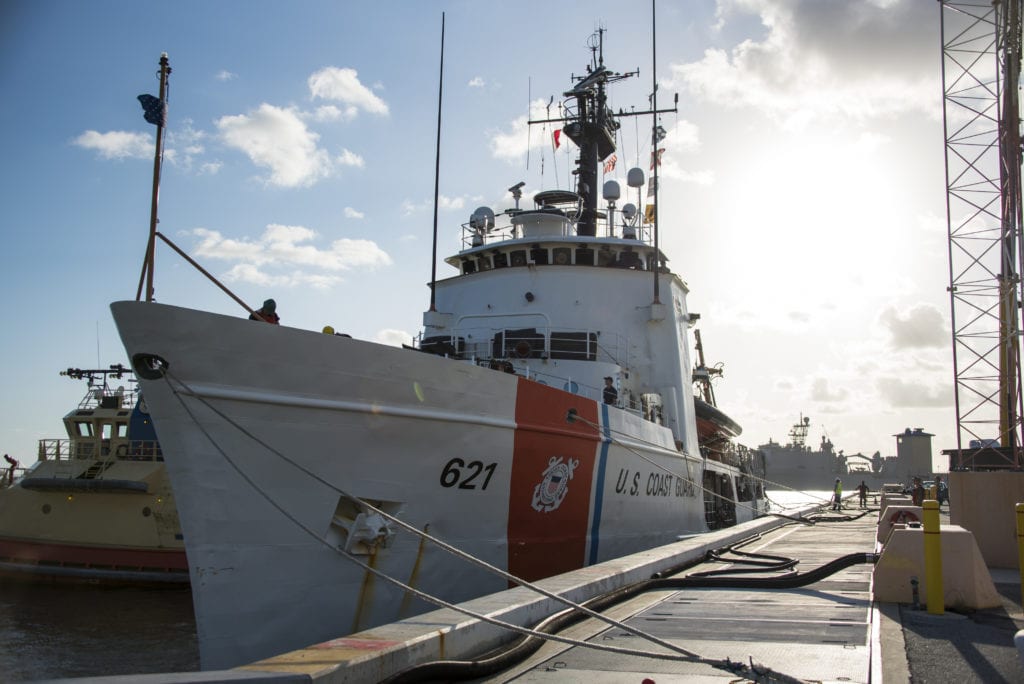
The Coast Guard Cutter Valiant crew returns to homeport Wednesday, Oct. 3, 2018, at Naval Station Mayport, Florida. The Valiant crew returned to homeport after a six-week counter-drug patrol in the Caribbean. U.S. Coast Guard / Petty Officer 3rd Class Ryan Dickinson
JACKSONVILLE, Fla.— The USCGC Valiant (WMEC-621) crew returned home to Naval Station Mayport March 16 after completing a 26-day patrol conducting law enforcement operations in the Caribbean Sea, the Coast Guard 7th District said in a release.
Coast Guard Cutter Valiant patrolled over 4,600 nautical miles in the Caribbean Sea, conducting counter-narcotics operations in support of Joint Interagency Task Force South (JIATF-S), Coast Guard District 7 and Coast Guard Sector San Juan, Puerto Rico.
While preparing for flight operations training with Coast Guard Air Station Borinquen, Puerto Rico, Valiant received information about a potential target of interest in the Mona Pass from a maritime patrol aircraft. Valiant shifted gears from training to law enforcement and interdicted a 16-foot go-fast style vessel, seizing over 520 pounds of cocaine, valued at over $8.8 million, and apprehending three suspected narcotics traffickers.
Valiant also partnered with the USS Wichita (LCS 13), to safely transfer nine suspected narcotics traffickers and 132 additional pounds of cocaine for prosecution in the United States. The joint team ensured the safe transfer of all suspected traffickers, evidence, and narcotics to the United States for future prosecution.
Valiant’s patrol started with a training availability cycle. However, the COVID-19 pandemic continued to present challenges including limited port calls and the need to completely isolate for 14 days to ensure the crew’s health and safety before getting underway after several COVID-19 positive cases. Additionally, Valiant had to overcome a variety of mechanical issues. However, by partnering with Coast Guard maintenance support teams stationed in San Juan, Puerto Rico and deployable technical experts, Valiant’s team of technical experts was able to execute repairs and continue on the mission.
“This was an extremely challenging patrol for team Valiant and I could not be more proud of the entire crew to overcome every obstacle and ultimately have several operational successes,” said Cmdr. Jeff Payne, Valiant’s commanding officer. “Our friends and families back home also deserve much of the credit for our success. While only underway for 26 days, Valiant’s patrol truly started on 25 January when we began the training cycle. That was followed by a variety of mechanical and pandemic issues requiring both the crew and our families to constantly adjust and find solutions. However, we overcame each challenge, teamed with our Department of Defense counterparts, and ultimately executed textbook missions protecting our shores and nation.”
The Valiant is a multi-mission 210-foot medium-endurance cutter. Missions include search and rescue, maritime law enforcement, marine environmental protection, homeland security and national defense operations.