Royal Malaysian Navy Stands Up Unmanned Aircraft Squadron
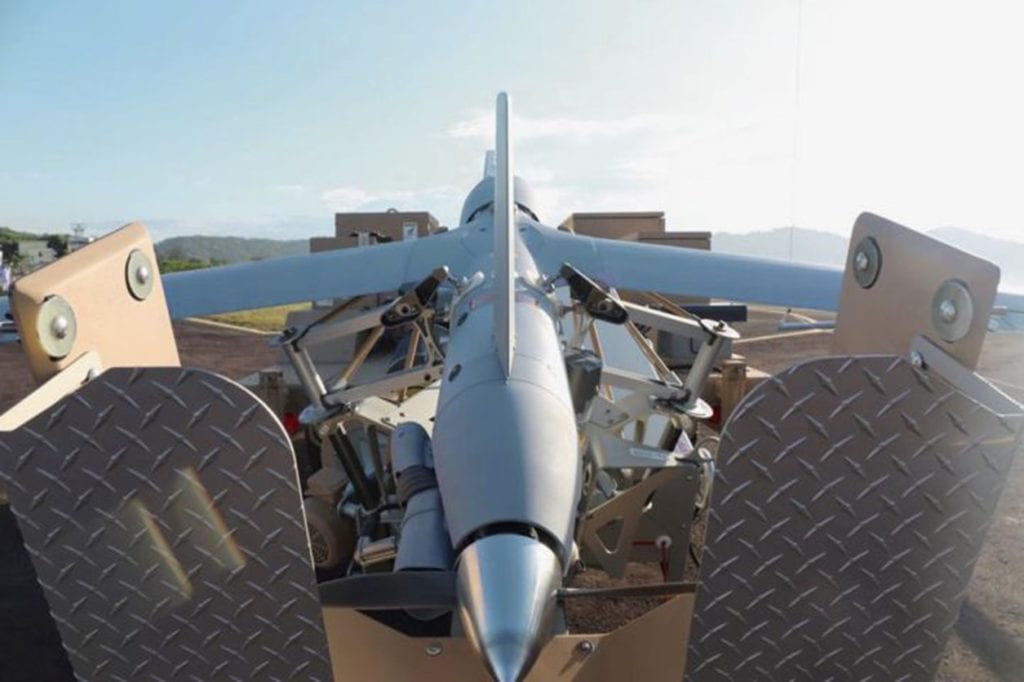
A ScanEagle UAS being displayed on its pneumatic launcher at the inauguration ceremony of Malaysia’s 601 Squadron on 4 March 2021. Royal Malaysian Navy
The Royal Malaysian Navy (RMN) established the 601st Unmanned Aerial System Squadron on March 4, 2021, operating the Boeing Insitu ScanEagle UAS from its base at Kota Kinabalu in Sabah. It is the RMN’s first unit dedicated to unmanned aerial systems.
According to First Admiral Ahmad Shafirudin, commander of the Naval Air of the RMN, the squadron will acquire capability and knowledge for UAS operations and support for the RMN and Malaysia’s joint forces.
The RMN has already received six aircraft from Insitu Boeing as part of an order for a total of 12 systems, announced by the U.S. Department of Defense on May 31, 2019 under of the Foreign Military Sales program, and part of the U.S. government’s Maritime Security Initiative. The remaining six ScanEagles are to be delivered by 2022. The value of the contract is $19.3 million. The Naval Air Systems Command, Patuxent River, Maryland, is the contracting activity. That contract also announced systems for Indonesia, Philippines and Vietnam.
At that time, the U.S. Embassy in Kuala Lumpur issued a statement saying, “These UAVs will enhance the Royal Malaysian Navy’s ability to defend the country’s territorial integrity.”
The contract also included two pneumatic launchers, two SkyHook UAS retrieval systems, two ground control units, as well as spare payloads, spare and repair parts, support equipment, tools, training and maintenance technical services, and field service representatives.
ScanEagle is a small, long-endurance, low-altitude system that can carry electro-optical imagers, long-wave infrared sensors and X-band radar payloads. The RMN intends to initially operate the systems from land with a mobile detachment concept, but eventually they could be hosted aboard ships.
The 601 squadron will be located at RMN Naval Base at Kota Kinabalu in Sabah on the northern part of the island of Borneo, in East Malaysia. There are several reasons the squadron will be located in East Malaysia. Unmanned air operations in Western Malaysia are complicated by the more complex and crowded airspace. More importantly, RMN officials acknowledge a more pressing need for maritime ISR across Malaysia’s eastern maritime border, where there is a current threat of non-state-sponsored militant activities.
Malaysia’s chief of navy, Adm. Tan Sri Mohd Reza bin Mohd Sany, participated in the event. U.S. Defense Attaché Capt. Muzzafar Khan, who attended the official handover ceremony, said, “For over 60 years the U.S. and Malaysia have shared a productive and mutually beneficial security cooperation partnership, and I am glad to see that continuing today.”
Coast Guard Reducing Some Marine Protector Patrol Boats for Budget Reasons, Commandant Says
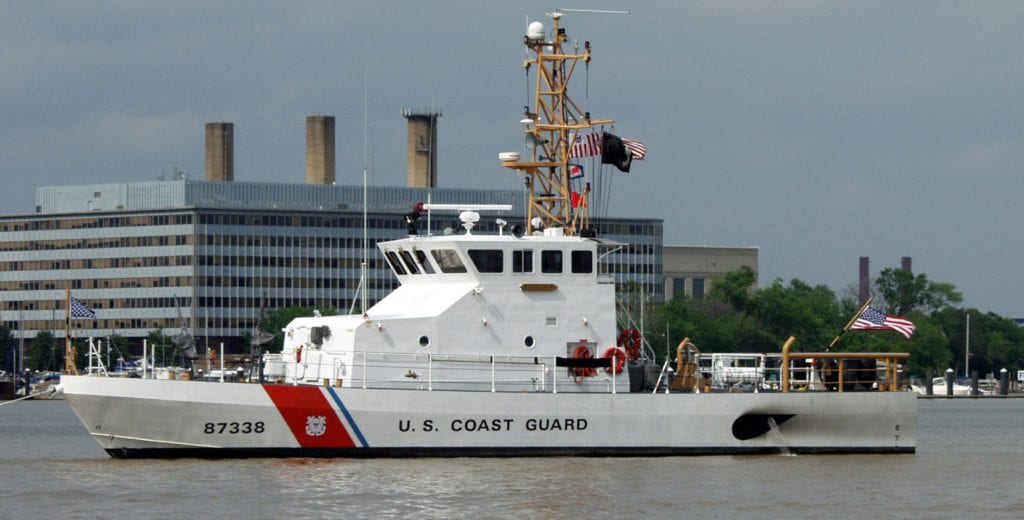
U.S. Coast Guard Cutter Ibis (WPB 87338), anchored in the Anacostia River in Washington, D.C. in May, 2003. Ibis is an 87-foot Coastal Patrol Boat and part of the Coast Guard’s Marine Protector Class of vessels. U.S. Coast Guard / Joseph P. Cirone
ARLINGTON, Va. — Budget constraints are the main reason the Coast Guard is decommissioning a few 87-foot Marine Protector-class patrol boats, the Coast Guard commandant said, but the capabilities of other boats will compensate for the change.
“We are taking some 87-footers out of service,” said Coast Guard Commandant Adm. Karl Schultz, responding to a question from Seapower during a March 11 in a teleconference with reporters following his State-of-the-Coast Guard address in San Diego. “That’s a budget reality.”
Schultz explained that, during the 1980s, 49 Island-class 110-foot patrol boats were built, but with six deployed to the Persian Gulf with Patrol Force Southwest Asia and six retired after a failed hull-length extension, the fleet in domestic waters was down to 34 and has been reduced since to less than 20. However, the 64 larger Sentinel-class 154-foot responses cutters (FRCs) being built — of which 58 will be stationed in the United States and its territories — have been replacing the Inland-class boats.
“So, there is a lot more new ship capacity,” Schultz said. “When you look at an FRC versus an Island-class patrol boat — significantly more linear feet across the waterline, significantly more tonnage, about 28 to 30-knot speed, eight more crew members, an over-the-horizon boat capability, just a lot more C5 [command, control, communications, computers, combat systems, intelligence capability]. So, there’s a lot more capability and capacity on the waterfront with the swap out.”
Schultz said the Congress funded more 87-foot patrol boats than the program of record’s requirement when the Marine Protector program started.
The commandant said some of the Marine Protectors may be declared excess defense articles and offered to foreign navies and coast guards, just as some Island -class patrol boats have been.
“We may hold some to bring back into service,” he said.
It is absolutely budgetarily influenced and informed within the topline, he said. “I’m the last guy as a cutterman who wants to remove a cutter from service, but I think we’ll have plenty of capacity. That fast response cutter — its seakeeping, its legs — is considerably more [capable] than the patrol boats it’s replacing.”
Referring to the March 10 decommissioning of the Marine Protector-class USCGC Dorado at Crescent City, California, Schultz pointed out that with the mission demands and capabilities in that area resident in the Coast Guard’s heavy-weather-capable 45-foot response boats and the nearby aviation capability, ‘taking out some of those 87’s was a relatively rational, hard choice we had to make.”
Coast Guard Commandant Outlines Future of Service in San Diego
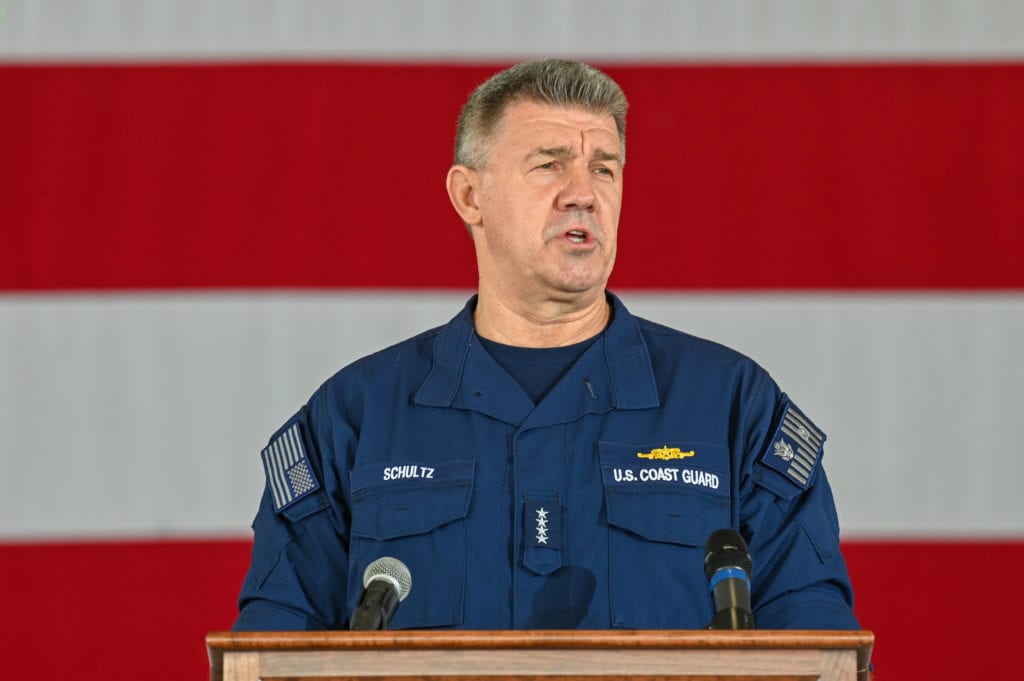
Adm. Karl Schultz, the commandant of the Coast Guard, speaks during the 2021 State of the Coast Guard Address in San Diego March 11, 2021. During the annual address, Schultz reflected on the organization’s successes over the past year and outlined the shared vision for the future of the Coast Guard. U.S. Coast Guard / Petty Officer 2nd Class Travis Magee
SAN DIEGO — The Commandant of the United States Coast Guard delivered his third state of the Coast Guard address March 11 at Coast Guard Sector San Diego, Coast Guard Headquarters said in a release.
Adm. Karl Schultz outlined his vision for the service to protect the homeland, enhance economic prosperity, and advance America’s national security interests. Schultz accentuated the dedication and sacrifice of Coast Guard members stationed across the country and deployed during this past year of unprecedented challenges.
“Across the Service, I see individual Coast Guard members contributing to their communities, and standing the watch to secure the Homeland, enhance our economic prosperity, and advance our national interests across the globe,” Schultz said.
During the annual address, Schultz reflected on the organization’s success over the past year and featured members of the Coast Guard who excelled in crisis, rescued mariners in distress, interdicted illicit narcotics, and responded to a record-setting Atlantic basin hurricane season, all complicated by the challenges presented by the COVID-19 global pandemic.
“Coast Guard members stood the watch amidst adversity, showcasing what makes our Service special — our people,” Schultz told the mostly virtual attendees this year due to COVID-19 restrictions.
He also underscored new Coast Guard capabilities in Southern California. “In April, we will break ground on our first new aviation unit in more than two decades — located right here in Southern California. Air Station Ventura County will significantly enhance our aviation multi-mission capability in the region,” Schultz said.
The service chief discussed a variety of ongoing and emerging fleet recapitalization programs, providing updates on the Polar Security and Offshore Patrol Cutter acquisitions; efforts to replace the aging fleet of inland buoy and construction tenders with Waterways Commerce Cutters; and initial steps to transition to an all MH-60 Jayhawk helicopter fleet.
Schultz further highlighted the Coast Guard’s operations in the nation’s system of ports and waterways, better known as the Marine Transportation System (MTS). The MTS is a key economic engine for the nation, fueling 26% of America’s gross domestic product (GDP) which equates to $5.4 trillion of annual economic activity and 31 million jobs.
“Our seaports are the gateways for 90% of international trade, and the Coast Guard helps to oversee this vital economic engine that ensures energy products and other goods arrive at businesses and storefronts in every corner of our country,” Schultz highlighted.
Navy Aims to Fast-Track Artificial Intelligence, Machine Learning to Maintain Dominance
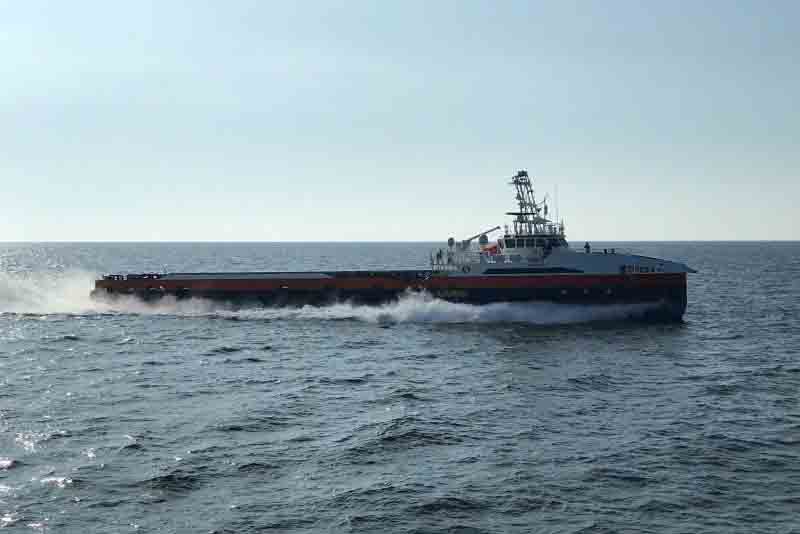
This unmanned surface vessel, part of the Strategic Capabilities Office’s Ghost Fleet Overlord program, recently made a trip from the Gulf Coast to the coast of California, almost entirely by traveling autonomously. In December, it participated in exercise Dawn Blitz, where it also demonstrated its autonomous capabilities. Defense Department Strategic Capabilities Office
Like a bolt from the blue, the Navy has a new modernization priority — Project Overmatch, a campaign to accelerate delivery of artificial intelligence, machine learning and tools needed to allow the fleet to disperse forces, mass fires, integrate unmanned ships and, in the view of service leaders, maintain maritime dominance in the future.
The project aims to begin delivering the Naval Operational Architecture (NOA), a lackluster name for a breathtaking effort whose results will determine nothing less than the service’s future ability to establish and sustain sea control by integrating network infrastructure, data and analytic tools to provide decision-advantage in a fight.
“Beyond recapitalizing our undersea nuclear deterrent, there is no higher developmental priority in the U.S. Navy,” Chief of Naval Operations Adm. Mike Gilday wrote in Oct. 1, 2020, memo to Rear Adm. Douglas Small establishing Project Overmatch. “Your goal is to enable a Navy that swarms the sea, delivering synchronized lethal and nonlethal effects from near and far, every axis and every domain.”
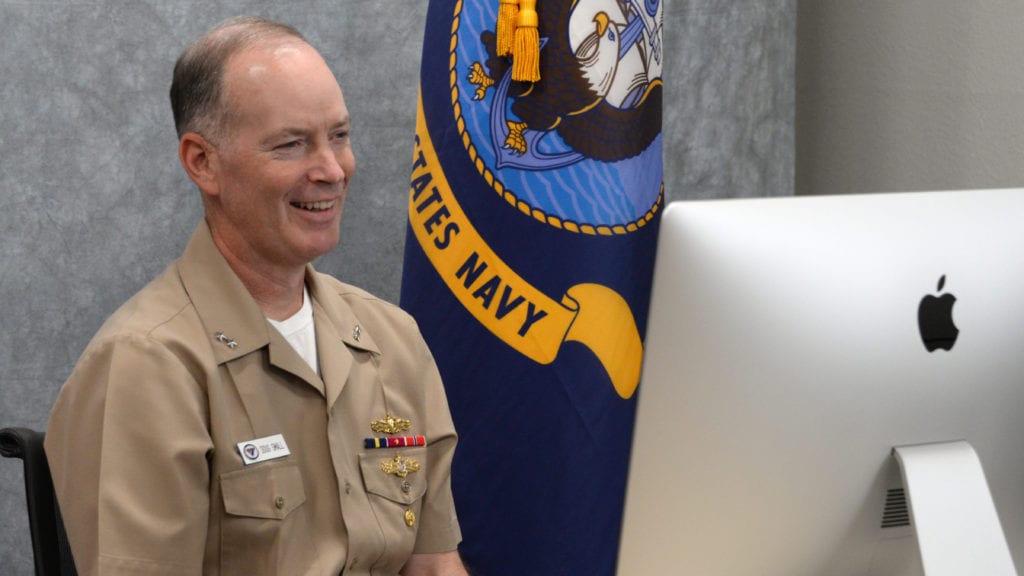
Small, who in addition to heading Project Overmatch is head of Naval Information Warfare Systems Command, was further tasked by the CNO “to develop the networks, infrastructure, data architecture, tools, and analytics that support the operational and developmental environment that will enable our sustained maritime dominance.”
The two-star admiral says he has committed the memo to memory and, for good measure, carries a copy at all times. Why? Gilday likens Project Overmatch to some of the most important Navy engineering and development challenges ever, including adopting nuclear power, developing the Polaris Missile and creating the Aegis Combat System.
Project Overmatch is not only about technical linkages and new software tools, according to a service official, it aims to speed development of concepts of operations for test, evaluation and capability exploitation of long-range fires, helping pave the way for new fleets of large and medium unmanned ships.
Vice Adm. James Kilby, deputy chief of naval operations for warfighting requirements and capabilities, told an online audience in January that Project Over- match plans to deliver a “minimally viable capability” — including new artificial intelligence and machine learning combat tools — to the Theodore Roosevelt aircraft carrier strike group in 2023.
Rear Adm. Douglas Small, Commander, Naval Information Warfare Systems Command (NAVWAR), discusses NAVWAR’s role in Project Overmatch to a virtual audience at the 2021 Surface Navy Association symposium from the systems command’s Old Town San Diego complex. U.S. Navy photo by Rick Naystatt
Small, speaking at a separate online conference at the end of January, described the effort in broad strokes.
“When you have a project the size of Project Overmatch — connecting everything and bringing [artificial intelligence] and [machine learning] to every- thing — you have to go at it in an agile manner,” Small said. “Step one for us was: Let’s break this thing down into agile chunks and take a look at what are the things that we’re working on currently now that we could take advantage of and grow from there.
“It consists of things like networks that are brought in as part of Overmatch,” Small said. “Certain configurations of networking gear like CANES [Consolidated Afloat Networks and Enterprise Services], certain sets of management aids and planners and things like that. And then defining data structures right for that first increment of capability. So that’s, that’s the concept behind a minimum viable product … so we’ll take some time to develop that and then get it out as it’s ready.”
Once delivered to the carrier strike group, Project Over- match aims to accelerate user feedback to developers to refine fielding of new capabilities and ensure functionality as new tools are integrated into the NOA. The effort also includes using live virtual events and training to execute and practice fleet-centered design.
JADC2
Project Overmatch is effectively the naval component of the Defense Department-wide effort to establish a Joint All-Domain Command and Control capability, which aims to network the entire U.S. weapons inventory in a manner similar to the way commercial handheld devices are linked, with each able to access an information cloud.
The U.S. military wants combat capabilities akin to Uber, Amazon and Facebook in their ability to scale and serve unique needs of different military users.
JADC2 was spearheaded by the Air Force in 2019; in 2020 the Army announced a similar campaign called Project Convergence. Last fall, the two services signed a joint memorandum of agreement to explore close integration.
While the Navy has not inked any formal agreements with the Army and Air Force, service leaders stress they are collaborating. The Navy, for instance, participated in Air Force-sponsored JADC2 events — contributing a DDG-51 Arleigh Burke-class destroyer and an aircraft carrier capable F-35C Joint Strike Fighter to a January 2020 all-service experiment that focused on defending the United States against a cruise missile attack. Navy leaders were present during the Army’s initial Project Convergence event last fall. And now projects Overmatch and Convergence are eyeing a collaborative event this summer.
Meantime, the Joint Staff is working to establish a frame- work to coordinate efforts of the three military departments. Gen. John Hyten, the No. 2 military officer and chairman of the Joint Requirements Oversight Council, estimates that by late spring the Pentagon will issue a new Joint Warfighting Concept to provide an overarching blueprint for JADC2 as well as three other key areas: joint glob- al fires, contested logistics and information advantage.
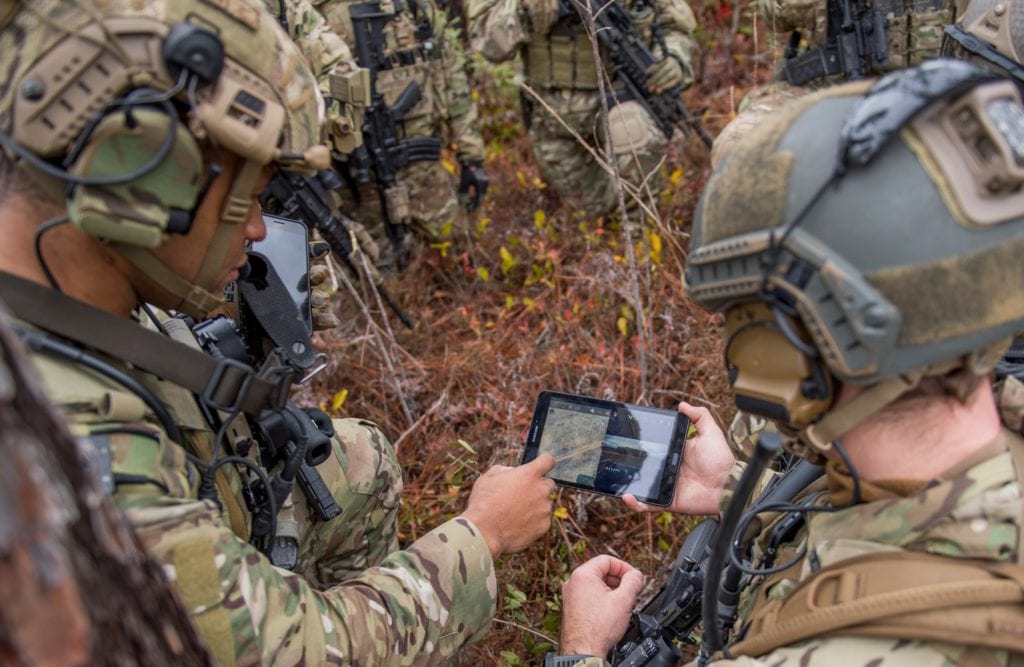
Members of the 6th Special Operations Squadron use a tablet to upload coordinates during an exercise showcasing the capabilities of the Advanced Battle Management System at Duke Field, Florida, Dec. 17, 2019. During the first demonstration of the ABMS, operators across the Air Force, Army, Navy and industry tested multiple real-time data sharing tools and technology in a homeland defense-based scenario enacted by U.S. Northern Command and enabled by Air Force senior leaders. U.S. Air Force / Tech. Sgt. Joshua J. Garcia
Building on Experience
“We’re not starting this journey from a cold start,” Kilby said of the complex effort to create new technical linkages across platforms. “We’ve been working toward it for some time.”
For instance, the Navy has developed Naval Integrated Fire Control-Counter Air, an “any sensor, any shooter” capability that extends the air and missile defense battlespace to the maximum kinematic range of weapons for air, surface and strike warfare missions. NIFC-CA allows aircraft and surface ships to pass data that enable shooters to attack targets beyond their organic detection range.
Similarly, the Cooperative Engagement Capability — through connecting sensors and communications tools — makes possible the ability for multiple surface ships and aircrafts to form an air defense network for the pur- pose of sharing radar target measurements in real-time.
The adoption of commercial-off-the-shelf hardware into the Aegis Combat System and the introduction of a common source library now allows the Navy to scale the power of the air and missile defense system across ship classes and land- based systems.
Project Overmatch seeks to replicate these sorts of integrations, but on a much larger scale.
“Our end state: We have to pass the best sensing to the best kinetic or non-kinetic platforms to create the tactical battle network, where the whole system fights as one regardless of how many units are in,” said Kilby. “Great power competition demands that we deliver distributed, networked and lethal naval force. Time is of the essence.”
On Dec. 15, Small hosted a classified conference on the West Coast for defense contractors to explain Project Overmatch. Interest was high: Representatives from 150 companies attended.
“I laid out basically everything that we’re doing, the why of everything that we’re doing, and made specific asks for help,” Small said in January. “One of the specific things that I asked for is imagination.
“We think we understand where we’re headed in terms of the future and the things that you can unleash from a connected Navy,” Small said, but noted that sometimes a new technology’s utility — he mentioned the introduction of the iPad — is not always obvious.
“There’s no user when presented with an iPad back in the day that would have said, ‘Oh my gosh, yes I need this large cell phone that’s between my laptop and my cell phone.’ It would have never hit the market,” Small said. “But the fact is by watching people and understanding the state of technology and what could be needed, the iPad is now this ubiquitous device.”
Small said he is hoping for industry’s help identifying potential in new technologies — waveforms, machine learning algorithms and such — for Project Overmatch.
“This is not something the Navy is at a standstill on,” said Small. “We’ve done some incredible things tying various networks and sensors together. So, we’re taking that to the next level and beyond.”
China Adopts ‘Assertive Posture’ With Eye on Taiwan, Admiral Says
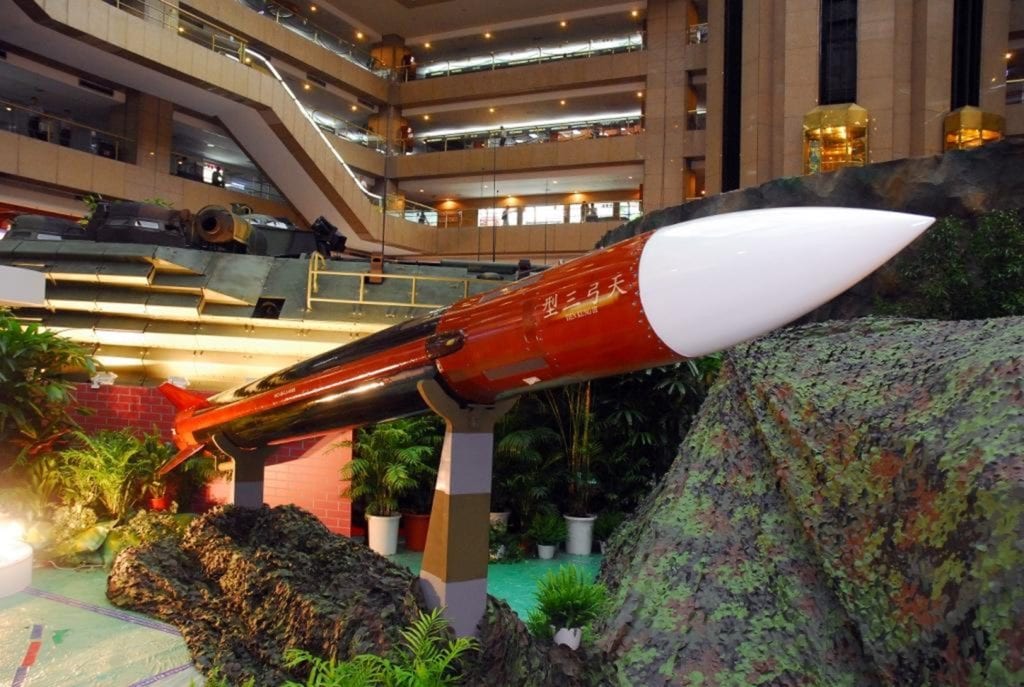
The Tien Kung Ⅲ area defense system, developed indigenously by the National Chun-Sheng Institute of Science and Technology (NCSIST), is designed to intercept tactical ballistic missiles. NCSIST
Admiral Philip Davidson, commander of the U.S. Indo-Pacific Command, speaking at the American Enterprise Institute on March 4 and in testimony to Congress on March 9, said the People’s Republic of China (PRC) is stepping up its pressure on Taiwan and called for the island nation to increase it defensive capabilities.
In his testimony on Capitol Hill, Davidson said, “The PRC has adopted an increasingly assertive military posture to exert pressure and expand its influence across the region. This is particularly stark concerning Taiwan. Over the past year, Beijing has pursued a coordinated campaign of diplomatic, informational, economic, and — increasingly — military tools to isolate Taipei from the international community and if necessary, compel unification with the PRC.”
“I worry that they’re [China] accelerating their ambitions to supplant the United States and our leadership role in the rules-based international order… by 2050,” he said. “Taiwan is clearly one of their ambitions before that. And I think the threat is manifest during this decade, in fact, in the next six years.”
At the American Enterprise Institute, Davidson said it is vital the U.S. continue arms sales to Taiwan and encouraged their continued investments in national defense. Taiwan receives military assistance from the United States, but being diplomatically and commercially isolated, Taiwan has had to develop much of its defense capabilities on its own.
“Helping to encourage Taiwan on its investments, a mix of capabilities that include capabilities that helps Taiwan deter, as well as provides some decent [other] capabilities that helps Taiwan defend, I think is a very important approach that the [Defense] Department needs to take,” Davidson. “And I would say, you know, for the greater U.S. government — consistent arms sales to Taiwan to help in this deterrence strategy is critically important. And again, that takes a balance to capabilities to go to them.”
The Taiwan News reported on Feb. 17 that Taiwan’s National Chung-Shan Institute of Science and Technology (NCSIST) has been directed to ramp up production of Taiwan-made weapons systems, including anti-aircraft and anti-ship missiles. NCSIST is responsible for the development, manufacture and sale of Taiwan’s indigenous defense technology and weaponry.
According to the news report, the list includes the Sky Bow III (Tien Kung III) surface-to-air, anti-ballistic missile and the Hsiung Feng III supersonic missile capable of destroying both land-based and naval targets. Development of the Sky Sword II (Tien Chien II) radar-guided air-to-air missile, as well as some classified missile systems, will be stepped up.
The PRC is a nation of 1.4 billion, with the largest navy in the world. One hundred miles away is Taiwan, a country of 22 million people. Militarily, it almost seems to be an untenable position.
“Taiwan is the most dangerous Sino-American flashpoint, because regaining de facto sovereignty over Taiwan has long been a Chinese core interest, and the potential for the use of force to accomplish reunification is always on the table,” said Ret. Rear Adm. Michael McDevitt, author of the recently published “China as a Twenty-First-Century Naval Power: Theory, Practice, and Implications” from Naval Institute Press.
Should China and Taiwan begin hostilities, the People’s Liberation Army (PLA) has a decided home-field advantage. “In the face of almost two decades of Chinese military modernization, Taiwan’s forces — as well as the U.S. forward deployed forces — are vastly outgunned on a day-to-day basis, as they operate literally in China’s front yard, because they face the totality of China’s armed forces,” McDevitt said.
‘“[PRC President and Communist Party Secretary] Xi Jinping has suggested that an indefinite perpetuation of the current status quo, with Taiwan existing as a de facto independent country, cannot go on forever. Xi gives the impression he is impatient because he fears perpetuation of the status quo will eventually lead to ‘peaceful separation,'” he said.
McDevitt said there are those that think Xi Jinping wants to be remembered as the party secretary that finally resolves the Taiwan question. “Taiwan is always going to be just a hundred miles of the coast of China, it will never be towed out to the mid-Pacific,” he said.
“The basic U.S. policy on reunification is straightforward,” he said. If the people of Taiwan decide in favor of it, “that is fine, but in the meanwhile, any attempts by the mainland to unify through coercion or outright aggression might result in U.S. military intervention,” said McDevitt. “Given the economic clout and military capability of the mainland, it is hard to imagine that reunification of some sort, a commonwealth for example, will not eventually take place, unless of course, Beijing agrees to let Taiwan declare independence, which in my mind would be the sensible thing for Beijing to do. Taiwan is not going anywhere.”
The Biden administration has signaled its support for Taiwan. State Department Spokesman Ned Price said on Jan. 21, “The United States notes with concern the pattern of ongoing PRC attempts to intimidate its neighbors, including Taiwan. We urge Beijing to cease its military, diplomatic, and economic pressure against Taiwan and instead engage in meaningful dialogue with Taiwan’s democratically elected representatives. We will stand with friends and allies to advance our shared prosperity, security, and values in the Indo-Pacific region — and that includes deepening our ties with democratic Taiwan.
“The United States will continue to support a peaceful resolution of cross-strait issues, consistent with the wishes and best interests of the people on Taiwan,” Price said. “The United States maintains its longstanding commitments as outlined in the Three Communiqués, the Taiwan Relations Act, and the Six Assurances. We will continue to assist Taiwan in maintaining a sufficient self-defense capability. Our commitment to Taiwan is rock-solid and contributes to the maintenance of peace and stability across the Taiwan Strait and within the region.”
Senators, Congressmen Reintroduce the Energizing American Shipbuilding Act
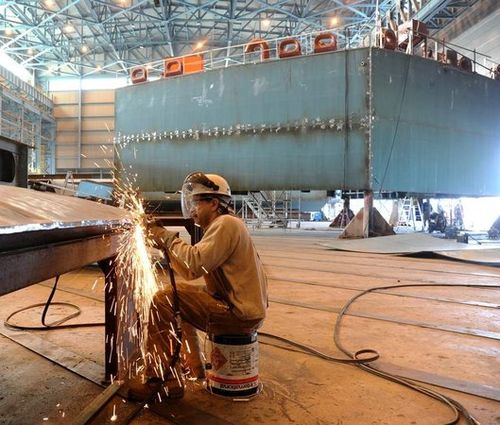
Members of the U.S. Senate and House have reintroduced the Energizing American Shipbuilding Act, intended to boost ship construction. USDOT
WASHINGTON – U.S. Sen. Roger Wicker, R-Mississippi, a senior member of the Senate Armed Services Committee, joined Sen. Bob Casey, D-Pennsylvania, in reintroducing the Energizing American Shipbuilding Act, Wicker’s office said in a March 11 release.
Reps. John Garamendi, D-California, who serves on the House Armed Services Committee, and Rob Wittman, R-Virginia, ranking member of the Seapower and Projection Forces Subcommittee, introduced the companion bill in the House of Representatives.
The legislation would support American shipbuilding by requiring a portion of liquefied natural gas (LNG) and crude oil exports to be transported on U.S.-built, U.S.-crewed vessels.
“Strengthening our domestic maritime industry is essential to our national defense,” Wicker said. “Ensuring the U.S. can move our growing energy exports on American-flagged, American-crewed vessels protects the critical role these vessels play in our national defense and bolsters hundreds of thousands of American shipbuilding and maritime jobs. As foreign nations continue to invest heavily in their own shipbuilding capacity, the United States cannot allow our own capabilities to dwindle.”
“America’s merchant fleet has dwindled 60 percent since 1991. Requiring LNG and oil to be exported on U.S.-built and crewed vessels will help strengthen our nation’s shipyards and maritime industry and keep America competitive in international markets,” Caseysaid. “The bipartisan Energizing American Shipbuilding Act would also create good-paying jobs for our ports in Pennsylvania, and throughout the country, while increasing ship manufacturing to ensure that we can provide sealift capacity for our military.”
“U.S. exports of America’s LNG and crude oil resources present a unique opportunity to create new middle-class jobs by strengthening our nation’s crucial domestic shipbuilding, advanced manufacturing, and maritime industries — which are key to national security and our ability to project American military power abroad,”Garamendisaid. “American shipyards and mariners are ready for the job, and our bill ensures American workers are no longer expected to compete against heavily subsidized foreign shipyards in Korea, China, and elsewhere. Our domestic maritime industry is critically important to the U.S. economy and national security, and I will work tirelessly until this bill becomes law.”
“The Energizing American Shipbuilding Act is a major step in the right direction for the American shipbuilding industry, the men and women of America’s shipyards, and our national security,” Wittman said. “The EAS creates new, good-paying jobs for working-class Americans in every state while enhancing our national security by transporting more American-produced energy on American crewed, built, and flagged ships. Furthermore, The EAS Act ensures the United States has the industrial shipbuilding capacity necessary for our national defense by building new LNG carriers rivaling those of China and Russia and ensuring the continued prosperity of our shipbuilding industry.”
The bill would require that vessels built in the U.S. transport 15 percent of total seaborne LNG exports by 2043 and 10 percent of total seaborne crude oil exports by 2035. If enacted, the bill is expected to spur the construction of dozens of ships, supporting thousands of good-paying jobs in American shipyards, while also boosting domestic vessel component manufacturing and maritime industries.
Coast Guard Cutter Dorado Decommissioned after 23 Years of Service
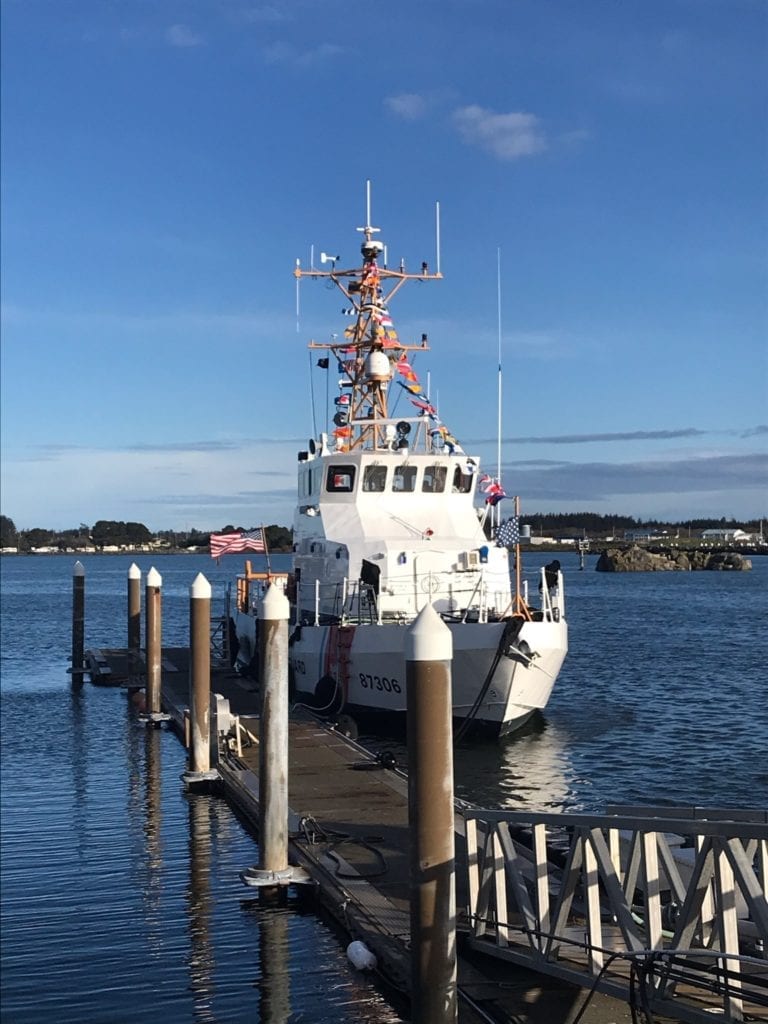
The Coast Guard Cutter Dorado (WPB-87306) is shown before a decommissioning ceremony for the cutter, March 10, 2021 in Crescent City, California. The Dorado is being decommissioned after 23 years of service in the Coast Guard from 1999 to 2021. U.S. Coast Guard
MCKINLEYVILLE, Calif. — The Coast Guard Cutter Dorado (WPB-87306) was decommissioned March 10 after 23 years of service during a ceremony in Crescent City, California.
The Dorado was the Coast Guard’s sixth 87-foot Marine Protector-class patrol boat to serve as the Coast Guard’s primary nearshore patrol asset.
“I would like to thank my crew and all previous sailors for bolstering her highly successful service life,” said Lt. Rebecca Cotton, the Dorado’s commanding officer. “They made the Dorado an unforgettable cutter in which to serve the West Coast for the past 23 years. Equally important are our partners at the 11th Coast Guard District, Coast Guard Sector Humboldt Bay and the city of Crescent City. I would like to extend tremendous thanks as Dorado’s success throughout the years would not have been possible without their support.”
The Dorado was built in 1998 by Bollinger Machine Shop and Shipyard, Inc. in Lockport, Louisiana. Once construction was complete, Dorado’s crew transited the ship through the Panama Canal to reach its new homeport in Crescent City where it was officially placed into commission.
During Dorado’s time in service, the crew completed more than 135 search and rescue cases and 1,000 law enforcement and fishery boardings.
“The Coast Guard Cutter Dorado and her crew have been vital to our mission of safeguarding the waters of Northern California,” said Capt. Mark Hiigel, the Sector Humboldt Bay commander. “No matter what was asked of them, they answered the call and I am extremely grateful for their hard work and dedication. Dorado will be missed along our coast. However, we always stand ready to ensure the safety and security of our waterways.”
Dorado’s crew is scheduled to sail the ship to Baltimore where it is slated to be turned in to the Foreign Military Sales program.
Marine Protector-class patrol boats are primarily used for combating drug smuggling, illegal immigration, marine fisheries enforcement and search and rescue.
The Coast Guard commissioned four 154-foot fast response cutters in California between 2018 and 2019, which operate along California’s entire coast and international waters off Mexico and Central America conducting missions such as search and rescue, fishery patrols, national defense and port, waterways and coastal security.
Cutter Offloads 7,500 Pounds of Interdicted Cocaine, Marijuana in San Diego
The crew of the Coast Guard Cutter Bertholf (WMSL-750) offloads approximately 7,500 pounds of seized cocaine and marijuana in San Diego, March 20, 2021. U.S. Coast Guard / Petty Officer 2nd Class Travis Magee
SAN DIEGO — The crew of the Coast Guard Cutter Bertholf (WMSL-750) offloaded approximately 7,500 pounds of seized cocaine and marijuana in San Diego, March 10, the Coast Guard 11th District said in a release.
The drugs, worth an estimated $126.7 million, were seized in international waters of the eastern Pacific Ocean between January and February, representing 10 suspected drug smuggling vessel interdictions off the coasts of Mexico, Central and South America by the following Coast Guard and Navy ships:
The Coast Guard Cutter Bertholf (WMSL 750) crew was responsible for four interdictions seizing approximately 6,200 pounds of cocaine.
The Coast Guard Cutter Munro (WMSL 755) crew was responsible for three interdictions seizing approximately 1,100 pounds of cocaine and 50 pounds of marijuana.
The Coast Guard Law Enforcement Detachment 107 deployed aboard the USS Freedom (LCS 1) was responsible for one interdiction seizing approximately 22 pounds of cocaine.
The Coast Guard Cutter Harriet Lane (WMEC 903) crew was responsible for one interdiction seizing approximately 50 pounds of marijuana.
The Coast Guard Cutter Vigilant (WMEC 617) crew was responsible for one interdiction seizing approximately 22 pounds of cocaine.
Speakers at the event included Adm. Karl Schultz, the Coast Guard commandant, and Capt. Brian Anderson, the Bertholf commanding officer.
“The 7,000 pounds of cocaine offloaded today was interdicted as a result of extraordinary effort and joint and interagency partnerships,” said Schultz. “While the Bertholf may have physically stopped or interdicted the drug smuggling vessels, our DoD and DHS partners, particularly CBP Air and Marine Operations maritime patrol aircraft, coordinated through Joint Interagency Task Force-South, put the Bertholf in the right place at the right time to conduct at-sea interdictions.”
On April 1, U.S. Southern Command increased counter-narcotics operations in the Western Hemisphere to disrupt the flow of drugs. Numerous U.S. agencies from the departments of Defense, Justice, and Homeland Security cooperated in the effort to combat transnational organized crime. The Coast Guard, Navy, Customs and Border Protection, FBI, Drug Enforcement Administration, and Immigration and Customs Enforcement, along with allied and international partner agencies, play a role in counter-drug operations.
The fight against drug cartels in the Eastern Pacific Ocean requires unity of effort in all phases from detection, monitoring, and interdictions, to criminal prosecutions by international partners and U.S. Attorneys’ Offices in districts across the nation. The law enforcement phase of counter-smuggling operations in the eastern Pacific Ocean is conducted under the authority of the 11th Coast Guard District, headquartered in Alameda. The interdictions, including the actual boardings, are led and conducted by members of the U.S. Coast Guard.
“The crew is lauded for their dedication to duty and resiliency throughout this patrol,” Anderson said. “Tasks that once seemed routine, became more complex with personal protective equipment and decontamination procedures added to our standard operating procedures. Early in the deployment, we interdicted three go-fast vessels over a span of six hours, which demonstrated our full capabilities and our commitment to keeping America safe and secure. I couldn’t be more proud of my crew.”
The Bertholf is a 418-foot national security cutter, commissioned in 2008 and homeported in Alameda. The Munro is a 418-foot national security cutter homeported in Alameda. The Freedom is a 387-foot littoral combat ship homeported in San Diego. The Harriet Lane is a 270-foot medium-endurance cutter homeported in Portsmouth, Virginia. The Vigilant is a 210-foot medium-endurance cutter homeported in Port Canaveral, Florida.
AeroVironment’s Arcturus UAV Subsidiary Awarded $7M for SOCOM UAS Program
SIMI VALLEY, Calif., March 9, 2021 – AeroVironment Inc.’s wholly owned subsidiary Arcturus UAV, now operating under the AeroVironment brand, was awarded a competitive task order valued at approximately $7 million from the U.S. Special Operations Command (USSOCOM), the company said in a March 9 release. The competitive task order is for a one-year period of performance, which started Feb. 3, 2021.
USSOCOM selected Arcturus UAV as one of six companies qualified for the potential $975 million Indefinite Delivery, Indefinite Quantity (IDIQ) MEUAS contract in June 2020. The contract enables awardees to compete for site-specific task orders and provide USSOCOM with unmanned aircraft systems services and support for intelligence, surveillance and reconnaissance (ISR) operations.
“Part of AeroVironment’s expanded portfolio of medium UAS, the fixed wing Jump 20 is capable of vertical takeoff and landing, making it completely runway independent,” said Rick Pedigo, AeroVironment vice president of global sales and business development. “Runway independence maximizes the ability of customers to deploy the Jump 20 in a broad range of locations and environments, while minimizing the logistical footprint required to operate it. Jump 20 is also capable of hosting multiple different payload options, delivering true versatility and multi-mission capabilities to support a wide array of customer requirements.”
AeroVironment recently successfully demonstrated the Jump 20 for the U.S. Army Future Tactical Unmanned Aircraft System (FTUAS) “Rodeo,” which took place from Feb. 22 through March 5 at Fort Benning, Georgia.
DOD Releases Fiscal Year 2020 Freedom of Navigation Report
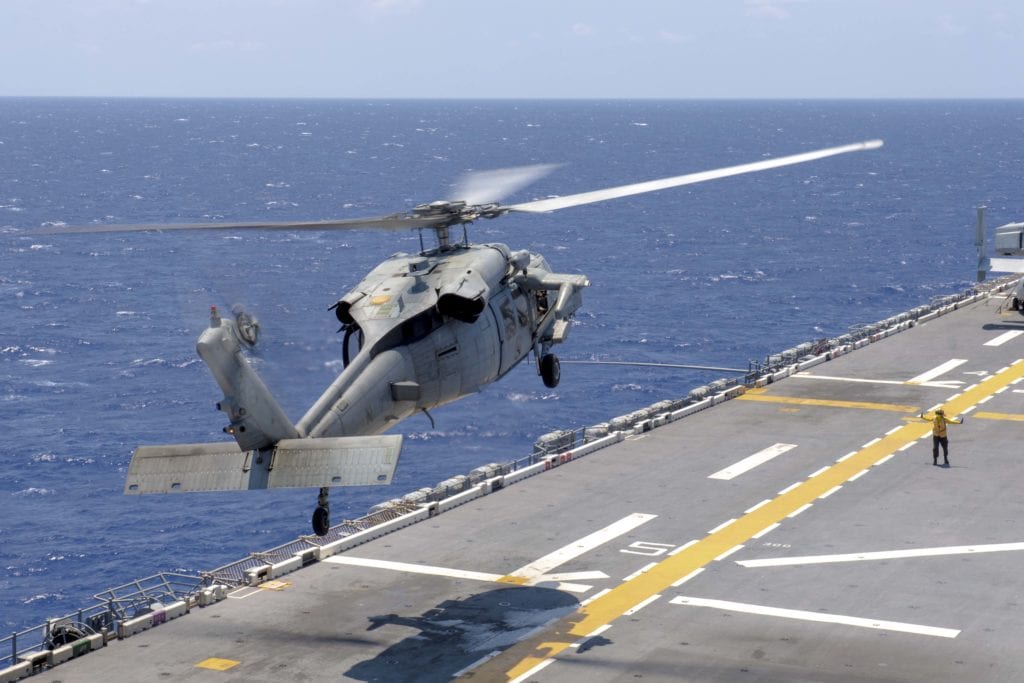
An MH-60S Sea Hawk helicopter assigned to the Archangels of Helicopter Sea Combat Squadron (HSC) 25 Detachment 6 prepares to land on the flight deck of the forward-deployed amphibious assault ship USS America (LHA 6) as part of a 2020 FONOP. U.S. Navy / Mass Communication Specialist 2nd Class Shelby Tucker
ARLINGTON, Va. — The Department of Defense (DoD) released on March 10 its annual Freedom of Navigation (FON) Report for Fiscal Year 2020. During the period from Oct. 1, 2019, through Sept. 30, 2020, U.S. forces operationally challenged 28 different excessive maritime claims made by 19 different claimants throughout the world.
Unlawful and sweeping maritime claims — or incoherent legal theories of maritime entitlements — that are inconsistent with customary international law as reflected in the Law of the Sea Convention pose a threat to the legal foundation of the rules-based international order. Consequently, the United States is committed to confronting this threat by challenging excessive maritime claims.
DoD’s operational challenges are also known as “FON assertions,” “FON operations,” and “FONOPs.” The comprehensive, regular, and routine execution of these operations complements diplomatic engagements by the U.S. State Department and supports the longstanding U.S. national interest in freedom of the seas worldwide.
Upholding freedom of navigation as a principle supports unimpeded lawful commerce and the global mobility of U.S. forces. FONOPs demonstrate the United States will fly, sail, and operate wherever international law allows — regardless of the location of excessive maritime claims and regardless of current events.
Each year, DoD releases an unclassified summarized FON Report identifying the broad range of excessive maritime claims that are challenged by U.S. forces. The FON Report also includes general geographic information to describe the location of FON assertions while still maintaining operational security of U.S. military forces.
“Excessive maritime claims” are those that are inconsistent with international law as reflected in the Law of the Sea Convention. They include a variety of restrictions on the exercise of navigation and overflight rights and freedoms and other lawful uses of the sea. If left unchallenged, excessive maritime claims could limit the rights and freedoms enjoyed by the United States and other nations.
As long as restrictions on navigation and overflight rights and freedoms that exceed the authority provided under international law persist, the United States will continue to challenge such unlawful maritime claims.
The United States will uphold the rights, freedoms, and lawful uses of the sea for the benefit of all nations — and will stand with like-minded partners doing the same.