Coast Guard Transfers 6 Migrants to Bahamian Authorities
MIAMI — A Coast Guard Cutter Diligence rescue crew transferred six Cuban migrants to Bahamian authorities March 5, the Coast Guard 7th District said in a release.
During a routine patrol, an Air Station Miami HC-144 Ocean Sentry aircrew spotted the six people and dropped lifesaving supplies to them, Wednesday, at approximately 3 p.m., after they were spotted on Anguilla Cay, Bahamas.
The Coast Guard cutter rescue crew arrived on scene March 4 and ensured the six people: five adults and one 17-year-old unaccompanied minor, did not have medical concerns before bringing them on the ship.
Since Oct. 1, 2020, Coast Guard crews have interdicted 87 Cubans compared to fiscal year 2020, Oct. 1, 2019 – Sept. 30, 2020, where crews interdicted 49 Cubans.
Once aboard a Coast Guard cutter, all migrants receive food, water, shelter and basic medical attention. Throughout the interdiction, Coast Guard crew members were equipped with personal protective equipment to minimize potential exposure to any possible case of COVID-19. There were no migrants in these cases reported to have any COVID-19 related symptoms.
Nimitz Returns Home from Deployment
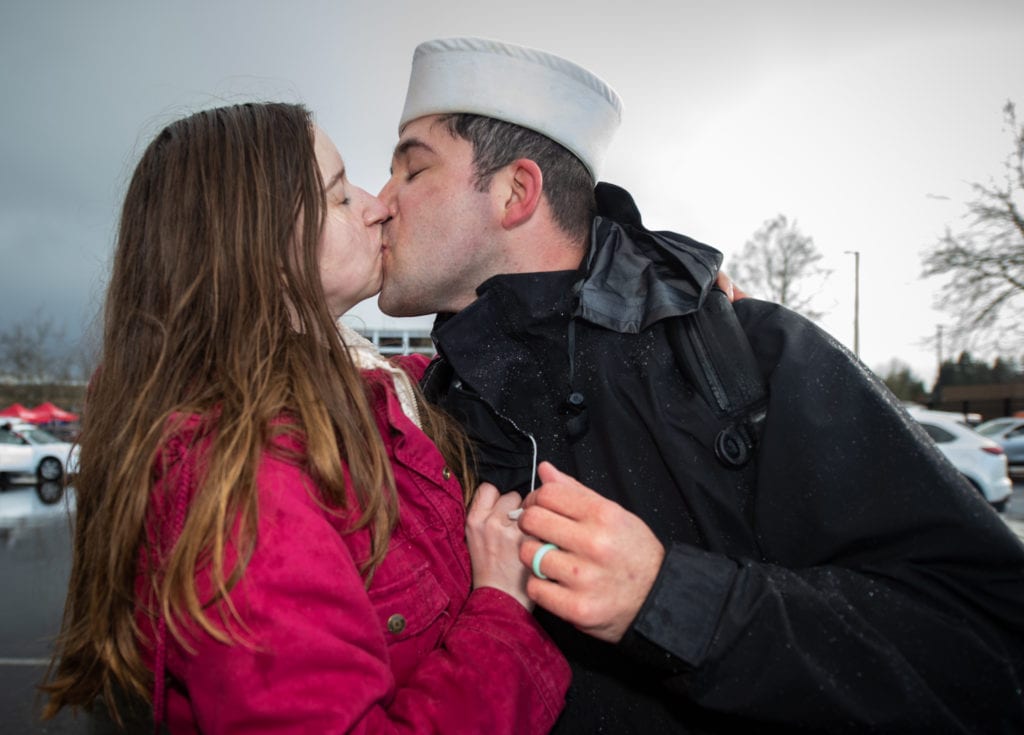
Information Systems Technician 1st Class Jorge Franco, from Lacey, Washington, greets his wife after returning from deployment. Nimitz, part of Nimitz Carrier Strike Group, returned to its homeport Naval Base Kitsap, Bremerton, Wash., after more than 11 months following a deployment to U.S. 5th Fleet and U.S. 7th Fleet, which included freedom of navigation operations and participation in Operations Freedom’s Sentinel, Inherent Resolve, and Octave Quartz. U.S. Navy / Mass Communication Specialist 2nd Class Sarah Christoph
BREMERTON, Wash. — Sailors assigned to aircraft carrier USS Nimitz (CVN 68) returned to the Pacific Northwest area, Mar. 4, after nearly 11-months deployed in U.S. 3rd, 5th, and 7th Fleets, USS Nimitz Public Affairs said.
Nimitz was the first carrier to embark on a deployment for the U.S. Navy after the onset of the COVID-19 pandemic. The crew walked aboard Nimitz April 1, 2020, at their homeport aboard Naval Base Kitsap, Bremerton, Washington, for what would be a 27-day restriction of movement (ROM) period. Nimitz deployed from San Diego June 8 after completing integrated training with other assets from the Nimitz Carrier Strike Group.
“It has been a long 11 months since we bid farewell to our homeport in the beautiful Pacific Northwest, and it feels great to be back,” said Capt. Max Clark, Nimitz commanding officer, and Philadelphia native. “I am so proud of the Sailors on board Nimitz. The hard work, dedication, and teamwork they demonstrated day in and day out to accomplish all missions assigned is commendable.”
“They and their families have my deepest respect and gratitude,” added Clark. “We all look forward to returning now to our families and friends here in Bremerton and the surrounding areas. It’s wonderful to be home.”
While deployed, Nimitz completed five dual carrier operations in U.S. 7th Fleet with the Ronald Reagan and Theodore Roosevelt Carrier Strike Groups and participated in the India hosted multinational Exercise Malabar 2020 with the Japan Maritime Self-Defense Force and Australian Navy in the Bay of Bengal.
“The pandemic changed a lot of things that the Navy normally does,” said Senior Chief Operations Specialist Torrence Mabry, from Youngstown, Ohio. “Fortunately, we were the ship that was able to do it. At the end of the day we did what we had to do while we were in 5th Fleet. We did what we had to do while we were in 7th Fleet. We did what we had to do around the world. Now is the time to enjoy the benefits and do the things you enjoy doing. Because you sacrificed and put your life on the line.”
In the U.S. 5th Fleet area of operation, Nimitz supported Operation Freedom’s Sentinel as part of the NATO-led Resolute Support mission in Afghanistan, and Operation Inherent Resolve with close air support and defensive counter-air missions against the Islamic State in Iraq and Syria. The strike group provided associated and direct support to the 33-nation coalition Combined Maritime Forces (CMF) and the eight-nation coalition International Maritime Security Construct (IMSC) to ensure the free flow of commerce and maritime security in three critical waterways. Nimitz also operated off the coast of Somalia in December to support Joint Task Force –Quartz and Operation Octave Quartz during a repositioning of U.S. forces within East Africa.
“We all banded together and got through it,” said Culinary Specialist 2nd Class Tradondra King, a native of Miami. “That shows a lot. During this extremely tough time everyone found that strength and resiliency in them. We had to get this done, we had a job to do and a mission to complete. That was the way and what we had to do.”
U.S. 3rd Fleet leads naval forces in the Indo-Pacific and provides the realistic, relevant training necessary to flawlessly execute our Navy’s timeless roles of sea control and power projection. U.S. 3rd Fleet works in close coordination with other numbered Fleets to provide commanders with capable, ready assets to deploy forward and win in day-to-day competition, in crisis, and in conflict.
“We did a great thing,” said Mabry. “Nimitz pulled it off, better than any other carrier so far. We wrote the book. We set the standard high and now it’s time for everybody else to follow.”
HASC Chairman: Don’t ‘Waste Any More Money’ on F-35 Strike Fighter
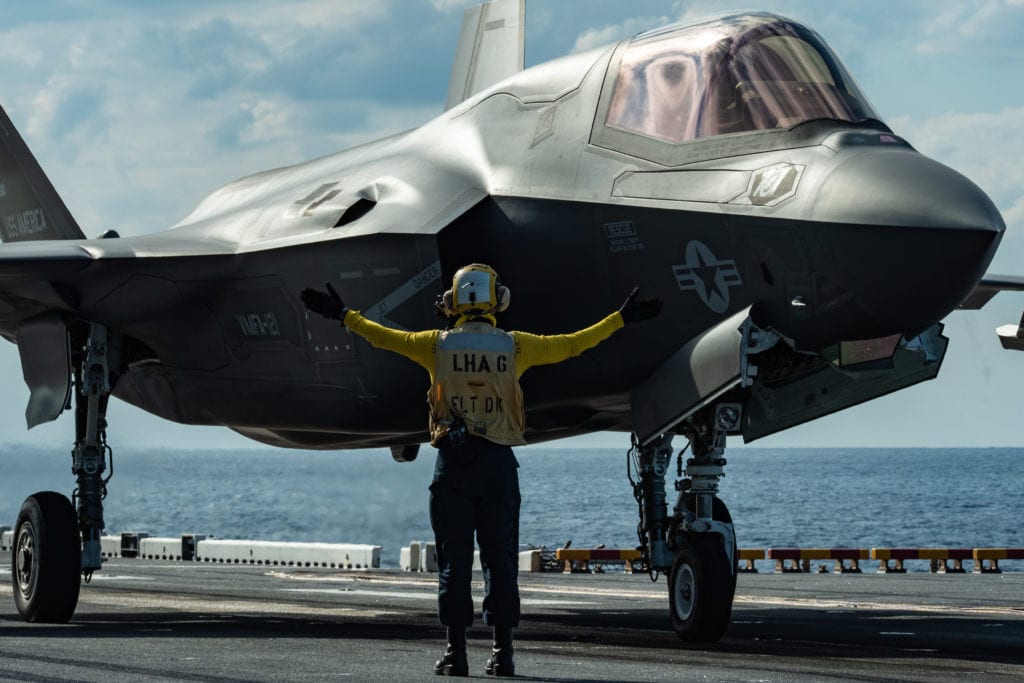
Aviation Boatswains Mate (Handling) 3rd Class Joshua Ott conducts flight operations with an F-35B Lightning II fighter aircraft assigned to the 31st Marine Expeditionary Unit (MEU). U.S. Navy / Mass Communication Specialist Seaman Matthew Cavenaile
ARLINGTON, Va. — The chairman of the House Armed Services Committee says he’d like the Defense Department to stop buying the troubled and massively expensive F-35 Lightning II strike fighter.
In a wide-ranging discussion livestreamed March 5 by the Brookings Institution, a Washington think tank, the chairman, Washington Democrat Rep. Adam Smith, said “our acquisition and procurement process over the last 20 years can only be described as a complete disaster.”
Citing development and maintenance problems or cost over runs with the F-35 — believed to be the world’s most expensive weapons platform — as well as the Navy’s Littoral Combat Ship and the Marine Corps’ canceled Expeditionary Fighting Vehicle, Smith said “we on the Armed Services Committee have to seriously scrub those programs like the F-35,” adding “we have to make sure that we don’t waste any more” money.
“What does the F-35 give us, and is there a way to cut our losses?” Smith asked, noting “the sustainment costs are brutal.” Originally planned to replace 90% of U.S. strike fighter aircraft, Smith conceded “you can’t get rid of the program,” but as HASC chairman said he was seeking “a mix of fighter/attack aircraft that’s cost effective.”
The Marine Corps has converted five squadrons to the F-35B vertical takeoff and short landing variant of the fifth-generation strike fighter. The Navy’s first fighter squadron to transition from the F/A-18E Super Hornet to the F-35C Lightning II aircraft carrier variant is slated to deploy later this year on USS Carl Vinson. Another squadron will become the Navy’s second fleet F-35C squadron after training at Naval Air Station Lemoore, California. Meanwhile, a Marine Corps squadron has completed transition to the F-35C and is expected to deploy on a carrier in fiscal 2022.
Smith also dismissed Pentagon plans late in the Trump administration to create a 500-ship Navy, many of which would be small ships or unmanned vessels. However, he called submarines “the most important part” of the nuclear triad that includes long range bombers and ground-based intercontinental ballistic missiles.
“We must have nuclear deterrent,” Smith said, “so that nobody thinks they can ever launch any nuclear weapon of any size without paying an unacceptable cost.” He did question, however, whether the United States needed 5,000 nuclear-armed missiles as a deterrent when China has less than 200 nuclear weapons and is projected to double that amount to slightly under 400 weapons in coming years. He wondered whether the United States needed to spend more than $1 trillion to maintain that advantage.
The chairman said he wanted to have a conversation with missile hawks about how large a deterrent nuclear force is needed.
“I will say the submarines are the most important piece of this without question,” he said, adding, “the ability to deliver from the submarines is the most survivable leg of the triad.”
Lawmakers should examine if the United States can achieve the same level of deterrence for less money, “as China has,” he said.
Coast Guard Interdicts 25 Migrants off West Palm Beach
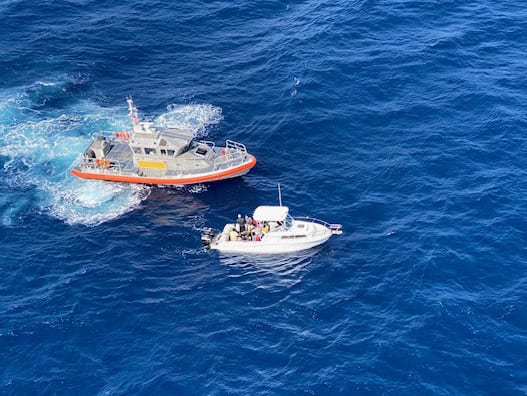
Coast Guard Station Lake Worth Inlet rescue crews arrived on scene to a 30-foot reportedly taking on water approximately 30 miles off Jupiter, Florida, March 4, 2021. The crew determined the vessel was not in distress just overloaded with people. U.S. Coast Guard
MIAMI — Coast Guard Station Lake Worth Inlet and Customs and Border Protection Air and Marine Operations rescue crews interdicted a 30-foot vessel with 25 people aboard March 3 after they called for help reporting they were taking on water approximately 30 miles northeast of Jupiter, the Coast Guard7th District said in a release.
The Station Lake Worth Inlet rescue crew determined the vessel was overloaded and not in danger of sinking. There were no reported medical concerns.
Coast Guard Cutter William Flores arrived on scene and embarked 25 Haitian nationals: nine adult males, nine adult females, and seven accompanied minors for repatriation to Haiti.
“Thankfully, the people aboard this vessel had a VHF radio in order to call for help, but there wasn’t any other lifesaving equipment on board,” said Senior Chief Petty Officer Jason Reynolds, command duty officer, Sector Miami. “The risk of loss of life is too great to take to the seas in overloaded, unseaworthy vessels and no lifesaving gear.”
Since Oct. 1, 2020, Coast Guard crews have interdicted 181 Haitians compared to fiscal year 2020, Oct. 1, 2019 – Sept. 30, 2020, where crews interdicted 418 Haitians.
Once aboard a Coast Guard cutter, all migrants receive food, water, shelter and basic medical attention. Throughout the interdiction, Coast Guard crew members were equipped with personal protective equipment to minimize potential exposure to any possible case of COVID-19. There were no migrants in these cases reported to have any COVID-19 related symptoms.
Seaborne Targets Depot Team Demonstrates Contribution to Readiness
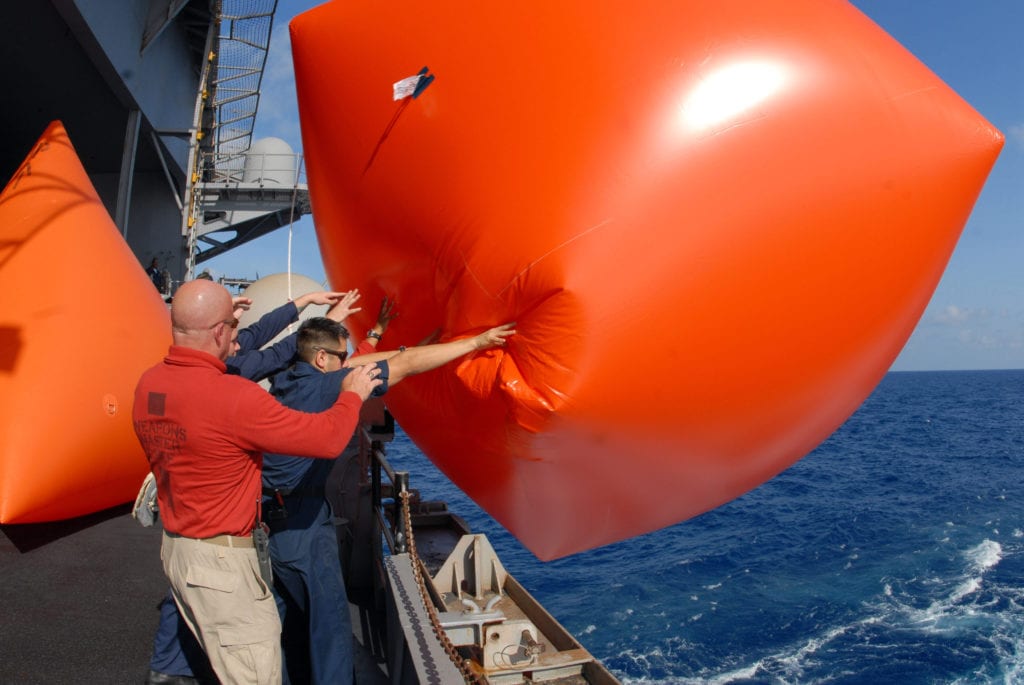
Weapons Department Sailors aboard the Nimitz-class aircraft carrier USS Ronald Reagan launches an inflated target, Killer Tomato, to allow the ship’s full-bore team a chance to fire on a active target. U.S. Navy / Petty Officer 2nd Class Gary Prill
PORT HUENEME, Calif. – The U.S. Navy’s Seaborne Targets team from Program Executive Office (PEO) Ships and NAVAIR’s Naval Air Warfare Center Weapons Division (NAWCWD) demonstrated its essential capabilities to Chief of Naval Operations (CNO) Adm. Michael Gilday, during his visit to Naval Base Ventura County, Port Hueneme, Feb. 26, Team Ships Public Affairs said in a March 5 release.
Seaborne targets are used during the required testing and training of missile systems, guns, and other weapons designed to destroy an approaching “threat” to ships and aircraft. Adm. Gilday viewed unique capabilities of the Government-developed remote-control system used to control the target boats. The remote-control system allows range operations personnel to control target boats in groups or formations, realistically simulating the threat of multiple boats simultaneously attacking a ship. Various types and configurations of seaborne targets were also on display.
“The CNO has tasked us with maintaining our advantage at sea and we know that threats to ships and aircraft are constantly emerging and evolving,” said Mike Kosar, program manager, Auxiliary Ships, Small Boats and Craft, Program Executive Office (PEO) Ships. “The Navy must constantly adapt by developing new weapons systems to counter those threats and therefore, must develop new seaborne targets to test the systems and train operators to respond to the approaching threat.”
Seaborne targets are known for their orange color which allows them to be easily identified. The Navy’s inventory of seaborne targets is comprised primarily of self-propelled boats and barges or floating pontoons designed to be towed behind the boats.
To produce target boats, the PEO Ships Support Ships, Boats and Craft program office works to procure and deliver them and installs remote control systems on the boats following delivery. NAWCWD personnel perform final assembly of all tow targets in Port Hueneme. Seaborne Targets Depot personnel test the targets before shipping them to the sea ranges where they are ultimately used.
“The in-house capabilities of the Seaborne Targets team enable us to retain the technical knowledge and expertise required to provide support wherever our targets are used,” Kosar said. “Our surface force must have confidence in the reliability of the systems and weapons they are given. The vital work of the Seaborne Targets team helps ensure the readiness of our warfighters.”
HII Announces the Election of Kari Wilkinson as Ingalls Shipbuilding President
Kari Wilkinson, incoming executive vice president of Huntington Ingalls Industries and president of Ingalls Shipbuilding. HII
NEWPORT NEWS, Va.–Huntington Ingalls Industries’ (HII) board of directors has elected Kari Wilkinson to serve as executive vice president of HII and president of HII’s Ingalls Shipbuilding division, effective April 1, the company announced in a March 5 release. She will succeed Brian Cuccias, who announced he will retire April 1.
Cuccias was named Ingalls Shipbuilding president in 2014 and is responsible for all programs and operations at the shipyard in Pascagoula, Mississippi. His career began in 1979 when he joined Litton Data Systems as a financial analyst on several Navy programs. Prior to becoming president of Ingalls, Cuccias held various positions of increasing responsibility at the division, including vice president, amphibious ship programs and vice president, program management.
“Under Brian’s leadership, Ingalls Shipbuilding optimized production, improved performance and continued meeting or exceeding customer commitments through many significant and unforeseen challenges,” said HII Executive Vice President and Chief Operating Officer Chris Kastner. “His shipbuilding expertise brought immeasurable value, and his contributions to this business have positioned Ingalls for lasting success.”
Kari Wilkinson, who will report to Kastner, currently serves as Ingalls’ vice president, program management.
“Kari is a respected leader with an impressive 25-year record of success managing programs and overseeing major shipbuilding initiatives at Ingalls,” Kastner said. “Her focus on operational excellence, exemplary leadership skills and ability to build effective customer relationships well positions her for this new role, and I look forward to working with her to continue the Ingalls Shipbuilding legacy of success.”
Wilkinson began her career with Ingalls as an associate naval architect in 1996. Since that time, she has supported major shipbuilding production events and milestones from positions in engineering, has worked closely with business development on requirements and preliminary ship designs for both domestic and international customers, and also coordinated the prioritization of equipment and processes in operations during the Hurricane Katrina recovery effort.
Wilkinson transitioned into program management in 2007 as a ship program manager for the San Antonio-class LPD program, assuming the position of vice president, program management in 2016. In this current role, she has profit and loss responsibility for all elements of program execution and serves as the principal liaison to the Navy and Coast Guard for all platforms in the Ingalls portfolio.
Originally from Jenison, Michigan, Wilkinson earned a bachelor of science in naval architecture and marine engineering from the University of Michigan, and an MBA from Temple University.
U.S. Will Fight from Guam and for Guam, U.S. Indo-Pacific Commander Says
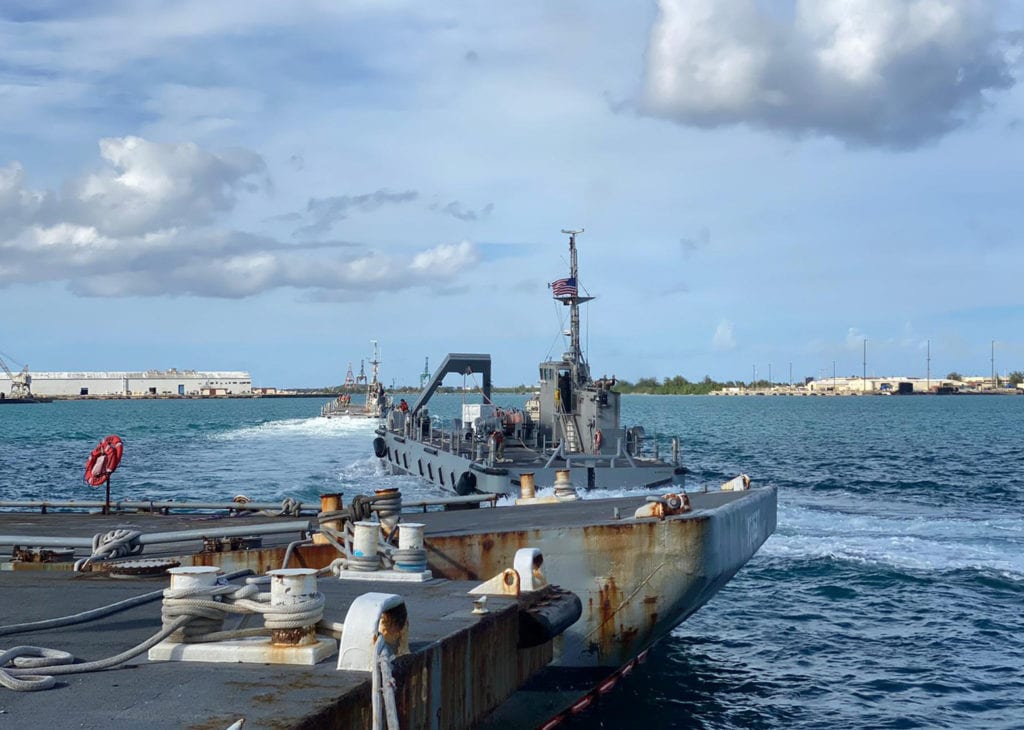
Sailors deployed from Naval Beach Group 1 navigate Improved Navy Lighterage Systems in Apra Harbor, Guam. U.S. Navy / Chief Boatswain’s Mate Daniel Nguyen
ARLINGTON, Va. — The Navy admiral in charge U.S. Indo-Pacific Command said building up the defenses of Guam is his highest budget priority and reminded observers Guam is not just a base for military operations but a part of the American homeland, and should be defended as such.
Guam, a large island southernmost of the Marianas island chain, is a U.S. territory and has been a U.S. base since before World War II — except for the Japanese occupation during 1941-1944.
“Guam is absolutely critical in maintaining deterrence and stability in the region,” said Adm. Philip Davidson, commander, U.S. Indo-Pacific Command, speaking March 4 during a webinar of the American Enterprise Institute, a Washington think tank. “It is our most critical operating location west of the International Dateline. Funding for the air and missile defense of Guam is my Number 1 priority — most importantly because Guam is U.S. homeland.
“There are 170,000 Americans living in Guam, and their defense is homeland defense,” Davidson said. “Defense Department personnel comprise some 13% of the total population on Guam, a total of nearly 22,000 service members, civilians, contractors and family members that are supporting America’s of Guam. That doesn’t even include rotational forces [that deploy to Guam].”
Davidson said Guam is a “critical nexus for command and control, for logistics and sustainment, and for power. It has strategic deep-water ports and airfields. We have billions of dollars in military capability in Guam today and there are billions of dollars programmed by the United States to advance those capabilities tomorrow.”
He pointed to an example, Marine Corps Base Camp Blaine, established in November 2020 and built to garrison 5,000 Marines as the first new Marine Corps base established in the Pacific since 1952.
The admiral wants to establish Aegis Ashore missile-defense facilities in Guam to augment the Terminal High-Altitude Area Defense radar system already in Guam and provide 360-degree missile defense of the island and “the full spectrum of detect-to-engage sequence, the sensing, the network and the delivery of fires to support our maneuver.”
He pointed out that an Aegis Ashore facility would accomplish what otherwise would require three Arleigh Burke-class guided-missile destroyers to defend Guam, ships that could be freed to employ their multi-mission capabilities elsewhere.
Davidson responded to critics who say that bolstering missile defenses of Guam would make the island a target, noting that “it already is one. China is making no secret of this fact, as evidenced in last fall’s widely circulated PLA Air Force propaganda video which specifically depicted an attack on a mock-up of Andersen Air Force Base in Guam.
“In all, the Guam defense system will allow us to regain the advantage, help us to deter China, and will demonstrate our steadfast commitment to our allies and partners in the region that we are here to stay and to defend what is ours,” he said. “… It is not a de facto status that we only need to be able to fight from [Guam] — we’re going to have to be able to fight for it, and missile defense in the region is critical.”
SECDEF Announces Marine General Promotions
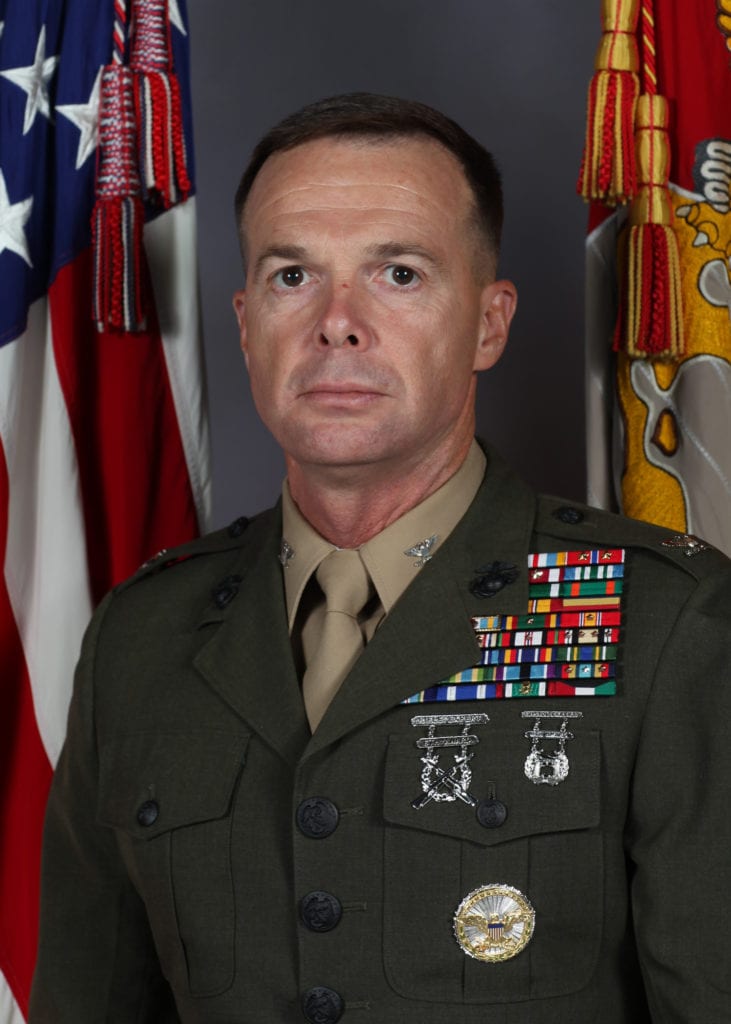
Brig. Gen. Jay M. Bargeron, nominated for appointment to the rank of major general, one of several flag officer nominations announced March 4. U.S. Marine Corps
ARLINGTON, Va. — Secretary of Defense Lloyd J. Austin III announced on March 4 that the president has made the following nominations:
Marine Corps Brig. Gen. Jay M. Bargeron has been nominated for appointment to the rank of major general. Bargeron is currently serving as president, Marine Corps University, Training and Education Command, Quantico, Virginia.
Marine Corps Brig. Gen. Brian W. Cavanaugh has been nominated for appointment to the rank of major general. Cavanaugh is currently serving as assistant deputy commandant, programs and resources, Headquarters, U.S. Marine Corps, Washington, D.C.
Marine Corps Brig. Gen. Dimitri Henry has been nominated for appointment to the rank of major general. Henry is currently serving as director, J-2, U.S. Central Command, MacDill Air Force Base, Florida.
Marine Corps Brig. Gen. Ryan P. Heritage has been nominated for appointment to the rank of major general. Heritage is currently serving as commanding general, Marine Corps Recruit Depot San Diego; and commnding general, Western Recruiting Region, San Diego, California.
Marine Corps Brig. Gen. Christopher A. McPhillips has been nominated for appointment to the rank of major general. McPhillips is currently serving as commanding general, 1st Marine Aircraft Wing, Okinawa, Japan.
Marine Corps Brig. Gen. Robert B. Sofge Jr. has been nominated for appointment to the rank of major general. Sofge is currently serving as deputy commander, U.S. Marine Corps Forces Pacific, Camp Smith, Hawaii.
Marine Corps Brig. Gen. Matthew G. Trollinger has been nominated for appointment to the rank of major general. Trollinger is currently serving as deputy director, Politico-Military Affairs (Middle East), J-5, Joint Staff, Washington, D.C.
Marine Corps Col. Joseph R. Clearfield has been nominated for appointment to the rank of brigadier general. Clearfield is currently serving as assistant chief of staff, G-3, U.S. Marine Corps Forces Cyberspace Command, Fort George G. Meade, Maryland.
Marine Corps Col. Mark H. Clingan has been nominated for appointment to the rank of brigadier general. Clingan is currently serving as chief of staff, III Marine Expeditionary Force, Okinawa, Japan.
Marine Corps Col. Simon M. Doran has been nominated for appointment to the rank of brigadier general. Doran is currently serving as special assignment officer, Royal Air Force, British Armed Forces, London, United Kingdom.
Marine Corps Col. Walker M. Field has been nominated for appointment to the rank of brigadier general. Field is currently serving as military fellow, Council on Foreign Relations, New York, New York.
Marine Corps Col. Anthony M. Henderson has been nominated for appointment to the rank of brigadier general. Henderson is currently serving as director, concepts and plans, Marine Corps Warfighting Laboratory, Marine Corps Base Quantico, Virginia.
Marine Corps Col. Michael E. McWilliams has been nominated for appointment to the rank of brigadier general. McWilliams is currently serving as executive assistant for deputy commandant, installations and logistics, Headquarters, U.S. Marine Corps, Washington, D.C.
Marine Corps Col. Matthew T. Mowery has been nominated for appointment to the rank of brigadier general. Mowery is currently serving as operations and readiness branch head, Aviation Plans, Programs, Joint/Congressional Matters, Doctrine and Budget Branch, Aviation Branch, Headquarters, U.S. Marine Corps, Washington, D.C.
Marine Corps Col. Andrew M. Niebel has been nominated for appointment to the rank of brigadier general. Niebel is currently serving as chief of staff, Marine Corps Installations Command, Headquarters, U.S. Marine Corps, Washington, D.C.
Marine Corps Col. Ahmed T. Williamson has been nominated for appointment to the rank of brigadier general. Williamson is currently serving as military assistant, Office of the Assistant Commandant of the Marine Corps, Headquarters, U.S. Marine Corps, Washington, D.C.
Marine Corps Reserve
Marine Corps Reserve Brig. Gen. Mark A. Hashimoto has been nominated for appointment to the rank of major general. Hashimoto is currently serving as commanding general, Force Headquarters Group, U.S. Marine Forces Reserve, New Orleans, Louisiana.
Marine Corps Reserve Col. Sean N. Day has been nominated for appointment to the rank of brigadier general. Day is currently serving as deputy commander, Force Headquarters Group, U.S. Marine Corps Forces Reserve, New Orleans, Louisiana.
Coast Guard Set to Retire Last High-Endurance Cutter, Commandant Says
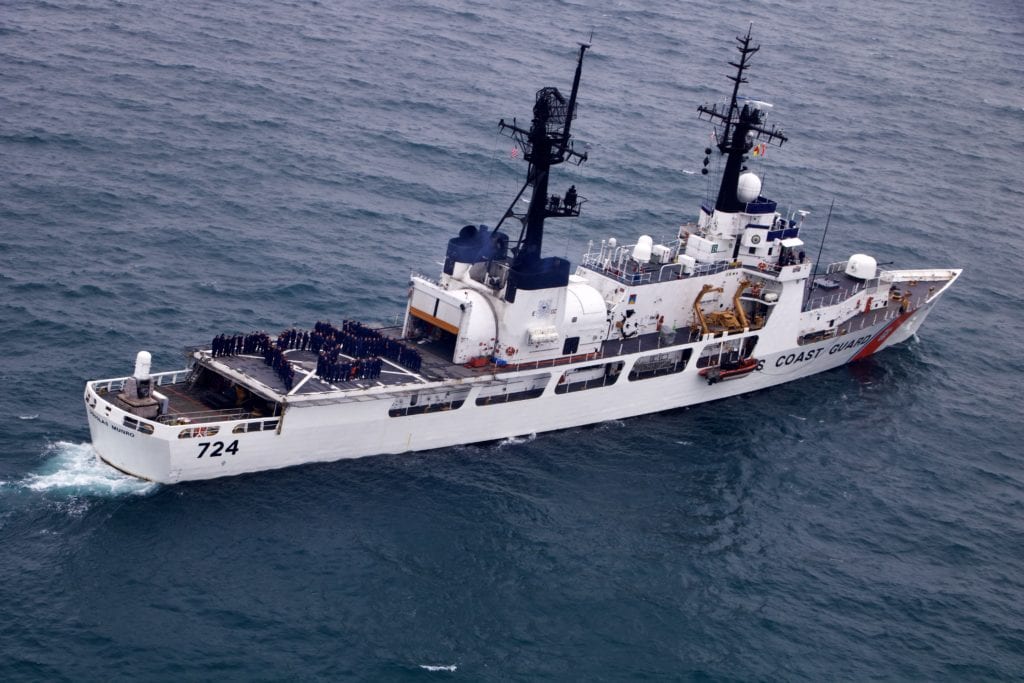
Members from Coast Guard Cutter Douglas Munro stand in formation on the back of the cutter, July 24, 2020. The cutter’s hull day, July 24, correlates with its hull number, 724. U.S. Coast Guard
WASHINGTON —The Coast Guard will retire USCGC Douglas Munro at the end of March, concluding 49 years of Coast Guard service for the cutter and 54 years for the Secretary-class 378-Foot cutters.
In a March 4 message to the Coast Guard, Commandant Adm. Karl L. Schultz said that on March 31 the Douglas Munro would be placed in In-Commission Special Status, which begins the decommissioning process.
The 12 Secretary-class cutters were the mainstay of the Coast Guard’s ocean-going fleet until their replacement began 13 years ago by the new Legend-class national security cutters. Some deployed with carrier strike groups and operated in the Persian Gulf. They had an anti-submarine warfare (ASW) capability until 1992, when it was removed. The same year some were armed with Harpoon anti-ship missiles. The original 5-inch gun mounts were replace in the late 1980s to mid-1990s with Mk75 76mm guns.
The Douglas Munro, built by Avondale Shipyards in Louisiana, was commissioned on Sept. 27, 1971. It was named Munro until the Coast Guard’s new Legend-class national security cutter USCGC Munro was built.
As the high-endurance cutters were decommissioned, they were transferred to foreign navies or coast guards. Hamilton, Dallas and Boutwell have been transferred to the Philippines; Chase and Gallatin to Nigeria; Jarvis and Rush to Bangladesh; Morgenthau to Vietnam; Sherman to Sri Lanka, and Mellon to Bahrain. John Midgette is in Seattle being prepared for delivery to Vietnam. Douglas Munro likely will serve in a foreign navy as well, though transfer has not yet been announced.
Communications, Information Sharing Seen as Critical for Middle East Shipping Security
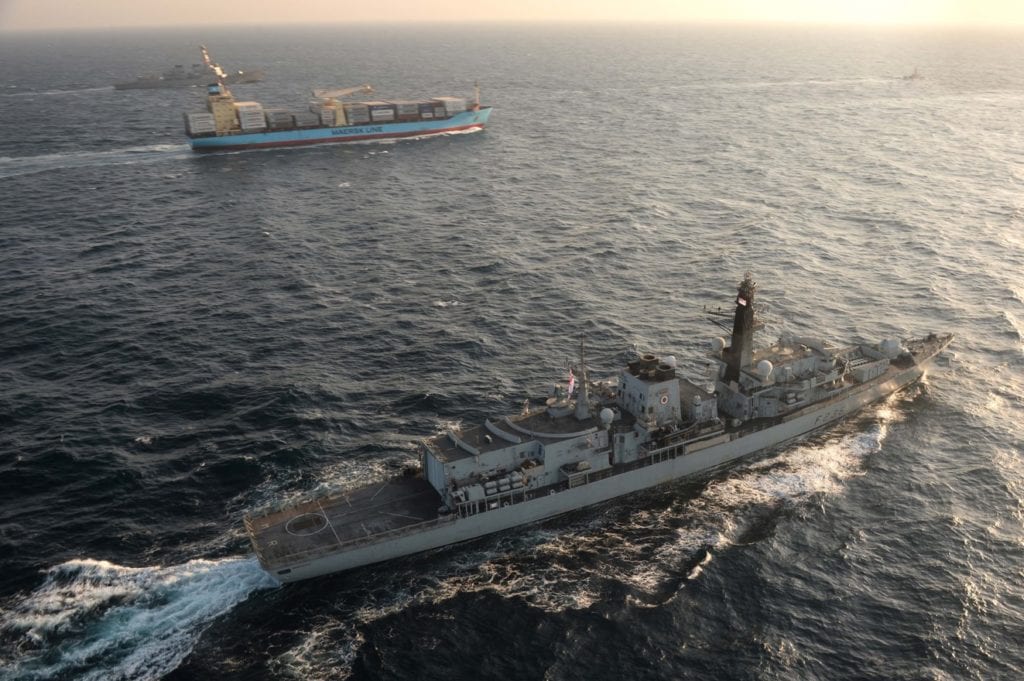
Collaboration between merchant shipping and military forces is seen as critical to securing trade flows across the Middle East. NCAGS
Collaboration between the merchant shipping community and coalition military forces is critical in securing maritime trade flows across the Middle East region, with communications and information sharing central to such collaboration, a U.S. Navy officer told a recent regional shipping stakeholder conference.
“Events have made it clear that no one entity alone can provide assurance to merchant shipping in this region,” Capt. Todd Hiller, commanding officer of Bahrain-based Naval Forces Central Command’s (NAVCENT’s) Naval Cooperation And Guidance for Shipping (NCAGS) organization, told the annual International Maritime Security Construct (IMSC) conference last month. “Never before has it been more important to collaborate with our coalition partners and stakeholders to protect freedom of navigation in this critical part of the world.”
Established in 2019 following attacks on commercial ships in port and at sea, IMSC is a multinational maritime coalition designed to deter “gray zone” threats to commercial shipping operating between the Southern Red Sea and the Northern Gulf. The 2021 conference, titled Security through Partnership, was IMSC’s second annual event, held virtually due to the Covid-19 pandemic.
While IMSC-led naval presence has done much to deter attacks, risk persists. “From unmanned vessel-borne improvised explosive device attacks, to limpet mines attached to the hulls of tankers, to the recent seizure of the Motor Tanker Hankuk Chemi … these threats continue to attempt to destabilize commercial shipping,” Hiller said.
“Given the high risk of navigating, and security interests in the Middle East, there has been a steady uptick in stakeholder involvement in information sharing,” he said. “More times to not, stakeholders and coalition partners have shared specific knowledge and expertise that is paramount in staying ahead of the [risk].”
NCAGS acts as a key node in such information sharing, Hiller said. “NCAGS is an organization that bridges the gap between sustainment of forward-deployed military forces and merchant shipping, by providing a framework for communicating directions, advisories, concerns, and information. The mission is to assist the [U.S. 5th] Fleet commander in managing risk by providing maritime domain awareness (MDA), real-time clarity of the merchant shipping picture, and ensuring safe passage of merchant shipping in crisis or contingency.”
Staffed by U.S. Navy reservists, many of whom are merchant mariners or strategic sealift officers, NCAGS can scale up from providing single personnel as merchant marine advisors or liaison officers ashore or at sea, to a large theater contingent providing a shipping coordination center with teams assigned ashore or at sea.
Effective communications and information sharing is two way, Hiller said. For NCAGS, its outputs include creating incident reports, conducting ship visits, recommending transit routes, providing subject matter expertise, sharing best practice (currently based around the stakeholder-produced Best Management Practice document, or BMP 5), supporting NAVCENT forces and building and sharing an overall MDA and “pattern of life” picture. NCAGS is a touchpoint for shipping, for example for vessels transiting high-risk regions like the Southern Red Sea or the Straits of Hormuz. In return, the shipping community shares ship, cargo, and voyage information with NCAGS and encourages vessel masters to follow BMP5 guidance and report incidents to help build MDA.
“[Sharing] the most current information and accurate assessment of the merchant shipping picture is critical to the establishment of the ‘pattern of life’ and the achievement of MDA,” Hiller said.
From NCAGS’ perspective, effective communications and information sharing are enabled by its monitoring, tracking, and wider information technologies.
“Staying ahead with the latest information technology will keep NCAGS ahead of adversaries and reduce risk as it relates to operations, monitoring and surveillance, piracy, war, or other risks that could potentially impact MDA and patterns of life within the region,” Hiller said.
Hiller told Seapower that NCAGS information technologies include AIS Live and the SeaVision web-based maritime situational awareness tool, and that it is procuring the Maritime Intelligence Risk Suite tool that combines shipping database, real-time ship tracking, and risk event information.