HII Achieves Milestone in RCOH of USS George Washington
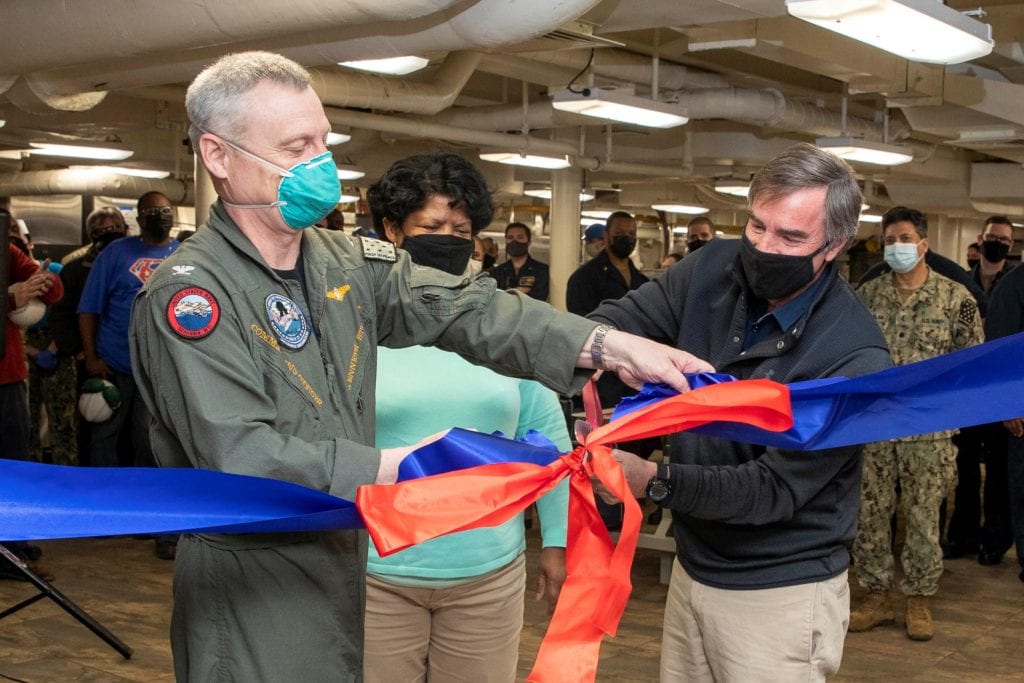
The aircraft carrier USS George Washington (CVN 73) celebrated the reopening of the aft crew mess with a ribbon-cutting ceremony on April 16, 2021. Pictured (Left to right): Capt. Kenneth Strong, the ship’s commanding officer; CVN 73 program director Thomasina Wright; and Scott Menkes, deputy project supervisor for Supervisor of Shipbuilding, Newport News. U.S. NAVY / MCSN Dakota Nack
NEWPORT NEWS, Va. — Huntington Ingalls Industries’ Newport News Shipbuilding division reached a major milestone on the refueling and complex overhaul (RCOH) of USS George Washington(CVN 73), the company said in an April 16 release.
Following a ribbon-cutting ceremony, Sailors ate the first meal prepared in the galley in the nearly three years since the ship arrived at Newport News. The opening of the crew galley is one of the last significant steps before the first 1,100 Sailors are expected to move aboard in June.
“George Washington has gone through a transformation since it arrived at Newport News for the mid-life refueling overhaul and maintenance availability,” said Todd West, Newport News’ vice president, in-service aircraft carrier programs. “The crew beginning their move aboard and the reopening of berthing spaces and galleys, all supporting our nearing completion of the RCOH, is a sign that the ship is being brought back to life. We look forward to continuing our work with our Navy partners to redeliver the ship to the fleet.”
The Nimitz-class aircraft carrier is in the final stages of testing, which is designed to exercise all aspects of the propulsion plant systems and will certify the systems and components for future operations over the next 25 years of service. The RCOH is more than 85% complete, and the ship is on track to be re-delivered to the Navy in 2022.
Aircraft Carrier Industrial Base Coalition Confident of Another Dual-CV Buy
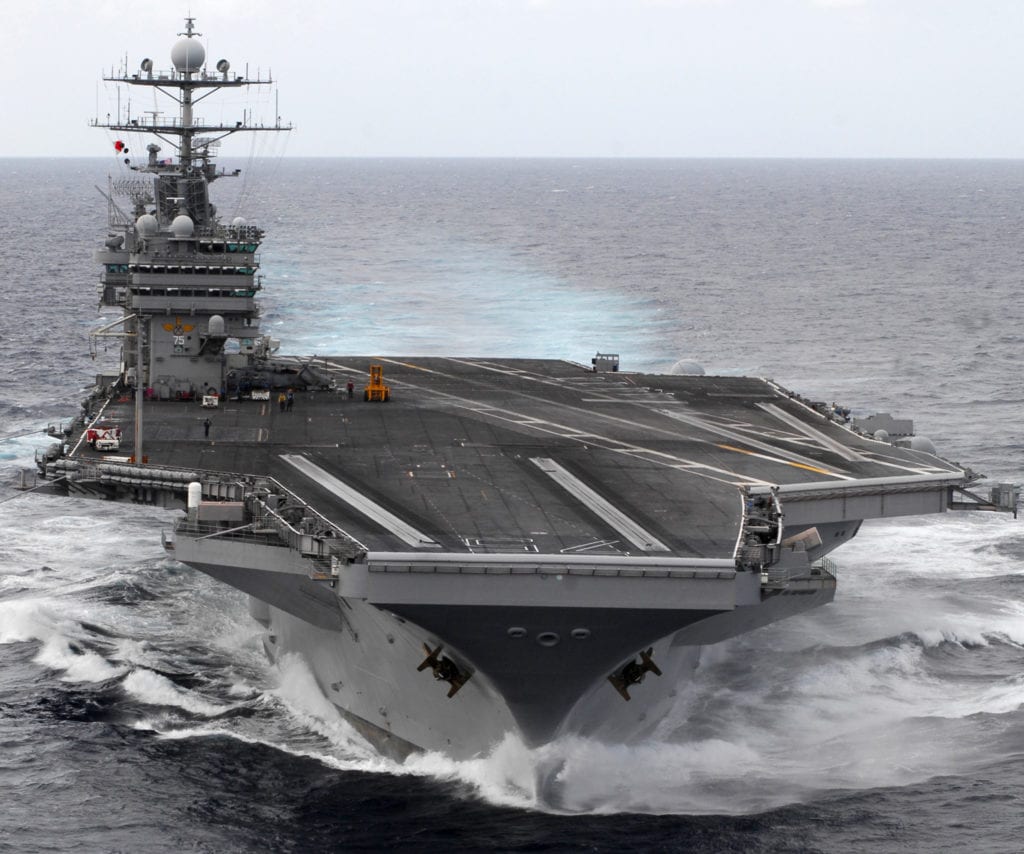
The Nimitz-class aircraft carrier USS Harry S. Truman (CVN 75), due to be retired, a move opposed by the Aircraft Carrier Industrial Base Coalition. U.S. NAVY
ARLINGTON, Va. — The chairman of the industrial coalition of suppliers for the Navy’s aircraft carriers said the coalition supports continuing to build large aircraft carriers instead of light ones and predicts there will be another dual-carrier procurement in the future.
“We’re strong supporters of the large platform,” said Rick Giannini, chairman of the Aircraft Carrier Industrial Base Coalition (ACIBC), who also is president and chief executive officer of Milwaukee Valve Co. in New Berlin, Wisconsin, in an interview with Seapower.
Giannini said the size of the Navy’s carrier aircraft demand a large flight deck to sustain a high sortie rate and that a large aircraft carrier is the most survivable airfield.
The Navy will be conducting an analysis of the concept of light aircraft carriers.
“I believe the L-class ships [amphibious assault ships] operating with the F-35B would fit that bill,” said Rear Adm. Gregory Harris, the Navy’s director for Air Warfare, speaking last month at a Navy League Special Topic Breakfast webinar, sponsored by General Dynamics. “Others would disagree.”
Harris said he is “confident that over the long run we’ll find that there’s not a compelling return on investment to make a smaller carrier just [because of] speed, station-keeping, the air wing that you would put on top of that carrier, and the ability to have the fuel for the air wing and for the carrier to have for the surface combatants.”
The ACIBC members meet on Capitol Hill every year to lobby Congress. This year’s virtual session included more than 260 companies holding more than 123 scheduled meetings with members of Congress to impress upon them the importance of aircraft carriers to the national defense.
“We’re doing everything we can to get that message out,” Gianni said.
The ACIBC represents the more than 2,000 supplier companies in 46 states, supporting 92,000-plus jobs. These companies inject over $8.8 billion into our nation’s economy.
He was critical of proposed initiatives to retire the USS Harry S. Truman instead of refueling it for another quarter century of service, noting the Navy risks falling below the legally mandated number of 11 aircraft carriers.
That leads right back to the industrial base, because for us it’s all about stability and predictability of where those funds ae coming from,” Giannini said, noting that the Navy’s two-ship buy of CVN 80 and 81 brought a lot of stability to the suppliers.
“We’re always concerned when a new administration comes in every time these things are starting over for the next ship in the class,” he said. “We’re fortunate right now; we have two [CVNs] in the pipeline — orders in [fiscal 2019] for eight years of work. We’re still confident that the reasons carriers have been required for the last 50 years aren’t going to be any different than the requirements for the next 50 to 100 years.
“We remain confident there will be another block buy for [CVNs] 82 and 83, because it is the best way to spend the nation’s money, which is to ensure that the supply base has this steady and predictable stream of work, so we can lower the cost,” he said.
Giannini pointed to the example of a class of valves supplied by his company that, because of the last dual-carrier buy, were produced at 20-25% lower cost. Not only is the cost being reduced because the orders for both ships come at once, but additional cost savings come by being able to order materials at today’s prices rather than at future prices.
USS Oakland Commissioning Ceremony Set for April 17
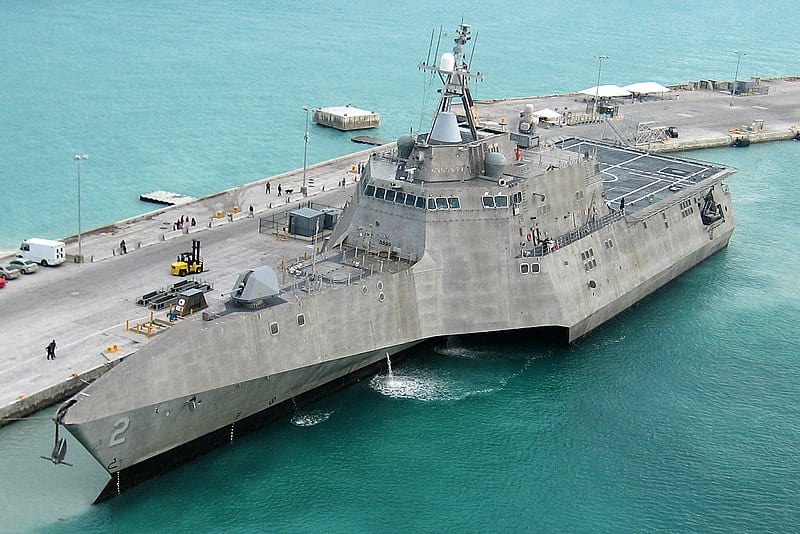
The USS Independence, a sister ship to the future USS Oakland, which will be commissioned on Saturday, April 17. U.S. NAVY
ARLINGTON — The Navy’s newest Freedom-variant littoral combat ship, the future USS Oakland (LCS 24), will be commissioned at 10:00 a.m. PST on Saturday, April 17, 2021 in Oakland, California, the Defense Department said in an April 16 release.
Due to public health and safety concerns related to the novel coronavirus (COVID-19) pandemic, the commissioning will be a private event. The ceremony will be live-streamed for those unable to attend. The following link will become active approximately five minutes prior to the event (9:55 a.m. PST): https://allhands.navy.mil/Live-Stream.
Acting Secretary of the Navy Thomas W. Harker, will deliver the commissioning ceremony’s principal address. Ms. Kate Brandt, Google sustainability officer, is the ship’s sponsor. The ceremony will be highlighted by a time-honored Navy tradition when Ms. Brandt gives the order to “man our ship and bring her to life!”
Cmdr. Francisco X. Garza, a native of Phoenix, Arizona, is the ship’s commanding officer and leads a crew of 70 officers and enlisted personnel. The 3,200-ton Oakland was built by General Dynamics/Austal USA in Mobile, Alabama. The ship is 421 feet in length, has a beam of 103 feet, and a navigational draft of 15 feet. The ship is powered by two gas turbine engines, two main propulsion diesel engines, and four waterjets to reach speeds up to 40-plus knots.
“The USS Oakland crew is excited and ready to bring our ship to life and join the fleet,” said Garza. “We are privileged to be a part of this ship and embody the spirit of the people of Oakland. As plank owners and future crew members build a positive legacy for this ship, the city of Oakland will experience those successes with us.”
Oakland is the third ship to bear the name. She is the 12th Independence-variant LCS and the 297th ship to join our battle force. The littoral combat ship is a fast, agile, focused-mission platform designed to operate in near-shore environments, while capable of open-ocean tasking and winning against 21st-century coastal threats such as submarines, mines, and swarming small craft. The LCS is capable of supporting forward presence, maritime security, sea control, and deterrence.
USS Oakland will be homeported at Naval Base San Diego, California.
Five Marine Officers Nominated, Renominated to Lt. General
Lt. Gen. David G. Bellon, reappointed to the grade of lieutenant general and assigned as commander, Marine Forces Reserve, one of several nominations announced April 16. U.S. MARINE CORPS
ARLINGTON, Va. – Secretary of Defense Lloyd J. Austin III announced April 16 that the president has made the following nominations:
Marine Corps Lt. Gen. David G. Bellon for reappointment to the grade of lieutenant general, and assignment as commander, Marine Forces Reserve; and commander, Marine Forces South. Bellon is currently serving as commander, U.S. Marine Forces Reserve, New Orleans, Louisiana.
Marine Corps Lt. Gen. George W. Smith Jr. for reappointment to the grade of lieutenant general, and assignment as commanding general, I Marine Expeditionary Force. Smith is currently serving as the deputy commandant for plans, policies, and operations, Headquarters, U.S. Marine Corps, Washington, D.C.
Marine Corps Maj. Gen. Edward D. Banta for appointment to the grade of lieutenant general, and assignment as deputy commandant for installations and logistics, Headquarters, U.S. Marine Corps. Banta is currently serving as commander, Marine Corps Installations Command; and assistant deputy commandant for installations and logistics (facilities), Headquarters, U.S. Marine Corps, Washington, D.C.
Marine Corps Maj. Gen. Kevin M. Iiams for appointment to the grade of lieutenant general, and assignment as commanding general, Training and Education Command. Iiams is currently serving as the assistant deputy commandant for combat development and integration; and deputy commanding general, Marine Corps Combat Development Command, Marine Corps Base Quantico, Virginia.
Marine Corps Maj. Gen. William M. Jurney for appointment to the grade of lieutenant general, and assignment as commanding general, II Marine Expeditionary Force. Jurney is currently serving as commanding general, Marine Air Ground Task Force Training Command; and commanding general, Marine Corps Air Ground Combat Center, Twentynine Palms, California.
Forecasting for the Fleet: Naval Meteorology and Oceanography Command Monitors Weather, Ocean and Atmospheric Conditions to Keep the Navy in the Fight
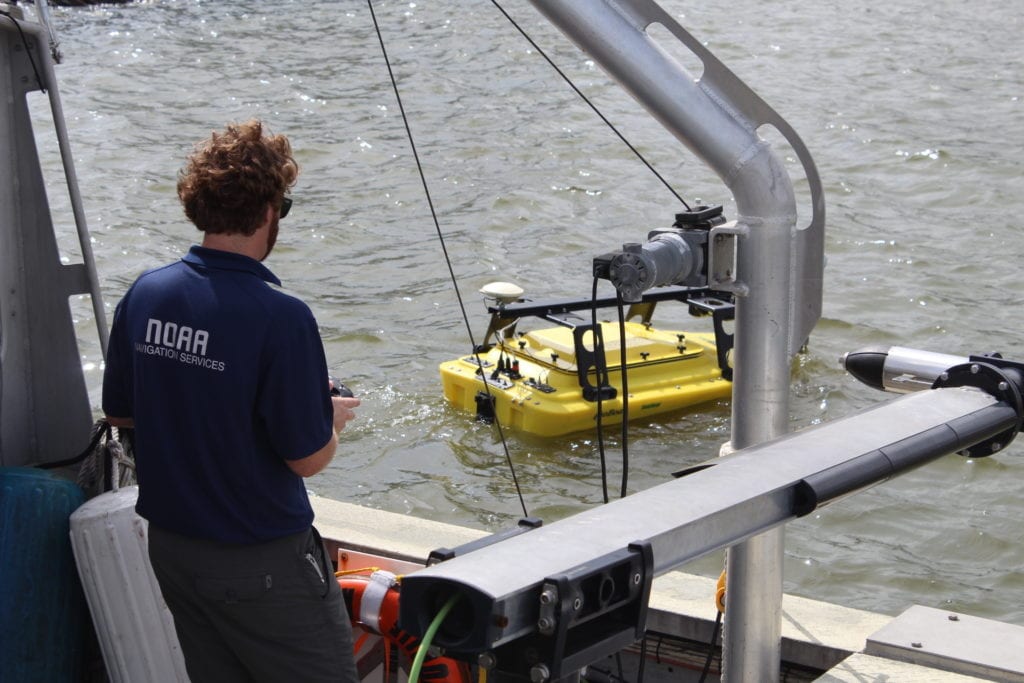
Personnel from the National Oceanic and Atmospheric Administration (NOAA) operate an autonomous surface vehicle (USV) in the Port of Gulfport, Miss., during the Commander, Naval Meteorology and Oceanography Command’s (CNMOC) Advanced Naval Technology Exercise (ANTX) on Nov. 6, 2019. ANTX is a catalyst for innovation, experimentation and high velocity learning featuring more than 50 participants including industry partners. The exercise tests and evaluates technologies and future concepts that address human and machine interactions within the maritime domain. NAVAL OCEANOGRAPHY / Kayla Adcock
Everyone wants accurate weather predictions, but for the military, and the Navy in particular, they can be crucial — typhoons can sink ships and bad weather can force operational delays.
Providing timely and accurate weather predictions and information about the maritime environment falls to the roughly 2,500 military members and civilians who work for the Naval Meteorology and Oceanography Command.
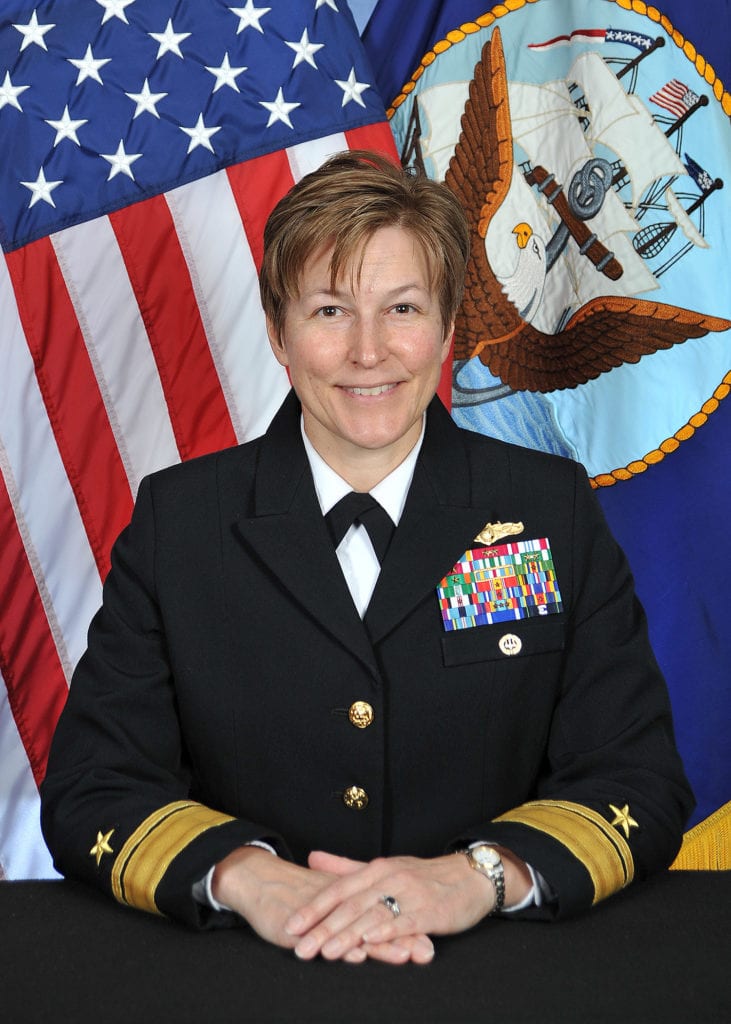
“Naval oceanography applies meteorological, oceanographic and astrometric decision-science expertise across every aspect of warfare,” said Rear Adm. John A. Okon, who heads the Stennis Space Flight Center, Mississippi-based command. “No other organization across our government, [including] the Department of Defense, applies this knowledge under, on or above the sea in a manner with assured information that can be protected and relied upon in the high-end fight.”
The Navy’s antisubmarine, mine, electromagnetic and special warfare communities all depend upon information the Naval Oceanography Operations Command — which reports to Okon — gathers and processes. Six Pathfinder-class (T-AGS) survey ships and a fleet of unmanned underwater vehicles operate while forward deployed, constantly compiling data.
Buoyancy gliders, drifters, upper-air balloons, satellites and telescopes monitor the operational space from the ocean floor to the stars, providing commanders with real-time understanding of the conditions in which they conduct their missions. The data is processed into numerical models that forecast conditions of the atmosphere, ocean, waves, ice and surf as accurately as possible — and predict how they would affect the performance of weapons systems and fleet operations.
“We use high-performance computing to match with the expert knowledge of our Sailors and civilians — subject matter experts — to develop various certain scenarios that might affect fleet operations,” Okon said.
For example, a typhoon moving through the Western Pacific would certainly curtail surface-fleet operations, Okon said, but offer optimal conditions to conduct antisubmarine warfare. “This is a critical tier that develops environmental knowledge and a predictive advantage to the fleet.”
Round the Clock Forecasting
The Fleet Numerical Meteorology and Oceanography Center (FNMOC) engages in round-the-clock, high-performance computing at all levels of security, from unclassified to top secret. “FNMOC has the nation’s only information-assured modeling capability,” Okon said.
Fleet weather centers at Norfolk and San Diego naval stations can take information from both the Oceanography Operations Command and FNMOC and provide operational area forecasts to the fleet as it is in route, Okon said. Even though such actions ensure a margin of safety, Okon pointed out that “Mother Nature always gets a vote.”
The cooperative effort among the production centers and the fleet weather center provides further information that would keep the forces of nature from wreaking havoc on a mission, Okon said. Additionally, the U.S. Naval Observatory in Washington, D.C., provides the authoritative time reference essential for precise navigation and positioning necessary for accurate computer operation, as well as targeting of weapons and systems.
Okon described the concept of battlespace on demand as a multi-tiered pyramid. The bottom layer consists of observational platforms, with eyes on the oceans, the atmosphere and space. The next tier employs models generated from those observations, providing a functional understanding and prediction of any given environment. The top layer, he said, uses the collected information to determine how the environment would affect performance of forces and systems.
Ultimately, Okon said, the highly trained Sailors and civilians who work under him are experts in disseminating the data and providing the fleet with the predictive advantage they need. The work at hand requires what he calls a highly trained and motivated staff of apprentice, journeyman and master forecasters. “They’re the ones who link the data to decisions,” Okon said.
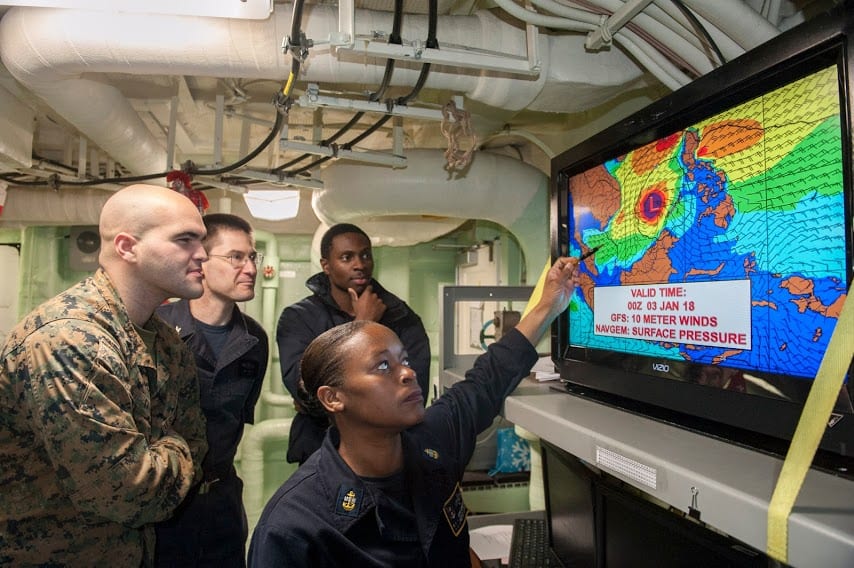
AGC Asya Andrews (right) reviews model data with her OA Division team onboard USS America (LHA- 6) to assess impacts of a developing tropical depression in the South China Sea in this 2017 photo. As a result of forecasting and model performance, the team anticipated the formation of Tropical Depression 01W and provided critical recommendations to the Amphibious Readiness Group that ensured safety of navigation during their transit home from their 5th and 7th Fleet Deployment. NAVAL OCEANOGRAPHY / Katey Turfitt
Much of his enlisted force consists of 975 aerographer’s mates. Some 340 officers are oceanographers, the senior-most of whom hold masters’ degrees in meteorology.
“We also have civilians who have dedicated their lives to this cause — naval oceanography — to predicting the physical battle space,” Okon said.
As technical lead for the command’s acoustics department, civilian Joseph Senne evaluates the effects on the environment as sound travels through water and into sediment. Any naval craft — manned, unmanned, surface or subsurface — will be affected, he said.
“We estimate geologic properties so that fleet systems give more accurate predictions of how acoustics interact with the seafloor as they’re moving through different world areas,” said Senne, a physicist who holds a doctorate in ocean engineering and master’s degree in marine science. While the general approach to the job is not new, Senne said, the work constantly changes as computers become more capable.
Senne and his colleagues work with other organizations in the Navy research community, including the Office of Naval Research (ONR), the Naval Research Laboratory (NRL) and the warfare development centers.
“We’re more the production piece, making sure that the answers we’re providing around the world are interacting with tactical decision aids and giving correct answers,” Senne said.
The different parts of the ocean change constantly, he said. Salinity, temperature and the water column itself all have an effect on the way sound travels.
“The cutting edge is being able to keep track of the spatial and temporal variability of the water column, as well as taking advantage of new technologies and methodologies to describe the geo-acoustic environment,” Senne said. “Sound that hits rocky outcroppings is going to behave very differently than when it’s hitting mud.”
Getting this information disseminated and delivered to the captain of a vessel can influence critical decisions. Correct information would better enable a sensor to accurately indicate that an object is one specific distance away or moving in one particular direction. Senne and his colleagues are called upon to spend considerable time at sea plying their trade, with productive results.
“We have mounted sensors on our ships that are multi- beam bathymetry and sub-bottom profiling measurement systems,” Senne said. “They’re putting out sound at very specific frequency bands.”
Based on how the sound reflects off of the sediment, the angle at which it is emitted and returned and travel time, shipboard crews can determine the depth of the water in which they are operating.
“We can do that at very high resolutions and are able to map out the seabed itself,” Senne said. “On top of that, on our acoustic surveys, we will trail seismic-type equipment behind us that is putting sound deeper into the sediment so that it’s not just reflecting from the water-sediment interface but from the layer interfaces of the sediment as well.”
Relaying the Message
The command’s Sailors have to be proficient in jobs that require mastery of a complicated skill set and explain its relevant points to people in leadership who must use them to take critical action at a moment’s notice. Chief Aerographer’s Mate Ciera Greene, an instructor at the Fleet Anti-Submarine Warfare Training Center at Point Loma, California, embraces the challenge.
“It’s super rewarding to have your products be valued at such a high level, and [to be] talking directly to the people making decisions,” Greene said. To be effective, Greene at times has to engage in jargon-filled discourse with her professional colleagues.
“When we’re going through our schooling, we are learning the parameters and rules and science of it all in depth,” Greene said.
But relaying relevant information to those who need it requires a different skill set that also must be learned, Greene said.
“When we talk to other people, we want to explain how we got our answers in definiteness [and] build our credibility,” Greene said. “When a weather briefing is due, you have to understand what everyone is thinking about, the things that matter and the things that could help. And you tailor your briefing to that.”
Bogging down presentations with technical jargon could mean a missed opportunity to inject a valuable piece of information into the decision-making process. The meteorological and oceanographic community, Greene said, uses data from its models primarily provide a level of safety.
“To be a part of the mission in a way that can only make it more efficient and effective is huge,” Greene said. “I’m very proud to be a part of it.”
As quick as Okon is to recognize the contributions civilians and Sailors like Senne and Greene, he understands that continued success hinges upon cooperative arrangements that extend both with and beyond the Navy com- munity. Partnerships with government agencies like the National Oceanic and Atmospheric Administration, and cooperative research and development agreements with industry, are essential to speed emerging technology through the production pipeline and deliver it to forward operators.
“It is a very big deal. These are key challenges for us, in under and on the sea,” Okon said.
Arrangements such as the command’s two-decade partnership with the University of Southern Mississippi and the Defense Advanced Projects Research Agency, as well as ONR and NRL, are producing results, Okon said.
“The Gulf Coast Tech Bridge Network spans from Talla- hassee to Panama City [Florida], to Stennis Space Center[in Mississippi], to New Orleans,” Okon said. “It’s a collaboration of three Navy commands — mine, the Naval Surface Warfare Center Panama City Division, and the Naval Research Laboratory at Stennis, and it serves as the nation’s regional super connector — tying together government, industry and academia to solve the Navy’s and nation’s challenges in coastal regions.”
International partners also play essential roles, Okon said, by providing vital oceanographic data and access to ports and harbors around the world. The collective effort, he said, is vital in countering the power competition and thwarting the illegal drug trade.
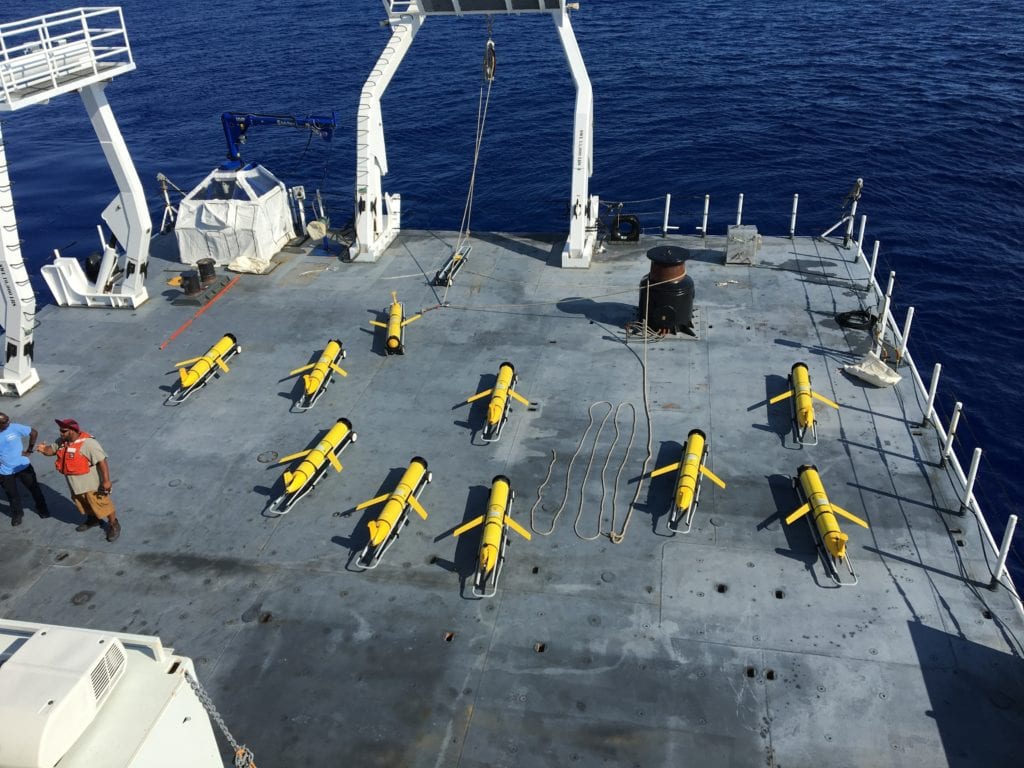
Naval Oceanographic Office personnel prepare to launch 10 littoral battlespace sensing gliders from USNS Maury in the Eastern Atlantic Ocean in support of NAVOCEANO’s goal to deploy more than 50 gliders globally. These gliders are unmanned underwater vehicles used to collect data that is incorporated into ocean models, ultimately providing underwater forecasts for U.S. Navy operations. NAVAL OCEANOGRAPHY / Rebecca Shaw
Unmanned Expertise
Additionally, the oceanography community is emerging as a Defense Department leader in the operation of unmanned vehicles, Okon said.
“We are a key component of the Navy’s innovation culture of catalysts, and we must outpace our competition to ensure that U.S. forces retain that technical warfighting advantage,” Okon said.
With more than 20 years’ experience in operating some 100 different unmanned systems, Okon said, only the commercial oil and gas industry has been at it longer. The command has operated these systems in every ocean in the world and has what he described as a significant inventory of vehicles that have logged more than 60,000 miles and 19,000 hours of bottom time in nearly 2,000 sorties.
“We are the only organization in the world to successfully deploy, operate and retrieve the most ocean gliders at one time — more than 100,” Okon said. “We did that from one location, right here at Stennis.”
The combination of human talent and cutting-edge assets, Okon believes, place the oceanography community in a prime role for the continuing effort to maintain freedom of the seas and win wars.
“Wherever the Navy or joint maritime force is,” Okon said, “you will find naval oceanography.”
Flag Officers Newly Nominated as Vice Admirals and Commanders for Three Fleets
Rear. Adm. Kelly A. Aeschbach, one of six nominations for vice admiral announced on April 15. U.S. NAVY
ARLINGTON, Va. — Defense Secretary Lloyd J. Austin III announced a number of Navy flag officer nominations by the president on April 15, including six for vice admiral, three of which would assume command of the U.S. 3rd, 5thand 7th Fleets.
Austin said the president has made the following nominations:
Navy Rear Adm. Kelly A. Aeschbach for appointment to the grade of vice admiral, and assignment as commander, Naval Information Forces, Suffolk, Virginia. Aeschbach is currently serving as director, National Maritime Intelligence Integration Office; and commander, Office of Naval Intelligence, Washington, D.C.
Navy Vice Adm. Scott D. Conn for reappointment to the grade of vice admiral, and assignment as deputy chief of naval operations for warfighting requirements and capabilities, N-9, Office of the Chief of Naval Operations, Washington, D.C. Conn is currently serving as commander, Third Fleet, San Diego, California.
Navy Rear Adm. Charles B. Cooper II for appointment to the grade of vice admiral, and assignment as commander, U.S. Naval Forces, Central Command; commander, Fifth Fleet; and commander, Combined Maritime Forces, Manama, Bahrain. Cooper most recently served as commander, Naval Surface Force, Atlantic, Norfolk, Virginia.
Navy Rear Adm. John V. Fuller for appointment to the grade of vice admiral, and assignment as inspector general, Department of the Navy, Washington, D.C. Fuller is currently serving as deputy director for force protection, J-8, Joint Staff, Washington, D.C.
Navy Rear Adm. Stephen T. Koehler for appointment to the grade of vice admiral, and assignment as commander, Third Fleet, San Diego, California. Koehler is currently serving as deputy commander, U.S. Pacific Fleet, Pearl Harbor, Hawaii.
Navy Rear Adm. Karl O. Thomas for appointment to the grade of vice admiral, and assignment as commander, Seventh Fleet, Yokosuka, Japan. Thomas is currently serving as assistant deputy chief of naval operations, plans and strategy, N3/N5B, Office of the Chief of Naval Operations, Washington, D.C.
Navy Rear Adm. (lower half) Robert T. Clark has been nominated for appointment to the grade of rear admiral. Clark is currently serving as deputy commander, Seventh Fleet, Yokosuka, Japan.
Navy Rear Adm. (lower half) Nancy S. Lacore has been nominated for appointment to the grade of rear admiral. Lacore is currently serving as chief of staff, U.S. Naval Forces Europe/U.S. Naval Forces Africa/Sixth Fleet, Naples, Italy.
Navy Rear Adm. (lower half) Eileen H. Laubacher has been nominated for appointment to the grade of rear admiral. Laubacher is currently serving as senior defense official/defense attaché – India, New Delhi, India.
Navy Rear Adm. (lower half) Theodore P. LeClair has been nominated for appointment to the grade of rear admiral. LeClair is currently serving as mobilization assistant to the director for operations, J3, U.S. Indo-Pacific Command, Camp H. M. Smith, Hawaii.
EUCOM Commander Seeks More Destroyers, F-35s to Deter Russian Belligerence
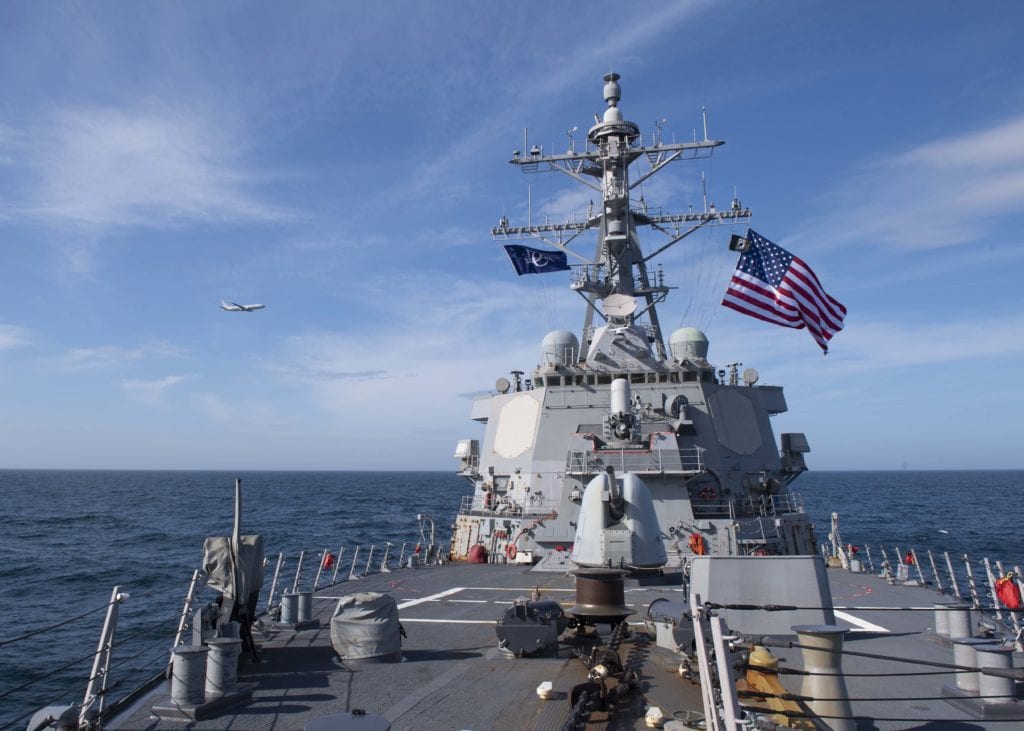
A Boeing P-8 Poseidon flies over the Arleigh Burke-class guided-missile destroyer USS Donald Cook (DDG 75) during a photo exercise in the Black Sea, Feb. 9, 2021. Donald Cook, forward-deployed to Rota, Spain, is on patrol in the U.S. Sixth Fleet area of operations in support of regional allies and partners and U.S. national security in Europe and Africa. U.S. NAVY / Mass Communication Specialist 3rd Class Will Hardy
ARLINGTON, Va. — The Air Force general heading U.S. European Command says more Navy destroyers and Air Force strike fighters are what he needs to both deter and monitor Russia’s aggressive behavior from Arctic waters to the Black Sea.
“I see a concerted effort on behalf of Russia’s maritime forces in the Baltic, in the Barents and Black seas,” Gen. Tod Walters told a House Armed Services Committee April 15 during a hearing on national security challenges and U.S. military activities in Europe. Improving overall strategic indications and warnings (I&W), as well as command and control (C2), “starts with two destroyers to improve our ability to see undersea and it also culminates with F-35s.”
Wolters said he anticipated receiving the first set of U.S. F-35 Lightning II joint strike fighters in Britain this Fall. There are already 30 non-U.S. F-35s in Europe and the total number is expected to reach 450 jets by 2030. “And we’re programmed now with the United States Navy in the 2025 and 2026 timeframe to hopefully receive two additional destroyers,” he said.
There are four destroyers already based in Rota, Spain, which Wolters described as “the workhorses of deterrence,” projecting U.S. presence into the Mediterranean and Black seas and then back out again and up to the Arctic. Two more, also to be based in Rota, are required because of a consistent increase in Russian undersea activity in the Greenland-Iceland-United Kingdom gap. The historic maritime chokepoint in the 20th century is an access lane to the Atlantic Ocean for Arctic-based Russian subs. “The destroyers’ participation in undersea warfare, C2 and I&W is absolutely, positively critical,” Wolters said.
While the U.S. submarine fleet is “performing admirably,” Wolters said, command and control involves other assets like the Boeing P-8 Poseidon maritime patrol aircraft and destroyers.
“To comprehensively defend in this area, from undersea to all the way to 25,000 feet with a P-8, we need to make sure we have the right hardware and software, and we’re traversing in that direction,” Wolters said, adding. “It’s very challenging with respect to numbers.”
Asked by Virginia Republican Rep. Robert Wittman if he believed Russia’s seizure of Crimea in 2014 “gives them a strategic foothold in that area” and helps efforts to modernize the Black Sea fleet?” Wolders said “our vigilance is sky high” in the Barents and Baltic seas, as well as the Black Sea. “And every point that you alluded to with respect to potential intentions, we are preparing for, and planning for and expecting it occur.”
Laura Cooper, the deputy assistant secretary of defense for Russia, Ukraine, and Eurasia, who also testified at the hearing, said the Pentagon had increased its focus on the Black Sea. “And we’re taking an approach that looks holistically at all of our allies and partners in the region,” she said, adding, “We’ve started with efforts to build maritime domain awareness capacity” in Ukraine, Georgia, Bulgaria and Romania.
Coast Guard Cutter Shearwater Decommissioned after 19 Years of Service
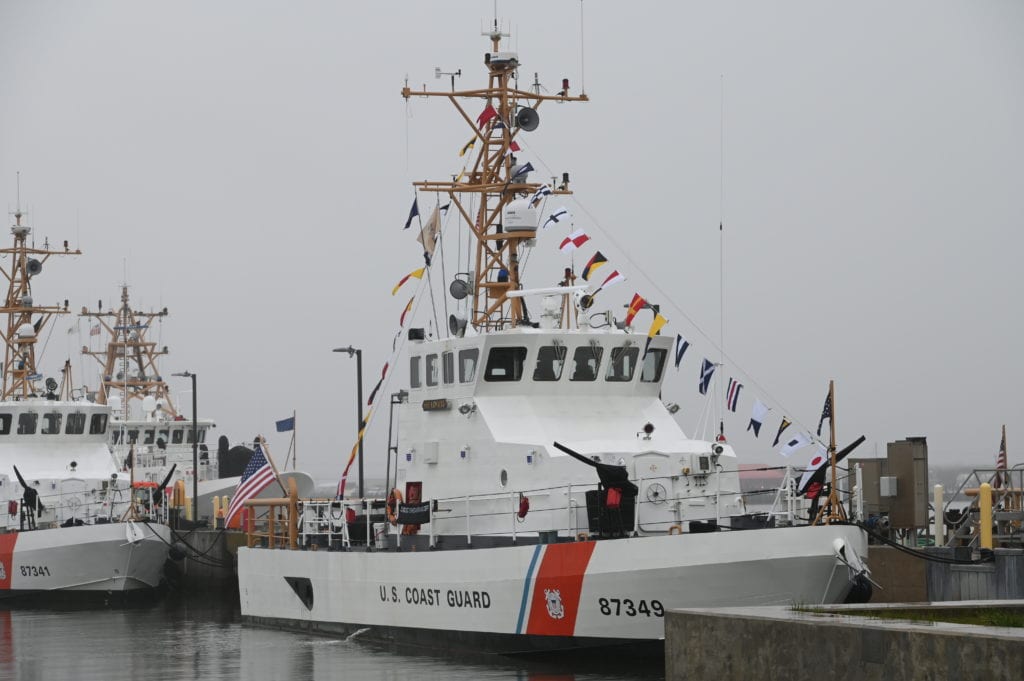
Coast Guard Cutter Shearwater, homeported in Cape May, New Jersey, is moored to the pier prior to the cutter’s decommissioning ceremony at Coast Guard Training Center Cape May, April 15, 2021. Coast Guard Cutter Shearwater was the 49th vessel of the Marine Protector Class of Coast Guard Patrol Boats. U.S. COAST GUARD / Petty Officer 3rd Class Kimberly Reaves
CAPE MAY, N.J. – The Coast Guard decommissioned the cutter Shearwater during a ceremony at Coast Guard Training Center Cape May that was presided over by Capt. Jonathan Theel, the commanding officer of Coast Guard Sector Delaware Bay, April 15, 2021, the Coast Guard 5th District said in a release.
Shearwater was one of the Coast Guard’s 70 remaining 87-foot Marine Protector-class patrol boats. Training Center Cape May is now the homeport to three Coast Guard Fast Response Cutters.
Commissioned in 2002, the Shearwater was the 49th of 73 coastal patrol boats built for search and rescue, ports, waterways, and coastal security, living marine resource enforcement, marine safety, and marine environmental protection.
“Shearwater is a special ship that has served District 5 throughout the course of her history,” said Master Chief Petty Officer Tony Martinez, commanding officer of the Shearwater. “With a who’s who of prominent Coast Guard members, including high profile command master chiefs and command cadres with multiple tours, Shearwater boasted some of the finest crews throughout her tenure. She has been a fixture in both of her homeports, remaining durable and dependable throughout her history. I personally want to thank all of the crews for their dedication and service to our great nation as they were instrumental to Shearwater’s mission of takin’ care of business.”
Shearwater’s keel was laid on April 30, 2002 at Bollinger Shipyards in Lockport, Louisiana. Shearwater was launched on Aug. 6, 2002, and commissioned on Oct. 5, 2002.
Over the past 19 years of service, Shearwater’s crews conducted a wide range of operations. Living up to the Shearwater’s motto “Takin’ Care of Business,” coined by the commissioning crew, crews completed 1,664 activities ranging from law enforcement boardings to search and rescue responses throughout the Mid-Atlantic region. From 2002 to 2018, the ship was homeported at Coast Guard Base Portsmouth, Virginia. Upon relocating to Cape May in 2018, the ship was dubbed “the Queen of the Cape” by a Coast Guard Auxiliarist.
During the cutter’s last year of service, the sunset crew of 12 enlisted crew members continued this legacy, conducting high profile operations including the disentanglement of a leatherback turtle off of Cape May in August of 2020, and an 18-hour tow of a disabled fishing vessel 70 nautical miles east of Cape Charles, Virginia.
“With a strong personal connection to the first officer in charge of this ship, I felt an immense honor being the final OIC aboard Shearwater,” said Martinez. “As I pause and reflect, remembering the first time I saw the ship from an 87 on the other end of the pier, the pride I feel commanding this ship is indescribable. To lead this sunset crew and watch them grow over the past two years has been humbling and rewarding. I am grateful for their dedication and service and look forward to staying in touch and following their careers. While our business here is done, we will proudly carry on Shearwater’s legacy of hard work and reliability.”
Navy Holds Decommissioning Ceremony for Fire-Damaged USS Bonhomme Richard
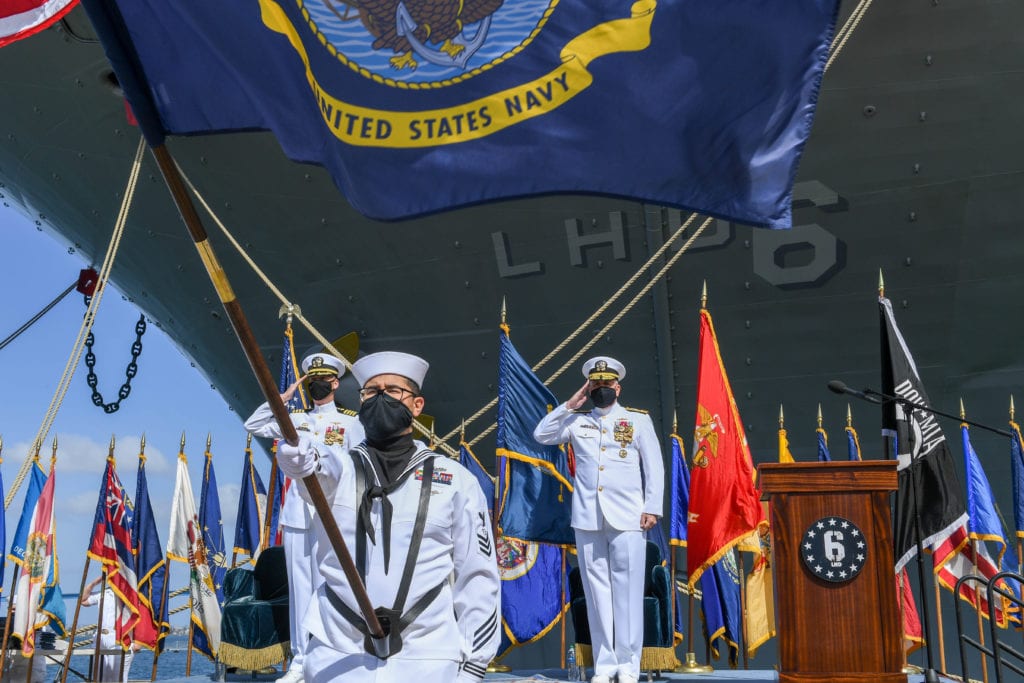
Rear Adm. Philip Sobeck, Commander, Expeditionary Strike Group Three, and Capt. G. S. Thoroman, commanding officer, amphibious assault ship USS Bonhomme Richard (LHD 6), salute the ensign for colors during a decommissioning ceremony for Bonhomme Richard at Naval Base San Diego April 14. The ceremony highlighted the history of the ship, its crew, and their legacy. Due to health and safety concerns related to COVID-19, the event was closed to the public. U.S. NAVY / Mass Communication Specialist 2nd Class Alex Millar
SAN DIEGO — The U.S. Navy held a decommissioning ceremony for amphibious assault ship USS Bonhomme Richard (LHD 6) at Naval Base San Diego April 14, the Naval Surface Force Public Affairs said in a release.
The Bonhomme Richard had been severely damaged in a fire that began on July 12 while in port going through an extensive maintenance availability. The Navy determined the funds required to repair the 22-year-old ship or convert it to an alternate use would be better spent on other priorities.
The ceremony highlighted the history of the ship, its crew, and their legacy. Bonhomme Richard was the third ship to bear the name. It was named in honor of John Paul Jones’ famous frigate, named the French equivalent for “Good man Richard.” This was in honor of Benjamin Franklin, the U.S. Ambassador to France at the time. The name Bonhomme Richard is derived from Franklin’s pen name.
“[The original Bonhomme Richard] Sailors gave their all to prevail against seemingly impossible odds, and they won.” said Rear Adm. Philip Sobeck, commander, Expeditionary Strike Group 3. “They taught us that you don’t always save the ship, but you never stop fighting. The reputation of that fighting spirit began to proceed our Navy wherever we sailed and that same spirit persists today.”
Like the previous five Wasp-class ships, Bonhomme Richard was designed to embark, deploy, and land elements of a Marine landing force in amphibious assault operations by helicopter, landing craft, or amphibious vehicles.
Throughout its history, Bonhomme Richard projected power and maintained presence by serving as the cornerstone of Amphibious Ready Groups (ARG) or Expeditionary Strike Groups (ESG). It transported and landed elements of the Marine Expeditionary Unit (MEU) or Marine Expeditionary Brigade (MEB) with a combination of aircraft and landing craft.
Not long after commissioning, the ship was called to action for Operation Stabilize in February 2000, providing peacekeeping and humanitarian operations of the coast of East Timor. This made Bonhomme Richard the first U.S. Navy ship to make a Western Pacific deployment in the 2000s.
Bonhomme Richard’s following deployment put it in the spotlight of Operation Iraqi Freedom. The ship offloaded more than a thousand Marines and their equipment from the 3rd Battalion, 1st Marines into Kuwait. After delivering attack and transport helicopters, as well as troops and vehicles, Bonhomme Richard took position just miles off the coast of Kuwait to launch AV-8B Harrier aircraft into Iraq. From the deck of Bonhomme Richard, Marine Attack Squadrons (VMA) 211 and 311 flew missions into Iraq and expended more than 175,000 pounds of ordnance and provided close air support to Marines on the ground. In total, the ship launched more than 800 sorties in support of Operation Iraqi Freedom. More than 500 of those were combat launches.
Navy, Coast Guard Formalize Partnership Between Naval Postgraduate School and Coast Guard Research and Development Center
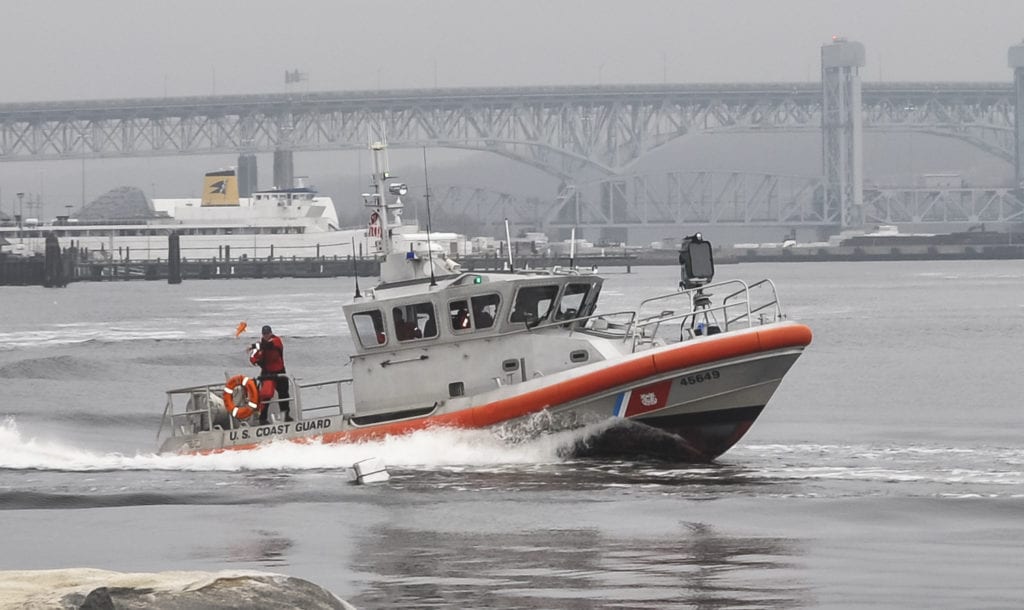
A Coast Guard crewmember jettisons a Maritime Object Tracking Technology marker as part of a Coast Guard Research and Development Center technology demonstration on the Thames River, New London, Connecticut, Thursday, Feb. 15, 2018. U.S. COAST GUARD RESEARCH AND DEVELOPMENT CENTER
The U.S. Naval Postgraduate School (NPS) and Coast Guard Research and Development Center (RDC) signed a new five-year memorandum of understanding (MOU) on April 14, 2021, which facilitates collaboration on joint research that directly supports common defense priorities and Coast Guard statutory missions.
NPS President retired Vice Adm. Ann E. Rondeau and RDC Commanding Officer Capt. Dan Keane met on a virtual platform to both sign the document that will continue and enhance collaborative research and educational cooperation between the two institutions. The document establishes a framework for future collaboration, joint research and access to capabilities.
“The Tri-Service Maritime Strategy (TSMS), Advantage at Sea, prioritizes developing future capability and capacity for both the Navy and the Coast Guard,” said Rondeau. “Our formalized partnership not only strengthens the strong ties between NPS and the Coast Guard, but it brings to bear our defense-focused faculty and operationally experienced Navy and Coast Guard students in joint projects to develop our future force and support that strategy.”
Keane said partnerships are vital to the RDC portfolio accomplishment strategy, such as with Department of Defense and Department of Energy labs, the Federal Lab Consortium, and academia. “Perhaps one our strongest and most impactful partnerships is with the Naval Postgraduate School,” he said.
“Since an MOU was signed three years ago, the RDC has become a topic sponsor, we have proposed questions related to our portfolio that have turned into academic products; NPS researchers have worked with our researchers on summer studies; and we have provided platforms for NPS experimentation. We believe that we have just scratched the surface and the future is incredibly bright,” said Keane. “The partnership is strong today, and is only going to grow stronger in the future. We are excited about the next five years.”
According to a joint statement about the signing, the MOU will help focus NPS on aspects of the TSMS that chiefly fall to the Coast Guard to define research projects that those students, and NPS faculty, can work on together and advance toward solving key maritime challenges. “In addition to identifying thesis topics of mutual interest, the MOU includes access and use of each institution’s unique laboratories and facilities, and involves other key research exchanges to mutually advance their mission of research and education for warfighting advantage,” the statement said.
Planning is underway to facilitate joint research projects on such things including renewable energy, additive manufacturing, maritime-domain awareness and wargaming.
There is a small cohort of mid-career Coast Guard officers attending NPS as students, joining the 600 naval officers and 300 Marine Corps officers attending the school.
According to NPS Dean of Research Dr. Jeffery Paduan, NPS has an impressive cadre of subject matter experts. The school offers masters and doctorate programs in 70 different fields of studies with 227 tenure-track faculty and 347 non-tenure track faculty.
Paduan said both NPS and RDC have distinguished histories as leading research institutions. “The Navy and Coast Guard face overlapping challenges at sea, and both of our organizations complement each other in addressing these problems. This MOU will lead to many more joint projects and shared benefits.”
Students will benefit from thesis topics and capstone projects of mutual interest, with access to each institution’s unique laboratories, facilities, expertise and research capabilities at sea and ashore.
Rondeau said the teaming brings opportunities to understand and solve problems, and solidifies a promising “partnership in science, technology, education, learning and teaming — and in the end, winning. This MOU opens up our apertures to possibilities that are in front of us. I truly believe this has power beyond even what we can imagine today.”