Marine Corps to Increase KC-130J Force in Pacific to Enhance Mobility of Marine Littoral Regiment 
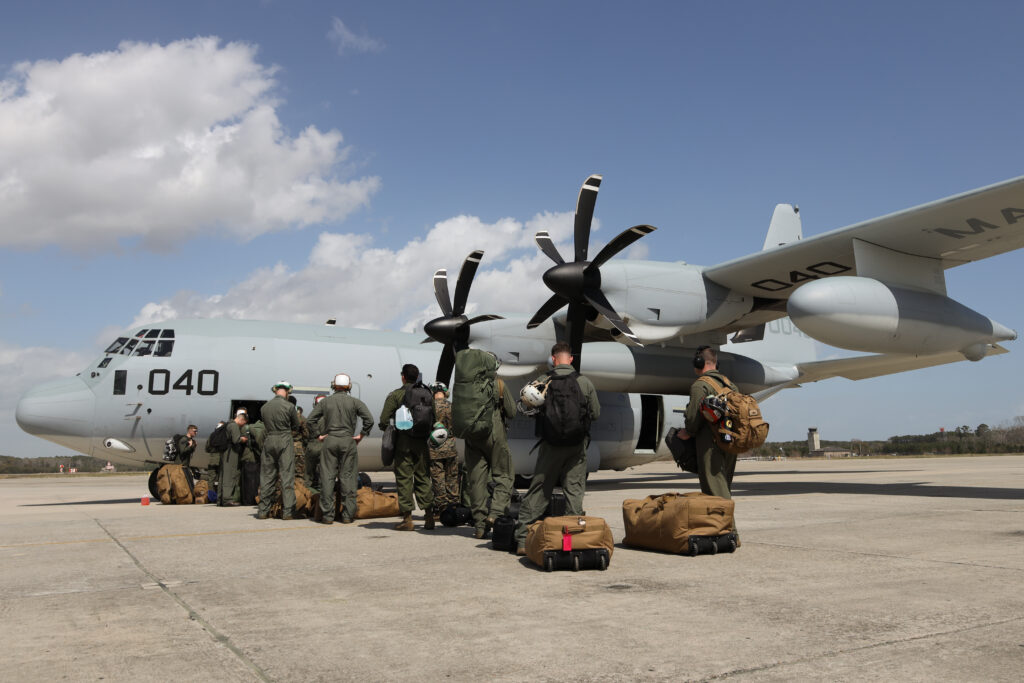
U.S. Marines with Marine All-Weather Fighter Attack Squadron (VMFA(AW)) 533 prepare to board a KC-130J Super Hercules before a flight at Marine Corps Air Station Beaufort, South Carolina, March 7. U.S. MARINE CORPS / Cpl. Lauren Salmon

ARLINGTON, Va. — The Marine Corps plans to activate another KC-130J Super Hercules tanker/transport squadron as part of its aim to provide increased mobility of Marine Corps forces in the Pacific area of responsibility in support of Force Design 2030. 

According to the 2022 Marine Corps Aviation Plan released this week, the Corps plans to activate Marine Aerial Refueler Transport Squadron 153 (VMGR-153) in fiscal 2023. The squadron will be based at Marine Corps Air Station Kaneohe Bay, Hawaii, where two MV-22B Osprey squadrons also are based. 

The additional squadron in Hawaii will enable Marine Forces Pacific to better support aerial refueling, logistics, close air support and multi-sensor imagery reconnaissance in support of expeditionary advance base operations in the Pacific region, particularly for the recently activated 3rd Marine Littoral Regiment, also based in Hawaii. 

VMGR-153 will grow to 17 KC-130J aircraft by fiscal 2026. The East Coast squadron, VMGR-252, based at MCAS Cherry Point, North Carolina, will level out this year at 17 aircraft, and the West Coast squadron, VMGR-352 at MCAS Miramar, California, also will reach a force level of 17 aircraft by the end of fiscal 2022. The squadron based at MCAS Iwakuni, Japan, VMGR-152, will reach a level of 17 aircraft in fiscal 2023.  

The reserve squadron based at Naval Air Station Fort Worth, Texas, VMGR-234, is scheduled to reach a level of 17 aircraft in fiscal 2027. The reserve squadron based at Stewart Air National Guard Base, VMGR-452, has only five KC-130Js and is planned to remain at that level. 

The Marine Corps’ program of record for KC-130Js is 86 aircraft.  

VMGR-252 and VMGR-352 rotate detachments to support the North Africa and East Africa Responses Forces. 

The Marine Corps also plans to sustain the Harvest Hercules Airborne Weapons Kit (Harvest HAWK) program. Ten KC-130J aircraft — five with VMGR-252, four with VMGR-353 and one with test squadron VX-20 — have been modified post-production with the Harvest HAWK to provide the MAGTF a multi-sensor imagery reconnaissance and close air support capability with the MX-20 electro-optical/infra-red imaging system and both wing and door mounted employment of AGM-114P Hellfire and AGM-176 Griffin missiles. A total of six kits are on hand for the 10 fleet aircraft. 


Navy Hospital Ship Departs for Pacific Partnership 2022 

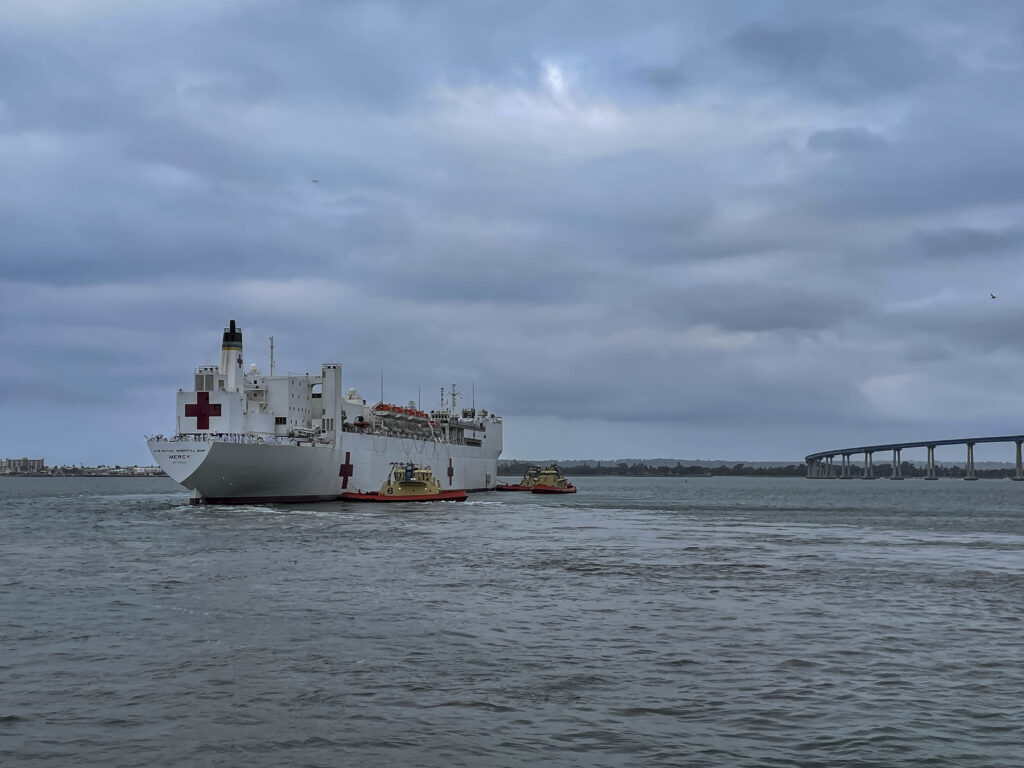
SAMilitary Sealift Command hospital ship USNS Mercy (T-AH 19) departs from Naval Base San Diego, May 3, marking the beginning of Pacific Partnership 2022. U.S. NAVY / Mass Communication Specialist 3rd Class Sang Kim

SAN DIEGO — Military Sealift Command hospital ship USNS Mercy (T-AH 19) departed San Diego, May 3, marking the beginning of Pacific Partnership 2022, the partnership’s public affairs said in a release. 

Now in its 17th year, Pacific Partnership is the largest annual multinational humanitarian assistance and disaster relief preparedness mission conducted in the Indo-Pacific. The Pacific Partnership 22 team will work with host nation counterparts and regional partners to provide tailored medical, dental, and veterinary care and conduct bilateral engineering civic actions, and exchange information related to disaster response processes and procedures. 

As part of PP22, Mercy and the mission team will conduct missions throughout Oceania and the Western Pacific. Typical Pacific Partnership events include the building of schools, medical and engineering expert exchanges, and host nation outreach events. 

“Pacific Partnership is a unifying mission that builds trust among nations to work efficiently together in preparing to respond in crisis,” said U.S. Navy Capt. Hank Kim, Pacific Partnership 22 mission commander.  

“I look forward to exchanging experiences and expertise with our host and partner nations to collectively build skills that will last well after the mission.” 


Navy Awards Austal $230.5 Million Contract for EPF 16 

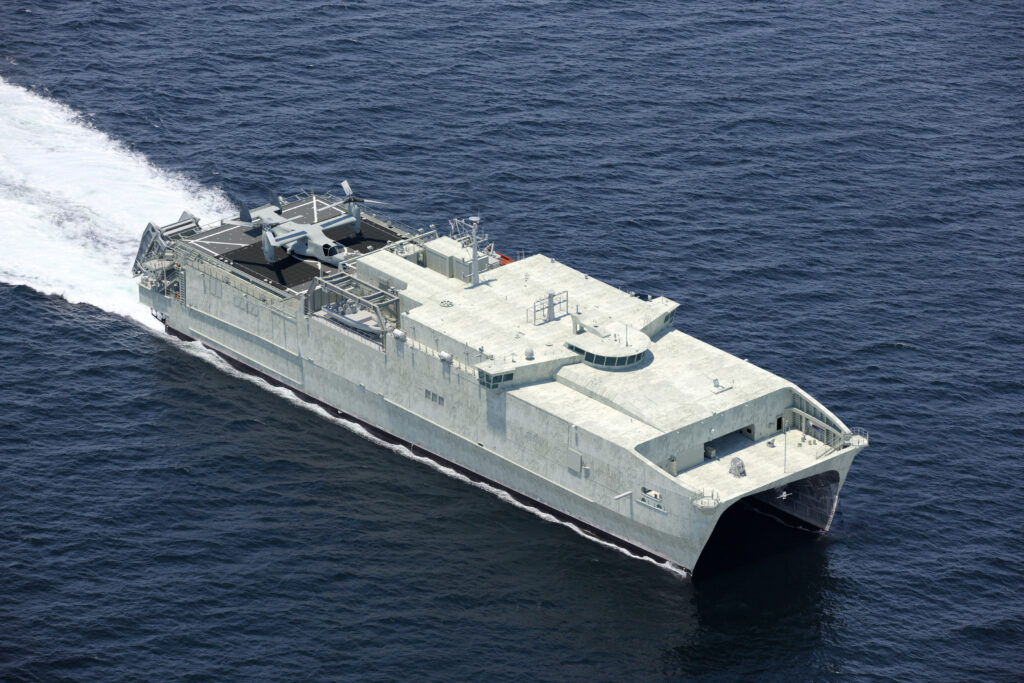
An expeditionary fast transport flight II ship. AUSTAL USA

MOBILE, Ala. — Austal USA has been awarded a $230.5 million contract for the detail design and construction of EPF 16, the Navy’s newest expeditionary fast transport ship, the company said May 3.  

Austal USA has successfully delivered 12 EPFs, on schedule and on budget. Three additional EPFs are currently under construction. EPFs have demonstrated their operational capability to conduct a variety of missions to include humanitarian assistance, disaster relief, maritime security, surveillance, command and control and counter narcotic missions around the globe. The inherent versatility of the EPF design allows for its mission to be tailored to the needs of each fleet and combatant commander’s geographic command. 

“Like the previously delivered EPFs, EPF 16 will benefit from the serial production of this program, resulting not only in a world-class ship but also providing assurance to the U.S. Navy that capability will be delivered on budget and on schedule,” said Austal USA President Rusty Murdaugh. “Our reputation for delivering quality is a direct reflection of the commitment and dedication of our talented shipbuilders and suppliers.” 

EPF 16 will be the third ship constructed in the Flight II configuration. Flight II ships will enhance the original capabilities of the Spearhead class through incorporation of reconfigurable spaces for operating rooms and postsurgical recovery efforts. Combined with the ship’s flight deck that is capable of landing V-22 aircraft, Flight II ships provide unmatched versatility.  

Construction efforts on EPF 16 are expected to commence later this year with delivery projected for 2025. Austal USA is currently under contract to build additional EPFs, the Independence-variant littoral combat ship, and the Navajo-class towing, salvage and rescue ships and is supporting Navy unmanned vessel programs leveraging its advanced machinery control system. 


Navy Awards Collins Aerospace Second LRIP Order for TCTS Increment II Air Combat Training System  

CEDAR RAPIDS, Iowa — Collins Aerospace has been awarded the second low-rate production order for Tactical Combat Training System – Increment II (TCTS II) Air Combat Training System by the U.S. Navy, the company announced May 2. 

The contract, valued at $24 million, includes both airborne and ground subsystems and will support fielding requirements at various USN training ranges. TCTS II is preparing for upcoming final development test and operational flights this fall and is on track to complete initial operational capability at Naval Air Station Fallon, Nevada, in late 2022. This is the final low-rate production order of TCTS II before entering full-rate production in early 2023. 

Developed and built by Collins Aerospace and teammate Leonardo DRS, TCTS II is a scalable and flexible open-architecture system that enables highly secure air combat training among fourth- and fifth-generation U.S. aircraft, as well as international aircraft. Using Live Virtual Constructive technology, it simulates various tailored combat situations needed to train aviators like they fight. 

TCTS II is scheduled to complete the IOC milestone in late 2022 at NAS Fallon, which is the leading training facility for naval air warfare, and the first training range to field TCTS II. Completing IOC at NAS Fallon is a critical step in demonstrating that TCTS II meets Navy requirements, as carrier air wings must complete Air Wing Fallon training prior to deployment. 

“TCTS II provides end-users the ability to train as they’ve never been able to train before, with secure cross-service air combat training and joint Live, Virtual, and Constructive-enabled capabilities. This program truly redefines the future of training.” said Heather Robertson, vice president, and general manager of Integrated Solutions for Collins Aerospace. “This type of technology enables warfighters and coalition partners to further perfect joint tactics against peer adversaries.” 


Marine Corps Aviation Plan Reduces Number of F-35s in Some Squadrons, Keeps 420 F-35s Total 

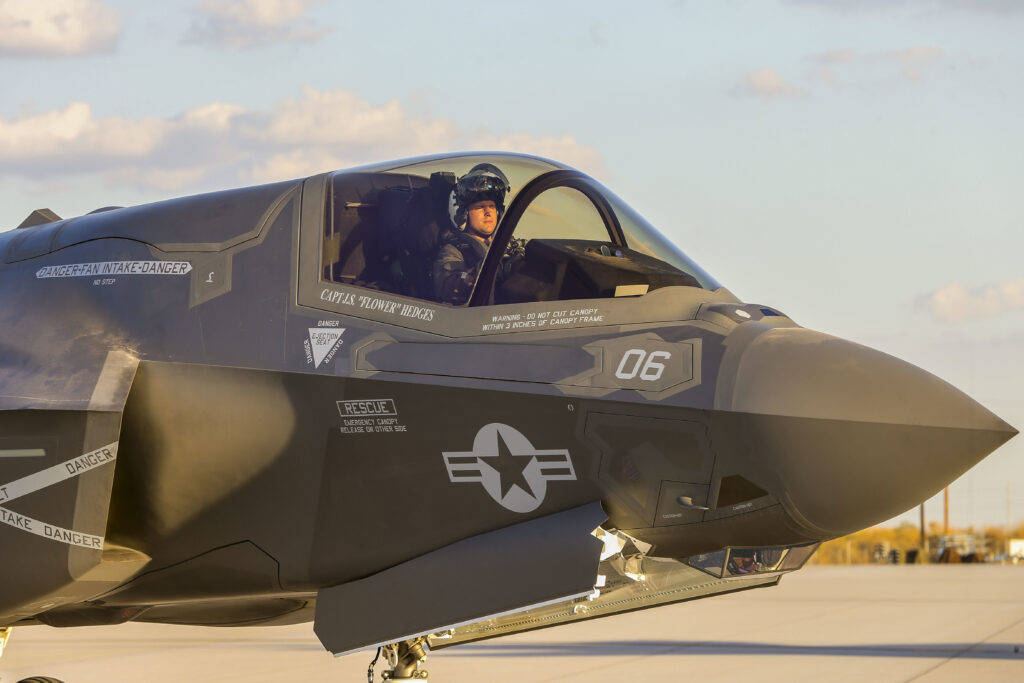
U.S. Marine Corps Maj. Mark Noble, F-35 instructor pilot with Marine Aviation Weapons and Tactics Squadron One, taxis on the runway during a hot load at Marine Corps Air Station Yuma, Arizona, in 2016. U.S. MARINE CORPS / Staff Sgt. Artur Shvartsberg, MAWTS-1 COMCAM

ARLINGTON, Va. — The Marine Corps plans to reduce the number of F-35 Lightning II strike fighters planned for some Marine fighter attack squadrons but is not reducing the program or record of 420 F-35s. 

In the 2022 Marine Corps Aviation Plan released this week, the Corps shows it will reduce the number of F-35Bs in some squadrons from 16 to 10 aircraft. Originally the 16 were going to allow for a six-plane detachment on board an amphibious assault ship in addition to a 10-plane land-based force. In the current plan, all F-35B (and carrier-capable F-35C) squadrons will be equipped with 10 aircraft.  

The plan for F-35 squadrons is in accord with Marine Corps Commandant David H. Berger’s Force Design 2030 plan for restructuring the Marine Corps. 

Lt. Gen. Mark Wise, deputy commandant for Aviation, speaking to reporters May 2 at the Pentagon, said the change in the numbers in the F-35 squadrons “really had to do with what is the optimum way, so starting with the requirement and moving backwards.

“The F-35 is designed to deploy as a division, so 10-airplane [squadrons] were designed to field two divisions with two [aircraft] in backup,” Wise said. “That is the model that we believe is the right direction to go for a Marine expeditionary unit. That way you’re deploying a whole squadron as well. You’re not leaving pieces of it behind. So, you don’t have a command element that’s got to go to one side or go to the other side. With that said, we will continue to learn and evolve and experiment and wargame and do all the things we’ve been doing to make sure that number is right. We have to make sure that the rest of the ACE [Aviation Combat Element] on board the L-class ships, are the numbers are balanced appropriately? Do they all fit? Is all the maintenance able to be done? So, there’s some experimentation to go to make sure we’ve got it perfectly right, but we think we’re off to a pretty good start.” 

Wise said that “overall, our POR [program of record] still remains the same [at 353 F-35Bs and 67 F-35Cs] because if you look at the entirety of the program from start to now, there were certain affordability decisions made early on that had to do with things like our attrition model was truncated in order to meet affordability concerns. So, if you take the attrition model and expand it back to the numbers that we have for those 18 active and two reserve squadrons, your number actually ends up being our POR.”

The Corps intends to upgrade all of its existing F/A-18 Hornet-equipped Marine fighter attack (VMFA) squadrons and convert the remaining AV-8B Harrier II Marine attack (VMA) squadrons to VMFAs. Two more squadrons — one a reserve unit — will be reactivated, while another will be deactivated for about four years and will be reactivated as an F-35C squadron. In all, the plan has the Corps fielding 14 active component and two reserve F-35B squadrons and four active component F-35C squadrons by fiscal 2032. 

The Corps also has two F-35B fleet replacement squadrons, one on each coast. (F-35C training will remain with the Navy’s fleet replacement squadron, VFA-125.) The F/A-18 Hornet fleet replacement squadron, VMFAT-101, will be deactivated in fiscal 2024 and turn its training responsibilities to VMFA-323, a deploying squadron which will maintain a fleet replacement detachment until fiscal 2027.  

Of the Corp’s six remaining active-component Hornet squadrons, five now fly a mix of seven single-seat F/A-18Cs and five two-seat F/A-18Ds. VMFA-323 will retain F/A-18Cs and reserve VMFA-112 will give up its last four F/A-18A++ versions to become an all “C/C+” squadron. 

The four existing Harrier squadrons, all based at Marine Corps Air Station Cherry Point, North Carolina, now fly only the radar-equipped version of the AV-8B. One squadron, VMA-223, also runs a fleet replacement detachment that includes two-seat TAV-8Bs. The Harriers are slated to be phased out in fiscal 2027. 


Keel Authenticated for Future USNS Earl Warren  

WASHINGTON — The keel for the future USNS Earl Warren (T-AO 207), the Navy’s 3rd John Lewis-class fleet replenishment oiler, was laid at General Dynamics National Steel and Shipbuilding Co. on April 30, Team Ships Public Affairs said May 2. 

A keel laying is the recognition of the start of a ship’s construction. It is the joining together of a ship’s modular components and the authentication or etching of an honoree’s initials into a ceremonial keel plate. The ship’s sponsor, Supreme Court Justice Elena Kagan, had her initials etched into the keel plate by NASSCO welders. 

“We are looking forward to getting these ships to the fleet to support at-sea operations,” said John Lighthammer, program manager, Auxiliary and Special Mission Shipbuilding Program Office. “This new class of oilers is bringing much needed capability and capacity to the fleet.” 

The John Lewis-class T-AOs will be operated by Military Sealift Command to provide fuel and lubricating oil, and small quantities of fresh and frozen provisions, stores, and potable water to Navy ships at sea, and fuel for embarked aircraft. 

The oilers feature the capacity to carry barrels of oil, a significant dry cargo capacity, aviation capability and a speed of 20 knots. NASSCO designed the new vessels with double hulls to protect against oil spills and strengthened cargo and ballast tanks. The new T-AOs will add capacity to the Navy’s Combat Logistics Force and become the cornerstone of the fuel delivery system. 


USNS John Lewis Conducts Acceptance Trials 

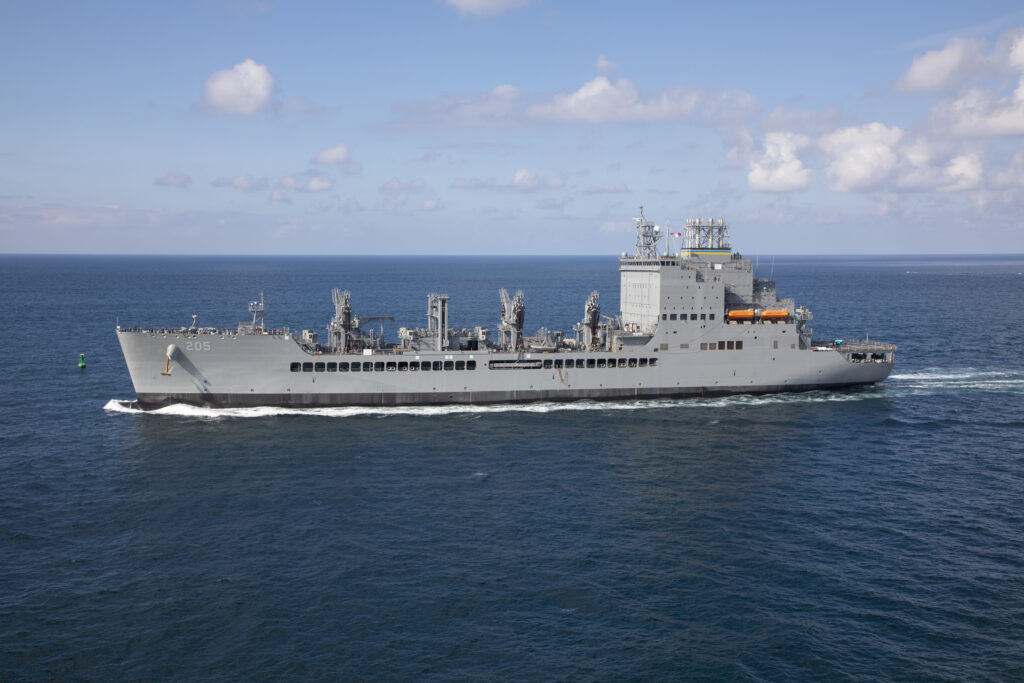
USNS John Lewis (T-AO 205), the Navy’s lead ship of its new class of fleet replenishment oilers, conducted acceptance trials on April 25. GENERAL DYNAMICS NATIONAL STEEL AND SHIPBUILDING CO.

WASHINGTON — USNS John Lewis (T-AO 205), the Navy’s lead ship of its new class of fleet replenishment oilers, conducted acceptance trials on April 25, Team Ships Public Affairs said May 2. 

Acceptance trials consist of a series of in-port and at-sea demonstrations that allow the Navy and the shipbuilder, General Dynamics National Steel and Shipbuilding Co., to assess the ship’s systems and readiness prior to delivery to the Navy. 

“The John Lewis-class oilers will add capacity to the Navy’s Combat Logistics Force and become the cornerstone of the fuel delivery system at sea,” said John Lighthammer, program manager, Auxiliary and Special Mission Shipbuilding Program Office. “We are excited to welcome the USNS John Lewis to the fleet.” 

The John Lewis-class T-AOs will be operated by Military Sealift Command to provide fuel and lubricating oil, and small quantities of fresh and frozen provisions, stores, and potable water to Navy ships at sea, and fuel for the embarked aircraft.   

The oilers feature the capacity to carry barrels of oil, a significant dry cargo capacity, aviation capability and a speed of 20 knots. NASSCO designed the new vessels with double hulls to protect against oil spills and strengthened cargo and ballast tanks.  

NASSCO is currently in production on USNS Harvey Milk (T-AO 206), USNS Earl Warren (T-AO 207), and USNS Robert F. Kennedy (T-AO 208). The future USNS Lucy Stone (T-AO 209) and USNS Sojourner Truth (T-AO 210) are under contract. NASSCO is also currently in production of two Expeditionary Sea Bases (ESB) – the future USS John L. Canley (ESB 6) and USS Robert E. Simanek (ESB 7). 


Keel Authenticated for Future USS John L. Canley 

WASHINGTON — The keel for the future USS John L. Canley (ESB 6), the Navy’s fourth expeditionary sea base, was laid at General Dynamics National Steel and Shipbuilding Co. shipyard in San Diego on April 30, Team Ships Public Affairs said May 2. 

The ship is named for Medal of Honor recipient retired Marine Corps Sgt. Maj. John L. Canley. Canley was awarded the nation’s highest honor 50 years after his actions serving as company gunnery sergeant, Company A, First Battalion, First Marines, First Marine Division in the Republic of Vietnam during the Battle of Hue City. 

“Sergeant Major Canley’s story is one of service, honor, and commitment. All those who serve aboard his namesake ship will carry on his distinguished legacy,” said Tim Roberts, Strategic and Theater Sealift program manager, Program Executive Office, Ships. “These mobile, modular sea base ships are optimized to support the needs of our Sailors and Marines while providing critical access in the maritime domain.” 

Expeditionary sea base ships are highly flexible platforms used across a broad range of military operations supporting multiple operational phases. Acting as a mobile sea base, they are a part of the critical access infrastructure that supports the deployment of forces and supplies to provide prepositioned equipment and sustainment with adaptable distribution capability. 

In 2019, the Navy decided to commission all expeditionary sea base ships to allow them to conduct a broader and more lethal mission set compared to original plans for them to operate with a USNS designation. A Navy O-6 commands ESBs and a hybrid-manned crew of military personnel and Military Sealift Command civilian mariners. This crew makeup provides combatant commanders with increased operational flexibility in employing the platform. 

Construction of the future USS Robert E. Simanek (ESB 7) and the Navy’s John Lewis Class Fleet Replenishment Oilers (T-AO) are ongoing at GD-NASSCO. 


U.S. 4th Fleet and USNS Burlington Conduct Fleet Experimentation in Key West 

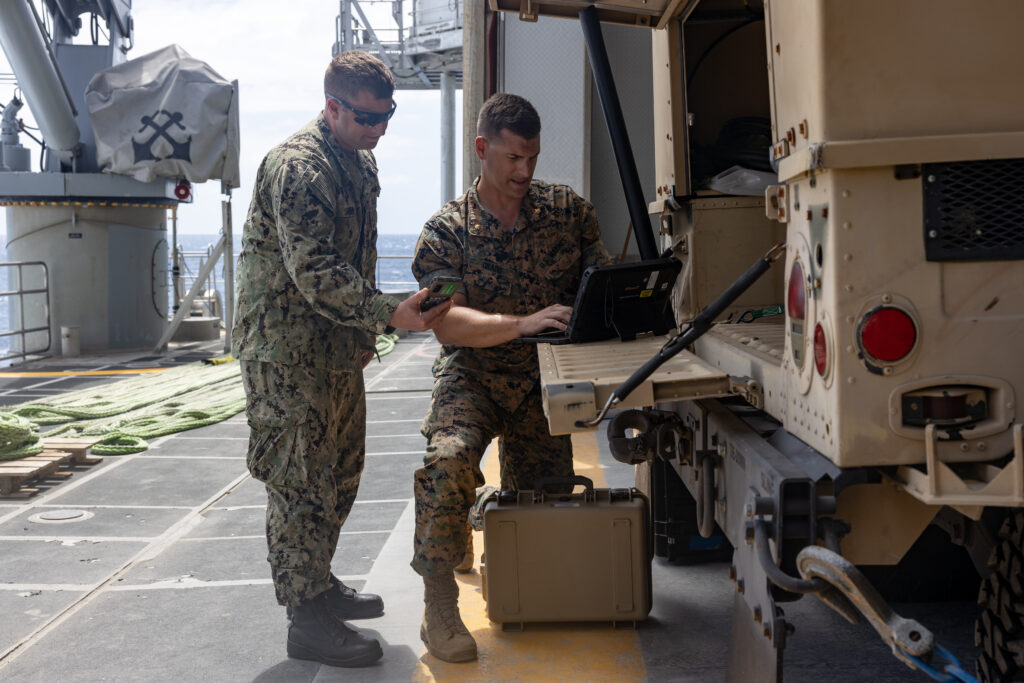
Marine Corps Maj. Brooks Grado, an intelligence officer with U.S. Marine Corps Forces, Southern Command and Navy Cmdr. Jonathan Saburn, a future operations officer assigned to U.S. 4th Fleet, discuss future operating concepts aboard the expeditionary fast transport vessel USNS Burlington (T-EPF-10) during a fleet experimentation period. U.S. MARINE CORPS / Cpl. Brendan Mullin

ATLANTIC OCEAN — The Spearhead-class expeditionary fast transport vessel USNS Burlington (T-EPF-10) completed U.S. Naval Forces Southern Command/U.S. 4th Fleet 2022 Fleet Experimentation events in Key West, Florida, April 22-27, 2022, said U.S. Naval Forces Southern Command / U.S. 4th Fleet said April 29. 

The U.S. Southern Command area of responsibility provides a permissive environment to experiment with new technologies, tactics, techniques and procedures. U.S. Naval Forces Southern Command/U.S. 4th Fleet provides an annual experimentation venue for technology developers to embark with the operational force, evaluate new systems in the maritime environment, validate assumptions, and receive feedback from Sailors and Marines. 
 
“The U.S. Navy must move faster, take smart risks, and focus on key operational problems to outpace our global threats,” said Dr. Christopher Heagney, NAVAIR Fleet/Force Advisor to U.S. 4th Fleet. “Our ability to establish maritime superiority in the littorals is foundational to deterring future conflict. Here, we are bringing together air, expeditionary, and information warfare to achieve that effect.” 
 
During the week-long engagement, Burlington went to sea to perform a series of tests and demonstrations with the assistance of scientists and engineers from U.S. 4th Fleet, Office of Naval Research, Naval Information Warfare Center Atlantic, Naval Surface Warfare Centers, Naval Air Warfare Center Aircraft Division, among other science and research institutions. 
 
Test concepts were selected based on operational needs and gaps. This year’s iteration aimed to demonstrate Navy/Marine Corps integration to protect naval assets during expeditionary advanced basing operations, by evaluating expeditionary systems for force protection and coordinated electronic warfare. 
 
“These fleet experiments provide an important opportunity to test new ideas in a controlled environment. They also put technology experts in close contact with fleet operators to increase mutual understanding of operational problems and the state-of-the-art tools that can be leveraged to address them,” said Rear Adm. Doug Sasse, reserve vice commander of U.S. 4th Fleet. “This year’s experiments were expeditionary focused and demonstrated how spectrum dominance can provide great advantage for our forces operating in littoral waters in the U.S. 4th Fleet area of responsibility and around the globe.” 
 
Experiments were conducted in a phased approach, with each segment building upon the previous one. A Humvee was embarked on Burlington as the primary vessel to facilitate experiments and ultimately evaluate capabilities in a contested environment. 
 
In Phase 1, ingress, Burlington was at sea with a Humvee onboard to demonstrate electronic warfare support and establish command and control. Forces tested satellite connections, C2 through tethered aircraft, detection of simulated enemy forces, and the ship’s ability to protect itself with jamming. 
 
Phase 2, the landing, offloaded the Humvee on Saddle Bunch Key en route to establish the EABO. The Humvee followed a route to the basing site, combating simulated attacks from unmanned aerial systems, simulated improvised explosive devices and other cyber and electronic attacks. 
 
Finally, in Phase 3, inside force operations, the Humvee arrived at its basing site, where forces were able to establish a communications network, and conduct coordinated electronic attack tactics on simulated enemy forces. 
 
“The ‘theater of experimentation’ is a well-earned name,” said Dr. Waleed Barnawi, ONR Program Officer. “Dr. Heagney and the 4th Fleet staff provided us a great venue to test cyber and electronic warfare capabilities, and a resilient communications architecture that will connect Navy and Marine Corps warfighters inside and outside the weapons engagement zone. I’m very grateful for Rear Adm. Sasse and his team for coming down as well. He and his team provided unique insight that only comes from an event like this.”


Coast Guard Sector St. Petersburg Will Receive First 154-Foot Fast Response Cutter 

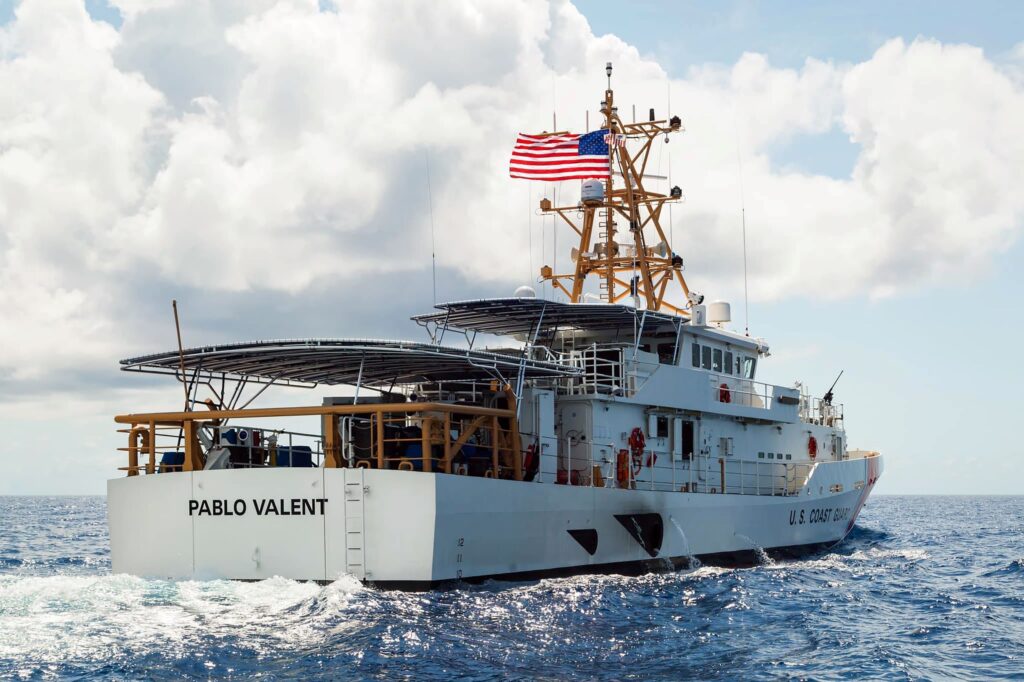
Coast Guard Cutter Pablo Valent, a 154-foot Sentinel-class vessel, is homeported at Coast Guard Sector St. Petersburg, Florida. U.S. COAST GUARD

ST. PETERSBURG, Fla. — Coast Guard Sector St. Petersburg received its first 154-foot fast response cutter on May 1. 

Coast Guard Cutter Pablo Valent, a Sentinel-class vessel, will arrive at its new homeport where the crew will begin training to become certified in law enforcement and rescue operations. Pablo Valent is scheduled to be officially commissioned on May 11. 

Pablo Valent will operate throughout the Gulf of Mexico and the Florida Keys. There are 12 other FRCs in Florida, which operate throughout the Caribbean Sea. 

FRC’s are multi-mission ships designed to conduct drug and migrant interdictions; ports, waterways and coastal security operations; fisheries and environmental protection patrols; national defense missions; and search and rescue. 

Each cutter is designed for a crew of 24, has a range of 2,500 miles and is equipped for patrols up to five days. The FRCs are part of the Coast Guard’s overall fleet modernization initiative. 

FRCs feature advanced command, control, communications, computers, intelligence, surveillance and reconnaissance equipment as well as over-the-horizon response boat deployment capability and improved habitability for the crew. The ships can reach speeds of 28 knots and are equipped to coordinate operations with partner agencies and long-range Coast Guard assets such as the Coast Guard’s National Security Cutters.