Bell Delivers Marine Corps’ Final AH-1Z Helicopter
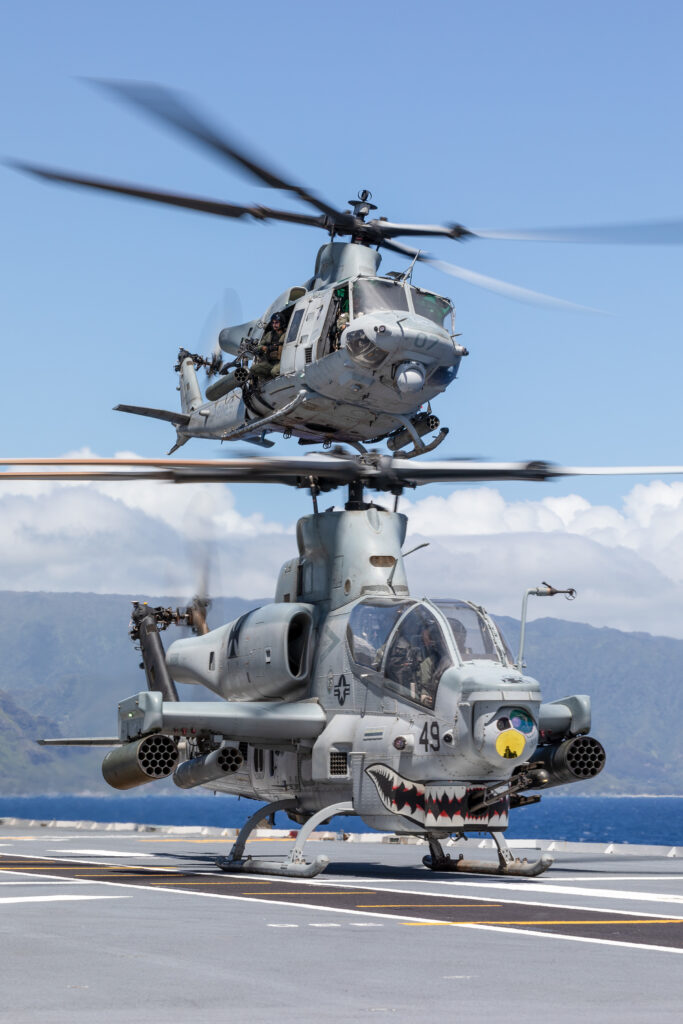
A UH-1Y Venom lifts off from the deck of an amphibious assault ship as an AH-1Z Viper prepares to launch. BELL

AMARILLO, Texas — In a ceremony at the Amarillo Assembly Center, Bell Textron Inc., a Textron Inc. company, celebrated the delivery of the 189th AH-1Z Viper to the U.S. Marine Corps, completing the Program of Record (POR) for the latest version of the storied H-1 platform. Bell completed the UH-1Y POR of 160 aircraft in 2018 bringing the combined Ah-1Z/UH-1Y POR to 349 aircraft.  

“The first production lot of US Marine Corps H-1s was ordered in 1962, and they changed the way Marines fight today,” said Mike Deslatte, Bell H-1 vice president and program director. “Completing the AH-1Z and UH-1Y deliveries to the US Marine Corps adds one more chapter to the legacy of the H-1 platform.” 

Bell has been producing H-1s for the U.S. military since 1959. Bell originally designed the H-1 for the U.S. Army with the iconic “Huey.” In 1966 Bell created the AH-1 Cobra as the first dedicated gunship. In 1970, the Bell UH-1N brought twin engine capabilities to more than 28 countries, and in 1984 the AH-1W provided the U.S. Marine Corps increased attack helicopter capability.  

The current generation AH-1Z Viper and UH-1Y Venom are the most agile, mobile and survivable combination of aircraft used by the Department of Defense. The 85% common platforms are the only two aircraft that share so much commonality, providing the Marines with logistical agility and reduced operating costs. The AH-1Z achieved initial operating capacity in February 2011 and the UH-1Y achieved initial operating capacity in August 2008. The first combined Viper/Venom deployment with a Marine Expeditionary Unit occurred in 2009. 

“H-1s are key to the 2022 Marine Corps Aviation Plan,” said Col. Vasillios Pappas, Light/Attack Helicopters program manager (PMA-276). “With the U.S. program of record now complete, the Marines have the flexibility to manage and deploy the helicopters based on current and future mission requirements as established at the start of the program.” 

The H-1 production line is still active in support of foreign military sales to approved U.S. allies. Bell continues to produce AH-1Z Vipers for the Kingdom of Bahrain and will manufacture eight UH-1Ys and four AH-1Zs for the Czech Republic in 2023. 

Since the first delivery of the AH-1Zs and UH-1Ys to the U.S. Marines, the H-1 mixed fleet has accumulated more than 450,000 flight hours through a full spectrum of military operations. Bell will continue to support the U.S. H-1s with lethality, survivability and reliability upgrades through a long-term modernization plan that helps ensure the aircraft keep an overwhelming tactical advantage for generations. 


Coast Guard Cutter Midgett Returns Home from Western Pacific Deployment

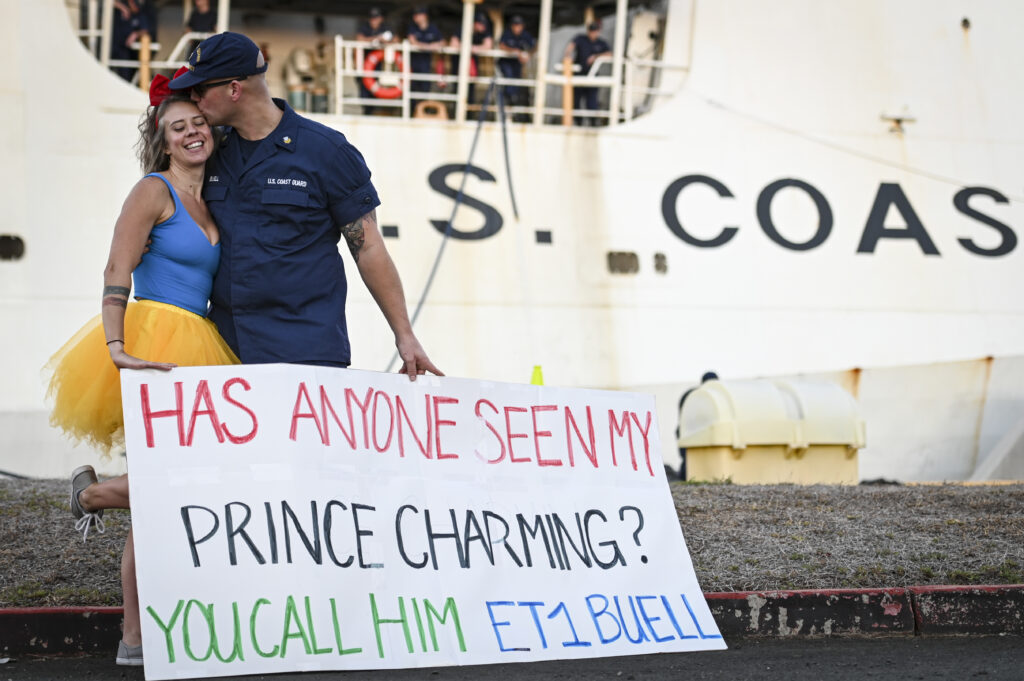
Petty Officer 1st Class Kyle Buell stands with his wife after U.S. Coast Guard Cutter Midgett (WMSL 757) returned to homeport in Honolulu, Hawaii, Oct. 31, 2022. The crew was deployed for nearly three months in the Western Pacific theatre. U.S. COAST GUARD / Petty Officer Steve Strohmaier

HONOLULU — The U.S. Coast Guard Cutter Midgett (WMSL 757) and crew returned to its homeport, Monday, following an 83-day, 16,000 nautical-mile deployment to the Western Pacific, the Coast Guard Pacific Area said in a Nov. 1 release. 

The Midgett and crew departed Honolulu in August to the Western Pacific to operate under the tactical control of U.S. Navy 7th Fleet to promote a free and open Indo-Pacific region. 

“The Coast Guard strives to be a trusted partner, and we play a vital role in ensuring safety, security and prosperity across the Indo-Pacific,” said Vice Adm. Andrew J. Tiongson, commander Pacific Area. “As the region faces challenges like climate change and Illegal, Unregulated and Unreported Fishing, we will join with our Pacific partners to face these common threats and challenges together.”  

Midgett’s crew executed numerous cooperative engagements, professional exchanges and capacity building efforts with naval allies and partners, who included the Philippine Coast Guard, Singapore Maritime Security Response Flotilla, the Information Fusion Center, Police Coast Guard, Indian Coast Guard and Maldives National Defense Force

“I am extremely proud of this crew and all they have accomplished over this deployment,” said Capt. Willie Carmichael, commanding officer of Midgett. “They engaged in meaningful and collaborative engagements with our partners that increased our interoperability to address shared maritime threats and challenges. This Western Pacific deployment highlights the critical role the Coast Guard plays in strengthening maritime governance around the world and how much our partners value our presence. Midgett’s ability and dedication to sail across two oceans and participate in purposeful engagements with our partners is a testament to the United States’ commitment to a free and open Indo-Pacific.”  

The U.S. Coast Guard has a 150-year enduring role in the Indo-Pacific. The service’s ongoing deployment of resources to the region directly supports U.S. foreign policy. As both a federal law enforcement agency and a branch of the armed forces, the Coast Guard is uniquely positioned to conduct security cooperation in support of combatant commanders on all seven continents. The service routinely provides forces in joint military operations worldwide, including the deployment of cutters, boats, aircraft and deployable specialized forces. 

Since 2019, Coast Guard Cutters Bertholf (WMSL 750), Stratton (WMSL 752), Waesche (WMSL 751) and Munro (WMSL 755) have deployed to the Western Pacific. 

Commissioned in 2019, Midgett is one of two Coast Guard legend-class national security cutters homeported in Honolulu. National security cutters are 418 feet long, 54 feet wide and have a 4,600 long-ton displacement. They have a top speed in excess of 28 knots, a range of 12,000 nautical miles, endurance of up to 90 days and can hold a crew of up to 170. 

Midgett is the second cutter named after the Midgett family, many of whom served in the U.S. Coast Guard, U.S. Life Saving Service and other predecessor life-saving services. Seven members of the Midgett family have been awarded the Gold Lifesaving Medal, including John Allen Midgett Jr. and Rasmus Midgett. 

National security cutters feature advanced command and control capabilities, aviation support facilities, stern cutter boat launch and increased endurance for long-range patrols to disrupt threats to national security further offshore. 


Admiral: Guam Weather ‘Challenging’ for Navy’s Triton UAV Operations

A U.S. Navy MQ-4C Triton assigned to Unmanned Patrol Squadron (VUP) 19 prepares to take off from the flightline at Marine Corps Air Station (MCAS) Iwakuni, Japan, Oct. 5, 2022. U.S. MARINE CORPS / Lance Cpl. David Getz

ARLINGTON, Va. — The weather in Guam has proved to pose challenges to operations of the Navy’s MQ-4C Triton high-altitude, long-endurance unmanned aerial vehicle, a Navy admiral said. He also praised the value of the Triton as a targeting platform. 

In a situation report late last summer to the maritime patrol reconnaissance community, Rear Adm. Adam “Kujo” Kijek, commander, Patrol and Reconnaissance Group, said the “most impactful lesson” of the Early Operational Capability deployment of the Triton to Guam was one “delivered by mother nature.” 

Kijek said the “weather in Guam, and associated OP Areas [operations areas], can be very challenging for UAV operations. During ‘monsoon’ season, and with a stated goal of 16 missions per month, there were many days that Triton could not get airborne or access required operating areas due to adverse weather. However, when weather permits Triton has proven its operational worth.” 

The admiral said that “to help combat these environmental anomalies, we executed a Seasonal Relocation Plan (SRP) to Misawa AB [Air Base] last summer, and Iwakuni [Marine Corps Air Station] this summer.  Exercising these expeditionary muscles and harvesting lessons learned will pay huge dividends when Triton Multi-INT shows up in theater next year.”     

Kijek noted that “there is tremendous value in providing the persistent ISR [intelligence, surveillance and reconnaissance] that Triton brings by establishing pattern of life and building a real-time Common Operational Picture for Fleet and Combatant Commanders. However, from a tactical perspective, I have been most impressed when Triton works as a targeting platform in concert with other aircraft and surface units.”  

The admiral said he believed “the operational impact of Triton will grow exponentially” when the UAV’s Multi-Intelligence Integrated Functional Capability-4 upgrade is deployed in 2023.   

“The ability of Triton’s SIGINT [signals intelligence] package to exploit the electromagnetic spectrum and the sheer volume of information harvested will present significant challenges to the Intel Community,” he said. “Simply adding a SIGINT Coordinator (SC) to every Triton aircrew is not enough. We are working closely with the C10F [Commander, U.S. 10th Fleet and NAVIFOR [Navy Information Forces] to ensure that Triton is postured to take full advantage of Navy’s Distributed SIGINT Operations architecture to realize its full potential. Achieving these linkages will be a primary focus during my tenure.” 


Major Pier Project Completed at Naval Base Kitsap Bangor

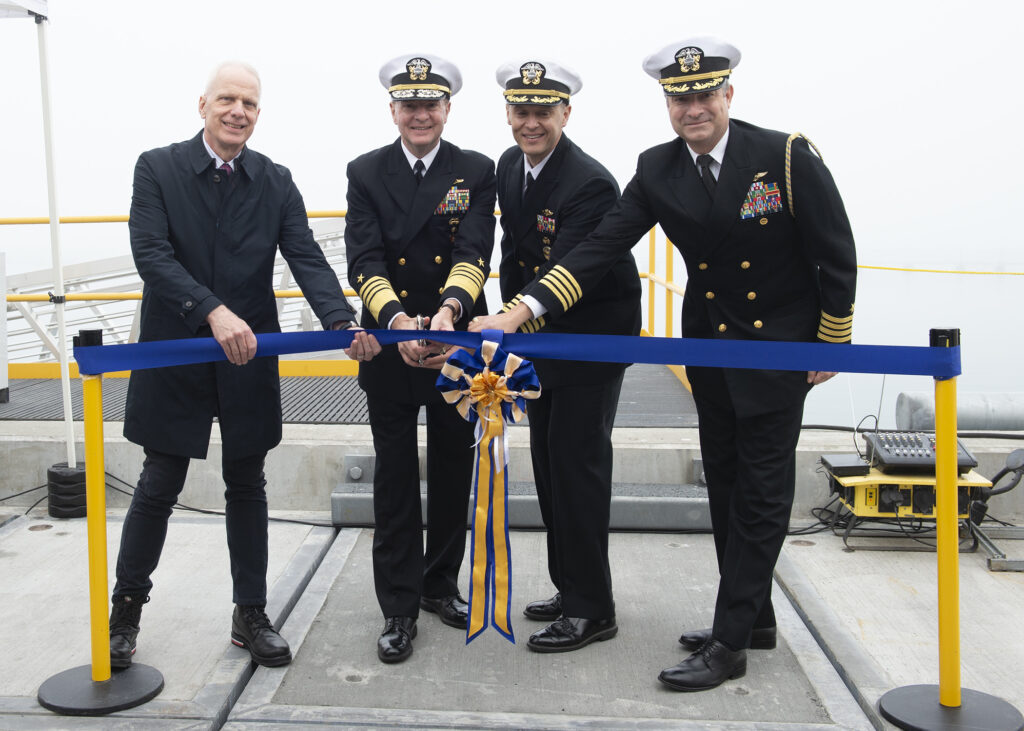
Mr. Peter Fleck, Submarine Development Group 5 facility operations manager, left, Adm. Stuart Munsch, commander, U.S. Naval Forces Europe-Africa, Capt. Gary Montalvo, commodore, Submarine Development Group 5 and Capt. Kevin Pickard, chief of staff, Navy Region Northwest, cut a ribbon during a ceremony for a newly-completed service pier located on Naval Base Kitsap – Bangor, October 19, 2022. U.S. NAVY / Mass Communication Specialist 1st Class Brian G. Reynolds

NAVAL BASE KITSAP, Wash. — Submarine Development Squadron (DEVRON) 5 held a ribbon cutting ceremony, Oct. 19, 2022, on a newly-completed service pier extension located on Naval Base Kitsap Bangor, Washington, Lt. Cmdr Christopher F. Donnelly of Commander, Submarine Force, U.S. Pacific Fleet, said in a Nov. 1 release. 

The ceremony marked the completion of a major infrastructure project, nicknamed the “Olympic pier” due to its proximity to the Olympic Mountain Range, which will support the arrival of fast attack submarines, including the planned change of homeport for USS Seawolf (SSN 21) and USS Connecticut (SSN 22) from Naval Station Bremerton to Naval Base Kitsap-Bangor. 
 
The ceremony, which was led by Capt. Gary Montalvo, commodore of DEVRON 5, hosted the event which featured Adm. Stuart Munsch, commander of U.S. Naval Forces Europe-Africa, as the keynote speaker. 

The service pier extension project was more than a decade in the making. Originally envisioned in 2008 and supported by Munsch, who was the DEVRON 5 commodore at the time and knew it was a project that was needed to service all classes of SSNs. Construction began in 2020. 
 
“Your efforts, and that of many others over the years, to build this pier and ready it to sustain our most advanced submarines, represents the best of the many organizations working together, fighting any and all obstacles to build capability to enhance our undersea dominance,” said Montalvo. 
 
The service pier extension includes state-of-the-art technologies for security and pier services for moored submarines. The shore power configuration incorporates the latest technology to provide multiple fully redundant power sources, ensuring continuous safe in-port operations and minimizing the affects due to normal wear and tear or natural disasters. The pier boasts a first-of-its-kind captured mooring system that compensates for tidal changes, which will ensure all classes of submarines remain securely moored without need to frequently adjust mooring lines. 
 
A full environmental assessment of the project was performed during the design phase in order to minimize the environmental impacts to the Hood Canal and its local fish and wildlife. Environmental considerations include a newly-designed, all-electric crane which will provide service on the pier, and the deliberate positioning of backup diesel generators located upland, away from the water. 
 
Upland support infrastructure for the service pier extension include a newly constructed parking lot to provide safe and convenient access for submarine crews and support personnel. The pier has maintenance support facilities dedicated to units moored at the service pier extension. 
 
“The completion of Olympic Pier advances a visionary shore infrastructure plan designed to improve quality of work for our Sailors, increase operational availability of fast attack submarines in the Pacific Northwest, and advance the research, development, test and evaluation needed to deliver decisive warfighting advantage,” said Munsch. “Olympic Pier enables us to bring together intellectual and industrial partners with the Submarine Force’s most experienced operators of advanced undersea systems and, now, the right current and future submarines to test and field those decisive new capabilities.” 
 
The service pier extension provides substantial immediate and long term benefits to the submarine force and the Navy. The planned change of homeport for Seawolf and Connecticut will improve the quality of service to the units while in port. Dedicated pier and maintenance facilities promote efficiency for maintenance. 
 
Support, training and oversight provided by DEVRON 5, the Immediate Superior in Command, will be improved by the close physical proximity of the boats. Longer-term benefits include the capability to maintain increased persistent presence of fast attack submarines in the northern Pacific region, and the continued development of future undersea warfare capabilities.


Navy Achieves Full Operational Capability on Critical Underwater Training Range

The Naval Aviation Training Systems and Ranges program office (PMA-205) recently achieved Full Operational Capability on their Undersea Warfare Training Ranges Increment I (USWTR INC I) program. U.S. NAVY

PATUXENT RIVER, Md. — The Naval Aviation Training Systems and Ranges program office’s (PMA-205) Ocean Systems Fixed Ranges team recently achieved full operational capability on the Undersea Warfare Training Ranges Increment I (USWTR INC I) program 13 months ahead of schedule, the Naval Air Systems Command said in a Nov. 1 release. 

The Naval Aviation Training Systems and Ranges program office’s (PMA-205) Ocean Systems Fixed Ranges team recently achieved full operational capability on the Undersea Warfare Training Ranges Increment I (USWTR INC I) program 13 months ahead of schedule. U.S. NAVY 

 The USWTR INC I training range supports fleet readiness through realistic training and the tactical development of submarine, surface ship, and aircraft undersea warfare capabilities. 

“Since completing installation, the fleet has conducted four exercises on the Increment I range, to include critical anti-submarine warfare exercises, which shape future exercises and further advance the capabilities the Navy has to offer,” said Brandi Payne-Tapponnier, the program’s team lead. USWTR INC I allows for timely and accurate feedback of training performance to exercise participants and the ability to rapidly reconstruct the training event, enhancing the quality of complex training scenarios, she said.  

The USWTR program consists of three increments. During USWTR INC I, the team managed the installation of the ocean sensor and shore electronics subsystems located off the coast of Florida. Under Increments II and III, the team is upgrading previously installed systems at the USWTR’s other range locations in areas of the Pacific Ocean and international waters of the Caribbean Sea. 

“These ranges are essential to our national security, and provide critical support to the helicopter maritime strike, maritime patrol and reconnaissance, and Navy ship communities,” said Capt. Kevin McGee, PMA-205 program manager. “They include a vast array of technology providing a realistic training environment that enables ships and aircraft to track targets for anti-submarine warfare training, which increases fleet capability and lethality.” 

The team acquired and installed an additional total of 500 nautical miles of instrumented undersea warfare training ranges in littoral waters in the Atlantic Ocean. Secondary missions of USWTR INC I include training in shallow water and conducting regional conflict operations training. 


Navy Resumes Flight Operations for Some T-45 Aircraft

Chief of Naval Air Training Rear Adm. Richard Brophy (right) and Training Squadron 21 Commanding Officer Cmdr. Matthew Starr taxi in a T-45C Goshawk prior to a proficiency flight, Oct. 31. U.S. NAVY

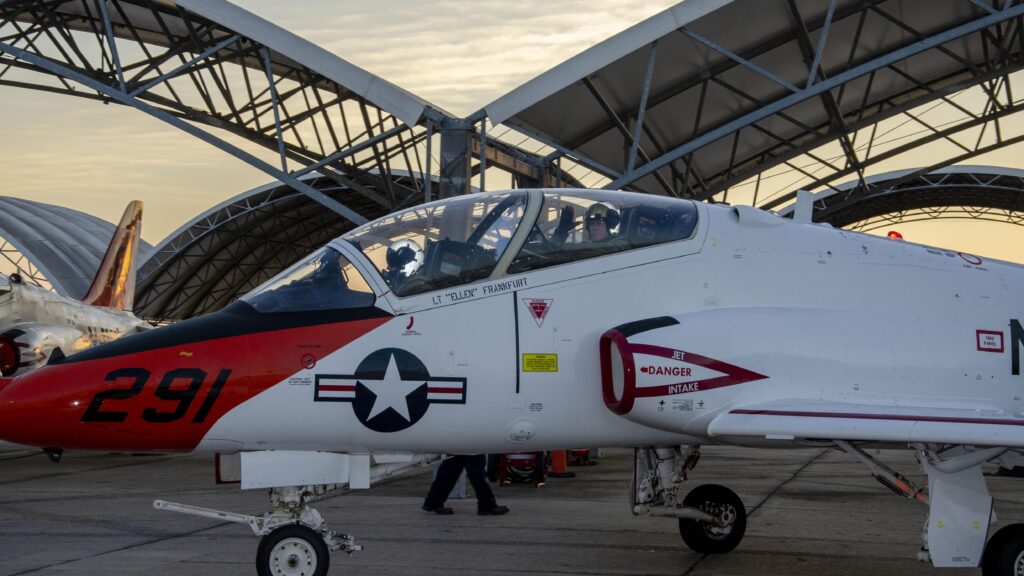
PATUXENT RIVER, Md. — Chief of Naval Air Training (CNATRA) had resumed T-45C Goshawk aircraft flight operations Oct. 31, the Naval Air Systems Command said in a release.  

The Navy and Marine Corps’ fleet of T-45Cs have been on a safety pause since Oct. 14 following the discovery of an engine blade failure. Engineering analysis has revealed that a subset of T-45C engine blades do not meet the manufacturer’s engine specifications; those aircraft remain grounded. The T-45Cs that have returned to flight contain engines that are compliant with these specifications.  

“The process of returning to operations is based off engineering analysis by NAVAIR, with the most important decision being the safety of our aviators,” said CNATRA Rear Adm. Richard Brophy. “The aircraft we are flying are verified and known-good. We have the highest confidence in the compliance of these aircraft.” 

Flight operations for the rest of the T-45C fleet will remain paused as the Navy and its industry partner Rolls Royce continue to evaluate engineering data on the non-conforming parts and work to return additional T-45Cs to operational status. During this time, training air wings and squadrons are maximizing ground training, including classroom lectures, simulators and computer-based training. 

The T-45C is a tandem-seat jet trainer whose mission is to train Navy and Marine Corps pilots. 

“We sincerely thank the team at NAVAIR for their hard work and commitment to finding the best possible solution for the long-term safety of our aviators and aircraft. While the reintroduction of the T-45C fleet will be a staggered approach, it is not a process that will be rushed. It is essential that our maintenance partners analyze and diagnose this issue thoroughly so training operations can fully resume with the safety of each of our aviators as a top priority,” said Brophy. 

“Safety of our student aviators and instructors is paramount,” said Rear Adm. John Lemmon, Program Executive Officer for Tactical Aircraft Programs (PEO(T)). “Our Navy teams and industry partner are diligently and thoroughly analyzing all facets of this issue to determine a safe and expeditious way forward for the rest of the T-45 fleet to return to flight.”