USCGC Vigorous Returns Home after a 48-day Multi-Mission Patrol
U.S. Coast Guard Cutter Vigorous moored at home port in Virginia Beach, Virginia Dec. 21, 2022. Vigorous is a 210-foot, Reliance-class medium endurance cutter with a crew of 74. U.S. COAST GUARD / Petty Officer 3rd Class Kate Kilroy
VIRGINIA BEACH, Va.— The crew of the U.S. Coast Guard Cutter Vigorous (WMEC 627) returned to their homeport in Virginia Beach Dec. 21, following a 48-day patrol in the Northern Caribbean Sea, the Coast Guard Atlantic Area said in a release.
In support of the Coast Guard’s Seventh District, Vigorous’ crew conducted maritime safety and security missions as they responded to the historically high migration activity and remained prepared to interdict and disrupt the flow of illegal narcotics in the South Florida Straits and Windward Pass.
During the patrol, Vigorous traveled more than 8,000 miles and contributed to the safe transfer of more than 500 Cuban nationals. Vigorous worked with numerous Coast Guard assets, U.S. Customs and Border Protection boats and good Samaritan vessels to detect, deter and intercept unsafe and illegal ventures bound for the United States.
“The Vigorous crew’s remarkable professionalism, competence and determination were on full display as we met the diverse challenges of operations at sea,” said Cmdr. Ryan Waters, commanding officer of Vigorous. “Whether executing days of small boat operations late into the night or rendering assistance to mariners on a disabled vessel, the Vigorous crew exceeded expectations at every turn. After a successful patrol, we look forward to returning home to our family and friends on shore.”
Vigorous is a 210-foot, Reliance-class medium-endurance with a crew of 74. The cutter’s primary missions are counter-drug operations, migrant interdiction, enforcing federal fishery laws and search and rescue in support of U.S. Coast Guard operations throughout the Western Hemisphere.
UK Chief of Defence Staff Highlights Maritime Context Within Defense Review Refresh
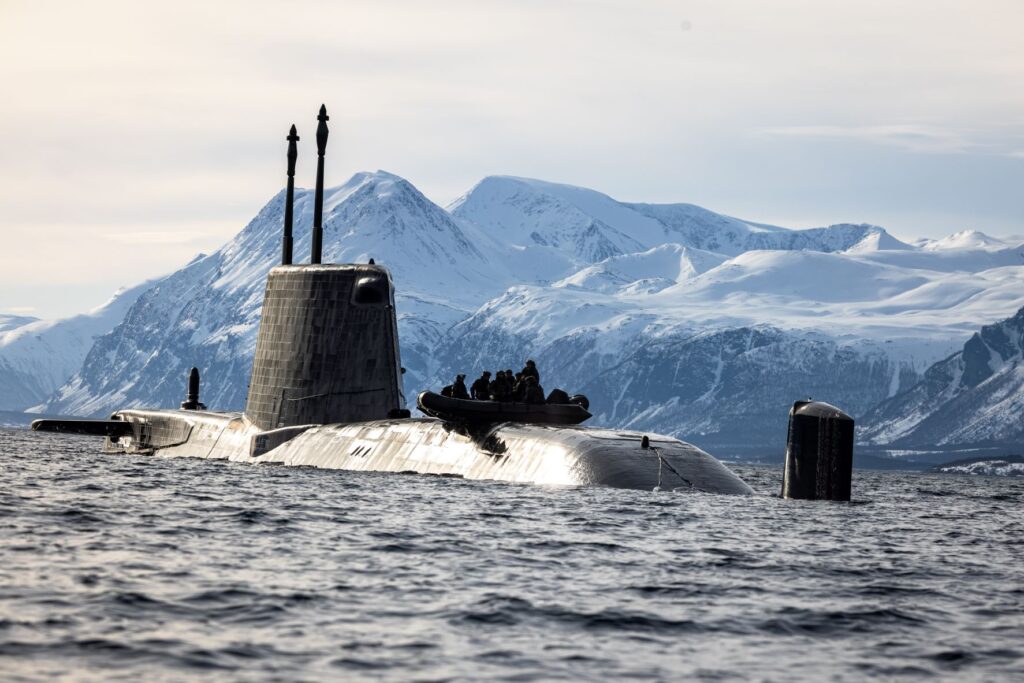
A Royal Navy Astute-class submarine deploys Royal Marines raiding forces during an exercise in Norwegian waters in early 2022. With NATO growing its North Atlantic naval presence, the United Kingdom’s impending refresh of its 2021 Integrated Review may enable the United Kingdom to consider increasing its submarine force levels. U.K. MINISTRY OF DEFENCE
LONDON — As the United Kingdom adapts to the consequences of conventional war in Europe and wider emerging security challenges, it is preparing to refresh its 2021 Integrated Review (IR) of defense, security and foreign policy. The United Kingdom has already delivered on several naval capability developments outlined in the IR. However, an ‘IR Refresh’ may enable the United Kingdom to enhance certain elements of its naval force posture.
These themes were discussed by U.K. Chief of Defence Staff (CDS) Adm. Sir Tony Radakin, in the annual CDS lecture at the Royal United Services Institute, London on Dec. 14.
Radakin pointed to three premises in the global security situation: that current times are “extraordinarily dangerous”; that these “extraordinary times call for an extraordinary response,” which is being delivered and is countering Russia’s aggression in Ukraine; and that the response to the Ukraine war has reinforced U.K. requirement to retain a global outlook.
In the Ukraine war, focus falls on land operations. However, Radakin outlined the wider maritime context. Russian naval losses have been significant, with 12 ships (including a capital ship, the Slava-class cruiser Moskva) lost at sea or in port. In return, NATO has become stronger at sea, with Radakin noting the “hard power amassed” in the North Atlantic.
The 2021 IR identified Russia as an acute threat and China as an emerging challenge, Radakin said. However, he added, “what has happened is that events of the past year have trended towards the most negative scenarios we envisaged in the IR.”
Reflecting Western focus on high-end conventional warfare as a consequence of conflict in Ukraine, Radakin explained that the United Kingdom has delivered several significant naval capability developments since the IR. “We’ve placed the contract for the second batch of Type 26 frigates, and for the Naval Strike Missile [NSM]. The Fleet Solid Support [FSS] Ship program is moving forward, and we’ve purchased a new Multi-Role Ocean Survey Ship [MROSS] to protect our critical underwater infrastructure.”
November was a busy month for the Royal Navy (RN). The contract was awarded for the second Type 26 batch, comprising the final five hulls of the eight-ship class. The United Kingdom announced that 11 RN ships — a mix of Type 23 frigates and Type 45 destroyers — will receive an NSM fit, with three fitted in time for operational deployment within 12 months. The United Kingdom also down-selected an FSS supplier.
Progress will continue into early 2023, when the RN is scheduled to receive the first of two MROSS vessels.
The ‘IR Refresh’ will have to address continuing challenges with Russia, but should maintain a global perspective, Radakin argued. Tackling the threats facing the United Kingdom, the review would also present opportunities.
Radakin pointed to the September 2021 Australia/UK/US (AUKUS) accord, at the core of which is building a nuclear-powered attack submarine (SSN) capability for Australia. This may enable the United Kingdom to re-assess its own SSN force level, Adm Radakin explained. “If we have the courage to do this properly, then it’s also the means to strengthen the resilience of our own nuclear enterprise and grow our submarine numbers in the decades to come,” he said. “This will benefit our contribution to NATO as well as our presence in the Indo-Pacific.”
The ‘IR Refresh,’ Radakin continued, “[is] about thinking big: accelerating the transformation of the armed forces to become even more lethal and integrated; maximising the capabilities that offer a decisive advantage; being even more global in our outlook.”
To deliver this global outlook, Radakin asked, “might it mean a British carrier regularly deployed in the Indo-Pacific at the heart of an allied strike group?”
Naval Postgraduate School and Stanford University Formalize Partnership to Address Global Climate Change, Energy Security and Sustainability
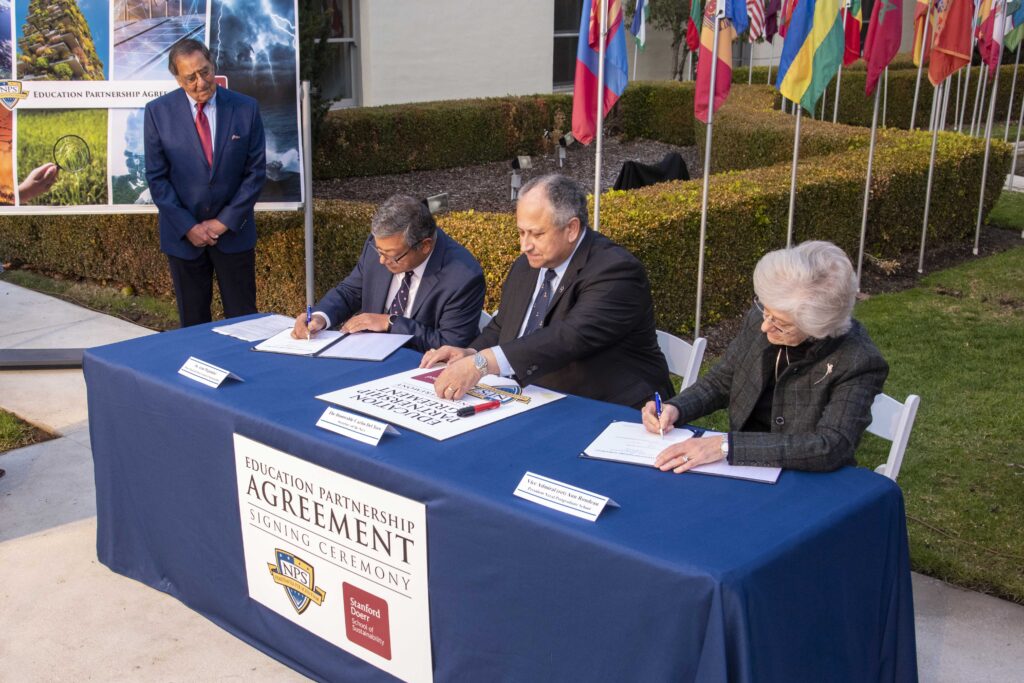
Secretary of the Navy Carlos De Toro was on hand for the signing of an Education Partnership Agreement between the Naval Postgraduate School (NPS) and the Stanford Doerr School of Sustainability on Dec. 15. U.S. NAVY/ Javier Chagoya
MONTEREY, Calif. — The Naval Postgraduate School (NPS) and Stanford University Doerr School of Sustainability have created a formal partnership to address the challenging issues of global climate change, energy security and sustainability.
The announcement was made on Dec. 15 at the NPS campus in Monterey, California.
The Education Partnership Agreement (EPA) was signed by NPS President Vice Adm. (ret.) Ann E. Rondeau and Dr. Arun Majumdar, dean of the Doerr School of Sustainability, during a ceremony that was presided over by Secretary of the Navy Carlos Del Toro.
“Bold climate action is a mission imperative for the Department of the Navy, and we must harness all of the tools at our disposal in order to make urgently needed change,” said Del Toro. “This collaboration between the Naval Postgraduate School and Stanford University will bring together two globally recognized hubs of research and innovation, focused on realizing solutions that our Navy and our nation can employ now and in the future.”
According to a press release from NPS, the Navy’s climate strategy highlights two major performance goals in its response: building climate resilience and reducing climate threats. But, the release said, it also underlines the importance of leveraging and empowering the education of Sailors and Marines to meet the challenges of climate and energy security and sustainability through knowledge and innovation.
“The combination of expertise, operational experience, education and entrepreneurship in this partnership with Stanford and their Doerr School of Sustainability is truly unique and a powerful contribution to the global climate challenges ahead of us all,” said Rondeau.
The NPS Climate and Security Network (CSN) brings together the school’s collective expertise on climate security and creates opportunities for interdisciplinary collaboration and information sharing. Through the CSN’s efforts, NPS student and faculty have contributed to the development of key climate strategies and plans within the Department of Defense and conduct research to inform future force design, force generation and deployment considerations.
The Doerr School is a new addition to the Stanford campus. Launched in May 2022, the school works with local and global collaborators to understand the challenges of climate change and find solutions that can be executed with impact at scale. The school includes multiple academic departments, including the Woods Institute for the Environment and the Precourt Institute for Energy; a sustainability accelerator to drive policy and technology solutions at scale; and a newly established Oceans Department located at the Hopkins Marine Station in Monterey.
Academic collaboration and research partnerships between NPS and Stanford are not new. Both schools have partnered on research efforts, leveraging each other’s strengths as well as their proximity in Northern California — the schools are 90 minutes apart by car.
Under the partnership agreement, NPS and the Doerr School of Sustainability will conduct joint research with the CSN and other NPS departments and groups, including the Energy Academic Group, Center for Infrastructure Defense, Meteorology, Oceanography, National Security Affairs, Defense Management and Engineering to investigate climate security, energy security, sustainability and more.
Naval Medical Research Center Begins Phase 1 Testing of Diarrhea Vaccine
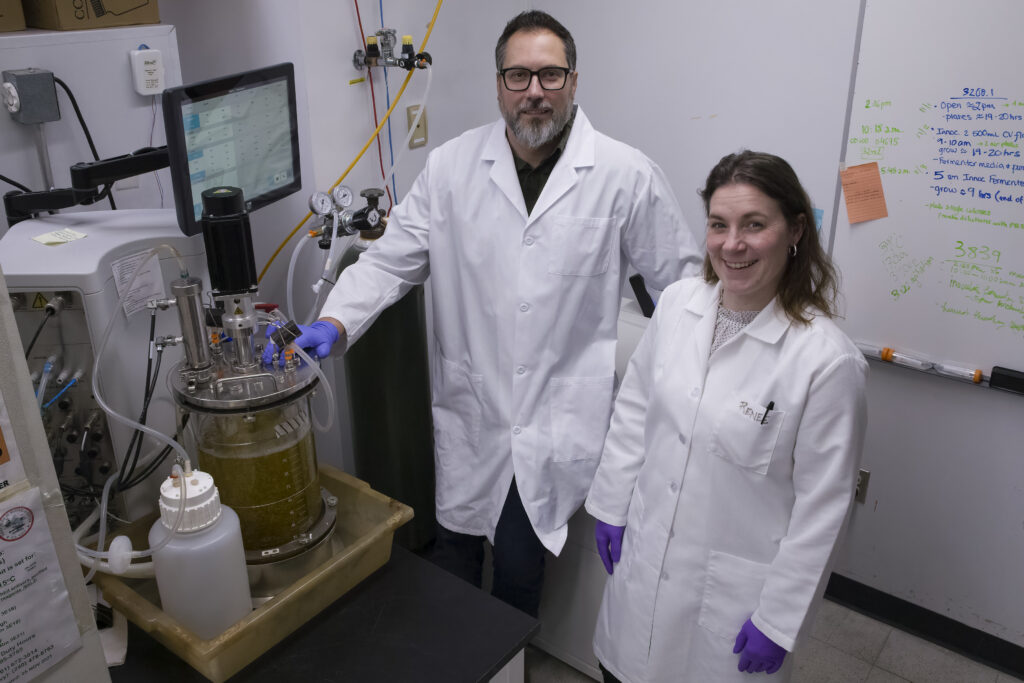
Dr. Frederic Poly and Dr. Renee Laird, research scientists with Naval Medical Research Center (NMRC), pose for a photo in the Enteric Diseases laboratory. NMRC’s Enteric Diseases Department, led by Poly, have partnered with the National Institute of Health’s National Institute of Allergy and Infectious Diseases to begin phase 1 testing of a new vaccine for Campylobacter jejuni, a foodborne pathogen. U.S. NAVY / Michael Wilson
SILVER SPRING, Md. — Researchers with Naval Medical Research Center (NMRC)’s Enteric Diseases Department have partnered with the National Institute of Health’s National Institute of Allergy and Infectious Diseases to begin phase 1 testing of a new Campylobacter jejuni vaccine, NMRC announced in a Dec. 19 release.
Campylobacter jejuni, a foodborne pathogen, is one of the most common causes of diarrheal illness in the U.S. and abroad, and can impact readiness of deployed or traveling service members.
Phase 1 testing, currently underway at Cincinnati Children’s Hospital Medical Center, focuses on the safety and best means of Campylobacter vaccine delivery. Researchers will vaccinate 60 patients in total as part of Phase 1 testing. This first phase of testing is expected to continue through the end of 2023.
Phase 2 testing will involve vaccinating groups of adults with a dose of the vaccine determined in phase 1, to determine its effectiveness in protecting against Campylobacter. NMRC researchers expect to begin phase 2 testing by 2025 at the earliest, depending on funding and the facilities available.
Diarrhea is a frequently occurring illness during military operations, despite modern preventive medicine efforts. The impact of severe diarrhea can be debilitating and impair a service member’s ability to do their job. Acute diarrheal illness during deployment is commonly responsible for loss of duty days, negatively affects mission readiness and may be fatal in the worst cases.
“With really infectious diarrhea, you get cramping, and if you have cramps, you can’t really operate,” said Dr. Frederic Poly, head of NMRC’s Enteric Diseases Department, who has been involved with the project since 2005. “You can develop a fever; you’re going to get dehydrated and you’re going to lose cognitive perception. These are all symptoms that will negatively impact how you function.”
Following recovery from initial infection and bouts of diarrhea, individuals can still experience long-term effects of infection.
“With Campylobacter, there’s potential downstream effects, like irritable bowel syndrome or Guillain-Barré syndrome, which can lead to respiratory and neurological issues,” noted Lt. Yuliya Johnson, a microbiologist with NMRC. “It doesn’t happen to everyone, but there is still an associated risk we hope to mitigate by developing a vaccine.”
According to Poly, this vaccine will be the first developed for use against Campylobacter, and if successful, has the potential to benefit civilian and pediatric populations as well. Vaccination at a young age can curb developmental issues caused by diarrhea that might otherwise affect physical and mental development in children.
Poly, NMRC’s most recent senior civilian of the quarter for science, leads the NMRC Enteric Diseases Department. The department, composed of 23 full time microbiologists, molecular biologists, biochemists and immunologists, researches treatments for the prevention of infectious bacterial diarrhea.
This past year, the department completed development and clinical evaluation of a prophylactic against another military relevant enteric pathogen, ETEC (enterotoxigenic E. coli). The enteric diseases lab is also working on the development of an oral prophylactic to prevent infection from several other intestinal pathogens.
NMRC and its commands are engaged in a broad spectrum of activity from basic science in the laboratory to field studies in austere and remote areas of the world to investigations in operational environments. In support of the Navy, Marine Corps and joint U.S. warfighters, researchers study infectious diseases, biological warfare detection and defense, combat casualty care, environmental health concerns, aerospace and undersea medicine, medical modeling, simulation, operational mission support, epidemiology and behavioral sciences.
Ships and Human Performance: Surface Forces Take Holistic Approach to Sailors, Crew Training
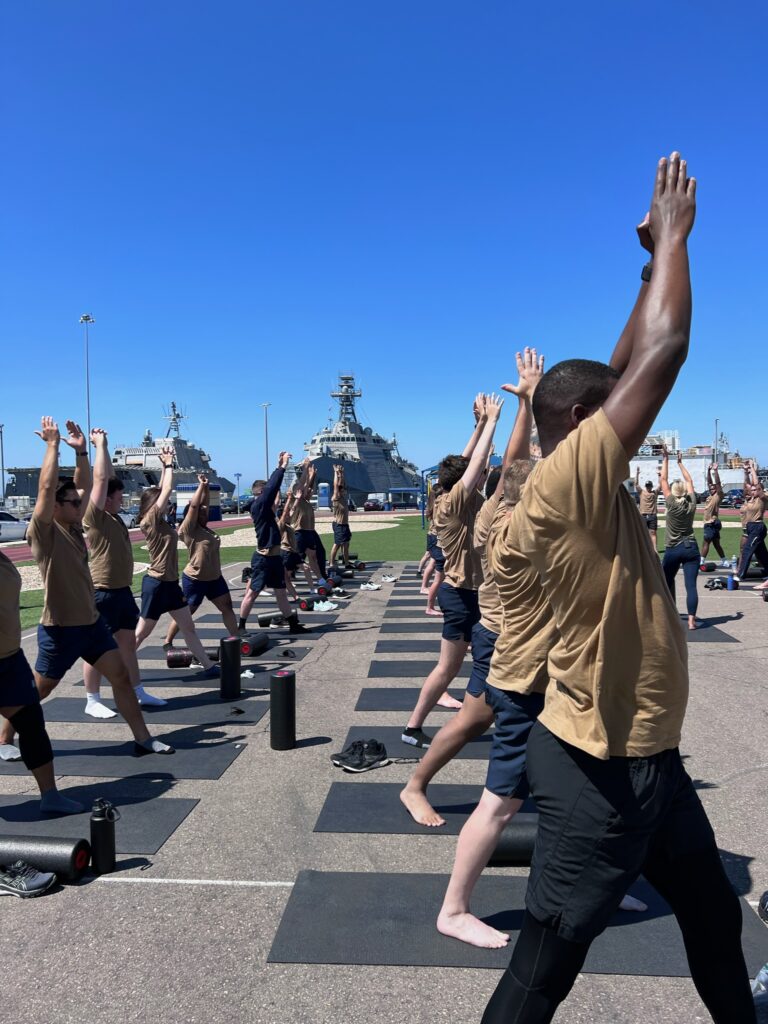
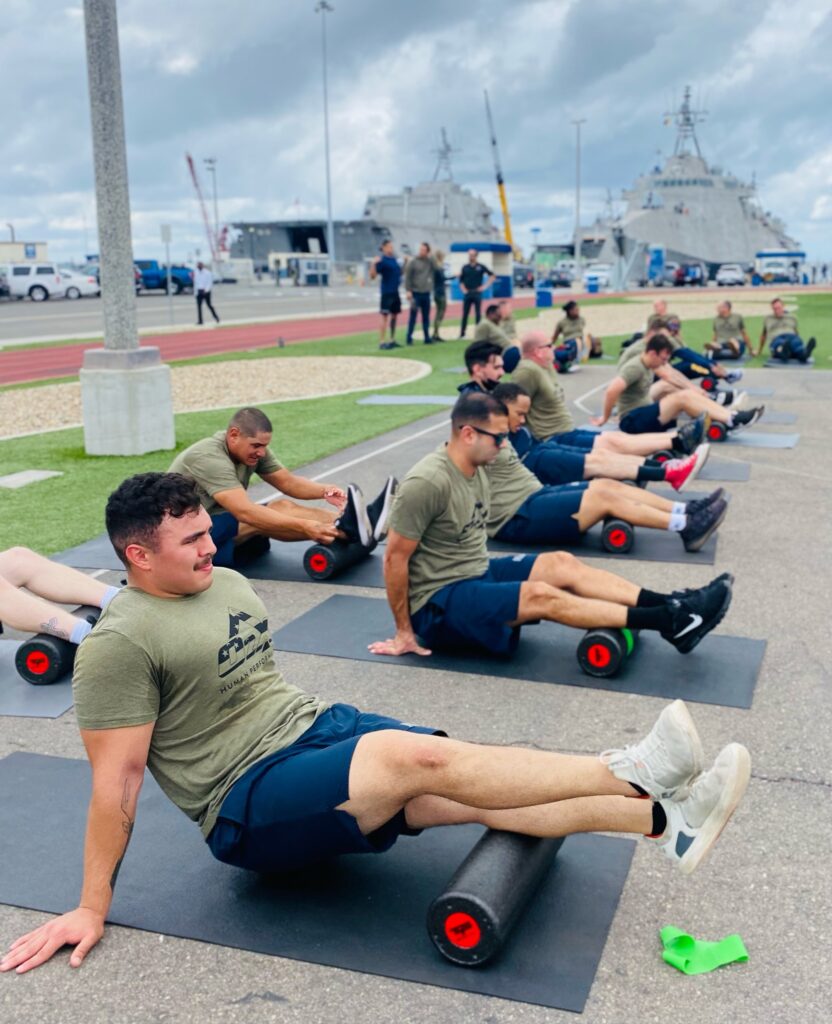
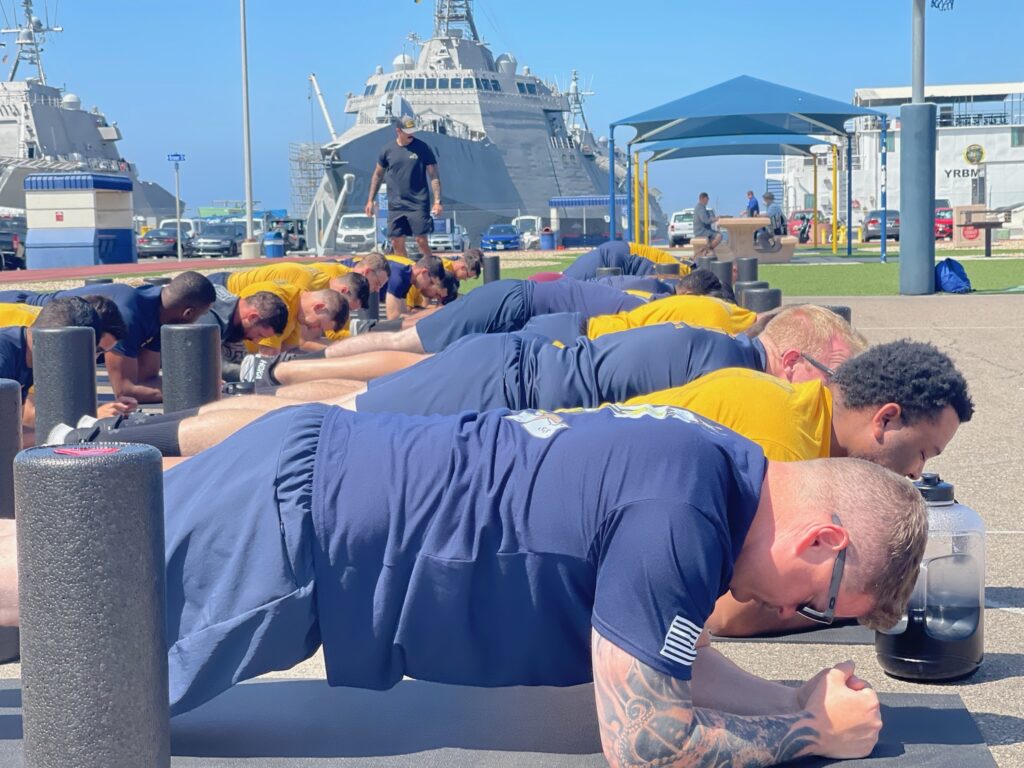
Human performance company O2X led littoral combat ship crews in two days of exercise and yoga classes during a workshop in San Diego in late 2021. U.S. NAVY
On the surface of it, the idea of training Sailors about nutrition, exercise, fitness, injury prevention, sleep and mental well-being didn’t seem like a hard sell. Two days of classroom instruction, workout drills and yoga sessions, all led by professional trainers, gave them a temporary break in their routine aboard ship in homeport at Naval Base San Diego.
The workshops led by O2X Human Performance over the past year are an outgrowth of an innovative program that began in 2021 at Surface Warfare Officers School to teach future ship commanders how to better lead their crews by maximizing their own work performance, physical fitness, mental health and mental readiness. The holistic approach to these programs are among the surface Navy’s continuing course changes after investigations into the causes of shipboard mishaps, including collisions and groundings, found commanders and crews plagued by sleep deprivation, stress, fatigue and inadequate training.
The initial series of workshops for ships’ crews — supported by Naval Surface Force officials in concert with Naval Health Research Center’s Crew Readiness and Watchstanding (CREW) efforts — found that all Sailors benefit from the training and incorporated it into their own work and personal lives.
“We’ve collected a substantial data. It’s loved. Everybody likes it,” said Dale Russell, the Naval Surface Force’s operational safety and human factors advisor in San Diego.
As of mid-October, 770 Navy personnel have gone through the O2X program since it was incorporated into the Prospective Commanding Officer/Executive Officer courses at Surface Warfare Officer School in Newport, Rhode Island, according to O2X Human Performance, a Scituate, Massachusetts-based company founded by three former Navy SEALs. That includes 440 officers at SWOS and 305 sailors and officers from Naval Surface Forces Pacific ships in San Diego, including destroyer USS Preble (DDG 88), littoral combat ship USS Manchester (LCS 14) and, more recently, the Blue Crew of USS Omaha (LCS 12).
Buoyed by the positive feedback, Naval Surface Force is weighing the next step and plans to expand its investment across the waterfront by developing a program in-house. Consider it the human equivalent of preventative maintenance measures the Navy long has had in place for its multi-billion-dollar inventories of ships and aircraft.
Preventative Maintenance
It would be “an O2X-like program that is organic to the fleet and is built around firefighting and damage control,” Russell said. “It will give the team something to rally around. It’ll build unit cohesion, solidarity, camaraderie… [and] it’ll give them a context to get into physical shape. This will give them something to train around.”
An ongoing CREW study, into wearables for fatigue management, is helping get “this curriculum in front of as many Sailors, leaders and surface fleet that we possibly can,” said Adam La Reau, a former SEAL and co-founder of O2X Human Performance. Sailors “are excited that the Navy is putting the time into them.
“We’re providing skills-based training. That education, just like with their skills-based training with the jobs that they do every single day, continues,” La Reau said. “Human performance is no different than [training] in their roles as a navigator. They constantly have to learn.”
“This is not something that you provide one time,” he said. Ideally, “they have to be built into their routine, built into their battle rhythms, but also at touchpoints. These are hard installs of education along the way. It could be when a ship is coming out of a maintenance cycle. It could be at Great Lakes, post-A School. It could be periodically when a ship crew change-out happens.”
The O2X classes are an outgrowth of a program that began in 2021 at Surface Warfare Officers School to teach future ship commanders how to better lead their crews by maximizing their own work performance and physical fitness. U.S. NAVY
O2X’s mantra focuses on one making small but important incremental changes of 1% — whether in sleep or nutrition habits, managing stress or exercise routine. Each workshop wraps up with an all-hands discussion on making that goal a daily reality. “It’s not just with the leaders, it’s with the entire crew and teaching them about taking ownership,” La Reau said.
“It’s like everyone’s on a team, and you’re walking into a locker room every single day and we continue to fill each other up. We find ways as an organization, not necessarily waiting for the CO or the XO or one of the senior enlisted to step up and say something. Everybody has a voice here,” he added. “The Sailors have a ton of examples of previous ships and past experiences that may be small things that we could potentially change. We don’t have to do it the way we’ve always done it.”
O2X Human Performance is working with Naval Health Research Center over the next year in the CREW study and with the Navy’s Center for Security Forces and is talking with aviation and safety commands for potential collaboration in similar vein as the fleet.
“There’s quite a bit of appetite and opportunity,” La Reau said, noting the training touches on safety, health, wellness, readiness, resilience, retention and maybe recruitment. “There’s also a risk-mitigation factor here. It’s driving self awareness. It’s understanding what your capabilities are, understanding … how to persevere through challenging times or in the moment to be able to dig into resources to execute at a very high level.”
The best part, he said, is “we’re seeing these individuals saying, ‘I need to make a change. Me being a good leader is definitely tied to taking care of myself and me being a good example. Especially onboard a vessel, onboard a ship. People are emulating what I do and how I live my life. I need to take care of myself, so I can take care of my ship and my Sailors and so I can be the best leader that I can be. And I can do the things that the country has asked me to do.’”
Naval Surface Force and Naval Health Research Center continue to process and analyze feedback and data collected through the workshops’ participants who use wearable devices that track sleep, exercise and other information. “The scientific literature is pretty clear: If you exercise, your biophysical response makes you sleep better, which gives cortisol, which makes you feel better. It builds social bonds, which make you feel better, sleep better, exercise better,” Russell said. “So, it’s a positive feedback loop.”
The reality of daily life in the fleet, however, makes physical training extremely hard for many Sailors and crews to sustain, he acknowledged. But Sailors want just that. In safety climate assessments across the fleet, collected as part of the CREW effort over the last two years, “Sailors have voiced: We really want to work out more. We’re bummed that we don’t have group PT,” Russell said. “A very small percentage of the ships even have mandatory PT, because of the nature of the environment they work in. We’ve realized that a paradigm shift is needed, but that’s easier said than done in a large organization like ours.”
Naval Surface Force officials, led by Vice Adm. Roy Kitchener, are working to change that. As it develops its organic human performance training, the surface Navy also will roll out a new watchbill software, OWL, designed to help leaders and crews manage fatigue.
“We are right now pilot-testing that on, I think eight ships this fall, currently. If this works out, then we’ll start rolling it out to the fleet next year, fleetwide,” Russell said. “We are getting ready to rewrite our CREW Endurance instruction to capture that.”
Buoyed by positive feedback, Naval Surface Force plans to expand its investment across the waterfront by developing a similar program in-house. U.S. NAVY
Wearable Devices
SURFOR also is looking at using wearable devices as “an occupational management” tool, he said, provided they can develop algorithms that work for shipboard life. Trackers such as Fitbit work if one is “walking on terra firma, not on water, which throws off some of the sensors on it,” he said. With 18 months of data collected so far, SURFOR is “putting motion sensors aboard the ships so we can kind of get a feel for how a ship like an LCS bobs in the water as opposed to an amphib, so we can tweak the algorithm based on whatever ship they’re on.
“The plan will be to roll out 55,000 wearables to the entire fleet,” he said, acknowledging the challenge since one-third of a ship’s crew turns over annually. More likely those devices would be fielded to field it to “key, critical billets,” likely the bridge, engineering and combat information center.
Several months ago, Kitchener allocated $1 million for the authority to operate “a wireless hub to go on ships and pull the data off the wearables to the ship’s network — CANES — and feed it into OWL,” Russell said. If all goes as planned, that connectivity will be up and running on those ships during exercise Talisman Saber in 2023 “so we can kind of pressure-test it.”
“OWL will give the leadership on the ship that visibility of what’s going on. … They can break it down by department, watchbill, however they want to slice and dice that data,” he said. Connectivity can be spotty at sea, so they’re looking to push data off the ship and into Jupiter, the Navy’s enterprise data link environment. The combination of OWL implementation and wearables could provided a “check engine,” light, for example, for someone who didn’t sleep well at night.
“That could the touchpoint” for a leader to then ask them to go see medical or ask about their sleep, Russell said. “So no matter – whether you have COVID or whether you haven’t slept well or you had a fight with your loved one or you’ve got an STD — it’s your heart-rate variability and deviation from that. … We’re just trying to trigger that touchpoint and say, something’s wrong. Let’s go see what might be wrong.”
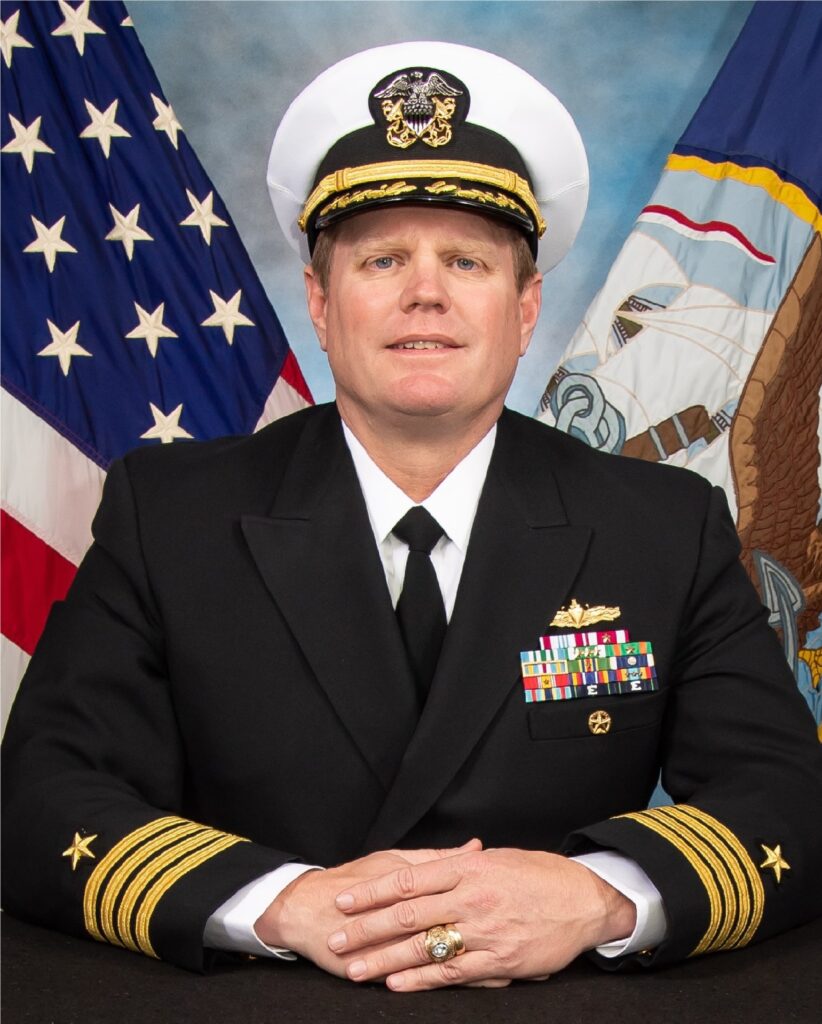
Capt. Shea S. Thompson Commodore, Surface Development Squadron One (SURFDEVRON 1)
Capt. Shea S. Thompson. U.S. NAVY
A native of San Marcos, California, Thompson received his commission from the U.S. Naval Academy in 1997. His sea tours included USS George Philip (FFG 12), USS Cape St. George (CG 71), and USS John Paul Jones (DDG 53). He served as executive officer and then commanding officer of USS Chafee (DDG 90). Subsequently he commanded USS Bunker Hill (CG 52).
Thompson’s tours ashore include Naval Postgraduate School where he earned a Master’s Degree in Financial Management; Ballistic Missile Defense Syndicate Lead at Tactical Training Group Pacific; Ballistic Missile Defense Training Officer at U.S. 3rd Fleet; Joint Interface Control Officer at Headquarters U.S. European Command (J3); C4ISR Operations Branch Chief at U.S. Strategic Command, Joint Force Component Command Global Strike (J6); N8/9 Branch Head Headquarters Surface and Mine Warfare Development Center.
Thompson discussed the roles of Surface Development Squadron One with Senior Editor Richard R. Burgess. Excerpts follow.
How did your background prepare you for your current command?
THOMPSON: Actually, my background prepared me quite well. Following my command tour on USS Chafee, I had the privilege of being assigned to the Surface and Mine Warfighting Development Center [SMWDC] where I served as N8/9 Branch Head for Future Requirements & Resources and Experimentation from 2016 to 2019. During that time, I had significant exposure to the acquisition and budgeting process as well as requirements generation. SMWDC’s Warfare Improvement Programs fell under my portfolio for those three years. We produced the surface fleet’s Integrated Prioritized Capabilities List for surface warfare Integrated Air and Missile Defense, Surface Warfare, Amphibious Warfare and Mine Warfare. That experience really benefited me as I became intimately familiar with the capability gaps across all those mission areas.
I’ve worked with a number of stakeholders to include the technical community on how we would get at closing those gaps and back in 2017, we recognized unmanned systems had a role to play in closing a number of gaps across those mission areas. The beauty was, as I also wore the N9 hat, I was able to partner with industry and experiment with new and innovative capabilities that helped close those gaps. For example, I personally worked closely with industry on the first-ever remote operation of Sea Hunter [unmanned surface vessel] from a surface combatant to validate that capability. So, the learning curve of employing and operating unmanned platforms with and from manned surface forces wasn’t that steep for me as I came into this job.
In fact, when I took command of SURFDEVRON, I was encouraged by the progress I saw had been made since my time in SMWDC and my time taking command here. We’ve come a long way since 2017 [with] the current and future capabilities and possibilities that exist with manned and unmanned teaming, how that will enhance the lethality of the surface force going forward.
How many personnel comprise your command?
THOMPSON: On staff here at SURFDEVRON I have 13 Officers, 58 enlisted, and one civilian permanently assigned. USS Michael Monsoor (DDG 1001) and USS Zumwalt (DDG 1000) each muster about 180 personnel. Obviously, I’m eagerly awaiting delivery of USS Lyndon B. Johnson (DDG 1002) when that day comes. USV Division 1 was formally established during the SURFDEVRON 1 change of command ceremony on May 13 and is now commanded by CDR Jerry Daley. That squadron has actually grown to 103 Sailors comprised of 12 officers and 91 enlisted. Those folks are there to provide dedicated support to USV operations.
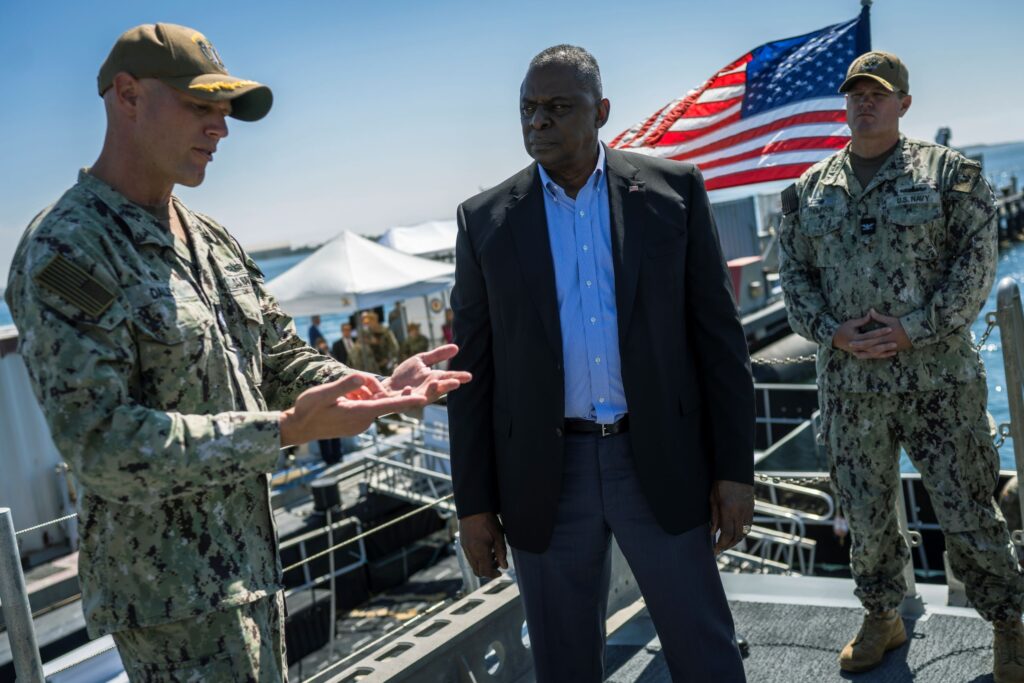
Cmdr. Jeremiah Daley, commanding officer, Unmanned Surface Vehicle Division One, Secretary of Defense Lloyd J. Austin III and Capt. Shea Thompson, commodore, Surface Development Squadron One, tour USV Sea Hunter at Naval Station Point Loma, California, Sept. 28. DOD / Chad J. McNeeley
How has the Chief of Naval Operations’ new Navigation Plan influenced the focus of your work?
THOMPSON: The CNO’s Navigation Plan is the guiding framework for my efforts for USV experimentation and fleet integration. In there, it talks about [how] unmanned surface platforms will increase the fleet’s capacity for distribution and expand our intelligence, surveillance and reconnaissance advantage, add depth to our missile magazines, supplement logistics, and enhance fleet survivability. This transition will gradually rebalance the fleet away from exquisite manpower-intensive platforms for smaller, less expensive yet lethal platforms. The capacity goal, if I remember correctly, is approximately 150 USVs.
That plan also emphasizes the importance of the manned/unmanned teaming in future fleet operations. We’re really getting at that. For example, one of the concepts we’re working on is further distributing the force through manned and unmanned teaming. Your typical surface action group, or SAG, consists of three destroyers. Right now, we’re trying to reimagine that traditional SAG. Instead of three manned DDGs making up that SAG, we’re exploring options to have one DDG as the center of a SAG teamed up with a number of unmanned surface vessels that would be one SAG. That also frees up the other two destroyers to create other manned/ unmanned SAGs and further distribute the force and enhance the capability and lethality of those SAGs as well. Honestly, I envision a future where this is the standard SAG construct and my team here is moving out full speed on proving out that concept.
What kind of experiments have you been working on with the Zumwalt-class DDGs?
THOMPSON: I would say that for the class, it’s been less about experimentation and more about class capability validation. That’s not to say we haven’t been leveraging those platforms for experimentation efforts.
I know you’re aware that Zumwalt is currently employed in the Indo-Pacific region, and she is working on fleet integration and participation in fleet exercises. We’re pushing her forward to learn how the ship can best operate and integrate with other fleet assets and how this integration is done at the tip of the spear. You can only do so much learning pierside. It is important to accelerate her introduction into fleet exercises and this learning is going to inform future employment of the class. Prior to this employment, Zumwalt went through your standard workups for employment, conducting basic training certification events and participating in the Surface Warfare Advanced Tactical Training, otherwise known as SWATT.
Earlier this year, Monsoor participated in an ASW [antisubmarine warfare] exercise known as SCC Mini-wars, and she did that with coalition partners and the USV Sea Hawk in the Hawaiian op area. Monsoor also recently participated in the first RIMPAC exercise for the class where, again, she focused on force integration and continued her work with unmanned vessels in that exercise.
Do you expect the Zumwalt DDGs to return to your squadron after their modification with the Conventional Prompt Strike capability?
THOMPSON: They’re going to come back to me following deployment and they’re going to be with me for the foreseeable future. The future plans for the class remain in work. We are gathering data right know regarding Zumwalt’s current deployment and Michael Monsoor’s RIMPAC support. We’re going to leverage that data and lessons learned on any future deployments to include how to maintain and sustain the platform in an operational environment when deployed forward. I will say the best way to continue learning and validating the existing capabilities and TTPs [tactics, techniques and procedures] for the class is to keep them underway and employed, whether that’s with 3rd Fleet or 7th Fleet.
What kind of things are you doing with the two Overlord USVs and what are you planning in the future once the other two Overlord USV are on strength?
THOMPSON: All four of the USVs that I own right now were involved in RIMPAC: Sea Hunter, Sea Hawk, Nomad and Ranger. Their involvement in RIMPAC really helped determine and define how the capabilities of the unmanned fleet will integrate with our manned ships. RIMPAC was an excellent arena to showcase the USVs’ usefulness in electronic warfare, data collection and how warships can leverage USVs in the high-end fight. In every exercise we do from SCC mini wars to SWATT to RIMPAC, the objectives being accomplished form the building blocks of realizing the manned/unmanned concept. A USV tracking a submarine using its ASW payload or providing target-quality tracks to a surface combatant — think EW [electronic warfare] payloads, sensor suite, etc. — we’re proving the USV is value added in providing our warships with more flexibility in meeting the mission.
How about your experimentation with Sea Hunter and Sea Hawk USVs?
THOMPSON: They each bring different payloads and capabilities. And so, we’re working with those to further validate our concepts. For the broader unmanned campaign plan, Surface Development Squadron One is developing those concepts in the playbooks, in the TTPs and we’re doing that with other stakeholders. We’re not doing that in a vacuum. I see those concepts and TTPs playing in the potential surface battles of tomorrow. The prototype USVs are being heavily leveraged to validate these concepts and TTPs. When the program of record USV does come online, we can quickly transition it into fleet operations. The goal to me will be for them to be embedded into fleet operations to further distribute the force, provide manned warships with target quality tracks and, also, for adjunct magazines.
One important note I think is worth mentioning is we’re focused on autonomous USVs with a man-on-the-loop technology. That means that even though a USV may be in an autonomous mode while conducting a mission, it is always being monitored — including its health status — and at any time the man-on-the-loop, whether on board a ship or shore, can take direct control as required.
Are there any specific accomplishments you want to mention with regard to the USVs or the Monsoor in RIMPAC?
THOMPSON: Sea Hawk was out during the SCC Mini-Wars and did excellent work. She validated the value of her ASW payload. Not just here at the Echelon 5 level but all the way into the Echelon 2 level. In the near future, we’re participating in a fleet exercise that we’ll explore how that capability supports our expeditionary capability and the Marine Corps’ efforts on that front, too. The big ship-to-shore movement of USVs’ C2 [command and control] nodes, officially we’re working with PMS-406 to gain unmanned, unescorted, OTH [over the horizon] proof-of-concept testing.
For Monsoor, RIMPAC was really a test of the operational concepts and to gather insights about further employment for the class. She flexed her capabilities across all mission areas to include SUW, ASW, and air defense. She also conducted an experiment that consisted of launched employment and recovery of a UAV to enhance maritime surveillance. All four USVs that participated in RIMPAC demonstrated how they fit into the composite warfare commander concepts either attached to a destroyer or sent out on individual missions. It really helped to determine how the capabilities of the unmanned fleet integrate with our manned ships, with focus on ASW, EW, surface warfare, interoperability and transfer of control of those USVs between manned ships and ashore or vice versa.
Then-Cdmr. Shea Thompson gives remarks during the Surface Development Squadron One change of command ceremony in May. During the ceremony, Thompson relieved Capt. Jeffery Heames as commander Surface Development Squadron One. U.S. NAVY / Mass Communication Specialist 2nd Class Diana Quinlan
With the Navy developing the Next-Generation Destroyer (DDG(X)) and the Large USV, are you actively engaged in providing feedback for development of those vessels?
THOMPSON: Yes. As we worked fleet introduction for DDG 1000 class and the USVs, there are a number of lessons learned that can be applied to both the DDG(X) and LUSV, not just from a capability validation perspective but also from a maintenance and sustainment perspective. And so, those lessons are being shared across the enterprise. The LUSV program is in the prototyping stage while we develop and demonstrate the technology for critical subsystems, through a comprehensive land-based and afloat test program across HM&E [hull, mechanical and engineering], C2, autonomy, perception and integrated combat system aspects prior to moving into serial production. By the end of 2023, we expect to have seven USV prototypes operating under the direction of Surface Development Squadron One and that’s in partnership with PMS-406 and the USV Program Office.
USVs are planned to be the high-endurance adjunct [missile] magazine based on commercial designs built around the common missile launcher and combat systems. The initial capability will be to support both surface warfare and strike warfare, but I anticipate that being expanded and air defense as well. The six LUSV studies contracts were awarded in September of this year. Those contracts are going to help refine specifications and requirements to inform future LUSV detail design and construction.
What advances have you seen in unmanned operations technology and sustainment since your squadron was established?
THOMPSON: Since Surface Development Squadron One was established, the advances I am most encouraged by are, we’ve got much more confidence in safe autonomous operations. We’ve been out and operating with these platforms for a long period of time. That resiliency really translates to increased on-station time, our abilities to control from ship or shore or, again, transfer control from ship-to-shore and vice versa. The capabilities of the various payloads for USVs provide the operators and leadership the confidence that manned/unmanned teaming does, in fact, enhance the lethality of the surface force.
I really believe it’s a game-changing concept, not only for the future force structure but from a tactical, operational and strategic perspective. Those are the big differences I see from back in 2017 when I was just proving out that I can actually operate a USV from a destroyer to where we are today. I’ll tell you that with the USV prototypes, we’re rapidly expanding their participation in the exercises as well as conducting independent operations such as a recent missile test from an Overlord USV. The maturing fleet experimentation and testing program only serves to increase the fleet’s knowledge on USV integration and operational and infrastructure support requirements.
What do you see as the remaining challenges of deploying, operating, and sustaining USVs?
THOMPSON: Well, you know, we’re going to continue working to make the USVs more reliable and sustainable through experimentation, lessons learned, testing, evaluation and increased employment. You can’t learn when those things are pierside, so we got to keep pushing them out there. Every USV underway hour provides us additional data and learning opportunities that support the maturation of economy and reliability. I said that one of the encouraging things was an increased confidence level and the safe autonomous operations. We still have some work to do in that area. Obviously, COLREGS [International Regulations for Preventing Collisions at Sea 1972] remains a focus area for the program. Today, the autonomy and reliability conduct vessel avoidance for 1v1 [one versus one] COLREGS encounters. However, we’re still got some work to do in complying with the full scope of COLREGS. That’s the hierarchy of vessels, low visibility compliance, autonomous lights, autonomous sound signals, etc.
Lack of Crew Keeping New Zealand Naval Vessels at the Pier
ARLINGTON, Va. — The Royal New Zealand Navy has tied up three of its nine ships due to crew shortages.
279-foot offshore patrol vessels titled the HMNZS Wellington and HMNZS Otago and 180-foot inshore patrol vessel HMZNS Hawea are in docked at the Devonport Naval Base because there aren’t enough Sailors to operate and maintain the ships.
Wellington, which reportedly returned early from a scheduled three-month deployment in November because of manpower shortages, is the latest ship to be taken from service and placed in a “care and custody” status.
Wellington and Otago have crews of 50 personnel and perform missions similar to U.S. Coast Guard medium endurance cutters. The Hawea has a crew of 27, and is similar in size and mission to U.S. Coast Guard fast response cutters.
Personnel from the three ships have been reassigned to other ships in the New Zealand fleet to keep them operational. No date has been set to return the ships to full duty. One of the causes for the attrition is competition from better paying jobs. Officials have cited a “widening gap between our sailor remuneration and what the highly competitive job market is offering.”
As the U.S. and its allies and partners in the Indo-Pacific Region counter China’s growing economic and military posture in the region, the need for the presence of naval and coast guard ships becomes more acute. With 15,000 personnel, New Zealand’s defence force is not large by regional standards, but it does provide search and rescue coverage for a large part of the South Pacific, and provides vital support to smaller nations in Oceania. Having fewer ships available makes the job even harder.
HII Begins Fabrication of Amphibious Assault Ship Fallujah
HII has started fabrication of the future USS Fallujah. HII
PASCAGOULA, Miss. — HII’s Ingalls Shipbuilding division started fabrication of the U.S. Navy’s newest amphibious assault ship Fallujah (LHA 9) on Dec. 19, the company said in a Dec. 20 release. The start of fabrication signifies that the first 100 tons of steel have been cut for the ship and that the shipyard is ready to move forward with the construction of the ship.
“Our shipbuilders are proud of the work they do for the security of our nation and for our Navy and Marine Corps customers,” said Eugene Miller, Ingalls Shipbuilding LHA program manager. “The start of fabrication on Fallujah is a significant milestone in the construction of this large-deck amphibious ship and demonstrates our ability to maintain a sustained LHA production line at Ingalls.”
For nearly 50 years, Ingalls has built large-deck amphibious assault ships and is the sole shipbuilder for amphibious ships. Ingalls has delivered 15 large-deck ships, including the Tarawa-class, LHA 1-5; the Wasp-class, LHD 1-8; and most recently the America-class, LHA 6 and LHA 7. The third of the America class, Bougainville (LHA 8), is currently under construction.
The America class is a multi-functional and versatile ship that is capable of operating in a high density, multi-threat environment as an integral member of an expeditionary strike group, an amphibious task force or an amphibious ready group.
In October, Ingalls was awarded the $2.4 billion U.S. Navy fixed-price-incentive contract for the detail design and construction of Fallujah. Similar to Bougainville, Fallujah will retain the aviation capability of the America-class design while adding the surface assault capability of a well deck and a larger flight deck configured for F-35B Joint Strike Fighter and MV-22 Osprey aircraft. These large-deck amphibious assault ships also include top-of-the-line medical facilities with full operating suites and triage capabilities.
HII’s Pharos Demonstrates Launch and Recovery with Navy Snakehead LDUUV
HII collaborated with the U.S. Navy on a research and development effort that advanced the launch and recovery of a large size unmanned undersea vehicle, using an amphibious ship and HII’s Pharos system. HII
NEWPORT, R.I. — HII collaborated with the Navy on a research and development effort that advanced the launch and recovery of a large-size unmanned undersea vehicle (UUV), using an amphibious ship and HII’s Pharos system, the company said in a Dec. 20 release.
“This is a great example of synergies within HII that accelerate the Navy’s vision for the future fleet,” said Chris Kastner, HII president and CEO. “I’m proud of the cross-division teaming, plus the pace of progress of unmanned systems toward launch and recovery from an amphibious ship.”
Building on the success of a June 2022 demonstration where HII launched and recovered its large diameter UUV Proteus with its Pharos system, HII entered into two separate Cooperative Research and Development Agreements (CRADA) to further advance the capability to deploy unmanned vehicles from ships. The CRADAs were with Naval Surface Warfare Center Panama City division and the Naval Undersea Warfare Center Division Newport, Rhode Island.
Led by the company’s Advanced Technology Group, comprised of members from Mission Technologies and Ingalls Shipbuilding divisions, HII designed and constructed a surrogate system which was land tested in Panama City, Florida, to ensure the system could accommodate the Navy’s Snakehead phase one large displacement unmanned undersea vehicle (LDUUV) in a loaded condition. The test demonstrated that Pharos can be adapted to a wide range of vehicles, including LDUUVs.
Following that successful demonstration, Pharos and the Snakehead LDUUVs were tested at the Navy’s Narragansett Bay Test Facility in Newport. Pharos, with the Snakehead LDUUV embarked in its cradle, was lowered down and pulled up a ramp to simulate disembarking and embarking the system in the well deck of an amphibious ship. The simulation ensured that the 22,000-pound pull was within the existing capabilities of an LPD as operating in the Navy fleet.
“These demonstrations validate a near term launch and recovery capability for the Pharos system,” said Todd Borkey, HII’s executive vice president and chief technology officer. “HII accelerates the transitioning of new technology into the customer’s mission, thus we are eager to enter the next phase of testing and demonstrate a launch and recovery from an LPD.”
The Pharos system began as a corporate independent research and development project. Ingalls Shipbuilding developed over 40 launch and recovery concepts from a mothership. These concepts were down-selected to the Pharos system with the objective of demonstrating the launch and recovery capability of a LDUUV from an LPD. Ingalls Shipbuilding and Mission Technologies took the Pharos concept and collaboratively designed, developed and constructed Pharos to enable the demonstrations.
USCGC Forward Offloads $176 Million Worth of Cocaine in Port Everglades
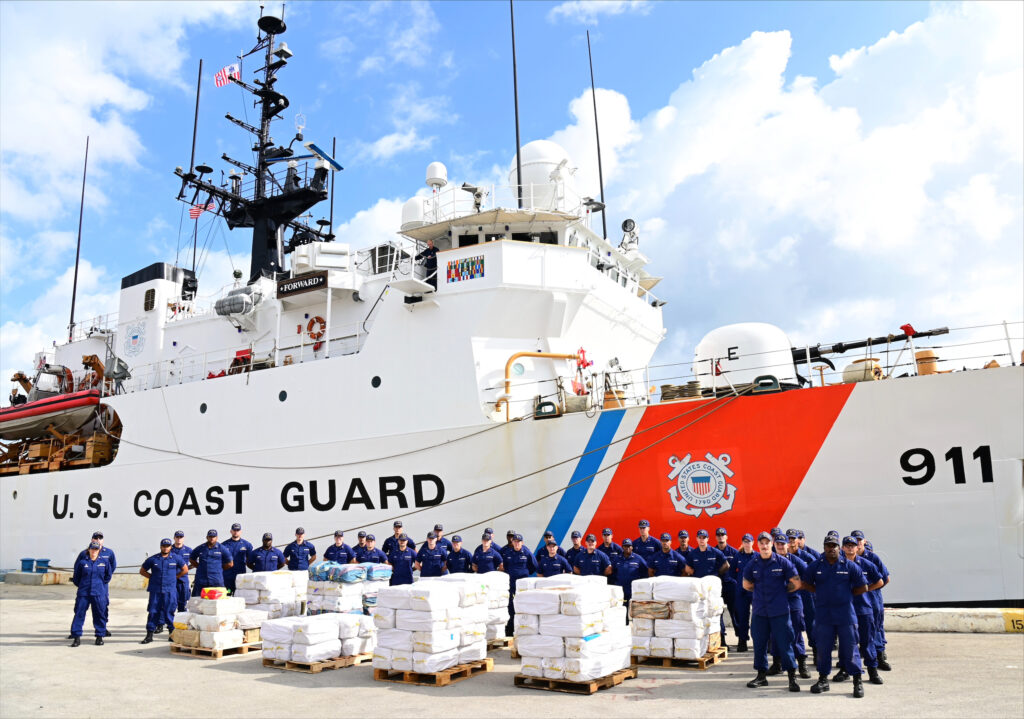
The crew of the Coast Guard Cutter Forward pose with approximately 13,375 pounds of cocaine in Port Everglades, Florida, Dec. 15, 2022. U.S. COAST GUARD / Petty Officer 3rd Class Eric Rodriguez
PORT EVERGLADES, Fla. — The crew of the U.S. Coast Guard Cutter (USCGC) Forward (WMEC 911) offloaded approximately 13,375 pounds of cocaine worth an estimated $176 million in Port Everglades, Florida, Dec. 15, the Coast Guard 7th District said in a Dec. 19 release.
The drugs were interdicted in the international waters of the Caribbean Sea by crews from Forward, Coast Guard Helicopter Interdiction Tactical Squadron and Coast Guard Law Enforcement Detachment 408 on the HNLMS Holland (P840).
Throughout the patrol, Forward held approximately 18,500 pounds of cocaine on deck worth an estimated $244 million. Earlier this month, Forward transferred approximately 4,365 pounds of cocaine to USCGC Campbell (WMEC 909) and 1,654 pounds of cocaine to the United States Drug Enforcement Administration. Forward also intercepted three suspected narcotics smugglers and held 12 others.
“Working with the Dutch to support multi-national interests in the Caribbean is greatly rewarding,” said Cmdr. Staci K. Rutsch, Forward’s commanding officer. “Coupled with our ship’s organic law enforcement capabilities, this patrol led to a significant removal of illicit narcotics from the maritime domain. Opposing transnational criminal organizations is important in maintaining our partnerships and keeping our partners in the central Caribbean safe. I could not be more proud of the crew’s hard work in supporting this mission.”
The fight against drug cartels in the Caribbean Sea and the transnational criminal organizations they are associated with requires a unity of effort in all phases; from detection and monitoring to interdiction and apprehension, and on to criminal prosecutions by international partners and U.S. Attorneys’ Offices in districts across the nation.
Forward is a 270-foot Famous-class medium-endurance cutter homeported in Portsmouth, Virginia, with a crew of 97. The cutter’s primary missions include law enforcement, search and rescue, protection of living marine resources, homeland security and defense operations, international training and humanitarian operations throughout the Western hemisphere.