Coast Guard takes part in San Francisco Fleet Week with ship tours and community events

***** 

Oct. 5, 2023 

By U.S. Coast Guard District 11 

SAN FRANCISCO — The U.S. Coast Guard will participate in the annual San Francisco Fleet Week from October 2-10 in San Francisco Bay.  

Throughout the week, the Coast Guard will showcase its capabilities and commitment to the community through various public engagements, including weekend ship tours of the National Security Cutter Waesche (WMSL-751) and Fast Response Cutter Benjamin Bottoms (WPC 1132), search-and-rescue demonstrations and recruiting booths with static displays at the Fleet Week Expo on the Marina Green from Oct. 5-8, and more.  

“We are honored to be a part of San Francisco Fleet Week – we are the largest branch of service in the Bay Area, and we are thrilled to be a large piece of this honored event,” said Rear Adm. Andrew Sugimoto, commander 11th Coast Guard District. Our vast mission specialties gives us an opportunity to help ensure a safe event for everyone, as well as highlight the skills and capabilities of our service.”  

San Francisco Fleet Week is a multi-day event that celebrates our nation’s sea services and offers the public a unique opportunity to engage with the men and women serving in the U.S. Coast Guard, Navy, and Marine Corps.  

“We are the oldest continuous seagoing service in the U.S. and encourage more young men and women to join our ranks,” said Capt. Taylor Lam, commander, Coast Guard Sector San Francisco. “We hope that our presence at Fleet Week will be an opportunity for visitors to learn more about us.”  

Media interested in interviewing Coast Guard personnel during San Francisco Fleet Week can contact District 11 Public Affairs via email at [email protected] or at 510-437-3808.  

The U.S. Coast Guard invites the public to celebrate our nation’s sea services and meet our Coast Guard members. For more information about San Francisco Fleet Week, click here.  


U.S. Navy Awards Sev1Tech $45 Million Contract for Logistics IT Support

Release from Sev1Tech 

***** 

Sev1Tech to provide services for the Program Executive Office for Manpower, Logistics, and Business Solutions’ portfolio of essential branch operations 

WOODBRIDGE, Va., October 5, 2023 – Sev1Tech, a leader in providing information technology (IT), engineering, program management, C5ISR and cybersecurity systems integration and support services, was awarded a $45 million contract with the U.S. Navy’s Program Executive Office for Manpower, Logistics and Business Solutions (PEO MLB) to provide Logistics IT integration and support (LIIS) services. Over the next five years, Sev1Tech will integrate Naval Logistics IT (LOG IT) capabilities into an end-to-end System of Systems (SoS) solution using agile and DevSecOps methodologies. These capabilities will include Naval Maintenance, Repair, and Overhaul (N-MRO), Naval Supply Chain Management (N-SCM), Naval Product Lifecycle Management (N-PLM), Logistics Integrated Data Environment (L-IDE), and Logistics Information Naval Connector (LINC).  

Sev1Tech’s Maritime Division will assist PEO MLB in managing its portfolio of over 200 current LOG IT systems by integrating common capabilities, data, and support services to improve service performance and decrease operational costs by reducing, eliminating, and automating duplicative services, capabilities, and data sets. In addition, Sev1Tech’s highly specialized integration platform and use of agile development processes and adaptable DevSecOps architecture will support continuous modernization, integration, and migration of LOG IT systems and accelerate speed to fleet of logistics capabilities.   

“This is a tremendous opportunity to accelerate Naval logistics IT modernization efforts across Navy SYSCOM and fleet end users,” noted Bob Lohfeld, CEO at Sev1Tech. “Leveraging our data integration, DevSecOps, and digital engineering expertise, our team will implement our portfolio integration solution to transform nearly 200 Navy logistics IT systems to a single, integrated Naval portfolio of systems, services and applications, deployed ashore and afloat. This capability is critical in enabling our warfighters to maintain their competitive edge and win the high-end fight.”  

Sev1Tech will be responsible for supporting more than 200 afloat and ashore IT systems and applications that service over 150,000 users. The contract will ultimately support all Naval Systems Commands (SYSCOMS) and Naval Operational Forces, including ships, carriers, submarines, aviation squadrons, and expeditionary forces.   

The contract will leverage Sev1Tech’s systems engineering, DevSecOps, and product support capabilities to accelerate the Navy’s ongoing Logistics IT modernization journey and enable Naval platforms, weapon systems, and associated infrastructure to be more ready, agile, efficient, and cost-effective.  


U.S. Ships to participate in San Francisco Fleet Week

***** 

03 October 2023 

Story by Brian O’Rourke 

SAN FRANCISCO – Sailors, Marines and Coast Guardsmen from several ships, squadrons and military units will be in San Francisco for the annual San Francisco Fleet Week, Oct. 2-9.

Participating ships and units include the San Antonio-class amphibious transport dock ship USS John P. Murtha (LPD 26); the Arleigh Burke-class guided missile destroyer USS Paul Hamilton (DDG 60); the Legend-class Coast Guard cutter USCGC Waesche (WMSL 751); the Coast Guard fast response cutter USCGC Benjamin Bottoms (WPC 1132); the Blue Angels; the Navy parachute team, the Leap Frogs; Navy Band Southwest; 1st Marine Division Band; I Marine Expeditionary Force; 1st Marine Logistics Group; Combat Logistics Battalion 11; 1st Medical Battalion; U.S. Coast Guard District 11; Navy Talent Acquisition Group Golden Gate; Explosive Ordnance Disposal Group 1; Amphibious Construction Battalion 1; Amphibious Squadron 7; Expeditionary Strike Group 3; and Navy Region Southwest.

San Francisco Fleet Week offers the public an opportunity to take a tour of the ships and interact with service members as they showcase their ships’, units’, and services’ capabilities. It also gives the public a chance to gain a better understanding of how the sea services support the national defense of the United States and protect freedom of the seas. 
 
Navy, Marine Corps and Coast Guard forces and assets also participate in a robust disaster response exercise, an annual event joint training event that adds a serious, practical objective to San Francisco Fleet Week. The exercise is designed to train military forces and local, county, state and federal government agencies to work together to respond to natural and man-made disasters, such as earthquakes, wildfires and industrial accidents. 
 
Service members will have an opportunity to interact with the local community while participating in a number of community relations projects and entertainment events throughout the week. 
 
The Fleet arrived in San Francisco Sunday-Monday, Oct. 1-2. The public will have opportunities to tour the ships and meet service members following their arrival. 
 
The schedule for ship tours is as follows and is subject to change: 
Wednesday, October 4 
Pier 30/32 
10 a.m. – 2 p.m. 
 
Thursday, October 5 
Pier 30/32 
10 a.m. – 4 p.m. 
 
Friday, October 6 
No tours, however, the ships can be seen in the San Francisco Fleet Week Parade of Ships 11-11:30 a.m. from Marina Green, Fort Mason, Aquatic Park, Fisherman’s Wharf, Pier 39 and the Embarcadero. 
 
Saturday, October 7 
Piers 30/32, 35 
10 a.m. – 4 p.m. 
 
Sunday, October 8 
Pier 30/32, 35 
10 a.m. – 4 p.m. 
 
Monday, October 9 
Pier 30/32, 35 
9 a.m. – 12 p.m. 
 
The public is encouraged to attend tours and interact with service members. 
Prohibited items aboard include the following: 
– Food or drinks, including ice chests and coolers 
– Camera tripods 
– Skateboards, bicycles, hover boards 
– Gang-related clothing 
– Unmanned aerial systems 
– Weapons, including knives, firearms and club weapons, 
– Defensive chemicals or sprays, including mace and pepper spray; 
– Spray cans of any type, fireworks, flammable liquids or other explosives 
– Illegal drugs and drugs considered illegal at the federal level, including marijuana, and/or drug-related paraphernalia 
– Electronic cigarettes 
– Large bags, including backpacks and large camera bags (small camera bags and small handbags may be permitted, but will be subject to search) 
– Strollers 
– Drinks, other than water, to facilitate security 
– Pets are also prohibited, with the exception of service dogs for the disabled. 
– Ship tours may not be appropriate for those with disabilities and access and functional needs or certain medical conditions. There are steep ladders (stairways) to climb and uneven surfaces to traverse on board the ship. An alternative experience will be provided on the pier for those who wish to learn more about the ships in port. 
 
For more information, please visit the San Francisco Fleet Week web site at www.fleetweeksf.org. 


USS Detroit (LCS 7) Decommissioned

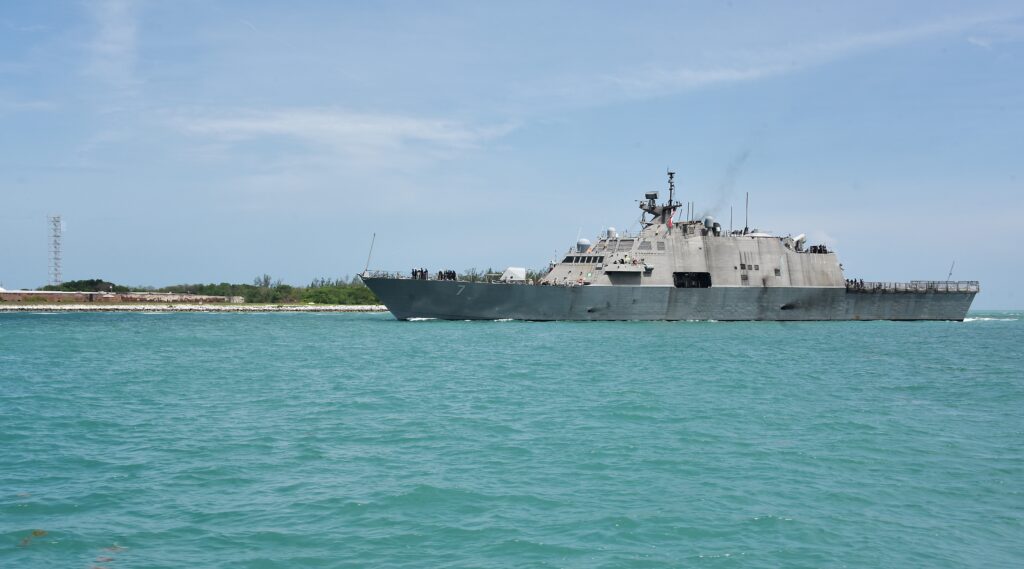
KEY WEST, Fla. (June 5, 2020) The Freedom-variant littoral combat ship USS Detroit (LCS 7) passes Fort Zachary Taylor Historic State Park near the southern tip of Key West, Fla., preparing to pull into Naval Air Station Key West’s Truman Harbor. (U.S. Navy photo by Danette Baso Silvers)

***** 

MAYPORT, FL, UNITED STATES 

Story by Lt. Ayifa Brooks, 09.29.2023 

Commander, Littoral Combat Ship Squadron TWO   

NAVAL STATION MAYPORT (Sept. 29, 2023) – Freedom-variant littoral combat ship (LCS) USS Detroit (LCS 7) was decommissioned in Mayport, Fla., September 29. 
 
As an operational unit, Detroit and its crew played an important role in the defense of our nation and maritime freedom. Detroit and its Sailors were key to determine the operational success and deployment capabilities of today’s LCS platform. 
 
During the ceremony guest speaker, Capt. Meger Chappell, Commanding Officer, Destroyer Squadron Four Zero, wished the crew of Detroit fair winds and following seas as they bid farewell to their ship. 
 
“To the Sailors who have served aboard the USS Detroit, both past and present, I extend my deepest appreciation for your service.” said Capt. Meger Chappell, Commanding Officer, Destroyer Squadron Four Zero. “Your unwavering commitment and dedication to duty have been an inspiration to us all. The legacy of Detroit will live on through your stories, your achievements, and the impact you have made on our nation’s defense.” 
 
Detroit and its Sailors contributed a tremendous amount of work and time to ensure success of the LCS program during the ship’s time in naval service. USS Detroit (LCS 7) began the year with a Light Off Assessment (LOA) on January 30. The crew performed with distinction through several major milestones to include LOA, contractor sea trials, and the basic/advance phase in preparation for her 2023 deployment. Detroit completed her most recent deployment to Fourth Fleet in April 2023 partnered with the embarked US Coast Guard Law Enforcement Detachment, other US warships, Department of Defense, Department of Justice, Department of Homeland Security. Detroit participated in two fleet experiments off the coast of San Juan, Puerto Rico, which greatly contributed to C4F’s tactical mission set. Detroit and her embarked LEDETs, seized an estimated total of 900kg of cocaine from entering the United States. Detroit provided maritime security presence enabling the free flow of commerce in key corridors of trade. 
 
“USS Detroit, the sixth ship to her name, represented the city of Detroit, the great state of Michigan, and her Nation with honor and distinction,” said Cmdr. Kyle Hickman, Detroit’s Commanding Officer. “Deploying four times to the SOUTHCOM AOR in just seven years, Detroit led the way in training, operations as a Surface Mission Module test platform, and critical COMFOURTHFLT tasking to include counter-drug interdiction, interoperability, and cooperative engagements throughout the Caribbean.” 
 
Detroit was designed by Lockheed Martin and constructed by Marinette Marine Corporation (Fincantieri) Marinette, Wisconsin. Detroit was commissioned October 22, 2016, in Lake Michigan. Mrs. Barbara Levin, wife of former U.S. Senator Carl Levin, served as the ship’s sponsor. 
 
USS Detroit (LCS 7) is the sixth US Navy vessel to bear the name of Michigan’s largest city. The ship represents the proud people of the Detroit community. Upon decommissioning, its Sailors will receive follow-on orders to new assignments. 
 
LCS are fast, agile, mission-focused platforms designed to operate in near-shore environments, winning against 21st-century coastal threats. LCS are versatile and are capable to support a broad spectrum of fleet missions and operate alongside regional navies and coast guards while supporting forward presence, maritime security, sea control, and deterrence missions around the globe. 
 
For more news from Commander, Littoral Combat Ship Squadron Two, visit https://www.surflant.usff.navy.mil/lcsron2/ or follow on Facebook at https://www.facebook.com/comlcsron2/ 
### 


General Dynamics Electric Boat Awarded $967 Million Contract Modification for Virginia-Class Submarines

***** 

GROTON, Conn. (October 3, 2023) – General Dynamics Electric Boat, a business unit of General Dynamics, announced today it has been awarded a $967 million contract modification from the U.S. Navy for Lead Yard Support and Development and Design efforts for Virginia-class fast-attack submarines.  

The cost-plus-fixed fee modification to a previously awarded contract totals $967,185,528. Work will be performed in Groton, Connecticut; McLeansville, North Carolina; Newport News, Virginia; and Newport and Quonset Point, Rhode Island. Work is expected to be completed by October 2024. This contract was awarded on September 29. 2023. 

“This contract award supports critical work to further advance the capability and superiority of the Virginia class submarine,” said Kevin Graney, president of General Dynamics Electric Boat. “We are proud to continue our tradition of delivering this state-of the-art platform that ensures the safety of our sailors and their continued dominance in the undersea domain.” 

Virginia-class submarines are designed for the full range of 21st-century mission requirements, including anti-submarine and surface ship warfare and special operations support. 

General Dynamics Electric Boat is the prime contractor and lead design yard for the Virginia class and constructs the ships in a teaming arrangement with HII’s Newport News Shipbuilding in Virginia. 


VMM-364 transfers Horn of Africa mission to VMM-261

*****

10.03.2023

Story by Petty Officer 2nd Class Rion Codrington 

Camp Lemonnier, Djibouti  

AMP LEMONNIER, Djibouti (October 1, 2023) – Marine Medium Tiltrotor Squadron 364 reinforced (VMM-364) handed off their mission as the Aviation Combat Element in the Horn of Africa to VMM-261 (REIN) following a transfer of authority ceremony at Camp Lemonnier, Djibouti, Oct. 1. 
 
Both squadrons are forward deployed to Camp Lemonnier to provide 24/7 crisis response in support of Combine Joint Task Force – Horn of Africa in order to enhance partner nation capacity, promote regional stability, deter conflict, and protect U.S. and partner force interests. 
 
“Every one of you play an integral role in the success of our mission here,” said U.S. Army Maj. Gen. Jami Shawley, commanding general of Combined Joint Task Force-Horn of Africa. “It is your collective efforts, determination, and unwavering commitment to one another that we can overcome all obstacles.” 
 
During their deployment, VMM-364 executed 2,300 flight hours, supporting the transportation of over 2 million pounds of cargo, and thousands of passengers in multiple named operations. 
 
“Not only have the Purple Foxes made a difference here in theater, but helped provide an important layer of defense and deterrence for freedom and democracy around the world,” said U.S. Marine Corps Lt. Col. John Miller, commander of VMM-364. 
 
VMM-261 has a history in providing humanitarian aid, and assault support for amphibious and shore operations such as Operation Urgent Fury in Grenada. 
 
“Since our inception in 1951, the Raging Bulls have an impressive metric of success, giving our superiors what they need, when they need it,” said U.S. Marine Corps Maj. Benjamin Weiss, executive officer of VMM-261. 
 
With the turnover finalized, VMM-261 hopes expand of the successes of VMM-364, said Weiss. 
 
“As the successors to VMM-364, we aim to improve upon their foundation and maintain or exceed their capacity to support the joint force.” said Weiss. “It is our intent to set the standard and support CLDJ, it’s tenants commands and the region.” 
 
CLDJ is an operational installation that enables U.S., allied, and partner nation forces to be where and when they are needed to ensure security in Europe, Africa, and Southwest Asi 


SECNAV Names Future Nuclear-Powered Attack Submarine USS San Francisco (SSN 810) 

Photo By Chief Petty Officer Shannon Renfroe | Secretary of the Navy Carlos Del Toro, today, announced that the future Virginia-class nuclear-powered attack submarine SSN 810 will be named USS San Francisco, Oct. 3. In addition, Secretary Del Toro announced the Speaker Emerita Nancy Pelosi agreed to be the ship’s sponsor. Secretary Del Toro made the announcement during Fleet Week San Francisco.

Release from the Secretary of the Navy Public Affairs 

***** 

Secretary of the Navy Carlos Del Toro, today, announced that the future Virginia-class nuclear-powered attack submarine SSN 810 will be named USS San Francisco. 
 
Secretary Del Toro made the announcement during San Francisco Fleet Week. 
 
“The future USS San Francisco, once commissioned, will be our nation’s newest Virginia-class nuclear-powered fast-attack submarine. USS San Francisco will build upon the legacy of her namesakes, and will no doubt represent the people of this city and our nation with honor wherever she may sail,” said Secretary Del Toro. 
 
In addition, Secretary Del Toro announced the Speaker Emerita Nancy Pelosi agreed to be the ship’s sponsor. In that role, Speaker Emerita Pelosi will represent a lifelong relationship with the ship and crew. 
 
“For over 36 years, Speaker Emerita Pelosi has represented the people of San Francisco with honor and distinction in Congress and has served as a staunch advocate for our national security and the promotion of our democratic values around the world,” said Secretary Del Toro. “She is a champion for justice and equality, to ensure every American is afforded the dignity and respect they deserve.” 
 
“It is with great pride and patriotism that I serve as the sponsor of the magnificent USS San Francisco, which will bring luster to our City as it sails the seas defending our Nation,” Speaker Emerita Nancy Pelosi said. “The naming of this ship comes as our City and our Nation continue to mourn the loss of our beloved Dianne Feinstein: our Forever Mayor, a champion of San Francisco and a proud patriot. It is fitting that we announce the naming of this ship during San Francisco Fleet Week, a tradition that she began as Mayor more than four decades ago. As we honor Senator Feinstein’s towering legacy, may the USS San Francisco always find fair winds and following seas.” 
 
This is the fourth vessel to honor San Francisco. The first San Francisco, a steel protected cruiser, blockaded Havana, Cuba, during the Spanish-American War and served as a mine planter in the North Sea during World War I. 
 
The second San Francisco, a heavy cruiser, had an equally distinguished career, participating in operations and engagements at Cape Esperance, Guadalcanal, Guam, the Marshall Islands, and Okinawa during World War II. In total, the ship and its crew earned 17 Battle Stars, a Presidential Unit Citation, four Medals of Honor, and 32 Navy Crosses. 
 
The third San Francisco was a Los Angeles-class nuclear submarine (SSN 711), which completed multiple deployments to the western Pacific, earning a Navy Unit Commendation and Navy Expeditionary Medal among other awards. Decommissioned in 2022, the venerable boat now serves as a moored training vessel for the Naval Nuclear Power Training Unit, Charleston, South Carolina. 
 
Attack submarines like the future USS San Francisco are designed to seek and destroy enemy submarines and surface ships; project power ashore with Tomahawk cruise missiles and Special Operation Forces (SOF); carry out Intelligence, Surveillance and Reconnaissance (ISR) missions; support battle group operations; and engage in mine warfare. 
 
More information on attack submarines can be found here. 
https://www.navy.mil/Resources/Fact-Files/Display-FactFiles/Article/2169558/attack-submarines-ssn/ 


Secretary Del Toro Tours Historic West Coast Facility, Explores Ways to Increase Shipyard Capacity in the Pacific 

Release from Secretary of the Navy Public Affairs

***** 

VALLEJO, CA, UNITED STATES 

10.02.2023 

Office of the Secretary of the Navy   

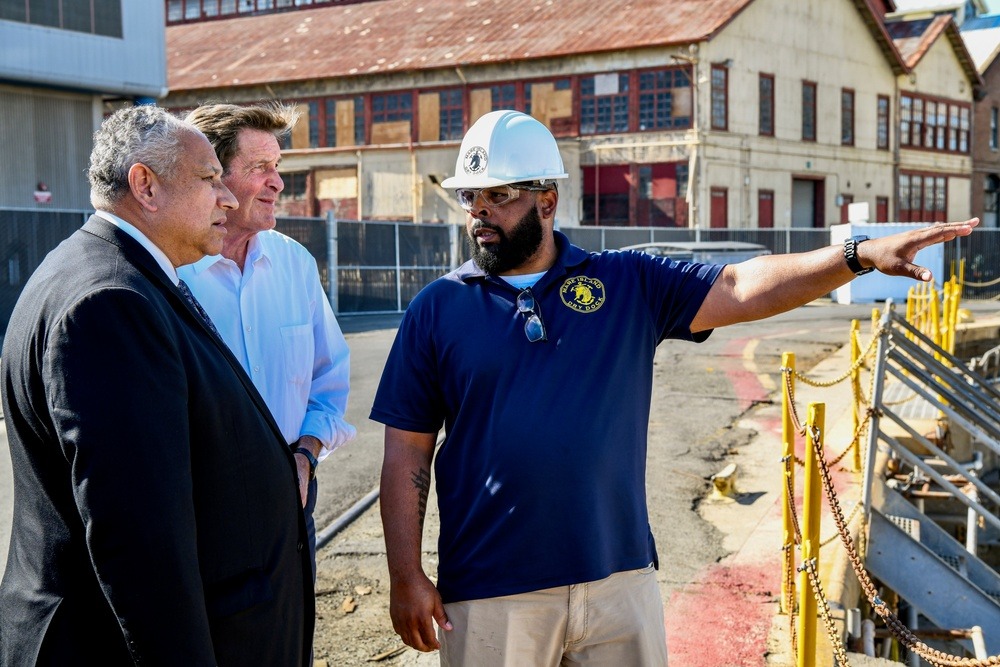
A week after calling for a new, bold maritime statecraft, Secretary of the Navy Carlos Del Toro and key members of his team visited the Mare Island Dry Dock, located on the historic Mare Island Shipyard, in Vallejo, Calif., Oct. 2. 
 
Established in 1854, Mare Island Naval Shipyard was the Nation’s first Navy base in the Pacific. During World War II, it was one of the busiest naval shipyards in the world. In its last 25 years of operation, it was the leading submarine port for the West Coast. 
 
Today, with strategic competition challenges in the Pacific, Secretary Del Toro, joined by U. S. Rep. John Garamendi, toured the Mare Island Dry Dock facility, met with shipyard leadership, and discussed opportunities and options to address emerging maritime challenges and increase shipyard capacity in the Pacific. 
 
“We’re making a concerted effort to improve our naval shipbuilding and repair industry – both public and commercial – with historically high investments in the industrial base,” said Secretary Del Toro. “That’s how we grow our nation’s strategic advantage at sea.” 
 
During the visit, Secretary Del Toro expressed how impressed he was with the facilities and the amount of capacity and infrastructure that remains. 
 
As Secretary Del Toro outlined in his recent address at Harvard, “The maritime industry is a strategic sector critical to our economic and national security. It is vital to achieving resilient global supply chains and is ripe with opportunity to partner with a greater number of shipbuilders here in the U.S. and with our closest allies overseas, including Japan and South Korea. It also requires urgent U.S. public investment and international statecraft to attract the necessary private capital.” 
 
The visit to Mare Island Dry Dock is the latest shipyard engagement by the Secretary. In July, Secretary Del Toro visited Pearl Harbor Naval Shipyard and Intermediate Maintenance Facility (PHNSY & IMF). In August, he toured Bayonne Drydock & Repair Corp. 
 
The visits are part of the Department of the Navy’s efforts toward a new maritime statecraft that is bold and founded on a strong Navy and Marine Corps to fulfill our national security interests and address future challenges. 
 
Additionally, the administration is working to set the necessary conditions to attract the most advanced shipbuilders in the world to open U.S.-owned subsidiaries and invest in commercial shipyards here in the U.S., modernizing and expanding our shipbuilding industrial capacity and creating a healthier, more competitive shipbuilding workforce. 


Systems Models Keep Submarines Mission Ready

BY TRACY GREGORIO

An important, yet often underappreciated challenge for undersea warfare is keeping submarine systems well-maintained and available. Every command has a budget for reliability, maintainability, and availability (RMA), but those resources are limited and need to be carefully allocated to keep warfighting systems mission-ready.

For decades now, maintenance planning has been performed by seasoned engineers who understand how component lifecycles and failure rates can affect their systems. This process of expert-driven failure modes and effects analysis (FMEA) is time consuming, expensive, and can take months to complete by veterans whose expertise is sorely needed elsewhere.

Additional time is also needed to evaluate changes using the Risk Management Framework (RMF), to identify cybersecurity vulnerabilities that may degrade system availability.

Model-Based Approach.

To address this challenge, a model-based system engineering (MBSE) approach is starting to automate failure mode analysis, facilitating more efficient RMA planning. This shift provides additional time for design optimization, refinement of reliability predictions, and comprehensive analysis of casualty reporting. The result is better mission-readiness for our fleet, while consuming fewer resources.

Reliability analysis is important to ensure that a warfighting platform has no single point of failure across its many components. Between a ship’s tight spaces and funding limitations, it’s impossible to go to sea with spares for everything.

One organization using this new MBSE approach is the Undersea Communications & Integration Program Office, PEO C4I / Program Manager, Warfare (PMW 770). Their Program Manager, Captain David Kuhn explained, “If spares are not available, we have to plan for alternate ways of accomplishing a mission, even if it’s less stealthily. To ensure we optimize our ability to change parts and/or have redundant paths for missions, we build forecasts based on how often parts are used. If a component fails early and there is no spare on board, it could be a mission kill.”

The MBSE models enable program managers, like Kuhn, to create forecasts better and faster, while
tying together different engineering disciplines and stakeholder communities. “Engineers specialized in systems design, cyber, and reliably each have their own approach,” said Kuhn. “They need different views and have historically used different models. Now they use the same model, each getting the views they need, and enabling analysis that just couldn’t be done before.”

Confidence in Outcomes

These consolidated models enable analysis and simulation on a fully validated data set that increases confidence in predicted outcomes. Kuhn illustrated the value of this analysis by describing a recent upgrade needed to improve system monitoring through the addition of passive data taps. “What normally would have needed 60 or 90 days we accomplished in a couple weeks, letting us quickly deploy the upgrades to the fleet.”
The models also enable green or less experienced engineers to address critical maintenance planning elements. “MBSE helps new people coming on to look at a failure diagram and understand it faster and more accurately,” notes Kuhn.
This MBSE approach is being used by engineers adapting systems to field on the new classes of submarine to plan and optimize their maintenance schemes. This approach will ensure that component failures don’t interfere with the platform’s most important mission threads.
“The hull designs of the new sub class have an impact on how we design and maintain our antenna systems,” explained Kuhn. “Through the MBSE model, we saw how a change in one subsystem increased tensions in another. While each element was meeting its defined requirements, the model showed that failure risk increased. While we might have eventually caught the issue, the model helped us see it easily and early in the design cycle.”

The MBSE model also generates the reports and views needed to get system changes through the
RMF approval process. Kuhn, explaining the practical consequences, stated, “We use the model to assess RMF compliance faster and with more accuracy, in part by eliminating the possibility of ‘fat finger’ data re-entry errors. Our team says they can complete RMF diagrams in a third of the normal time.”
That is a huge time-saver for engineers, and a safety net against errors. The system uses the following key components:

  1. A digital model of the warfighting platform is created to replicate all components, connections, and system functionality. This model is capable
    of simulating every system operation, effectively capturing the interactions between various components. It also illustrates their relationship with the officers and sailors who are responsible for the operation and maintenance of the system.
  2. The model is populated with reliability data
    from COTS manufacturers and field experience, generating reliability diagrams correlated to mission threads.
  3. Engineers use the model to simulate planned maintenance or upgrades and test operational threads for mission success, reviewing different alternatives for impacts on mission readiness.
  4. The models export field-level instructional resources directly into interactive electronic technical manuals (ITEMs). This reduces the
    cost and time needed to give sailors up-to-date information for their individual hull, so they can maintain mission readiness and quickly respond to unexpected failures.

This approach is not limited to the latest-generation submarines. Maintenance planners are constantly dealing with obsolescence replacement.

“Our C4I systems make heavy use of commercial off-the-shelf servers and hard drives that go obsolete in as little as four years,” said Kuhn. “The models help us identify where one change drives a companion change in another system. For instance, we might need to make a firewall change for data to flow properly. We have to replace those elements quickly without waiting for a major availability cycle that might be five years out. We can’t afford for our systems to be the reason a sub is not out at sea.”

Transition Challenges

There are challenges in moving to a new approach in terms of the tools and skillsets needed by the workforce. Comparing MBSE transition challenges to those encountered during the shift to Computer-Aided Design (CAD), Kuhn said, “Just as we had to transition from engineers with drafting expertise into those who could work in CAD, now we need engineers that know how to use MBSE tools. It’s not as easy as opening Microsoft Word, but it can be done. The real key will be changing entire processes to adapt to the MBSE models. Using the same old processes, but just layering on the new tools will not be effective. It requires a cultural change, just as happened when we went from pencil drafting to CAD.”

This approach can improve the maintainability of any sea-going platform with integrated MBSE models that span engineering disciplines, cyber, RMF compliance, and reliability. It doesn‘t happen overnight, but can make an impact, one model and one command at a time.



Marine Corps deactivates historic F/A-18 training squadron

MIRAMAR, CA, UNITED STATES 

09.29.2023 
3rd Marine Aircraft Wing

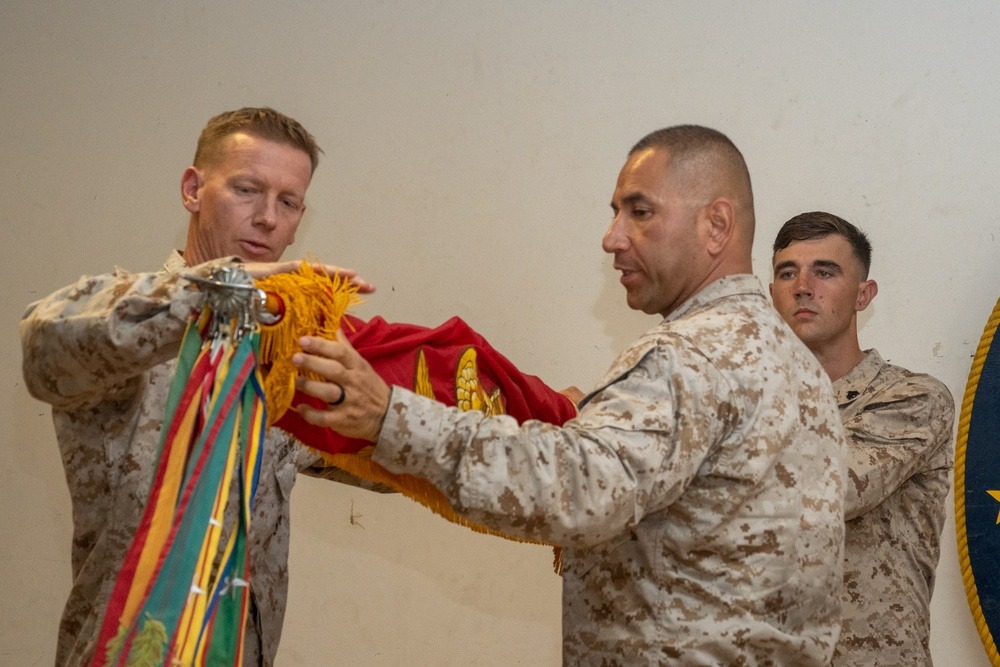
MARINE CORPS AIR STATION MIRAMAR, Calif. — The 3rd Marine Aircraft Wing deactivated VMFAT-101, an historic F/A-18 Hornet training squadron, here on September 29, 2023. 
 
Since 1969, instructor pilots of the VMFAT-101 “Sharpshooters” have qualified combat aviators and sent them to operational squadrons worldwide. 
 
The squadron commemorated the event by “flying the barn” – launching 18 aircraft in a single flight. More than 300 Marines, Sailors, veterans, family members, and community supporters then gathered for a sundown ceremony to commemorate the squadron’s history and contributions to Marine Corps readiness. 
 
“Pilots come to VMFAT-101, cut their teeth, and are transformed into aviation warriors,” said Col. William J. Mitchell, commanding officer of MAG-11. 
 
Since October 2019, VMFAT-101 has trained Navy and Marine Corps aviators as the only remaining F/A-18 Hornet Fleet Replacement Squadron in the Department of the Navy. 
 
“Thousands of aircrew have passed through the halls of VMFAT-101 – fighter pilots, fighter radar intercept officers, fighter weapon systems officers, and it’s bigger than that,” said Brig. Gen. Robert B. Brodie, Assistant Wing Commander of 3rd MAW. “This squadron has trained more maintenance Marines than any other in the Marine Corps. It’s a holistic approach to ensure we are ready to fight and win.” 
 
The training mission of VMFAT-101 will transfer to the “Death Rattlers” of VMFA-323, a 3rd MAW operational squadron at MCAS Miramar. As outlined in the 2022 Marine Corps Aviation Plan, the Hornet will continue to operate and provide combat capability until its complete transition to the F-35 Lighting II in 2030. 
 
Brodie is an F/A-18 pilot and served as commanding officer of VMFAT-101 from 2011 to 2013. He and Lt. Col. Ryan J. Franzen, the final commanding officer of VMFAT-101, were joined by ten former VMFAT-101 commanding officers and two spouses representing their late husbands. 
 
“We’re standing on the shoulders of giants,” said Franzen. “You helped shape the ‘Sharpshooter’ legacy.”