US Coast Guard Cutter Dauntless returns home after 61-day Operation Vigilant Sentry patrol 
U.S. Coast Guard Atlantic Area, April 24, 2024 

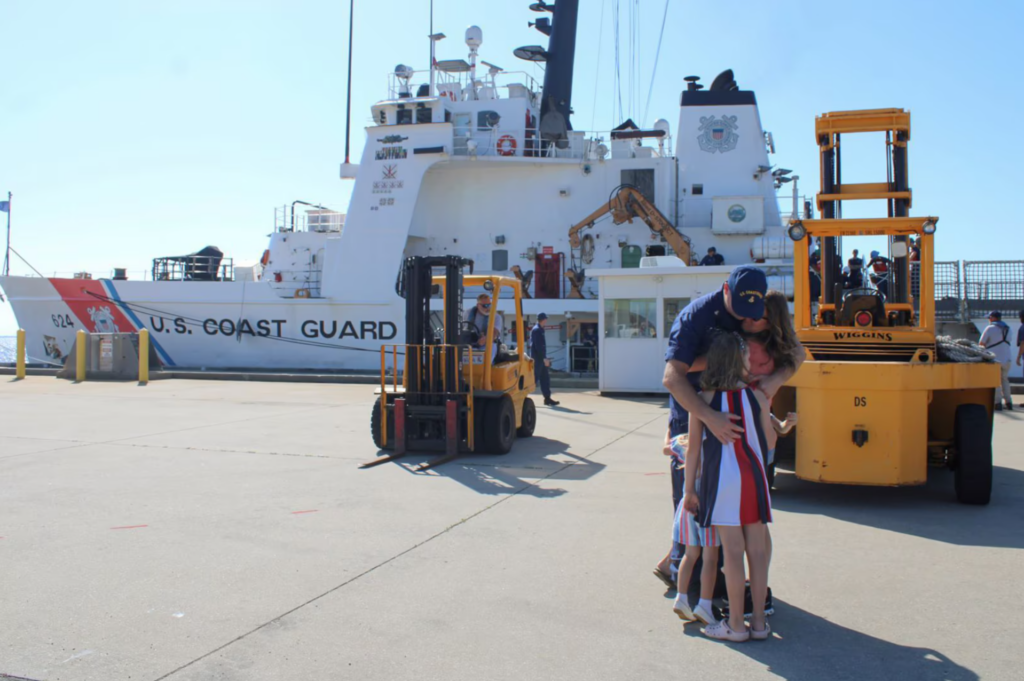
PENSACOLA, Fla. —  The crew of U.S. Coast Guard Cutter Dauntless (WMEC 624) returned to their home port in Pensacola, Wednesday, following a 61-day patrol in the Windward Passage and Florida Straits. While underway, crew members conducted maritime safety and security missions to protect life at sea and deter illegal migrant voyages bound for the United States. 

Dauntless deployed in support of Homeland Security Task Force – Southeast (HSTF-SE) and Operation Vigilant Sentry (OVS) while patrolling in the Coast Guard Seventh District’s area of responsibility. While underway, Dauntless worked alongside other Coast Guard assets and units to dissuade unsafe maritime migration and enforce U.S. law on the high seas. 

During the patrol, a good Samaritan on a sailboat reported a disabled vessel using VHF-FM channel 16. Dauntless’ crew received notification and conducted a search and rescue mission over several hours on a moonless night while searching for the unlit boat. Eventually, the crew located the overloaded and disabled sail freighter with 65 Haitian migrants aboard, including several children. All 65 migrants were safely evacuated and transferred aboard Dauntless, where they received food, water and basic medical care. Dauntless worked with multiple surface and air assets to successfully carryout the search, rescue and repatriation of the migrants. 

Migrants attempting to reach the United States through nonlegal channels, or who land on U.S. shores without authorization, are subject to removal and repatriation to their country of origin or departure. Consistent with U.S. policy, those who bypass or attempt to circumvent lawful immigration pathways face consequences including the potential of being barred from future lawful entry in addition to risking their lives unnecessarily. 

“This case was a prime example of the humanitarian lifesaving mission we remain always ready for,” said Cmdr. Aaron Kowalczk, commanding officer of Dauntless. “The crew’s ability to find the vessel and then safely complete the rescue in the dark of night is just another example of the utmost professionalism and skill they show every day and is indicative of 56 years of exemplary service by cutter Dauntless and her crews.”  

Established in 2003, HSTF-SE is the Department of Homeland Security-led interagency task force charged with directing operational and tactical planning, command and control, and functions as a standing organization to deter, mitigate, and respond to maritime mass migration in the Caribbean Sea and Florida Straits.  

OVS is the 2004 DHS plan that provides the structure for deploying joint air and surface assets and personnel to respond to irregular maritime migration in the Caribbean corridor of the United States. Its primary objectives are to protect life at sea while deterring and dissuading mass maritime migration alongside our federal, state, and local partners.   

Dauntless is a 210-foot, Reliance-class medium-endurance cutter originally built in 1967 and commissioned in 1968. The cutter’s primary missions are counter narcotics operations, migrant interdiction, living marine resources protection, and search and rescue in support of U.S. Coast Guard operations throughout the Western Hemisphere. 

For information on how to join the U.S. Coast Guard, visit GoCoastGuard.com to learn about active duty, reserve, officer and enlisted opportunities. Information on how to apply to the U.S. Coast Guard Academy can be found here


Electric Boat Competition Sparks Interest in Naval Science Careers 

23 April 2024 

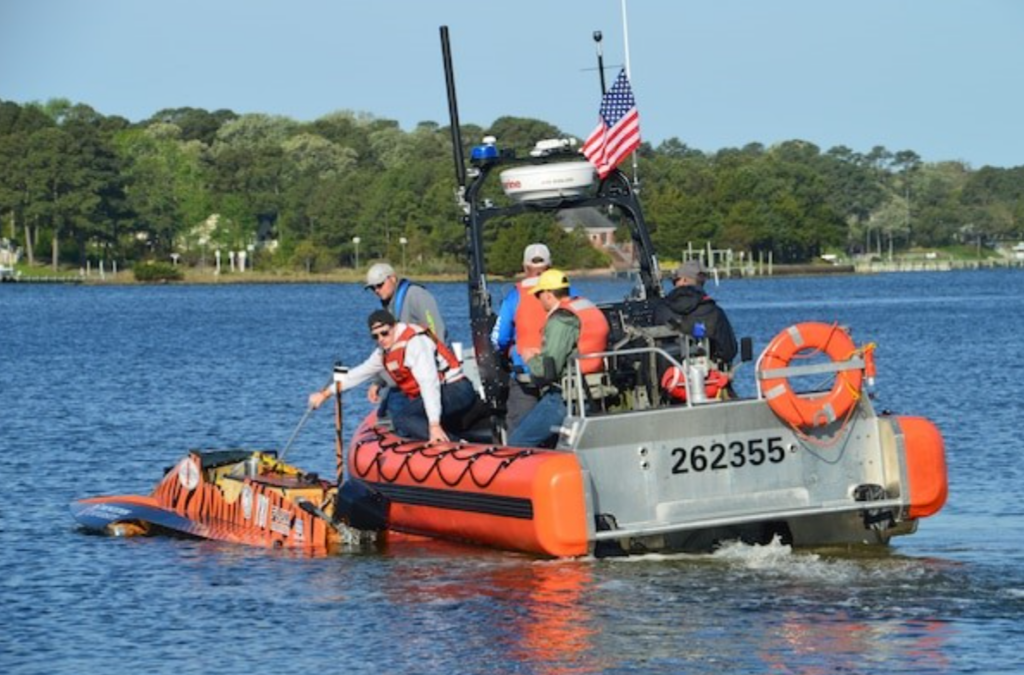
Student engineering teams from Princeton, Washington College and the University of Alabama have won first place in their respective events at the “Promoting Electric Propulsion” (PEP) boat races, sponsored by the Office of Naval Research (ONR) and the American Society of Naval Engineers (ASNE). 
 
In just six years, this electric boat-building competition has grown from a single university to 34, with more than 200 students who took part in the five-mile races on Broad Bay in Virginia Beach. Dr. Steve Russell, program officer, Sea Warfare and Weapons department, said he launched the PEP competition with a colleague from ASNE, Dr. Leigh McCue, and Tim Cullis, Naval Sea Warfare Center Carderock, after seeing a public race by local hobbyists in the Chesapeake Bay. 
 
“It gave us the idea this would be a good way for the Navy to get engineering students interested in electric propulsion, so we did it.” 
 
Russell said they are reaching hundreds of science and engineering students every year. The PEP racing event not only offers students valuable learning experiences, it provides the Navy and Marines with a workforce for the future. 
 
“The goal is to create a pipeline of graduating engineers who have worked on a suite of problems that are currently issues within the U.S. Navy. They come out of school after having designed and built a boat like this, and learning about high power electronics, propulsion, hull design, cooling and boat stability – the naval architecture parts of it,” Russell said. “So far, we’ve hired many of them into the warfare centers and our industry partners.” 
 
The teams of college students come from universities all over the country. Some are very well known, like Princeton and Texas A&M, but others are much smaller and not necessarily easily recognized. That doesn’t mean the smaller universities aren’t as competitive. Russell said Washington College in Maryland came in first and second place, respectively, in the 2022 and 2023 manned race, as well as placing first in 2024. 
 
“They don’t even have an engineering school. It’s just a group of students who go to school near the Chesapeake Bay and they built a couple of very good boats,” he said. 
 
The PEP competition includes manned and unmanned boat races. Russell said the manned competition seems to be more exciting for the students. It is a race, after all – and they can go pretty fast. Most of the entrants, though, register for the unmanned competition. Regardless of which category the teams fall into, they are all involved in meaningful and, in some cases, record-breaking work. 
 
“While we’re not really looking to use any of the techniques that the students come up with, their innovation has been very impressive. For example, the Princeton team last fall took their boat down to a river in North Carolina and beat the world record for electric boat speed on the water with an average speed of 114 mph,” Russell said. “What we’re really trying to do is to get them interested in solving Navy-related problems, and hopefully they will pursue careers in the Navy.” 
 
It’s also become something of an industry event where the students are introduced to industry partners in the area. Since its inception in 2018, the PEP competition has helped recruit 44 engineering graduates for the Navy. Eleven others gained engineering positions with industry partners. 
 
For more information on PEP, visit their website at https://www.navalengineers.org/Education/Promoting-Electric-Propulsion-PEP


SECNAV Advocates Increased Legal Immigration to Increase Shipbuilder Workforce

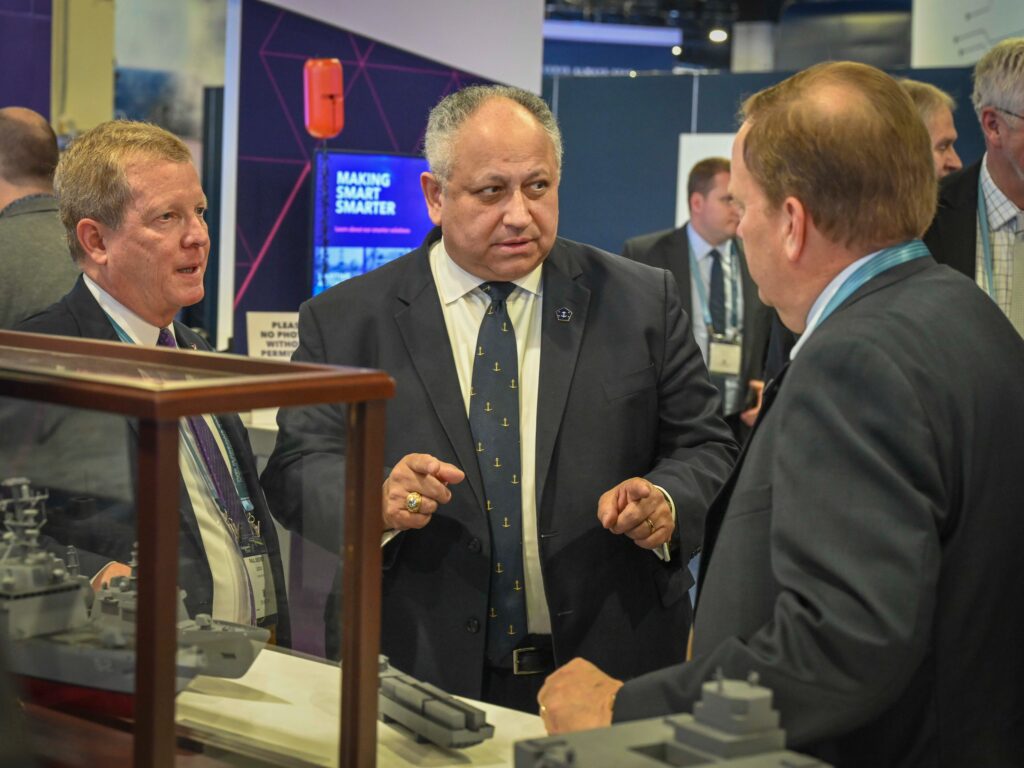
Secretary of the Navy Carlos Del Toro visits industry booths during the Navy League of the United States’ Sea-Air-Space Exposition 2024 at National Harbor, Maryland, April 9. U.S. Navy | MC2 Jared Mancuso

By Richard R. Burgess, Senior Editor 

ARLINGTON, Va. — The secretary of the Navy said the shortage of workers in the U.S. shipbuilding industry could be partially alleviated by allowing more legal immigrants into the country to work in the shipyards. 

Speaking April 23 at the Stimson Institute, a Washington think tank, SECNAV Carlos Del Toro acknowledged that supply chain issues caused by the COVID-19 pandemic negatively affected the ability on shipyards to meet delivery schedules of Navy ships, said he thought “the bigger problem than that … is actually the lack of blue-collar workers that we have in this country. 

“Regretfully, we’re a pretty divided country politically, you might say, but it really is time for Congress to get together and pass comprehensive reform and increase the amount of legal immigration that we actually allow into this country [and] increase the amount of work visa programs that are authorized for blue-collar workers to come from other nations and actually do the work here as has actually existed since the founding of our government, very much so,” Del Toro said. 

The SECNAV noted the current unemployment rate in many U.S. states is low, “but what we’ve got to do is open up the spigot a bit, basically, on legal immigration to allow blue-collar workers to come here and also to devote an enormous amount of resources into re-training individuals so they can actually work in our shipyards and be employed by the types of trades that are open to shipyard workers, for example.” 

Del Toro noted the U.S. government will in the next five years “be pumping in $15 billion investment into the submarine industrial base alone and an additional billion-dollar investment into the surface industrial base as well.” 

The SECNAV also noted that the atrophied U.S. commercial shipbuilding industry needs to be reinvigorated by a “whole-of-government effort around a national maritime statecraft.” 


RTX Breaks Ground on $115M Expansion of Alabama Missile Integration Facility

The Arleigh Burke-class guided-missile destroyer USS Higgins (DDG 76) launches a Raytheon-built Standard Missile (SM) 2 from a forward launcher while operating in the Philippine Sea, April 5. U.S. Navy | MC1 Hannah Fry

HUNTSVILLE, Alabama – Raytheon, an RTX business, recently broke ground on a $115 million, 26,000 square-foot expansion of its Redstone Raytheon Missile Integration Facility, which will increase the factory’s space for integrating and delivering on critical defense programs by more than 50 percent. 

The expansion will also bring an estimated 185 new jobs to the area, growing RTX’s employee footprint in Alabama to more than 2,200 people. 

“This important investment in the Huntsville region will help us meet the growing needs of our military customers and service members,” said Raytheon President Phil Jasper. “It will also ready our operations to accelerate delivery of our vital counter-hypersonic solution.”    

Raytheon’s Redstone facility is the final integration point for many missile programs for the U.S. Missile Defense Agency, U.S. Navy, and other defense customers. The facility currently handles integration of nine variants of the Standard Missile family, including Standard Missile-3 and Standard Missile-6, and will accommodate additional defense programs, including the Glide Phase Interceptor.  


Coast Guard Interdiction Leads to the Apprehension of 3 Wanted U.S. Citizens

SAN JUAN, Puerto Rico — The crew of the Coast Guard Cutter Winslow Griesser interdicted an unlawful migration voyage in the Mona Passage, Friday. 

Following the interdiction, Dominican Republic Navy authorities detained three U.S. citizens, who reportedly are affiliated with a criminal gang and wanted in connection with a July 2020 shooting at a residential community in Puerto Rico in which four people were killed.  

The suspects are currently under the custody of the Dominican Republic ‘Dirección Nacional de Control de Drogas (DNCD) (United States Marshals Service Dominican Republic Foreign Field Office Fugitive Investigative Unit). United States Marshals Service Puerto Rico Fugitive Task Force for the District of Puerto Rico are coordinating the deportation of the three suspects. 

Coast Guard watchtanders at Sector San Juan received notification Friday morning from the aircrew of a U.S. Customs and Border Protection Air and Marine Operations multi-role enforcement aircraft, reporting the sighting of a suspected migrant vessel, approximately 55 nautical miles northwest of Puerto Rico. Watchstanders diverted the Coast Guard Cutter Winslow Griesser to interdict the suspect vessel. Once on scene, cutter Winslow Griesser’s crew deployed their over-the-horizon small boat and stopped the 20-foot go-fast vessel that was carrying eight people and multiple cockfighting roosters. The migrants claimed to have departed from Dominican Republic on a voyage to Puerto Rico, however, they experienced engine malfunctions which forced them to return to Dominican Republic before being interdicted. 

Working in coordination with the Dominican Republic Navy, cutter Winslow Griesser’s crew took the migrant vessel in tow and rendezvoused with a Dominican Republic Navy vessel, who embarked and received custody of the migrants. 

Further investigation efforts by Dominican Republic Navy and Homeland Security Investigations (HSI) revealed three of the alleged migrants were U.S. citizens with active U.S. warrants. 

“Our strong partnerships and daily collaboration between all federal partner agencies involved in this case as well as Dominican Republic Navy and Dominican law enforcement authorities resulted in the safe repatriation of five migrants and the apprehension of three wanted U.S. citizens,” said Lt. Vincente Garcia, Coast Guard liaison to the Dominican Republic. “These efforts are instrumental to achieving regional stability and safeguarding our nation’s southernmost maritime border from dangers and threats associated with unlawful migration and other prevalent illicit maritime activity.” 

Migrants who are interdicted at sea or apprehended ashore will not be allowed to stay in the United States or a U.S. territory. Furthermore, anyone who arrives unlawfully may be declared ineligible for legal immigration parole options and be repatriated to their country of origin or returned to the country from where the voyage departed from. 

The Coast Guard, along with its Homeland Security Task Force – Southeast partners, maintains a continual presence with air, land, and sea assets in the Florida Straits, the Windward Passage, the Mona Passage, and the Caribbean Sea. The HSTF-SE combined, multi-layered approach is designed to protect the safety of life at sea while preventing unlawful maritime entry to the United States and its territories. 

Since Oct. 1, 2023, through March 31, 2024, the Coast Guard has carried out 28 unlawful irregular migration voyage interdictions in the Mona Passage and waters near Puerto Rico. Interdicted during this period, are 932 non-U.S. citizens including 890 Dominicans, and 41 Haitians and one Venezuelan.  


Commander, U.S. Pacific Fleet Participates in Western Pacific Naval Symposium

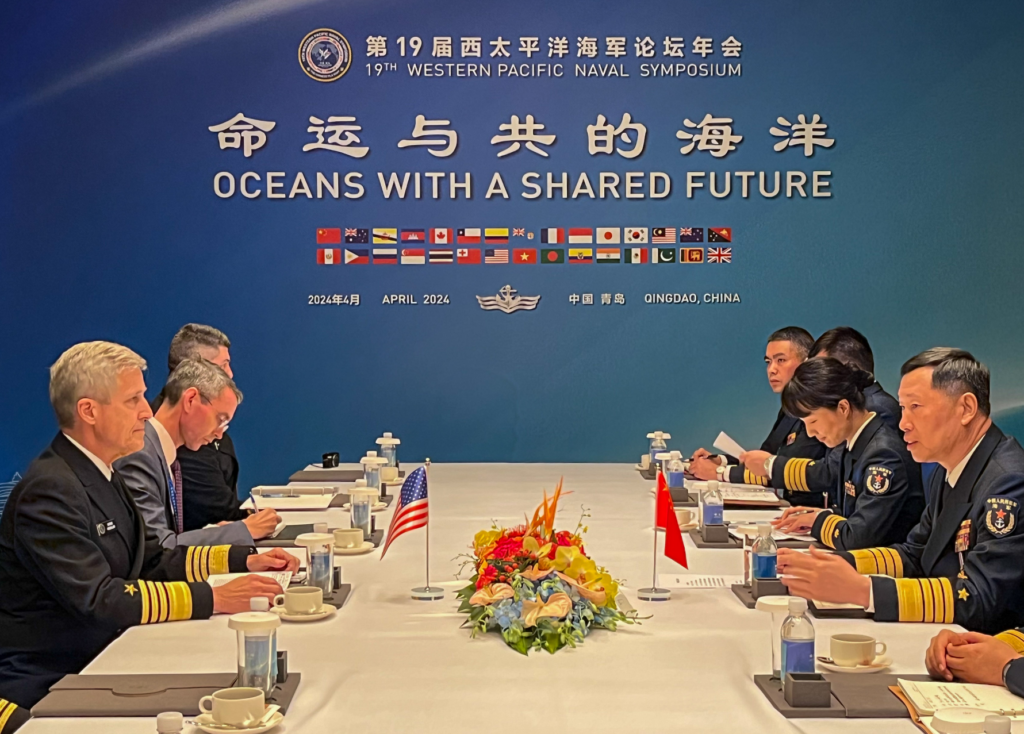
QINGDAO, China (April 21, 2024) Adm. Stephen Koehler, left, commander of U.S. Pacific Fleet, meets with Adm. Hu Zhongming, right, commander of the People’s Liberation Army Navy, at the Western Pacific Naval Symposium in Qingdao, China, April 21, 2024. Koehler met with Hu to discuss the increasing security challenges in the Indo-Pacific. (U.S. Navy photo)

3 April 2024 

From U.S. Pacific Fleet Public Affairs 

U.S. Pacific Fleet spokesperson Navy Commander Hayley Sims provided the following readout: U.S. Pacific Fleet Commander Adm. Stephen Koehler participated in the 19th Western Pacific Naval Symposium (WPNS), which was hosted this year in Qingdao, People’s Republic of China from 21-23 April. 

WPNS is a multi-lateral organization with a history dating back to 1987. It includes 23 member and seven observer nations with maritime safety equities throughout the Western Pacific. Responsibility to host WPNS activities, including working groups and symposiums, is rotated annually among member countries on a volunteer basis. WPNS provides naval leaders the opportunity to discuss maritime matters of mutual interest while also giving the United States, allies, and partners an opportunity to underscore the importance of safe and responsible operations in support of a free and open Indo-Pacific. 
  
Discussions during this year’s symposium included maritime issues, areas for cooperation, and military-to-military communication. 
 
While at the symposium, Koehler met bilaterally with heads of Navy from Australia, Bangladesh, Chile, Colombia, France, Thailand, United Kingdom, and Vietnam to discuss the importance of continued multi-lateral exercises and combined operations that enhance interoperability and boost deterrence in support of a shared vision for a free and open Indo-Pacific region. Consistent with standard practice at WPNS, Koehler also met with host-nation representatives from the People’s Liberation Army Navy to discuss the importance of maintaining open lines of communication, operational safety, and regional security concerns. 
  
Admiral Koehler is traveling throughout the region after assuming command of U.S. Pacific Fleet earlier this month. He first made stops to Japan and Republic of Korea where he met with senior officials to discuss the increasing security challenge in the Indo-Pacific and the importance of trilateral cooperation between Japan, Republic of Korea, and the United States to demonstrate the strength and resolve against those who challenge regional stability. 


USCG Commissions Newest National Security Cutter Named for first Master Chief Petty Officer of the Coast Guard

U.S. Coast Guard Atlantic Area, April 20, 2024 

NORTH CHARLESTON, S.C. — The Coast Guard welcomed its newest cutter into the fleet, the U.S. Coast Guard Cutter Calhoun (WMSL 759), Saturday, during a commissioning ceremony at Coast Guard Base Charleston, presided over by Coast Guard Commandant Adm. Linda Fagan. 

Calhoun is the 10th Legend-class national security cutter (NSC) to join the Coast Guard and is the fourth NSC to be homeported in North Charleston alongside Coast Guard Cutters Hamilton (WMSL 753), James (WMSL 754) and Stone (WMSL 758). 

Calhoun’s namesake comes from the first Master Chief Petty Officer of the Coast Guard, Charles L. Calhoun. Calhoun led a distinguished career, serving in the U.S. Navy during World War II prior to enlisting in the Coast Guard in 1946. Calhoun’s Coast Guard career was marked by over 170 months of sea service, including service in Vietnam during the Vietnam War. Calhoun became the first Master Chief Petty Officer of the Coast Guard on Aug. 27, 1969, and was a champion for the service’s enlisted personnel and is responsible for bridging the gap between the command and enlisted workforce. The commissioning ceremony’s date of April 20 is in honor of Calhoun’s birthday. 

“I’m honored to share the job title, Master Chief Petty Officer of the Coast Guard, with Charles Calhoun,” said Heath Jones, 14th Master Chief Petty Officer of the Coast Guard. “His efforts as a voice for the enlisted workforce created significant, lasting culture change within the Coast Guard. His dedication to people, the most precious resource we have, and the challenges he faced paved the way for the talent transformation work we’re doing today.” 

Construction of Calhoun began in 2019 and the cutter was officially delivered to the Coast Guard in October 2023 from Ingalls Shipbuilding in Pascagoula, Mississippi. After deploying in support of oil spill response and counter migration, Calhoun arrived at its homeport in North Charleston on Dec. 3, 2023. The commissioning of Calhoun officially places the cutter in service for the Coast Guard and marks the most significant milestone of the cutter’s life to date. 

“What a monumental day for this crew, our service, and the legacy of Master Chief Calhoun,” said Capt. Timothy Sommella, commanding officer of Calhoun. “Now that Calhoun has entered active service, we are ready to serve alongside our fellow cutters and interagency partners in protecting the American people from threats here at home and abroad. The crew has worked tirelessly to see this day and is very proud.” 

The 418-foot, Legend-class national security cutters are equipped with state-of-the-art command and control equipment, the ability to launch and house multiple small boats and aircraft, and an advanced engineering plant capable of reaching speeds of roughly 30 mph, making them the most versatile cutters in the Coast Guard fleet. The cutter’s primary missions will include counterdrug operations, migrant interdiction, living marine resources and defense readiness in support of Coast Guard operations throughout the world. 


SECDEF Announces Flag Officer Nominations

April 19, 2024 

Secretary of Defense Lloyd J. Austin III announced on April 19 that the president has made the following nominations: 

Navy Vice Adm. Michael E. Boyle for reappointment to the grade of vice admiral, with assignment as deputy chief of naval operations for Operations, Plans, and Strategy, N3/N5, Office of the Chief of Naval Operations, Pentagon, Washington, D.C.  Boyle is currently serving as commander, Third Fleet, San Diego, California. 

Navy Rear Adm. Dion D. English for appointment to the grade of vice admiral, with assignment as director for Logistics, J-4, Joint Staff, Pentagon, Washington, D.C.  English is currently serving as director, Supply, Ordnance and Logistics Operations Division, N4L, Office of the Chief of Naval Operations, Pentagon, Washington, D.C.


Sub USS New Hampshire Conducts Brief Stop off Coast of Iceland

By U.S. Naval Forces Europe and Africa / U.S. Sixth Fleet Public Affairs 

April 20, 2024 

COAST OF ICELAND  –  The Virginia-class nuclear-powered fast attack submarine USS New Hampshire (SSN 778) conducted a brief stop for personnel and supplies off of the coast of Iceland, April 18, 2024. 
 
This is the second time a U.S. Navy submarine has conducted a brief stop in Iceland since the Icelandic Minister of Foreign Affairs informed the United States that U.S. Navy submarines were allowed to make short visits in Iceland to receive supplies and personnel. The first U.S. Navy submarine to visit Iceland 
was the Los Angeles-class fast-attack submarine USS San Juan in April 2023. 
 
“It is an honor to be back in Iceland to conduct a brief stop for personnel and supplies, and we thank our Icelandic Allies for their continued support as we operate in the region in support of our NATO Allies and partners,”said Capt. Benjamin Selph, commodore, Task Force 69. “Stops like this are visible 
demonstration of the strength of the U.S.-Icelandic relationship and our commitment to promoting security and stability in the region.” 
 
As founding members of NATO, Iceland and the U.S. share a long history of cooperation as we work towards mutual goals of safety and security in the region. Now in its 75th year, the NATO Alliance is a testament to the power of collective defense and the strength of solid relationships between Allied and partner nations. 
 
In addition to allowing U.S. Navy submarines to conduct brief stops for personnel and supplies, Iceland also provides host country support to U.S. and Allied maritime patrol and reconnaissance aircraft (MPRA) from Keflavik Air Base. 
 
For more than 80 years, U.S. Naval Forces Europe-U.S. Naval Forces Africa (NAVEUR-NAVAF) has forged strategic relationships with allies and partners, leveraging a foundation of shared values to preserve security and stability. 
 
Headquartered in Naples, Italy, NAVEUR-NAVAF operates U.S. naval forces in the U.S. European Command (USEUCOM) and U.S. Africa Command (USAFRICOM) areas of responsibility. U.S. Sixth Fleet is permanently assigned to NAVEUR-NAVAF, and employs maritime forces through the full spectrum of joint and naval operations. 


U.S. Coast Guard Cutter Stratton Returns Home Following 111-day Alaskan Deployment

U.S. Coast Guard Pacific Area, April 22, 2024 

ALAMEDA, Calif. – U.S. Coast Guard Coast Guard Cutter Stratton (WMSL 752) and crew returned to home port in Alameda, Monday, following a 111-day deployment to the Bering Sea in support of search and rescue capabilities and protecting the United States’ northern-most borders. 

Stratton and crew departed Alameda January 2, and while deployed, Coast Guard’s Seventeenth District maintained operational control. Congress mandates a continuous presence for search and rescue capabilities in the Bering Sea, and Stratton and crew operated in the harsh environment for 72 days. Stratton was at the forefront of maritime safety and security. The cutter’s presence in the region ensured rapid response to emergencies, safeguarding the lives of Alaskan fishermen. 

While deployed in the Alaskan region, Stratton regularly worked with Coast Guard Air Station Kodiak’s MH-60 Jayhawk helicopters and aircrews. Stratton completed 363 helicopter landings with Jayhawk crews to conduct training and to enhance the organization’s collective search and rescue capabilities. Helicopter training included shipboard landings, on-deck fueling, and in-flight refueling, in which the cutter passes a fuel hose to the helicopter while it remains airborne. 

One of Stratton’s primary missions this patrol was fisheries law enforcement in the Bering Sea. Stratton’s law enforcement teams conducted 18 boardings, in key fishing spots such as Slime Bank, Dutch Harbor, and St. Paul Island. Stratton queried 98 fishing vessels, obtaining critical information to ensure commercial vessels were legally operating in the region. Additionally, Stratton’s boarding team detained an individual aboard a fishing vessel, who was wanted for an active arrest warrant. The individual was transported to local authorities in Dutch Harbor, Alaska. 

Stratton’s law enforcement efforts played a vital role in ensuring the safe operation of Alaskan fishing vessels by enforcing safety regulations and NOAA fisheries regulations. NOAA oversees the management of commercial and recreational fisheries within U.S. waters, aiming to safeguard and promote sustainable fish populations. Alaska’s fisheries are some of the nation’s largest providers of seafood and are a critical component of the U.S. economy. Alaska’s seafood industry averages $5.6 billion in total annual economic activity. The Coast Guard’s efforts in ensuring safe fishing practices are essential to support this vital industry. 

“I’m extremely proud of this crew and all they have accomplished. Their expertise and commitment enabled our successful operations” said Capt. Brian Krautler, commanding officer of Stratton. “The Bering Sea is notorious for its harsh conditions, and our presence ensures rapid response to emergencies, safeguarding lives at sea.” 

Commissioned in 2012, Stratton is one of four Coast Guard legend-class national security cutters homeported in Alameda, California. National Security Cutters are 418-feet long, 54-feet wide, and have a 4,600 long-ton displacement. They have a top speed in excess of 28 knots, a range of 12,000 nautical miles, and can hold a crew of up to 170. National Security Cutters routinely conduct operations throughout the Pacific, where their unmatched combination of range, speed, and ability to operate in extreme weather provides the mission flexibility necessary to conduct vital strategic missions. 

The namesake of U.S. Coast Guard Cutter Stratton is Capt. Dorothy Stratton, who led the service’s all-female reserve force during World War II. Stratton was the first female commissioned officer in the Coast Guard and commanded more than 10,000 personnel. The ship’s motto is “We can’t afford not to.”