AUKUS Program Marks ‘Greatest Industrial Undertaking’ for Australia
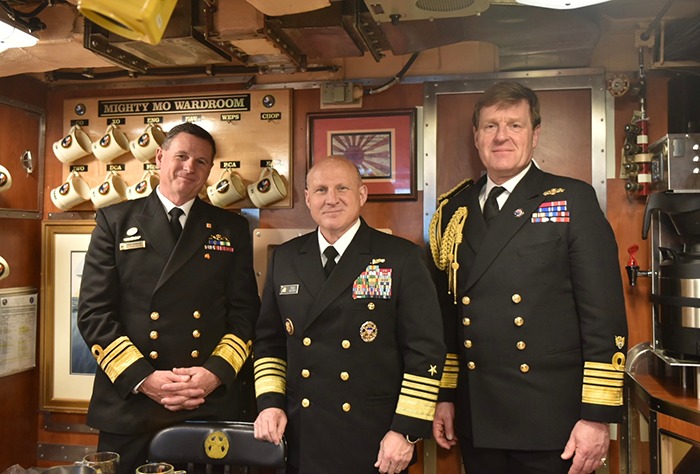
Then-CNO Admiral Mike Gilday, Royal Navy First Sea Lord and Chief of Naval Staff Adm. Sir Ben Key, and Chief of the Royal Australian Navy Vice Adm. Mark Hammond, tour the Virginia-class fast-attack submarine USS Missouri following the AUKUS bilateral announcement in San Diego, Calif, March 13, 2023. 
CREDIT: U.S. Navy | Commander Courtney Hillson 

The AUKUS program, the multination effort to provide Australia with nuclear-powered submarines, will kick-start that country’s ability to build nuclear subs, an Australian minister said in a panel discussion at Sea-Air-Space on April 8. 

Pat Conroy, Australia’s minister for defense industry and minister for international development and the Pacific, said the effort will be a challenge but it was a logical choice to select a partnership of Australian Submarine Corp. and BAE Systems to build the subs, as ASC built Australia’s diesel-electric submarines and BAE builds the United Kingdom’s Astute and Dreadnought-class submarines. 

“For them to form a joint venture for us was the right model,” Conroy said. He said it will be a “step up” for them to move to nuclear standards, but they’ve had a long partnership with General Dynamics Electric Boat in the United States.  

“Electric Boat was instrument in fixing some of the challenges that we encountered earlier in the Collins class,” Conroy said. “So, we’re confident we’ll put the ecosystem in and we’re investing around $30 billion Australia to increase our industrial place uplift that will really underpin what is the greatest industrial undertaking our country’s ever attempted.” 

Moderator Megan Eckstein of Defense News noted the United States and United Kingdom are talking about building up the nuclear industrial base, but for Australia, “you’re starting from scratch.” 

Conroy replied, “it’s an incredible effort, and lots of progress has been made from legislative rules to establishing a nuclear regulatory authority to starting to train our workers, our industry in the nuclear mindset. It has been a challenge, but also a great opportunity to include Australian companies from the ground floor.” 

Australia is mounting a full national mobilization, he said, including funding 4,000 additional permanent university places in STEM subjects to grow the workforce. 

“We think we need 20,000 workers. We’ve got Royal Australian Navy sailors working on U.S. submarine tenders in Guam right now, and a hundred ASC employees will be working for harbor sustainment next year,” he said. 

“So, we’re starting that training pipeline. That $30 billion dollars will be a massive investment. And while it’s a challenge, there’s also opportunities,” he said.  

“I’ve had the privilege of going through Barrow-in-Furness in the U.K. [home of BAE Systems Submarines] and the Groton, Connecticut yard here [home of Electric Boat] and they’ve got tremendous expertise built up over a century. But they’ve also got the challenges of that, of being built around towns like in Barrow-in-Furness. You’ve got terrace houses next to assembly halls because the town and a shipyard being built up together. Having a brownfield site where we can build with the best equipment, with lots of open space, will really allow us to maximize efficiencies and learnings from our oldest partners.” 


Atlantic Commander: Industry-Government Partnership Essential to Coast Guard Innovation

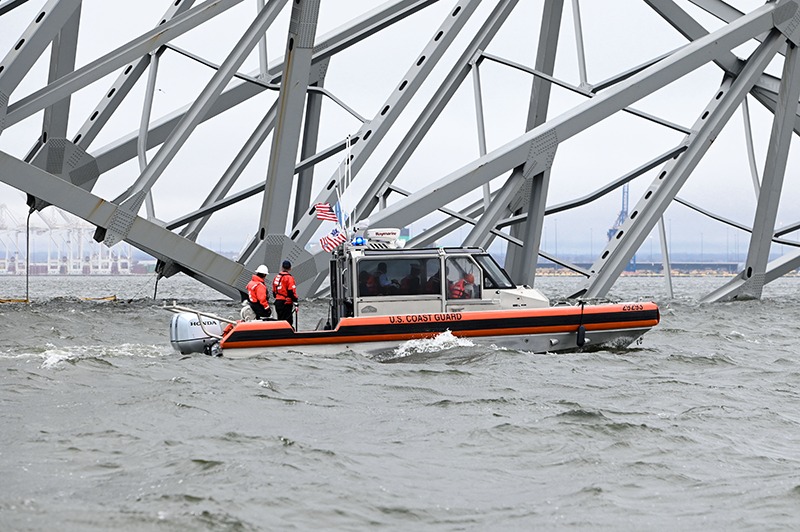
U.S. Coast Guard response boat crews enforce a safety zone, April 2, 2024, after the collapse of the Francis Scott Key Bridge in Baltimore, Maryland. 

By Erika Fitzpatrick, Contributor 

Future innovation within the U.S. Coast Guard comes from listening to and partnering with the defense industry, Vice Admiral Kevin E. Lunday, U.S. Coast Guard Commander of the Atlantic Area and Defense Force East, said April 8 at Sea-Air-Space 2024. 

“Most of the innovation, most of the great ideas — the kernel, the incubator for those — is within the defense industrial base,” he said. The Navy League’s symposium, which he called the premiere industry-government event, is a “special opportunity to have a conversation and a dialogue.”  

In addition to supporting U.S. Combatant Commands, Lunday directs Coast Guard forces and operations involving navigable waterways east of the Rocky Mountains to the East Coast, throughout the Atlantic Ocean, and in parts of the Arctic Ocean to the Arabian Gulf.  

As such, his command is involved in a range of often high-profile events and issues. 

For instance, when Baltimore’s Francis Scott Key bridge collapsed on March 26 within minutes of being rammed by a massive, malfunctioning container ship, Lunday directed forces there within hours for active search and rescue and follow-on recovery efforts. In cooperation with federal, state, and local partners, the USCG set up and now helps lead the Key Bridge Response Unified Command.  

“While that may seem like a very unusual operation in some respects — a bridge collapse after a ship hitting it — that kind of emergency response that the Coast Guard is involved in leading is very common for what we do across the Atlantic area, across the service, every day,” he said.  

Other Atlantic-area USCG operations include:  

  • Helping prevent and prepare for maritime mass migration incidents and fighting transnational crime in the eastern Caribbean through participation in the Joint Task Force-East.  

  • Controlling, reducing, and preventing deaths from irregular maritime migration, particularly in stemming the flow of migrants from the economically and politically stressed countries of Haiti and Cuba, through Homeland Security Task Force-Southeast.  

  • Looking into the circumstances involved in the June 2023 implosion of the Titan submersible, an ongoing review conducted by the Coast Guard Marine Board of Investigation.  

Lunday credited USCG’s successful involvement in these and other endeavors to long-term investments in incident command response and in technological systems that shed light on maritime migration patterns and provide other mission-critical information. 

Need to Think Differently  

Lunday said USCG is intently focused on readiness — how to carefully balance the readiness of the force with the demand for execution. 

However, he said, new solutions are needed, and the Coast Guard looks to private industry to provide many of them.  

Our leadership challenges us is to “think differently about how we conduct operations,” Lunday said, “because the increased demands for services and readiness challenges are forcing us to think differently.”  

For instance, the Coast Guard needs effective technologies with government and mission application. These include artificial intelligence and data tools to better analyze, understand, model, and predict patterns of human behavior. 

Because industry is thinking about where we need to be going, Lunday said, we should “open our mind and our ears and listen to what they’re saying about how we move forward.”  


CMS Breakfast: Pursuing Ways to Strengthen the Workforce, Boost Readiness

Government and industry need to work together to solve the problems of shipbuilding schedules, workforce retention and getting deployable technology into the hands of warfighters at scale, speakers said at the Center for Maritime Strategy breakfast on April 9. 

“Is it time to call for the Defense Production Act?” asked Admiral James Foggo, the dean of CMS and panel moderator, noting the number of shipyards have declined over the decades from 55 to just six today. 

“It’s about setting conditions,” said Nickolas Guertin, the Navy’s relatively new assistant secretary for research, development and acquisition, noting the industry saw the need to ramp up shipbuilding in the 1930s, providing critical capability when World War II began. “Setting conditions is part of what I can do.” 

Guertin said defense officials and industry need to stop thinking of themselves as carrier people or submarine people, “but as delivering game-changing capability across the tyranny of distance.” 

He said government and industry need to look at the workforce as national strategic assets and create environments where they want to stay in an industry adversely affected by COVID.  

“Their happiness at work is a primary task for industry … we are bleeding people on the waterfront and we need to turn that around,” he said. 

Admiral Daryl Caudle, commander of Fleet Forces Command, said it has become obvious to Chief of Naval Operations Admiral Lisa Franchetti that the Navy she has inherited “will not fundamentally change in size. It just will not. We have a responsibility to wring out every ounce of readiness we can.” 

The Navy needs to innovate on force generation, defining what combat surge readiness looks like, and coupling revolutionary technology like artificial intelligence and machine learning with actual problems they can help solve, “so we can actually apply [them] where those technologies need to land,” he said. 

It would also be helpful to give industry clear demand signals through clear requirements and multi-year procurements, Caudle said, and the service must turn concepts of operations into concepts of deployment. “How do I get this into the theater?” 

DIU Evolution 

That is one of the jobs of DIU, the Defense Innovation Unit directed by Doug Beck, recruited by the late secretary of defense Ash Carter, who Beck said was prescient about the direction industry was going and realized “we must leverage the incredible technology in our commercial tech sector,” Beck said. 

“What he saw was that in so many areas of technology — artificial intelligence, autonomy, biotech, space, cyber — those areas of technology are going faster in order to meet the relentless demands of billions of consumers around the world,” much faster than “they possibly could in our bespoke only” defense market. 

The nation is now at a tipping point, he said, where the president, secretary of defense, commercial tech sector and Congress all “get it” and need to move that technology to the field. DIU’s first iteration was building a bridge to the tech sector, version 2.0 was proving that commercial technology could help solve military problems and the latest version, call it DIU 3.0, is aimed applying technology “with strategic effect,” and doing so at scale. 

One such effort is Replicator, a Department of Defense effort to field thousands of attritable, autonomous, uncrewed systems to counter China’s growing naval capability. The initial effort is about creating the capability and then doing that “over and over again,” Beck said. “We are on track for both of those objectives.” 

He said he couldn’t talk about actual systems that are part of the effort, but said tranche 1 is “off to the races” and they are working on tranche 2, with a deadline of August 2025. 

Columbia Status 

Matthew Sermon, the executive director, PEO Strategic Submarines, addressed the Columbia-class submarine program, identified as being well behind schedule, according to a Navy shipbuilding review. 

“Columbia is becoming a ship,” with the lead ship is under construction, stable requirements and a mature design, he said. However, it has experienced “lead ship challenges,” which he said could be expected in the first ship designed entirely in a 3D model. 

“We’re not going to surrender that lead ship schedule,” he said, and the program is moving to match the production cadence required by the Navy. 

Speaking of innovative technology, he said additive manufacturing is entering the workforce, although it may not be as widely distributed as previously thought. 

“We have narrowed that down to six critical materials” and the related parts, he said. “We’re going to prove it out, we’re going to destructively test it … we’re going to get it right.” 


Ursa Major Signs Contract with US Navy for Next Gen Solid Rocket Motors for Standard Missile

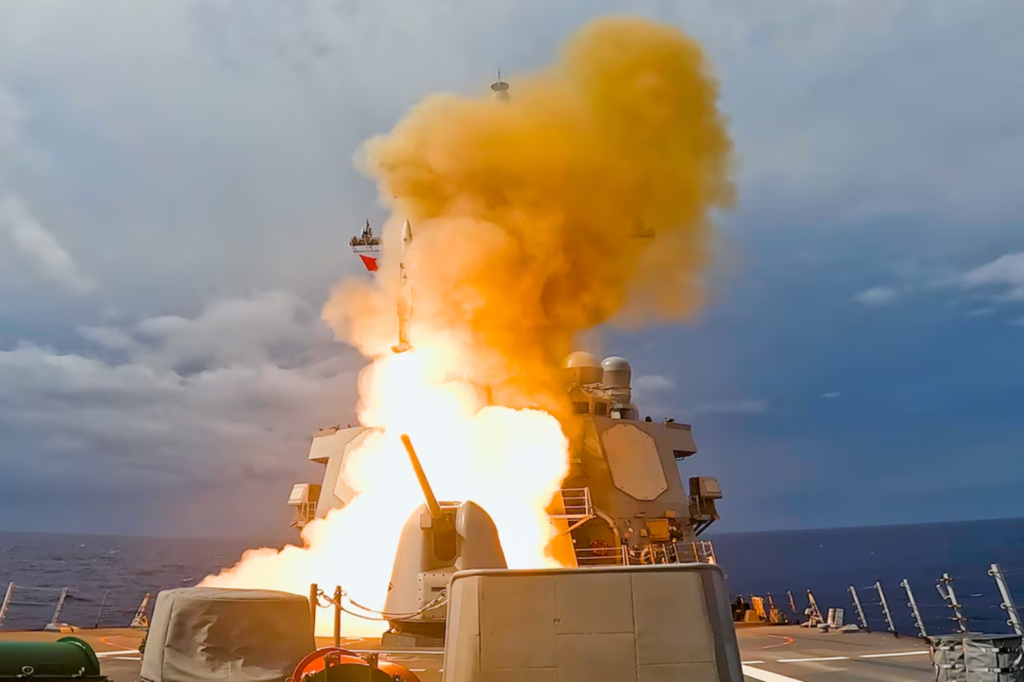
PHILIPPINE SEA (April 5, 2024) The Arleigh Burke-class guided-missile destroyer USS Higgins (DDG 76) launches a Standard Missile (SM) 2 from a forward launcher while operating in the Philippine Sea, April 5, 2024. (USN photo by MC1 Hannah Fry)

DENVER, April 8, 2024 — Ursa Major, America’s leading privately funded company focused solely on propulsion, announced a contract today with the Naval Energetics Systems and Technologies (NEST) Program to develop and hot fire test a prototype solid rocket motor (SRM) for the U.S. Navy’s Standard Missile (SM) program. Under this contract, Ursa Major will develop a new design and apply the company’s revolutionary manufacturing process to the Navy’s workhorse Mk 104 dual-thrust rocket motor in coordination with the Navy’s Program Executive Office Integrated Warfare Systems 3.0, Naval Air Warfare Center – Weapons Division at China Lake, and the Naval Surface Warfare Center at Indian Head. 

The Mk 104 SRM powers the Navy’s SM arsenal, including the SM-2, used for surface-to-air defense; the SM-3, used for ballistic missile defense; and the SM-6, an anti-air, land, and sea missile. In 2022, the Missile Defense Agency stated that the SM-6 is the only missile capable of intercepting maneuverable hypersonic missiles. While the Mk 104 is a high-performance motor, legacy models are challenging to manufacture. Using the company’s cutting-edge Lynx production process for SRMs, Ursa Major will leverage additive manufacturing to design a high-performing motor built for manufacturability and reliability. 

“We are proud of the Navy’s support and recognition of Ursa Major as a trusted partner to develop the next generation of Mk 104 solid rocket motors,” said Ursa Major founder and CEO Joe Laurienti. “Our new approach to manufacturing SRMs allows Ursa Major to quickly develop high-performing motors at scale, driving volume and cost efficiencies to address this critical national need.” 

“PEO IWS is excited to work with Ursa Major on this effort to bolster a critical component of the Nation’s industrial base,” said Captain Thomas Seigenthaler, the director of PEO IWS 3.0. “The production of solid rocket motors is a top priority, and we are impressed with Ursa Major’s innovative approach to address manufacturing challenges.” 

Lynx, Ursa Major’s innovative new approach to designing and manufacturing SRMs, was introduced in November 2023. The manufacturing process uses additive manufacturing and a product-agnostic tooling system to rapidly produce scalable SRM systems without expensive or time-consuming re-tooling or re-training. Learn more here


April 8 Red Sea Update 

U.S. Central Command, April 8, 2024 

 
12:15 p.m. and 2:40 p.m. (Sanaa time) on April 8, U.S. Central Command (USCENTCOM) forces successfully engaged and destroyed an air defense system with two missiles ready to launch, a ground control station in Houthi-controlled areas of Yemen, and one unmanned aerial system launched by Iranian-backed Houthi terrorists from Yemen over the Red Sea. There were no injuries or damage reported by U.S., coalition, or commercial ships. 

Separately, at approximately 8:00 a.m. (Sanaa time) on April 7, an anti-ship ballistic missile was launched from a Houthi-controlled area of Yemen toward the Gulf of Aden where a coalition ship was escorting M/V Hope Island, a Marshall Islands flagged, U.K. owned, Italian operated cargo ship. There were no injuries or damage reported by U.S., coalition, or commercial ships. 

This was the fifth observed missile launch against this coalition ship and M/V Hope Island. 

USCENTCOM is dedicated to protecting the freedom of navigation and making international waters safer and more secure for coalition and merchant vessels. 


USS Antietam Shifts Homeport to Hawaii 

By Commander, U.S. 3rd Fleet Public Affairs, April 8, 2024 

JOINT BASE PEARL HARBOR-HICKAM, Hawaii  –   

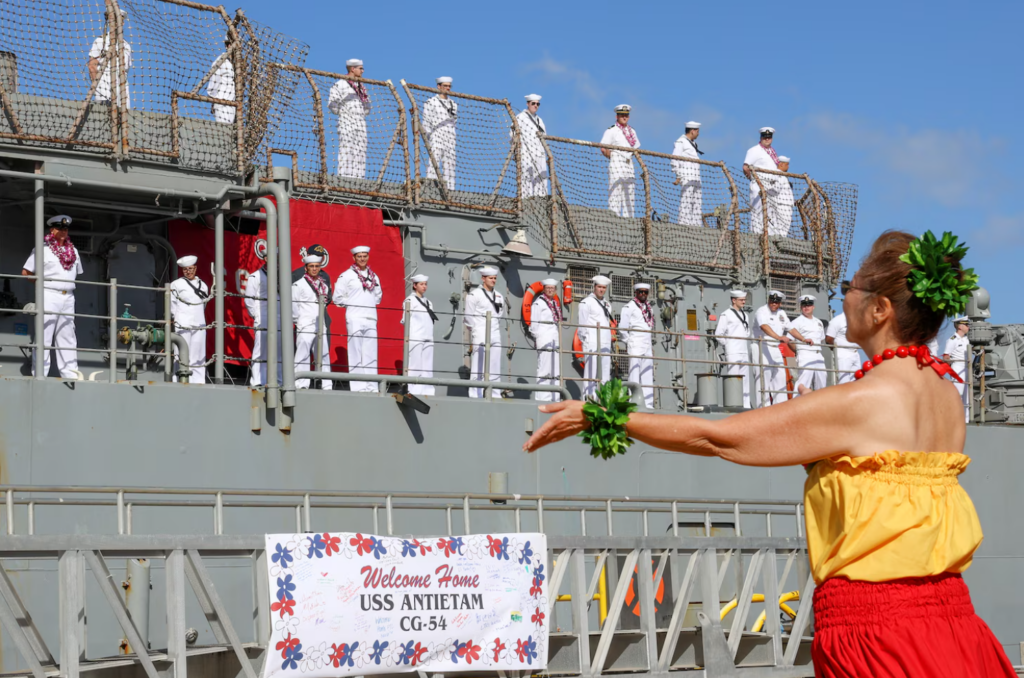
The Ticonderoga-class guided missile cruiser USS Antietam (CG 54) arrived to its new homeport of Joint Base Pearl Harbor-Hickam, Hawaii, April 5, as part of a planned rotation of forces in the Pacific. 
 
Antietam is now assigned to Commander, Naval Surface Group Middle Pacific and U.S. 3rd Fleet. 
 
Antietam departed Yokosuka, Japan, Jan. 26 to transit to Hawaii and assist in enforcing international fisheries law during their Oceania Maritime Security Initiative (OMSI) mission. OMSI is a Secretary of Defense program leveraging Department of Defense assets transiting the region to increase the Coast Guard’s maritime domain awareness, ultimately supporting its maritime law enforcement operations in Oceania. 
 
“I’m proud of the Antietam crew for their execution of the Oceanic Maritime Security Initiative during our homeport shift from Yokosuka, Japan to Hawaii,” said Capt. Victor Garza, commanding officer of Antietam. “I thank the families for the support they give their Sailors. It is their strength that enables us to go to sea.” 
 
During Antietam’s transit to Hawaii, the ship made port calls in major naval ports including Suva, Fiji and Apra Harbor, Guam. 
 
Aloha to Antietam and welcome to Hawaii! 
 
The mission of Commander, Naval Surface Group Middle Pacific is to manage the overall warfighting capability of the Surface Combatant Force homeported at Joint Base Pearl Harbor-Hickam, Hawaii; to coordinate through the Fleet Response Plan cycle the manning, operations, combat systems, engineering, maintenance, training, logistics, administration, and support of assigned units to achieve the highest levels of combat readiness. 
 
An integral part of U.S. Pacific Fleet, U.S. 3rd Fleet operates naval forces in the Indo-Pacific and provides the realistic, relevant training necessary to execute our Navy’s role across the full spectrum of military operations – from combat operations to humanitarian assistance and disaster relief. U.S. 3rd Fleet works together with our allies and partners to advance freedom of navigation, the rule of law, and other principles that underpin security for the Indo-Pacific region. 


HII Awarded $74 Million Contract to Support U.S. Navy Vertical Launch Systems 

Research and development will enhance fleet defensive capabilities 

MCLEAN, Va., April 09, 2024 (GLOBE NEWSWIRE) — HII (NYSE: HII) announced today that its Mission Technologies division was awarded a $74 million contract to research, analyze and develop enhanced capabilities for the Mk 41 and Mk 57 vertical launching systems (VLS) onboard U.S. Navy surface ships. 

The task order, administered by the Naval Surface Warfare Center (NSWC) Port Hueneme Division, also applies to associated naval surface weapon systems, combat systems and sensors employed within the Navy. 

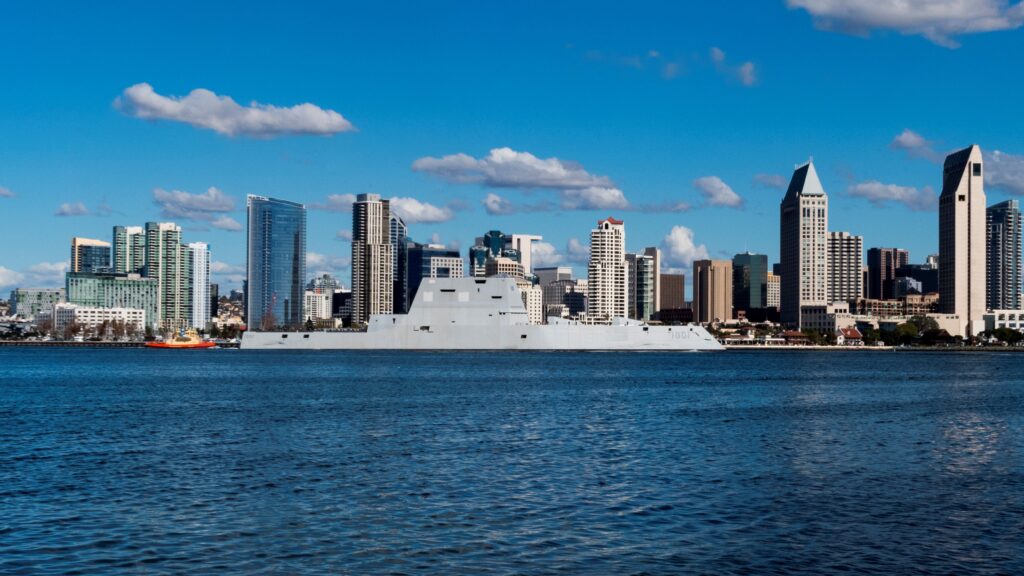
HII’s statement of work includes outfitting the first Zumwalt-class destroyer (DDG 1001) with the latest Mk 57 vertical launch system universal canister electronics unit. The unit, developed by HII, ensures warfighters can fire any missile from any VLS cell on Zumwalt-class ships. 

“We are extremely pleased to continue our support to the U.S. Navy, providing critical research, development, test and evaluation in support of vertical launch systems for NSWC Port Hueneme,” said Todd Gentry, president of Mission Technologies’ C5ISR business group. “Facilitating the insertion of technology into naval weapon and combat systems maximizes defensive capabilities for our warfighters, giving them a distinct advantage over adversaries.” 

A photo accompanying this release is available at: https://hii.com/news/hii-award-support-us-navy-vertical-launch-systems-2024/

HII will also leverage industry capabilities to support rapid design prototyping, technological improvements and engineering requirements associated with obsolescence issues. 

HII was awarded the recompeted task order under the Department of Defense’s Information Analysis Center Multiple Award Contract vehicle (IAC MAC). These IAC MAC task orders are awarded by the U.S. Air Force’s 774th Enterprise Sourcing Squadron to develop and create new knowledge for the enhancement of the Defense Technical Information Center repository and the research and development and science and technology community. 

The task order has a five-year term. Most of the work will be performed in Syracuse, New York, and Arlington, Virginia. HII’s support to NSWC Port Hueneme is an extension of work performed under a previous contract awarded in 2021. 


Northrop Grumman Completes Assembly of Manta Ray UUV 

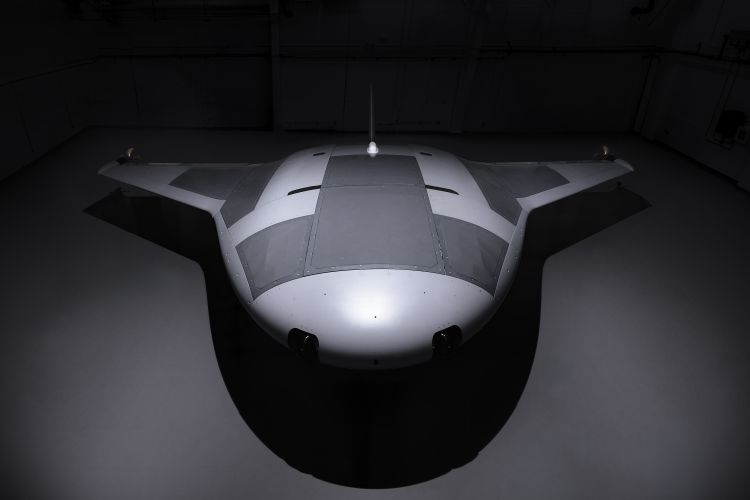
A full-size prototype of Manta Ray, a new class of uncrewed underwater vehicle, is assembled in Northrop Grumman’s Annapolis facility. (Photo Credit: Northrop Grumman)

ANNAPOLIS, Md. – April 8, 2024 – (PHOTO RELEASE) Northrop Grumman Corporation (NYSE: NOC) completed assembly of a full-size uncrewed underwater vehicle (UUV) prototype known as Manta Ray. A new class of UUV, it is an extra-large glider that will operate long-duration, long-range and payload-capable undersea missions without need for on-site human logistics. 

Manta Ray was built through a Defense Advanced Research Projects Agency (DARPA) program aimed at advancing key technologies to benefit future UUV designs, including techniques to manage energy, increased payload capacity, low-power propulsion and more.  


Future Challenges May Involve Rethinking How the U.S. Fights, Speakers Say

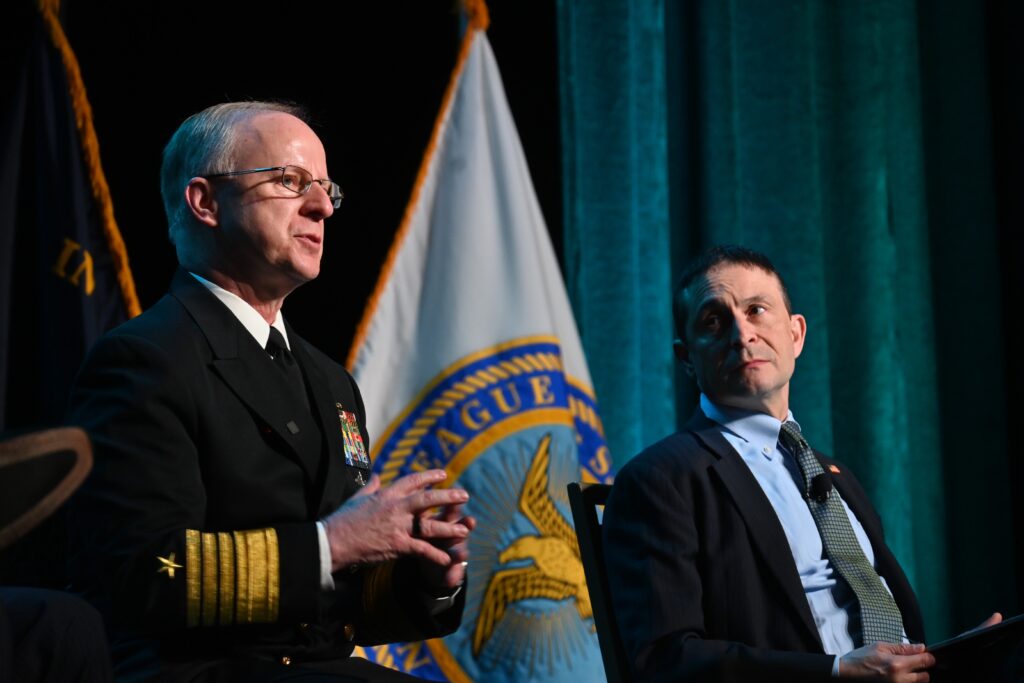
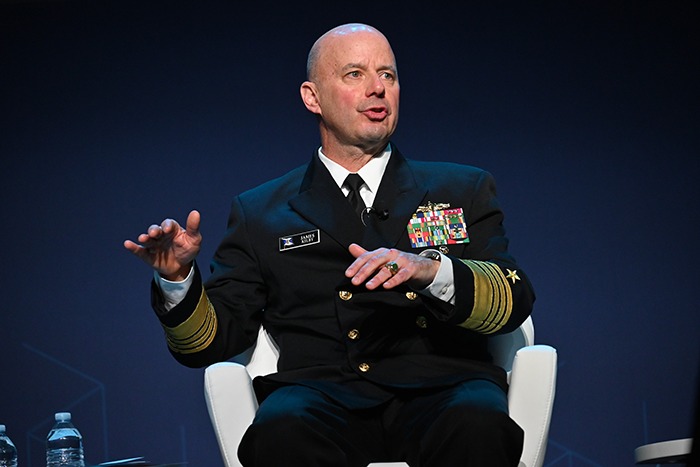
Amiral James Kilby, the Vice Chief of Naval Operations, speaks at the luncheon panel on Monday. 

The United States is facing a variety of challenges, from Houthi rebels in the Red Sea to the People’s Republic of China, but the preferred American way of fighting — massive overmatch — may not be tenable for the future, two panelists said during the luncheon event at the opening day of Sea-Air-Space. 

China is investing in its military faster than the U.S. is, and the new U.S. defense budget is a 1% increase in the top line, which amounts to a decrease with inflation, said retired Admiral James “Sandy” Winnefeld, chair of the President’s Intelligence Committee. 

“Even if we could build the ships that we wanted to build, we would have trouble maintaining them all,” he said. “And then manning is a challenge for us. So, it’s entirely possible that the means that we want to apply to this problem … are not going to be there.” 

What the nation may need to do is adopt a “whole of nation approach, not just a military-on-military approach, which involves diplomacy, economics, information, and of course the military,” he said. 

Vice Chief of Naval Operations Admiral James Kilby said one way forward is with disruptive technology, the sort being developed by the Disruptive Capabilities Office, the group set up last fall by Secretary of the Navy Carlos Del Toro to more quickly move technology to the field. 

He wouldn’t go into specifics of what the office is working on, but it’s intended to look at a broad swatch of technology and see what can be tested and moved rapidly to the warfighter. 

“The Disruptive Capabilities Office is meant to look across the whole DoD spectrum and understand what can be brought to bear quickly and to put that together in a test environment, test it, and have some confidence in it before we go after it,” he said. 

“… That is different behavior than how we’re used to doing it, and it’s basically capability focused,” he said. It builds on the work of Task Force 59, which deployed maritime unmanned systems, and is aimed at ways to “produce some capability now versus the perfect in future,” he said. 


Retention is Good but Workforce Challenges Remain, Service Chiefs Say

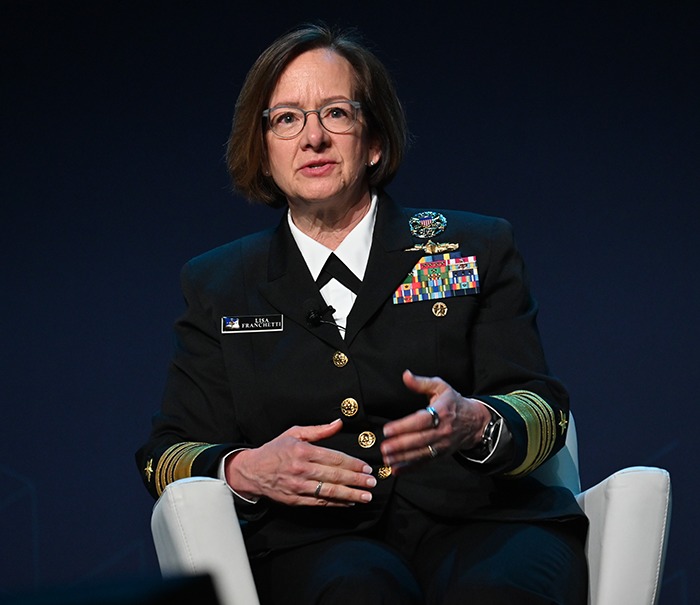
Navy CNO Admiral Lisa Franchetti speaks at the opening session of Sea-Air-Space 2024

Retention in the Navy and Marine Corps is going well, but recruitment remains a challenge across the services, including the Maritime Administration, and the services must set priorities in a time of great challenges and tight budgets, sea service chiefs said in the kickoff keynote panel of Sea-Air-Space 2024. 

Undersecretary of the Navy Erik Raven, who introduced the panel, asked what is needed to continue U.S. dominance. “We need budgets to support our strategy, with people and readiness coming first,” he said. 

He noted the fiscal 2025 Navy budget request involves “some tough choices, putting quality of service and readiness at the top of the priority list means other program must either must make do or take risks.” 

But the proposed budget “boldly advances our undersea capabilities for both U.S. and AUKUS demands, solidifies our commitment to 31 amphibious ships, and advances the landing ship medium into production,” he said. 

The panelists then took up the issue of budgets and the challenges facing the services. Chief of Naval Operations Admiral Lisa Franchetti said the service has only a .7% increase in its budget in the fiscal 2025 request, forcing it to set priorities. 

Number one is the Columbia-class submarine program, next is near-term readiness in “our forces and our people,” and next is working with industry partners to make that happen. 

“You can see the demand signal: 88 ships under contract, 66 under construction … we know we need a larger Navy, every study since 2016 has shown that,” she said. “I think the most effective way to work on that right now is invest in our industrial base, invest in the workforce, invest alongside our industry partners in the infrastructure necessary to really set the conditions to speed up the production and the throughput of the ships and submarines that we need to put more players on the field.” 

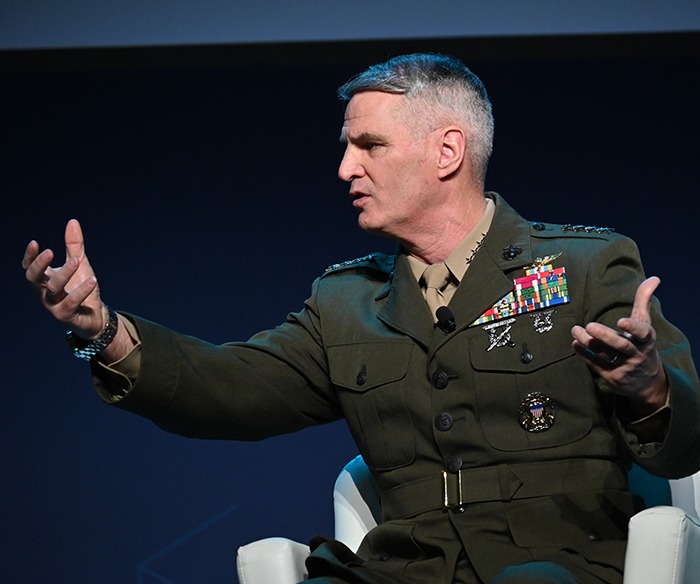
General Chris Mahoney, the assistant commandant of the Marine Corps.

General Chris Mahoney, the assistant commandant of the Marine Corps, said the fiscal ’25 budget funds the LPDs, LHAs and LSMs the service needs, so “for what allows us to be ready, the 25 program right now is looking very strong.” 

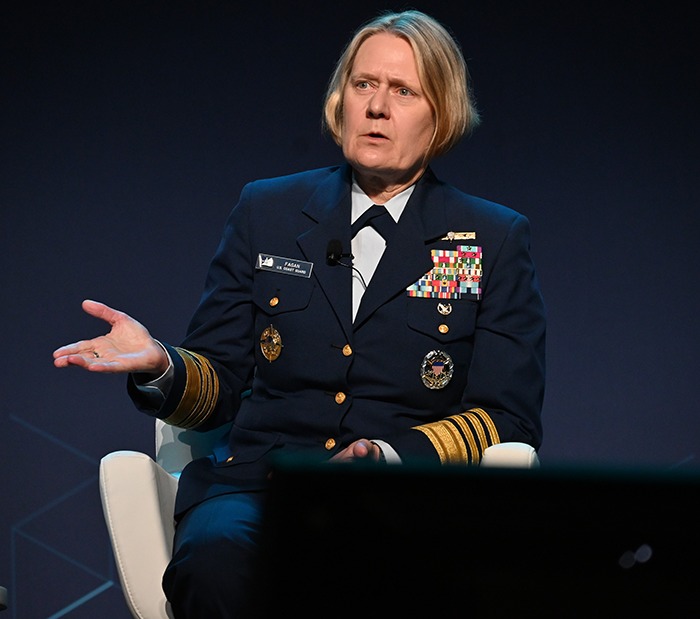
Admiral Linda Fagan, commandant of the Coast Guard, said “demand for the Coast Guard is deafening and it’s worldwide,” from dealing with the aftermath of the collapsed bridge in Baltimore to working with small nations that need the presence of cutters to help defend their interests. 

She noted there is great Coast Guard demand for new ships as well.  

“We, too, are in the largest acquisition that we’ve had since World War II. We compete for the same industrial base space, both new construction and repair with the Navy. And it’s critical for the nation that we’ve got that kind of reliable access and commitment to the new ship capacity and then repair capacity and maintenance capacity for the ships that are operating.” 

The Maritime Administration, too, is building new ships, albeit on a much smaller scale, said MARAD Administrator Ann Phillips. Its new builds, five new training ships, are for the Merchant Marine academies.

Admiral Linda Fagan, commandant of the U.S. Coast Guard.

“We thank Congress for the funding to be able to build these vessels, but when you have a 100% design, when you have firm fixed-price contracts, when you have by law a very small change order budget, and you have commercial best practices being applied, you are able to move through this vessel construction and vessel procurement,” Phillips said. “We’re on budget. We’re nearly on time.” 

Retention and Recruitment 

Of course, having ships is one thing, but the services must be able to crew them and maintain them, which are challenges of their own. 

“I’m happy to say that retention is very good in the Navy right now in almost all of our fields. And so, to me, that’s a signal that people are really committed to our mission,” Franchetti said.  

The service is “very focused” on recruiting, she said. “We can have all the best platforms in the world, but if we don’t have the warfighters that can deploy them, we’re not going to be an effective Navy,” she said. “So, we’re focused hard on recruiting,” including by elevating the head of Navy recruiting to a two-star admiral. 

The Navy is also “expanding the pool of folks that can join our Navy team,” including by boosting the age of enlistment to 42. “If anybody out there is not turned 42 yet, there should be some recruiters around who are going to sign you up,” she said. “And if your kid is above 18, you and your kid can be enlisted simultaneously.” 

The Coast Guard has had a shortfall as well, Fagan said, but has “kind of recovered” and is looking to recruit more effectively as well, including by boosting its recruiting capacity by nearly 25% and going after young people where they are, including standing up junior ROTC programs and even going on Twitch. 

“It’s an online collaborative gaming site, which, surprisingly, there were a lot of 20-year-olds,” she joked. “There’s the target audience.” 

Mahoney said retention numbers in the Marine Corps are “very, very good. We’ve made mission, we will make mission this year. You heard here first, our attention numbers are good and getting better, but it’s not a condition of stasis. You don’t declare victory and walk on to the next issue.” 

The Marines must look at the factors that make and keep young men and women Marines, “and that equates to their conditions of the barracks, access to healthcare, access to childcare, good childcare, good gyms. And you’ve got to bring in new ideas to continually, not sit there and declare victory once again, but to make sure that you are addressing needs that they have,” Mahoney said.