ARLINGTON, Va.–Secretary of Defense Pete Hegseth announced today that the president has made the following nomination:
Marine Corps Maj. Gen. David J. Bligh for appointment as judge advocate general of the Navy. Bligh is currently serving as the staff judge advocate to the Commandant of the Marine Corps, Headquarters, Marine Corps, Pentagon, Washington, D.C.
Below is the official biography of Major General Bligh:
Major General Bligh was raised in Athens, Pennsylvania. He is a 1988 graduate of Indiana University of Pennsylvania and a 1997 graduate of the University of Georgia School of Law.
Major General Bligh was commissioned through the Platoon Leaders Course program in 1988. He initially served as a Platoon Commander and Company Commander at 2nd Assault Amphibian Battalion, Camp Lejeune, North Carolina. He later served as a Series Commander at Marine Corps Recruit Depot, Parris Island, South Carolina.
Upon completion of the Naval Justice School, Major General Bligh served as a civil law officer, trial counsel, and officer-in-charge of legal assistance at Camp Lejeune. He was then assigned as Director, Joint Law Center, Marine Corps Air Station New River, North Carolina. During this assignment, Major General Bligh deployed for OIF-I with Task Force Tarawa.
Major General Bligh has served as the Staff Judge Advocate for 3rd Marine Division and III Marine Expeditionary Force in Okinawa, Japan, and Marine Corps Forces Command in Norfolk, Virginia. Prior to assuming his current duties, Major General Bligh served as the Deputy Staff Judge Advocate to the Commandant of the Marine Corps, and later as the Assistant Judge Advocate General of the Navy (Military Law).
Austal USA Completed Acceptance Trials on 19th Independence-variant LCS Pierre
From Austal USA, June 24, 2025
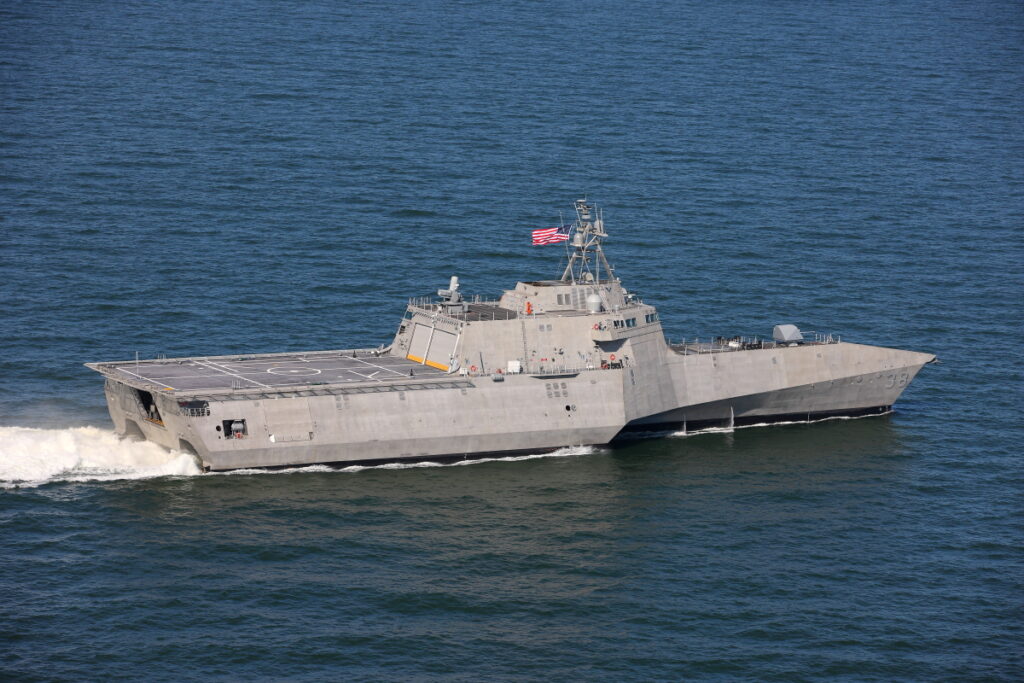
MOBILE, Ala. – Austal USA successfully completed acceptance trials on the company’s 19th Independence-variant Littoral Combat Ship (LCS), the last ship in the class. Future USS Pierre (LCS 38) returned to port late on June 11 after conducting trials.
“The completion of LCS 38 sea trials marks the achievement of an important milestone at Austal USA, the last LCS to go out to sea under our control,” said Harley Combs, Austal USA Vice President of Surface Ship Programs. “Congratulations to our Austal USA shipbuilders, vendors and our Navy teammates who coordinated to accomplish this successful milestone preparing the ship for delivery in a couple of weeks.”
Acceptance trials involve comprehensive testing conducted on the ship’s major systems and equipment in order to demonstrate their successful operation and mission readiness. The U.S. Navy’s Board of Inspection and Survey (INSURV) participates throughout the trials to validate the quality of construction and compliance with Navy requirements.
Sea trials are a team effort and the Austal USA team has consistently proven their excellence as evidenced by the number of successful LCS trial events that have been approved by INSURV. Successfully completing sea trial require expertise from across the company including test and activation/trials, program management, engineering, operations, site services, and supply chain management.
Pierre will be the 19th Independence-variant Littoral Combat Ship and will soon transition to her home port of San Diego. With the delivery of Pierre, Austal USA will have delivered 19 LCS to the Navy in just over 15 years. At times during the program Austal USA delivered three Independence-variant LCS in a year.
In addition to Pierre, Austal USA is also constructing seven more Navy and Coast Guard ships as well as modules for both the Virginia- and Columbia-class submarine programs and aircraft elevators for the Ford-class aircraft carrier fleet.
Tripoli Arrives in Sasebo, Japan, for Duty with U.S. 7th Fleet
From Lt. Nicholas Spaleny, June 23, 2025
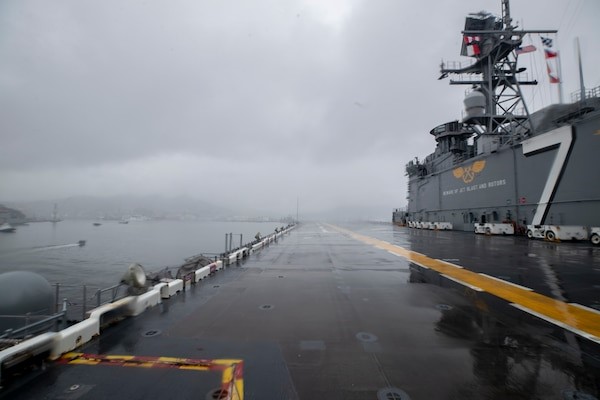
SASEBO, Japan – The America-class amphibious assault ship USS Tripoli (LHA 7) arrived in Sasebo, Japan, June 23, as part of a scheduled rotation of forces in the Indo-Pacific.
Tripoli’s forward-deployment ensures that the most capable surface ships and superior technology is best positioned to honor the United States’ security commitment with their Japanese allies.
“Tripoli is proud to join the long history of committed partnership in the region,” said Capt. Eddie Park, Tripoli’s commanding officer. “Our Sailors and Marines are ready to join the capable team of Forward Deployed Naval Forces and contribute to the security, stability and prosperity of the Indo-Pacific region.”
The forward presence of Tripoli supports the United States’ commitment to the defense of Japan, enhances the national security of the United States and improves its ability to protect strategic interests.
The security environment in the Indo-Pacific requires the most capable ships to enable rapid response times for maritime and joint forces.
“Today is only the first day of what will be a positive and longstanding relationship between USS Tripoli and the people of Sasebo, Japan,” said Park. “We are all looking forward to becoming a welcome and active part of the Sasebo community.”
Tripoli departed San Diego on May 19, and is the second America-class amphibious assault ship to be forward deployed to Japan. Tripoli was commissioned July 15, 2020, and is the second America-class amphibious assault ship built for the United States Navy. The ship is named after the U.S. Marine Corps victory against Tripoli at the Battle of Derna during the First Barbary War in 1805.
U.S. 7th Fleet, the U.S. Navy’s largest forward-deployed numbered fleet, which routinely interacts and operates with allies and partners in preserving a free and open Indo-Pacific region.
USCGC Stratton Arrives in Kagoshima, Leads Joint Operations with Partner Coast Guards
Japan Coast Guard members wave U.S. and Japanese flags to welcome the arrival of the Legend-class U.S. Coast Guard Cutter Stratton (WMSL 752) to Kagoshima, Japan, June 16, 2025 during a trilateral exercise with U.S. and Philippine Coast Guards. (U.S. Coast Guard photo by Senior Chief Petty Officer Matthew S. Masaschi)
From U.S. Coast Guard Pacific Area, June 20 2025
KAGOSHIMA, Japan – U.S. Coast Guard Cutter Stratton (WMSL 752) arrived in Kagoshima, Japan, June 16 to conduct the first-ever trilateral operations between the U.S. Coast Guard, Japan Coast Guard (JCG) and Philippine Coast Guard (PCG) within Japan’s territorial waters. This engagement builds on Operation SAPPHIRE, the U.S.-Japan Coast Guard bilateral effort aimed at strengthening interoperability to support maritime governance, peace and stability in the Indo-Pacific region.
Stratton led and participated in crew exchanges and ship familiarization tours. The ships held reciprocal tours, highlighting capabilities and assets to improve interoperability and generate combined effects at sea.
“These shoreside engagements in Kagoshima are opportunities to build on the already close working relationship we have with the Japan and Philippine Coast Guards,” said Capt. Brian Krautler, commanding officer of Stratton. “Stratton is scheduled to conduct several trilateral engagements with the JCG and PCG, both during this port call and at sea, to increase interoperability and cooperation with our partners who share our deeply rooted values and respect for the rule of law. Our coast guard services stand shoulder-to-shoulder in strengthening maritime safety and security in the region and serving as the unique instruments bridging national safety and security, and law enforcement.”
At sea, Stratton will conduct joint search and rescue training and exercises with JCG and PCG assets, including the deployment of vessels, boats, helicopter and unmanned system.
During the current Western Pacific patrol, Stratton is scheduled to engage with regional partners and participate in joint operations to support and enhance maritime governance, safety and security.
Commissioned in 2012, Stratton is one of ten legend-class National Security Cutters (NSC) and one of four homeported in Alameda, California. NSCs are 418-feet long, 54-feet wide, and have a 4,600 long-ton displacement. They have a top speed of 28 knots, a range of 12,000 nautical miles, and sail with a crew of up to 170. NSCs routinely conduct operations throughout the Pacific, where their unmatched combination of range, speed, and ability to operate in extreme weather provides the mission flexibility necessary to conduct vital strategic missions.
The namesake of U.S. Coast Guard Cutter Stratton is Capt. Dorothy Stratton, the first female commissioned officer in the Coast Guard. Captain Stratton led the service’s all-female reserve force during World War II, commanding more than 10,000 personnel. The ship’s motto is “We Can’t Afford Not To.”
7th Fleet is the U.S. Navy’s largest forward-deployed numbered fleet and routinely interacts and operates with allies and partners in preserving a free and open Indo-Pacific region.
Hegseth, Caine Laud Success of U.S. Strike on Iran Nuke Sites
June 22, 2025 | By Matthew Olay, DoD News
During a press conference at the Pentagon today, Defense Secretary Pete Hegseth and Air Force Gen. Dan Caine, chairman of the Joint Chiefs of Staff, lauded the success of the U.S. Central Command’s overnight strike on three Iranian nuclear facilities.
Dubbed “Operation Midnight Hammer,” Centcom deployed multiple combined assets to inflict significant damage at the sites of Fordo, Natanz and Isfahan.
“The order we received from our commander in chief was focused, it was powerful and it was clear. We devastated the Iranian nuclear program,” Hegseth said at the outset of his remarks, also noting that the operation did not target Iranian troops or citizens.
“Initial battle damage assessments indicate that all three sites sustained extremely severe damage and destruction,” Caine told the media.
After proceeding quietly and with minimal communication for 18 hours from the U.S. to the target area, the first of seven B-2 Spirit stealth bombers dropped two 30,000 GBU-57 Massive Ordnance Penetrator “bunker buster” bombs at the Fordo site yesterday at approximately 6:40 p.m. EDT, Caine said.
The initial mission package also included several decoy aircraft that flew west over the Pacific Ocean as “a deception effort known only to an extremely small number of planners and key leaders here in Washington and ,” Caine said.
Such tactics were also used in support of the main strike package of aircraft.
“The U.S. employed several deception tactics — including decoys — as the fourth and fifth generation aircraft pushed out in front of the strike package at high altitude and high speed, sweeping in front of the package for enemy fighters and surface-to-air missile threats,” Caine said.
Following the initial strike on Fordo, the remaining B-2s went on to deploy their ordnance, eventually totaling 14 MOPs hitting the targeted areas.
This was the first operational use of the GBU-57 MOP, Caine noted.
In addition to the MOPs, Caine said a U.S. submarine operating in Centcom’s area of responsibility launched more than two dozen Tomahawk land attack cruise missiles at key infrastructure targets at the Isfahan site, bringing the overall total of precision-guided weapons employed during the operation to approximately 75.
Caine stated there was no detectable retaliation to the strikes.
“We are unaware of any shots fired at the package on the way out. Iran’s fighters did not fly, and it appears that Iran’s surface-to-air missile systems did not see us,” he said, adding, “Throughout the mission, we maintained the element of surprise.”
Both Hegseth and Caine shared praise for the military personnel who worked to execute the mission.
“I want to recognize the pilots who flew those bombers, who flew those fighters, who flew those refuelers; warriors. I want to recognize the sailors on those destroyers, in those subs, on those carriers; warriors, all of them,” Hegseth said, also recognizing soldiers who conducted air and base defense.
“Every American involved in this operation performed flawlessly,” he added, also giving recognition to the Israeli government for its contribution to the positioning and preparation of the effort.
“This was a complex and high-risk mission, carried out with exceptional skill and discipline by our joint force,” Caine said, also noting that the mission demonstrated the “unmatched reach, coordination and capability of the United States military.”
“In just a matter of weeks, this went from strategic planning to global execution,” he said, adding that he concurs with President Donald J. Trump’s assessment that
“no other military in the world could have done this.”
When asked about the overall intent of the strikes, Hegseth said the mission was specifically focused on preventing Iran from developing a nuclear weapon.
“This mission was not, and has not been, about regime change. The president authorized a precision operation to neutralize the threats to our national interests posed by the Iranian nuclear program and the collective self-defense of our troops and our ally, Israel,” Hegseth said.
As to the potential for Iran attempting retaliation for the U.S. strikes, Caine said Centcom is operating under elevated force protection measures throughout the Middle East region and that any retaliation by Iran or its proxies would be “an incredibly poor choice.”
“We will defend ourselves. The safety of our service members and civilians remains our highest priority,” he said.
SECDEF Announces Marine Corps General Officer Nominations
From the U.S. Department of Defense, June 20, 2025
ARLINGTON, Va. — Secretary of Defense Pete Hegseth announced today that the President has made the following nominations:
Marine Corps Gen. Christopher J. Mahoney for reappointment to the grade of general, with assignment as vice chairman of the Joint Chiefs of Staff, Pentagon, Washington, D.C. Mahoney is currently serving as assistant commandant of the Marine Corps, Headquarters, U.S. Marine Corps, Pentagon, Washington, D.C.
Marine Corps Lt. Gen. Gregory L. Masiello for reappointment to the grade of lieutenant general, with assignment as director, Joint Strike Fighter Program, Office of the Secretary of Defense, Pentagon, Washington, D.C. Masiello is currently serving as director, Defense Contract Management Agency, Fort Lee, Virginia.
Marine Corps Lt. Gen. Benjamin T. Watson for reappointment to the grade of lieutenant general, with assignment as deputy commandant, Training and Education and commanding general, Training and Education Command, Quantico, Virginia. Watson is currently serving as commanding general, Training and Education Command, Quantico, Virginia.
Marine Corps Maj. Gen. Jay M. Bargeron for appointment to the grade of lieutenant general, with assignment as deputy commandant for Plans, Policies, and Operations, Headquarters, U.S. Marine Corps, Pentagon, Washington, D.C. Bargeron is currently serving as director, J-5, U.S. Indo-Pacific Command, Hawaii.
Marine Corps Maj. Gen. William J. Bowers for appointment to the grade of lieutenant general, with assignment as deputy commandant for Manpower and Reserve Affairs, Quantico, Virginia. Bowers is currently serving as commanding general, Marine Corps Recruiting Command, Quantico, Virginia.
Marine Corps Maj. Gen. Stephen E. Liszewski for appointment to the grade of lieutenant general, with assignment as director, Joint Force Development, J-7, Joint Staff, Pentagon, Washington, D.C. Liszewski is currently serving as vice director, Joint Staff, Pentagon, Washington, D.C.
Marine Corps Maj. Gen. David L. Odom for appointment to the grade of lieutenant general, with assignment as director for operations, J-3, Joint Staff, Pentagon, Washington, D.C. Odom is currently serving as director, Joint Capabilities Integration Directorate, Headquarters, U.S. Marine Corps, Quantico, Virginia.
WASHINGTON, D.C. – U.S. Senator Tim Kaine (D-VA), a member of the Senate Armed Services and Foreign Relations Committees, and Senator Pete Ricketts (R-NE), a member of the Foreign Relations Committee, introduced the AUKUS Improvement Act, bipartisan legislation to strengthen the Australia-United Kingdom-United States (AUKUS) agreement by streamlining defense industrial base collaboration and co-production of Virginia-class submarines. This legislation builds upon provisions that Kaine pushed to get signed into law as part of the Fiscal Year 2024 National Defense Authorization Act.
“The AUKUS partnership is critical to countering the threat from China and ensuring the Indo-Pacific remains free and open,” said Kaine. “I’m proud to introduce this bipartisan legislation to strengthen AUKUS and boost defense collaboration among our countries.”
Specifically, the AUKUS Improvement Act would:
Exempt U.S. State Department-vetted entities that have been approved as AUKUS Authorized Users from the requirement to obtain Third Party transfer approvals under Foreign Military Sales.
Exempt Australia and the United Kingdom from the need for Congressional Notification for overseas manufacturing.
Kaine has been a strong champion of AUKUS in Congress and has helped get signed into law provisions to implement and strengthen the partnership. He has played a key role in securing more resources for the submarine industrial base, including additional funding for the Virginia-class submarine program that is currently facing significant delays because of workforce challenges and supply chain disruptions. The on-time completion of Virginia-class submarines, which are built in Virginia and Connecticut, is critical to fulfilling the AUKUS agreement, through which the U.S. will sell at least two Virginia-class submarines to Australia to boost security and freedom of navigation in the Indo-Pacific, and counter Chinese military aggression in the region.
In addition to Kaine and Ricketts, the legislation is cosponsored by U.S. Senators John Cornyn (R-TX), Chris Murphy (D-CT), Dan Sullivan (R-AK), Chris Coons (D-DE), Deb Fischer (R-NE), and Rick Scott (R-FL).
Acting CNO Kilby Visits BlackSea Technologies in Baltimore, Observes Small USV Operations
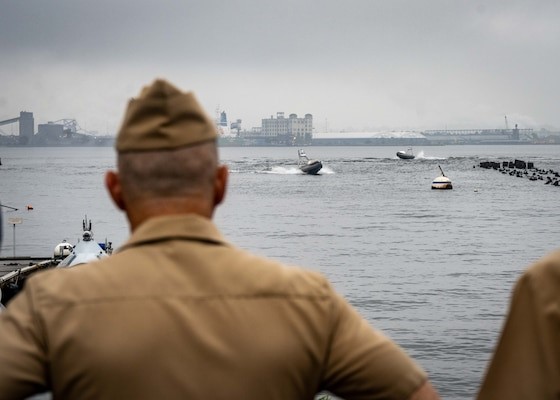
BALTIMORE, Md. – Acting Chief of Naval Operations Adm. Jim Kilby visited the Black Sea Technologies (BlackSea) personnel to explore ways to enhance the U.S. Navy’s Global Autonomous Reconnaissance Craft (GARC) program, during a visit to the BlackSea facilities, June 18, 2025. (U.S. Navy photo by Mass Communications Specialist 1st Class Joe J. Cardona Gonzalez)
From the Navy Office of Information, June 18, 2025
Acting Chief of Naval Operations Adm. Jim Kilby visited the BlackSea Technologies (BlackSea) headquarters and production facilities in Baltimore, June 18, to see first-hand how BlackSea supports the U.S. Navy’s Small Unmanned Surface Vehicles (sUSV) program and how it plans to continue to expand its capabilities to support fleet operations.
Acting Chief of Naval Operations Adm. Jim Kilby visited the BlackSea Technologies (BlackSea) headquarters and production facilities in Baltimore, June 18, to see first-hand how BlackSea supports the U.S. Navy’s Small Unmanned Surface Vehicles (sUSV) program and how it plans to continue to expand its capabilities to support fleet operations.
The Navy is procuring sUSVs for fleet operations and experimentation to advance robotic maritime strategies and tactics.
“These systems will play a critical role in the future of naval warfare by extending fleet reach, improving situational awareness, and increasing combat effectiveness,” said Kilby. “We see unmanned systems as a force multiplier for traditional vessels, not a replacement.”
During the visit, Kilby met with BlackSea personnel to explore ways to enhance and grow the U.S. Navy’s Global Autonomous Reconnaissance Craft (GARC) program. GARCs are 16-foot USVs that enable research, testing, and operations that will allow integration throughout the surface, expeditionary, and joint maritime forces.
Small unmanned surface vehicles are part of the Navy’s family of unmanned maritime systems, designed to complement and support the traditional fleet across a range of missions. Small USVs are assigned to Unmanned Surface Vessel Squadron (USVRON) Three and USVRON Seven for testing and experimentation, including launch and recovery from Navy platforms.
Through analysis, simulation, prototyping, and demonstration, the Navy plans to field and operate progressively more capable unmanned maritime systems that enhance fleet endurance and resilience while minimizing risk to human life. Small USVs are rapidly integrating into the fleet exercises such as Fourth Fleet’s Hybrid Fleet Campaign Event (FLEX) international exercises such as the recent Baltic Operations (BALTOPS).
“The development and deployment of unmanned systems, including the small USV, is a strategic acquisition for the Navy,” Kilby added. “A strong partnership with industry is critical as we seek to maintain technological superiority and operational advantage in an increasingly complex maritime environment.”
Kilby concluded his visit by observing a demonstration of the GARC and the BlackSea Seabased Petroleum Discharge System and conducting a comprehensive tour of the manufacturing facility. During the tour, he engaged with BlackSea workforce and subject matter experts to gain deeper insights into the versatility and innovative capabilities of these advanced systems.
Strong partnerships with industry are essential to accelerating these advancements and delivering cutting-edge technologies. These innovations are shaping the future of naval operations and strengthening our maritime advantage.
Vigor Marine Group Launches as Unified Maritime Leader
Nationwide capabilities to bolster U.S. defense and commercial maritime readiness
PORTLAND, OR (June 19, 2025) – Five leading marine and industrial service companies — Vigor, Continental Maritime of San Diego, MHI Ship Repair & Services, Seaward Marine Services, and Accurate Marine Environmental — today announced their unification under a single name: Vigor Marine Group. As a full-service prime contractor, the group delivers comprehensive solutions for the maintenance, modernization, and lifecycle management of military and commercial vessels across the United States.
“Vigor Marine Group represents a unified identity for a highly experienced team with bi-coastal capabilities,” said Francesco Valente, CEO of Vigor Marine Group. “Each of our companies has built a strong reputation for innovation, quality, and reliability. Now, together, we can provide customers the strength of a national platform combined with the responsiveness of local shipyards, enabling us to build on our legacy of performance and on-time delivery.”
Vigor Marine Group offers a broad range of services, including drydocking, pier-side, and topside marine services, with integrated project management teams on both coasts to ensure the timely return of vessels to service.
Key National Initiatives
Vigor Marine Group plays a crucial role in several high-profile national projects:
It was among the first contractors selected for the U.S. Navy’s Arleigh Burke-class Destroyer Modernization 2.0 program.
The group has helped lead the $4 billion zero-emission transition for Washington State Ferries, starting with hybrid-electric conversions of three Jumbo Mark II-class ferries.
Vigor Marine Group is partnering with the U.S. Army to produce the Maneuver Support Vessel (Light), a next-generation landing craft to replace the aging LCM-8 fleet.
Organizational Divisions
VMG is structured into three key divisions:
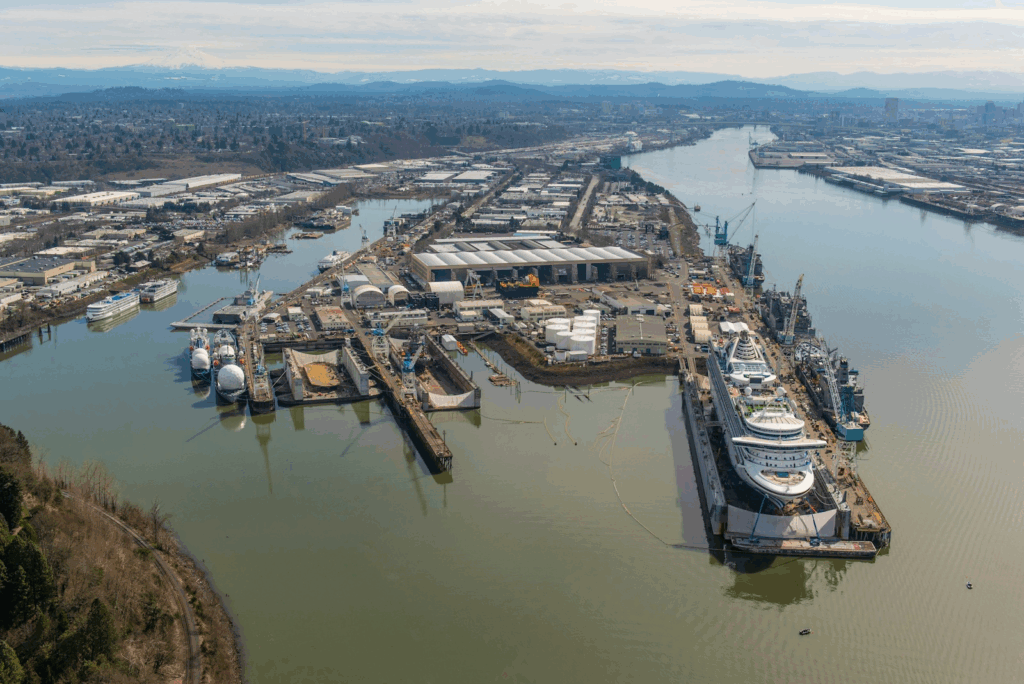
Maintenance & Modernization: This division includes Vigor’s shipyards in Portland, Seattle, and Ketchikan, the largest footprint for any operator in the Pacific Northwest; Vigor Marine CM San Diego, a certified master ship repair contractor for the U.S. Navy; and Vigor Marine MHI Norfolk, a premier East Coast repair yard.
Marine Services: Comprising Vigor Services Accurate (tank cleaning and wastewater treatment) and Vigor Services Seaward (underwater hull cleaning and coating).
Marine Fabrication: Continuing Vigor’s legacy in small-craft production for defense, fisheries, and commercial customers.
“We are proud to bring forward the full value of Vigor Marine Group,” said Valente. “As the largest maintenance and modernization group on the West Coast, one of the leading builders of aluminum-hull combatant crafts in the U.S., and a top-tier partner for cruise ship and Navy MRO services, we are well-positioned for growth. This unification will enable us to continue innovating as a trusted solutions provider and a critical national asset for maritime and defense operations.”
Infrastructure and Workforce
Vigor Marine Group operates from five shipyards and eight dry docks, including North America’s largest floating dry dock, with over 17,000 feet of pier space located on historically significant maritime sites, such as former Todd and Kaiser shipyards and key U.S. naval installations.
With a workforce of 2,600 skilled employees across five states, Vigor Marine Group is recognized for its award-winning safety culture, technical expertise, and commitment to workforce development. The team also has a history of supporting operations in other strategic naval ports such as Pearl Harbor.
Background of Titan Acquisition Holdings
The companies comprising Vigor Marine Group were originally united under Titan Acquisition Holdings, which was established in 2019 when The Carlyle Group and Stellex Capital Management acquired Vigor Industrial, MHI, Seaward Marine, and Accurate Marine. In 2020, Continental Maritime of San Diego was added to the portfolio. In 2023, Lone Star Funds became Titan’s controlling owner, and Francesco Valente, former CEO of Fincantieri Marine Group, joined as CEO in September 2024.
Today, Vigor Marine Group serves a diverse range of customers, including the U.S. Navy, Military Sealift Command, U.S. Army, U.S. Coast Guard, cruise line operators, state ferry systems, and commercial fleets, offering unparalleled expertise, scale, and service across the maritime lifecycle.
Pacific Partnership 2025 Concludes Mission Stop in Suva, Fiji, June 16, 2025
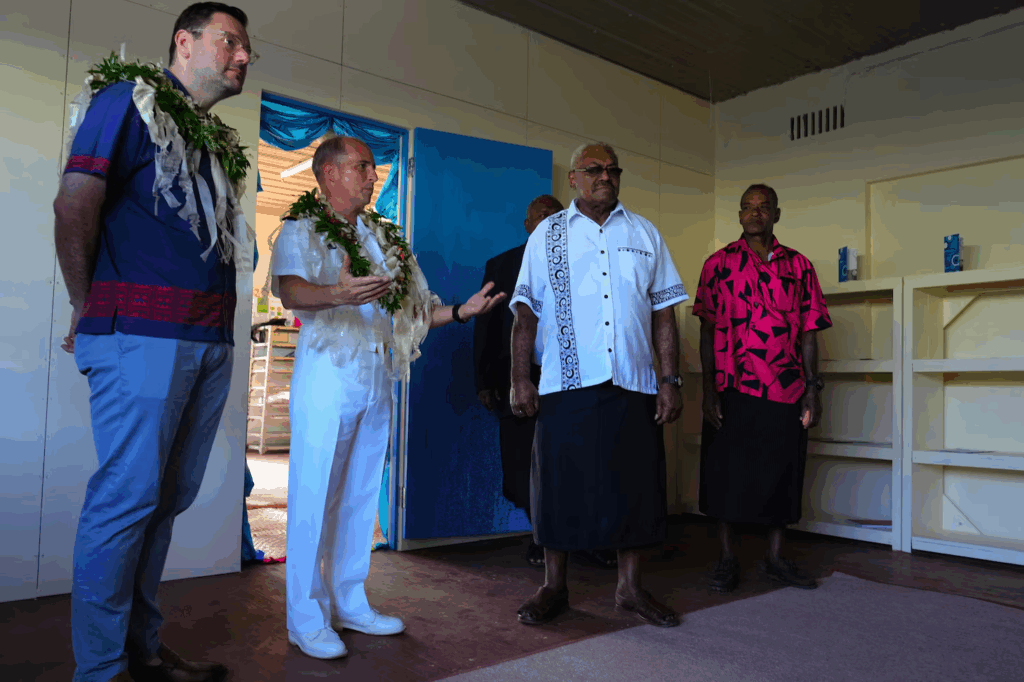
SUVA, Fiji (June 16, 2025) Capt. Mark B. Stefanik, center left, mission commander of Pacific Partnership 2025 (PP-25), shows Mr. Samuela Togenavanua, local tribe leader of Suva, and other local dignitaries a newly renovated classroom at Waiqanake District School as part of PP-25 in Suva, Fiji, June 16, 2025. (U.S. Navy photo by MC2 Moises Sandoval/Released)
By MC2 Moises Sandoval, June 20, 2025
SUVA, Fiji – Pacific Partnership 2025 officially concluded its mission stop in Fiji with a closing ceremony hosted at the Waiqanake District School on June 16, 2025.
The largest annual multinational humanitarian assistance and disaster response preparedness mission conducted in the Indo-Pacific, Pacific Partnership enables participants, including United States and Fijian personnel, to work together to enhance disaster response capabilities and foster new and enduring friendships.
“The United States of America believes in a free and open Pacific for all nations,” said U.S. Navy Capt. Mark B. Stefanik, mission commander during the closing ceremony. “We deeply value our long history with Fiji and we hope that the work done here helps to reinforce our commitment to this island and to the people of Fiji.”
While in Fiji, the medical team, consisting of U.S. and Fijian public health services personnel, conducted a total of 16 side-by-side subject matter expert exchanges in the fields of hemoculture, permaculture, agriculture, and apiculture. The team accrued more than 26 hours of hands-on training through public health engagements such as the Polymerase Chain Reaction laboratory, spay and neuter clinics, ruminant husbandry training, and a beekeeping tour assembling over 42 participants from across Suva.
The Pacific Partnership engineering team also capitalized on the opportunity to provide focused support to address several local infrastructure concerns. A total of 12 U.S. Navy Sailors, assigned to Amphibious Construction Battalion 1, and 8 New Zealand Royal Army Engineers collaborated to undertake the construction and repairs of the Waiqanake District School, to include the complete renovation and installation of a small library in a classroom building. The team also removed obsolete rain gutters from three different classroom buildings and rendered a fresh coat of paint to two classroom buildings. Waiqanake District School, which accommodates over 300 staff, faculty and students, hosted a ribbon cutting ceremony in celebration for the newly renovated facilities on June 16.
U.S. Navy Musicians with the Pacific Fleet “Big Wave” Brass Band engaged in a variety of live performances across more than 10 school campuses and venues across the island of Viti Levu, Fiji. This musical ensemble featured 10 musicians, which hosted concerts between Suva and Nadi, including the closing ceremony of Pacific Partnership 2025’s mission stop in Fiji.
Now in its 21st iteration, Pacific Partnership series is the largest annual multinational humanitarian assistance and disaster management preparedness mission conducted in the Indo-Pacific. Pacific Partnership works collaboratively with host and partner nations to enhance regional interoperability and disaster response capabilities, increase security and stability in the region, and foster new and enduring friendships in the Indo-Pacific.