Bollinger Shipyards Signs Contract to Build Four U.S. Coast Guard Arctic Security Cutters

Construction of ASCs at Bollinger’s Gulf Coast shipbuilding facilities promotes the rapid onshoring of icebreaking technology and swift deployment of these new critical vessels to the fleet.  

Release From Bollinger Shipyards

LOCKPORT, La. — (December 29, 2025) – Bollinger Shipyards (“Bollinger”) today announced it has signed a contract with the U.S. Coast Guard for the construction of four Arctic Security Cutters (ASCs), a new class of medium polar icebreakers that will expand America’s operational presence in the Arctic. 

The contract formalizes Bollinger’s leading role in the historic U.S.–Finland collaboration announced earlier this fall by the White House.   Bollinger will construct ASCs based on the Multi-Purpose Icebreaker design by Seaspan Shipyards of Vancouver, Canada, developed with Aker Arctic Technology Inc of Helsinki, Finland. To support the objectives of the White House, Bollinger has worked in close partnership with Rauma Marine Construction Oy, a Finnish shipyard, to ensure that the US receives these icebreaking capabilities as rapidly as possible. 

Work on the four Bollinger-built ASCs will be based at its shipyard in Houma, Louisiana. Construction of the ASCs will be supported by the company’s workforce at multiple facilities across America’s Gulf Coast to meet the aggressive schedule set forth by President Trump. 

“The Arctic Security Cutter is one of the most consequential and time-sensitive shipbuilding programs in U.S. Coast Guard history, and today’s contract award is a clear vote of confidence in the men and women of Bollinger,” said Ben Bordelon, President and CEO of Bollinger Shipyards. “The program will be Bollinger’s fifth class of cutters built for the Coast Guard, building on our current Sentinel and Polar Security Cutter programs and more than 40 years of experience in delivering over 187 cutters for the service. With clear direction from President Trump and an aggressive delivery timeline, our mission is straightforward: leverage the full strength of our shipbuilding facilities across the Gulf Coast, along with our proven partners, to deliver these cutters on schedule and mission ready on day one.” 

“By centering ASC construction in Houma, Louisiana, while drawing on our broader footprint, we gain the flexibility and capacity to move fast without compromising safety or quality,” Bordelon added. “These ships will operate in some of the harshest conditions on Earth. Our responsibility is to deliver a stable, reliable platform that Coast Guard crews can trust from their first mission underway and for decades to come.” 

The contract for four Bollinger-built ASCs is part of a broader program that will ultimately field up to eleven Arctic Security Cutters under the trilateral ICE Pact framework. Together with the ongoing Polar Security Cutter program, ASC will provide the Coast Guard with a modern, layered icebreaking fleet capable of enforcing U.S. sovereignty, protecting American interests against global threats and enabling year-round operations as commercial activity and strategic competition accelerate in the Arctic. 

About the Arctic Security Cutter Program 

The Arctic Security Cutter is a new class of medium polar icebreakers designed to conduct missions of the U.S. Coast Guard in the world’s most challenging maritime environments.  The ASC will be capable of breaking thick sea ice, sailing thousands of nautical miles without resupply and remaining on-station for extended periods. Along with the future Polar Security Cutter class, ASCs will provide the Coast Guard with the endurance and capability needed to protect U.S. interests in the rapidly evolving Arctic domain. 


Navy Tests New Digital Health System to Modernize At-Sea Care 

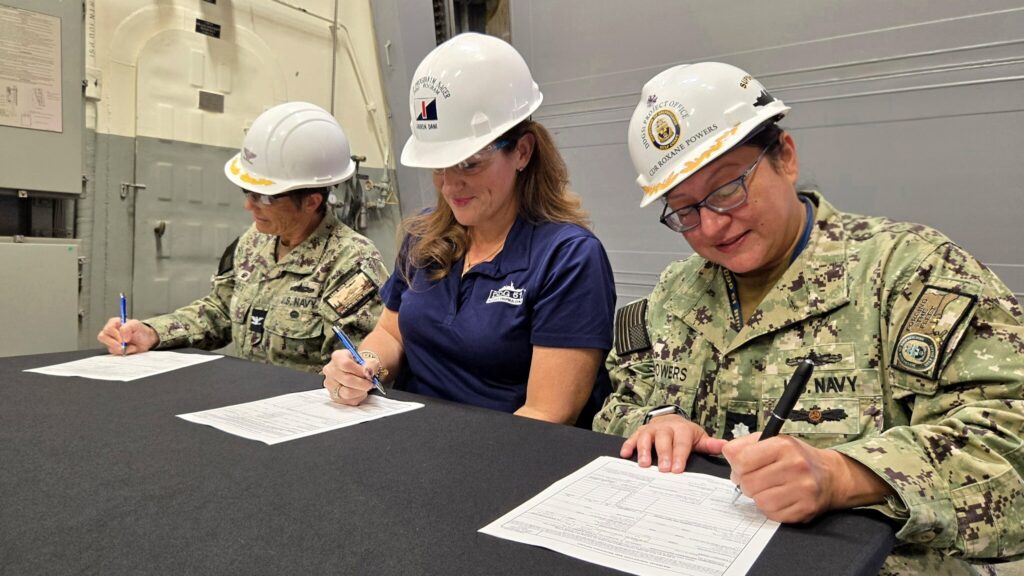
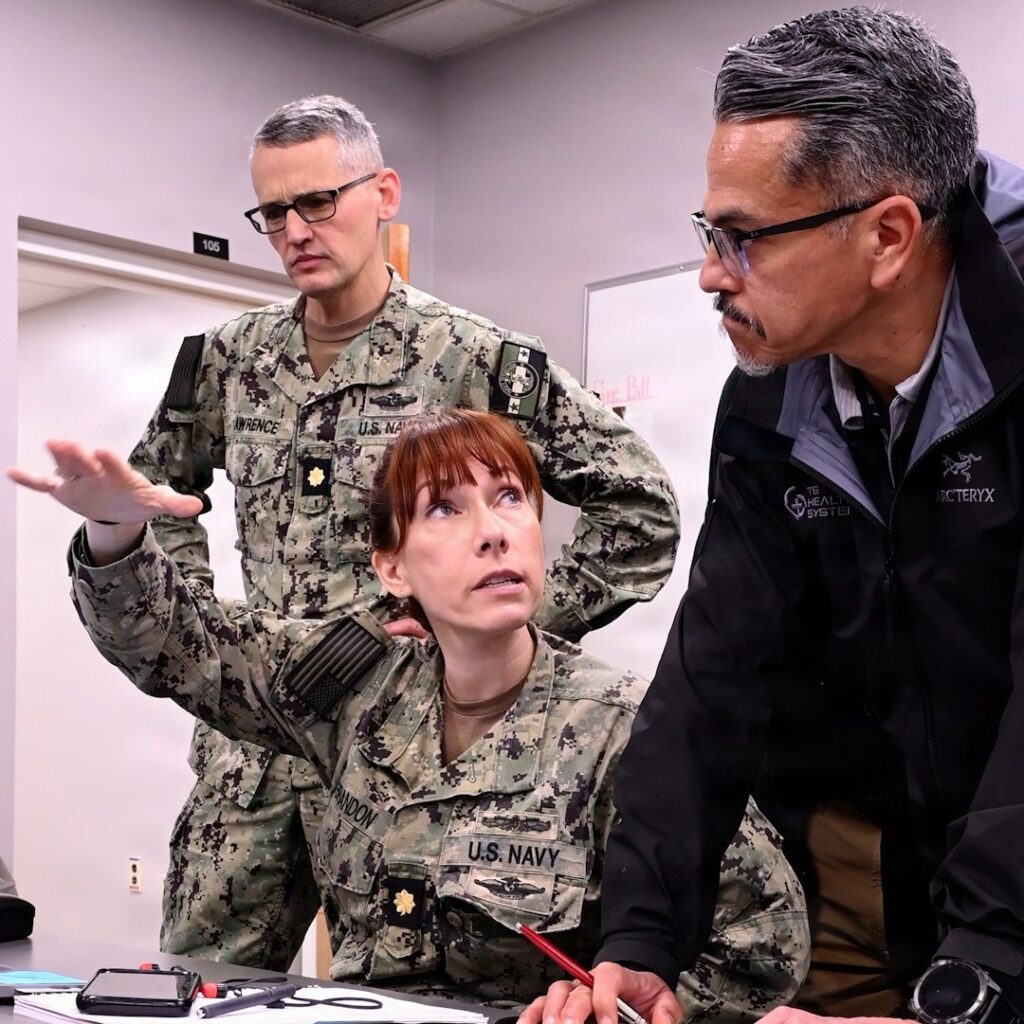
MAYPORT, Fla. U.S. Navy Lt. Cmdr. Erik Lawrence, left, U.S. Navy chief nursing informatics officer for Joint Operational Medicine Information System (JOMIS) assigned to U.S. Navy Bureau of Medicine and Surgery, Lt. Cmdr. Elise Brandon, assigned to Naval Medical Forces Atlantic, and Joe Espinosa from the JOMIS Program Office, discuss the data seeding process in the JOMIS Operational Medicine Care Delivery Platform (OpMed CDP), during a pilot onboard USS Carney (DDG 64) in Mayport, Dec. 9. (U.S. Navy photo by MC2 Sasha Ambrose)

From Petty Officer 2nd Class Sasha Ambrose – U.S. Navy Bureau of Medicine and Surgery

Navy Medicine conducted its first pilot test of the Operational Medicine Care Delivery Platform (OpMed CDP) aboard the Arleigh Burke-class destroyer USS Carney (DDG 64) to bring modern, seamless patient care to service members aboard ships, Dec. 1-12. 

The Joint Operational Medicine Information System (JOMIS), under the Program Executive Office for Defense Healthcare Management Systems, developed OpMed CDP as part of modernized health IT software suite. This pilot program was established through a partnership with the U.S. Navy Bureau of Medicine and Surgery (BUMED), U.S. Fleet Forces Command (USFFC), Commander, Naval Surface Force Atlantic (CNSL), Commander, Naval Medical Forces Atlantic (NMFL), and JOMIS to gain fleet approval of the software’s functionality. 

 “The JOMIS ecosystem will transform the way our clinicians, physicians, and corpsmen provide care to warfighters in operational settings to maintain patient data flow through the continuum of care,” stated Lt. Cmdr. Erik Lawrence, U.S. Navy chief nursing informatics officer for JOMIS assigned to BUMED. 

During the 12-day test, the ship’s crew received comprehensive, user-centered training on the system. The goal was to make documenting and accessing a patient’s electronic health record simple and accurate – from pharmacy and lab work to general check-ups – and to ensure connectivity with the Military Health System’s MHS GENESIS platform. 

“We’re still learning how it [OpMed CDP] works, but the team has been really helpful with answering questions and listening to feedback, so I’m really excited to keep moving,” described Hospital Corpsman 3rd Class Johnny Percadoni, assigned to Carney, during a hands-on, scenario-based session. “It’s a different day and a new system, but I think it’s going to become a lot more prevalent and useful for us.” This phased, structured training install approach – also called fielding – is critical to implementing OpMed CDP across the Navy. The JOMIS Fielding Plan is designed to ensure a disciplined rollout that allows for agile development, continuous user feedback, and alignment with operational readiness cycles. 

“We’ve been developing this agile software for the past three and a half years to provide better decision support at the point of care for medical providers,” explained Cmdr. John de Geus, the U.S. Navy’s chief health informatics officer. “But also to provide data to operational commanders in dynamic, real-time environments.” 

Based on the initial trial, CNSL has decided to move into the next phase: an extended pilot to ensure that the final product will be resilient, effective, and ready for the demands of the fleet. 

“A successful fielding isn’t just about delivering software; it’s about delivering the right capability,” concluded de Geus. “The initial pilot provided crucial insights, which is why we are moving to an extended pilot. This decision reinforces our commitment to a truly feedback-driven process, prioritizing the needs of our Sailors above all else.” 

Once all phases are complete, Carney will be the first ship to use OpMed CDP for daily medical operations. This will modernize Navy Medicine’s readiness and ensure seamless data sharing, ultimately help to prepare warfighters for their missions at sea. 

For 250 years, Navy Medicine – represented by more than 44,000 highly-trained military and civilian healthcare professionals – has delivered quality healthcare and enduring expeditionary medical support to the warfighter on, below, and above the sea, and ashore. 


HII Delivers Destroyer Ted Stevens to U.S. Navy

Release From HII

PASCAGOULA, Miss., Dec. 29, 2025 (GLOBE NEWSWIRE) — HII’s (NYSE: HII) Ingalls Shipbuilding division has delivered Arleigh Burke-class guided missile destroyer Ted Stevens (DDG 128) to the U.S. Navy. This marks the second Flight III Arleigh Burke-class destroyer to be delivered by Ingalls shipbuilders. 

“The delivery of Ted Stevens reflects the strong momentum of our destroyer program as we accelerate Flight III production and bring enhanced capabilities to the fleet,” said Brian Blanchette, Ingalls Shipbuilding president. “We are honored to deliver DDG 128 to the Navy knowing that it will stand as a powerful asset in strengthening U.S. maritime security for decades to come.” 

The future USS Ted Stevens represents the next generation of surface combatants for the U.S. Navy, featuring the second-in-class Flight III AN/SPY-6 (V)1 radar system and the Aegis Baseline 10 combat system, designed to counter threats well into the 21st century. 

At Ingalls Shipbuilding there are four more Flight III destroyers under fabrication and another seven moving through early pre-planning stages of construction. To increase the throughput and meet the increased demand for ships by the U.S. Navy, Ingalls recently embarked on a distributed shipbuilding initiative to improve schedule adherence for all ships built at Ingalls by partnering with shipyards and fabricators beyond the company’s traditional labor market. 

To date, Ingalls Shipbuilding has delivered 36 Arleigh Burke-class destroyers to the U.S. Navy, including the first Flight III, USS Jack H. Lucas (DDG 125) and Ted Stevens (DDG 128). The four Flight III destroyers under construction include: Jeremiah Denton (DDG 129), George M. Neal (DDG 131), Sam Nunn (DDG 133), and Thad Cochran (DDG 135). Additionally, Ingalls is in early pre-planning and material procurement phases for John F. Lehman (DDG 137), Telesforo Trinidad (DDG 139), Ernest E. Evans (DDG 141), Charles French (DDG 142), Richard J. Danzig (DDG 143), Intrepid (DDG 145) and Robert Kerrey (DDG 146). 

To learn more about the DDG 51 Arleigh Burke-class destroyer program at Ingalls visit: https://hii.com/what-we-do/capabilities/guided-missile-destroyers/arleigh-burke-class/.  


USS Annapolis Returns to Guam Following Indo-Pacific Deployment 

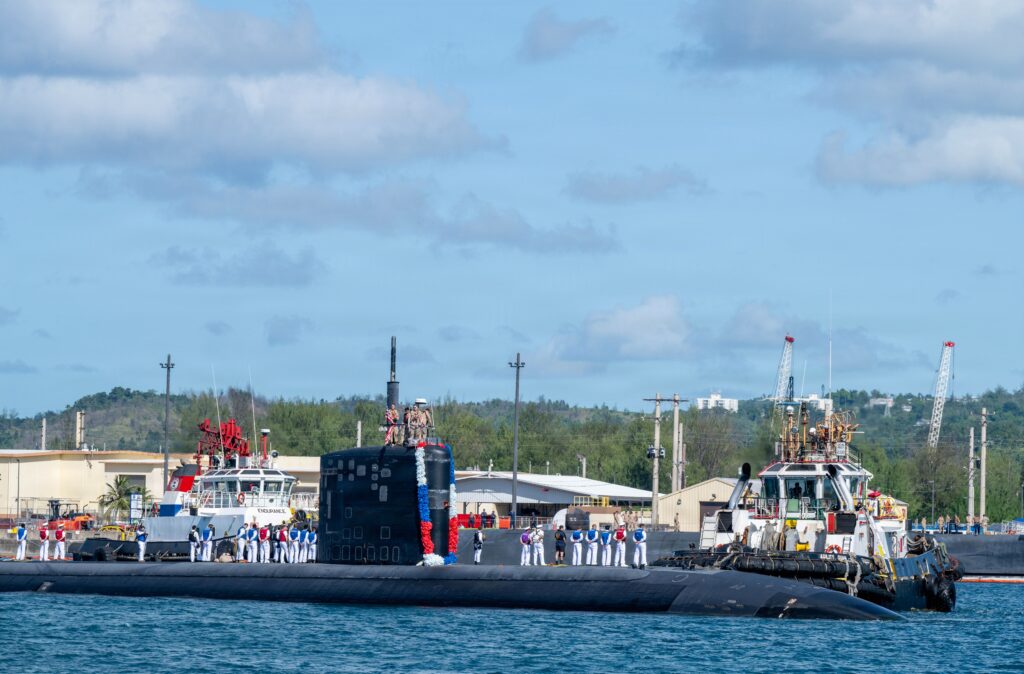
NAVAL BASE GUAM (Dec. 19, 2025) – Los Angeles-class fast-attack submarine USS Annapolis (SSN 760) transits Apra Harbor, Naval Base Guam, returning to its homeport after completing a routine deployment in the Indo-Pacific, Dec. 19, 2025. (U.S. Navy photo by MC1 Class Bryan Mai) 

From Lt. James Caliva, Commander, Submarine Squadron 15

NAVAL BASE GUAM (Dec. 19, 2025) — Los Angeles–class fast-attack submarine USS Annapolis (SSN 760) returned to its homeport at Naval Base Guam following a routine deployment in the Indo-Pacific, Dec. 19, 2025 

“USS Annapolis delivered outstanding results, completing an exceptional deployment that showcased the operational readiness of the Pacific undersea force,” said Capt. Neil Steinhagen, commander, Submarine Squadron 15. “The crew’s disciplined execution was central to their success and clearly reflects the strength of our forward-deployed posture in support of our mission in the Indo-Pacific. True to their motto, ‘Born Free, Hope to Die Free,’ the Sailors of Annapolis remained professional, focused, and effective in every task. Well done, team—welcome home.” 
  
During the deployment, Annapolis conducted a range of missions that strengthened national security, enhanced maritime operational capabilities, and reinforced the strategic value of forward-deployed submarines operating at the tip of the spear. The submarine also conducted a port visit to Yokosuka, Japan, reinforcing the United States’ enduring commitment to the region. 
  
“No matter the mission, this crew executed with precision and professionalism,” said Cmdr. Clint Emrich, commanding officer of USS Annapolis (SSN 760). “Their readiness, discipline, and teamwork were the foundation of a successful deployment, and every Sailor played a role in delivering results. I’m proud of how this crew performed and how they represented Annapolis throughout the Indo-Pacific.” 
  
During the deployment, 30 Sailors assigned to Annapolis earned their submarine warfare insignia—commonly known as “dolphins” or “fish”. The insignia signifies qualification to operate at the highest standards of the undersea force and reflects mastery of submarine systems, watch stations, and mission execution. 
  
Annapolis’ return was marked by the Navy’s time-honored “first kiss” and “first hug” traditions, with Senior Chief Machinist Mate (Nuclear) Chris Mahmood receiving the first kiss and Chief Fire Control Technician Isaiah King receiving the first hug. 
  
Commissioned April 11, 1992, Annapolis is the fourth ship in U.S. Navy history to be named for Annapolis, Maryland, home of the United States Naval Academy. Assigned to Commander, Submarine Squadron 15 at Polaris Point, Naval Base Guam, Annapolis is one of five forward-deployed fast-attack submarines. Renowned for their speed, endurance, stealth, and mobility, fast-attack submarines are the backbone of the Navy’s submarine force. Regarded as apex predators of the sea, Guam’s fast-attack submarines operate forward in support of a free and open Indo-Pacific. 


Royal Navy Hosts Mine Countermeasures Conference 2025

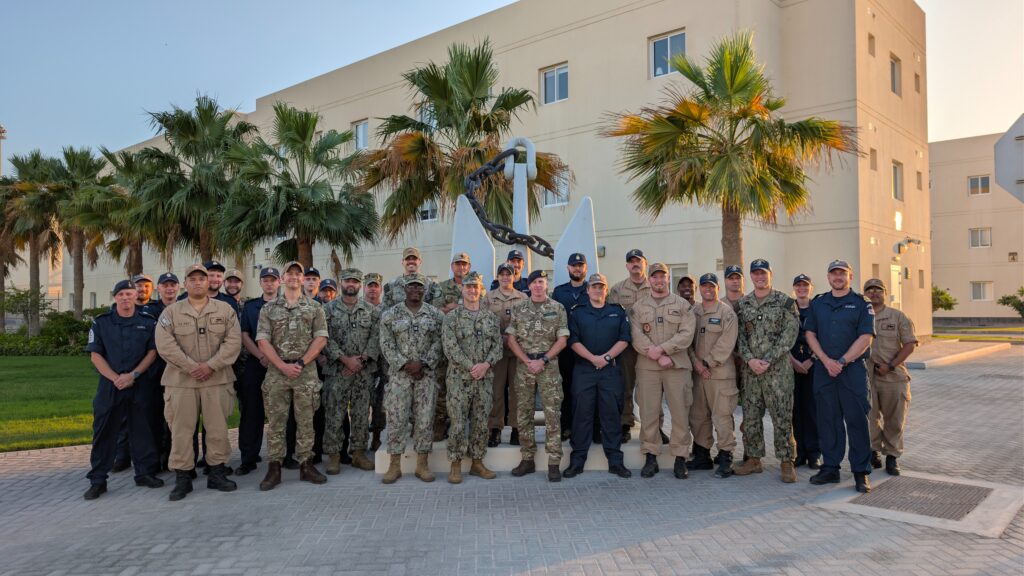
The Royal Navy hosted a mine countermeasures conference at the U.K. Naval Support Facility in Manama, Bahrain, Dec. 15. (Photo by NAVCENT Public Affairs) 

By NAVCENT Public Affairs

MANAMA, Bahrain — The Royal Navy hosted a mine countermeasures conference at the U.K. Naval Support Facility in Manama, Bahrain, Dec. 15. 
 
Royal Navy Commodore Ben Aldous, Commander, U.K. Maritime Component Command and deputy commander, Combined Maritime Forces, made opening remarks at the conference and emphasized the critical importance of continued interoperability, shared success and mutual trust among those in attendance. 
 
Attendees included personnel from the Royal Navy Mine & Threat Exploitation Group, Mine Warfare Battle Staff, the Hunt-class mine countermeasures vessel HMS Middleton (M-34), as well as liaison officers from the Royal New Zealand Navy and Royal Australian Navy. Additionally, personnel from U.S. mine warfare units, like expeditionary mine countermeasures and explosive ordnance disposal units, and Sailors from the Independence-class littoral combat ships USS Canberra (LCS-30) and USS Santa Barbara (LCS-32) were in attendance. 
 
Units that provided briefings spoke about their successes, challenges and future opportunities. The presentations sparked discussions and created an opportunity for collaboration among the key players in the local MCM community. Key topics of discussion were advancing squadron autonomy, the integration of the Mine & Threat Exploitation Group, and the development of the littoral combat ship mission package. 


U.S. Coast Guard to Return Station Pascagoula to Full Operations

Release From U.S. Coast Guard Headquarters

WASHINGTON — The U.S. Coast Guard announced Tuesday it will return Station Pascagoula in Pascagoula, Mississippi to full response operations. 

In conjunction with assignment year 2026, Station Pascagoula will go from scheduled mission operations to full response operations. 

“After temporarily reducing capabilities at Station Pascagoula in 2023 due to severe workforce shortages, I am pleased to announce the Coast Guard will fully restore the unit’s operational capabilities and readiness in 2026,” said Adm. Kevin E. Lunday, acting commandant. “Our strong recruiting performance has made this possible. Station Pascagoula is vital to securing our southern maritime border and supporting the Port of Pascagoula’s $18 billion economic impact. This action directly supports our nation’s security and economic prosperity.” 

The return of Coast Guard Station Pascagoula to full response operations represents a local application of the national strategy in achieving operational control of the border and facilitating commerce. Strategically positioned on the Gulf Coast, the station directly contributes to controlling the southern maritime border by conducting operations to deter and interdict illegal migration and illicit trafficking. Simultaneously, it facilitates commerce vital to economic security by controlling and securing the Port of Pascagoula against both physical and cyber threats, supporting the goal of U.S. maritime dominance. Underpinning these dedicated missions is the station’s sustained readiness, embodying the Coast Guard’s “Semper Paratus” principle to successfully respond to any crisis or contingency with little warning, from search and rescue emergencies to natural disasters. 


L3Harris Technologies Announced as Latest Tenant at ProvPort

Release From ProvPort

Providence, R.I. – ProvPort announced its newest tenant today, L3Harris Technologies, a national security and defense company. 
 
L3Harris will utilize ProvPort to support their operations, including the loading and offloading of subsea telecommunications cable where it can be spooled and stored. As part of their lease, L3Harris will be constructing a 50,000-square-foot warehouse, an investment in port infrastructure totaling $6 million. 
 
The Waterson Terminal Services, LLC team, which operates as the terminal manager at ProvPort and oversees all stevedoring operations, will leverage their extensive offshore wind-cable-handling experience to support L3Harris. 
 
PROVPORT INC and the Waterson Terminal Services team bring the specialized expertise we need in undersea cable handling and spooling. Combined with Rhode Island’s strategic location, it was a clear, smart investment for us,” said Trey Mathews, Interim General Manager, Acoustic Systems, L3Harris. 
 
“Rhode Island has long been a hub of marine-related defense industries and having L3Harris here in Rhode Island is a great fit for ProvPort and our vision of attracting tenants that align with the modern maritime economy. We are more than pleased that L3Harris is our newest tenant and that they will be making a significant investment in ProvPort’s infrastructure,” said Chris Waterson, president and CEO, Waterson Terminal Services. 


USCGC Myrtle Hazard Returns After Operation Blue Pacific Patrol to Combat Illegal Fishing

The USCGC Myrtle Hazard (WPC 1139) crew conducts bilateral maritime law enforcement boardings with members of the National Police in the Federated States of Micronesia’s exclusive economic zone on Nov. 22, 2025. The crew returned home Dec. 14, 2025, after completing a successful expeditionary patrol under Operation Blue Pacific, deepening partnerships with Pacific nations and bolstering maritime security in the region. Photo credit: U.S. Coast Guard

From U.S. Coast Guard Forces Micronesia, Dec. 19 2025

SANTA RITA, Guam — The USCGC Myrtle Hazard (WPC 1139) crew returned home Sunday after completing a successful expeditionary patrol under Operation Blue Pacific, deepening partnerships with Pacific nations and bolstering maritime security in the region.

The Sentinel-class fast response cutter crew operated for over 500 hours, patrolling 5,380 nautical miles from Nov. 17 to Dec. 14, with 15 days dedicated to providing a persistent presence in the exclusive economic zones of the Federated States of Micronesia and the Republic of Palau, as well as on the high seas.

Crew members worked closely with partners from FSM and Palau. They enacted the bilateral maritime law enforcement agreements with Pacific partners and embarked law enforcement officers from these nations’ maritime police forces to conduct interoperable patrols. This hands-on cooperation enabled the joint teams to conduct six bilateral boardings and inspections of fishing vessels in the FSM EEZ. On the high seas, the cutter’s crew inspected one vessel under the authority of the Western and Central Pacific Fisheries Commission.

These efforts helped combat illegal fishing and other illicit maritime activities. They also enhanced maritime domain awareness, supported the safe flow of commerce, and promoted good maritime governance.

Myrtle Hazard’s team stepped in to provide critical presence in Palau’s waters during a five-day patrol. This coverage supported Palauan authorities while their Guardian-class patrol boat underwent scheduled maintenance. The patrol went beyond simple transit. It focused on building maritime security, engaging directly with Pacific partners, and enforcing international maritime law through shared operations.

“The relationships we build with our Pacific partners are at the heart of this mission,” said Lt. Emma Saunders, commanding officer of Myrtle Hazard. “Executing bilateral maritime law enforcement operations with our partners allows us to work side by side with the common goals of deterring illicit maritime activities, protecting our oceans, and supporting the communities that rely on their natural resources.”

These actions advanced U.S. Coast Guard priorities, enabling border security, protecting lawful commerce and trade, and staying ready for contingencies. A persistent, low-visibility presence fosters trust and strengthens ties within the Pacific community through shared law-enforcement-led and community-engagement efforts.

To build goodwill, the crew organized five community events in Pohnpei and Kosrae, FSM. These included a volleyball game with locals, swimming lessons for children, and tours of the cutter.

“The community events in Pohnpei and Kosrae were some of our favorite parts of the patrol,” said Saunders. “We have some pretty good athletes on the crew, and sharing the court with the all-stars from the local village teams made for an unforgettable volleyball match full of laughs and friendly competition. The swimming lessons for local youth and cutter tours for veterans and their families were a hit all around. It’s moments like these that really help build lasting relationships.” Crew members further maintained readiness through training, earning new qualifications and currency, and completing 10 drills covering navigation, engineering, damage control, and medical response. During the patrol, Myrtle Hazard crossed the equator. The crew celebrated with traditional ceremonies, including a line-crossing event, a Cutterman ceremony recognizing a member serving more than five years at sea, and a promotion to lieutenant junior grade.

About Operation Blue Pacific Operation Blue Pacific is the U.S. Coast Guard’s strategic, multi-mission campaign to foster security, safety, sovereignty, and economic prosperity across Oceania and the Pacific Islands, working collaboratively with island nations to combat illegal fishing, narcotics, support search and rescue, and build strong mutual maritime governance through ship patrols, training, and shared operations, enhancing regional stability and the U.S.’s role as a trusted partner.

About USCGC Myrtle Hazard The Myrtle Hazard is the 39th 154-foot Sentinel-class FRC, named in honor of the first enlisted woman in the U.S. Coast Guard who served as an electrician and radio operator. It is one of three cutters currently based in Guam, a cornerstone for the U.S. Coast Guard’s ongoing commitment to the U.S. and the people of Oceania.


Pentagon Announces General Officer Nominations

From the Department of Defense, Dec. 19, 2025

Secretary of War Pete Hegseth announced Dec. 19 the president has made the following nominations:

Marine Corps Lt. Gen. Francis L. Donovan for appointment to the grade of general, with assignment as commander, U.S. Southern Command, Doral, Florida. Donovan is currently serving as vice commander, U.S. Special Operations Command, Pentagon, Washington, D.C.

Marine Corps Maj. Gen. Marcus B. Annibale for appointment to the grade of lieutenant general, with assignment as deputy chief of staff for Capability Development, Supreme Allied Command Transformation, Norfolk, Virginia. Annibale is currently serving as commanding general, 1st Marine Aircraft Wing, Okinawa, Japan.

Marine Corps Col. Seth E. Anderson for appointment to the grade of brigadier general. Anderson is currently serving as assistant chief of staff, G-2, 3d Marine Aircraft Wing, Miramar, California.

Marine Corps Col. Robert B. Finneran for appointment to the grade of brigadier general. Finneran is currently serving as chief of staff, 2d Marine Aircraft Wing, Havelock, North Carolina.

Marine Corps Col. Edmund B. Hipp has for appointment to the grade of brigadier general. Hipp is currently serving as Director, Future Operations Division, J-35, U.S. Indo-Pacific Command, Oahu, Hawaii.

Marine Corps Col. Andre M. Ingram for appointment to the grade of brigadier general. Ingram is currently serving as chief of staff, Headquarters, Marine Corps Forces Command, Norfolk, Virginia.

Marine Corps Col. Lance J. Langfeldt for appointment to the grade of brigadier general. Langfeldt is currently serving as chief of staff, J-3, U.S. Strategic Command, Omaha, Nebraska.

Marine Corps Col. Reginald J. McClam for appointment to the grade of brigadier general. McClam is currently serving as director, Ground Combat Element Division, Combat Development and Integration, Headquarters, U.S. Marine Corps.

Marine Corps Col. Thomas M. Siverts for appointment to the grade of brigadier general. Siverts is currently serving as executive assistant to the Director, Joint Staff, Pentagon, Washington, D.C.

Marine Corps Col. Daniel J. Skuce for appointment to the grade of brigadier general. Skuce is currently serving as military assistant, Office of the Assistant Commandant of the Marine Corps, Headquarters, U.S. Marine Corps, Pentagon, Washington, D.C.

Marine Corps Col. Joshua M. Smith for appointment to the grade of brigadier general. Smith is currently serving as commanding officer, Marine Aviation Weapons and Tactics Squadron 1, Yuma, Arizona.


Coast Guard Cutter Active Returns Following Counterdrug Patrol, $41.3M Cocaine Seized

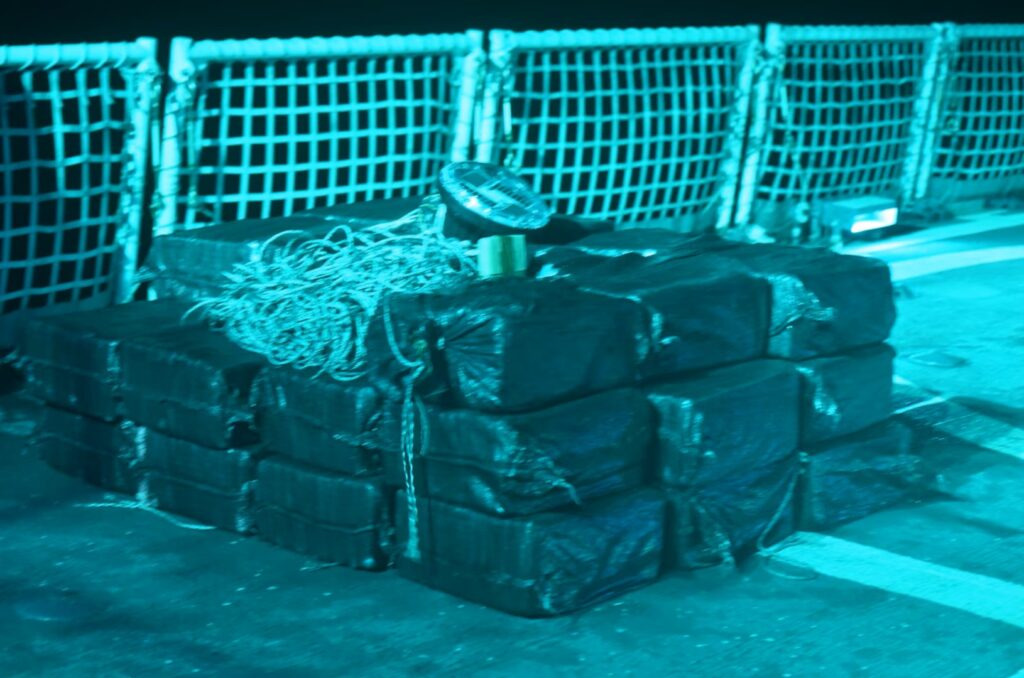
Thirty-three bales of contraband sit on the USCGC Active’s (WMEC 618) flight deck from an interdiction of a suspected drug smuggling vessel while patrolling the Eastern Pacific Ocean, Nov. 25, 2025. Active’s crew seized more than 3,300 pounds of cocaine and detained three suspected drug smugglers during the operation. Photo credit: U.S. Coast Guard

From U.S. Coast Guard Oceania District, Dec. 22, 2025

PORT ANGELES, Wash. – The U.S. Coast Guard Cutter Active (WMEC 618) returned to its home port of Port Angeles Sunday, concluding a 60-day counternarcotics deployment to the Eastern Pacific Ocean in support of Operation Pacific Viper.

The Active’s crew of 75 Coast Guard men and women patrolled 10,000 nautical miles and interdicted two suspected drug-smuggling vessels, seizing more than 6,000 pounds of cocaine with an estimated street value of $41.3 million.

In a 72-hour period, the Active’s crew interdicted two “go-fast” vessels, designed to evade detection, while patrolling international waters in the eastern Pacific Ocean.

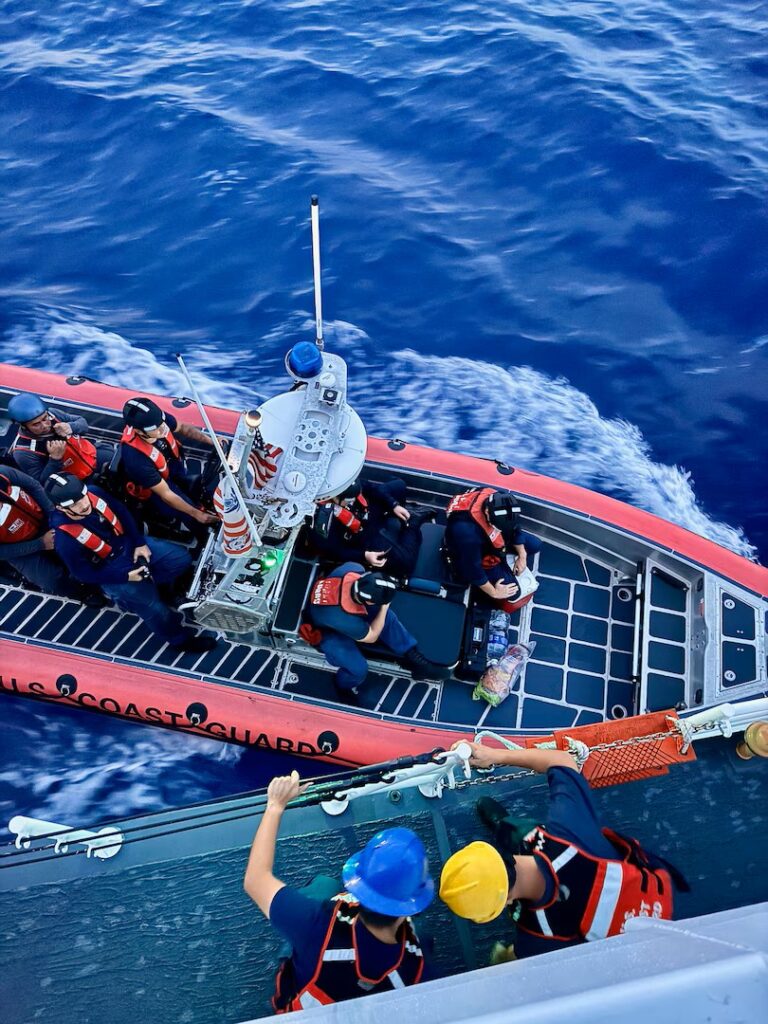
On Nov. 25, with assistance from the U.S. Coast Guard Cutter James (WMSL 754), the Active’s pursuit team traveled more than 60 nautical miles aboard a small boat to intercept a 30-foot go-fast vessel, seizing more than 3,300 pounds of cocaine and detaining three suspected smugglers. On Nov. 28, the Active’s crew, working with U.S. Coast Guard Cutter Escanaba (WMEC 907), intercepted a 40-foot go-fast vessel, seizing more than 2,400 pounds of cocaine and detaining three suspected smugglers.

The seized narcotics were offloaded in San Diego, and the suspects were turned over to federal law enforcement agents.

The Coast Guard is the lead federal agency for maritime law enforcement, including drug interdiction on the high seas.

Theses interdictions were part of Operation Pacific Viper, a Coast Guard surge operation targeting transnational criminal organizations and disrupting the flow of illegal narcotics into the United States. These operations are critical to protecting U.S. communities from the harmful effects of cocaine and synthetic drugs, such as fentanyl.  

“I am incredibly proud of this crew,” said Cmdr. Earl Potter, commanding officer of the Cutter Active. “Their determination, resilience, and professionalism enable us to complete these dynamic and dangerous missions at sea. The conditions are challenging, the hours are long, and the demands are high, but this team consistently maintains focus and executes with distinction. The crew’s commitment to protecting our nation and keeping drugs off our streets defines the Active’s legacy, and I know there is no finer crew than the one serving aboard Active.”  

The U.S. Coast Guard’s narcotics interdiction efforts target transnational criminal organizations that are funded by drug trafficking. Deployments like the Active’s disrupt supply networks in Central and South America. The Active’s success demonstrates the impact a single Coast Guard unit can have when working with interagency and foreign partners. Sustained resources for patrolling these smuggling transit zones are crucial to maritime security and effectively extend U.S. border security far beyond our coastlines.  

The Active, nicknamed “Lil Tough Guy,” supports the Coast Guard’s law enforcement, living marine resource protection, and search and rescue missions. Commissioned in 1966, it is one of two medium endurance cutters homeported on the West Coast and is the oldest major cutter in the Pacific Area.