NRL: Breakthroughs in Testing Solid-Fuel Ramjets Advance Research
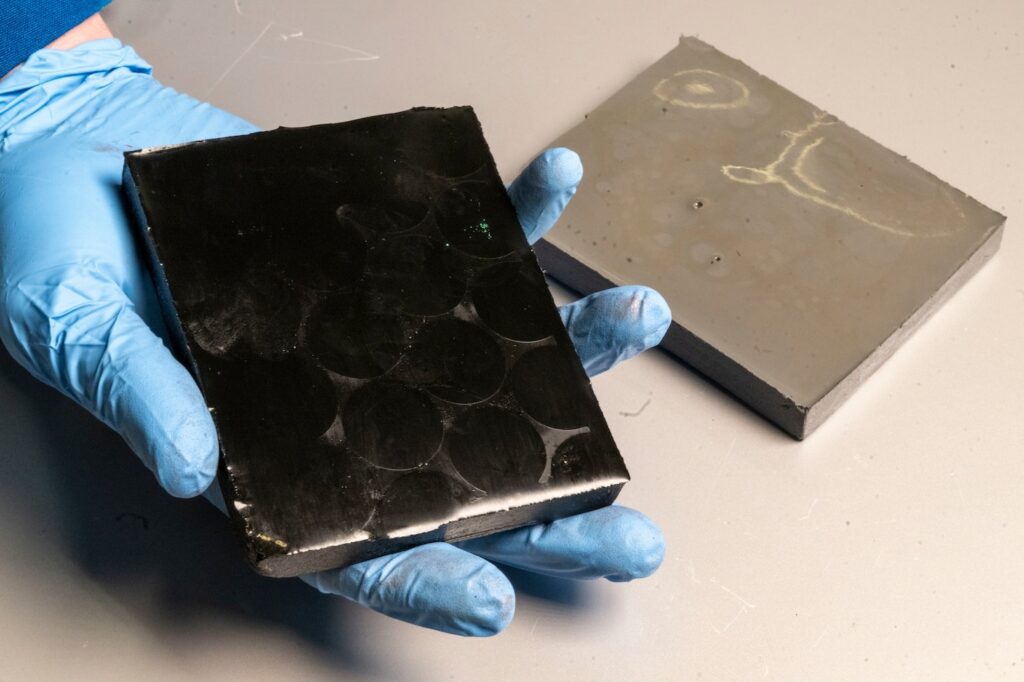
Featured are composite fuel slabs at the U.S. Naval Research Laboratory’s (NRL) Combustion Lab in Chesapeake Beach, Maryland, Jan. 15, 2026. The fuel slabs contain a polymer binder, featuring carbon black (left) to increase its absorption of radiant energy and aluminum (right) to increase its energy density. Researchers and engineers at NRL use these fuel slabs with an optically-accessible solid-fuel slab burner to perform combustion experiments at conditions relevant to solid-fuel ramjet flight. (U.S. Navy photo by Jonathan Sunderman)

Jan. 29, 2026 |  By Jameson Crabtree, U.S. Naval Research Laboratory  

Scientists at the U.S. Naval Research Laboratory are developing the next generation of solid-fuel ramjet propulsion, addressing one of the field’s most persistent challenges: understanding and predicting what happens inside an operating combustor.  

NRL scientists have figured out how to “see inside” one of the most extreme engines ever built, turning guesswork into knowledge and making future long-range, high-speed flight more achievable than ever before. 

A solid-fuel ramjet is an air-breathing engine that uses solid fuel rather than liquid, offering high energy density and mechanically simple propulsion by burning the fuel with oxygen from the air to produce thrust. By drawing oxygen from the atmosphere rather than carrying an oxidizer on board, solid-fuel ramjets can carry more fuel in the same volume and fly farther than traditional rocket systems.  

“If you replace all the oxidizer and instead use oxygen from the air to burn your fuel, you can increase range by up to 200 to 300% in the same form factor,” said Brian Bojko, a combustion scientist at NRL.  

Despite that promise, widespread adoption has been slowed by the extreme internal environment of solid-fuel ramjets, where high temperatures, soot and rapidly evolving flow structures prevent traditional probes from accessing critical data. Unlike liquid or gaseous fuels, solid fuels release energy through surface regression and often produce a complex mixture of combustion products, making it far more difficult to control burning rates and predict performance. This is why understanding and predicting what happens inside an operating combustor is so important.  

“In solid-fuel ramjets, you don’t have direct control over the mass flow rate like you do with liquid systems,” Bojko explained. “The heat from combustion actually drives the gasification of the solid fuel, so pressure, temperature and airflow all feed back into how the engine behaves.”  

Without detailed measurements of flame temperature, fuel regression and fuel-vapor transport, designers have historically relied on trial-and-error approaches.   

“A lot of the design has been kind of Edisonian,” Bojko said. “You take a guess, test it and iterate. But without seeing the physics inside the combustor, it’s hard to know if you’re getting the right answer for the right reason.”  

At the same time, computational approaches such as Reynolds-Averaged Navier–Stokes and Detached Eddy Simulation have been limited by a lack of high-quality experimental data for validation.  

RANS, DES and`Large Eddy Simulation represent increasing levels of physical realism in turbulence simulation, where more turbulent structures are directly resolved rather than modeled. Moving from RANS to DES to LES brings simulations closer to the true flow physics, especially for unsteady flows, but at a significantly higher computational cost. Reynolds-Averaged Navier–Stokes models capture most of the turbulence and are computationally efficient but less accurate for unsteady flows. Detached Eddy Simulation resolves large turbulent structures while modeling smaller ones, balancing accuracy and cost. LES resolves most turbulent motion directly, offering the highest accuracy at the highest computational expense. 

“With only a few pressure or temperature points, you can match a simulation to an experiment and still be wrong,” Bojko said. “Optical access lets us validate the flame structure, recirculation zones and combustion species directly.” 

Seeing Flame Temperature in Real Time  

To address these gaps, researchers employed optical diagnostics capable of operating in the harsh, particle-laden environment of a solid-fuel ramjet combustor. Measuring flame temperature is especially important, Bojko said, because models often assume combustion efficiency rather than measure it.  

“These diagnostics give us new data we simply didn’t have before,” said David Kessler, a senior computational scientist at NRL. “They allow us to measure gas-phase species and temperatures in an environment where traditional probes just don’t work.”  

The chemistry behind how solid fuels decompose and feed the flame is just as important as measuring the flame itself, according to researchers. As heat from the flame feeds back into the fuel surface, the solid polymer undergoes phase change and chemical breakdown, releasing a complex mixture of gaseous hydrocarbons that sustain combustion. 

“You have this continuous feedback loop,” said Brian Fisher, a combustion research engineer at NRL. “The flame heats the fuel, the fuel decomposes into gas-phase species, and those species then mix with the air and keep the flame going. It’s a coupled thermal, chemical and fluid-dynamic process, and that’s what makes solid-fuel ramjets both powerful and challenging to predict.” 

Mapping Fuel Regression and Validating Models  

Understanding how quickly the solid fuel surface recedes, known as fuel regression, is critical because it directly governs thrust and performance. The team combined experimental diagnostics with high-fidelity simulations to resolve heat feedback to the fuel surface, a key driver of regression.  

“One of the biggest things you need to capture is the heat transfer back to the solid fuel,” Bojko said. “RANS can give you an OK answer, but it doesn’t resolve the fundamental processes as well as DES or Large Eddy Simulation. Those higher-fidelity approaches cost more computationally, but they give you a much better picture of what’s happening.” 

Visualizing Fuel Vapor Before It Burns  

For the first time, the researchers also visualized fuel vapor released from the solid surface before ignition, revealing how complex hydrocarbon species mix and evolve prior to combustion. Solid-fuel ramjets commonly use hydroxyl-terminated polybutadiene, a long-chain polymer that breaks down into many different gaseous species.  

“When HTPB decomposes, you don’t know what species are coming off the surface, and those species dictate the combustion mechanism,” Bojko said. “They change with temperature, pressure and heat flux, so being able to characterize them is critical to understanding the underlying mechanisms across different flight conditions.”  

In parallel, NRL researchers are investigating advanced composite fuels designed to increase the energy density of solid fuel in the same volume.  

“We’re interested in adding energetic additives, like metal particles, into polymer fuels to increase their energy density,” said Clayton Geipel, a combustion research engineer at NRL. “As the fuel burns, those particles are released into the flame and ignite, giving you more energy from the same volume of fuel. That directly translates into greater potential range for future systems.”  

“You want to jam as much energy content into that block of fuel as you can while still having a reasonable rate of combustion; that’s the challenge,” said Albert Epshteyn, materials scientist at NRL.  

Although metals can have slightly lower energy per unit mass than hydrocarbons, their much higher density allows more total energy to be packed into the same volume, a critical advantage for compact, long-range systems. 

Reducing Risk and Accelerating  

Together, these diagnostics and simulations transform solid-fuel ramjet combustion from a largely inferred process into a measurable, predictable system. The validated models allow researchers to conduct design iterations computationally before moving to costly experiments.  

“Our main objective is to reduce risk,” Bojko said. “If we have validated computational models, we can do design iterations much more efficiently in terms of cost and time and narrow down the physics before we ever go to full-scale testing.”  

Kessler emphasized the broader impact.  

“NRL is developing technologies that help accelerate the transition of solid-fuel ramjets, technology that can significantly increase the range of next-generation high-speed systems,” he said.  

Building on that foundation, the team is now focused on bridging the gap between small-scale laboratory experiments and real-world propulsion systems. 

“All of our work right now happens at small-scale facilities in idealized, optically accessible geometries,” Geipel said. “That’s what allows us to make detailed measurements, but there are still important questions about how those results apply to a full-scale, enclosed ramjet.”  

While small-scale experiments reveal detailed physics, scaling those results to full-size engines remains a central uncertainty in the field. The next phase of the research will focus on extending these validated tools and models to larger, more representative test configurations. This intermediate step preserves diagnostic access while introducing greater geometric and physical realism. That progression is designed to ensure the physics and chemistry observed in the lab translate reliably to operational propulsion systems.  

By integrating optical diagnostics, detailed chemistry and validated simulations across multiple scales, the research provides the propulsion community with tools to reduce uncertainty, shorten development timelines and enable future high-speed air-breathing propulsion technologies.  


Coast Guard Gearing Up to Absorb Massive Investment, Commandant Says

Artist rendering of the Arctic Security Cutter (Bollinger)

By Richard R. Burgess, Senior Editor 

ARLINGTON, Va. — With nearly $25 billion in reconciliation funding from Congress, the U.S. Coast Guard is moving out on some new programs and adding to others as it prepares for an expansion in numbers of cutters, aircraft, bases, and personnel, the Coast Guard’s commandant told Congress.  

Adm. Kevin Lunday, commandant of the Coast Guard, testifying Jan. 29, 2026, before the Senate Committee on Commerce, Science, and Transportation, said the reconciliation law passed in 2025 was the “most significant investment in Coast Guard history.” 

Lunday told the committee that with the expanded force bought with the reconciliation law, the service would need congressional support for consistent, sustained funding to operate it. 

The Coast Guard recently has awarded contracts to build six Arctic Security Cutters (ASCs) with plans to build a total of 11. Lunday said that — of the first six — four will be built in the United States by Bollinger Shipyards and two in Finland by Rauma Marine Construction Oy. The new icebreakers are based on the Multi-Purpose Icebreaker design by Seaspan Shipyards of Vancouver, Canada, developed with Aker Arctic Technology Inc of Helsinki, Finland. In service, the ASCs would greatly expand the Arctic capabilities of the Coast Guard.  

The reconciliation law also funds 22 cutters, including three of the six contracted ASCs, nine new Offshore Patrol Cutters and 10 additional fast response cutters (FRCs), bringing the FRC program total to 77 cutters. 

Lunday said the Coast Guard gas requested information from the defense industry regarding a new class of light and medium icebreakers to replace old icebreaking tugs. These cutters would be built in the United States, he said.  

The commandant also said that a second Great Lakes Icebreaker was one of his top priorities. 

He affirmed that the first Polar Security Cutter is on track for delivery in 2030. 

The Coast Guard also is procuring six additional HC-130J Super Hercules maritime patrol aircraft and 40 additional MH-60 Jayhawk helicopters. The additional MH-60s will enable the service to replace MH-65 Dolphin helicopters and to have more MH-60s to deploy on the expanding force of cutters including Polar Security Cutters. 

Lunday said the reconciliation law will enable the Coast Guard to accelerate phaseout of its MH-65 helicopter fleet before the originally planned retirement year of 2037.  

The law also added procurement of some MQ-9 Reaper unmanned aerial vehicles. 

Under the Force Design 2028, the Coast Guard is expanding its force by 15,000 personnel. Lunday pointed out that 13,000 personnel will be needed to crew the 11 Arctic Security Cutters. 


Navy Divers Reinforce Maritime Force Protection at Naval Support Activity Souda Bay, Greece 

From U.S. 6th Fleet, Jan. 28, 2026 

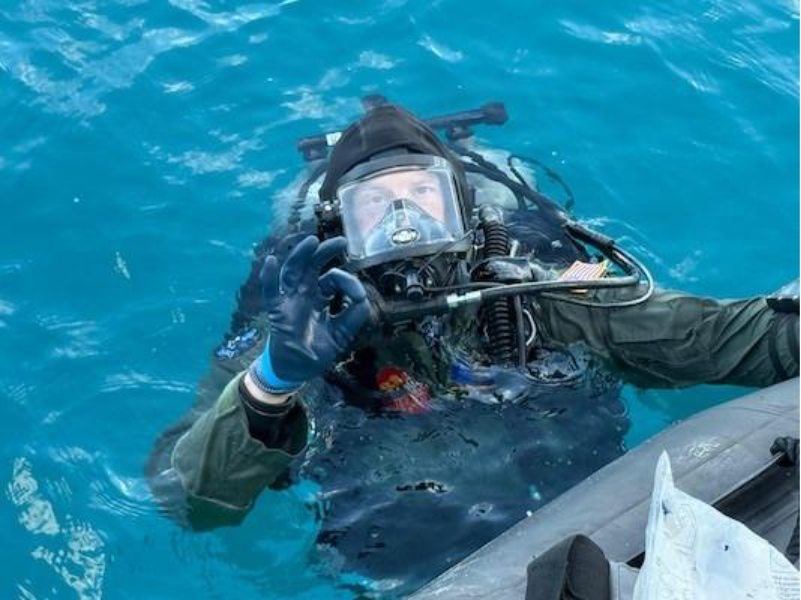
SOUDA BAY, Greece – U.S. Navy Seabee Divers, assigned to Underwater Construction Team (UCT) 1, Construction Dive Detachment Bravo (CDD/B), completed inspections and maintenance on the port security barrier system and tested new methods for underwater concrete repairs on the Marathi NATO Pier Complex from Dec. 2025 to Jan. 2026. 

The inspection revealed underwater damage that, if left unaddressed, could reduce the effectiveness of a critical floating security barrier used to protect ships during maintenance and resupply, underscoring the need for regular inspections by specialized Navy divers to keep the system fully operational. 

“For the pier repair project, we are basically adding reinforcement to holes and damage in the existing structural concrete,” said Construction Mechanic 2nd Class Zack Risinger, UCT 1, CDD/B project supervisor. “Working with the Hellenic Navy, we identified the priority repair site, and now, we’re going down and installing composite formwork with anchor bolts so that we can backfill the void with high-strength concrete.” 

Naval Support Activity (NSA) Souda Bay’s port facility, also known as the NATO Marathi Pier Complex, is an active host nation military base under the operation of the Hellenic Navy. The NATO Marathi Pier Complex is one of the largest natural ports in the Mediterranean and provides berthing, refueling, ammunition handling, general supply handling, and minor maintenance and ship repair to NATO and U.S. 6th Fleet ships during normal and contingency operations. The NATO Marathi Pier Complex is the deepest port in the Mediterranean used by the U.S. Navy and can handle everything from aircraft carriers to submarines. 

“The Seabee Divers come to Souda Bay every few years to provide a specialized service that we could not otherwise obtain” said Port Operations Regional Program Director Jim Walker, Commander, Navy Region Europe, Africa, Central. “The divers always get the job done on time; despite the very challenging weather conditions Souda Bay is known for in the winter.” 

Seabee divers conducted the inspections using specialized tools, including chain gauges and a remotely operated vehicle to assess deeper anchor points, and completed underwater concrete repairs using a high-strength fiber-reinforced polymer panel designed for rapid structural repairs. The repair system is currently being evaluated for future expeditionary port damage repair missions in remote and extreme environments. 

“Completing these projects in Greece was not only a great opportunity to do challenging work that directly supports U.S. 6th Fleet, but also to work directly with the Hellenic Navy,” said Lt. Juliana Pereira, UTC 1, CDD/B officer-in-charge. “The opportunity to build stronger relationships with important Allies like Greece is the highlight of this deployment and something our entire team enjoyed.” 

The Seabee Divers are deployed to U.S. 6th Fleet under Commander Task Force (CTF) 68 for a six-month deployment executing maritime infrastructure projects and security cooperation engagements with priority partners across the U.S. European Command region. As part of the U.S. 6th Fleet Maritime Infrastructure Assessment Program, UCT 1 completed an in-depth maritime infrastructure assessment of the NATO Marathi Pier Complex at Souda Bay in 2022. 

UCT 1, CDD/B, currently deployed as Commander Task Unit 68.2.2 is a specially trained and equipped unit within Navy Expeditionary Combat Command that specializes in diving, light salvage, underwater construction, and military engineering operations in austere environments. 

22nd Naval Construction Regiment, headquartered in Rota, Spain as Commander task Group 68.2 commands naval construction forces for Navy Expeditionary Combat Forces Europe-Africa/Task Force 68, supporting U.S., allied, and partner interests across the U.S. 6th Fleet area of operations. 

Commander Task Force 68 (CTF 68) is a component of the U.S. 6th Fleet and commands all Naval Expeditionary Combat Forces in the U.S. European Command and U.S. Africa Command areas of responsibility. These expeditionary forces provide maritime engineering and combat support capabilities in remote, austere, and complex environments. 


HII’s Newport News Shipbuilding Marks 140 Years of Service to the Nation 

From HII 

NEWPORT NEWS, Va., Jan. 28, 2026 (GLOBE NEWSWIRE) — HII’s (NYSE: HII) Newport News Shipbuilding division is marking 140 years of service to the nation today. 

On Jan. 28, 1886, Collis P. Huntington, a businessman whose investments enabled completion of the U.S. transcontinental railroad, turned his focus to shipbuilding, establishing what was first chartered as Chesapeake Dry Dock and Construction Co. and was then renamed Newport News Shipbuilding and Drydock Company. 

Several years later, the shipyard delivered its first vessel, the tugboat Dorothy, named for the daughter of William C. Whitney, the 31st Secretary of the Navy. Today, Dorothy sits outside the gates of NNS as a reminder of the shipyard’s humble beginnings. 

“For 140 years NNS shipbuilders have answered the call to serve our nation,” NNS President Kari Wilkinson said. “Generations of families have carried forward the noble profession of shipbuilding, proudly maintaining the Newport News Shipbuilding legacy. To this day, we are grateful for all of the shipbuilders who served before us and built what we work so hard today to sustain.” 

Since its founding, NNS has delivered more than 800 ships to commercial and military customers. Today, the shipyard designs, builds, maintains, refuels and inactivates nuclear-powered aircraft carriers and submarines for the U.S. Navy. 

Spanning 550 acres along two miles of the James River, NNS employs 26,000 shipbuilders and is the largest industrial employer in the commonwealth of Virginia. The shipyard also operates additional locations in Norfolk, Virginia, and Goose Creek, South Carolina, to support production. 


Data Link Solutions Awarded $248M Navy Contract to Deliver Tactical Radio System 

From BAE Systems, Jan. 28, 2026 

Software-defined radio designed to run complex Link 16 waveform delivers enhanced command and control (C2) capabilities 

WAYNE, N.J. — January 28, 2026 – The U.S. Navy has awarded Data Link Solutions, a joint venture between BAE Systems and Collins Aerospace, an RTX business, a $248 million production contract to deliver hundreds of Multifunctional Information Distribution System Joint Tactical Radio System (MIDS JTRS) terminals for U.S. forces and allies.  

The system provides situational awareness and enables jam-resistant Link 16 connectivity with line-of-sight voice, video, and data communications for sea, ground, and air assets in dynamic operational environments. Finding the quickest and most secure path, MIDS JTRS enables the sharing of relative position and targeting data among joint forces and allows warfighters to make well-informed decisions swiftly in contested scenarios.  

“This contract demonstrates the ongoing need to equip our warfighters with a high-performing, secure command and control solution and our commitment to deliver at the speed of need,” said Brian Shadiack, director of Data Link Solutions. “With increased production capacity, we will provide hundreds of MIDS JTRS radio terminals for more than 45 U.S. and international platform types, including unmanned aerial vehicles and armored C2 ground vehicles.” 

MIDS JTRS is a four-channel, software-defined radio designed to run the complex Link 16 waveform and up to three additional communication protocols. Link 16 is a standardized communications system used by NATO, the U.S., and its allies and partner nations to share real-time tactical data. It is a scalable and flexible solution to tailor networks to mission needs. In addition to Link 16 compatibility, MIDS JTRS’ advanced Tactical Targeting Networking Technology offers a low latency, high communications waveform capability that provides critical platform connectivity and throughput within contested environments. The Department of War is fielding MIDS JTRS on the F-15, F-16, F/A-18, and F-22 aircraft, as well as maritime vessels and ground command and control assets. 

Data Link Solutions is a leading supplier of Link 16 terminals and software, as well as logistics and support services for air-, land-, and sea-based platforms. With more than 25 years of experience providing affordable, high-performance, and high-reliability data link terminals for forces, the organization has delivered over 9,000 Link 16 systems worldwide to more than 50 nations. 

Work on the MIDS JTRS program takes place in Wayne, New Jersey, and Cedar Rapids, Iowa. 


Singapore, Denmark Plan to Join the P-8 Poseidon Club

A New Zealand Defence Force P-8A Poseidon maritime patrol aircraft. (Photo credit: Defence Public Affairs, Corporal Naomi James)

By Richard R. Burgess, Senior Editor 

ARLINGTON, Va. — In recent weeks two more nations have been approved by the U.S. State Department for possible procurement of Boeing-built P-8 Poseidon maritime patrol aircraft (MPA).  

The Defense Security Cooperation Agency (DSCA) has announced that Denmark and Singapore each have been approved by the U.S. State Department for possible Foreign Military Sales of three and four P-8A aircraft, respectively. 

The procurement of the four P-8As and associated systems and support services for Singapore is estimated to total $2.316 billion. The sale also would include MK54 lightweight tordedoes  drawn from existing U.S. Navy stocks, the DSCA announced on Jan. 20, 2026.  

Earlier, the DSCA announced on Dec. 29, 2025, the State Department approved the possible sale of three P-8As and associated systems and support to Denmark. The value of the sale is estimated at $1.8 billion.  

The Defense Security Cooperation Agency delivered the required certification notifying Congress, the agency said. 

Interestingly, the two nations have not traditionally operated long-range MPA. The acquisitions will strengthen the anti-submarine and surface warfare capabilities of allies of the United States and NATO allies. 

The P-8A is operated by seven armed forces including the U.S. Navy, Royal Australian Air Force, Royal Air Force, Royal Norwegian Air Force, New Zealand Defence Force, Republic of Korea Navy, and German Navy. The Royal Canadian Air Force also has P-8As on order. All of these except the Royal Air Force previously operated versions or derivatives of the P-3 Orion. India also operates a similar version of the Poseidon purchased by direct commercial sale, the P-8I Neptune. 


Philippines, U.S. Conduct Bilateral Maritime Cooperative Activity

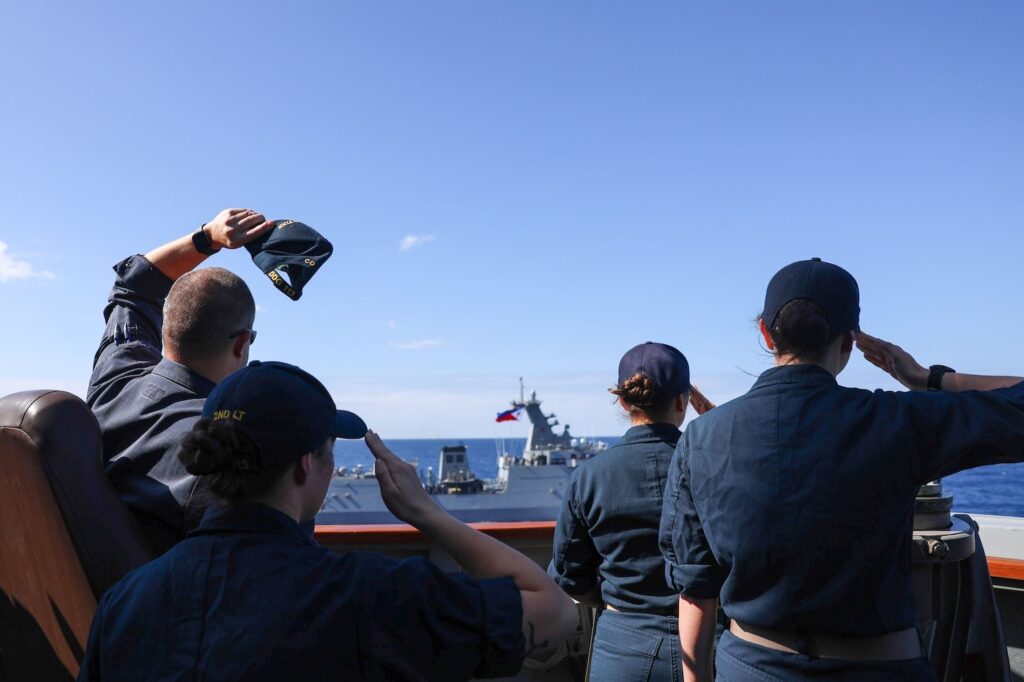
SOUTH CHINA SEA (Jan. 26, 2026) — U.S. Navy Sailors aboard Arleigh Burke-class guided-missile destroyer USS John Finn (DDG 113) wave at the Philippine Navy Jose Rizal-class frigate BRP Antonio Luna (FF151) during the Maritime Cooperative Activity (MCA) in the Philippines’ Exclusive Economic Zone, Jan. 26, 2026. (U.S. Navy photo by MC2 Alexandria Esteban) 

By U.S. 7th Fleet Public Affairs, Jan. 27, 2026 

SOUTH CHINA SEA   –  The Armed Forces of the Philippines (AFP) and the U.S. Navy conducted a bilateral Maritime Cooperative Activity (MCA) within the Philippines’ Exclusive Economic Zone, demonstrating a collective commitment to strengthen regional and international cooperation in support of a free and open Indo-Pacific, Jan. 25-26, 2026. 

MCAs are conducted in a manner consistent with international law and with due regard to the safety, navigational rights and freedoms of all nations. 

This MCA continues to build on interoperability between the AFP and U.S. Navy through maneuver exercises, replenishment-at-sea evolutions, communications checks, and shared maritime domain awareness. 

Participating units included U.S. Navy Arleigh Burke-class guided-missile destroyer USS John Finn (DDG 113), P-8A Poseidon maritime patrol and reconnaissance aircraft assigned to Patrol Squadron (VP) 45, Philippine Navy Jose Rizal-class guided-missile frigate BRP Antonio Luna (FF151), Philippine Air Force FA-50 aircraft, A-29 Super Tucano aircraft, and Philippine Coast Guard offshore patrol vessel BRP Gabriela Silang (OPV 8301) with embarked AW109. 

The U.S., along with our allies and partners, upholds the right to freedom of navigation and overflight and other lawful uses of the sea and international airspace, as well as respect to the maritime rights under international law.   

U.S. 7th Fleet, the Navy’s largest forward-deployed numbered fleet, routinely interacts and operates with allies and partners in preserving a free and open Indo-Pacific region. 


USS Wichita Crew Completes Critical Repairs at Sea, Sustains Mission Readiness

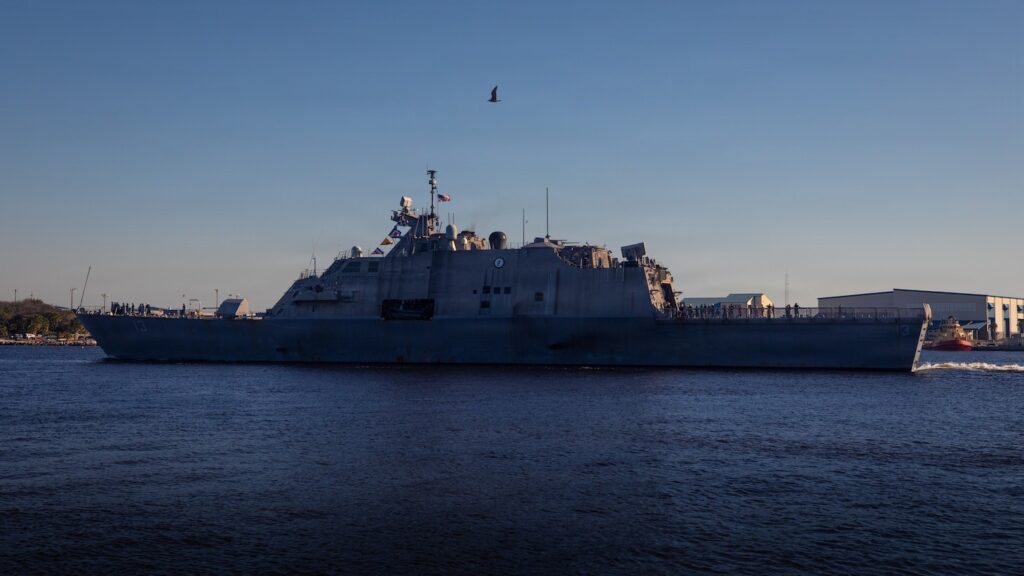
MAYPORT, Fla. (Nov. 14, 2025) – The Freedom-variant littoral combat ship USS Wichita (LCS 13) departs Naval Station Mayport, Florida, to support U.S. Northern Command (USNORTHCOM) southern border operations, Nov. 14. (U.S. Navy photo by MC1 Brandon J. Vinson) 

Release From U.S. Fleet Forces Command

CARIBBEAN SEA (Jan. 26, 2026) – Sailors aboard the Freedom-variant littoral combat ship USS Wichita (LCS 13) recently completed a series of critical engineering repairs while deployed, demonstrating the growing self-sufficiency and technical expertise of the Littoral Combat Ship force. 

While operating in the U.S. Fourth Fleet area of operations, Wichita Sailors repaired key ship systems, including a ship’s service diesel generator (SSDG), a main propulsion diesel engine (MPDE), and supporting auxiliary equipment. These efforts allowed the warship to remain fully mission capable. 

Repairs of this scope were previously conducted during shipyard availabilities; however, through dedicated training, strict adherence to technical documentation, and a drive to master their craft, Wichita Sailors demonstrated the importance of ownership and self-sufficiency in sustaining operational readiness. 

“Our primary task is to maintain and operate the engineering plant in a consistently high state of readiness in order to support the ship’s mission as an instrument of national policy,” said Lt. Brandon Cravey, Wichita’s chief engineer. “Our weekly engineering evolutions and damage control drills allow us to respond quickly and efficiently to a wide variety of casualties. We must be ready to answer all bells.” 

The most significant repair began when watchstanders identified an abnormal lube oil leak on one of the ship’s diesel generators. Acting quickly, Sailors secured the engine and isolated the issue before it could escalate into a more serious casualty. 

Engineering teams conducted a detailed inspection, identified a failed component, and completed repairs within 24 hours—restoring full electrical generating capability without disrupting operations. Advance planning by Wichita’s engineering and supply teams ensured high-demand spare parts were available onboard, reducing reliance on shore-based support and shortening repair timelines. 

In a separate instance, Sailors repaired a failing heating element on one of the ship’s main propulsion diesel engines. Working closely with Littoral Combat Ship Squadron Two and the Navy logistics enterprise, the crew completed the repair within 72 hours with no impact to operational tasking. 

Cmdr. Travis Snover, Wichita’s commanding officer, said the crew’s success reflects a broader cultural shift across the LCS community. “To say I’m proud of Wichita’s engineering team would be an understatement,” Snover said. “Their initiative, professional curiosity, and commitment to mastering their equipment are the enablers of our success at sea. With maintenance requirements becoming less reliant on contracted shore side support in the LCS community, it is imperative that Wichita Sailors take ownership of our equipment and learn to recognize the signs and symptoms of potential failure. We, as a team onboard Wichita, have made ownership the foundation of our culture and strive to demonstrate that Sailors at sea, when provided the necessary tools, parts, and materials, can ensure that each and every ship is ready on arrival when we are called to stand the watch.” 

USS Wichita departed Naval Station Mayport in October 2025 for a regularly scheduled deployment with an embarked Coast Guard Law Enforcement Detachment, supporting missions assigned by U.S. Fourth Fleet and U.S. Second Fleet. 


USS Cincinnati arrives in Ream Naval Base 

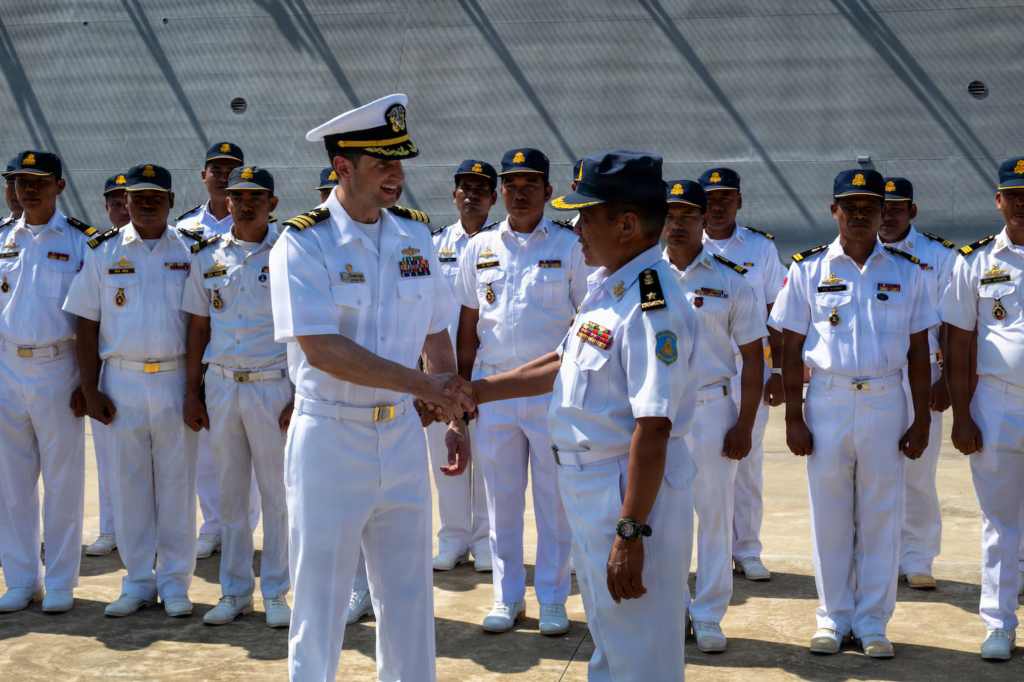
REAM NAVAL BASE, Cambodia (Jan. 24, 2026) A Royal Cambodian Navy Delegation welcomes Independence-Variant littoral combat ship USS Cincinnati (LCS 20) to Ream Naval Base, Cambodia, Jan. 24. Cincinnati is operating in the U.S. 7th Fleet area of operations to ensure maritime security and stability in the Indo-Pacific region. (U.S. Navy photo by MC2 Class Nicholas Rodriguez) 

By Destroyer Squadron 7 Public Affairs, Jan. 24, 2026 

REAM NAVAL BASE, Cambodia  –  Independence-variant littoral combat ship USS Cincinnati (LCS 20) arrived in Ream Naval Base for a temporary port visit, Jan. 24, 2026. 
 
Cincinnati’s visit to Cambodia celebrates the continued partnership between the United States and Cambodia, reaffirming our shared commitment to regional security, peace and prosperity. While in port, the crew will conduct ship tours, hold subject matter expert exchanges, and meet with key leaders to further enhance maritime partnership between the two nations. 
 
“It is an honor to be welcomed by the Cambodian people at Ream Naval Base,” said Capt. Matt Scarlett, commodore, Destroyer Squadron (DESRON) 7. “We are always excited to work alongside our partners and continue to build a free and open Indo-Pacific for all nations.” 
 
This visit also demonstrates the deepening cooperation and expanding friendship between the U.S. and Royal Cambodian navies. Cambodia and the United States work shoulder-to-shoulder to uphold a free and open Indo-Pacific. 
 
As we mark the 250th anniversary of the founding of the United States, we reflect not only on our ideals, but also on the enduring role of diplomacy in shaping our nation’s journey and global impact. This visit is a testament to our long-standing partnership with Cambodia and our shared vision for the future. Cincinnati’s visit also follows Independence-variant littoral combat ship USS Savannah’s (LCS 28) port visit to the Kingdom of Cambodia in December 2024. 
 
As the U.S. Navy’s forward-deployed DESRON in Southeast Asia, DESRON 7 serves as the primary tactical commander of littoral combat ships deployed to the U.S. 7th Fleet area of responsibility. 
 
U.S. 7th Fleet, the Navy’s largest forward-deployed numbered fleet, routinely interacts and operates with allies and partners in preserving a free and open Indo-Pacific region. 


War Department Releases New Defense Strategy 

ARLINGTON, Va. – The U.S. Department of War released the 2026 National Defense Strategy (NDS) on Jan. 23, 2026.  

The New NDS can be read here: 

https://media.defense.gov/2026/Jan/23/2003864773/-1/-1/0/2026-NATIONAL-DEFENSE-STRATEGY.PDF