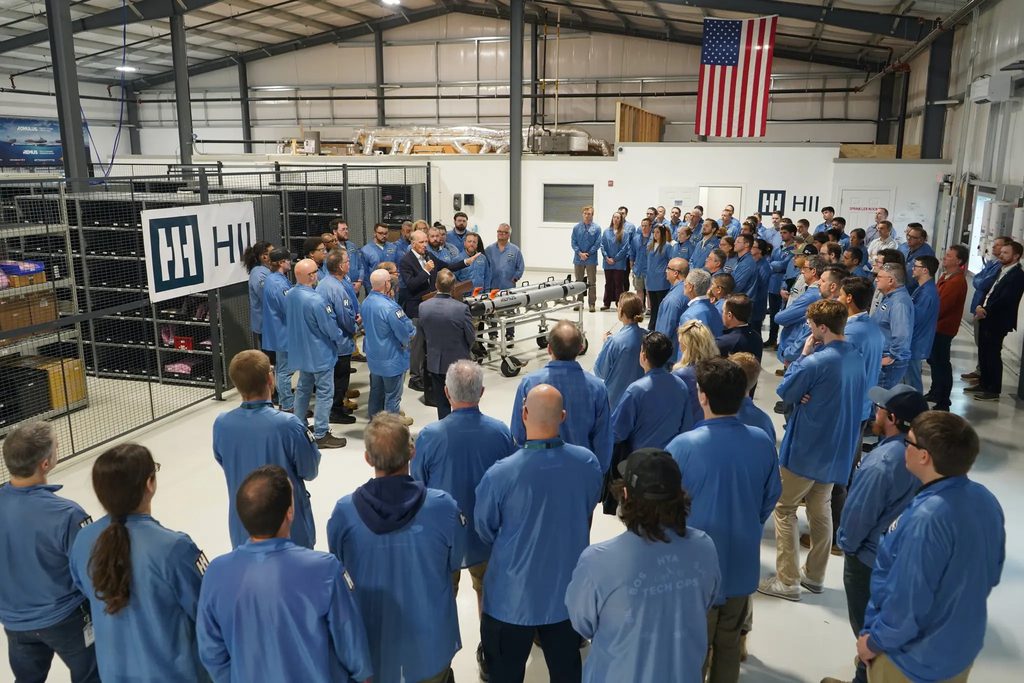
HII Hosts National Commission on the Future of The Navy at Ingalls Shipbuilding
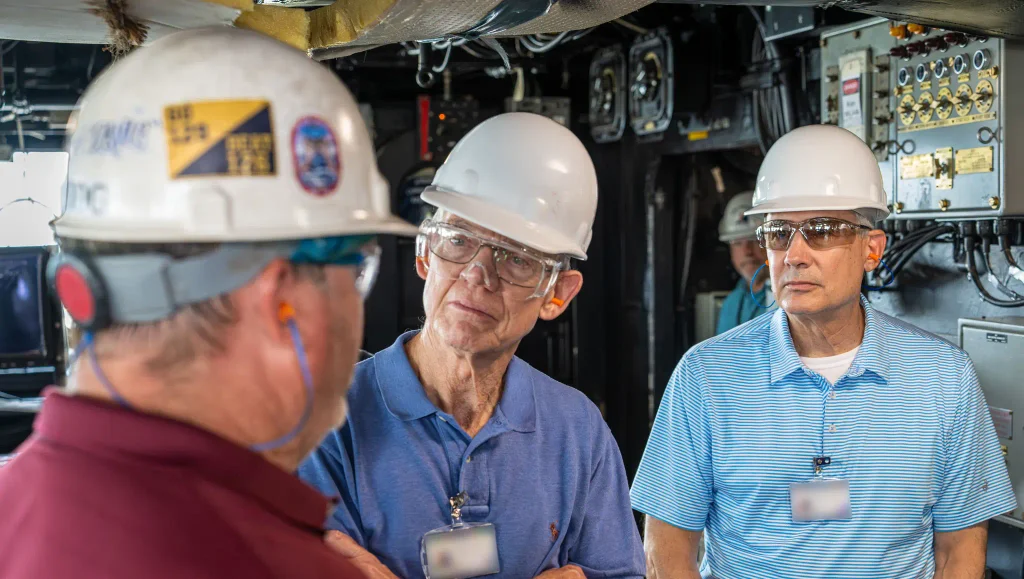
PASCAGOULA, Miss. — HII welcomed members of the National Commission on the Future of the Navy (FNC) to its Ingalls Shipbuilding division Thursday as part of the commission’s nationwide review to develop recommendations for strengthening American seapower.
The visit provided commission members with a firsthand look at the shipbuilding capabilities, workforce training and industrial investments that support the Navy’s future fleet requirements. As part of its comprehensive study of naval strategy, resources, force structure and the industrial base, the commission is assessing the nation’s shipbuilding capacity and long-term production needs.
“A strong Navy relies on a capable and resilient industrial base,” Commissioner Mitch Waldman said. “We are grateful for the opportunity to see firsthand the significant industrial capacity and workforce capability that Ingalls Shipbuilding provides as the commission continues to assess the nation’s ability to design, build and sustain the future Navy.”
During the visit, commission members toured key production and training areas, including the Flight III Arleigh Burke-class destroyer Jeremiah Denton (DDG 129), the Virtual Reality Welding Lab and the Maritime Training Academy. The tour highlighted the pace and scale of Ingalls’ operations, as well as major infrastructure investments designed to support increased throughput across the U.S. maritime industrial base.
“Ingalls shipbuilders bring unmatched skill and dedication to every ship we build, and it was a privilege to show the commission how their work in the shipyard directly supports the fleet,” said Eric Crooker, Ingalls vice president of program management. “With more than 87 years of experience building ships for the U.S. Navy, and over a dozen ships in active construction, our team’s dedication and upcoming ship deliveries demonstrate the strength of our workforce and the capability we provide to the nation.”
With 13 ships in construction and three deliveries planned in the next year, Ingalls Shipbuilding offers a firsthand view of the production capacity and workforce capabilities central to meeting future fleet requirements. The shipyard’s recent progress through its distributed shipbuilding program further illustrates its role in the broader maritime industrial base.
Congress established the FNC to provide an independent review of naval force structure, shipbuilding performance and industrial-base requirements. Public hearings began in March 2026, with initial findings expected in January 2027.
From HII, Sept. 25, 2026
Vice Adm. Brad Collins Takes the Reins of the Navy Shore Enterprise
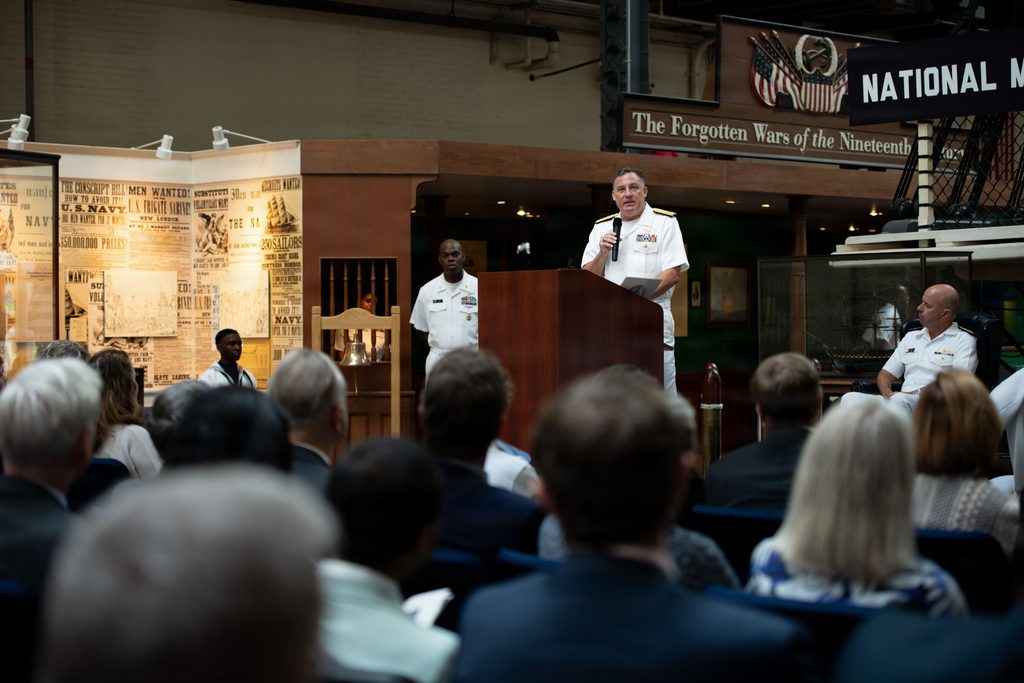
WASHINGTON (Sept. 24, 2026) Vice Adm. Brad Collins, incoming commander, Navy Installations Command, delivers remarks during a change of command ceremony at the National Museum of the United States Navy at the Washington Navy Yard, Sept. 24, 2026. Seated behind him are Vice Adm. Scott Gray, outgoing commander, and Vice Chief of Naval Operations Adm. James Kilby. During the ceremony, Collins assumed command of CNIC, taking responsibility for the Navy’s 71 installations and worldwide shore infrastructure. (U.S. Navy photo by Chief Mass Communication Specialist Janweb B. Lagazo)
WASHINGTON, D.C. — Vice Adm. Brad Collins assumed command of Commander, Navy Installations Command (CNIC) from Vice Adm. Scott Gray during a change of command ceremony held at the Washington Navy Yard, Sept. 24, 2026
Vice Chief of Naval Operations Adm. James Kilby presided over the ceremony, honoring Gray’s leadership of the Navy’s Shore Enterprise and welcoming Collins.
“The Navy sustains and projects maritime operations from its shore installations, and our ability to win in combat depends on what happens ashore,” said Kilby. “It’s not just about platforms. As the CNO says, ‘Our installations are where we build our most important weapon system – the Sailor.’ For CNIC, taking care of Sailors, Marines, and their families is not a collateral duty; it’s what CNIC does every day.”
The ceremony marked the culmination of a three-year tour for Gray, who reorganized the Shore Enterprise, established CNIC as the Shore Type Commander (TYCOM) and improved Quality of Service for Sailors and families.
Across a $9.5 billion annual infrastructure portfolio, Gray modernized shore management through requirements-based budgeting and data analytics, while leading the integration of more than 10,700 billets across public works departments, defense fuel support points, and the Navy Petroleum Office. Operationally, he aligned installations directly with maritime forces by establishing Task Force Shore within the Pacific Fleet Maritime Operations Center and fortifying strategic posture worldwide from advancing the AUKUS partnership at NSA Stirling to executing major infrastructure investments in Guam, Spain, and homeports across the fleet.
Gray placed equal emphasis on Navy Quality of Service, championing substantial improvements to living standards and family support. Under his leadership, CNIC funded vital unaccompanied housing and fitness center upgrades, and delivered free Wi-Fi to barracks and galleys. Gray also oversaw a 500 percent expansion of the Military Childcare in Your Neighborhood-PLUS program, adding 10,000 community childcare fee assistance spaces and reducing the Navy’s overall childcare waitlist by nearly 5,000 children.
Gray will report to the Pentagon to serve as the Deputy Chief of Naval Operations for Navy Sustainment, leading the newly established office to integrate and synchronize capabilities.
“As I transition to my new role as the Deputy Chief of Naval Operations for Navy Sustainment, I am taking the lessons of the Shore with me to the Pentagon,” said Gray. “I know what it looks like when the Shore is under-resourced and the friction it causes. In this new capacity, our work together will continue—unifying our logistics, infrastructure, and base operating capabilities so that we can better support the fleet, empower the industrial base, and build on the momentum we have created across the Shore Enterprise.”
Collins assumes leadership of CNIC bringing region and operational shore leadership experience, having previously served as CNIC Chief of Staff as well as commander of Navy Region Northwest; Navy Region Europe, Africa, Central; and Navy Region Hawaii.
“It is truly an honor and a privilege to assume command of CNIC,” said Collins. “CNIC’s regions and installations provide the foundation that enables our fleet, supports our Sailors and families, and ensures the Navy is prepared to meet future demands. My focus will be on delivering reliable, responsive support to the people and commands that depend on us.”
Collins underscored his commitment to enterprise continuity, resilience, and operational focus.
“As we move forward, we will stay focused on strengthening that foundation in practical, meaningful ways,” Collins added. “We will continue improving how our regions and installations deliver support to the fleet, the fighter, and the family. That means staying close to the mission, understanding where friction exists, and working across the enterprise to solve problems in ways that make a real difference at the deckplate level.”
From the Navy Office of Information, Sept. 24,
Vice Adm. Doug Perry Passes the Watch of U.S. 2nd Fleet and NATO’s Joint Force Command Norfolk
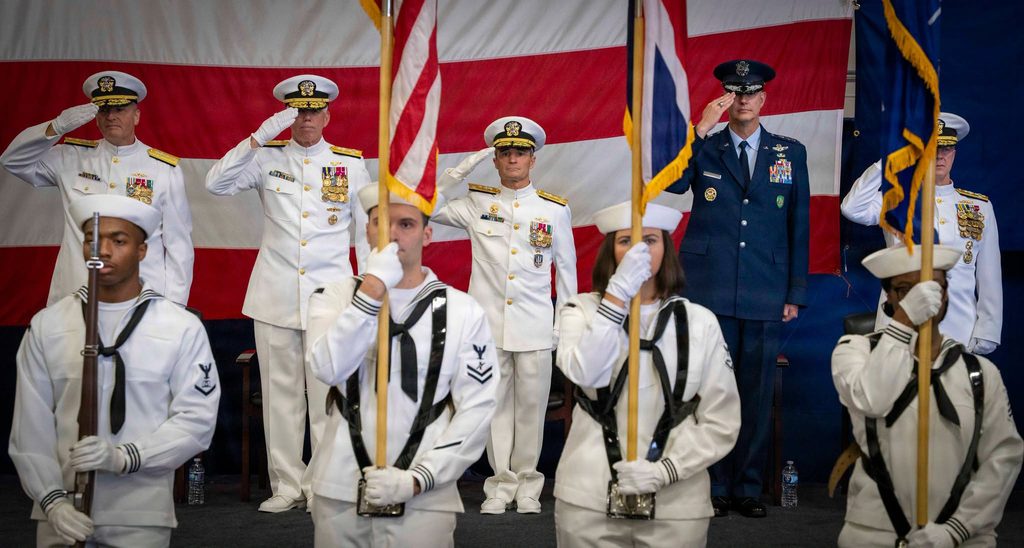
NORFOLK, Va. — More than 500 distinguished guests, international military representatives, and family members attended the NATO’s Joint Force Command Norfolk (JFCNF) Assumption of Command and U.S. 2nd Fleet (C2F) Change of Command Ceremony aboard the aircraft carrier USS Nimitz (CVN 68) on Sept. 24.
The day marked a historic military transition as Vice Adm. Doug Perry was relieved as the commander of both JFCNF and C2F, culminating in a profound retirement ceremony recognizing 37 years of honorable service to the nation.
Senior U.S. military leadership in attendance included U.S. Air Force Gen. Alexus Grynkewich, NATO Supreme Allied Commander Europe; U.S. Navy Adm. Daryl Caudle, Chief of Naval Operations; and U.S. Navy Adm. Karl Thomas, U.S. Fleet Forces Command.
“Today, we acknowledge the accomplishments of two distinct commands with separate missions,” said Vice Adm. Perry. “The missions [of 2nd Fleet and JFC Norfolk] converge in the same strategic space through the western Atlantic through the Greenland, Iceland, United Kingdom gap and into the high north, the Arctic. Together, these commands ensure the United States and allied advantage in peace time is preserved and the rules-based international order as well; to sustain our readiness to respond in crisis and to defend, fight, and win in combat.”
The NATO portion of the ceremony proceeded first. For the first time in the command’s history, the blue-and-gold flag of JFCNF was passed to a European ally, UK Army Gen. Nick Perry.
Gen. Perry’s assumption of command represented a powerful and symbolic leap forward for NATO’s burden-sharing and transatlantic integration.
“I want to thank Doug Perry for his leadership,” Gen. Nick Perry said. “Under his stewardship Joint Force Command Norfolk has matured, strengthened its relationships across the alliance, and developed into a vital element of NATO’s collective security.”
Gen. Perry briefly reflected on the last 250 years of the United States’ history, from independence to global leadership, and commented on the ceremony’s notable location.
“There is no greater example of both the generosity and the awesome military power [of the United States] as we are hosted today on the USS Nimitz,” Perry stressed.
As the ceremony shifted focus from the JFCNF assumption of command, Adm. Thomas reflected on Vice Adm. Perry’s tour as the dual-hatted commander with an emphasis on C2F.
“Under his command, 2nd Fleet revitalized maritime homeland defense, from Vigilant Shield and Austere Challenge to Steadfast Defender, Operation NANOOK and Cutlass Fury, Doug ensured that our forces were constantly tested in the most demanding environments and under the most challenging of circumstances,” said Thomas. “You strengthened our alliances and ensured that any platform flying the American flag in the Atlantic was ready to fight and win.”
Following the NATO transition, Rear Adm. Martin Muckian relieved Vice Adm. Perry as the acting C2F commander.
With the official command transfers completed, the atmosphere in the hangar bay shifted to the deeply personal retirement ceremony for Vice Adm. Perry.
The guest of honor, Adm. Caudle, reflected on Vice Adm. Perry’s leadership philosophy and service to the country.
“His infectious energy has always been directed outward toward people. And that to me is the defining characteristic of Doug Perry as a leader,” said Caudle. “Doug never allowed rank to create distance between himself and his Sailors. It’s the people who generate combat power. Know your people, invest in them, challenge them, develop them, hold them to high standards and make sure they understand what they do matters. Doug has been living that philosophy for 37 years and people remember it.”
During his final remarks, Vice Adm. Perry reflected on this military career that began at the U.S. Naval Academy in 1989. He expressed deep gratitude for his parents who established a foundation for him at a young age. He thanked his family, friends, classmates, mentors, leaders and Sailors who have guided him and experienced the Navy journey alongside him.
“When I look back at 37 years – chiefs, Sailors, commanders, generals, air marshals – I don’t think about anything but the people and our experiences,” said Perry. “The people who raised me, people who taught me, challenged me, believed in me, and then stood the watch beside me, so we had that experience together. And most of all, I remember the Sailors and families who trusted me with the privilege of leading them … Every chapter of this journey, of my journey, carries your fingerprints.
“Today, I have the privilege of passing the watch. Ships will continue to sail. New Sailors will stand the watch and that’s exactly how it should be. Leadership is never about holding the watch forever. It’s about making a difference while standing the watch and then preparing the next person to take it.”
At the end of the ceremony, Master Chief Information Systems Technician Louis DeCesare recited “The Watch.” As the words of the poem echoed through the Nimitz’s hangar bay, Vice Adm. Perry’s daughter, U.S. Marine Corps 2nd Lt. Elle Perry, stepped forward to assist in the presentation.
“For thirty-seven years, this Sailor has stood the watch,” DeCesare said. “Today we are here to say, Shipmate, the watch stands relieved. Relieved by those you have trained, guided, and led. Shipmate you stand relieved … we have the watch.”
2nd Lt. Perry rendered a salute to her father symbolizing a generational passing of the watch.
The day marked both an end and a beginning – a passing of the watch ensures the waters of the Atlantic remain secure under the vigilant eyes of a united alliance.
U.S. 2nd Fleet, reestablished in 2018 in response to the changing global security environment, develops and employs maritime ready forces to fight across multiple domains in the Atlantic and Arctic in order to ensure access, deter aggression and defend U.S., allied, and partner interests.
From U.S. 2nd Fleet, Sept. 24, 2026
Navy W93 Mk7 Program Enters New Phase of Development
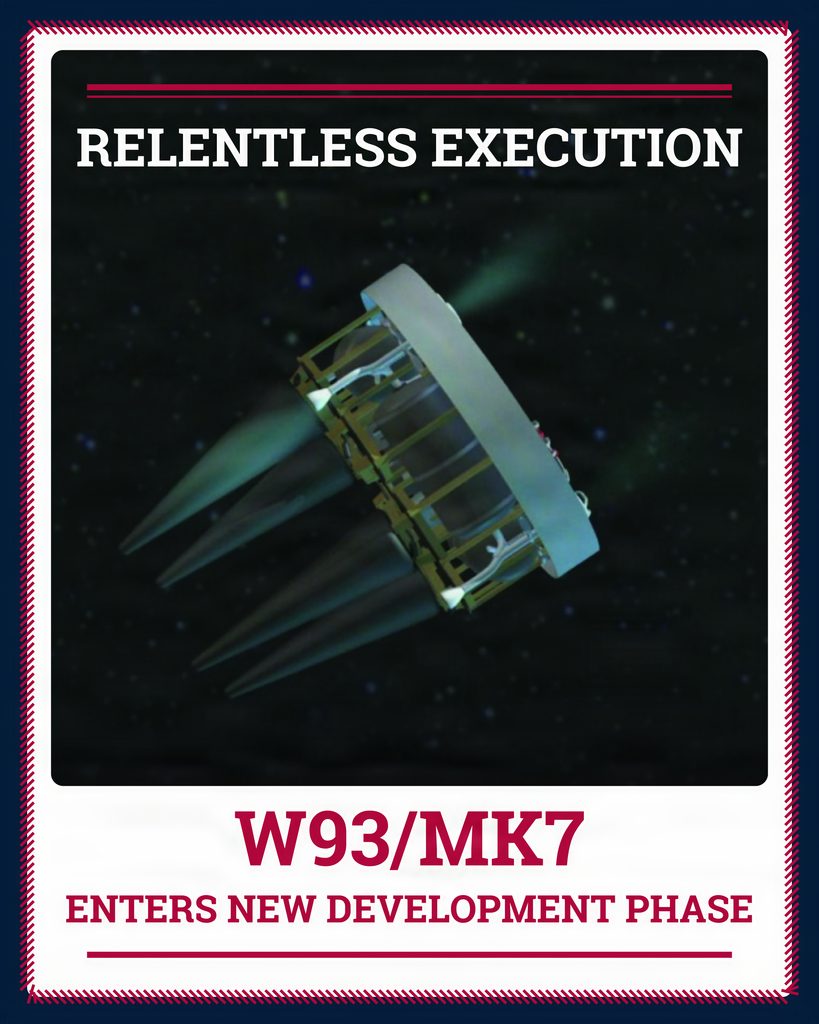
WASHINGTON NAVY YARD — The U.S. Navy’s Portfolio Acquisition Executive (PAE) Strategic Systems Programs’ (SSP) W93 Mk7 program has entered into the Engineering and Manufacturing Development (EMD) phase of the Defense Acquisition System after achieving Milestone B this year.
During the EMD phase, the program will focus on completing production design and proving that the design is producible to meet the needs of the Navy.
The W93 warhead and the Mk7 reentry body assembly are the first United States nuclear warhead and reentry system program initiated in nearly four decades and will provide a modern warhead to the U.S. submarine launched ballistic missile fleet.
“W93/Mk7 will provide flexibility and adaptability to meet future Warfighter needs and ensure an uninterrupted at sea deterrent for the sea-based leg of the nuclear triad,” said Vice Adm. Douglas Williams, director of PAE SSP. “We were able to accelerate our entry into this next phase because of the dedicated partnership between PAE SSP, National Nuclear Security Administration, and our industry base. This is what working at hyper-speed looks like.”
PAE SSP is partnered with the National Nuclear Security Administration within the Department of Energy, and its associated national laboratories, under the interagency Nuclear Weapons Life Cycle process to design, develop, and produce the W93/Mk7 warhead and reentry system.
“Credible deterrence demands that we move with urgency, and the progress we’re making on W93/Mk7 demonstrates exactly that,” said Brandon Williams, administrator of the National Nuclear Security Administration.
“We are revitalizing and modernizing the Nuclear Security Enterprise to design, develop, and produce this critical new weapon with the precision our Warfighters demand. We will continue working together to deliver this capability to the fleet and ensure our sea-based strategic deterrent remains ready for the future.”
PAE SSP is responsible for sustaining the strategic weapon system on the Ohio-class ballistic missile submarines and supporting the integration of the Trident II D5 Life Extension (D5LE) weapon system on the new Columbia-class SSBNs. Looking to the future, PAE SSP is actively modernizing the sea-based leg of the nuclear triad through the development of the D5LE2 strategic weapon system and pioneering regional strike capabilities of the future through development of SLCM-N and the non-nuclear hypersonic conventional prompt strike system.
From Shelby Thompson, Sept. 24, 2026
U.S. Navy Establishes Robotic and Autonomous Systems Warfighting Development Center
The Secretary of the Navy and the Chief of Naval Operations (CNO) officially established the Robotic and Autonomous Systems Warfighting Development Center (RASWDC) today, marking a critical milestone in accelerating the development, operational integration, and employment of robotic and autonomous systems (RAS) across the maritime domain.
Headquartered at Joint Expeditionary Base Little Creek-Fort Story, RASWDC is an Echelon 3 warfighting development center operating under U.S. Fleet Forces Command. The command will serve as the Navy’s dedicated, Fleet-facing operational integration point for robotic and autonomous capabilities.
“To maintain our decisive maritime advantage, we must rapidly integrate robotic and autonomous systems into how we operate, train, and deploy,” said the Chief of Naval Operations. “The establishment of RASWDC ensures our Sailors are equipped with the tactical edge, advanced training, and specialized doctrine required to win the high-end fight.”
The establishment of RASWDC operates in tandem with the recently announced Direct Reporting Portfolio Manager for Robotic and Autonomous Systems (DRPM RAS). While DRPM RAS provides single accountable portfolio authority for RAS acquisition, requirements implementation, budgeting, technical standards, and fielding, RASWDC focuses entirely on operational employment.
Together, these organizations create a rapid, direct feedback loop between the acquisition enterprise and operational forces. By capturing lessons from testing, experimentation, and training, RASWDC will ensure empirical performance data is returned rapidly to developers and program managers to improve future capability.
“RASWDC is the critical bridge between capability development and operational employment,” the CNO added. “By forging a direct feedback loop, we are accelerating the delivery of unmanned capabilities from the foundry directly to the Fleet, ensuring our forces are postured to meet any challenge.”
As robotic and autonomous systems become increasingly vital to naval warfare, RASWDC is designed to rapidly test, learn, iterate, and field capabilities. By strengthening “The Foundry,” the center ensures a direct connection between operational experience and future capability development. To support “The Fleet,” RASWDC will conduct operational testing in representative environments and synchronize efforts across the Navy’s warfare communities. Ultimately, to prepare Sailors for “The Fight,” the command will develop the specialized doctrine, tactics, techniques, and procedures (TTPs), as well as the advanced tactical instruction framework necessary to certify and deploy these advanced platforms.
The CNO has designated Rear Admiral Melvin Smith as the inaugural Commander of RASWDC and the supported commander for the establishment of the new organization. Rear Adm. Smith is leading a phased near-, mid-, and long-term implementation plan, which includes developing the command structure, mission relationships, and resource requirements as RASWDC progresses toward full operational capability.
“This is just day one,” said Rear Adm. Smith. “Our purpose here is to consolidate the Navy’s autonomous efforts across air, surface, and undersea domains, and give them a single home here at Little Creek. Our mandate is straightforward: educate our warfighters, equip the Fleet with tools that actually survive the environment, and develop the combined tactics to employ them decisively. We are here to make sure our forces don’t just field unmanned systems, but dominate with them.”
RASWDC will not replace the expertise or responsibilities resident within existing Warfighting Development Centers, Type Commanders, Systems Commands, or operational commands. Instead, it will provide a dedicated operational integration point, coordinating directly with these organizations to incorporate emerging requirements and share lessons learned.
From U.S. Fleet Forces Command, Sept. 24, 2026
L3Harris Awarded $876M Modification for Navy Low Band Jammer Work
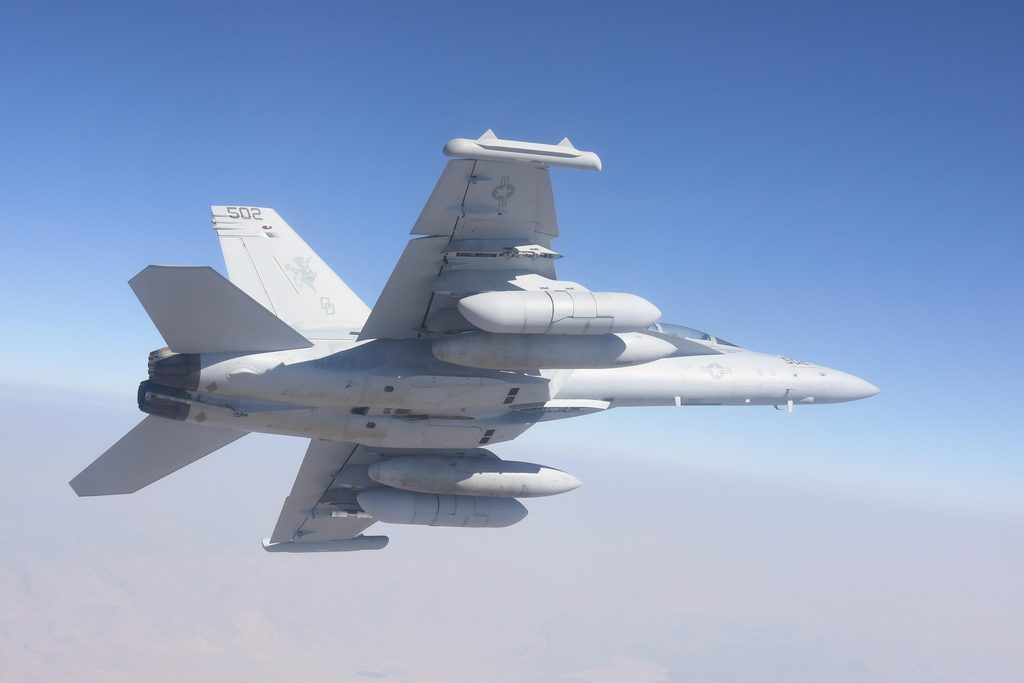
The cost-plus-incentive-fee, undefinitized modification adds non-recurring tooling and equipment, system demonstration test article pods; cybersecurity and system security development; and product, logistics, test and software support requirements to the contract’s scope, the Department of War said Wednesday.
Naval Air Systems Command at Patuxent River, Maryland, is the contracting activity. The modification was not competitively procured, and work is expected to finish in fiscal 2031.
Defense research and development priorities take center stage at the Potomac Officers Club’s2027 Defense R&D Summiton Feb. 4 in McLean, Virginia.Register now!
How Is the L3Harris Contract Modification Funded?
Fiscal 2026 Navy research, development, test and evaluation funds provide $3.7 million at the time of award. Royal Australian Air Force cooperative funds account for $23 million.
Salt Lake City, Utah, carries 43 percent of the work. Other sites include Hollywood, Alabama; Lansdale, Pennsylvania; Clifton, New Jersey; Boulder, Colorado; Goleta and Carlsbad, California; Edgewood and Long Island, New York; Waco, Texas; Parsippany, New Jersey; and locations in Australia.
The Navy split the Next Generation Jammer program into three pods, each covering a different portion of the electromagnetic spectrum. Raytheon won the mid-band award in 2016. The high-band segment has gone unfunded since at least fiscal 2020, according to DefenseScoop.
The low-band system was scheduled to reach early operational capability in 2029.
What Came Before the L3Harris Contract Modification?
L3Harris won the underlying $587 million engineering and manufacturing development contract in August 2024, covering design, production and delivery of test articles and fleet prototypes. That work included 11 pod simulators, eight operational prototype pods, four jettison mass model pods, two captive mass models, two mission system prototypes and two technique development systems.
The Navy received two offers for that award, which followed litigation that stalled the program for years. L3Harris filed suit in the Court of Federal Claims in September 2021 after the Government Accountability Office sided with Northrop Grumman, whose protest centered on a former Navy employee. That person allegedly worked on the program’s specifications while in employment talks with L3Harris, and Northrop argued the service had not accounted for the conflict, DefenseScoop reported. The Navy reopened bids and awarded the contract in 2024.
Red Cat Celebrates Inaugural Blue Ops Day in Georgia
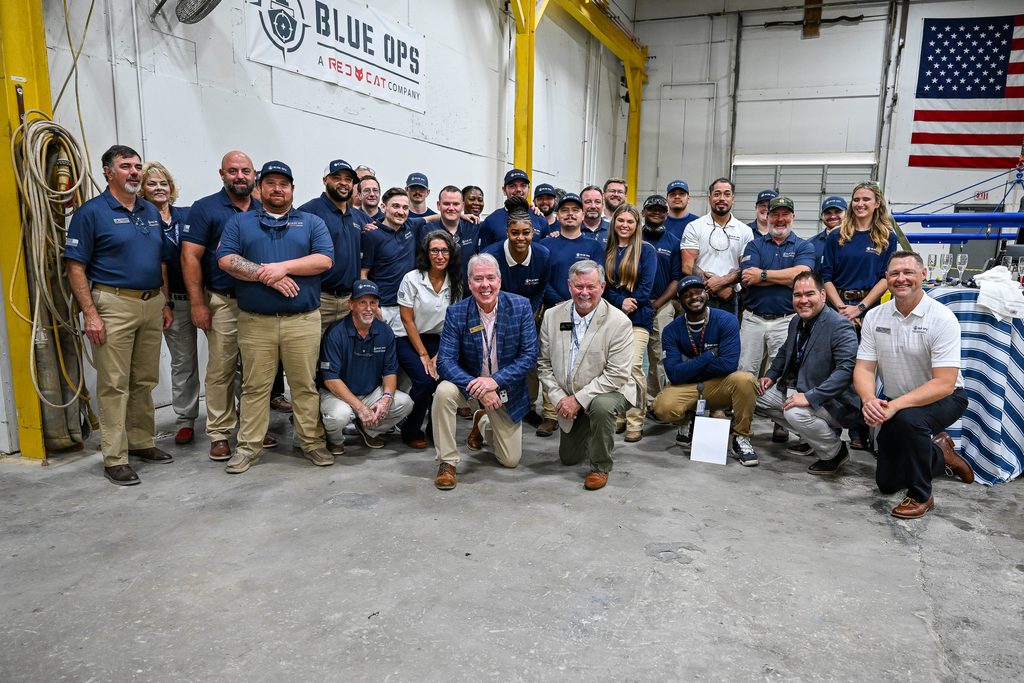
SALT LAKE CITY — Red Cat Holdings Inc., a U.S. based provider of advanced all domain drone and robotic solutions for defense and national security, announced that its Blue Ops maritime division marked the inaugural Blue Ops Day on September 21 with a celebration at the company’s manufacturing facility in Valdosta, Georgia.
Recognized through proclamations from the State of Georgia and Valdosta-Lowndes County, Blue Ops Day marked the culmination of a year of significant growth for Blue Ops in Georgia. Since leasing its 155,000-square-foot Valdosta facility in September 2025, Blue Ops has expanded its domestic manufacturing capabilities, announced plans to invest $30 million and create more than 200 local jobs, added advanced manufacturing technologies, and begun ramping its Variant 7 Uncrewed Surface Vessel (USV) into full-rate production.
The event recognized that progress with a celebration at the Valdosta facility, where Blue Ops has spent the past year building out the team, technology and infrastructure needed to support U.S. production of its growing family of USVs. Red Cat and Blue Ops leadership were joined by elected officials, employees and community leaders to recognize the milestone and Blue Ops’ growing role in Georgia and the U.S. maritime industrial base.
“America has a long history of leading the world in shipbuilding and innovation, and we have an opportunity to lead again,” said Barry Hinckley, President of Blue Ops. “The next generation of naval power will look different. Smaller, smarter, autonomous systems produced rapidly and at scale will operate alongside our traditional fleet. In Valdosta, we’re bringing American boatbuilding, advanced manufacturing and modern technology together to help revitalize our maritime industrial base and strengthen our nation’s capabilities at sea.”
The celebration brought together Red Cat and Blue Ops leadership, state and local government officials, and members of the Valdosta-Lowndes County community. Government attendees and speakers included Representative Austin Scott, Representative Rich McCormick, Georgia State Senator Russ Goodman, Valdosta Mayor Scott James Matheson, and Chairman of the Lowndes County Board of Commissioners Bill Slaughter.
During the event, Blue Ops showcased its Variant 5 and Variant 7 USVs. Guests toured the manufacturing floor to see where the company’s vessels are built and integrated, and the celebration included the christening of a Variant 7 before it was lowered into the facility’s test pool.
September 21 was formally recognized as Blue Ops Day through a statewide proclamation from the Governor’s Office and a joint proclamation from the City of Valdosta and Lowndes County, recognizing Blue Ops’ investment in the region and contribution to expanding U.S. maritime manufacturing capabilities.
Blue Ops, Red Cat’s maritime division, develops and manufactures a growing family of mission-adaptable USVs for U.S. and allied defense missions. The Valdosta manufacturing operation is part of Blue Ops’ growing U.S. footprint, alongside its headquarters and showroom in West Palm Beach, Florida. The Valdosta facility brings manufacturing, systems integration and testing capabilities together in one location, helping move maritime systems from design and engineering improvements to production.
Blue Ops’ continued growth in Valdosta expands Red Cat’s U.S. manufacturing footprint into the maritime domain while supporting the U.S. maritime industrial base through skilled manufacturing jobs and increased domestic capacity to build and deliver uncrewed systems for U.S. and allied forces.
From Red Cat Holdings, Sept. 24, 2026
U.S. Naval Forces Join Eight Nations in Exercise to Strengthen Maritime Security
YOKOSUKA, KANAGAWA, Japan — U.S. naval forces joined maritime forces from the Association of Southeast Asian Nations (ASEAN) Defense Ministers’ Meeting-Plus (ADMM-Plus) Experts’ Working Group (EWG) on Maritime Security Joint Cooperative Activity (MS JCA), Sept. 20.
Co-hosted by Japan and the Republic of the Philippines, the ADMM-Plus is executing the MS JCA as a multilateral maritime exercise designed to foster cooperation, enhance collective maritime domain awareness, and strengthen regional resilience against natural disasters.
“We are honored to be operating alongside our allies and regional partners for the MS JCA,” said U.S. Navy Capt. Bryan Gallant, operations officer for Commander, Task Force 76. “Practicing together now ensures we are ready before a crisis. This exercise builds the hands-on proficiency we need to coordinate smoothly and respond effectively to real-world challenges alongside our partners, keeping the Indo-Pacific free and open.”
Participating nations actively deploying ships, aircraft, and personnel include Australia, Brunei, India, Japan, New Zealand, the Republic of the Philippines, the Republic of Singapore, and the United States.
U.S. Navy participation included Independence-variant littoral combat ship USS Canberra (LCS 30) and a P-8A Poseidon maritime patrol and recoclass corvette INS Kulish (P63); Philippines Navy Jose Rizal-class frigate BRP Jose Rizal (FFG14) and Tarlac-class landing platform dock BRP Tarlac (LD601); Royal Australian Navy Anzac-class frigate HMAS Perth (FFH 157); Republic of Singapore Navy Independence-class littoral mission vessel RSS Justice; Royal Brunei Navy Darussalam-class offshore patrol vessel KDB Darussalam (06); and Royal New Zealand Navy Anzac-class frigate HMNZS Te Mana (F 111) and Polar-class sustainment vessel HMNZS Aotearoa (A 11).
Following the opening ceremony, the shore phase of the exercise will occur in Subic Bay, Zambales, Philippines, and feature a disaster-response tabletop exercise, subject matter expertise exchanges, an open house aboard participating ships, and cultural exchanges. The exercise will include a follow-on sea phase where key maritime skillsets and interoperability will be trained by the participants.
The ADMM-Plus is a platform for ASEAN and its dialogue partners to strengthen security and defense cooperation for peace, stability, and development in the region. The inaugural ADMM-Plus was convened in Ha Noi, Vietnam, Oct. 12, 2010. The ADMM-Plus EWG coordinates the MS JCA, which is a maritime exercise focusing on enhancing multilateral interoperability, information sharing, and practical cooperation among participating nations’ maritime forces to engage with a humanitarian assistance and disaster response scenario.
U.S. 7th Fleet, the Navy’s largest forward-deployed numbered fleet, routinely interacts and operates with allies and partners in preserving a free and open Indo-Pacific.
From Commander, U.S. 7th Fleet, Sept. 21, 2026
USNS William McLean Receives Presidential Unit Citation for Historic Deployment
NORFOLK, Va. — U.S. Navy Capt. Elizabeth Nelson, commodore, Military Sealift Command Atlantic (MSC Atlantic), welcomed home the civil service mariner (CIVMAR) crew of USNS William McLean (T-AKE 12), Sept. 2. She presented the team with the Presidential Unit Citation (PUC) award for an extraordinary deployment, supporting the USS Gerald R. Ford Carrier Strike Group (GRFCSG) during Operation Epic Fury (OEF).
McLean earned the PUC award alongside MSC’s fleet replenishment oiler USNS Kanawha (T-AO 196). Together, they share the historic distinction of being the first MSC Combat Logistics Force (CLF) vessels to receive this prestigious award. Kanawha received her award, July 17, 2026.
“You are the lifeline of the sea,” Nelson said. “McLean’s performance underscores the indispensable role that MSC’s CLF ships play in modern naval operations – ensuring U.S. and coalition forces remain forward, ready, and capable.”
Deployed for 179 days, the McLean served as a strategic enabler across the U.S. Fifth and Sixth Fleets, enabling sustained, port-independent operations for high-profile missions like OEF and Cobalt Shield. In its role as a floating warehouse, the ship replenished fuel, ammo, and stores while underway and eliminated the need for GRFCSG and other U.S. Navy and coalition warships to break station for logistical support.
At sea for 152 days , the McLean traveled 135,000 nautical miles. Sustaining 45 U.S. Navy and coalition ships, the crew executed 70 replenishments, transferred more than five million gallons of fuel, moved 1,900 cargo pallets, and transported 70 people.
The McLean crew also set the gold standard as goodwill ambassadors during 18 port visits to Greece and Italy. As MSC ambassadors, the crew helped to forge bonds of trust in the world of combat logistic sea services.
“The crew is proud to have been included in the recognition afforded by the battle group’s receiving the PUC, said Capt. Jeffrey Helfrich, McLean’s ship master. “The logistics support provided by William McLean was instrumental in the accomplishment of the mission”.
USNS William McLean is a Lewis and Clark-class dry cargo and ordnance vessel of the United States Navy Military Sealift Command. It is named in honor of William McLean, a United States Navy physicist, who conceived and developed the heat-seeking Sidewinder missile.
As part of MSC’s Combat Logistics Force vessels, McLean resupplies the fleet with fuel, stores, and ammunition, enabling Navy combat ships to remain at sea for extended periods.
MSC operates more than 140 civilian-crewed ships that replenish Navy vessels, preposition combat cargo, and move military supplies for deployed U.S. forces and coalition partners. Over the last 77 years, MSC has conducted hundreds of thousands of replenishments at sea.
HII Expands Unmanned Production Facility by 25% to Meet Growing Global Maritime Demand
POCASSET, Mass. — HII, a global leader in autonomous and unmanned maritime systems, celebrated the expansion of its unmanned systems production campus in Pocasset, Massachusetts, underscoring growing global demand for autonomous maritime platforms and the company’s continued investment in advanced unmanned maritime technology, New England’s skilled workforce and the region’s Blue Economy.
The expansion also advances the integration of HII’s Odyssey Autonomous Control Solutions (ACS) software, which supports advanced maritime autonomous and unmanned operations. These capabilities include simulation and modeling designed to support increasingly complex missions across multiple domains and vehicle types as well as autonomy hardware to be installed on ROMULS USVs.
HII celebrated the expansion with a ribbon-cutting ceremony attended by U.S. Rep. Bill Keating, MA-09, highlighting the company’s growing presence on Cape Cod and the region’s role in maritime technology and advanced manufacturing.
“Today’s expansion reflects HII’s continued investment in the people, technology and partnerships that have made us a leader in unmanned maritime capabilities and placed New England at the center for maritime innovation,” said Duane Fotheringham, president of the Unmanned Systems group in HII’s Mission Technologies division. “By bringing together advanced unmanned platforms, autonomy, integration, simulation and modeling capabilities, we are expanding our ability to deliver the maritime systems our customers need while continuing to create high-quality jobs here in Massachusetts.”
Keating has been a longtime supporter of HII’s operations in Massachusetts and served as a keynote speaker at the 2014 grand opening of HII’s unmanned production facility.
“HII’s continued growth on Cape Cod demonstrates how investments in advanced maritime technology can strengthen our national security while supporting good jobs and economic opportunity here in Massachusetts,” Keating said. “I was proud to join HII for the opening of the Pocasset manufacturing facility, and it is exciting to see how the company’s capabilities and workforce have continued to grow. The technologies being developed here strengthen the Blue Economy, support our maritime communities and help ensure the United States remains at the forefront of ocean innovation.”
HII currently employs approximately 300 people in Pocasset and has added 50 employees year to date in 2026, continuing a pattern of workforce growth in recent years. The expansion reflects the company’s ongoing commitment to Cape Cod and New England as a center for maritime technology development, advanced manufacturing and highly skilled employment.
HII’s unmanned systems heritage on Cape Cod is closely connected to its longstanding technology development partnership with Woods Hole Oceanographic Institution (WHOI). The collaboration has helped advance autonomous underwater technology and reflects the region’s concentration of scientific research, engineering and maritime expertise.
The technologies developed and produced in Pocasset support a broad range of missions. Beyond defense and national security applications, HII’s unmanned and autonomous systems support ocean exploration, academic and scientific research, environmental monitoring and commercial maritime operations.
REMUS UUVs provide autonomous undersea capabilities for missions ranging from oceanographic research and environmental monitoring to defense operations. HII’s ROMULUS USV family extends autonomous capabilities to the surface domain, while Odyssey autonomy provides a foundation for increasingly integrated autonomous operations. Together with HII’s advanced simulation and modeling capabilities, these technologies are designed to help customers plan, test and execute complex maritime autonomous and unmanned missions.
The REMUS family of UUVs, which celebrated its 25th anniversary in 2026, has been field-proven in naval and maritime operations around the world. HII has delivered more than 750 REMUS vehicles to customers in more than 30 countries, including 14 NATO members. More than 90% of REMUS systems delivered over the past 25 years remain in active service today.
The expanded Pocasset facility reinforces HII’s commitment to developing advanced maritime capabilities in Massachusetts while investing in the workforce and communities that support them.