A Panoply of USVs Graces the Gaylord Pier
By Brett Davis, Editor-in-Chief
In his keynote speech on Monday, Chief of Naval Operations Admiral Daryl Caudle said the future Golden Fleet will include a mix of main battle force ships and attritable, rapidly manufactured uncrewed systems.
To get started on his shopping Caudle would only need to take a short walk to the Gaylord Pier, where 10 exhibitors featured a variety of small to medium boats, many of them autonomous and uncrewed.
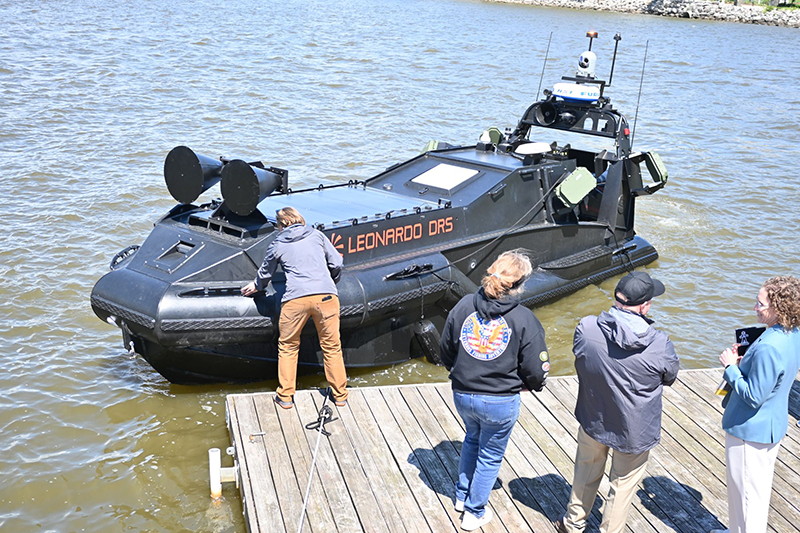
One was Leonardo DRS, which showcased its counter-UAS at sea system, which features a Ring counter-UAS system from partner Regulus mounted on a Sea Machines Stormrunner USV.
As presented at Sea-Air-Space, the system uses a GPS spoofer to defeat UAS, including small ones that can be detected up to about a kilometer away, according to Jason Beaty, Leonardo DRS’ program director for unmanned systems.
Further down the pier, California-based Navier made its show debut with two of its vessels, which can operate autonomously or with a crew. The company says its N30 Quanta-D system’s retractable hydrofoil design, based on the commercial N30 hydrofoil platform, enables superior speed, range and performance for the autonomous vessel.
The company has systems already deployed with the U.S. Navy, said Navier founder and CEO Sampriti Bhattacharyya, although she could not discuss specifics.
The N30 Quanta-D has a 2,000 nautical mile range, could be built quickly by a variety of shipyards and is cheap to operate, she said.
“This boat costs 50 percent less to operate, or much less [than comparable vehicles],” she said. “You think of hundreds of these boats over 10 years, or even five years, or three years, the operational cost savings adds up massively. So, everybody is thinking attritable, but even beyond attritable, these are definitely low cost to build but the operational cost is also super, super low.”
Another company on the pier is Michigan-based Ghostworks, which has a family of carbon fiber systems in use by Special Operations Forces and commercial users, said Britt Ward, the company’s chief naval architect.
The company was formed four years ago and marked its third appearance at Sea-Air-Space, Ward said. Ghostworks’ MUT 3.5-meter composite USV, its smallest, aimed at attritable and intelligence, surveillance and reconnaissance missions, and Magic, an eight-meter foil-assisted catamaran which can carry electronic equipment, nonlethal payloads and autonomous controls.
Further down the pier is BlackSea Technologies, which is displaying two small new USVs, Chaser and Comet.
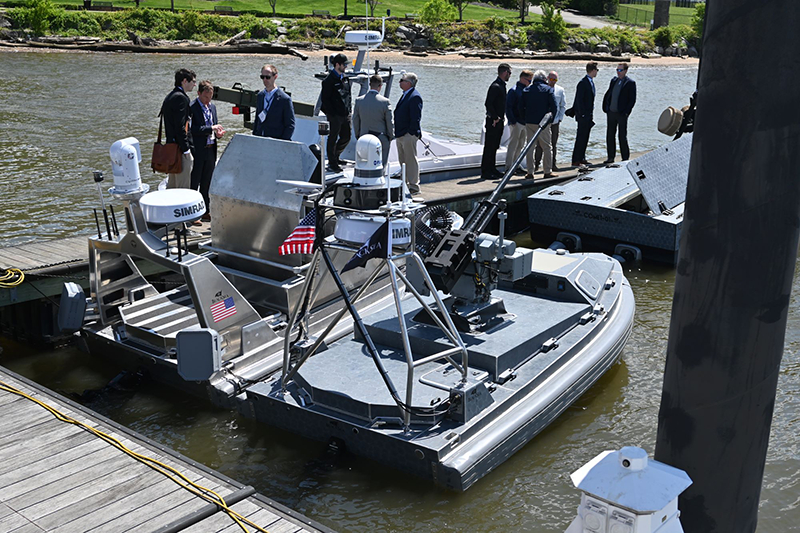
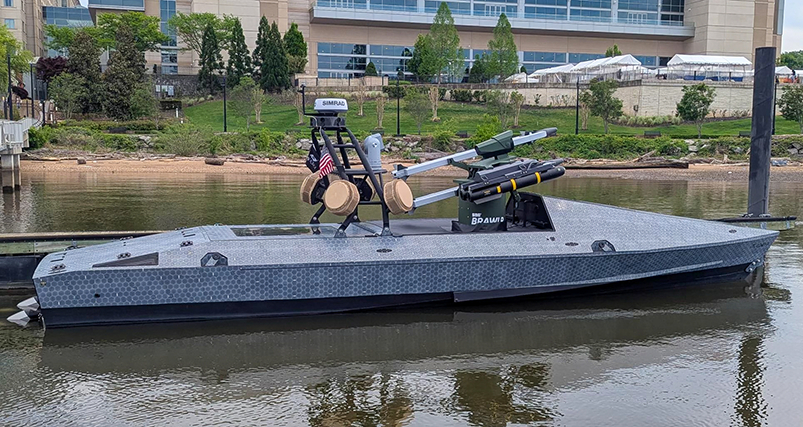
“Chaser and Comet reflect our focus on giving operators scalable, mission ready platforms that can adapt quickly to evolving threats and mission demands,” BlackSea President Bob Pudney said in a press release. “We are proud to launch them alongside a group of industry partners whose technology helps make these vessels possible.”
Chaser is a small USV designed to expand payload capacity, range and mission flexibility while maintaining rapid deployability and ease of use (meeting the Navy requirement to fit in a 20’ shipping container).
Comet is BlackSea’s larger, high speed combat ready platform, designed to bridge the gap between small tactical USVs and larger unmanned combat craft. The 13.1 meter vessel can exceed 45 knots, carry a 10,000 pound payload including fuel, and support advanced payloads for missions including counter UAS, mine countermeasures, surface warfare, antisubmarine warfare, electronic warfare, maritime domain awareness and high value unit escort.
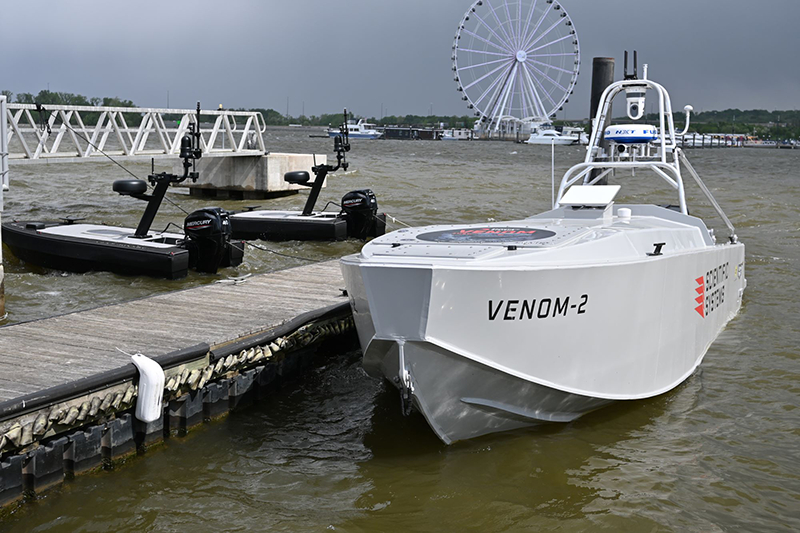
Other companies displaying on the pier include Scientific Systems with its Vehicle for Expeditionary Naval Over-the-Horizon Missions (VENOM), announced last year; Martec with its Mantas T38 Devil Ray autonomous USV, which has been used in various military exercises; Textron Systems with its Tsunami USV, which the company says is ready for mission-ready autonomy and is based on a commercial hull; Saronic with its Corsair USV, which debuted last year at Sea-Air-Space; HavocAI, whose software-defined hardware approach powers military and commercial autonomous systems; Maritime Robotics, which builds small “sea drones;” and Zodiac Milpro, one of the rare boats on the pier intended to carry people.