Addressing Challenges Ahead: NAVAIR Leadership Discusses Organizational Changes and Industry’s Role at Sea-Air-Space
From Naval Air Systems Command, Apr 21, 2026
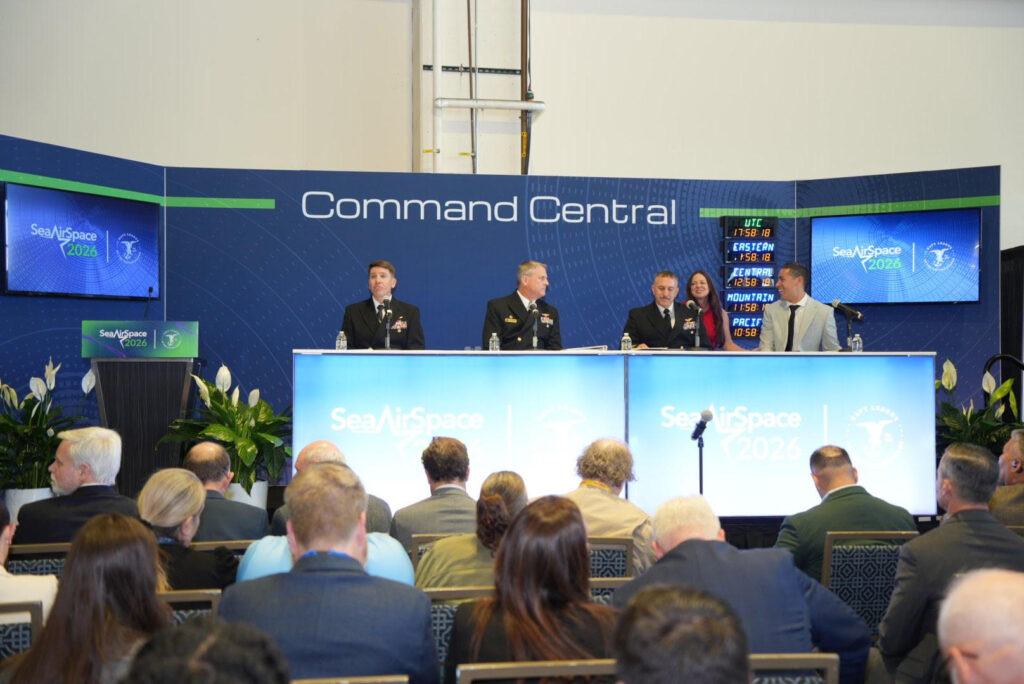
NATIONAL HARBOR, Md. — NAVAIR personnel kicked off Tuesday at Sea-Air-Space Exposition 2026 with “Start with the Fleet: Readiness, Capability, Speed,” a panel led by NAVAIR Commander Vice Adm. John E. Dougherty IV, who was joined by Rear Adm. Todd Evans, Commander, Naval Air Warfare Center Aircraft Division and chief engineer with NAVAIR; Vice Commander Capt. Joseph Hidalgo, representing Commander, Fleet Readiness Centers (COMFRC); and Paul McGinty, director of the NAVAIR Rapid Capability Cell.
Dougherty began the panel by laying out NAVAIR’s highest priorities.
“[At NAVAIR we need] to develop our people and grow our culture, to provide the readiness the warfighter needs, to accelerate delivery capability and to elevate our game,” he said. “It’s about focusing on outcomes and transforming our business so that we find better ways to deliver capability to the warfighter. We have got to go quicker, and I know that we’re ready to meet that challenge.
“What we can’t forget is that we’re in a great power competition, and in great power competition, the bar for our performance is raised. The threat is moving very fast in terms of capability and capacity and it’s up to us to get after that.”
Dougherty said the Navy is currently transitioning to Portfolio Acquisition Executive organizations. Under the PAE model, leaders are empowered —and expected— to make disciplined, data-driven trade-offs across cost, schedule and performance, with a clear priority on time to field. Additionally, each PAE is responsible for understanding and actively managing the industrial base supporting their portfolio, including production capacity, supply chain risk and opportunities to expand or diversify suppliers. He encouraged industry partners to “be aggressive” in engaging with naval aviation programs during this time to get input and ideas and keep the production engines running.
“This is a generational opportunity for this industry,” Evans said regarding the acquisition changes. “This industry has been around for a long time, and we’ve always heard ‘go fast, just go faster.’ That is tremendously difficult to change. In order to enable that change, we also have to change.”
“What gets me excited about it for naval aviation is [having a] single, accountable owner,” Dougherty said. “[The way we are organized now] there isn’t really one leader that’s in charge of making sure that all our capability roadmaps are aligned, that we’re putting our dollars toward the most consequential outcomes as we deliver warfighting capability. I like ‘portfolio’ over ‘program management.’ It’s about integrated warfighting capability. I think there is real opportunity in this PAE structure to drive better warfighting outcomes across all our programs with a capability mindset.”
Hidalgo highlighted the depot work done at the various Fleet Readiness Center sites, where most maintenance and sustainment work is performed on aircraft components and engines.
“We’re here for the warfighter,” Hidalgo said. “COMFRC is one of the sole source places where we can do work that gets it to the warfighter right there on the flight line. We get direct calls back from the warfighters because we’re on the flight line and working hand in hand with industry to help us improve anything we need to get done in a more expeditious timeframe.”
“On the rapid capability front, we’re trying to connect those [warfighter] needs and capabilities to true outcomes,” McGinty said, outlining what the NAVAIR Rapid Capability Cell is focused on. “We’re partnering with industry early, bringing our resources to bear with the expertise we have resident in our warfare centers and working within the systems and authorities we have … I think the key to this is really connecting to those problem sets, really trying to break down the barriers between what the warfighter needs and what we are asking industry to do and pin us all up in that space together to get after it.”
In response to a question about what keeps the panelists up at night, Dougherty said he knows that there is someone in NAVAIR who knows how to do things better.
“I don’t know it, but they do, and I need to get that information,” he said. “I believe that good ideas come from the heart of the organization. Our people are our most important asset. We have a world-class workforce here at NAVAIR. They’ve got fantastic ideas. I worry that there’s a lot more of that for us to tap into.”
“I want to make sure we are taking care of our people, making sure that they are adequately trained, that they have the equipment they need, and have the components [for aircraft],” Hidalgo said. “The people that we have at FRC are driving to get readiness to the warfighter. That is one of the things that keeps me up at night, making sure we have the things ready for the warfighter.”
When asked how NAVAIR is changing the contracting process in order to speed projects along, Dougherty said the organization is always “looking for ways to accelerate that timeline.”
“Our contracts team on the government side does pretty good on hitting their timelines. The ask that I would have for industry is to hit the timelines and get proposals back Negotiations can take too long, for sure, so there’s room for improvement.”
Dougherty said industry is needed now to help with current needs as well as any coming future fight.
“That future fight is maybe not so distant, if you look at the geopolitics in the world,” he said. “I would double-down on my message of urgency and double-down on the message that we have many operational needs. I need to connect you to those operational needs better and I want your thoughts.
“We’re in great power competition and we intend to win. And we’re going to get after it with you.”