Aircraft Carrier Suppliers Warn of Production Going Cold
By Richard R. Burgess, Senior Editor
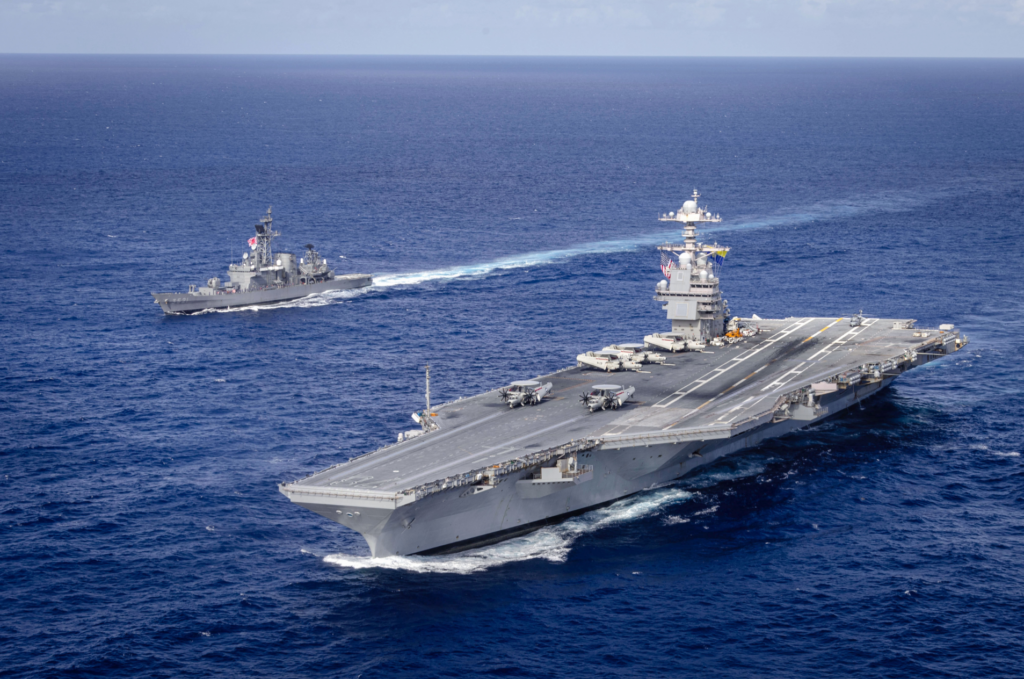
ARLINGTON, Va. — The coalition of industrial base suppliers for aircraft carrier production is warning that some suppliers’ production lines are going “cold” or soon will do so in there is further delay in starting procurement for the next Gerald R. Ford-class aircraft carrier, (CVN 82).
The Aircraft Carrier Industrial Base Coalition (ACIBC) is looking for a $600 million commitment from the Congress in advance procurement toward the construction of CVN 82. Last week ACIBC leaders and members met with members of Congress to discuss carrier funding.
“We’re asking for $600 million of advance procurement funding so that we can start long-lead material and get that ball rolling [for CVN 82],” said Lisa Papini, chair of the ACIBC. “We’re looking for a commitment to start CVN 82 no later than Fiscal Year 2029.”
Papini said the situation is worse for suppliers this year than last.
“Last year when we were here, we were warning that companies in our coalition without a new ship award would start to go cold, specifically, people that are doing continuous production lines would start to have those production lines go cold in the near future,” she said. “This year we have companies that are saying they have gone cold, or they will be cold — and by cold, I mean that that production line has ceased continuous operation.”
According to an ACIBC fact sheet with the results of a survey of 219 suppliers, 73% of member critical or single-source material supply lines are cold or will go cold in 2026 without the advance funding. Those percentages would increase in 2027 and 2028 to 83% and 96%, respectively, without the advance funding. A majority of the suppliers also provide products and materials for submarine construction as well.
To deal with the business delays, suppliers are reassigning workforce to other business or exploring other business outside of shipbuilding, the fact sheet said.
Papini said that the worsening situation does not match with the nation’s demand for aircraft carriers around the world, noting that in recent years carrier deployments have been extended numerous times and that longer deployments result in more need for supplier support and maintenance.
“The companies who support and who provide products to the new construction [carriers], so CVN 82, are the companies who provide the service and parts to sustain carriers and overhaul carriers as well, so as production lines start to go cold, the ability to support carriers in service and support overhauls decreases,” Papini said. “We’re at this inflexion point.”
She stressed that the industrial base “has such a significant role in supporting the ships when they are in service, helping them achieve their actual service life, keeping them running. It’s the companies across the country who have supplied the equipment, the parts, the services when something needs repair.”
The ACIBC would like to see Congress authorizing a two-carrier procurement, CVN 82 along with CVN 83. CVN 80 and CVN 81 were procured in such a manner.
“We know that that’s the best way to procure ships, to specifically procure aircraft carriers — so a two-carrier buy with three years of advanced procurement funding for long-lead material and four-year centers,” Papini said.
The Navy has stated that the optimum procurement profile for CVNs is two-ship procurement with at least three years of advance procurement and construction at four-year intervals.