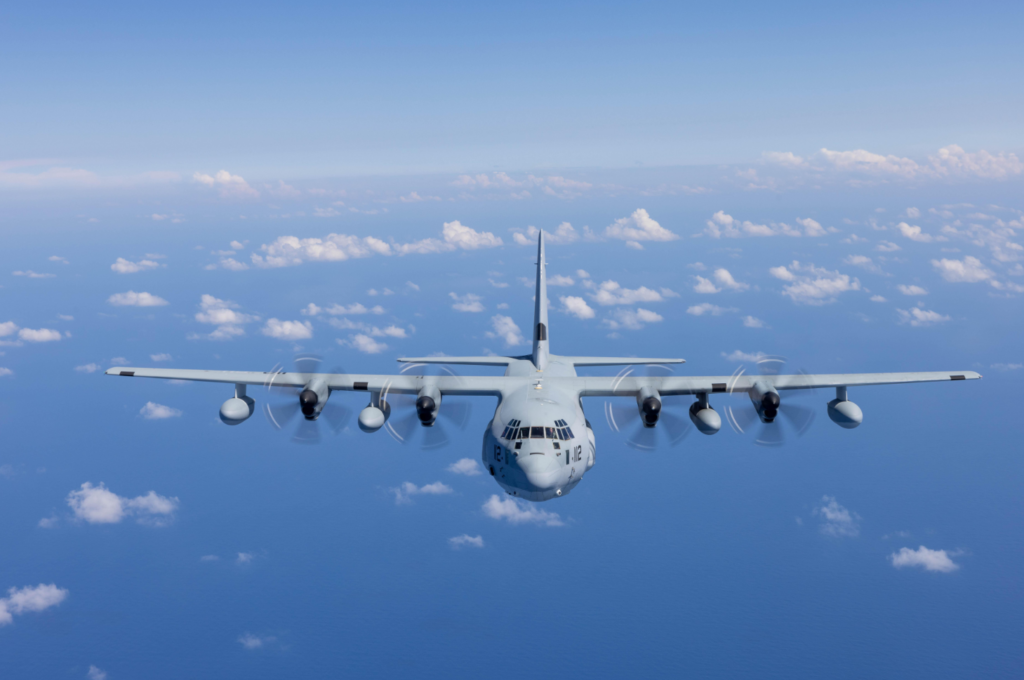
A KC-130J Super Hercules, assigned to Marine Aerial Refueler Transport Squadron 252, 2nd Marine Aircraft Wing, flies during a training exercise. The Hercules is celebrating 70 years and counting since its inception in 1954. Today, the C-130 Hercules is used in over 70 countries with more than a million flight hours and growing. (U.S. Marine Corps photo)
From Naval Air Systems Command, Jan. 14, 2025
PATUXENT RIVER, Md.–The ever-enduring C-130 Hercules celebrated 70 years of unwavering service last year. Since its inception in 1954, the Hercules continues to be used in over 70 countries with more than a million flight hours and growing.
Seven decades ago, the C-130 had an original usage as a medium cargo plane able to land in short, confined runways. As the mission and needs of the fleet changed, the aircraft moved into providing tactical airlift, humanitarian aid, air support, and various mission support across the globe.
The C-130 has had over 70 variants, 15 of which are actively being produced by Lockheed Martin today, and is distinguished by having the longest continuous military aircraft production run in history. From aerial command centers to weather observation and, occasionally, an aerial drone carrier, the Hercules meets the needs of the fleet. The C-130 has lent its services to nearly every mission capability needed for military or civilian application.
The U.S. Navy and Marine Corps employ multiple variants to provide assault and logistics support, including the KC-130J “Super” Hercules. This “super” plane includes the troops and cargo transport capabilities of other C-130 variants and adds air-to-air refueling capability for helicopter, fixed wing, and tilt-rotor receiver aircraft to its mission.
One standout variant is the C-130J assigned to the U.S. Navy Flight Demonstration Squadron. Affectionally named Fat Albert, the C-130 made its Blue Angels debut in 1970 and continues to fly alongside F/A-18E Super Hornets in airshows around the world.
The C-130 is responsible for supplying mission critical troops and materials in every American military conflict since the mid-20th century. This stellar aircraft can deliver a variety of airlift support, including parachute or ground delivered combat troops or cargo, such as vehicles, supplies, and evacuation support.
“There is no more versatile aircraft than the C-130,” said Col. Steven Puckett, program manager Tactical Airlift Program Office (PMA-207). “As a C-130 pilot and now the program manager for Navy and Marine Corps variants of the platform, maintaining the combat relevance and reliability of this critical logistics support aircraft is my organization’s highest priority.”
Tactical Airlift Program Office manages the cradle to grave procurement, development, support, fielding and disposal of the Navy’s tactical airlift platforms, including the C-130.
SECNAV Del Toro Names Future Aircraft Carriers CVN 82 and CVN 83
From SECNAV Public Affairs, Jan. 13, 2025
WASHINGTON – Secretary of the Navy Carlos Del Toro announced the names of two future Gerald R. Ford-class of aircraft carriers as the future USS William J. Clinton (CVN 82) and the future USS George W. Bush (CVN 83).
The future USS William J. Clinton honors President William J. Clinton, 42nd President of the United States of America, serving two terms from 1993 to 2001. The future USS George W. Bush honors President George W. Bush, 43rd President of the United States of America, serving two terms from 2001 to 2009. This will be the first Navy vessel named for either president.
The names follow the Navy tradition of often naming aircraft carriers after U.S. presidents.
“President Clinton and President Bush led the United States through some of the most challenging moments in U.S. history,” said Secretary Del Toro. “Their legacies will endure through these aircraft carriers, which serve as formidable platforms dedicated to safeguarding our national security and strengthening our resolve to protect this Nation against any who would threaten our freedoms and way of life.”
As Commander-in-Chief, Clinton was responsible for multiple military operations that achieved success with no combat casualties including Operation Uphold Democracy in 1994, Operation Deliberate Force in 1995, and Operation Allied Force in 1999. In response to a reported Iraqi attempt to assassinate former President H.W. Bush, President Clinton directed a U.S. Navy cruise missile strike against Iraqi intelligence headquarters in 1993, and another cruise missile strike in 1996, Operation Desert Strike, to deter Iraqi aggression. These strikes were followed in 1998 by Operation Desert Fox, an air campaign to degrade Iraqi capability to produce weapons of mass destruction. In 1996, he directed the largest deployment of U.S. naval forces since the Vietnam War in response to the Third Taiwan Straits Crisis to deter Chinese aggression.
Among his numerous diplomatic achievements, President Clinton had a pivotal role in the Oslo Accords, which established a framework for peace between Israel and Palestinians and was also instrumental in the Good Friday Agreement of 1998, which ended conflict in Northern Ireland. He declared Iran a “state sponsor of terrorism” and imposed substantial sanctions on Iran. An integral part of the “Agreed Framework” of 1994, his efforts temporarily halted North Korean attempts to develop nuclear weapons. He established full diplomatic relations with Vietnam and oversaw the first expansion of NATO since 1982, with the addition of Poland, Hungary and the Czech Republic, as well as creating the Partnership-for-Peace program with nations of the former Soviet Union.
“It’s never far from my mind that the precious freedoms Americans enjoy are safeguarded by our armed forces, anchored by a strong, modern, and agile Navy. I’m honored that future servicemembers carrying on that proud tradition will serve on a carrier bearing my name,” said President Bill Clinton.
During a private ceremony at the White House on Jan. 3, 2025, along with the ship’s name, Secretary Del Toro announced the sponsor for the future USS William J. Clinton (CVN 82) will be Ms. Chelsea Clinton, daughter of President Clinton. She will represent a lifelong relationship with the ship and crew.
As Commander-in-Chief, President Bush rallied the nation in the immediate aftermath of the terrorist attacks on 11 September 2001. He forged an international coalition of 25 NATO members and 17 partner nations to execute Operation Enduring Freedom, dismantling terrorist networks in Afghanistan. He spearheaded the largest U.S. government reorganization since 1947, creating the Department of Homeland Security by combining 22 federal agencies and establishing the Office of the Director of National Intelligence to integrate operations across 18 intelligence agencies. He also signed the USA Patriot Act, updated the Foreign Intelligence Surveillance Act, and directed deployment of aggressive financial measures to freeze terrorists’ assets.
In 2003, he directed Operation Iraqi Freedom, which ended the dictatorship of Saddam Hussein and enabled Iraq’s first direct elections in over three decades. On the global stage, President Bush supported a further expansion of NATO into Eastern Europe and the Baltic States, while working with Russia to reduce nuclear weapons stockpiles. Recognizing the evolving nature of global threats, he directed the establishment of the U.S. Africa Command and advanced the planning for U.S. Cyber Command. He also launched the President’s Emergency Plan for AIDS Relief (PEPFAR), a historic humanitarian initiative that saved millions of lives. Throughout his tenure, President Bush increased defense spending by more than a third to modernize the military and accelerate technological advancements, ensuring the United States Armed Forces remained the most capable in the world.
“I am honored that my name will be associated with the United States Navy and a symbol of our Nation’s might,” said former President Bush. “I have a special admiration for the men and women of our Navy – including my dad – and ask God to watch over this ship and those who sail aboard her.”
Aircraft carriers are the centerpiece of America’s Naval forces – the most adaptable and survivable airfields in the world. On any given day, Sailors aboard an aircraft carrier and its air wing come to the fight trained and equipped to fulfill a wide range of missions. They are ready to control the sea, conduct strikes, and maneuver across the electromagnetic spectrum and cyberspace. No other naval force fields a commensurate range and depth of combat capabilities.
Ex-USS John F. Kennedy to Commence Final Transit, Jan. 16
By NAVSEA Public Affairs, Jan. 14, 2025
PHILADELPHIA — The ex-John F. Kennedy (CV 67) is scheduled to commence its final transit from the U.S. Navy’s Inactive Ships Maintenance Facility in Philadelphia to Brownsville, Texas for dismantling, Jan. 16.
Upon departure early on Wednesday morning, the ship will be visible from the waterfronts along the Delaware River as the ship transits through the Delaware Bay and into the North Atlantic Ocean.
Commissioned on Sept. 7, 1968, CV 67 was the first Navy ship to be named John F. Kennedy and was the last conventionally powered aircraft carrier built by the U.S. Navy.
The ship conducted 18 deployments including to the Mediterranean, Tyrrhenian, Ionian, Ligurian, Aegean and Adriatic seas, during a period of escalating tension in the Middle East and North Africa, often while under the surveillance of Soviet ships.
In the wake of the September 2001 terrorist attacks, the John F. Kennedy and her battle group established air security along the mid-Atlantic seaboard, “to help calm a fearful and shocked Nation,” in support of Operation Noble Eagle. In February 2002, the ship deployed in support of Operations Anaconda and Enduring Freedom, followed by support of Operation Iraqi Freedom in July of 2004.
In 2005-2006, she served as a training platform and her final port visit was to Boston, MA in March 2007. After more than 39 years of conducting U.S. Navy missions worldwide, CV 67 was removed from service on August 1, 2007.
For more about Ex- USS John F. Kennedy’s historic contributions to the nation, visit:
BAE Systems Awarded $85 Million Contract to Deliver Network Tactical Common Data Links to the U.S. Navy
NTCDL enhances situational awareness and tactical battlefield advantage of the U.S. Navy through real-time and simultaneous networked operations
From BAE Systems, Jan. 14, 2025
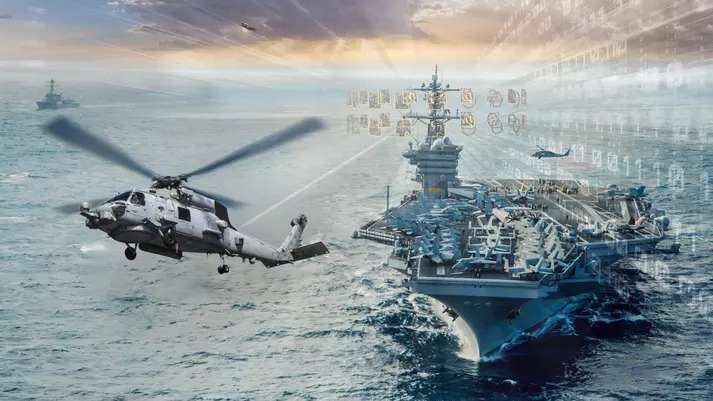
WAYNE, N.J. — Jan. 14, 2025 – In 2024, the U.S. Navy awarded BAE Systems an $85 million production contract to deliver additional Network Tactical Common Data Link (NTCDL) systems. NTCDL will enable a real-time exchange of voice, data, imagery, and full-motion video from a variety of air, surface, subsurface, and man-portable sources. Systems under the company’s current contract are presently being installed on U.S. Navy aircraft carriers and will be installed on new Constellation-class frigates.
“We have designed and produced a faster next-generation system to meet the demands of our customers’ evolving connectivity mission requirements,” said Amber Dolan, director of Adaptive Communications and Sensing at BAE Systems. “BAE Systems is committed to providing the U.S. Navy with a trusted and secure solution to transmit and receive the critical information needed to successfully accomplish its missions across the fleet.”
NTCDL is a multi-platform solution for all U.S. Navy Common Data Link (CDL) requirements. It is a modular, scalable system designed to increase link capacity and embrace waveform evolution. NTCDL supports multiple, simultaneous, networked operations using currently fielded CDL equipment, as well as next-generation manned and unmanned platforms. It enables operators to simultaneously transmit and receive real-time intelligence, surveillance, and reconnaissance data from multiple sources and exchange command and control information across separate or independent networks. This allows for effective communication among forces to maintain an advantage.
This award modifies an existing BAE Systems contract to extend the program’s total period of performance by three years. As the original developer and manufacturer of the NTCDL system, BAE Systems has the engineering and production capabilities to meet the program’s urgent fielding timeline requirements.
Work on this contract is performed at BAE Systems’ facilities in Maryland, Colorado, New Jersey, and New York.
Florida-Based Cutter Returns Home After 40-day Patrol in the Eastern Pacific Ocean
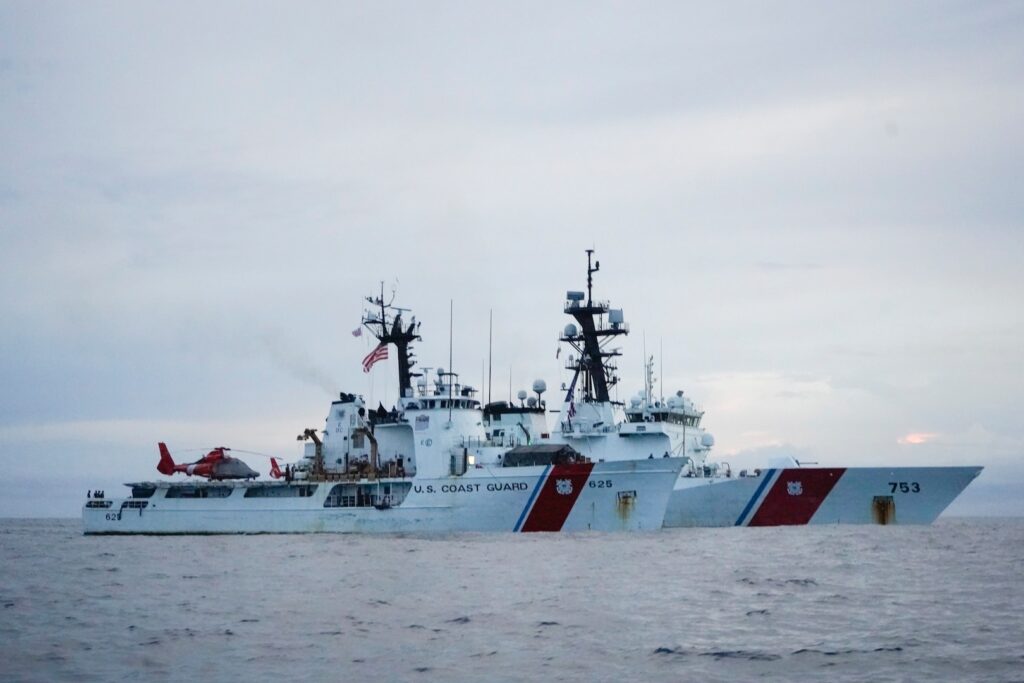
Coast Guard Cutters Venturous (WMEC 625) and Hamilton (WMSL 753) rendezvous at sea, Nov. 21, 2024, in the Eastern Pacific Ocean. Venturous’ crew conducted a 40-day counter drug patrol within the Coast Guard Eleventh District area of responsibility in support of Joint Interagency Task Force – South. (U.S. Coast Guard photo)
From U.S. Coast Guard Atlantic Area, Jan. 13, 2025
ST. PETERSBURG, Fla. — The crew of Coast Guard Cutter Venturous (WMEC 625) returned to their home port in St. Petersburg, Dec. 11, following a 40-day patrol in the Eastern Pacific Ocean.
Venturous’ crew deployed in support of Joint Interagency Task Force – South (JIATF-S) and conducted counter-drug missions in the Coast Guard Eleventh District’s area of responsibility.
Crew members worked alongside an embarked MH-65E Dolphin aircrew from the Coast Guard Helicopter Interdiction Tactical Squadron (HITRON) and law enforcement detachment boarding team members from the Tactical Law Enforcement Team – Pacific.
While underway, Venturous’ crew stopped two drug-smuggling vessels during separate interdictions at sea. During one interdiction, the cutter’s embarked HITRON aircrew assisted in interdicting a vessel carrying 4,270 pounds of marijuana.
Days later, the cutter’s boarding team interdicted a low-profile vessel and seized approximately 165 pounds of cocaine.
Along with the illicit narcotics, Coast Guard crew members apprehended six suspected smugglers who will face prosecution in federal courts by the U.S. Department of Justice.
While deployed, Venturous’ crew navigated the Panama Canal enroute to the Pacific Ocean, crossed the equator, travelled more than 8,800 nautical miles and made ports of call in Central and South America.
During a port of call in Manta, Ecuador, the crew hosted five senior officers from the Ecuadorian Navy (Armada del Ecuador) for a tour and diplomatic engagement. The partner-building event highlighted the recent success of enacting a bilateral agreement between the two nations. The “Agreement Between the United States of America and the Republic of Ecuador Concerning Counter Illicit Transnational Maritime Activity Operations” was entered in force on Feb. 23. Venturous also embarked an Ecuadorian Coast Guard (Armada del Ecuador Guardacostas) officer for two-weeks as part of the new shiprider program to help combat illicit maritime activity, including narcotic smuggling operations and illegal, unreported and unregulated fishing in the region.
“A St. Petersburg-based cutter, we were hit by both Hurricanes Helene and Milton a month before the scheduled patrol. We took care of each other and Atlantic Area Command shifted our schedule to accommodate the devastation our crew and their families faced,” said Cmdr. Karen Kutkiewicz, commanding officer of Venturous. “I am super proud of my crew, their resilience, and their devotion to duty. Our training came to fruition, and we optimized our time in vector with two drug busts within one week, including an elusive low-profile vessel.”
The Coast Guard plays a critical role in securing U.S. maritime borders and is the lead federal maritime law enforcement agency for drug interdiction on the high seas.
Detecting and interdicting illicit drug traffickers on the high seas involves significant interagency and international coordination. JIATF-S based in Key West, Florida conducts the detection and monitoring of aerial and maritime transit of illegal drugs.
Venturous is a 210-foot, Reliance-class medium endurance cutter with a crew complement of 76. The cutter’s primary missions are counter-drug and migrant interdiction operations, enforcement of federal fishery laws and search and rescue in support of U.S. Coast Guard operations throughout the Western Hemisphere. The cutter was commissioned in 1968 and falls under the command of U.S. Coast Guard Atlantic Area, which is based in Portsmouth, Virginia.
For information on how to join the U.S. Coast Guard, visit GoCoastGuard.com to learn about active duty, reserve, officer, and enlisted opportunities. Information on how to apply to the U.S. Coast Guard Academy can be found here.
RTX’s Raytheon awarded $333 million contract for SM-6 Block IA production
Missile supports anti-air, anti-surface warfare and sea-based terminal ballistic missile defense in one solution
From RTX, Jan. 13, 2025
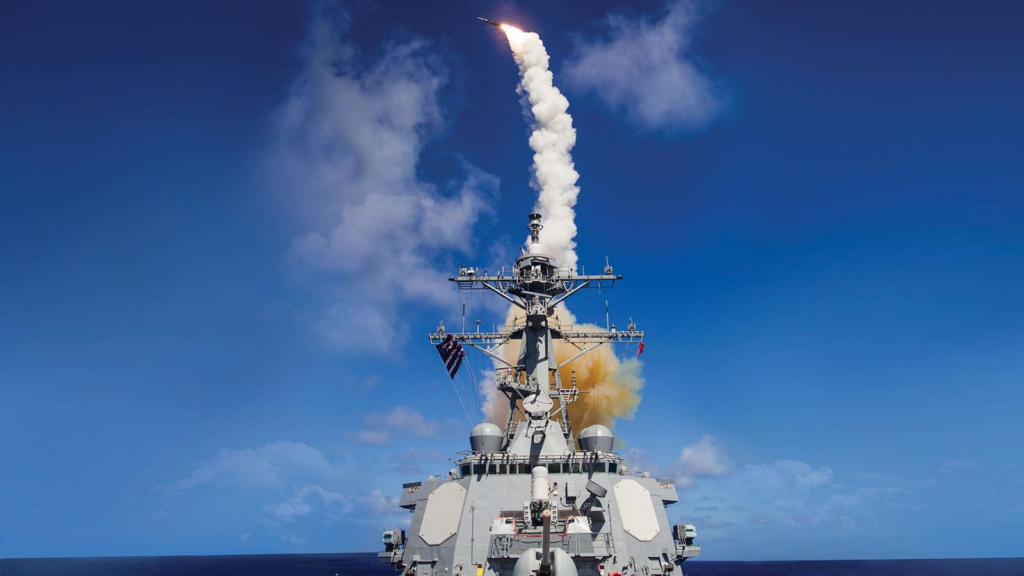
TUCSON, Ariz., Jan. 13, 2025 /PRNewswire/ — Raytheon, an RTX (NYSE: RTX) business, was awarded a $333 million contract from the U.S. Navy to produce Standard Missile-6 (SM-6) Block IA missiles.
“SM-6 has a proven performance, and this contract is an important step for providing this urgently needed weapon to our armed forces,” said Barbara Borgonovi, president of Naval Power at Raytheon. “Raytheon continues to work closely with our customers to ensure our military has an unfair advantage at sea and to keep our adversaries guessing.”
Deployed on U.S. Navy ships, SM-6 delivers a proven, over-the-horizon offensive and defensive capability by leveraging the time-tested Standard Missile airframe and propulsion system. It’s the only missile that supports anti-air and anti-surface warfare and sea-based terminal ballistic missile defense in one solution, enabling the U.S. and its allies to cost-effectively increase the offensive might of surface forces.
SM-6 has been successfully fired from various U.S. Navy ships, unmanned vessels, and launchers on land. In March 2024, SM-6 demonstrated its anti-missile capabilities by successfully intercepting a medium-range ballistic missile target at sea during the Flight Test Aegis Weapon System (FTM)-32 exercise.
Production under this contract will be completed at Raytheon facilities in Tucson, Ariz., Huntsville, Ala., Andover, Mass., and Dine, N.M. with expected completion by 2027.
Teledyne FLIR Defense Awarded $74 Million IDIQ Contract to Modernize U.S. Coast Guard Surveillance Systems
Company has provided Coast Guard imaging solutions used for search & rescue and other maritime missions for 20 years
From Teledyne FLIR Defense, Jan. 13, 2025
BOSTON, Mass., January 13, 2025 ― Teledyne FLIR Defense, part of Teledyne Technologies Incorporated (NYSE:TDY), announced it has been awarded a five-year Indefinite Delivery Indefinite Quantity (IDIQ) contract worth up to $74.2 million to provide modernized imaging surveillance systems to the United States Coast Guard (USCG).
FLIR Defense will deliver more than 125 Electro-Optic Sensor System-Modernized (ESS-M) systems for use on USCG rotary wing aircraft, specifically the MH-60 and MH-65. The advanced ESS-M platform features a full-HD sensor suite and updated user interfaces, as well as advanced processing capabilities and software enhancements that will support future growth.
The ESS-M systems provide operators with high-definition daylight, low light, and infrared imagery and will be used in support of all Coast Guard missions, with an emphasis on search and rescue, living marine resources, and law enforcement. The new technology also will augment coastal security, drug and migrant interdiction, ports and waterways protection, and other Coast Guard rapid response needs.
Teledyne FLIR Defense has been delivering and supporting legacy ESS systems for USCG medium- and short-range recovery aircraft since 2005.
“The significant updates through ESS-M will enable the U.S. Coast Guard to stay on technology’s cutting edge while conducting its wide range of key maritime operations,” said Dr. JihFen Lei, president of Teledyne FLIR Defense. “We’re proud to extend our history of support and look forward to building our relationship across all missions areas.”
Deliveries will begin in Q4-2025. For more on Teledyne FLIR’s maritime surveillance solutions, visit us online.
SECNAV Del Toro Names Future Columbia-class Submarine SSBN 828
From SECNAV Public Affairs, Jan. 13, 2025
WASHINGTON – Secretary of the Navy Carlos Del Toro announced Jan. 13 that the newest Columbia-class ballistic missile submarine will be named the future USS Groton (SSBN 828).
The announcement was made during Del Toro’s video remarks directed to the Department of Navy’s (DoN) submarine community.
“Our ballistic-missile submarines form a critical pillar of the Nation’s nuclear triad, playing an indispensable role in deterring conflict while upholding strategic stability,” said Secretary Del Toro. “Building on this strategic foundation, it is with great pride that I now turn to the next chapter in our Navy’s capabilities.”
Groton honors the port town in Connecticut and three previous vessels so named: a frigate (1944-1946), a patrol craft (1945-1960), and a nuclear fast attack submarine (1978-1997). USS Groton (SSBN 828) will be the third named Columbia-class submarine.
Both Senators for Connecticut expressed their appreciation for the naming and the constituents of the city of Groton.
“Naming the USS Groton recognizes this iconic Connecticut town as the submarine capital of the world — honoring the unsurpassed skill and dedication of men and women who work there. Groton has a rich shipbuilding legacy, and proven commitment to our national defense — manufacturing and maintaining vital weapons platforms, sustaining our undersea superiority,” said Sen. Blumenthal. “It is a proud community of hard workers, veterans, patriots, and public servants, and this honor celebrates them.”
“It’s only fitting the U.S. Navy is naming our next Columbia-class submarine after Groton, Connecticut — the submarine capital of the world,” said Sen. Murphy. “This is a well-deserved recognition of Groton’s rich history as a global leader in submarine technology and innovation, and a home to the thousands of Electric Boat workers and small businesses who power our nation’s naval defense. I will continue to use my seat on the Senate Appropriations Committee to make sure the next administration advances our submarine programs quickly and cost-effectively,
supports our maritime industrial workforce, and ensures the full and timely delivery of the cutting-edge submarines we need to uphold our national security.”
Rep. Courtney highlighted the legacy of Groton and the impact of Del Toro’s decision to name SSBN 828.
“Today’s decision by the US Navy to honor Groton, Connecticut as the name of its next submarine is welcome news. Groton is the birthplace of the modern nuclear-powered Navy under Admiral Hyman G. Rickover and home to our nation’s oldest submarine base as well as the Electric Boat shipyard whose talented shipbuilders have played a leading role since World War II where they constructed 74 submarines to fight the Axis powers. The naming of the third Columbia-class submarine as the future USS Groton is a well-deserved badge of honor that rightly acknowledges our community’s historic role in the United States submarine force,” said Courtney.
Located on lands originally settled by the Pequot, Groton was founded in 1705 when it split from New London. The English settlers turned to shipbuilding, and Groton ever since has excelled in the industry. A Navy Yard was established in 1868. It became a submarine base during World War I and the home to Electric Boat, which launched 74 diesel submarines during World War II. Today, Groton is celebrated as the Submarine Capital of the World and hosts the Electric Boat Division of General Dynamics, the Naval History and Heritage Command’s Submarine Force Library and Museum, and the first nuclear submarine, USS Nautilus.
The first Groton (PF 29) served on a North Atlantic weather station operating from Newfoundland and guiding wartime maritime traffic safely to Europe. She was subsequently transferred to the Coast Guard in 1946. The second Groton (PCE 900) operated in Hawaiian waters during World War II before serving as a Naval Reserve training ship out of Boston. Transferred to the Atlantic Fleet in 1955, she was renamed Groton and served until struck from the Navy List in 1960. The third Groton (SSN 694) completed an around-the-world cruise in 1980 on her first deployment to the Indian Ocean. She was decommissioned in 1997.
Along with announcing the ship’s name, Secretary Del Toro announced the sponsor for the future USS Groton (SSBN 828) as Mrs. Cynthia M. Blumenthal, who in her role as the ship’s sponsor will represent a lifelong relationship with the ship and crew.
Mrs. Blumenthal is not only the wife of Sen. Blumenthal, but she is also a military mother, who advocates for service members and their families. She has served as a senior advisor for fourteen successful campaigns for Sen. Blumenthal, while also serving on multiple boards for charitable organizations assisting wide-ranging communities, dedicating her life’s work to supporting others.
“I am tremendously honored to sponsor the future USS Groton (SSBN 828) and look forward to a lifelong relationship with the ship and its crew. Connecticut’s contributions to our nation’s maritime strength and national security are a source of great pride to all Nutmeggers,” said Cynthia M. Blumenthal. “On behalf of Connecticut’s citizens, I thank the Secretary of the Navy for this recognition. As a military parent, I know firsthand the commitment military families make in support of their members who serve. Those families also serve. It is a privilege to be allowed to dedicate myself to both the USS Groton and the submariners who be deployed on her as she protects our shores and our people.”
Sen. Blumenthal expressed his gratitude to Secretary Del Toro upon Mrs. Blumenthal’s invitation to sponsor the future USS Groton.
“I am proud that my wife, Cynthia, will be the sponsor of the USS Groton and serve as a bond between the vessel, her crew, and our nation – an honor and privilege Cynthia is perfectly qualified to take on,” said Blumenthal.
The Columbia-class submarine, formerly known as the SSBN-X Future Follow-on Submarine, is a new class of nuclear submarines designed to replace the U.S. Navy’s Ohio-class ballistic missile submarines.
The Navy’s ballistic missile submarines, often referred to as “boomers,” serve as an undetectable launch platform for submarine-launched ballistic missiles (SLBMs). They are designed specifically for stealth and the precise delivery of nuclear warheads.
U.S Navy to Christen Future USS Harrisburg
From the Navy Office of Information, Jan. 13, 2025
The U.S. Navy will christen the future USS Harrisburg (LPD 30) during a ceremony on Saturday, January 11, 2025, at 10:00 AM CST at HII’s Ingalls Shipbuilding division in Pascagoula, Mississippi.
The Honorable Carlos Del Toro, Secretary of the Navy, will deliver the ceremonial address.
In a time-honored Navy tradition, the ship’s sponsors, Pennsylvania residents Alexandra Curry and Jennifer Díaz, will christen the ship by breaking a bottle of sparkling wine across the bow. Ms. Curry is the wife of the Honorable Jim Curry, Mayor of Middletown, PA, and Ms. Díaz is the wife of Mr. Chris Díaz, Chief of Staff to the Secretary of the Navy.
The city of Harrisburg is vital to the Navy as it hosts defense logistics and naval supply support activities and plays a central role in the Navy’s national defense infrastructure. The city was originally a trading outpost and later became a top industrialized city in the 19th century with the construction of the Pennsylvania Canal and the Pennsylvania Railroad.
This is the second ship to honor the city of Harrisburg.
San Antonio-class amphibious transport dock ships (LPD) are warships that embark, transport, and land elements of a landing force for a variety of expeditionary warfare missions, humanitarian assistance, and disaster relief. They provide the Navy and Marine Corps with modern, sea-based platforms that are networked, survivable, and built to operate with 21st-century transformational platforms such as air-cushioned landing craft (LCAC), modern helicopters, and vertical take-off landing craft (MV-22). Harrisburg (LPD 30) is the first LPD Flight II ship, with additional follow-on ships (LPD 31-35) under contract with HII.
SECNAV Del Toro Names Future Amphibious Transport Dock the Future USS Travis Manion (LPD 33)
From SECNAV Public Affairs, Jan. 10, 2025
ANNAPOLIS, Md. – Secretary of the Navy Carlos Del Toro announced that a future San Antonio-class amphibious transport dock (LPD 33) will be named USS Travis Manion. Secretary Del Toro made the announcement on January 10, during a ceremony with the Travis Manion Foundation.
The future USS Travis Manion honors Silver Star recipient, 1st Lieutenant Travis Manion and his service. The future LPD 33 will be the first Navy vessel named for Travis Manion.
“The San Antonio-class amphibious ship represents the combined power of the Navy and Marine Corps team and relies on the seamless integration of Sailors and Marines working together,” said Del Toro. “Here, at his alma mater, I am proud to announce that the next San Antonio-class amphibious transport dock, LPD 33, will be named USS Travis Manion, serving as a symbol of courage, bravery, and selfless service for all who follow in her wake.”
Born to a Marine family, Manion graduated from the United States Naval Academy in 2004. After completion of entry-level officer training, he was assigned to 1st Reconnaissance Battalion and deployed to Iraq for his first tour of duty. In 2006, he was assigned to a military transition team advising the Iraqi Army and returned to Iraq in December that year.
On patrol in April 2007, Manion and his fellow Marines were ambushed. With his corpsman wounded, Manion exposed himself to enemy fire to recover the corpsman. Attacking the ambushers, Manion again moved through enemy fire to rescue another wounded Marine. With Iraqi reinforcements blocked, Manion again exposed himself to fire in attempt to find a better fighting position. He was fatally wounded by an enemy sniper. For his actions, he was awarded a Silver Star.
Manion Hall, a student barracks at The Basic School aboard Marine Corps Base Quantico, Virginia, is named in his honor. This is the first ship to be named after 1st Lieutenant Manion.
“The naming of this ship, the USS Travis Manion, is an incredible honor for Travis and our family, and an honor for all of those who stepped up to serve when our country called after September 11, 2001,” said Col. Thomas Manion, USMC, (Ret.) and Chairman Emeritus, Travis Manion Foundation. “Through the words he spoke before his final deployment, ‘If Not Me, Then Who…’, Travis left a legacy of service that lives on through the hundreds of thousands of veterans and families of the fallen across the country who share this ethos. Today, as our men and women continue to serve on the front lines, I know Travis would want this ship to be a tribute to this entire generation of veterans and a reminder to honor and remember their service and sacrifice.”
Along with the ship’s name, Secretary Del Toro announced the sponsors for the USS Travis Manion as sister, Ryan Manion, and nieces Maggie and Honor Borek. They, in their role as sponsors, will represent a lifelong relationship with the ship and crew.
“I never would have thought when we lost my brother Travis in 2007 that I – alongside Travis’ nieces, Maggie and Honor – would one day serve as sponsors of a ship named after him,” said Ryan Manion, CEO of Travis Manion Foundation. “Travis would be so proud to know that the USS Travis Manion will one day carry Marines – men and women like those he walked beside in the halls of Naval Academy and those he served beside on the battlefield. He’d also be adamant that this honor is not only about him, but about remembering the legacies of all of those who wore the uniform.”
Amphibious transport dock ships are warships that embark, transport and land elements of a landing force for a variety of expeditionary warfare missions. LPDs are used to transport and land Marines, their equipment, and supplies by embarked Landing Craft Air Cushion (LCAC) or conventional landing craft and amphibious assault vehicles (AAV) augmented by helicopters or vertical take-off and landing aircraft (MV 22). These ships support amphibious assault, special operations, or expeditionary warfare missions and serve as secondary aviation platforms for amphibious operations.