HURREX 2026: U.S. Navy Launches Major Hurricane Drill to Test Fleet and Shore Readiness 

From U.S. Fleet Forces Command, April 10, 2026 

WASHINGTON, D.C. – U.S. Fleet Forces Command (USFFC) and Commander, Navy Installations Command (CNIC) will launch their annual hurricane preparedness and disaster response exercise, HURRICANE EXERCISE/CITADEL GALE (HURREX/CG) 2026, from April 13-24. 

The two-week exercise ensures the Navy’s severe weather readiness and exercises response protocols to damaging weather events along the U.S.’s Southern and Eastern coasts. It provides a focused training event for afloat and shore-based commands using simulated hurricane scenarios to prepare for the upcoming hurricane season, ensuring the fleet remains ready for global tasking and a credible deterrent. 

Ensuring the resilience of our assets ashore is a critical component of national defense. HURREX/CG 2026 demonstrates the Navy’s commitment to maintaining uninterrupted operational readiness, ensuring that our forces can deploy worldwide, undeterred by environmental threats. The exercise sends a clear message to any potential adversary: the U.S. Navy is resilient, protected, and always ready. 

“Naval power underpins national security and economic prosperity. That strength begins at our homeports, where a warship’s readiness is forged from our shore-side infrastructure and the dedicated professionals who sustain it during calm weather and heavy storms,” said Adm. Karl Thomas, commander, U.S. Fleet Forces Command. “HURREX/CG 26 ensures we can harden our installations to protect them and our personnel during the upcoming hurricane season, and to ensure our forces remain ready for global tasking regardless of the environment.” 

A new element for this year’s exercise is the focus on public works scenarios designed to test the Navy’s recent Shore Command and Control Realignment. This realignment places Public Works Departments directly under Installation Commanding Officers and CNIC for immediate operational response and maintenance. NAVFAC retains its role focusing on large-scale restoration, major construction, and technical acquisition. HURREX 2026 will be the first exercise to test this new integrated command structure, with scenarios challenging CNIC-led installation teams to respond to infrastructure damage and exercise energy resilience capabilities, such as coordinating the refueling of critical generators. 

“Our installations are the bedrock that enables naval power projection, and this year’s exercise places that foundation under a microscope,” said Vice Adm. Scott Gray, Commander, Navy Installations Command. “By stress-testing our new command and control structure for public works, we are validating our capacity to maintain essential services like power and water in a crisis. This proves our shore enterprise is more than just infrastructure; it is a resilient and indispensable component of the Navy’s warfighting team, enabling our Sailors and civilians to remain focused and ready.” 

The exercise is structured in two distinct phases. The first week focuses on preparedness and response, simulating an approaching hurricane to drill decision-making timelines for setting Tropical Cyclone Conditions of Readiness (TCCOR), evacuating aircraft, and, if necessary, issuing sortie orders for ships to get underway. 

The second week shifts to recovery operations. Following the simulated storm’s passage, commands will exercise post-storm damage assessments, mustering personnel via the Navy Family Accountability and Assessment System (NFAAS), and restoring base operations. This phase heavily emphasizes coordination with local, state, and federal partners to ensure a unified recovery effort. 

Our people are our greatest warfighting advantage, and Sailors and their families are at the center of this readiness effort. All personnel are encouraged to log into the Navy Family Accountability and Assessment System (NFAAS) at https://navyfamily.navy.mil to verify and update their contact information, which is essential for personnel accountability in a crisis. 

While measures have been taken to minimize disruptions, the public may notice increased activity on and around naval installations as commands execute their response plans. 

For more details on any potential local impacts, residents are encouraged to visit their respective Navy installation’s website and social media channels. 


Ecuador and U.S. Navies Conduct Bilateral Maritime Engagement in Pacific Ocean

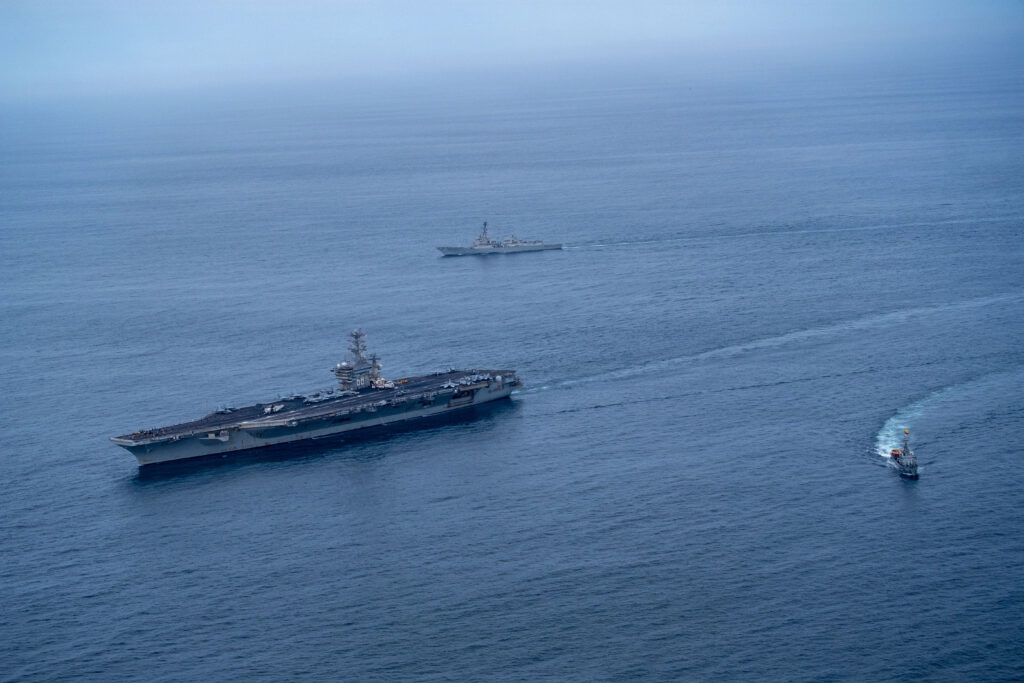
 Ecuadorian navy Esmeralda-class missile corvettes BAE Manabi (CM 12) and BAE Loja (CM 16) conduct formation maneuvering alongside Nimitz-class aircraft carrier USS Nimitz (CVN 68) and Arleigh Burke-class guided-missile destroyer USS Gridley (DDG 101), part of Nimitz Carrier Strike Group (NIMCSG), in the Pacific Ocean, April 8, 2026. (U.S. Navy photo by MC3 Class Gina Gallia) 

From the U.S. 4th Fleet, April 9, 2026 

PACIFIC OCEAN – The Ecuadorian and U.S. Navies conducted a bilateral maritime engagement as part of U.S. Naval Forces Southern Command/U.S. 4th Fleet’s Southern Seas 2026 deployment in the Pacific Ocean, April 7-8. 

The engagement, focused on increasing interoperability between the two navies, included participation by the Ecuadorian Esmeraldas-class missile corvettes BAE Manabi (CM 12) and BAE Loja (CM 16), Ecuadorian A-29 Super Tucano aircraft, Nimitz-class aircraft carrier USS Nimitz (CVN 68), Arleigh Burke-class guided-missile destroyer USS Gridley (DDG 101), and F-18 Super Hornets and MH-60 Sea Hawks assigned to Carrier Air Wing (CVW) 17. 

“Engaging with partners like Ecuador ensures that when the need arises, we can work together as a proficient warfighting team, built with trust and experience,” said Rear Adm. Cassidy Norman, commander of Carrier Strike Group 11. “Training on the high seas with Ecuadoran naval forces gave us the chance to hone our critical skills while also continuing to build a relationship that is already strong and enduring.” 

Training conducted included subject matter expert exchanges, simulated maritime interdiction operations scenarios, a live-fire gunnery exercise, maneuvering in formation and an air defense exercise. 

Nimitz also hosted a visit of senior Ecuadorian government and military leaders including Minister of Foreign Affairs Gabriela Sommerfeld, Minister of Defense Giancarlo Loffredo, and Chief of Defense Gen. Henry Delgado. The delegation was accompanied by U.S. Charge d’Affaires a.i. in Ecuador Lawrence Petroni. 

The visit was one of many planned opportunities for distinguished visitors to observe aircraft carrier operations during Southern Seas 2026. 

While aboard, the Ecuadorian delegation met with Norman and Capt. Joseph Furco, commanding officer of Nimitz. The leaders discussed the Southern Seas 2026 mission and the strong security partnership between Ecuador and the U.S. 

Visitors also observed flight operations and an air power demonstration from Nimitz’ flight deck. 

The visit and bilateral training demonstrated the Southern Seas 2026 mission to strengthen existing regional partnerships and encourage the establishment of new relationships through the exchange of maritime mission-focused knowledge and expertise. 

Southern Seas 2026 marks the 11th iteration of the exercise to the region since 2007. Like the previous deployments, Southern Seas 2026 is designed to foster goodwill, strengthen maritime partnerships to counter threats, and build the U.S. Navy’s team alongside partner nation maritime services. 

During the deployment, Nimitz Carrier Strike Group (NIMCSG) is scheduled to conduct passing exercises and operations at sea with partner nation maritime forces as the ships circumnavigate the continent of South America. 

NIMCSG consists of Nimitz, Carrier Air Wing (CVW) 17, Destroyer Squadron (DESRON) 9, and Gridley. 

USNAVSOUTH/FOURTHFLT is the trusted maritime partner for Caribbean, Central and South America maritime forces improving regional unity and security. 


Naval Postgraduate School Alumni Lead Artemis II Homebound 

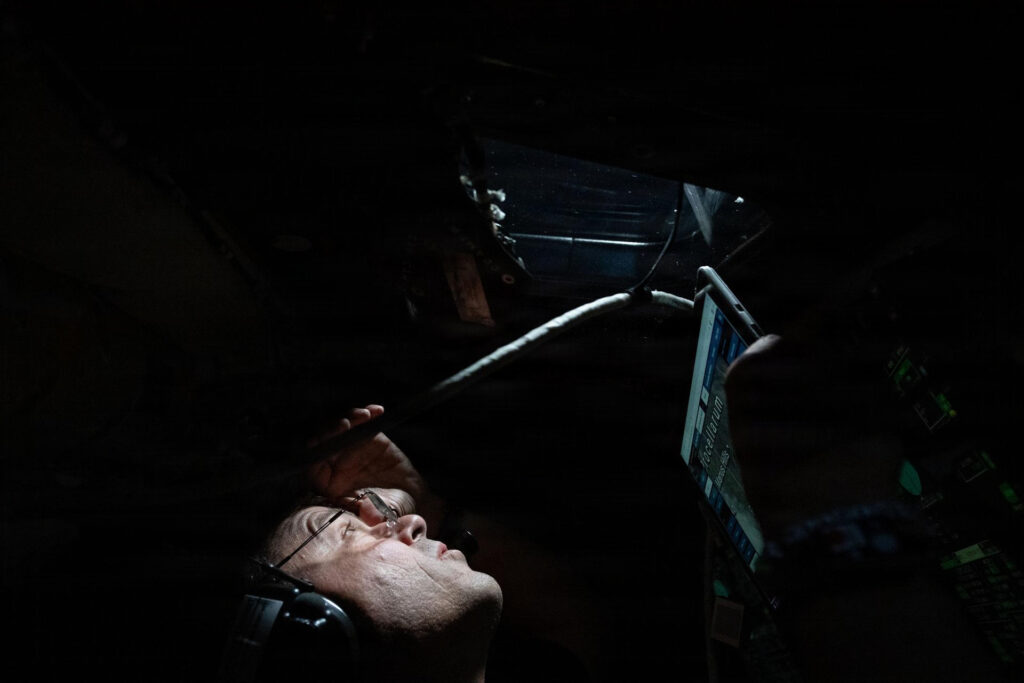
NPS alumnus and Artemis II mission commander retired U.S. Navy Capt. Reid Wiseman peers out the window of the Orion spacecraft just as his first lunar observation period of the day begins. Throughout the course of the sixth day of the mission, Wiseman and his crewmates took turns at the windows, capturing images and video of the Moon, along with recorded observations. (Credit NASA)

Naval Postgraduate School Alumni Lead Artemis II Homebound 

April 8, 2026 |  By Daniel Linehan, DoW News 

Next stop — Earth. 

After a historic lunar flyby at a record-setting distance, the Artemis II crew is now on its return journey, with splashdown expected April 10 in the Pacific Ocean, approximately 50-60 miles off the coast of San Diego.   

Awaiting their arrival will be the amphibious transport dock ship USS John P. Murtha, positioned to recover the astronauts and capsule.  

Mission commander and Naval Postgraduate School alumnus, retired Navy Capt. Reid Wiseman, now focuses on the most critical phase of the mission — bringing the crew home safely.  

“We are locked in,” Wiseman said. “We are definitely excited for the second half of this mission. And we are on guard. We are the first crew to fly this vehicle. We are ready for any contingency and any scenario. We are going to stay locked in every second until we are back on that Navy ship, at home reunited with our families.”  

Wiseman and spacecraft pilot, Navy Capt. Victor Glover — also an NPS alumnus — use their years of experience as Navy test pilots to guide the spacecraft, coined Integrity by the crew. Their advanced education and astronaut training will ensure a safe return to Earth.  

As our blue planet grows steadily larger in the capsule’s windows, the mission’s significance is clear. Their journey around the moon has generated critical insights that will inform future Artemis missions and advance NASA’s long-term goal of human exploration beyond lunar orbit.  

On the sixth day of the mission, the crew entered the moon’s sphere of influence — the point at which lunar gravity overtakes Earth’s pull — marking a key milestone in the mission. For hours, the astronauts conducted detailed observations of the moon’s near and far sides, capturing new imagery and data.  

Wiseman and Glover, alongside crewmates Christina Koch and Jeremy Hansen, passed within 4,070 miles of the lunar surface and experienced a 40-minute communications blackout, another defining moment of the mission.  

That moment was made even more meaningful by a prerecorded message from Apollo 8 and Apollo 13 astronaut Jim Lovell, a fellow naval aviator and test pilot, who died in 2025 at 97.  

“Hello Artemis II. This is Apollo astronaut Jim Lovell. Welcome to my old neighborhood,” the message read. “I’m proud to pass that torch to you as you swing around the moon and lay the groundwork for missions to Mars for the benefit of all. … Good luck and Godspeed from all those here on the good Earth.”  

The symbolism was powerful. Lovell, commander of Apollo 13, held the previous record for the farthest distance traveled from Earth at 248,655 miles. Artemis II surpassed that mark, reaching 252,760 miles, more than 4,000 miles farther than any human spaceflight before it.  

During the moon flyby, the crew worked in rotating pairs for six hours, observing the lunar surface. They witnessed Earth set behind the moon, then rise again. They also saw an extremely rare view of a solar eclipse as the moon passed between the spacecraft and the sun, a first for human eyes.  

While the Artemis II crew observed the moon, another spacecraft was watching them.  

NASA’s Lunar Reconnaissance Orbiter, a robotic spacecraft, captured images of the Integrity capsule as it swung around the moon. The orbiter’s mission includes mapping the moon’s surface, identifying potential resources such as water and ice and helping determine safe landing sites for future missions.   

NPS faculty and students contributed to the orbiter’s fast attitude maneuvering control system, which enables the spacecraft to precisely reorient, capabilities essential for tracking and imaging.  

Data from the Artemis II and imagery from the orbiter are now being processed and are anticipated by researchers at NASA and partner institutions.  

This collaboration reflects a broader, enduring partnership between NASA and NPS that advances both cutting-edge research and the education of future operational leaders and astronauts. The ability to connect real-world missions with graduate-level education remains a hallmark of the NPS experience.  

Since first putting humans in space, the Navy, NPS and NASA have had an inseparable bond in space education and research; from naval aviators turned astronauts to Navy ships and sailors returning the astronauts home after splashdown; and to the scientists, engineers and leaders filling every space in-between.  

With seven NPS alumni in the active NASA astronaut corps, the Navy and NPS remain vital contributors to America’s future lunar missions and space exploration. 


 USS John P. Murtha to Support NASA’s Artemis II Mission 

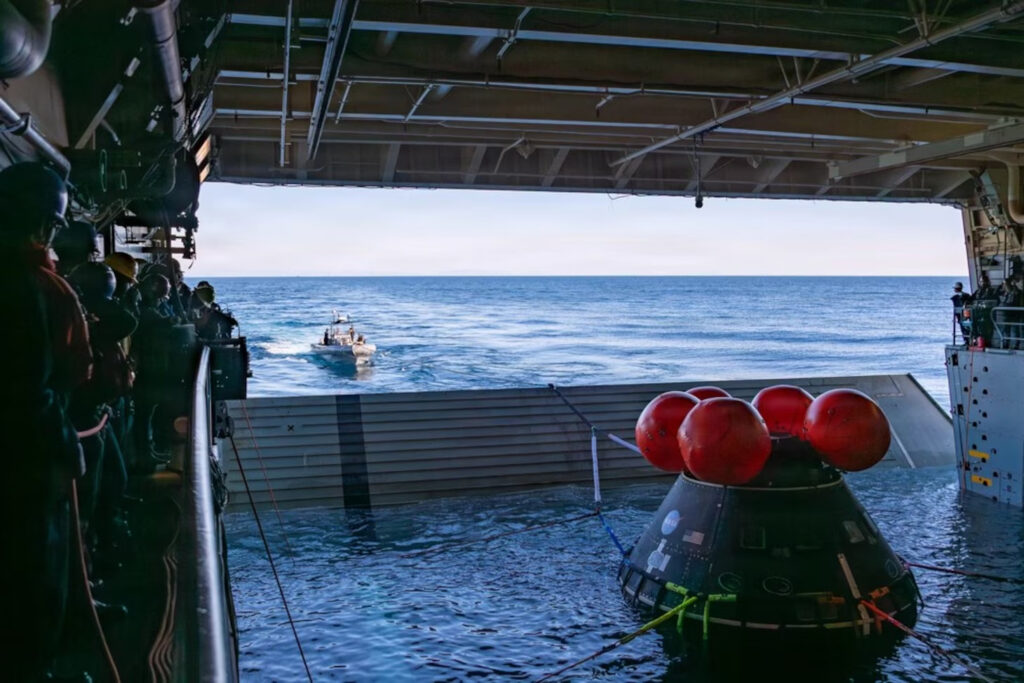
Sailors assigned to amphibious transport dock ship USS John P. Murtha (LPD 26) and NASA engineers prepare to release a crew module test article from the ship’s well deck, Jan. 26, 2026. John P. Murtha is underway in the U.S. 3rd Fleet area of operations performing a just-in-time training in support of U.S. Space Command’s human space flight recovery mission to retrieve NASA’s Artemis II crew and spacecraft following their splashdown in the Pacific Ocean. (U.S. Navy photo by MC1 Jomark A. Almazan) 

From Petty Officer 1st Class Jomark Almazan, April 6, 2026 

SAN DIEGO — Amphibious transport dock ship USS John P. Murtha (LPD 26) is slated to serve as the recovery ship for the Orion spacecraft and its crew upon their return from the historic Artemis II mission.

The ship is named in honor of the late and long-serving Pennsylvania Congressman John P. Murtha. 
 
“It is a fitting tribute to Congressman Murtha, who dedicated his life to serving our nation, that the ship bearing his name will be integral to this historic moment in space exploration,” said U.S. Navy Capt. Erik Kenny, commanding officer of John P. Murtha. “He was a champion for our military and a visionary. We are honored to carry on his legacy by supporting NASA and the Artemis II mission.” 
 
The Artemis II mission is the first crewed flight of NASA’s Space Launch System (SLS) rocket and Orion spacecraft, sending four astronauts on an approximately 10-day journey that will take them beyond the Moon. This mission will mark humanity’s first crewed voyage to the vicinity of the moon in over 50 years. 
 
Upon completion of their mission, the Orion capsule will splash down in the Pacific Ocean, where John P. Murtha and its crew will be prepared to recover the astronauts and the spacecraft. 
 
The U.S. Navy’s amphibious transport dock has unique advantages, including a well deck, helicopter pad, onboard medical facilities, and communication capabilities needed to support the mission. The platform gives NASA the ability to recover the Orion space capsule and collect critical data to help ensure it’s ready to recover the astronauts and capsule during future Artemis missions. 
 
MH-60S Sea Hawk helicopters from Helicopter Sea Combat Squadron (HSC) 23 will provide imagery support for NASA by tracking the Orion space capsule as it travels through Earth’s atmosphere. After splashdown, HSC-23 helicopters will recover the astronauts once they exit the capsule and bring them to the ship for assessment and then transport them to shore. 
 
Explosive Ordnance Disposal Group (EODGRU) 1 will provide Navy divers to recover and transport the Orion space capsule from the ocean to the ship’s well deck. Navy divers are experts in mobile diving, salvage, towing, and open water, small boat operations. In addition to the Navy divers, EODGRU-1 will support the recovery mission with a dive medical team to assess and assist the astronauts following their exit from the capsule. 
 
Artemis II is NASA’s first crewed mission in a series of missions around and to the lunar surface where crew can build and test systems needed to prepare for the challenge of future missions to Mars. The mission launched from NASA’s Kennedy Space Center in Florida, April 1, with four astronauts onboard. 


Mr. Peter Reddy named NAVSEA Warfare Centers Executive Director 

By NAVSEA Warfare Centers Public Affairs, April 8, 2026 

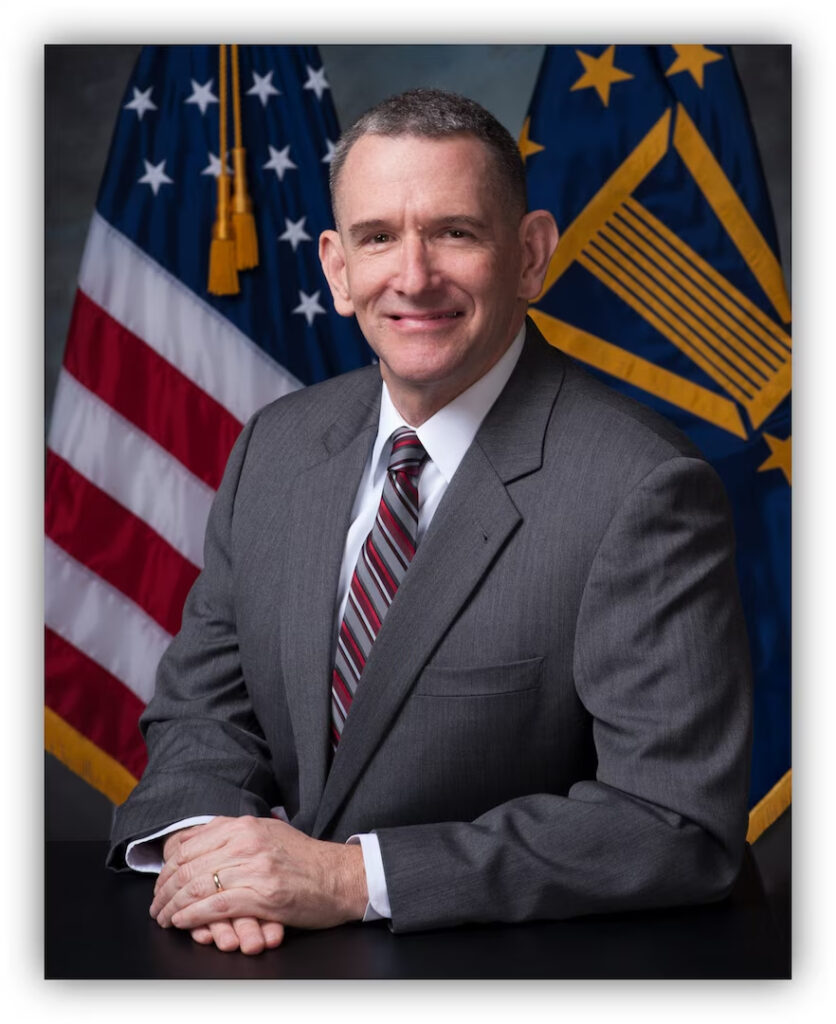
WASHINGTON – Mr. Peter Reddy has been appointed as the Executive Director of the Naval Sea Systems Command (NAVSEA) Naval Surface and Undersea Warfare Centers. 

Reddy most recently served as the Deputy Assistant Secretary of the Navy for Research, Development, Test and Engineering (DASN (RDT&E)), under the Assistant Secretary of the Navy for Research, Development and Acquisition (ASN (RDA)). In that role, he was responsible for executive oversight of all matters related to RDT&E budget activities, science and engineering, advanced research and development, prototyping and experimentation, and test and evaluation. He was also responsible for management and stewardship of the Naval Research and Development Establishment (NR&DE), which includes naval laboratories and warfare centers, Office of Naval Research, Naval Postgraduate School, five University Affiliated Research Centers, and the Navy’s Federally Funded Research and Development Center.  

Jason Potter, who is performing the duties of ASN (RDA), congratulated Reddy for assuming his critical new role at the NAVSEA Warfare Centers and called him a champion for the Department of the Navy engineering workforce, with an encyclopedic knowledge of the NR&DE and the intricacies of the Navy Working Capital Fund. 

Reddy became a member of the Senior Executive Service (SES) in November 2019 with his appointment as Executive Director of Naval Information Warfare Center (NIWC) Atlantic, part of the Naval Information Warfare Systems Command (NAVWAR), where he served until January 2025. 

A seasoned aerospace and systems engineer, Reddy brings extensive technical and engineering leadership expertise, forged through a distinguished career as both a senior civilian executive and a commissioned officer in the U.S. Marine Corps, where he served for 30 years before retiring from active duty in May 2014. He has a proven track record of managing a broad portfolio, including information systems technology; command, control, communications, computers, intelligence, surveillance and reconnaissance (C4ISR); and cyber systems. 

In a message to the NAVSEA Warfare Centers’ workforce, Acting NAVSEA Executive Director Thomas A. Perotti noted, “Mr. Reddy’s leadership and vision will be instrumental as we continue to accelerate the delivery of decisive combat power for our Navy and our nation.” 

The NAVSEA Warfare Centers are the Navy’s principal research, development, test and evaluation assessment activity for surface ship and submarine systems and subsystems and supply the technical operations, people, technology, engineering services and products needed to equip and support the fleet and meet the warfighters’ needs. The Warfare Centers comprise 10 divisions: Naval Surface Warfare Center (NSWC) Carderock, NSWC Corona, NSWC Crane, NSWC Dahlgren, NSWC Indian Head, Naval Undersea Warfare Center (NUWC) Keyport, NUWC Newport, NSWC Panama City, NSWC Philadelphia, and NSWC Port Hueneme. 


Navy UAS Surpass 1 Million Hours in ISR Operations

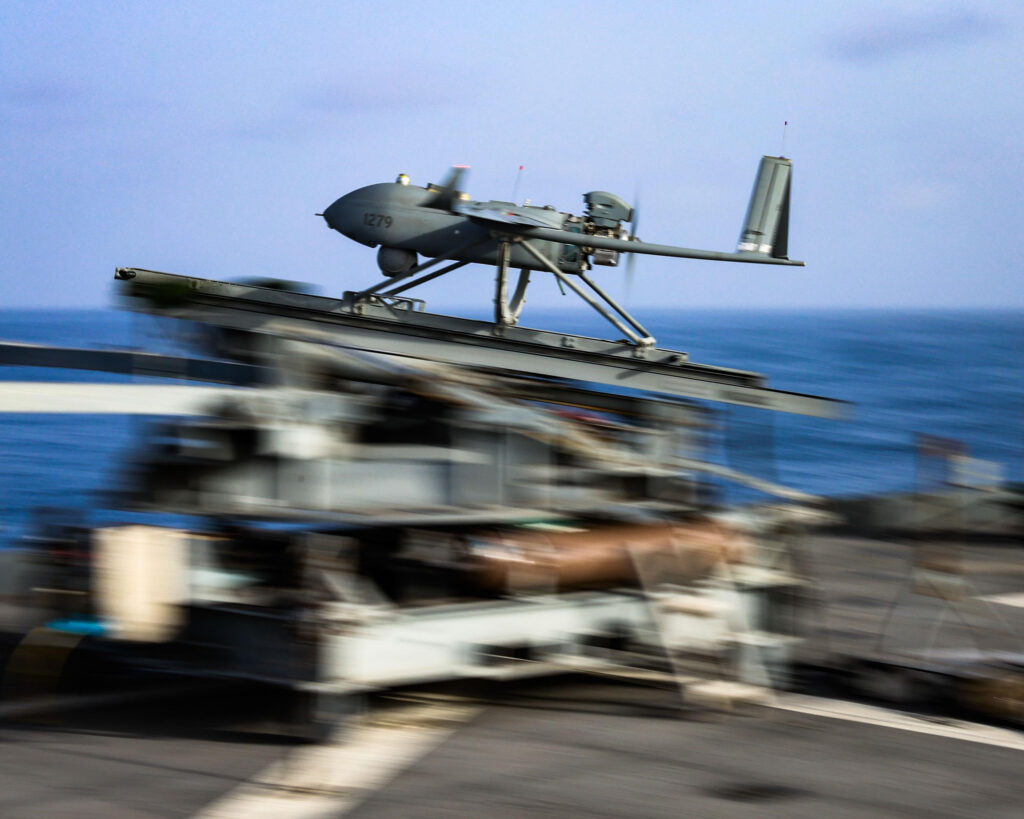
A Textron MQ-19 Aerosonde Unmanned Aircraft System launches from the expeditionary sea base ship USS Hershel “Woody” Williams (ESB-4).

From the Navy and Marine Corps Small Tactical Unmanned Aircraft Systems Program Office, April 9, 2026 

PATUXENT RIVER, Md. – The Navy and Marine Corps Small Tactical Unmanned Aircraft Systems (UAS) Program Office announced its Intelligence, Surveillance and Reconnaissance (ISR) Services UAS have surpassed 1 million flight hours supporting operations on land and at sea. 
 
Sailors achieved the milestone during routine mission support in the U.S. 6th Fleet. 
 
Since the program’s inception in 2005, the program office has completed more than 50 UAS installations aboard Navy and Military Sealift Command (MSC) ships and operated from more than 50 land-based locations worldwide. The ISR Services team ensures ships across the 4th, 5th, 6th and 7th fleets, as well as land-based operations worldwide, are equipped to provide day-and-night ISR support to joint force and coalition partners. 
 
“Every hour flown represents more than mission success—it reflects the resilience of our people, the trust of our partners and the impact we’ve had on history,” said Gregg Skinner, program manager. “Together, we’ve supported operations in every corner of the globe, advanced unmanned systems into the fight and stood ready in times of uncertainty.” 
 
More than a dozen ships are currently equipped with ISR Services UAS, enabling naval vessels to launch and recover aircraft in support of missions. Sea- and land-based systems include the Boeing Insitu MQ-27 ScanEagle and the Textron MQ-19 Aerosonde, both providing day-and-night surveillance and around-the-clock mission support to the warfighter. 
 
UAS installations are optimized to help transfer full-motion video and other sensor data to personnel in critical locations. The information gathered by these systems plays a vital role in tactical operational decision-making and long-term intelligence gathering, strengthening the Navy and Marine Corps’ ability to maintain maritime domain awareness and operational readiness. 


U.S. Coast Guard Cutter Midgett Rescues Family Missing for 7 Days in Micronesia 

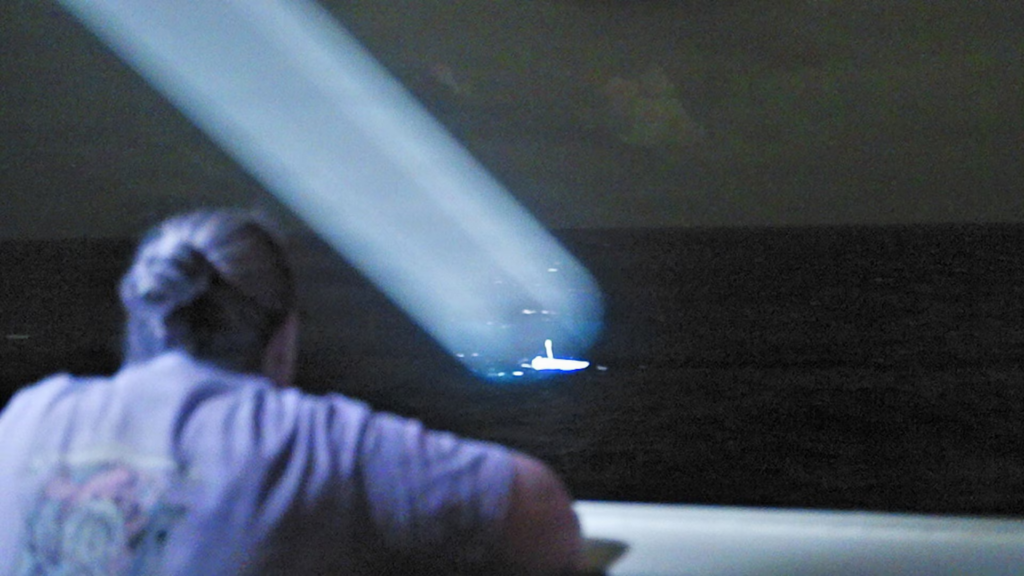
U.S. Coast Guard Lt. Cmdr. Stephanie Jocis, operations officer aboard Legend-class cutter USCGC Midgett (WMSL 757), observes a 23-foot single-outboard skiff vessel, carrying three members of a missing family in the waters of Chuuk State, Federated States of Micronesia, in Midgett’s search light during the early hours of April 6, 2026. The crew of Midgett rescued the family after the vessel went missing on March 30 in the waters of Chuuk State. U.S. Coast Guard missions in the Indo-Pacific focus on issues directly supporting and advancing our regional partners’ efforts to protect fish stocks and ensure the safety of life at sea, ensuring a secure and prosperous Indo-Pacific. (U.S. Coast Guard photo by Seaman Lauren Taber) 

From U.S. Coast Guard Forces Micronesia, April 7, 2026 

SANTA RITA, Guam — A family of three was returned to Chuuk State, part of the Federated States of Micronesia, following search and rescue operations conducted by the Legend-class cutter USCGC Midgett (WMSL 757) crew on April 6, 2026. 

The Midgett crew located the missing family after receiving a report on Easter Sunday from authorities in the Federated States of Micronesia and the U.S. Embassy that the vessel was overdue. 

“Our U.S. Coast Guard colleagues’ swift and courageous actions in this successful search and rescue mission not only reflect the highest standards of professionalism and humanity but also reinforce the deep and enduring partnership between the United States and the Federated States of Micronesia,” said Jennifer Johnson, U.S. Ambassador to the Federated States of Micronesia. “This mission exemplifies the spirit of cooperation and mutual support at the heart of the Compact of Free Association, underscoring how our close relations translate into real, life-saving outcomes for our people.” 

At night, the crew of Midgett visually located the 23-foot single-outboard skiff carrying the missing family, two men and one woman, in the waters off the coast of Chuuk State. The family departed Fananu Island on March 30 for the short passage to Murillo Island, but never arrived due to a failure of their single outboard engine. At the height of search planning, the predicted search area exceeded 14,000 square nautical miles in rough seas with waves reaching 10 feet. 

All three survivors were rescued and uninjured. They were then safely delivered to Weno in Chuuk State for further transport to Fananu Island. 

“National Security Cutter crews spend most of their time executing maritime law enforcement missions, often with our international partners,” said Capt. Brian Whisler, commanding officer of Midgett. “SAR cases like this one are not routine for our platform. Our bridge watchstanders spotted the small skiff in rough seas just after midnight, and that kind of situational awareness does not happen by accident. It is what this crew trains for, and I could not be prouder of how they performed.” 

During the SAR operation, watchstanders from the U.S. Coast Guard Joint Rescue Sub-Center Guam at U.S. Coast Guard Forces Micronesia/Sector Guam developed the search patterns and coordinated with U.S. Coast Guard District Oceania and Air Station Barbers Point personnel to launch an HC-130 Hercules airplane and crew from Hawai’i to support the search and directed the launch of the USCGC Frederick Hatch (WPC 1143) crew from Guam. The Midgett crew, already conducting a Western Pacific patrol, diverted following a bilateral maritime law enforcement boarding with two embarked officers from the FSM in their exclusive economic zone, approximately 200 nautical miles south of Fananu Island. 

“This rescue reflects the strategic value of maintaining a capable surface presence across the region’s vast maritime expanse,” said Lt. Cmdr. Derek Wallin, the U.S. Coast Guard search and rescue mission coordinator. “Without the Midgett’s proximity, coordinating a search across more than 14,000 square nautical miles of open ocean would have required significantly more time and resources. Time the three missing people may not have had.” 

Throughout its current Indo-Pacific region patrol, Midgett’s crew is scheduled to engage with regional partners and participate in joint operations to enhance maritime safety and security. While deployed to the region, Midgett is assigned to Destroyer Squadron 15, the Navy’s largest DESRON and the U.S. 7th Fleet’s principal surface force. DESRON 15 regularly assumes tactical control of surface units operating in the area. 

U.S. 7th Fleet, the Navy’s largest forward-deployed numbered fleet, routinely interacts and operates with allies and partners in preserving a free and open Indo-Pacific. 


NRL’s Advanced Payloads Soar into Orbit Aboard STPSat-7 Mission 

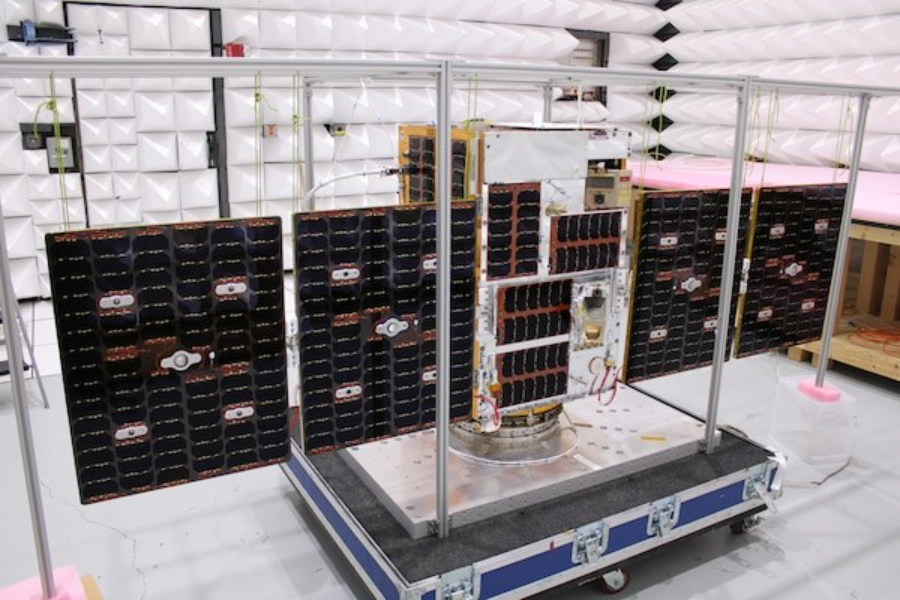
Department of War (DoW) Space Test Program’s (STP) STPSat-7 payload, at NASA Marshall Space Flight Center, Huntsville, Ala., June 25, 2025. (Photo by DoW Space Test Program)

From Emily Winget U.S. Naval Research Laboratory Corporate Communications, April 7, 2026 

WASHINGTON,D.C.  – U.S. Naval Research Laboratory (NRL) successfully launched three advanced experimental payloads aboard the Department of War (DoW) Space Test Program’s (STP) Satellite-7 mission at approximately 4:33 a.m. PDT on April 7 from Vandenberg U.S. Space Force (USSF) Base, Calif. 

U.S. Naval Research Laboratory (NRL) successfully launched three advanced experimental payloads aboard the Department of War (DoW) Space Test Program’s (STP) Satellite-7 mission at approximately 4:33 a.m. PDT  on April 7 from Vandenberg U.S. Space Force (USSF) Base, Calif

NRL’s payloads included the Lasersheet Anomaly Resolution and Debris Observation (LARADO) instrument; the Global Navigation Satellite System (GNSS) Orbiting Situational Awareness Sensor (GOSAS); and the Gadolinium Aluminum Gallium Garnet (GAGG) Radiation Instrument (GARI-1C). 

The STPSat-7 spacecraft is aboard the STP-S29A mission, which uses a Northrop Grumman Minotaur IV launch vehicle, marking a significant step forward in advancing U.S. space-based capabilities for the U.S. Navy and national security. By improving understanding of the space environment and testing next-generation satellite technologies, NRL is ensuring the United States maintains its technological advantage and protects critical assets in orbit. 

LARADO 

One of the key NRL payloads, LARADO will directly address the growing threat of orbital debris. 

“LARADO is the next step in ensuring situational awareness in space,” said Andrew Nicholas, NRL Sensor Development and Applications Section Head and LARADO principal investigator. “The instrument will detect and characterize small orbital debris that cannot be observed from the ground. This is vital to understanding the space environment and will provide essential data to update orbital debris models. These updates are important to the orbital debris research community, engineers designing spacecraft to survive and minimize growth to the debris environment, satellite operators, and policy makers.” 

The LARADO concept began in 2012. In FY22, NASA’s Heliophysics Division Space Weather Program’s Orbital Debris and Space Situational Awareness portfolio within its Science Mission Directorate began funding the development of the LARADO instrument for STPSat-7. 

GOSAS 

GOSAS will improve the reliability of navigation and communication systems for warfighters. 

“The GOSAS is a CubeSat-compatible, programmable dual GPS receiver designed to characterize the orbital GNSS environment and produce high quality ionospheric space weather products,” said Scott Budzien, Ph.D., NRL research physicist and GOSAS principal investigator. “Understanding and predicting space weather is critical for ensuring the accuracy of GPS and the integrity of military communications.” 

GOSAS is a follow-on to the NRL experiment GROUP-C (GPS Radio Occultation and Ultraviolet Photometry-Collocated) experiment on the International Space Station from 2017-2023 that serendipitously detected GPS ground interference. GOSAS originated in 2020 with the mission of increasing GPS accuracy for the warfighter. 

GARI-1C 

GARI-1C is set to pave the way for future defense applications from space, including detecting weapons of mass destruction. The NRL team takes technology developed for ground-based applications and tests its performance in space. Since most commercial-off-the-shelf components are not radiation-hardened, understanding how they respond to the harsh radiation environment of space is critical for future operational use. 

“GARI-1C is designed to space-qualify new gamma-ray detector technology for space-based defense applications,” stated Lee Mitchell, Ph.D., NRL Research Physicist and GARI-1C principal investigator. “This detector technology offers improved energy resolution, lower power consumption and reduced size compared to similar systems, which is key to developing more advanced and efficient sensors for detecting threats from orbit.” 

The DoD/DoW Space Test Program (STP) was founded in 1966 to provide flight opportunities for all DoD/DoW research and development activities in an economic and efficient manner. Under the U.S. Space Systems Command, STP supports mission design, payload-to-bus integration, space vehicle-to-launch vehicle integration, and on-orbit operations for S&T payloads that exhibit potential military utility. By advancing scientific knowledge and capability, STP is foundational to ensuring continuous STP advantage in the space domain. 

“The success of this mission, achieved through a powerful collaboration with the DoW’s Space Test Program, highlights how cutting-edge research and development are fundamental to preserving America’s strategic edge in space,” said USSF Lt. Col. Brian Shimek, system program manager and director for STP. 

NRL’s Space Science Division conducts a broad-spectrum of Research, Development, Test & Evaluation in solar-terrestrial physics, astrophysics, upper and middle atmospheric science, and astronomy. The Division’s Military Deputy, Lt. Elijah Ray, is embedded with DoW STP at Kirtland Air Force Base, N.M., as NRL’s on-site liaison for space experiment coordination and advocacy. 

About the U.S. Naval Research Laboratory 
NRL is a scientific and engineering command dedicated to research that drives innovative advances for the U.S. Navy and Marine Corps from the seafloor to space and in the information domain. NRL, located in Washington, D.C. with major field sites in Stennis Space Center, Mississippi; Key West, Florida; Monterey, California. 

NRL offers several mechanisms for collaborating with the broader scientific community, within and outside of the Federal government. These include Cooperative Research and Development Agreements (CRADAs), LP-CRADAs, Educational Partnership Agreements, agreements under the authority of 10 USC 4892, licensing agreements, FAR contracts, and other applicable agreements. 


U.S. Navy and Royal Danish Navy Conducted Medical Evacuation Near Greenland, Highlighting Arctic Interoperability 

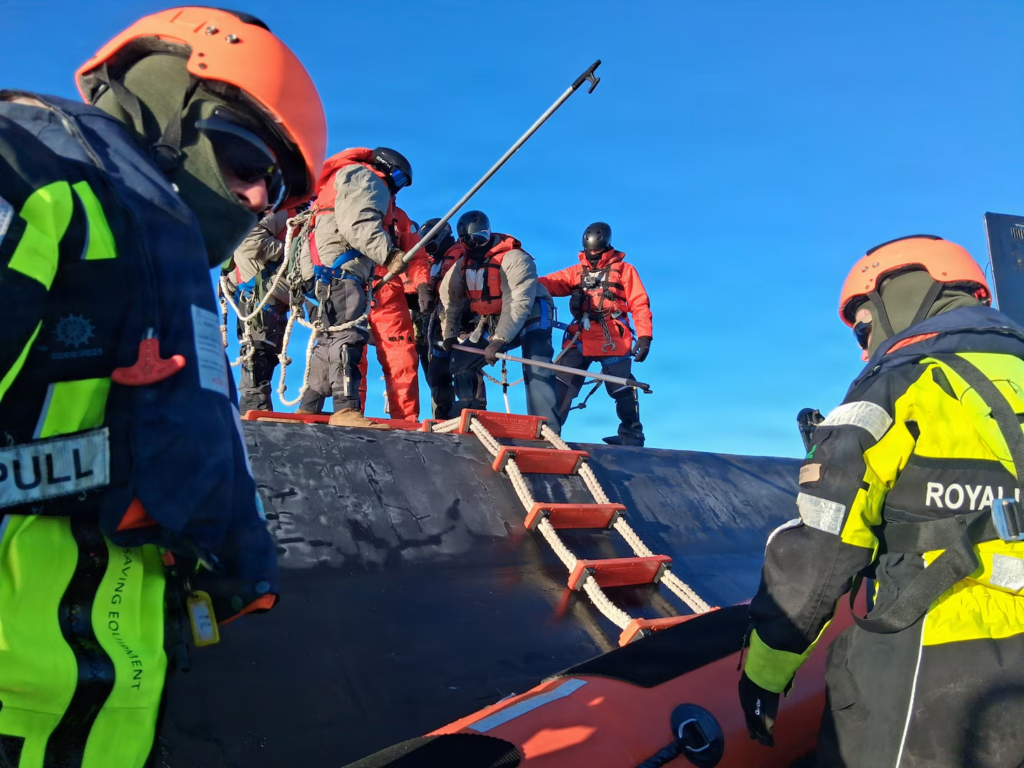
NUUK, Greenland (Feb. 21, 2026) – Members of the Royal Danish Navy assigned to the offshore patrol vessel HDMS VAEDDEREN (F 359) embark the Virginia-class fast-attack submarine USS Delaware (SSN 791) ) in preparation for a personnel transfer. Delaware is operating in the U.S. Naval Forces Northern Command (NAVNORTH) area of operations. NAVNORTH is the maritime component of U.S. Northern Command (USNORTHCOM) and is responsible for homeland defense, maritime security, and theater security cooperation in the Arctic and North American maritime approaches. (Courtesy photo)

By U.S. Northern Command Public Affairs, April 6, 2026 

PETERSON SFB, Colo.– A recent medical evacuation of a U.S. Navy Sailor off the coast of Greenland demonstrated the importance of international partnerships and readiness in the Arctic. 
  
In late February, while preparing for Ice Camp 2026, a Sailor aboard the Virginia-class fast-attack submarine USS Delaware (SSN 791) required urgent medical attention. Severe weather conditions prevented evacuation to other locations, prompting the submarine to divert toward Greenland. U.S. naval forces coordinated with the Danish Joint Arctic Command, which dispatched the Royal Danish Navy offshore patrol vessel HDMS Vaedderen (F 359) to assist. 
  
Crews from both nations worked together to transfer the Sailor at sea. 
  
The MEDEVAC occurred as U.S. forces were preparing for Ice Camp 2026, an Arctic operation focused on testing and refining capabilities in the region. These efforts underscore the shared commitment of the U.S. and its allies to Arctic security and regional stability. 


U.S. Coast Guard, NOAA partner to restore tsunami warning capability on remote FSM atoll during 29-day Operation Rematau patrol period 

The crew of USCGC Oliver Henry (WPC 1140) supports a University of Hawai’i Sea Level Center technician to upgrade a regional NOAA weather monitoring station on Kapingamarangi Atoll, Federated States of Micronesia, on March 20, 2026, in conjunction with supporting a supply delivery. Oliver Henry is the first Fast Response Cutter to make the transit. USCGC Oliver Henry (WPC 1140) returned to Guam on March 29, 2026, closing out a 29-day patrol period that restored a critical tsunami early warning station to a remote Pacific atoll, delivered humanitarian supplies to two island communities, and enforced fisheries laws across more than 4,000 nautical miles. (U.S. Coast Guard photo) 

U.S. Coast Guard Forces Micronesia, April 6, 2026 

SANTA RITA, Guam — The crew of the USCGC Oliver Henry (WPC 1140) returned to Guam on March 29, closing out a 29-day patrol period that restored a critical tsunami early warning station on a remote Pacific atoll, delivered humanitarian supplies to two island communities, and enforced fisheries laws across more than 4,000 nautical miles. 

The patrol under Operation Rematau covered U.S. waters in the Commonwealth of the Northern Mariana Islands, Guam, and the Federated States of Micronesia. 

“The Coast Guard’s credibility in this part of the Pacific is built one port call, one boarding, one supply delivery at a time. This patrol, from the fisheries enforcement work in FSM’s EEZ to getting that NOAA technician to Kapingamarangi, is exactly how we honor the commitments the United States made to the people in this region. I’m proud of how this team delivered on that responsibility,” said Lt. Ray Cerrato, commanding officer of USCGC Oliver Henry. 

The mission’s most consequential stop came at Kapingamarangi Atoll, one of FSM’s most isolated communities. The Oliver Henry crew transported a University of Hawai’i Sea Level Center technician to the atoll to upgrade a regional weather monitoring station, the first such upgrade in 12 years. Supported by the U.S. Embassy in the FSM and the National Oceanic and Atmospheric Administration, the mission restored the station’s capacity to support tsunami early-warning monitoring across the Western Pacific. 

The station’s importance came into sharp focus days after Oliver Henry returned to Guam. On April 2, a magnitude 7.4 earthquake struck in the Molucca Sea, prompting the Pacific Tsunami Warning Center to issue a threat forecast for coastal communities across the Western Pacific, including Guam, the CNMI, Palau, and Yap. The Kapingamarangi gauge was online and transmitting when the event occurred, ready to contribute observed sea level data to the warning center’s analysis. 

The earthquake’s distance meant tsunami generation was minimal and not detectable at the Kapingamarangi station, but the network it supports held. The PTWC team confirmed the station is one of a small number of sensors covering that stretch of the Western Pacific and that its restoration directly maintains the readiness network the warning center depends on. 

The crew conducted three fisheries enforcement boardings of foreign-flagged vessels, two Western and Central Pacific Fisheries Commission inspections on the high seas, and one enhanced bilateral boarding of a vessel under the FSM’s jurisdiction in their EEZ, directly advancing accountability under local and international laws in a region where illegal fishing is estimated to cost Pacific nations billions annually. 

At Kuttu and Kapingamarangi, the crew delivered 3,000 pounds of humanitarian supplies to residents with limited access to outside goods. The crew also provided Chuuk State Government officials with high-quality imagery documenting the condition of a cargo vessel that grounded on the reef outside of Kuttu Island in the Mortlock Islands in 1998 and has been deteriorating since, supporting local government response efforts. 

The patrol expanded the Coast Guard’s operational reach for future missions. The crew charted previously unrecorded reefs within Greenwich Pass at Kapingamarangi, establishing a navigable route into the atoll’s lagoon for future operations. The Oliver Henry crew also transported Marine Safety Unit Saipan personnel to Tinian and Rota for inspections of port facilities, streamlining logistics, and ensuring the safe flow of goods throughout the CNMI. 

During the 395 operational hours underway, the crew improved readiness by qualifying members in roles ranging from underway officer of the deck to engineering officer of the watch while also honoring nautical traditions with one member earning their permanent cutterman designation and six shellback designations during the patrol’s equatorial crossing. They also completed nearly two dozen engineering, navigation, and seamanship training drills, and confirmed the cutter’s weapons systems remain fully mission-capable during a live-fire exercise. 

Operation Rematau is the U.S. Coast Guard’s sustained operational presence across the Freely Associated States of the Pacific, the Federated States of Micronesia, the Republic of the Marshall Islands, and the Republic of Palau. The operation reflects U.S. commitments under the Compacts of Free Association and advances a secure, open, and prosperous Pacific.