USS Georgia Operates with Force Reconnaissance Marines and Special Operations Forces
MEDITERRANEAN SEA (July 31, 2024) U.S. Marines from the 2nd Force Reconnaissance Company, assigned to Task Force 61/2, conduct dive operations with Ohio-class guided-missile submarine USS Georgia (SSGN 729) while underway in the Mediterranean Sea July 31, 2024. (U.S. Navy Courtesy Photo)
By U.S. Naval Forces Europe-Africa/U.S. 6th Fleet Public Affairs, Aug. 5, 2024
NAPLES, Italy – The Ohio-class guided-missile submarine USS Georgia (SSGN 729), assigned to Commander, Task Force 69, concluded a series of interoperability training events with Force Reconnaissance Marines from the 2nd Reconnaissance Battalion and special operations forces (SOF) in the Mediterranean Sea, August 5, 2024.
The series of events between joint partners and allied countries demonstrates the ability of Task Force 69 to seamlessly integrate amphibious and special warfare into existing Navy missions in the U.S. 6th Fleet area of operations.
“As our submarine force continues to develop its diverse mission sets, we strengthen our ability to deter threats and ensure global access, security, and stability in the maritime domain,” said Capt. Benjamin Selph, Commander, Task Force 69. “Integration with joint and allied partners enhances our lethality as apex predators against hard targets in the U.S. Sixth Fleet area of operations.”
The purpose of the training was to improve U.S. Marine Corps and SOF integration with conventional naval forces in order to develop and improve tactics, techniques and procedures. Early in the series, Marines from the 2nd Force Reconnaissance Company launched and recovered small craft aboard USS Georgia in order to develop capabilities to execute combined arms attacks, advanced personnel recovery, and expeditionary theater undersea warfare deployments.
“Several of our Marines worked alongside Sailors aboard USS Georgia to facilitate joint operational planning at a level not executed before between the U.S. Marine Corps and the submarine force,” said Major W. Connor Smithson, 2nd Force Reconnaissance Company commander. “Collaboration at this level only acts as a force multiplier to bring out the best of both forces’ capabilities.”
Later in the series, East Coast-based U.S. Naval Special Warfare Operators conducted Submarine-Special Operations Forces interoperability training with USS Georgia, which can host up to 66 SOF personnel, and included participation from the Royal Navy’s Special Boat Service, Norwegian Marinejegerkommandoen, and Italian Gruppo Operativo Incursori.
The training iterations with SOF sought to expand and reinforce SOF interoperability with combined partners and provided a valuable opportunity to build combined SUBSOF communication and control architecture while also conducting critical undersea training and qualifications.
“The scale and importance of the accomplishments made by the teams onboard USS Georgia cannot be over-stated.” said Capt. Selph. “Integration with joint and allied SOF enhances our undersea forces’ ability to respond to any threat with increased speed and lethality.”
USS Georgia is homeported in Kings Bay, Georgia, and is on a routine deployment to the U.S. Sixth Fleet area of operations. While in U.S. Sixth Fleet, Commander, Task Force 69 is responsible for submarine warfare operations in Europe and Africa.
Headquartered in Naples, Italy, U.S. Naval Forces Europe-Africa (NAVEUR-NAVAF) operates U.S. naval forces in the U.S. European Command and U.S. Africa Command areas of responsibility. U.S. Sixth Fleet is permanently assigned to NAVEUR-NAVAF, and employs maritime forces through the full spectrum of joint and naval operations.
Coast Guard Encounters Russian Naval Vessel Near Alaska
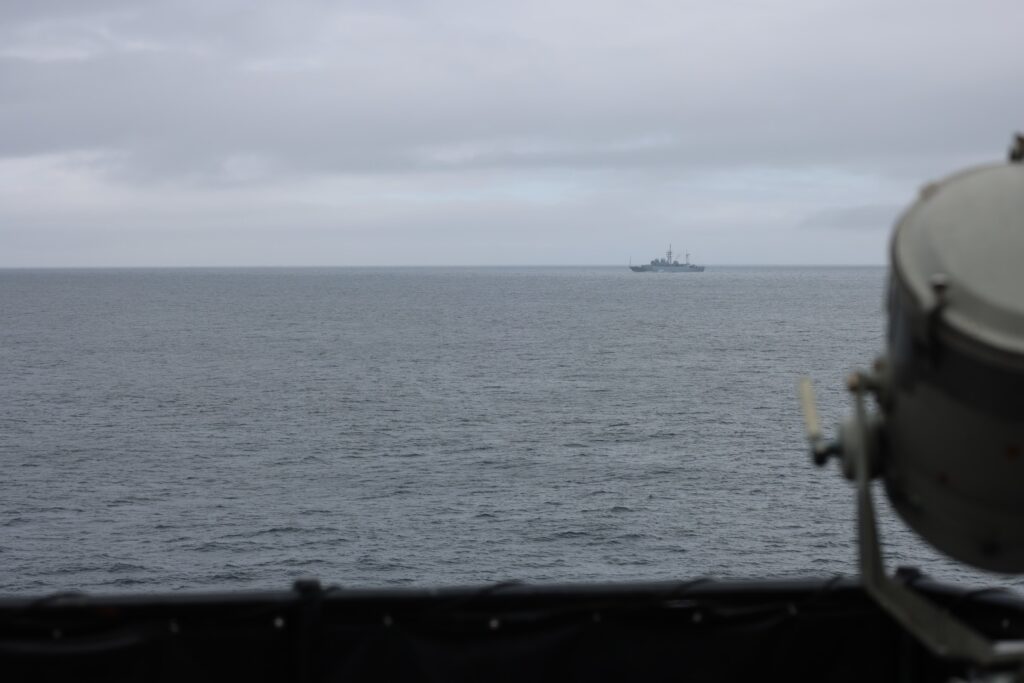
Coast Guard Cutter Alex Haley (WMEC 39) detected and followed a Russian Federation Vishnya-class naval vessel Aug. 5 south of the Aleutian Islands, Alaska. (U.S. Coast Guard courtesy photo)
From U.S. Coast Guard 17th District, Aug. 9, 2024
JUNEAU, Alaska — The U.S. Coast Guard located a Russian Federation Vishnya-class naval vessel Monday south of the Aleutian Islands, Alaska.
While patrolling the Aleutian Islands, the crew of U.S. Coast Guard Cutter Alex Haley (WMEC 39) detected the vessel 30 nautical miles southeast of Amukta Pass, Alaska.
The Russian vessel was transiting in international waters but inside the U.S. Exclusive Economic Zone, which extends 200 nautical miles from the U.S. shoreline. The Alex Haley did not communicate with the Russian vessel. The Alex Haley confirmed it to be a Russian Federation Vishnya-class naval vessel and followed the vessel as it transited east. An HC-130 air crew from Coast Guard Air Station Kodiak also observed the vessel.
“As a proud Alaska-homeported cutter, we patrol to uphold maritime governance and a rules-based international order,” said Cmdr. Steven Baldovsky, commanding officer of the Alex Haley. “We met presence with presence to ensure there were no disruptions to U.S. interests in the maritime environment around Alaska.”
Coast Guard Cutter Alex Haley patrolled under Operation Frontier Sentinel, a Coast Guard operation designed to meet presence with presence when strategic competitors operate in and around U.S. waters. The U.S Coast Guard’s presence strengthens the international rules-based order and promotes the conduct of operations in a manner that follows international law and norms.
This type of monitoring of vessel activity is not outside of the normal. A previous instance in 2024 can be found by clicking here.
The Alex Haley is a 283-foot medium-endurance cutter homeported in Kodiak, Alaska.
U.S Navy to Christen Expeditionary Fast Transport Future USNS Point Loma
From the U.S. Navy Office of Information, 9 August 2024
Mobile, Ala. — The Navy will christen the future USNS Point Loma (EPF 15), the second of the Spearhead-class Expeditionary Fast Transport (EPF) Flight II configurations, during a 10:00 a.m. EDT ceremony on Saturday, August 10, in Mobile, Alabama.
The Honorable Nickolas Guertin, Assistant Secretary of the Navy for Research, Development and Acquisition will deliver the principal address. Remarks will also be provided by Vice Adm. Scott Gray, Commander Navy Installations Command; Ms. Michelle Kruger, President of Austal USA; and Mr. Stan Kordana, Vice President of Program Execution, General Dynamics Mission Systems.
In a time-honored Navy tradition, ship sponsor Elizabeth Asher will christen the ship by the breaking of a bottle of sparkling wine across the ship’s bow.
The ship is named in honor of the community of Point Loma and its decades long relationship with the Navy, beginning with the establishment of the Naval Coaling Station, La Playa, in 1901, and later the Naval Supply Center San Diego in 1943.
This is the second ship to honor the Point Loma community.
As a Flight II ship, EPF 15 is configured to deploy as a fast transport, or with Role 2 Enhanced medical capability, or both. The medical mission capability includes an embarked medical unit, two operating rooms, and the ability to support 147 medical patients and 38 civilian crew that operate and maintain the ship. Flight II EPFs will also have an 11M Rigid Inflatable Boat and MV-22 capability.
USCGC Venturous Returns Home After Supporting Maritime Border Operations
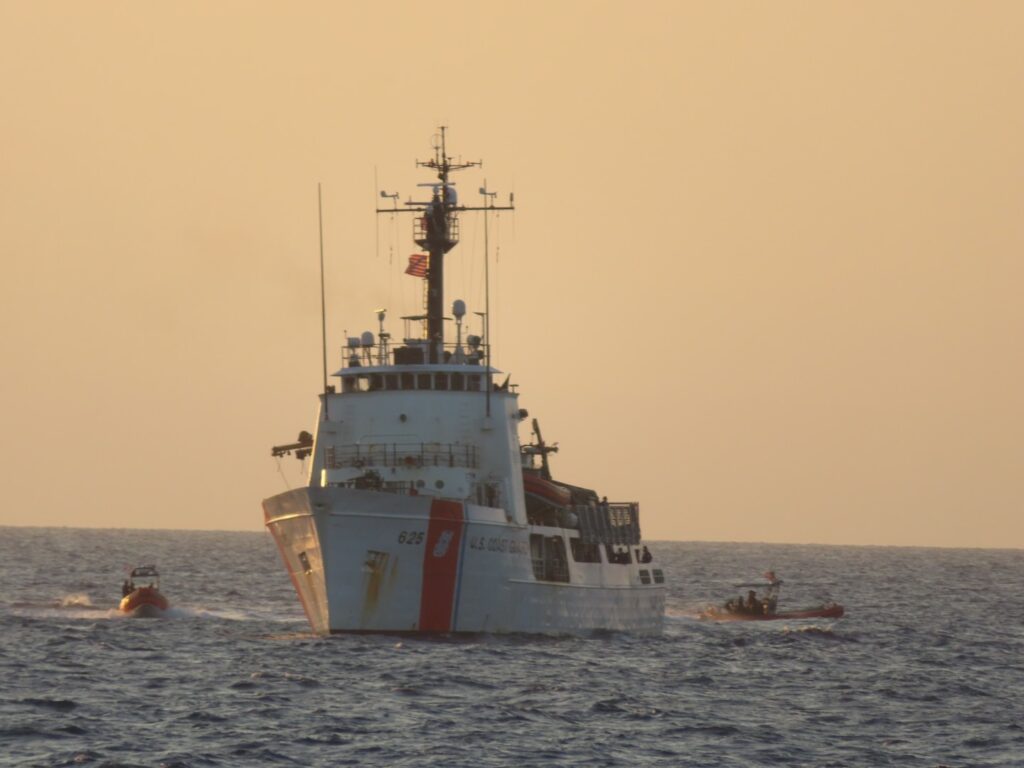
Coast Guard Cutter Venturous conducts small boat operations in Canal De Tortue, Haiti July 19, 2024. (U.S. Coast Guard photo by Petty Officer 1st Class Alvin Cruz)
ST. PETERSBURG, Fla. – The crew of the Coast Guard Cutter Venturous (WMEC 625) returned to their homeport of St. Petersburg, Fla., Thursday after a 60-day Caribbean patrol.
During the patrol, Venturous’ crew supported Operation Vigilant Sentry, a joint operation combining air and surface assets and personnel to address illegal maritime migration in the Caribbean corridor of the United States. The primary objective is to protect the safety of life at sea, and to deter maritime mass migration.
The Venturous and its crew of more than 70 Coast Guard men and women spent the first half of the deployment in the South Florida Straits patrolling off the Florida Keys and acting as the last line of defense against illegal maritime migration. As the largest cutter in the area, Venturous held seven rescued migrants before they were repatriated to their home country, while also providing much-needed first aid to those who suffered injuries from being at sea for multiple days. Additionally, Venturous assisted in the controlled transfer of nine suspected drug smugglers and approximately 1,378 pounds of illicit narcotics, ultimately leading to the prosecution of multiple narco-trafficking cases.
“This mission is inherently difficult; we see people on their worst day,” said Cmdr. Karen Kutkiewicz, commanding officer of Venturous. “Our crew embodies our core values of honor, respect, and devotion to duty every day. We take care of each other, and the detainees and migrants who cross our deck before their prosecution or repatriation.”
Halfway through the patrol, the ship’s engineers exhibited outstanding motivation, coordinating complex logistics to replace the Emergency Diesel Generator (EDG) in just 96 hours. This generator is essential for powering the critical switchboard during outages, ensuring that key systems remain operational when primary power sources fail. Replacing such crucial equipment typically requires extensive preparation and coordination over several months, followed by weeks of detailed repair work. However, through effective teamwork the process was greatly expedited, allowing Venturous to continue operations in the threat vector.
From offshore Florida, the Venturous transited south to patrol the Windward Pass between Cuba and Haiti to overtly deter those wanting to take to the seas and migrate north working with other Coast Guard and CBP assets. In most cases, migrant vessels in this area are homemade, unseaworthy, and overcrowded requiring the Coast Guard to conduct at-sea rescues. While in the area, the cutter utilized its Creole interpreter to conduct dozens of consent-based interviews with the local population of Haiti to gather critical information on the state of their government and life in their country.
During the patrol, Venturous’ senior members trained new members, guiding them through rigorous exercises and simulated scenarios, ensuring the crew is ready to safely navigate the ship, respond to emergencies, operate weapons systems, and handle the cutter’s intricate machinery.
Between training and operations, the crew still managed to find time for morale events including fitness challenges, underway fish-calls, skeet-shooting competitions, port-call sporting events, and mess deck trivia. Additionally, recent upgrades in the ship’s satellite communications have revolutionized the crew’s ability to employ internet applications, including the ability to video-call loved ones back home.
Venturous is a 210-foot Reliance-class medium endurance cutter. The cutter’s primary missions are counter-drug operations, migrant interdiction, and search and rescue in support of Coast Guard operations throughout the Western Hemisphere.
The Venturous was commissioned in 1968. The Reliance class of cutters will be replaced by the new Offshore Patrol Cutter (OPC) over the next several years. The OPC will provide a capability bridge between the national security cutter, which patrols the open ocean in the most demanding maritime environments, and the fast response cutter, which serves closer to shore. The ships will feature state-of-the-market technology and will replace the service’s 270-foot and 210-foot medium endurance cutters, which are becoming increasingly expensive to maintain and operate.
Coast Guard Cutter Kimball Returns Home Following Bering Sea Deployment
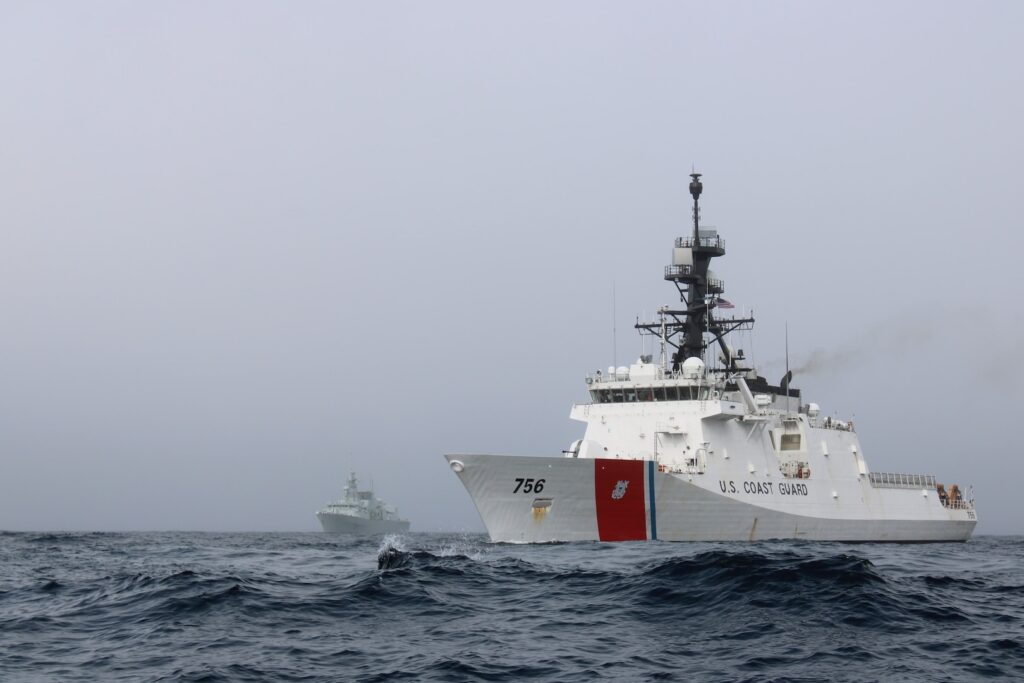
U.S. Coast Guard Cutter Kimball (WMSL 756) conducts a passing exercise with the Royal Canadian Navy ship HMCS Regina while Kimball patrols the Bering Sea, July 18, 2024. (U.S. Coast Guard photo by Ensign James Bongard.)
From U.S. Coast Guard 14th District, Aug. 7, 2024
HONOLULU — The crew of the Coast Guard Cutter Kimball (WMSL 756) returned to their home port at Base Honolulu, Thursday, after completing a 122-day patrol in the Northern Pacific, Bering Sea, and American Arctic.
Kimball’s crew patrolled in support of Operation Alaskan Groundfish Enforcer, Alaskan Sentinel and Bering Shield, promoting maritime governance by enforcing domestic fishery regulations while countering illicit maritime activity from foreign fleets along the maritime boundary line.
Kimball’s crew detected four Chinese surface combatants operating in vicinity of the Amchitka and Amukta Passage within the U.S. exclusive economic zone in early July. Under Operation Frontier Sentinel, Kimball monitored the Chinese vessels, meeting presence with presence to ensure there were no disruptions to U.S. interests in the maritime environment around Alaska.
Kimball’s crew interacted with strategic partners in Victoria, Canada, strengthening relationships by focusing on shared interests in the Bering Sea and the expanding Artic region. Kimball’s command cadre met with senior leadership from the Royal Canadian Navy at the Canadian Maritime Forces Pacific and Joint Task Force Pacific headquarters, participating in geopolitical analysis briefs and roundtable discussions on enhancing joint maritime domain awareness in the Arctic. The visit included tours of the HMCS Ottawa, HMCS Corner Brook and culminated later in the patrol with a passing exercise with HMCS Regina, promoting interoperability with the Royal Canadian Navy and simultaneously advancing the Tri-Service Maritime Strategy through U.S. sea-service engagements.
Showcasing law enforcement expertise, Kimball’s crew ensured fishing vessels in the Bering Sea were within compliance of all federal fishery conservation laws and safety requirements through the completion of twenty living marine resources boardings. Kimball’s boarding team identified one vessel operating in violation of U.S. fisheries regulations, resulting in a $4,500 violation from National Oceanic and Atmospheric Administration’s (NOAA) office of law enforcement.
Kimball’s crew protected U.S. economic interests monitoring foreign fishing vessels along the maritime boundary line, preventing U.S. economic exclusion zone incursions. Kimball’s law enforcement teams conducted a joint boarding with Customs and Border Protection and NOAA of a foreign flagged reefer vessel to inspect fish bait being imported into the United States strengthening federal partnerships in the region.
While operating in the Bering Sea, the crew demonstrated the multi-mission agility of the national security cutter’s advanced command-and-control capabilities by coordinating Alaskan based Coast Guard air and surface assets, forming dynamic force packages that dramatically enhanced the nation’s offshore search and rescue (SAR) abilities. Kimball operated with a forward deployed MH-60 Jayhawk helicopter and aircrew in Cold Bay, Alaska, and the District Seventeen command center to execute complex SAR exercises for improving, coordination, response times, and range of rotary Coast Guard assets to assist mariners in distress.
Additionally, Kimball’s crew was instrumental in conducting a proof of concept fueling at sea with the Coast Guard Cutter Bailey Barco (WPC-1122), a fast response cutter (FRC) homeported in Ketchikan, Alaska. This successful evolution extended the endurance of the Bailey Barco and resulted in Bailey Barco’s crew conducting over 10 vessel boardings in Bristol Bay, Alaska, an area not routinely accessed by FRCs due to logistical constraints.
During port visits in Alaska, Kimball’s crew engaged with local communities. In Nome, crewmembers engaged with the tribal leadership and conducted two community outreach events, including public training and engagements for “Kids Don’t Float,” a statewide initiative to prevent youth drowning incidents. Kimball crewmembers demonstrated the importance of proper life jacket use and cold immersion survival. While in Dutch Harbor, crewmembers volunteered for community events including staging tents and site facilities for summer cultural camps.
“This crew excelled at operating in one of the harshest maritime environments, rising to the challenge of meeting presence with presence when encountering strategic competitors, ensuring the safety and security of U.S. fishermen, engaging with local communities, and providing overarching SAR coverage throughout the Bering Sea” said Capt. Robert Kinsey, Kimball’s commanding officer. “The Coast Guard is a key domestic and international Arctic security leader, shaping the region to promote rule of law and prevent foreign malign influence. I couldn’t be more proud of the crew’s professionalism, dedication, and ability to work together with our partners, foreign and federal, to deliver mission excellence for the American people.”
Commissioned in 2019, Kimball is one of ten commissioned Coast Guard legend-class national security cutters and one of two homeported in Honolulu. National security cutters are 418-feet long, 54-feet wide, and have a 4,600 long-ton displacement. They have a top speed more than 28 knots, a range of 12,000 nautical miles, and can hold a crew of up to 170. National security cutters routinely conduct operations throughout the Pacific and Atlantic, where their combination of range, speed, and ability to operate in extreme weather provides the mission flexibility necessary to conduct vital strategic missions.
The namesake of U.S. Coast Guard Cutter Kimball is Sumner Increase Kimball, who was organizer of the United States Life-Saving Service and the General Superintendent of the Life-Saving Service from 1878–1915. The ship’s motto is “Wield the Paddles Together: Work Together.”
-USCG-
August 7 U.S. Central Command Update
From U.S. Central Command
Aug. 7, 2024
TAMPA, Fla. - In the past 24 hours, U.S. Central Command forces successfully destroyed two Iranian-backed Houthi uncrewed aerial vehicles, one Houthi ground control station, and three Houthi anti-ship cruise missiles in Houthi-controlled areas of Yemen.
These weapons presented a clear and imminent threat to U.S. and coalition forces, and merchant vessels in the region. This reckless and dangerous behavior by Iranian-backed Houthis continues to threaten regional stability and security.
Northrop Grumman, Genohco to Team on Korean Mine Countermeasures
Northrop Grumman’s self-contained design allows ALMDS to be installed on several aircraft types. (Photo Credit: US Navy)
MELBOURNE, Fla. – Aug. 8, 2024 – Northrop Grumman Corporation (NYSE: NOC) and Genohco have signed a Memorandum of Understanding (MOU) in connection with the Republic of Korea’s Mine Countermeasures Helicopter (KMCH) program. The agreement supports Northrop Grumman’s longstanding industrial cooperation with the Republic of Korea’s Defense Acquisition Program Administration and defines the work that Genohco will perform as a supplier.
This MOU follows Korea Aerospace Industries’ (KAI) 2023 contract for Northrop Grumman to provide Airborne Laser Mine Detection System (ALMDS) solutions and technical support for the Engineering, Manufacturing and Design phase of the Republic of Korea’s KMCH program.
Under the agreement, Genohco will support the manufacturing of ALMDS hardware components.
To date, Northrop Grumman has delivered 24 ALMDS units to the U.S. Navy and four units to the Japan Maritime Self-Defense Force (JMSDF).
Northrop Grumman and Genohco sign a Memorandum of Understanding to collaborate on the Republic of Korea’s Mine Countermeasures Program. (Photo Credit: Northrop Grumman)
Experts:
Janice Zilch, vice president, multi-domain command and control programs, Northrop Grumman: “Industry collaborations with companies such as Genohco and KAI are key to Northrop Grumman’s approach to technology development across the globe. Our team is committed to delivering advanced solutions to meet the security needs of the Republic of Korea’s Ministry of National Defense.”
Richard D. Yoo, senior director of business development, Genohco: “We are honored to be working with Northrop Grumman, a world leader in the defense industry. Projects like the KMCH program allow global contractors to collaborate with Korean industry. Being part of Northrop Grumman’s supply chain network, we look forward to providing innovative solutions together in the global market.”
Details:
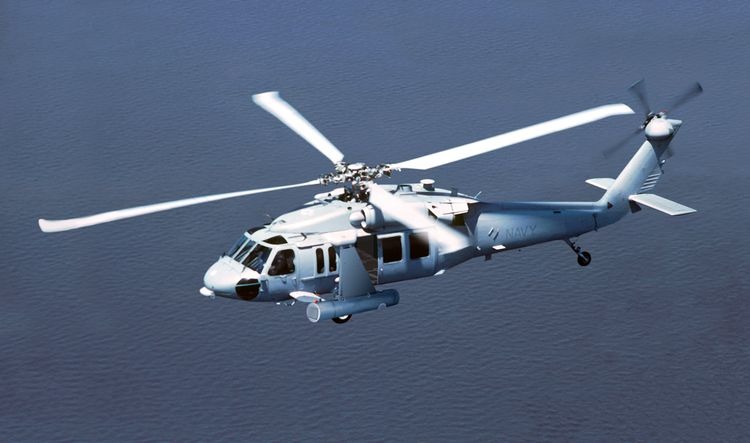
Northrop Grumman’s AN/AES-1 ALMDS detects, classifies and locates floating and near-surface moored mines. Mounted onto a variety of helicopter platforms, the system is capable of untethered day or night operations, which allow it to attain high area search rates. ALMDS also provides accurate target geo-location to support follow-on neutralization of the detected mines. Northrop Grumman’s support of the KMCH program leverages the company’s extensive systems integration and digital engineering expertise.
NAVCENT Commander: Difficult to Find Houthi Center of Gravity to Hold at Risk
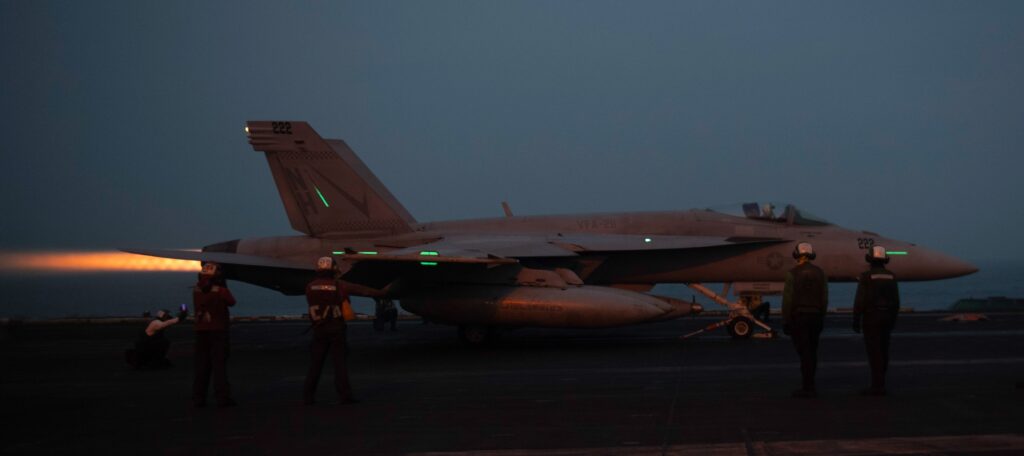
An F/A-18E Super Hornet from Strike Fighter Squadron (VFA) 211 launches from the Nimitz-class aircraft carrier USS Theodore Roosevelt (CVN 71) during flight operations in the U.S. 5th Fleet area of operations, July 31, 2024. (U.S. Navy photo)
By Richard R. Burgess, Senior Editor
ARLINGTON, Va. — The Houthi forces who have been attacking shipping in the Red Sea and Gulf of Aden lack a center of gravity, making for deterrence by U.S and partner forces difficult, the commander of U.S. naval forces in the Middle East said in a webinar.
Since November, a few weeks after the October 7 attack on Israel by Hamas terrorists, the U.S. Navy’s 5th Fleet, with cooperation from the navies of several allies and partners, has been engaged in protecting commercial shipping through the Red Sea and Gulf of Aden from attacks by ballistic missiles, anti-ship cruise missiles, unmanned aerial vehicles, unmanned surface craft, and unmanned underwater vehicles launched by the Houthi rebels in Yemen.
“We have certainly degraded their capability,” said Vice Admiral George Wikoff, commander, U.S. Naval Forces Central Command, commander, U.S. 5th Fleet, and commander, Maritime Forces, speaking in an August 7 webinar sponsored by the Center for Strategic and International Studies and the U.S. Naval Institute and funded by HII.
“However, have we stopped them? No,” Wickoff said, noting Houthi recent attacks on shipping, one of which damaged a commercial ship. “But our mission remains to disrupt their ability and try to preserve some semblance of maritime order while we give an opportunity for policy to be developed against the Houthis.
“The challenge of the deterrence is, obviously, you have to have a center of gravity to hold at risk, and one thing we don’t really know that much about—and we find this through history—is it is very difficult to find a centralized center of gravity that we can hold at risk over time and use that as a potential point of deterrence,” he said. “So, to apply a classic deterrence policy in this particular scenario is a bit challenging.”
Wickoff said the continuing naval operations in the BAM (Bab-el-Mandeb) Strait region will act as a “shock absorber.”
He noted an almost 50% drop in commercial shipping through the BAM region in the September through December time frame, with a large drop until the beginning of February.
“The reflected the maritime industry’s ability to re-calibrate and re-initiate their routes,” he said. “It’s a couple-months process to take transit patterns that go through the Red Sea and re-route them around the Cape of Good Hope, etc.”
Since the beginning of February there has been a stabilization, with approximately 1,000 ships going through the BAM per month, compared with approximately 2,000 ships per month prior to the Israel-Hamas war, Wickoff noted.
“Right now, the idea is to continue to maintain that decision space, try to preserve where we are right now … to allow other levers of government, other levers of the international community to pressurize the Houthis to stop what they’re doing in the maritime,” the admiral said.
U.S. Coast Guard Completes Operation Nasse in Pacific Region
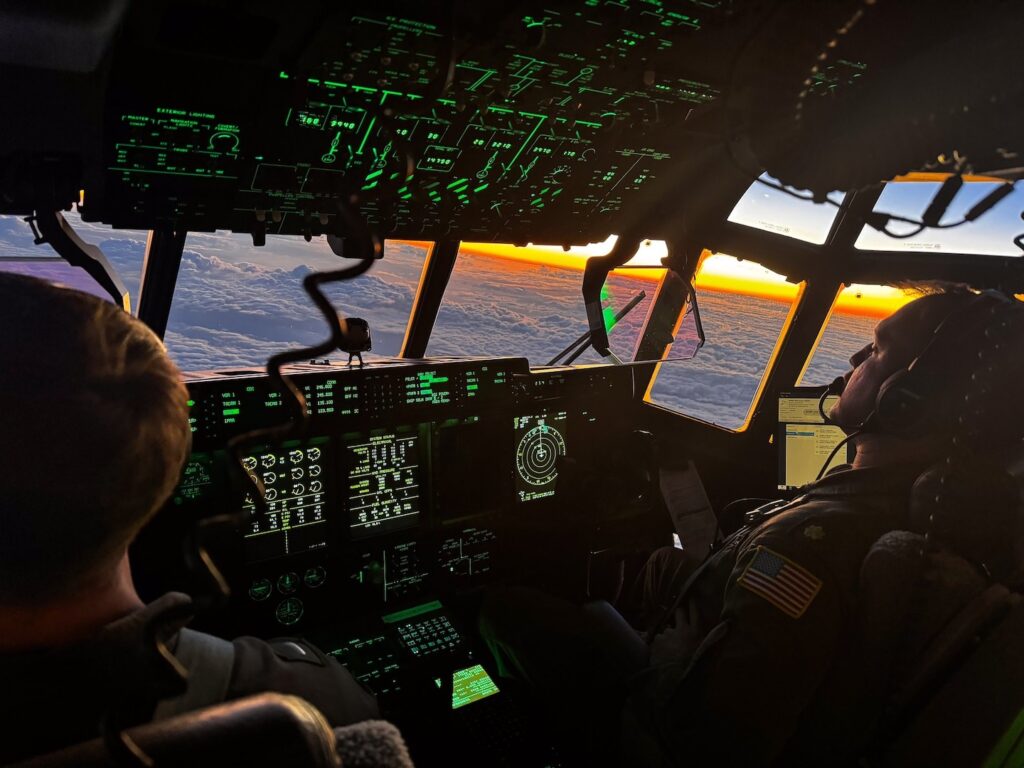
U.S. Coast Guard Lt. Junior Grade Nick Fuist and Lt. Cmdr. Keith Arnold , two pilots at U.S. Coast Guard Air Station Barbers Point, man the controls of a Coast Guard Air Station Barbers Point HC-130 Super Hercules in the skies above Auckland, New Zealand, Jul. 9, 2024. (U.S. Coast Guard photo by Petty Officer 2nd Class Nicholas Martino)
From Coast Guard District 14 External Affairs, Aug. 6, 2024
HONOLULU – The U.S. Coast Guard completed participation in Operation Nasse, a three-month operation conducted by Australia, France, New Zealand, and the U.S. to safeguard the invaluable marine resources of Pacific Island nations and the Western Central Pacific Ocean, July 12.
From July 1-12, an HC-130J Hercules airplane crew from Coast Guard Air Station Barbers Point patrolled the South Pacific High Seas in and around the Exclusive Economic Zones of Australia, New Caledonia, Fiji, New Zealand, Tonga, Niue, and the Cook Islands to detect, investigate and report any illegal, unreported and unregulated (IUU) fishing activity.
During the operation, the Coast Guard collaborated with Pacific Quadrilateral Defense Coordinating Group (Pacific QUAD) partners to enhance their Monitoring, Control and Surveillance (MCS) tools and communications to support regional and national maritime surveillance efforts.
The wide-ranging operations were supported by the Pacific Islands Forum Fisheries Agency’s (FFA) Regional Fisheries Surveillance Center (RFSC) and several FFA members to reinforce the conservation work of the Western and Central Pacific Fisheries Commission (WCPFC) on the high seas. Alongside the P-QUAD partners, Fiji, Vanuatu, and the Cook Islands participated in the operation for the first time.
Coast Guard participation in Operation Nasse is part of Operation Blue Pacific, an overarching multi-mission Coast Guard endeavor promoting security, safety, sovereignty, and economic prosperity in the Pacific while strengthening relationships between partner nations.
“Oceania is vast, and the challenges of illegal fishing require a united front,” said Lt. Cmdr. Keith Arnold, HC-130J aircraft commander for U.S. Coast Guard Air Station Barbers Point. “Collaborating with the Pacific Quad and other regional partners to combine our resources and expertise to enhance monitoring tools is crucial to countering illegal fishing activities in Oceania. Sharing data, strengthening our communication networks, and coordinating patrols allows us to create a more comprehensive picture of what’s happening on the water in the region. This collaborative approach sends a strong message to those engaged in illegal fishing: we will work together to stop these activities and protect these vital resources.”
Joint efforts for Operation Nasse covered over 16,000 square miles, with the U.S. Coast Guard contributing:
Over 58 hours of flight time
37 vessels sighted and analyzed
Four potential Conservation and Management Measures (CMM) violations reported
240 hours of analyst-to-analyst collaboration and training
Located in Honolulu, U.S. Coast Guard District Fourteen covers more than 14 million square miles of land and sea, conducting operations over the Hawaiian Islands, American Samoa, Saipan, Guam, Singapore and Japan.
Revolutionizing Marine Corps Maintenance with AR/VR Technology
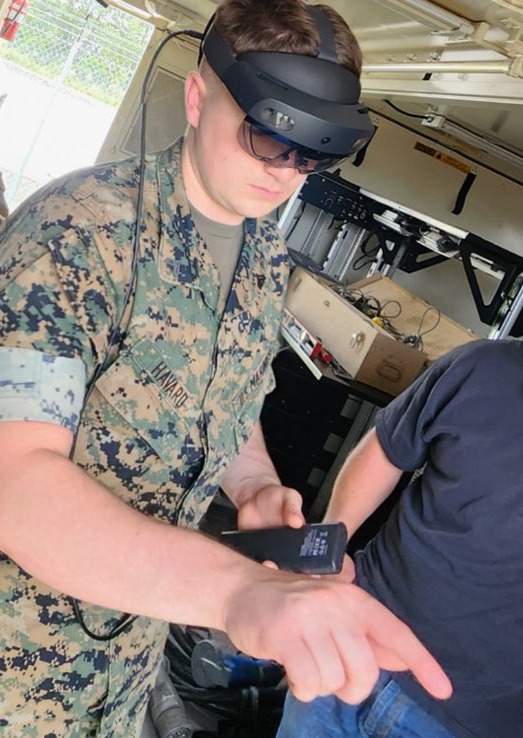
[Courtesy Photo] Cpl. Tyler Havard, S3 Schools Non-Commissioned Officer (NCO), 2D Maintenance Battalion, prepares an Augmented Reality lens for use during tele-maintenance between artisans at Marine Depot Maintenance Command’s Production Plant in Albany, Ga., and the maintenance team at Marine Wing Communications Squadron 28 (MWCS 28), Cherry Point, N.C.
By Jennifer N. Napier
MARINE CORPS LOGISTICS BASE ALBANY, GA –Augmented Reality (AR) and Virtual Reality (VR) are set to play pivotal roles in transforming tele-maintenance operations, ensuring that maintainers are always available to support the Marine on any front at any time.
Bridging the Gap
Tele-maintenance, the remote diagnosis and repair of equipment, has traditionally relied on phone calls and manual instructions. However, the arrival of AR and VR technologies promises to take maintenance capabilities to an entirely new level. By overlaying digital information onto the real world (AR) or creating fully immersive virtual environments (VR), these technologies provide a more intuitive and effective way for technicians to perform maintenance tasks remotely.
AR can significantly enhance the diagnostic process by allowing remote experts to visualize the exact conditions that field technicians are encountering. For instance, a technician wearing AR glasses can receive step-by-step guidance directly in their line of sight, with holographic overlays highlighting parts and tools needed for a specific task. This real-time, hands-free assistance minimizes errors and speeds up the repair process.
The Pursuit
Marine Depot Maintenance Command has been experimenting with AR technologies as part of its effort to modernize its maintenance capabilities from industrial-era practices to technologies suitable and capable of meeting the demands of the Information Age. The implementation of the “Industry 5.0 Framework” includes increasing production planning, control, and execution of capabilities by optimizing and automating business processes and optimization of facilities, business processes, and technology. As part of the effort, the command has actively engaged in experimentation and testing of AR capabilities since September 2022 and is gaining a better understanding of how it can be integrated into the command’s current and future capabilities.
Real-World AR Application: A Case Study
In May 2024, Marine Wing Communications Squadron 28 (MWCS 28) at MCAS Cherry Point, NC, sought Marine Depot Maintenance Command (MDMC) Business Development’s assistance to fix four non-operational electronic maintenance shelters experiencing various electrical problems. Normally, a forward maintenance team would be deployed from one of the command’s two production plants in either Albany, Georgia, or Barstow, California, to support this request. Opportunely, the squadron had another option.
At the beginning of the year, the 2D Maintenance Battalion acquired and trained on the same AR equipment that MDMC had been experimenting with. Cpl. Tyler Havard, S3 Schools Non-Commissioned Officer (NCO), 2D Maintenance Battalion, became proficient in the use of the lens through training earlier this year and was able to link up with MWCS 28 to quickly orient the ground electronic maintenance team on how to use the AR equipment.
Using augmented reality, the MDMC team remotely guided Marines through the shelter maintenance and troubleshooting processes and identified and resolved various electrical problems, proving the effectiveness of AR-enabled tele-maintenance in real-time. Cpl. Vradley Cerna, a digital wideband systems maintainer, and Organics NCO, was one of three Marines working on the shelters who collaborated with the depot.
Cerna said that his team has been trained in electrical maintenance and could have attempted to troubleshoot the issues themselves. However, having somebody already familiar with the electronic components and layout of specific shelter models who could guide them step-by-step was immensely helpful and sped up identifying the issues. It was Cerna’s first-time using AR lenses. He remarked, “It was a little surprising the first time you put them on to see the features through the lens and hear the maintainers on the other end like they are right there next to you. It was a great experience and an option I would want to use in the future.”
Key lessons from this operation highlight the effectiveness of AR for real-time collaboration, significant safety enhancements, and substantial cost savings. Previously, MDMC deployed contact teams on temporary additional duty (TAD), incurring travel costs and disrupting production.
Training and Skill Enhancement
The Marine Corps can also leverage AR and VR for training purposes. New and seasoned technicians alike can benefit from virtual simulations that replicate real-world scenarios. Training modules can include various maintenance tasks, from routine checks to emergency repairs, providing a safe and controlled environment to hone their skills.
By simulating real-world conditions, VR training can prepare Marines for the challenges they might face in the field. This immersive experience ensures that they are well-versed in the intricacies of their equipment and can perform under pressure, ultimately leading to higher efficiency and readiness levels.
Reducing Downtime and Costs
One of the most significant advantages of AR/VR tele-maintenance is the reduction in equipment downtime. Quick and accurate repairs mean that machinery is back in operation sooner, which is crucial in a military context where readiness is paramount. Additionally, by enabling remote experts to assist with repairs, the need to transport specialized personnel to various locations is minimized, resulting in cost savings and faster response times.
Overcoming Challenges
While the potential benefits of AR and VR in tele-maintenance are substantial, there are challenges to be addressed. Ensuring secure and reliable communication channels is critical, as is the need for ruggedized AR/VR hardware that can withstand the harsh environments Marines often operate in. Moreover, integrating these technologies into existing systems and workflows will require careful planning and training.
Future Prospects
As AR and VR continue to evolve, their applications will expand, offering even more sophisticated tools and capabilities across the logistics enterprise. By investing in AR and VR for tele-maintenance, the Marine Corps is not only improving its current operational efficiency but also paving the way for future innovations in military logistics. This forward-thinking approach ensures that Marines remain equipped with the best tools available, ready to tackle any challenge that comes their way.
AR and VR technologies are set to revolutionize the Marine Corps, offering enhanced diagnostics, improved training, reduced downtime, and significant cost savings. As these technologies continue to develop, their integration into military logistics will undoubtedly play a crucial role in maintaining the Marine Corps operational readiness and effectiveness. The successful implementation of AR-enabled tele-maintenance demonstrates advancements in military maintenance operations, showcasing the potential for widespread adoption and efficiency and providing an optimistic outlook for this technology’s future financial and operational benefits.