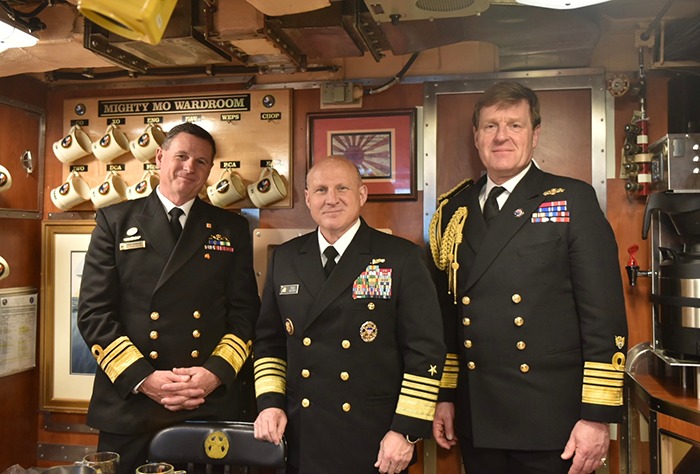
USCGC Harriet Lane Returns After Inaugural Operation Blue Pacific Patrol in Oceania
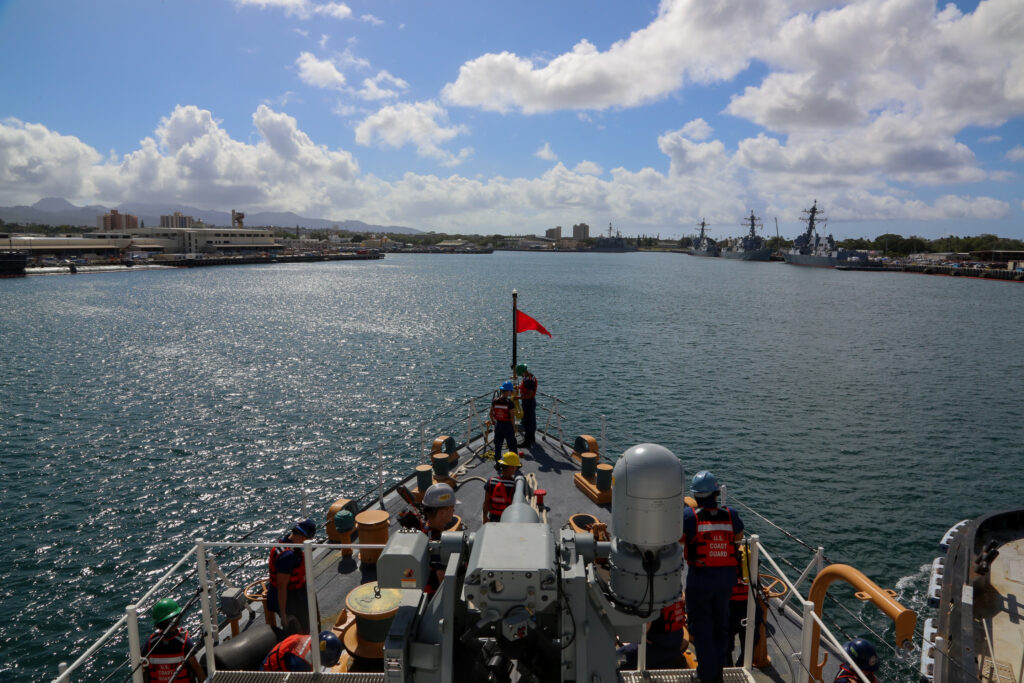
U.S. Coast Guard Cutter Harriet Lane (WMEC 903) crew renders honors to the Battleship Missouri Memorial as the Harriet Lane and crew return to home port in Pearl Harbor, Hawaii, April 9.

HONOLULU — U.S. Coast Guard Cutter Harriet Lane (WMEC 903) and crew returned to home port in Hawaii April 9 after a 79-day patrol in support of Coast Guard District Fourteen’s Operation Blue Pacific in Oceania.  

Harriet Lane and crew departed Pearl Harbor in January and traveled more than 15,000 nautical miles spanning from the Hawaiian Islands to the east coast of Australia. Patrolling in support of Operation Blue Pacific, the cutter and crew worked alongside Pacific Island nations to forge and advance relationships with like-minded allies and partners who share a common vision for maritime governance. 

Harriet Lane’s efforts included enhancing maritime domain awareness, combatting illegal fishing activities across Oceania, and participating in exercises to bolster partner capacity and interoperability. Leveraging bilateral maritime law enforcement agreements with Samoa, Fiji, Vanuatu, and Papua New Guinea, Harriet Lane conducted 27 boardings alongside Pacific Island partners in their respective exclusive economic zones (EEZs).  

Through bilateral maritime law enforcement agreements, the Coast Guard is able to provide a platform for partner nations to enforce domestic and international laws within territorial seas and the far reaches of their EEZs. The embarked shipriders identify boarding targets within their EEZ, take law enforcement action in accordance with their authority, and are supported by U.S. Coast Guard personnel throughout the course of the boarding activity. These operations are focused on increasing partner nations’ capabilities and maritime domain awareness while safeguarding sovereign rights, supporting sound maritime governance, and combatting illicit activities on the water. Additionally, Harriet Lane law enforcement personnel conducted four fishery boardings on the high seas in concert with the Western and Central Pacific Fisheries Commission. 

During Harriet Lane’s patrol, the crew made port calls in American Samoa, Samoa, Fiji, Vanuatu, Australia, Papua New Guinea, and the Marshall Islands. While offshore Nauru, Harriet Lane hosted key leadership engagements and underway subject matter exchanges with local enforcement agencies. Harriet Lane’s crew participated in numerous engagements with local communities throughout the region, including subject matter expert exchanges, such as search and rescue planning and small boat operations, school visits, and several tours of Harriet Lane with U.S. Ambassadors, foreign dignitaries, heads of police and fisheries agencies, and hosted the U.S. Coast Guard Commandant, Adm. Linda Fagan, as she led a maritime roundtable aboard the cutter in Vanuatu.  

“This was a patrol of firsts for Harriet Lane and the U.S. Coast Guard” said Cmdr. Nicole Tesoniero, commanding officer of Harriet Lane. “The Coast Guard has a long and storied history in the Pacific, and Harriet Lane’s introduction to the region delivers on a pledge to our allies and partners that the United States has an enduring commitment in the Blue Pacific. Harriet Lane’s crew delivered on each and every ask made throughout this patrol, and I could not be more proud of our crew’s dedication, professionalism, and service to our great nation. This was just the first of many patrols in support of Operation Blue Pacific for Harriet Lane and I look forward to seeing our impact continue to grow.” 

Harriet Lane, commissioned in 1984, is a 270-foot medium endurance cutter homeported in Pearl Harbor, Hawaii, to support Coast Guard missions in the Pacific region. The service’s medium endurance cutter fleet supports a variety of Coast Guard missions including search and rescue, law enforcement, maritime defense, and protection of the marine environment. 


USCG Cutter Bertholf Returns Home Following 98-Day Indo-Pacific Deployment

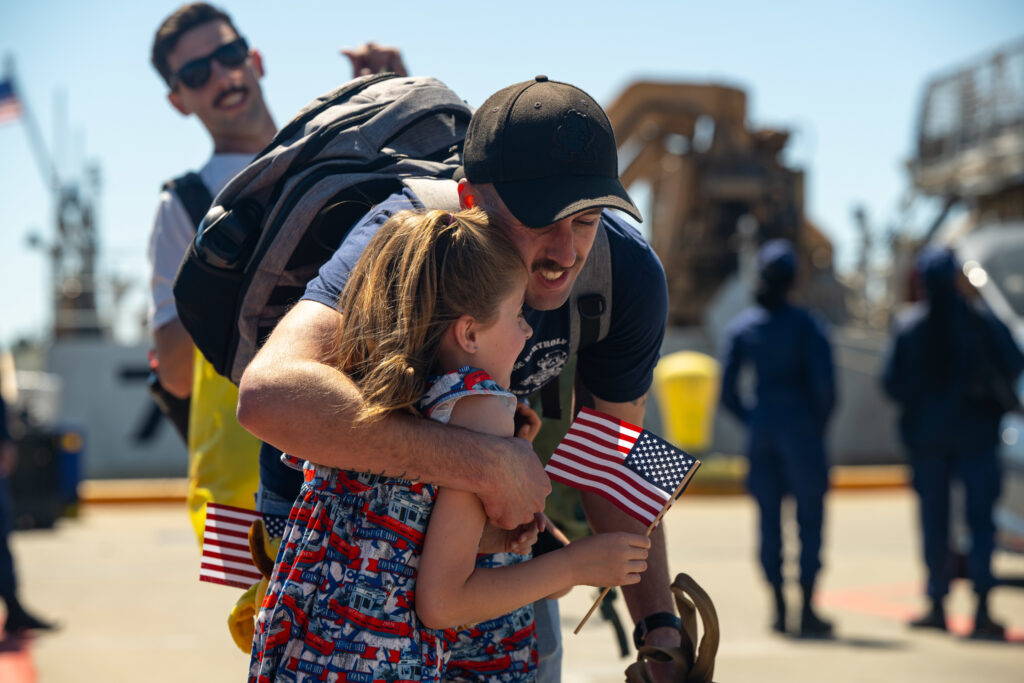
A crew member assigned to the Coast Guard Cutter Bertholf (WMSL 750) greets his family at the cutter’s return to home port on Coast Guard Base Alameda, California following a 98-day patrol in the Indo-Pacific region, April 8. U.S. Coast Guard | Petty Officer 3rd Class Hunter Schnabel

ALAMEDA, California — The U.S. Coast Guard Cutter Bertholf (WMSL 750) and crew returned home April 8 following a 21,000-mile, 98-day Indo-Pacific deployment in support of U.S. Indo-Pacific Command and U.S. Navy’s 7th Fleet.

Throughout the deployment, Bertholf led international engagements in the Republic of Singapore, Malaysia and India, strengthening interoperability and maritime governance through joint at-sea exercises, professional engagements, and subject matter expert exchanges.

Bertholf departed Alameda on Jan. 2 as the Coast Guard’s first of multiple national security cutter deployments to the Indo-Pacific this year.

“The opportunities to work with our allies and partners throughout the Indo-Pacific increased our regional interoperability and greatly strengthened the bonds which we share as a seagoing service,” said Captain Billy Mees, Bertholf’s commanding officer. “We greatly appreciated engaging in professional interactions, enhancing maritime capabilities, and reinforcing maritime governance in the area through promoting global connections, fostering unity, and advancing efforts to maintain an open and free Indo-Pacific region.”

While operating in the vicinity of Singapore, the crew of the Bertholf participated in multiple professional engagements and training exercises with members of the Republic of Singapore Navy, Singapore Police Coast Guard, and Malaysia Maritime Enforcement Agency (MMEA). Bertholf hosted U.S. Ambassador Jonathan E. Kaplan aboard for a tour and a chance for Bertholf’s crew to showcase the cutter’s operational capabilities.

Upon departure, Bertholf’s crew conducted at-sea exercises and subject matter expert exchanges with the Republic of Singapore Navy and MMEA, including a group sail through the Strait of Malacca.

Upon Bertholf’s service-first, historic arrival in Port Klang, Malaysia, the crew conducted several subject matter expert exchanges with the MMEA, Republic of Singapore Navy, Singapore Police Coast Guard, Japan Coast Guard, Korea Coast Guard, and Australian Border Force. The joint training included maritime law enforcement skills, small boat launch and recoveries, emergency rescue and carry procedures, and shipboard damage control tactics to bolster interoperability across the maritime domain of Southeast Asia. Bertholf hosted U.S. Ambassador Edgard D. Kagan and Malaysian dignitaries onboard for a U.S. Embassy reception on the cutter’s flight deck.

Bertholf’s final international port call was Port Blair, India, marking the first time a U.S. Coast Guard cutter has visited the Andaman and Nicobar Islands, a union territory of India situated between the Bay of Bengal and the Andaman Sea.

During the four-day engagement, Bertholf’s crew participated in sporting events and reciprocal tours, and Bertholf’s officers attended a formal reception at the India Coast Guard’s regional headquarters. Bertholf and India Coast Guard participated in the joint exercise ‘Sea Defender,’ with two days of at-sea exercises that included responses to shipboard drone and small boat attacks, shipboard damage control evolutions, pollution responses, counter drug interdiction and non-compliant vessel pursuit tactics, security boardings, flight operations, and an overnight group sail with the India Coast Guard across the Indian Exclusive Economic Zone to the Strait of Malacca.

Commissioned in 2008, Bertholf is one of four Coast Guard legend-class national security cutters homeported in Alameda. National security cutters are 418 feet long, 54 feet wide, and have a 4,600 long-ton displacement. They have a top speed of more than 28 knots, a range of 12,000 nautical miles, endurance of up to 90 days, and can hold a crew of up to 170.


BAE Receives Additional Contracts for Amphibious Combat Vehicles

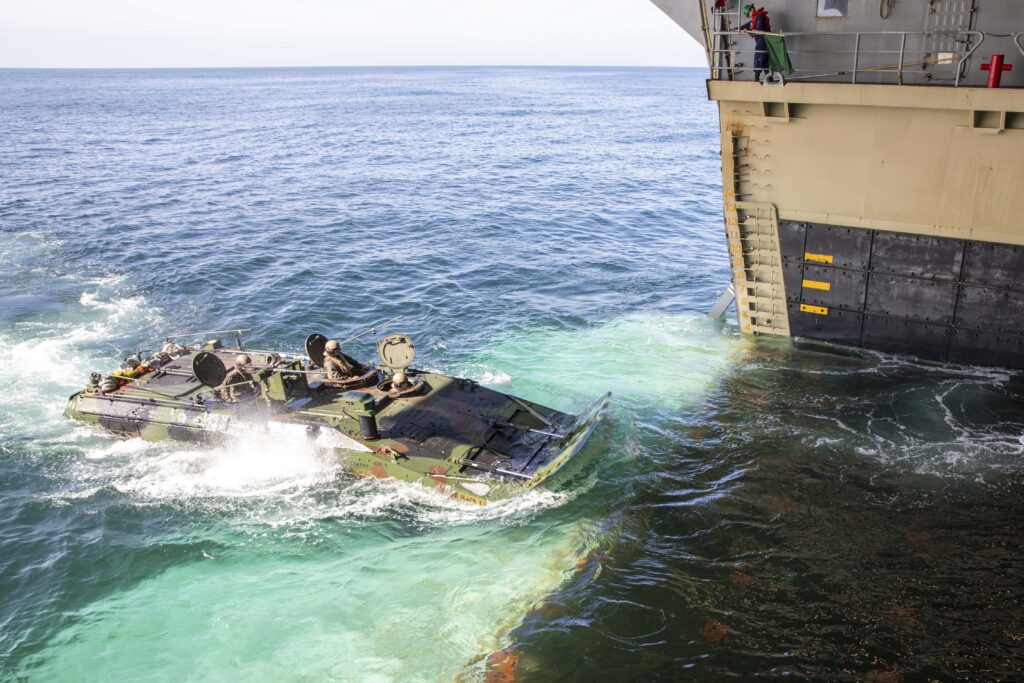
An Amphibious Combat Vehicle (ACV) with the 3d Assault Amphibian Battalion, 1st Marine Division, enters the well deck of amphibious assault ship USS Makin Island (LHD 8) during waterborne training in the Pacific Ocean. U.S. Navy | Mass Communication Specialist Seaman Kendra Helmbrecht

BAE Systems has been awarded an additional $25 million firm-fixed-price modification to a previously awarded $181 million contract by the U.S. Marine Corps for more Amphibious Combat Vehicles (ACVs) under the Marine Corps’ fourth order for full-rate production (FRP).

Total cumulative face value of the contract is $2.7 billion. In addition to vehicle production, the award covers the procurement of ACV Personnel (ACV-P) variants, fielding and sustainment costs, and support and test equipment.

Vehicles produced under this contract will fulfill the Marine Corps’ fleet requirements for ACV-Ps, providing them full operational amphibious capability to execute operations around the world.

“This contract award allows us to continue to deliver this critical capability to the Marine Corps to enable warfighters to complete ship-to-shore missions and other expeditionary requirements,” said Garrett Lacaillade, vice president of amphibious vehicles for BAE Systems. “We continue to work hand-in-hand with our strategic partner Iveco Defense Vehicles and the Marine Corps to ensure that ACVs are ready for current and future deployments.”

ACV-P is the first in a family of four variants to be manufactured and delivered to the Marine Corps. Additional variants include the ACV Command and Control (ACV-C) variant which is currently in production; the ACV 30mm Cannon (ACV-30) variant which production ready test vehicles were delivered for testing earlier this year; and an ACV Recovery (ACV-R) variant which recently completed the design and development phase.

The ACV 8×8 platform provides true open-ocean amphibious capability, land mobility, payload, and growth potential to accommodate future variant growth and technology integration to meet the Marine Corps’ ever-evolving operational needs. 

ACV production and support is taking place at BAE Systems locations in Stafford, Virginia; San Jose, California; Sterling Heights, Michigan; Aiken, South Carolina; and, York, Pennsylvania. Deliveries are anticipated to begin in late 2025.


NPS, Defense Innovation Unit Sign MOU to Enhance Learning, Experimentation, Prototyping for Maritime Advantage

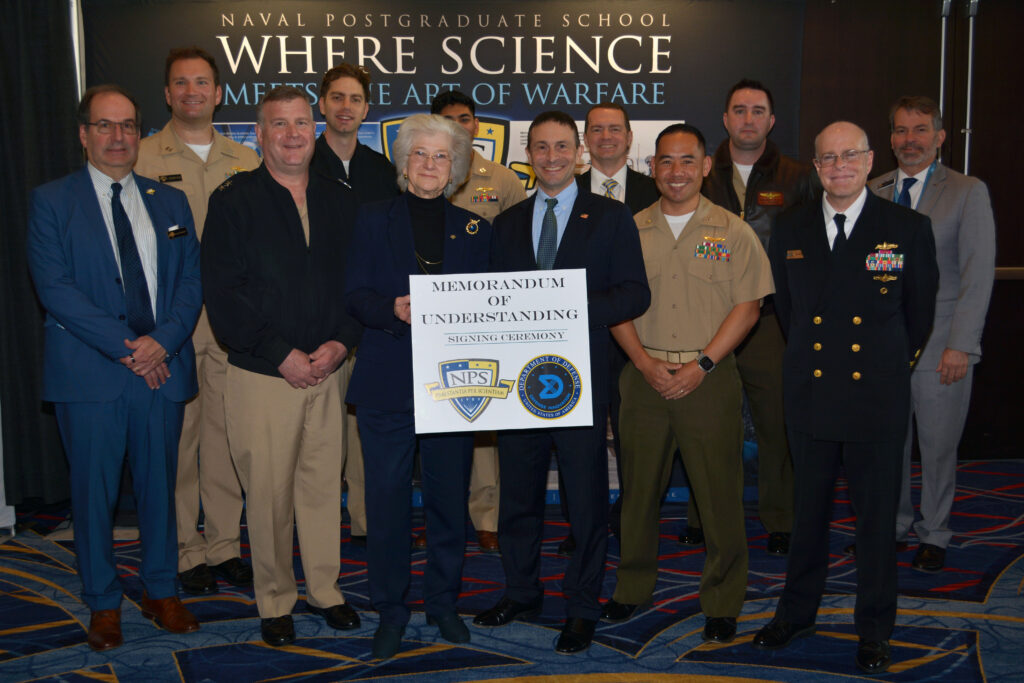
Retired Vice Adm. Ann Rondeau, president of the Naval Postgraduate School (NPS), and Doug Beck, director of the Defense Innovation Unit (DIU), are joined by senior Navy officials and NPS students after the signing of a Memorandum of Understanding (MOU) between the two institutions during the Sea-Air-Space conference in National Harbor, Md. The MOU will build upon past successes and existing academic and research relationships between DIU and NPS. U.S. Navy | Lt. Cmdr. Ed Early

The Naval Postgraduate School (NPS) and the Defense Innovation Unit (DIU) are joining forces in a cooperative endeavor to accelerate adoption of commercial dual-use technology solutions, while enhancing the advanced education of defense leaders necessary to employ them.

DIU Director Doug Beck and retired U.S. Navy Vice Adm. Ann Rondeau, President of NPS, announced a new Memorandum of Understanding (MOU) on April 9 at the Sea-Air-Space Conference in National Harbor, Md. The MOU will build upon past successes and existing relationships between DIU and NPS to expand complementary efforts and future opportunities targeting education, research, and innovation through student fellowships at DIU, personnel exchanges, collaborative experimentation, and projects with the Naval Innovation Center (NIC) at NPS.

Said Secretary of the Navy Carlos Del Toro, who announced the establishment of the NIC at NPS in December 2022: “I look forward to witnessing the vision for the Naval Innovation Center coming to life at NPS. The NIC will provide an educational opportunity and venue unavailable anywhere else in the world, where industry and academic partners will work side-by-side with our NPS students to research and discover advanced warfighting solutions.”

Department of Defense (DOD) capabilities are built on American ingenuity and innovation. The recently published National Defense Science and Technology Strategy acknowledged the deep linkage of defense education and research to discovery and innovation, stating that “education is another cornerstone for building enduring advantage” and that DOD “cannot create 21st century capabilities using 20th century equipment, education, and employment policies.”

Increasingly, innovation is led by industry, and academic institutions are forging long-term relations with technology companies to stay on the cutting edge. This agreement will help to increase those relationships and deliver needed capabilities to the fleet and joint force.

“DIU partners with many Silicon Valley organizations, from tech icons to start-ups as well as universities, and NPS is a natural fit given its defense focus,” said Beck. “Through this partnership we will connect companies with NPS talent and technology leaders, providing a catalyst for their learning and applied research to deliver innovative solutions for the joint force.”

For the Department of the Navy, the Naval Education Strategy guides and articulates the Secretary’s vision “for naval education to develop the world’s most capable, adaptive, and innovative naval force in support of the President’s national security priorities and the National Defense Strategy (NDS).” With a technical, outcome-based focus, NPS graduate education meets naval-unique and national defense needs.

According to Chief of Naval Operations Adm. Lisa Franchetti, the new partnership with DIU will enhance the capabilities of NPS aligned with her top priorities.

“NPS develops warfighters who are able to translate today’s uncertainties into tomorrow’s strategies, and continuously create warfighting advantages,” said Franchetti. “As the Navy’s flagship technical graduate school, this DIU partnership will strengthen NPS’ foundation to develop student excellence in their primary warfighting duties and further empower them to lead and solve real-world operational problems with leading-edge companies.”

Established in 1909 at the U.S. Naval Academy in Annapolis, Md., NPS moved to Monterey, Calif. in 1951, attracting faculty talent with the rise of Silicon Valley. Faculty depth across multiple disciplines in defense-related fields such as cybersecurity, oceanography, physics, naval engineering and space systems remains a hallmark of NPS – and a core attribute for DIU’s partners seeking to collaborate on defense research projects, experimentation and rapid prototyping.

“Our students are warrior-scholars, and they come to NPS to learn and make a difference,” said Rondeau. “NPS provides a venue to challenge assumptions, try new ideas, and with our industry partners, we serve as an innovation hub to rapidly adapt research concepts into prototype applications and capabilities. This new partnership with DIU will greatly enhance the impact our students can have on the fleet and force through expanded collaborations and greater access to emerging technologies.”

Today, NPS is home to the Naval Innovation Center, established by the Secretary of the Navy in December 2022 to enhance the school’s education, research and innovation impact. Del Toro is also championing a purposefully-designed building to house the NIC and fully leverage NPS attributes to support the innovation process at greater speed and scale.

The Defense Innovation Unit strengthens our national security by accelerating the adoption of leading commercial technology throughout the military and growing the national security innovation base. Learn more at: https://www.diu.mil/.


Sea-Air-Space Show Daily Coverage

Click each image to read daily coverage of #SAS24

Sea-Air-Space 2024 Playlist


Budget, Recruitment Challenges Drive Coast Guard Creativity, Officials Say

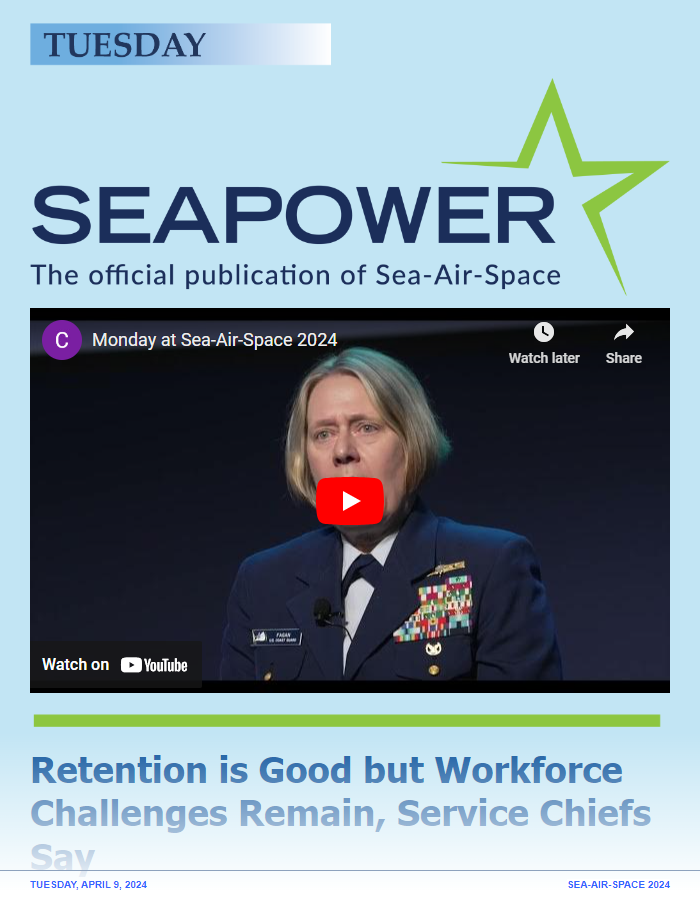
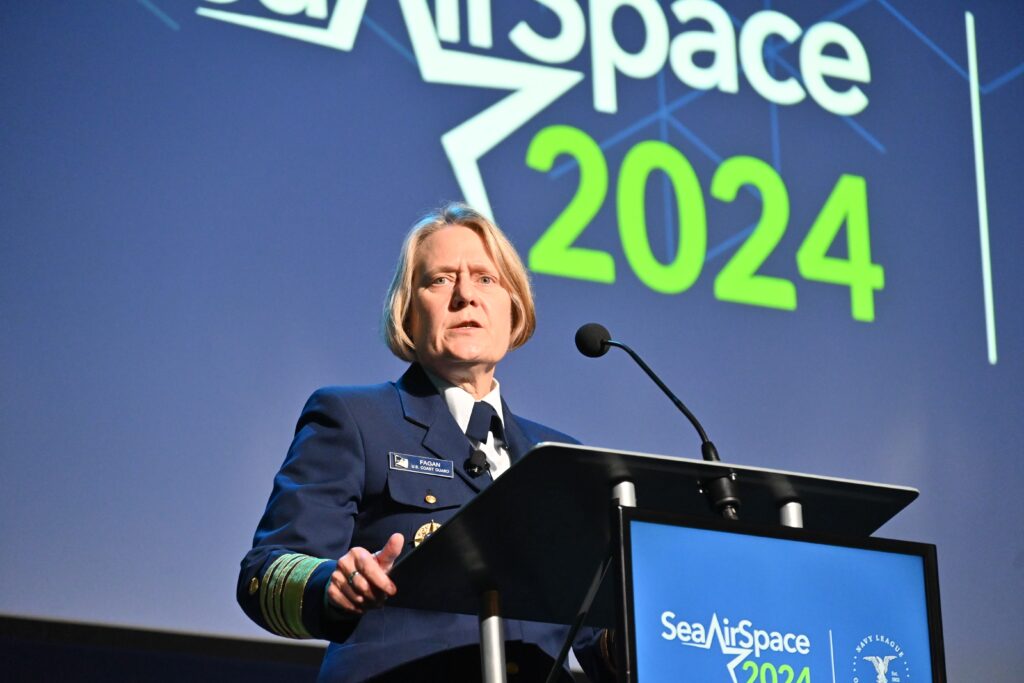
Coast Guard Commandant Admiral Linda Fagan speaks at the fifth annual Coast Guard breakfast. Brett Davis

Challenges with budgets, recruitment and retention levels are giving the U.S. Coast Guard the opportunity to be creative in addressing them and to update its policies and procedures, service officials said at the fifth annual Coast Guard Breakfast at Sea-Air-Space 2024.

Coast Guard Commandant Admiral Linda Fagan said the service has about half the maintenance budget it needs to maintain its legacy ships and equipment and is competing with the other services for shipbuilding and other industrial base services.

On the personnel side, persistent shortfalls in recruiting and retention ꟷ the service is down about 10% for enlisted personnel, Fagan said ꟷ have forced the Coast Guard to innovate and rethink the types of workers it recruits and how it enables their career.

“That crisis has really given us the opportunity to think,” Fagan said. “It strikes me the system that we’re operating, and much like the other services, the boot camps and schools, they’re optimized for 18 year olds fresh out of high school with little to no life experience, yet that’s not the recruiting pool that we’re experiencing or drawing into the service,” Fagan said.

The service is moving to a vastly different recruitment method, bringing in people aged as much as “42 years young” with much more life experience, enabling much greater flexibility for service members with families and making it easier for guard members to leave the service and re-enter.

That’s what enabled Rear Admiral Jo-Ann Burdian, the assistant commandant for response policy, to even be on stage on Wednesday at Sea-Air-Space, she said. She left active service as a lieutenant commander because she had three kids under the age of two at home.

“And when they were ready for me to come back, I still felt that calling back. I still felt like I had work to do for our Coast Guard and the nation, and the ability to come back and still go to graduate school, still compete for special assignments and be sitting here today” is a testament to the Coast Guard, she said.

Rear Admiral Russell Dash, commander of the Personnel Service Center, noted “we don’t always do press releases when we change policy, but we were the first one that went to 42 years old to be able to join the Coast Guard,” preceding the Navy’s similar move.

Chief of Naval Operations Admiral Lisa Franchetti said on Monday at Sea-Air-Space that a parent and child could enter Navy service at the same time, one at 42 and one at 18, but Dash said the Coast Guard has actually had that happen.

He said the service’s previous philosophies needed to change to make such things happen.

“There’s the acknowledgement that our standard of every single member of the Coast Guard needs to be worldwide deployable at every moment of their career, and the moment that you’re not worldwide deployable, we start a shot clock and say, you’ve got to fix yourself and get to this point, or we’re going to separate you. That’s wonderful when we had lines out the door, a waiting list to join the Coast Guard. But in the competition for talent, we’ve got to accept that’s not a standard that is maintainable for us. So, that has given us the opportunity to drive innovation.”

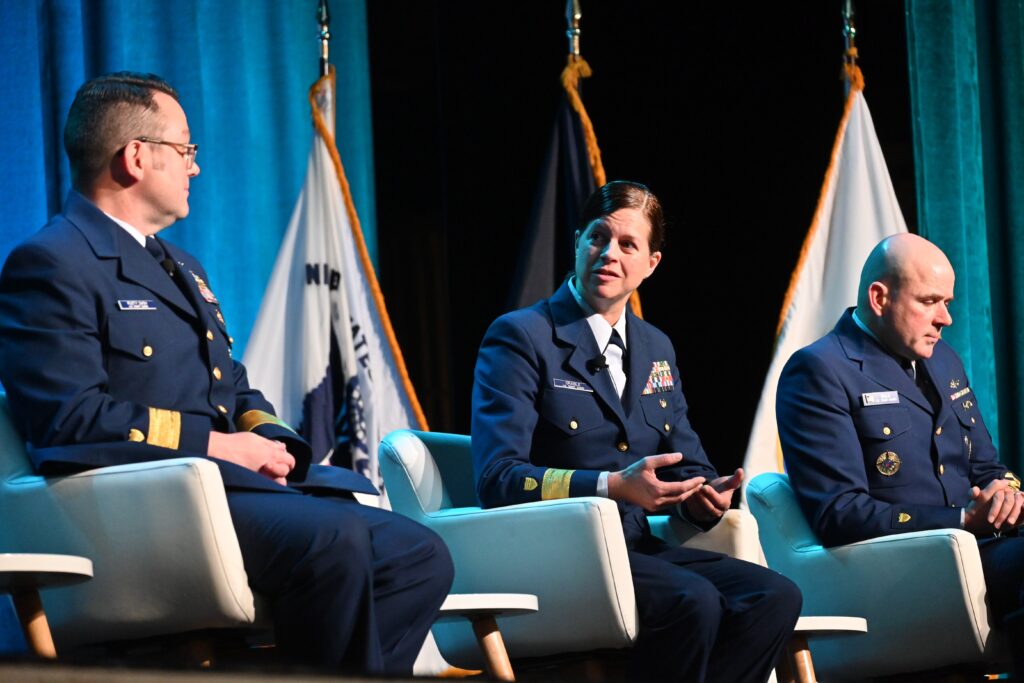
Rear Admiral Amy Grable makes a point about maintenance issues. Brett Davis

Maintenance

The service’s changes aren’t limited to personnel. To deal with that maintenance shortfall, the Coast Guard has gotten creative there as well.

“We do have shortfalls across all of our portfolios, including aviation, surface and shore,” said Rear Admiral Amy Grable, assistant commandant for Engineering and Logistics.

“We’re deferring 50% of our maintenance on many of our major cutters. And what that means to our crews is, what we used to call cannibalizing parts from one cutter to put on another cutter. It’s now so routine that we have a name for it, we call it a controlled parts exchange,” she said.


HASC Members Prepare to Dive into Navy Budget

Members of the House Armed Services Committee seem prepared to overturn some Navy decisions as outlined in the fiscal 2025 budget request, including retiring some ships early and funding only one Virginia-class submarine. 

“What has happened is, as the top line is increased, the game has become, ‘we’ll add a bunch of the stuff that we know Congress won’t add, and we’ll take out stuff that we know Congress is going to put back in.’ And that will be a net gain. That game has to stop,” said Rep. Wittman (R-Virginia), chair of the House Subcommittee on Tactical Air and Land Forces. 

As for the Virginia-class sub, Wittman said the Navy position that the program is behind anyway and the shipbuilders can’t keep up doesn’t make sense. 

“It really is about demand signal and, and you can’t have it both ways. You can’t say, well, the reason we are reducing the submarine request is because we don’t think the industrial base can do it. That’s wrong,” he said. “The industrial base can do it if you send them the demand signal. We’re at about 1.6, I think, submarines today annually, we need to be at 2.3. The way we get there is to send the proper demand signal.” 

Rep. Joe Courtney (D-Connecticut), the ranking member on the Subcommittee on Seapower and Projection Forces, said a defense industry report issued in December highlighted the need for procurement stability. 

“Procurement stability was the watchword throughout that report,” he said. “And, we’re sacrificing that. I mean, literally, within weeks” of the report. 

Naval aviation is also an issue, as the Navy has an air attack shortfall, noted moderator Bryan Clark, a senior fellow at the Hudson Institute. 

“There are some, thanks to Congress, some Super Hornets being procured in this year’s appropriations,” he said. “But there doesn’t seem to be a clear path ahead for the carrier air wing.” 

This drew an animated response from Wittman, who said there doesn’t seem to be a sense of urgency about the situation. 

“The challenge now is to make sure we get enough F-35s in production to be able to sustain these carrier wings,” and to make sure there’s not a “valley” as the Super Hornets retire, “where now all of a sudden you have aircraft carriers sitting at the dock because there’s no aircraft on board. That means we have to get those lines to intersect. That’s more of a challenge than what a lot of folks think because the tactical air component of that is about maintaining production.” 

The aircraft also need technical refresh three, an upgraded software capability that contractor Lockheed Martin warned will be delayed.  

“I mean, there needs to be an all hands on deck mentality to go, no, that’s not acceptable. We need these aircraft and now we’re going to have hundreds of aircraft sitting on the tarmac waiting to get a software upgrade, right?” 

Wittman continued, “F-35 is it, right? That’s all we have, right? Let’s get our fanny in gear and get this thing going and get it on the decks of the aircraft carriers, get it in the hands of our pilots in the Air Force. Get our fanny in gear. I mean, this is it. I hate to get fired up about it, but I’m fired up about it because this is the future of tactile air for this nation. Get our fanny in gear,” he said, slapping the arms of his chair for emphasis. 

Workforce Woes 

The panel, which included Reps. Donald Norcross (D-New Jersey), Jen Kiggans (R-Virginia) and Ronny Jackson (R-Texas), also discussed the workforce issues plaguing the defense industry. 

Kiggans, a former Navy helicopter pilot, said she sat on a HASC task force looking at recruitment and retention and what rose to the top were several issues: Compensation, housing and child care. 

“That 5.2% pay raise that we just gave our servicemen and women in the appropriations bills that were passed a couple weeks ago, that’s a good starting place, but there’s still more work to do,” Kiggans said.  

As for housing, she said college dorms are better than the places junior enlisted Sailors and Marines are asked to live. “We have to do better for our junior Soldiers, Sailors and Airmen and Marines to be able to expect them to want to do the job that we ask,” she said. 

On the pay issue, Wittman said, “this 5.2% increase this year was great, but remember, the lower you are on the salary scale, the percentage is not as quite as much in your paycheck. Take for example, if you come into our services, if you are a private in the Army, the Marine Corps, third-class Seamen, third-class Airman, your starting salary is $23,000 a year. That’s 11 dollars and 50 cents an hour asking you to do the most dangerous work of the nation, putting your life on the line. And guess what? You go to Chick-fil-A and serve chicken sandwiches and make more money in a much, much less challenging or dangerous environment. We have got to fix the junior enlisted salary differential.” 


Government, Industry Must Meet in ‘Common Place of Excellence,’ Del Toro Says

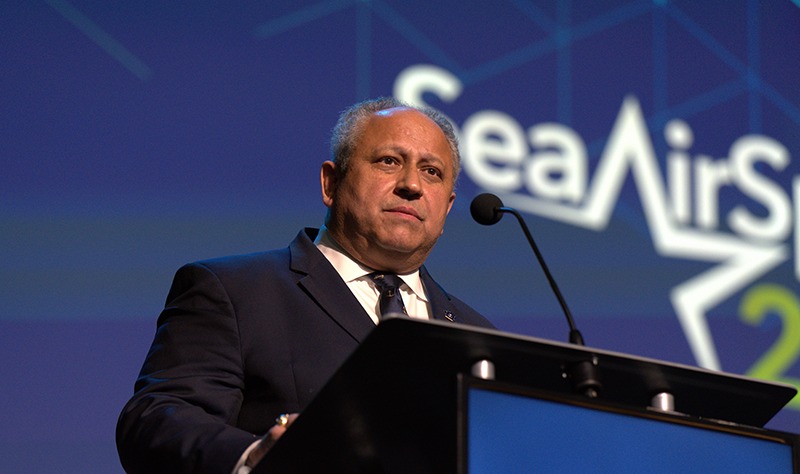
Industry and government alike must modernize their processes and up their game to overcome shipbuilding challenges, Secretary of the Navy Carlos Del Toro said April 9 at the lunch session at Sea-Air-Space, including by working with shipbuilding partners overseas. 

Del Toro began the speech with a bit of levity, bringing the U.S. Marine Corps mascot Chesty the bulldog onto the stage, before describing the challenges that face the nation, from Houthi rebel attacks in the Red Sea to the state of the nation’s shipbuilding facilities and workforce. 

“You have to understand, we, the nation, abandoned the shipbuilding industry and making the necessary investments in around the early 1980s,” Del Toro said. “Because we thought that somehow the private sector would just take care of itself. And some ways it did. China moved in with cheap labor and labor practices that weren’t fair. In fact, the United States is considering suing China for some of those unfair practices.” 

Incentives weren’t made, and after the Cold War the nation lost many of it shipbuilders, he said, adding, “thank God” the nation still has the shipbuilders it does. 

“But the fact is, we need more capacity if we want to a grow a Navy fleet. Let me be clear, we need a bigger Navy fleet to meet the challenges of the future. We need to have the industry to be able to grow that capacity. So, this is a whole of government discussion that we’ve initiated in the Navy across the government and there’s a lot of interest that’s growing in many different places throughout government. And I think that you’ll see this actually continue,” he said. 

Del Toro cited a recent visit to South Korea, where he saw what could be the future.  

“Right now, we build the most capable warships in the world in shipyards that are sometimes decades behind the global technological standard. This is an inefficient approach requiring far too much time and taxpayer dollars. And it’s certainly an approach that is only inadequate to pace our 21st century competitors,” he said. 

Japan and Korea, he noted, build high-quality ships “for a fraction of the cost that we do. When my team and I went to South Korea, we were floored at the level of digitization and real-time monitoring of shipbuilding progress with readily available information down to the individual pieces of stock materials. Their top executives can tell us to the day when ships would actually be delivered,” he said.  

“It’s an ethos of commitment to constant improvement that is the foundation of their reputation, consistently delivering on time and on budget, even during COVID. The daunting challenges that we face are also an opportunity, a great opportunity to partner with a greater number of shipbuilders here in the U.S. and with our closest allies abroad. We have an opportunity to attract the most advanced shipbuilders in the world to work with our first-rate ship builders of the world … and invest in commercial shipyards here at home,” Del Toro said. “This will allow us to modernize and expand our shipbuilding industrial capacity, creating good paying new-collar American jobs that come with a healthier and more competitive shipbuilding workforce.” 

Previous decades of investment are what have enabled the Navy to fight off the Houthi rebels as effectively as it has, Del Toro said. 

“Ladies and gentlemen, sometimes I think the American people think that this is somehow commonplace to do this, as our CNO said the other day. There is absolutely nothing commonplace about this. Our United States Navy has been attacked. We have conducted strikes like we haven’t seen in many ways since World War II.” 

He said investments in training have led to the successful engagements, along with the investments in the Aegis Combat System and the SPY-1 radar 

“Those investments are the reason why our Sailors and Marines have been able to combat thethis with proficiency that they have demonstrated to win the fight of the future,” he said. 

The services must make similar investments today in robotics and other technologies. Del Toro noted the service has newly introduced the robotics warfare specialist rating. The RW “will be the subject matter expert for computer vision, mission, autonomy, navigation, autonomy, data systems, artificial intelligence and machine learning,” he said, calling it a “significant milestone in our journey towards achieving a truly hybrid fleet.” 

And, he said again, the nation needs to investment in shipbuilding.  

“The findings of the 45-day comprehensive shipbuilding review have underscored too many of our industrial partners are behind schedule and over budget on our highest priority programs. Let’s be clear, I want American industry to thrive, as a business owner for almost two decades. I understand your perspective. I’m pushing our shipbuilding industry to invest in itself to get better, be technological leaders and to once again deliver platforms on time and on budget. We must deliver for the American people because it’s our line of work. We don’t get to make excuses,” he said. 

“Of course, there’s work for us to do on our end and the government as well. I’m determined to address the longstanding challenges in our procurement processes that cause industry heartburn as they tried to do business with us. And there are many that we have to work through. I expect our leaders in the government to foster culture of excellence and accountability across our own acquisition workforce. 

“The point is this,” Del Toro said. “Just as our country needs you and industry to be at the top of your game, I’m determined to ensure that we and the Department of the Navy are also on the top of our game. We must meet industry in a common place of excellence.” 


Additive Manufacturing, Small Business Collaboration Highlight First Day of Sea-Air-Space 2024

By NAVAIR

Naval Air Systems Command (NAVAIR) kicked off the 2024 Sea-Air-Space Expo on Monday with panel discussions on manned/unmanned and weapon systems advancements, additive manufacturing success stories and collaborative opportunities for small businesses to join with NAVAIR to aid the warfighter.  

The first panel was led by Rear Admiral Stephen Tedford, executive officer of the Program Executive Office for Unmanned Aviation and Strike Weapons (see Tuesday’s Show Daily for a story on his presentation). 

Theodore Gronda, program manager for the NAVAIR Additive Manufacturing (AM) Team, began his panel discussion by highlighting that the AM team was established in order to create parts in small quantities, when needed, to get a grounded aircraft back in service in a faster time than relying on industry partners for supply chain gaps. Additive Manufacturing is the ability to “print” an object based on information fed into a device, much like a 3D printer.  

Gronda said NAVAIR began supporting AM developments by separating them into three tiers. Tier 1 AM printers focus on “Commodity Polymers,” and is responsible for creating non-critical, smaller items such as knobs, clips and caps. Tier 2 AM printers focus on “Industrial Polymers,” including non-critical and critical parts such as tools, covers, brackets and mounts. Tier 3 AM printers are “Industrial Metal” and create non-critical and critical metal parts including valve bodies, gearboxes, fuel and engine components and manifolds.  

One of the newer capabilities Gronda announced was the addition of a “Solid State” cold spray technology, which uses a metal powder to spray and build up or repair a designated item.  

Currently, there are 96 AM devices deployed to 33 sites, including deployed aircraft carriers.   

A recent victory for the AM team’s capabilities was when they received word that a ship’s optical landing system had failed. There were aircraft aboard the ship that depended upon that critical landing system and were unable to fly. The ship contacted the AM team and they got to work, learning that the damaged part was simply a coupler, no bigger than four quarters. Within 12 hours, the team was able to redesign the coupler, test it, receive approval, and send the coupler data electronically to the ship where it was then printed. As they were about to install the part, the ship received orders to deploy and the repair was put on hold for a few hours to enable the ship to transit to its destination. Once it arrived, the coupler was installed, and aircraft from that ship were deployed to intercept UASs that were targeting allies.  

Another victory for the team, several E-6B Mercury customers found themselves in need of fuel cell interconnecting fittings replacements, as the previous vendor for the part went under during the Covid-19 pandemic. The AM team received a call in October, requesting 12 replacements for the fuel cell interconnectors. Within four months, the team was able to produce the parts and get them to the customers.  

Gronda stressed that this was just one example of how the pandemic affected the Naval Supply Systems Command (NAVSUP) ability to maintain sustainment capabilities and how the AM team is rising to meet those areas impacted by supply chain gaps created by the pandemic.  

Recognizing the increasing need of AM implementations, Gronda said the Naval Aviation Schoolhouse for Additive Manufacturing was established in February in Danville, Virginia, and will aim to create a pipeline of AM artisans to meet growing AM needs. The Schoolhouse is a collaborative effort with Naval Sea Systems Command (NAVSEA).  

Another success story related to the team was the ability to repair tire rim assemblies on F/A-18 Hornets. Gronda said pilots often land hard on carrier decks, causing the landing gear wheel hub to oblong and the tire to shake. If the tire shakes, it is taken off and discarded.  

“That tire is wildly expensive,” Gronda said. “There wasn’t an effective way to repair it. We go through 166 of these tires a year and they cost six figures apiece. Eighty percent of those tires are repairable with cold spray technology. It takes me two hours and costs $300. It’s a big deal for us. And what that’s done is taught us to think different. Stuff that we previously thought was not repairable is repairable now with cool spray and our additive manufacturing repair machines.”  

Small Business Opportunities 

The final panel of the day began with an overview of the NAVAIR Office of Small Business Programs (OSBP) and how collaborations with modestly sized operations can be mutually beneficial.   

The panel gave step-by-step guidance in how the team guides prospective partners through meeting with OSBP, specifically directing them to the OSBP website, https://www.navair.navy.mil/osbp/.  

Irma Alexander, deputy director for the OSBP, summed up whole purpose attendees were at Sea-Air-Space this week — market research.  

“The government is here to learn about you. You’re here to learn about us, about your competitors, about potential future collaborations,” Alexander said. “But how do you make those decisions? You make them through market research. That’s our common purpose. So, when you go home and you’re tired, think about the motivation you felt this morning, because that’s the motivation you need to go do your homework so you can come see us. Market research is the foundation from where you build your business decisions, where you decide how you’re going to capture that business, and how you’re going to mark it. The good news is we offer a lot of awesome market research resources.”  


AUKUS Program Marks ‘Greatest Industrial Undertaking’ for Australia

Then-CNO Admiral Mike Gilday, Royal Navy First Sea Lord and Chief of Naval Staff Adm. Sir Ben Key, and Chief of the Royal Australian Navy Vice Adm. Mark Hammond, tour the Virginia-class fast-attack submarine USS Missouri following the AUKUS bilateral announcement in San Diego, Calif, March 13, 2023. 
CREDIT: U.S. Navy | Commander Courtney Hillson 

The AUKUS program, the multination effort to provide Australia with nuclear-powered submarines, will kick-start that country’s ability to build nuclear subs, an Australian minister said in a panel discussion at Sea-Air-Space on April 8. 

Pat Conroy, Australia’s minister for defense industry and minister for international development and the Pacific, said the effort will be a challenge but it was a logical choice to select a partnership of Australian Submarine Corp. and BAE Systems to build the subs, as ASC built Australia’s diesel-electric submarines and BAE builds the United Kingdom’s Astute and Dreadnought-class submarines. 

“For them to form a joint venture for us was the right model,” Conroy said. He said it will be a “step up” for them to move to nuclear standards, but they’ve had a long partnership with General Dynamics Electric Boat in the United States.  

“Electric Boat was instrument in fixing some of the challenges that we encountered earlier in the Collins class,” Conroy said. “So, we’re confident we’ll put the ecosystem in and we’re investing around $30 billion Australia to increase our industrial place uplift that will really underpin what is the greatest industrial undertaking our country’s ever attempted.” 

Moderator Megan Eckstein of Defense News noted the United States and United Kingdom are talking about building up the nuclear industrial base, but for Australia, “you’re starting from scratch.” 

Conroy replied, “it’s an incredible effort, and lots of progress has been made from legislative rules to establishing a nuclear regulatory authority to starting to train our workers, our industry in the nuclear mindset. It has been a challenge, but also a great opportunity to include Australian companies from the ground floor.” 

Australia is mounting a full national mobilization, he said, including funding 4,000 additional permanent university places in STEM subjects to grow the workforce. 

“We think we need 20,000 workers. We’ve got Royal Australian Navy sailors working on U.S. submarine tenders in Guam right now, and a hundred ASC employees will be working for harbor sustainment next year,” he said. 

“So, we’re starting that training pipeline. That $30 billion dollars will be a massive investment. And while it’s a challenge, there’s also opportunities,” he said.  

“I’ve had the privilege of going through Barrow-in-Furness in the U.K. [home of BAE Systems Submarines] and the Groton, Connecticut yard here [home of Electric Boat] and they’ve got tremendous expertise built up over a century. But they’ve also got the challenges of that, of being built around towns like in Barrow-in-Furness. You’ve got terrace houses next to assembly halls because the town and a shipyard being built up together. Having a brownfield site where we can build with the best equipment, with lots of open space, will really allow us to maximize efficiencies and learnings from our oldest partners.”