World’s Largest Aircraft Carrier, Strike Group Return from Historic 11-Month Deployment
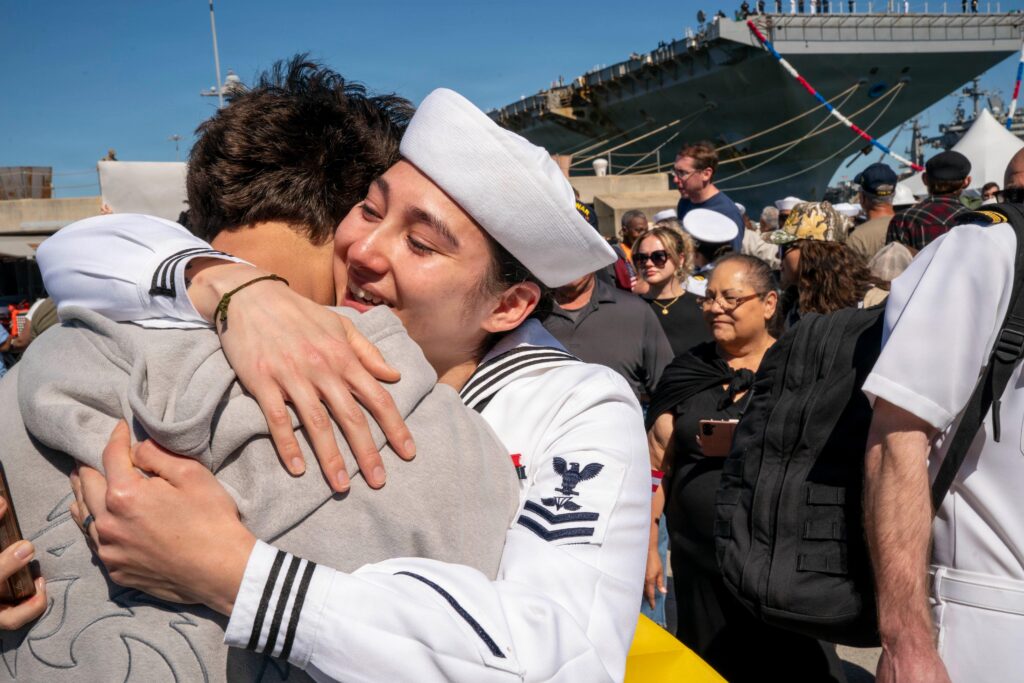
NORFOLK, Va. (May 16, 2026) – Aircrew Survival Equipmentman 2nd Class Ireland Lowe, assigned to the world’s largest aircraft carrier, USS Gerald R. Ford (CVN 78), hugs her family on the pier at Naval Station Norfolk, May 16, 2026, following a historic 11-month deployment to U.S. 2nd, 4th, 5th, and 6th Fleets as part of the Gerald R. Ford Carrier Strike Group. Before returning to Norfolk after 326 days, the Gerald R. Ford crew conducted 23 replenishments-at-sea and sailed over 57,713 nautical miles. Embarked Carrier Air Wing 8 logged more than 5,760 flight hours and 12,200 flight launches. (U.S. Navy photo by Mass Communication Specialist 1st Class Clay M. Whaley)

From Commander, U.S. Fleet Forces Command, May 16, 2026 

NORFOLK, Va. - Nearly 4,500 Sailors of the Gerald R. Ford Carrier Strike Group aboard USS Gerald R. Ford (CVN 78) returned to Naval Station Norfolk the morning of May 16, following a historic and successful 11-month deployment to the U.S. 4th, 5th and 6th Fleets. 
 
The aircraft carrier returned with its accompanying destroyers, USS Bainbridge (DDG 96), and USS Mahan (DDG 72). USS Winston Churchill (DDG 81) also returned to its homeport of Naval Station Mayport. 

 
Before returning to Norfolk after 326 days, the Gerald R. Ford crew conducted 23 replenishments-at-sea and sailed over 57,713 nautical miles. Embarked Carrier Air Wing (CVW) 8 logged more than 5,760 flight hours and 12,200 flight launches. 

Secretary of War Pete Hegseth greeted the Norfolk-based ships upon their return home. 

Hegseth spoke to the Gerald R. Ford crew over the ship’s announcement system (1MC) recognizing the Sailors for their resilience and toughness throughout the deployment. 

“For nearly a year, you have held the line for our nation,” he said. “Your voyage took you to places you never expected, from the Mediterranean Sea and 6th Fleet, where you thought you would be, to 4th Fleet, down in Southern Command for Operation Southern Spear and Absolute Resolve. Then, you fought through all the way to finish the latter part of your mission, which was to 5th Fleet in Operation Epic Fury, from Europe to Southern Command to Central Command. There, you had an unmistakable message to the world: no one can match the USS Ford. No one can match the United States military.” 

At the homecoming, Hegseth presented Carrier Strike Group 12 with the Presidential Unit Citation (PUC). The PUC is the highest honor a military unit can receive, awarded for extraordinary heroism in action against an armed enemy. 

“Individual valor is something we talk about a lot in our military, but what we honor today is something rarer: the collective soul of a unit that encountered the challenges of modern warfare and maintained an unbreakable resolve,” he said. “To wear this ribbon is to tell the world that everyone in this formation fought with an indomitable spirit. You operated with a grit and defiance that sets you apart. By your conduct, you have secured a permanent place in the hallowed lineage of our naval history.” 

Carrier Strike Group 12, commanded by Rear Adm. Gavin Duff, deployed June 24, 2025, and includes flagship USS Gerald R. Ford (CVN 78), commanded by Capt. Dave Skarosi; the nine squadrons of Carrier Air Wing (CVW) 8, commanded by Capt. Jacob Rose; Arleigh Burke-class destroyers within Destroyer Squadron (DESRON) 2, commanded by Capt. Mark Lawrence; and Arleigh Burke-class destroyer USS Winston S. Churchill (DDG 81), commanded by Capt. Judson Mallory. The guided-missile destroyers of DESRON 2 include USS Mahan (DDG 72) and USS Bainbridge (DDG 96). 

Squadrons of CVW 8 embarked aboard Gerald R. Ford include Strike Fighter Squadron (VFA) 37, “Ragin’ Bulls”; Strike Fighter Squadron (VFA) 213, “Blacklions”; Strike Fighter Squadron (VFA) 31, “Tomcatters”; Strike Fighter Squadron (VFA) 87, “Golden Warriors”; Electronic Attack Squadron (VAQ) 142, “Gray Wolves”; Airborne Command and Control Squadron (VAW) 124, “Bear Aces”; Helicopter Sea Combat Squadron (HSC) 9, “Tridents”; Helicopter Maritime Strike Squadron (HSM) 70, “Spartans”; and a detachment from Fleet Logistics Support Squadron (VRC) 40 “Rawhides.” 

U.S. 2nd Fleet, reestablished in 2018 in response to the changing global security environment, develops and employs maritime ready forces to fight across multiple domains in the Atlantic and Arctic in order to ensure access, deter aggression and defend U.S., allied, and partner interests. 
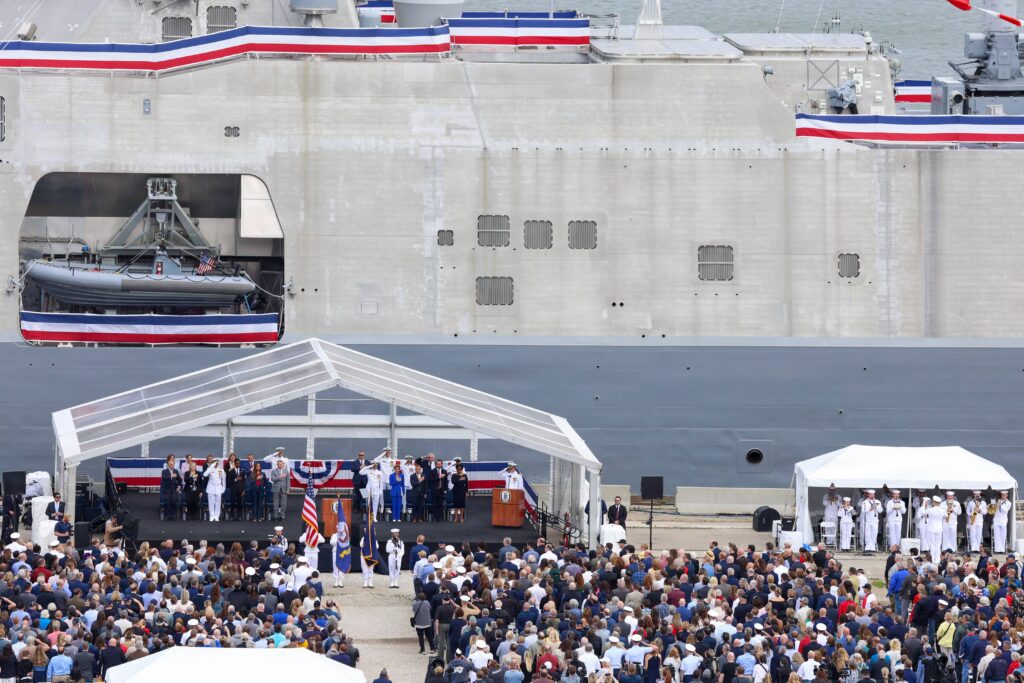


Littoral Combat Ship USS Cleveland Commissioned in Namesake City

CLEVELAND (May 16, 2026) – Attendees salute while colors are paraded during the commissioning ceremony of the Navy’s last Freedom-variant littoral combat ship USS Cleveland (LCS 31) in Cleveland. Cleveland is the fourth warship to be named after Ohio’s second largest city and is the 16th and final Freedom-variant littoral combat ship (LCS) to be built and commissioned in the U.S. Navy. (U.S. Navy photo by Mass Communication Specialist 2nd Class Kenneth Blair)

From Lt.j.g Rachael Jones and Ensign Dylan Barron, Commander, Naval Surface Force, U.S. Pacific Fleet Public Affairs  

CLEVELAND (May 16, 2026) – The U.S. Navy commissioned its newest and last Freedom-variant littoral combat ship USS Cleveland (LCS 31) in Cleveland.  

During the ceremony, Acting Secretary of the Navy The Honorable Hung Cao highlighted the significance of the crew’s role in bringing the ship to life as it began its commissioned service.  

“Today we celebrate the sailors who breathe life into this ship. To the officers and crew of USS Cleveland, today is your day,” said Cao. 

LCS 31 is the fourth ship to be named in honor of the city of Cleveland. The first was a cruiser (C-19) commissioned in 1903 that served during World War I. The second was the lead ship of her class of light cruisers, USS Cleveland (CL-55), which earned 13 battle stars for its service during World War II. The third was the Austin-class amphibious transport dock, USS Cleveland (LPD 7), which served from 1967 to 2011, providing critical support during the Vietnam War, Operation Desert Shield/Storm, and various humanitarian missions.  

LCS 31 is the 16th and final Freedom-variant littoral combat ship (LCS) to be built and commissioned in the U.S. Navy. 

Cleveland’s commanding officer, Cmdr. Bruce Hallett, emphasized the significance of the crew’s role in shaping the ship’s legacy as it enters service. 

“You are not simply serving aboard this ship. You are writing the first chapter of her history. You are forging a legacy that will endure long after all of us have left these decks,” said Hallett. 

The ship’s sponsor, Robyn Modly, gave the traditional order to “man our ship and bring her to life,” at which point the crew ceremonially ran aboard. 

“Every day we do something to support this ship and her sailors will be a glorious day. Today is just the first step toward the many glorious days that will follow,” said Modly. 

USS Cleveland (LCS 31) was built by Lockheed Martin and Fincantieri Marinette Marine in Marinette, Wisconsin. Following the commissioning, the ship will transit to its assigned homeport at Naval Station Mayport, Florida.  

In the week leading up to the commissioning ceremony, the Cleveland crew spent time with their ship’s sponsor, Mrs. Robyn Modly, a native Clevelander and wife of the former Secretary of the Navy, Thomas Modly. The Sailors also participated in community events to build a strong connection with their namesake city.  

Littoral Combat Ships (LCS) are fast, agile, mission-focused warships designed to operate in near-shore environments to counter 21st-century threats. It is a class of small surface combatants equipped to defeat challenges in the world’s littorals. LCS platforms can operate independently or in high-threat scenarios as part of a networked battle force that includes larger, multi-mission surface combatants such as cruisers and destroyers. 

The commissioning of USS Cleveland underscores the Navy’s commitment to building America’s Fleet of the Future. For 250 years, American naval power has projected strength globally. That mission continues – and intensifies. We operate forward 24/7, 365 days a year. This operational tempo demands continuous capability delivery, and the Fleet of the Future is our answer. 

The mission of Commander, Naval Surface Force, U.S. Pacific Fleet (CNSP) is to man, train, and equip the Surface Force to provide fleet commanders with credible naval power to control the sea and project power ashore. 

For more news from Commander, Naval Surface Force, U.S. Pacific Fleet, visit https://www.surfpac.navy.mil/. 

More information on the Littoral Combat Ship Program can be found at: https://www.navy.mil/Resources/Fact-Files/Display-FactFiles/Article/2171607/littoral-combat-ship-class-lcs/ 


BlackSea Technologies Demonstrates GARC Capabilities During Arctic Sentry 2026 in Norway

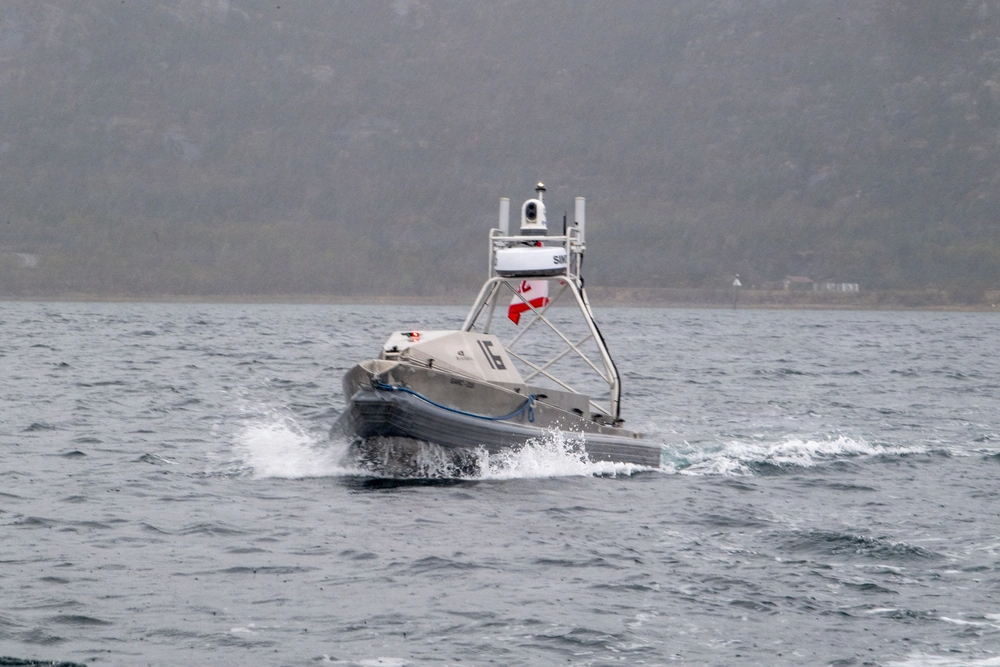
RAMSUND, Norway (May 12, 2026) — A Global Autonomous Reconnaissance Craft, attached to Commander, Task Force (CTF) 66, operates in Breivika Bay during Arctic Sentry 2026. Launched in February 2026, Arctic Sentry reflects Allies’ collective understanding that NATO must do even more as an alliance to ensure security in the Arctic and the High North, and to further strengthen its ability to operate in the region. (U.S. Navy photo by Mass Communication Specialist 1st Class Brandie Nuzzi) 

From BlackSea 

BALTIMORE, May 15, 2026, BlackSea Technologies recently participated in Arctic Sentry 2026, a NATO enhanced vigilance activity in the High North, demonstrating its Global Autonomous Reconnaissance Craft in Ramsund, Norway, alongside partners from U.S. 6th Fleet, U.S. Unmanned Surface Vessel Squadron 3 (USVRON-3) and the Royal Norwegian Navy.  

The exercise gave BlackSea’s GARC unmanned surface vessels an opportunity to operate in the far north, demonstrate autonomous surface vessel capabilities in cold weather maritime conditions, integrate with NATO partners and serve as training tools for the next generation of naval warfighters.  

“Arctic Sentry proves that GARC can operate effectively in dynamic, contested maritime environments north of the Arctic Circle,” said Lunsford Schock, mission director for BlackSea Technologies. “The exercise further cements our nation’s military partnerships with key European allies and reflects BlackSea’s commitment to preserving freedom of action at sea by delivering scalable, intelligent tools to naval forces around the world.” 

NATO launched Arctic Sentry in February as a multi-domain activity to strengthen the alliance’s posture in the Arctic and High North. NATO has said the activity brings NATO and allied exercises, forces and capabilities together under one overarching operational approach to the region. The activity is led by Joint Force Command Norfolk, with overall strategic direction from Allied Command Operations.  

U.S. Navy imagery released May 15 showed a Global Autonomous Reconnaissance Craft attached to Commander, Task Force 66 operating in Breivika Bay during Arctic Sentry 2026. The Navy identified the activity as taking place in Ramsund, Norway, and noted Arctic Sentry’s role in strengthening allied security in the Arctic and High North. 

BlackSea’s participation underscored the role of small, scalable autonomous surface vessels in distributed maritime operations, allied interoperability and training in strategically important waters. The demonstration also highlighted GARC’s ability to support naval forces in demanding operating environments where endurance, adaptability and autonomous capability are increasingly essential.  


Raytheon to Further Develop Next-Generation Software-Defined Radar Capability

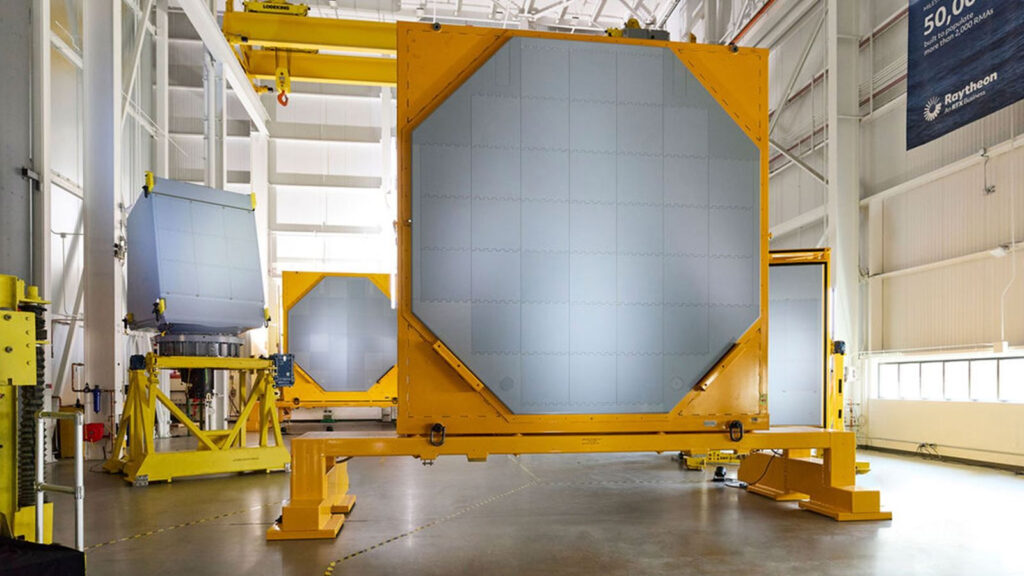
Raytheon has been awarded a contract from the Office of Naval Research to further develop advanced radar software for next-generation naval radars. Photo from RTX.

New software gives naval radars multi-mission flexibility and improved spectrum sharing with 5G 

From RTX 

ARLINGTON, Va. (May 18, 2026) — Raytheon, an RTX (NYSE: RTX) business, has been awarded a contract from the Office of Naval Research to further develop advanced radar software for next-generation naval radars. 

Under the contract, Raytheon’s Advanced Technology team will develop software that enables each building block within a radar to operate independently, allowing a single radar to perform multiple missions simultaneously. By treating each building block as its own software-defined aperture, the radar can rapidly adapt to changing operational needs and better share crowded frequency bands with commercial networks such as 5G. 

“The electromagnetic spectrum is more crowded than ever, and our systems have to be smarter about how they operate in it,” said Colin Whelan, president of Advanced Technology at Raytheon. “With precise, software-driven control over where and how we radiate, we’re taking an important step forward in how we use software‑defined apertures to keep pace with evolving mission demands.” 

Building on Raytheon’s long-standing work in software‑defined apertures, this flexible, modular architecture delivers capability enhancements through software rather than hardware redesign. This approach allows radar performance to be adapted and expanded over time with greater speed, lower cost, and reduced risk. 

Once the software development is complete, Raytheon will conduct a series of demonstrations to validate independent control of radar modules and associated capabilities such as multi-mission operation and spectrum sharing. Upon successful validation, the technology is expected to be transitioned into operational naval radar systems. 


U.S. Coast Guard’s Newest Polar Icebreaker Returns to Seattle Following 36-Day Deployment

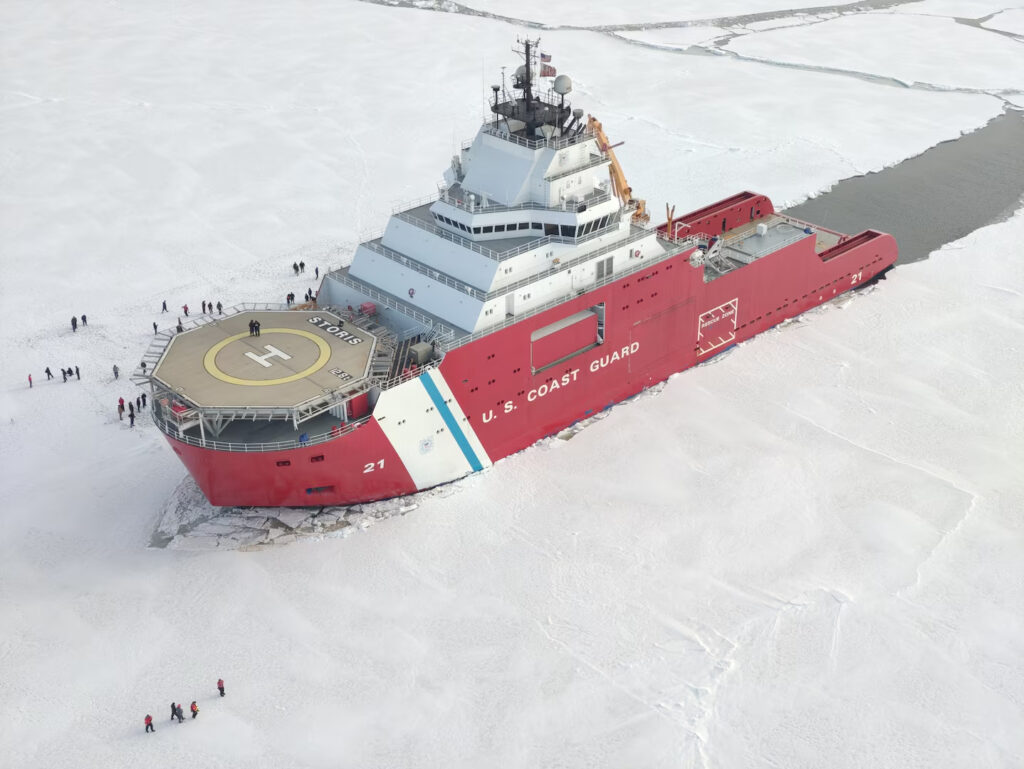
USCGC Storis (WAGB 21) sits hove to in the ice while conducting ice liberty for the crew in the Bering Sea, April 17, 2026. The patrol focused on advancing operational readiness, strengthening interoperability with other military assets, and testing new concepts to support prolonged operations in one of the world’s most demanding and austere maritime environments. (U.S. Coast Guard courtesy photo.)

From U.S. Coast Guard Northwest District, May 15, 2026 

SEATTLE — The crew of the U.S. Coast Guard’s newest polar icebreaker, the USCGC Storis (WAGB 21), returned to their temporary Seattle home port Monday after a 36-day deployment to the Bering Sea. 

The patrol focused on advancing operational readiness, strengthening interoperability with other military assets and testing new concepts to support prolonged operations in one of the world’s most demanding and austere maritime environments. 

Amid increased global focus on the Arctic, Storis’ deployment demonstrates the enhanced capability and commitment to securing maritime borders and protecting U.S. sovereignty and natural resources to safeguard national interests. 

Acquired and commissioned in 2025, Storis is the first polar icebreaker commissioned by the Coast Guard in more than two decades. A primary mission for the cutter and its crew during this deployment was conducting an ice assessment to establish baseline performance in a range of Arctic conditions. The crew evaluated the cutter’s full icebreaking capabilities, with data gathered serving as a benchmark to inform future operations for U.S. and allied vessels navigating high-latitude environments. 

The ice assessment and operational exercises are integral to the crew’s preparation for their scheduled summer deployment. 

“Operating the Storis in the extreme conditions of an Arctic winter is a clear statement of our nation’s resolve,” said Capt. Corey Kerns, commanding officer of Storis. “Storis represents a critical bridge to our future icebreaker fleet. This mission is about preparation, rigorous training and asserting the continued importance of the Arctic to our nation.” 

To demonstrate U.S. operational capability in the high latitudes, Storis conducted a joint passing exercise with the Legend-class national security cutter USCGC Waesche (WMSL 751). The exercise took place in challenging winter conditions less than a mile from the ice edge, with visibility limited to 150 yards. 

Storis and Waesche also executed a proof-of-concept fueling evolution in Dutch Harbor, Alaska. This logistical demonstration expanded Storis’ operational flexibility for future deployments. By establishing cutter-to-cutter refueling capability, Storis can extend an asset’s time on station, maximizing operational reach while reducing the need for long transits back to port for logistics. 

The crew conducted advanced ice rescue training during the deployment, practicing complex life-saving maneuvers in unforgiving Arctic conditions to prepare for high-risk search and rescue missions in ice-covered waters. This hands-on training ensures the Coast Guard can effectively respond to emergencies and protect mariners operating in harsh environments. 

To ensure maximum readiness in a rapidly evolving geostrategic environment, the crew also conducted a gunnery exercise. Operating in the Arctic presents unique defense challenges, and the live-fire exercise provided essential hands-on training for the ship’s weapons teams. By honing marksmanship and weapons system proficiency, the crew reinforced the Coast Guard’s role as an armed service capable of defending national security interests and responding to emerging maritime threats. 

Storis is a 360-foot medium icebreaker with a displacement of nearly 15,000 tons. Powered by four diesel engines generating 22,500 horsepower, the cutter can navigate through three feet of ice at five knots, adding crucial capability to the Coast Guard’s Arctic operations. 

Storis joins the cutters Healy (WAGB 20) and Polar Star (WAGB 10), augmenting the Coast Guard’s presence in the high latitudes and underscoring the United States’ commitment to Arctic security and stewardship. Storis is a multi-mission capable asset equipped to support logistics, search and rescue, ship escort, environmental protection, and enforcement of laws and treaties in the region. 


Coast Guard Cutter Tahoma Busts Cocaine ‘Triple Threat’

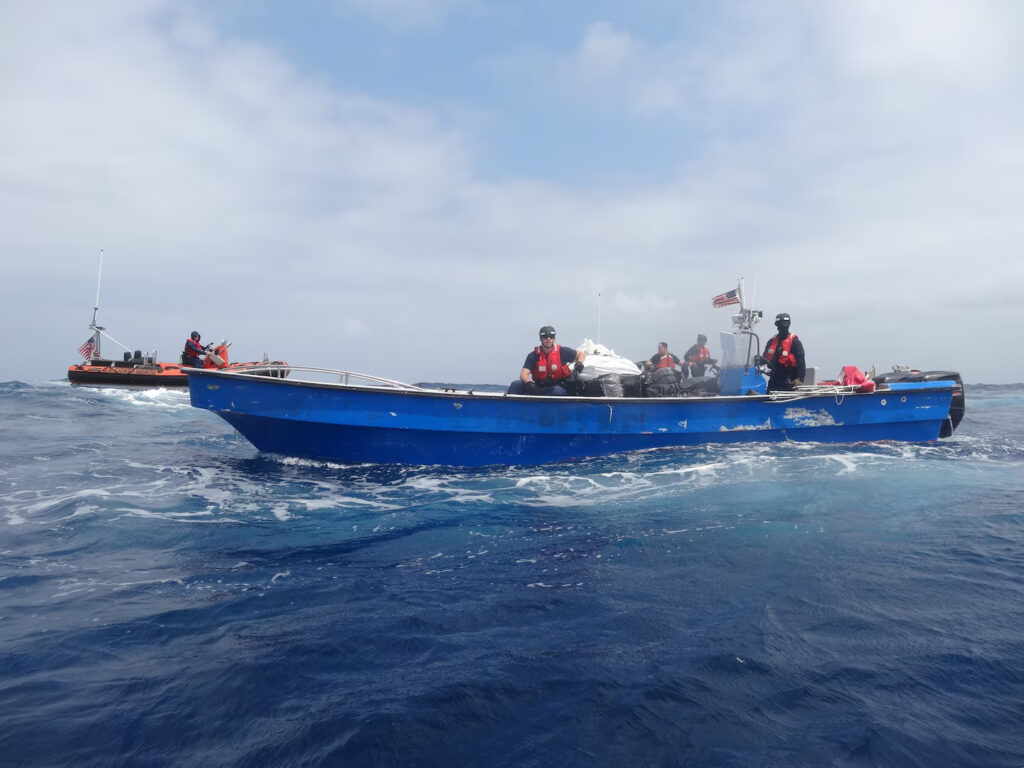
U.S. Coast Guard Cutter Tahoma crew members conduct interdiction operations in the Gulf of America, May 8, 2026. Tahoma’s crew, alongside a deployed Coast Guard Helicopter Interdiction Tactical Squadron aircrew, stopped three suspected smuggling vessels carrying narcotics during a maritime patrol approximately 90 miles off Cartagena, Colombia. (U.S. Coast Guard photo)

From U.S. Coast Guard Southeast District, May 14, 2026 

MIAMI – Coast Guard Cutter Tahoma’s crew simultaneously interdicted three suspected smuggling vessels carrying approximately 6,085 pounds of cocaine worth nearly $45.8 million, May 8, approximately 90 miles off Cartagena, Colombia. This seizure represents 2.3 million potentially lethal doses of cocaine that will not reach American streets. 

Tahoma’s crew launched their two small boats and their deployed Coast Guard Helicopter Interdiction Tactical Squadron aircrew stopping all three vessels. 

One vessel was non-compliant and required aerial use of force tactics, including precision sniper fire directed at the engines, to compel the vessel to stop resulting in the suspected smugglers on the vessel jumping overboard. The aircrew released multiple personal flotation devices, and the people were rescued with no reported injuries. The other two vessels stopped when directed by Coast Guard crews. 

“Interdicting three vessels simultaneously is a testament to the unwavering professionalism, precision, and dedication of our crews,” said Cmdr. Nolan Cuevas, Tahoma’s commanding officer. “This interdiction prevented a significant number of illegal narcotics from reaching America’s shores, and their teamwork underscores the Coast Guard’s mission to protect our nation and saving lives.” 

Tahoma’s crew will offload approximately 8,185 pounds of narcotics, worth nearly $61.6 million Thursday at Port Everglades. 

“Executing such a complex mission demands the highest proficiency from our crew,” Cuevas said. “Our success required the integration of thoughtful training, carefully planned logistics, and joint coordination. We are very proud of our efforts to prevent illicit networks from threatening our security.” 

The following assets and crews were involved in the interdiction operations: 

  • Coast Guard Cutter Tahoma 

  • Coast Guard Helicopter Interdiction Tactical Squadron 

Coast Guard Cutter Tahoma’s offload continues record-setting Coast Guard operations to interdict, seize, and disrupt transshipment of cocaine and other bulk illicit drugs by sea. This includes the Coast Guard’s seizure of over 511,000 pounds of cocaine in 2025 – over three times the Service’s annual average – as well as accelerated counter-narcotics operations in the Eastern Pacific through Operation Pacific Viper. The Coast Guard’s persistent operations and rapid response have denied criminal organizations billions in illicit revenue and prevented the flow of dangerous drugs into American communities. 

Eighty percent of interdictions of U.S.-bound drugs occur at sea. This underscores the importance of maritime interdiction in combatting the flow of illegal narcotics and protecting American communities from this deadly threat.Detecting and interdicting illicit drug traffickers on the high seas involves significant interagency and international coordination. Joint Interagency Task Force South, in Key West, conducts the detection and monitoring of aerial and maritime transit of illegal drugs. Once an interdiction becomes imminent, the law enforcement phase of the operation begins, and control of the operation shifts to the U.S. Coast Guard for the interdiction and apprehension phases. Interdictions in the Caribbean Sea are performed by members of the U.S. Coast Guard under the authority and control of the Coast Guard Southeast District, headquartered in Miami. 

Coast Guard Cutter Tahoma is a 270-foot medium endurance cutter homeported in Naval Station Newport, Rhode Island under U.S. Coast Guard Atlantic Area Command. 


U.S., Cameroon Boost Maritime Security with Unmanned Systems During Obangame Express

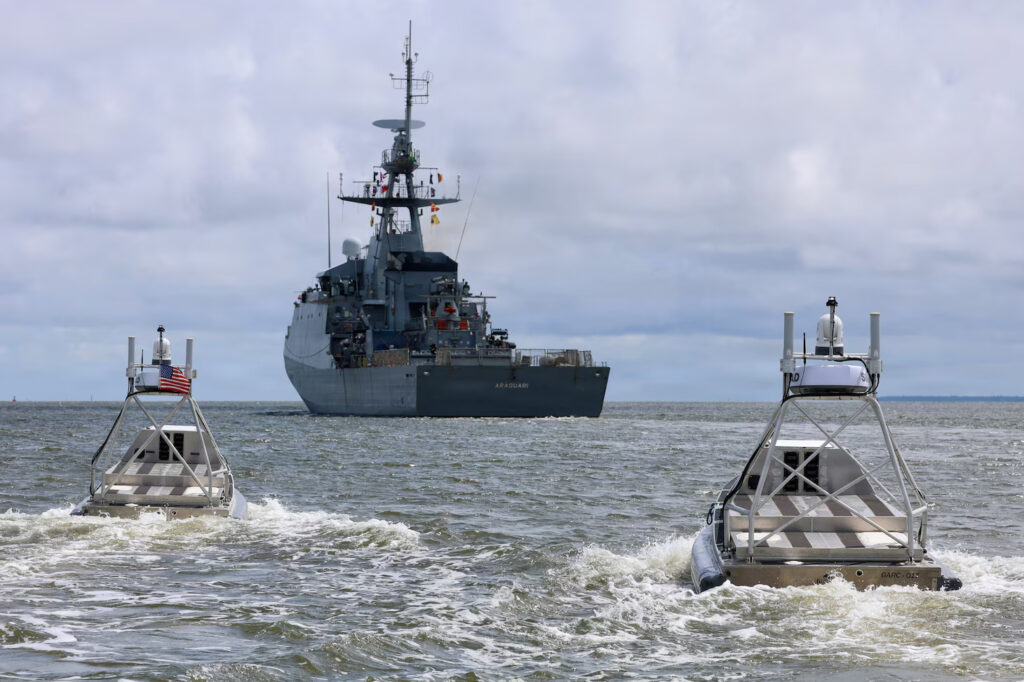
Global Autonomous Reconnaissance Crafts (GARC) deploy in formation with the Brazilian Amazonas-class offshore patrol vessel Araguari (P122) during a live robotic and autonomous systems (RAS) demonstration with Commander, Task Force (CTF) 66 during Exercise Obangame Express 2026 in Douala, Cameroon, April 25, 2026. (U.S. Navy) 

From U.S. Sixth Fleet Public Affairs, May14, 2026 

U.S. Sixth Fleet successfully integrated advanced unmanned surface vessels (USVs) during Exercise Obangame Express 2026 in Douala, Came

As part of the exercise, Commander Task Force 66 (CTF 66) conducted USV training initiatives in the port of Douala, integrating Lightfish and Global Autonomous Reconnaissance Craft (GARC) platforms to demonstrate expeditionary unmanned systems operations. 

During the training, shoreside operators employed Lightfish systems to enhance maritime domain awareness, enabling the detection and identification of simulated malign actors and threat vessels. Once identified, high-speed GARC assets were deployed to respond and conduct intercept operations, showcasing a layered and responsive unmanned capability. 

The ability to deploy a diverse package of USVs allows for the detection, identification, and interception of maritime threats with minimal infrastructure. This capability significantly increases operational reach and enhances security in contested or remote regions. 

Integrating deployable USVs into the fleet provides a rapid-response capability previously unavailable to surface forces. These systems allow the U.S. to project power into contested waters within hours, bypassing the lengthy transit times required for traditional vessels stationed in Europe. 

“On short notice, USV packages can be employed with a small operational footprint to protect ports, escort high-value assets and deter threats to critical maritime infrastructure, offering a flexible and scalable solution to emerging security challenges throughout the world,” said Rear Adm. Kelly Ward, commander of U.S. Sixth Fleet’s Task Force 66. “Obangame Express provided an invaluable opportunity to exercise this capability while training alongside our Cameroonian partners.” 

This capability is not limited to West Africa. The Navy’s expeditionary unmanned systems model enables rapid global deployment, providing near-immediate maritime security and warfighting support to allies and partners worldwide. 

Obangame Express is one of three regional maritime “Express” series exercises led by U.S. Sixth Fleet as part of a comprehensive strategy to provide collaborative opportunities to African forces and international partners to address maritime security concerns. 

Commander, U.S. Sixth Fleet, headquartered in Naples, Italy, conducts the full spectrum of joint and naval operations, often in concert with allies, international partners, and other U.S. government departments and agencies to advance U.S. national interests, security and stability in Europe and Africa. 


Carrier Air Wing 8 Returns from Historic 11-Month Deployment 

Strike Fighter Squadron (VFA) 213, the “Blacklions,” returned to Naval Air Station Oceana, Virginia, May 11, 2026, following a historic eleven-month deployment to U.S. 2nd, 4th, 5th and 6th Fleets as part of the Gerald R. Ford Carrier Strike Group assigned to Carrier Air Wing (CVW) 8. CVW-8 logged more than 5,500 flight hours in support of Operation Epic Fury alone, and more than 11,800 launches throughout the 11-month deployment. (U.S. Navy photo by Zachary wickline) 

From Commander, Naval Air Force Atlantic, May13, 2026  

Aircraft of the Gerald R. Ford Carrier Strike Group’s Carrier Air Wing (CVW) 8 returned to their home naval air stations May 11, following an historic and successful 11-month deployment to the U.S. Central Command, U.S. European Command and U.S. Southern Command areas of operations. 

Before returning after 322 days, breaking the post-Vietnam War record for days deployed, CVW-8 conducted more than 11,500 aircraft events launched from the Electromagnetic Aircraft Launching System (EMALS) and recovered with Advanced Arresting Gear aboard the world’s largest aircraft carrier, USS Gerald R. Ford (CVN 78). 

“The officers and Sailors of Carrier Air Wing 8 have served their nation with distinction,” said Rear Adm. Rich Brophy, commander, Naval Air Force Atlantic. “Throughout their record-breaking deployment, these aviators successfully conducted worldwide operations, embodying the highest ideals of resilience, courage, and selfless service to the nation.” 

The Gerald R. Ford Carrier Strike Group deployed as an integrated naval force in support of economic prosperity, national security, and national defense. The force conducted combat operations in support of Operation Southern Spear and Operation Absolute Resolve from the Caribbean Sea in U.S. Southern Command, and Operation Epic Fury from the Mediterranean Sea in U.S. European Command and the Red Sea in U.S. Central Command. 

“The men and women of Carrier Air Wing 8 performed admirably and projected power on a global scale,” said Adm. Karl Thomas, commander, U.S. Fleet Forces Command. “From major combat operations to exercising alongside our allies and partners in multiple regions, Carrier Air Wing 8 demonstrated to the world that they have the technical expertise, work ethic, and grit to accomplish the mission anywhere it is needed. I couldn’t be more proud of the team.” 

The Gerald R. Ford Carrier Strike Group operated with 20 ally and partner nations throughout deployment, conducting interoperability exercises to increase combined air power projection with Norway, United Kingdom, Germany, Finland, Italy, France, and Tunisia. The flagship conducted port visits in France, Norway, Spain, Croatia, Greece, and the U.S. Virgin Islands. 

CVW-8 includes Strike Fighter Squadron (VFA) 31, VFA-37, VFA-87, all flying the F/A-18E Super Hornet aircraft and based out of Naval Air Station (NAS) Oceana, Virginia; VFA-213 that flies the F/A-18F Super Hornet aircraft based out of NAS Oceana, Virginia; Electronic Attack Squadron (VAQ) 142 that flies the E/A-18G Growler aircraft based out of NAS Whidbey Island, Washington; Airborne Command & Control Squadron (VAW) 124 that flies the E-2D Advanced Hawkeye aircraft based out of Naval Station (NS) Norfolk, Virginia; Fleet Logistics Support Squadron (VRC) 40 that flies the C-2A Greyhound aircraft based out of NS Norfolk, Virginia; Helicopter Maritime Strike Squadron (HSM) 70 that flies the MH-60R Seahawk helicopter based out of NAS Jacksonville, Florida; and Helicopter Sea Combat Squadron (HSC) 9 that flies the MH-60S Knighthawk helicopter based out of NS Norfolk, Virginia. 

Gerald R. Ford, a first-in-class aircraft carrier and deployed flagship of Carrier Strike Group (CSG) 12, incorporates modern technology, innovative shipbuilding designs, and best practices from legacy aircraft carriers to increase the U.S. Navy’s capacity to underpin American security and economic prosperity, deter adversaries, and project power on a global scale through sustained operations at sea.


HII Hosts Rep. Adam Smith at Newport News Shipbuilding 

From HII 
 

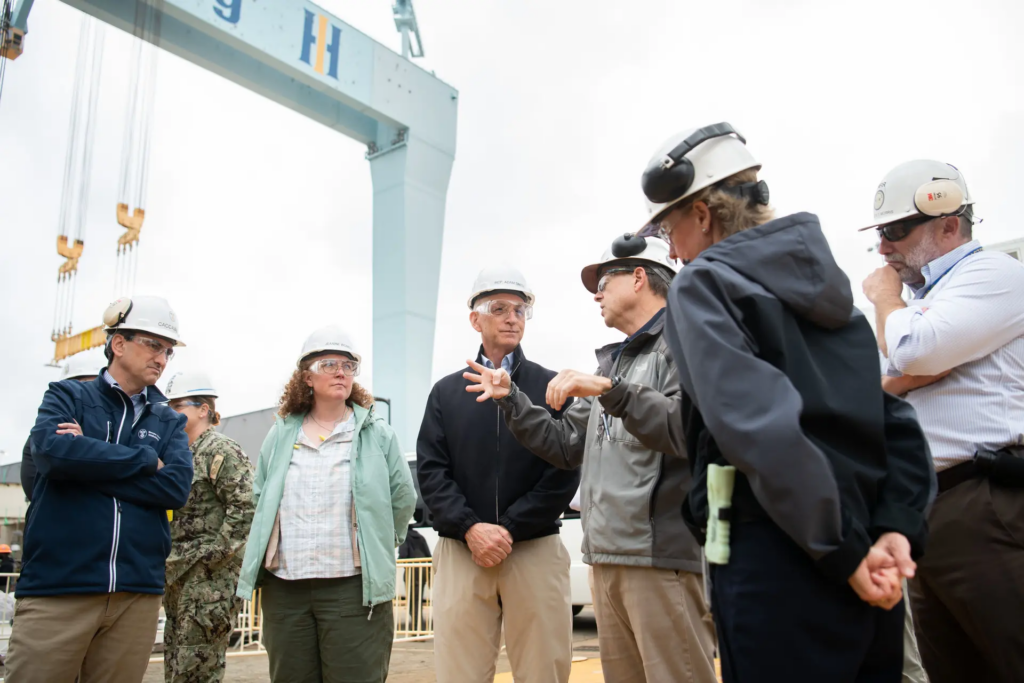
NEWPORT NEWS, Va., May 12, 2026 (GLOBE NEWSWIRE) — HII (NYSE: HII) hosted Rep. Adam Smith, D-Wash., ranking member of the House Armed Services Committee, at its Newport News Shipbuilding division Monday to meet with shipyard leadership and tour the company’s facilities. 

“We’re grateful for the time Rep. Smith invested with us to see our commitment to the mission and being held accountable for supporting it,” NNS President Kari Wilkinson said. “We understand the urgent need for submarines and aircraft carriers and are steadfast in our commitment to the nation.” 

During Monday’s tour, Smith saw construction progress on Columbia- and Virginia-class submarines, as well as on Gerald R. Ford-class aircraft carriers. He also witnessed how NNS is innovating with advanced technology solutions to increase efficiencies across the shipyard. 

“Revitalizing our defense industrial base — particularly in the area of shipbuilding — remains a top priority with strong bipartisan support in the committee,” Smith said. “Addressing capacity issues and workforce shortages amid the ongoing pacing challenge from China and threats from Russia, Iran, North Korea, and other global extremists is more important than ever. After seeing the work being done by the people at Newport News Shipbuilding, I’m confident that we can meet these threats and challenges as long as we remain committed to providing support for and oversight of the stable, long-term funding needed to invest in infrastructure and personnel. That is how we can achieve greater innovation with the kind of advanced technology needed to build a stronger national defense.” 

With a workforce of more than 26,000 shipbuilders, NNS is the largest industrial employer in Virginia. 


Thomas Releases Command Vision at U.S. Fleet Forces Command Commander’s Conference 

By U.S. Fleet Forces Command Public Affairs, May 13, 2026 

SUFFOLK, Va. — U.S. Fleet Forces Command concluded its annual Commander’s Conference May 7, bringing together senior military leaders to ensure the delivery of the world’s most ready, capable, and adaptive force—one fully integrated across all domains and prepared to deter, fight, and win in a dynamic battlespace. 
  
Hosted by Adm. Karl Thomas, commander, U.S. Fleet Forces Command, the two-day event centered on the theme “Bridging the Foundry to the Fight.” The discussions focused on strengthening our capabilities by restoring readiness and building a powerful Fleet from a resilient industrial base to maintain a decisive global warfighting advantage. During the event Thomas released his vision for the command, addressing how the Fleet should generate global warfighting advantages to drive his vision into execution and lethal performance: 
  
To deliver the world’s most ready, capable, and adaptive force that is integrated across domains, driven by innovation, and prepared to deter, fight, and win in a dynamic battlespace. 
  
“Our charge is to ensure the Navy remains the world’s most ready Fleet,” said Thomas. “That means transforming our processes into a world-class foundry where data-centric decision-making and innovation accelerate our ability to deliver combat-ready Sailors and ships to the point of need.” 
  
Throughout the conference, Thomas emphasized high-end warfighting through the “Foundry and Fleet” lens. This approach ensures that every aspect of force generation—from maintenance and modernization to advanced training—aligns to the demands of a contested environment. His vision is meant to achieve four Overarching Objectives: 
  
•    Forging the Total Sailor: A better-supported Sailor is a more lethal Sailor. Investing in our Sailors as warfighters, maintainers, individuals, and providers for their families; commending their willingness to sacrifice in the defense of our nation. 
•    Rehearsing the Fleet: Recognizing that platforms and supporting systems are becoming more complex, we must provide the doctrine, training, and protection, and rehearsal necessary across domains to ensure a ready Fleet capable of responding when our Nation demands. 
•    Optimizing Force Generation Readiness: Our Fleet must stand ready. We must maximize the number of trained, rehearsed, and certified personnel, platforms, and payloads when our Nation calls. 
•    Preparing for a Global Fight: Our goal is to deter by being better prepared and by presenting unsolvable dilemmas to our adversaries. Should deterrence fail, we will be ready to fight a high-end war and provide a range of military capabilities from restrained show of force, to surgical strikes, to sourcing overwhelming firepower. 
  
Additionally, Thomas outlines that this will all be built upon three underlying principles: 
  
•    High-End Warfighting: utilizing and embracing technologies to best see and sense the battlespace, confuse the adversary’s understanding, quickly promulgate orders to forces, aggregate firepower across domains at critical points, then maneuver in time and space to resupply and reattack, all while actively preventing the adversary from attempting the same. 
•    The Bedrock of Sailors and Families: Our advantage comes from the men and women we recruit, train, and retain. We must understand and support their needs and provide the tools, support, and time to ensure they are prepared to do our Nation’s bidding. 
•    Data-Centric Decision Making: The speed and scale of warfare is expanding and accelerating. This transformation requires more informed and quicker thinking leveraging authoritative data sources compiled to enhance evaluation, assessment, and speed of decision. 
  
Chief of Naval Operations Adm. Daryl Caudle addressed conference attendees and reinforced U.S. Fleet Forces Command’s role as both a force provider and as a critical driver in ensuring that today’s force is ready to fight and decisively win. 
  
“U.S. Fleet Forces Command is not just a force provider; it is the engine of our naval power,” said Caudle. “In today’s security environment, U.S. Fleet Forces Command sits at the center of how we generate combat power, allocate it across global demands, and manage risk to ensure our force remains the bedrock of national security.” 
  
A parallel spouse program focused on the bedrock of the force: Sailors and their families. Spouses from across the Fleet engaged with leadership on quality-of-life initiatives, cyber awareness, and the resources essential to maintaining family readiness during increased operational tempos. 
  
The conference reinforced the imperative to adapt how the Navy mans, trains, equips, and sustains the force to ensure it remains adaptive and capable of prevailing in any conflict. 
  
“This period for the Navy is unique at multiple levels,” said Thomas. “It is a unique time filled with opportunity to impact the Fleet for decades to come. Our senior leadership has provided clear, aligned guidance and this vision provides the guidance with which U.S. Fleet Forces Command will lead the way at seizing this opportunity.” 
  
U.S. Fleet Forces Command trains, certifies, and provides combat-ready naval forces to combatant commanders worldwide to conduct prompt, sustained operations at sea in support of national security objectives.