CNO Releases Priorities: America’s Warfighting Navy

***** 

By CNO Public Affairs 

WASHINGTON (Jan. 9, 2023) – Chief of Naval Operations Adm. Lisa Franchetti released her priorities in a paper titled “America’s Warfighting Navy,” at the Surface Navy Association’s National Symposium, Jan. 9. 

The text of America’s Warfighting Navy reads as follows: 

Who We Are. We are the United States Navy, the most powerful navy in the world. We are the Sailors and Civilians who have answered our Nation’s call to service. We are Americans who embody character, competence, and dedication to our mission. Our identity is forged by the sea and we serve with honor, courage, and commitment. 

What We Do. We are here to preserve the peace, respond in crisis, and win decisively in war. We operate far forward, around the world and around the clock, from the seabed to space, in cyberspace, and in the information environment to promote our Nation’s prosperity and security, deter aggression, and provide options to our nation’s leaders. We deliver power for peace, but are always postured and ready to fight and win as part of the Joint Force and alongside our Allies and partners. 

Where We Are Going. The threats to our nation and our interests are real and growing. The strategic environment has changed; gone are the days of operating from a maritime sanctuary against competitors who cannot threaten us. The National Defense Strategy makes clear that we must defend our homeland, deter strategic attack, deter and be prepared to prevail in conflict against the People’s Republic of China, and meet the acute challenge of an aggressive Russia and other persistent threats. Our adversaries have designed their militaries to overcome our traditional sources of strength. We must move rapidly to stay ahead and continuously create warfighting advantages. We must think, act, and operate differently, leveraging wargaming and experimentation to integrate conventional capability with hybrid, unmanned, and disruptive technologies. Tomorrow’s battlefield will be incredibly challenging and complex. To win decisively in that environment, our Sailors must be the best warfighters in the world with the best systems, weapons, and platforms to ensure we can defeat our adversaries. We will put more players on the field—platforms that are ready with the right capabilities, weapons and sustainment, and people who are ready with the right skills, tools, training, and mindset. 

Our Priorities. We will focus on Warfighting, Warfighters, and the Foundation that supports them. 

Warfighting: Deliver Decisive Combat Power. We will view everything we do through a warfighting lens to ensure our Navy remains the world’s preeminent fighting force. We will prioritize the readiness and capabilities required to fight and win at sea, and the logistics and shore support required to keep our Navy fit to fight. We recognize that we will never fight alone. We will advance naval integration with the Marine Corps, and synchronize and align our warfighting efforts with the Joint Force. We will design and drive interoperability with our Allies and partners to deliver combined lethality. 

Warfighters: Strengthen the Navy Team. We will use the principles of mission command to empower leaders at all levels to operate in uncertain, complex, and rapidly changing environments, ready to take initiative and bold action with confidence. We will build strong warfighting teams, recruiting and retaining talented people from across the rich fabric of America. We will provide      world-class training and education to our Sailors and Civilians, honing their skills and giving them every opportunity to succeed. We will ensure our quality of service meets the highest standards, and we will look after our families and support networks, who enable us to accomplish our warfighting mission.  

Foundation: Build Trust, Align Resources, Be Ready. We will earn and reinforce the trust and confidence of the American People every day. We will work with Congress to field and maintain the world’s most powerful Navy and the infrastructure that sustains it. We will team with industry and academia to solve our most pressing challenges. We will cooperate with the interagency to bolster integrated deterrence. We will align what we do ashore with the warfighting needs of our Fleet. 

Our Charge. America is counting on us to deter aggression, defend our national security interests, and preserve our way of life. With the right tools, a winning mindset, and the highest levels of integrity, we will operate safely as a team to deliver warfighting excellence.  

I am proud to serve alongside you. I thank you and your families for your continued commitment to ensuring we are always ready. 

We have taken a fix and set our course. Together we will deliver the Navy the Nation Needs. The time is now to move with purpose and urgency: ALL AHEAD FLANK! 

America’s Warfighting Navy can be found online here


Coast Guard offloads more than $32 million in illegal narcotics

Release from U.S. Coast Guard 7th District 

***** 

Jan. 9, 2024

MIAMI – The crew of Coast Guard Cutter Margaret Norvell offloaded more than 2,450 pounds of cocaine with an assessed street value of approximately $32.2 million in Miami, Tuesday.  

Coast Guard crews interdicted the illegal drugs in international waters of the Caribbean Sea during two separate cases. 

“Thanks to the tremendous efforts of the Coast Guard crews and agency partners involved with this interdiction, Coast Guard Cutter Margaret Norvell brought these suspected smugglers and illicit contraband ashore for prosecution,” said Lt. Cmdr. Colin Weaver, Commanding Officer. “Coast Guard crews continue to deliver on our important missions of homeland and maritime security to save lives and thwart transnational criminal organizations operating in the Caribbean.”  

The following assets were involved in the interdictions:  

  • USCG Cutter Richard Dixon 
  • USCG Cutter Dauntless 
  • Joint Interagency Task Force South  

Along with the illicit narcotics, six suspected smugglers were apprehended and will face prosecution in federal courts by the Department of Justice.  

These interdictions relate to Organized Crime Drug Enforcement Task Forces designated investigations. OCDETF identifies, disrupts, and dismantles the highest-level criminal organizations that threaten the United States using a prosecutor-led, intelligence-driven, multi-agency approach. Additional information about the OCDETF program can be found here.   

Detecting and interdicting illegal drug traffickers on the high seas involves significant interagency and international coordination. The Joint Interagency Task Force South in Key West, Florida conducts the detection and monitoring of aerial and maritime transit of illegal drugs. Once interdiction becomes imminent, the law enforcement phase of the operation begins, and control of the operation shifts to the U.S. Coast Guard throughout the interdiction and apprehension. Interdictions in the Caribbean Sea are performed by members of the U.S. Coast Guard under the authority and control of the Coast Guard’s Seventh District, headquartered in Miami.   


Flag Officer Announcements 

JAN. 9, 2024 

Secretary of Defense Lloyd J. Austin III announced today that the president has made the following nominations: 

Navy Captain Douglas J. Adams for appointment to the grade of rear admiral (lower half).  Adams is currently serving as deputy, Program Executive Office, Undersea Warfare Systems, Washington, D.C.    

Navy Captain Todd F. Cimicata for appointment to the grade of rear admiral (lower half).  Cimicata is currently serving as chief of staff, Naval Air Forces/Naval Air Force, U.S. Pacific Fleet, San Diego, California.  

Navy Captain Frankie J. Clark for appointment to the grade of rear admiral (lower half).  Clark is currently serving as executive assistant to the commander, U.S. Pacific Fleet, Pearl Harbor, Hawaii. 

Navy Captain David G. Duff for appointment to the grade of rear admiral (lower half).  Duff is currently serving as commanding officer, USS HARRY S. TRUMAN (CVN 75), Norfolk, Virginia. 

Navy Captain Daniel W. Ettlich for appointment to the grade of rear admiral (lower half).  Ettlich is currently serving as fleet maintenance officer, U.S. Pacific Fleet, Pearl Harbor, Hawaii. 

Navy Captain Todd M. Evans for appointment to the grade of rear admiral (lower half).  Evans is currently serving as vice commander, Naval Air Systems Command, Patuxent River, Maryland. 

Navy Captain Todd A. Figanbaum for appointment to the grade of rear admiral (lower half). Figanbaum is currently serving as director, Submarine Officer Career Management and Distribution Division (PERS-42), Navy Personnel Command, Millington, Tennessee. 

Navy Captain Bret M. Grabbe for appointment to the grade of rear admiral (lower half).  Grabbe is currently serving as chief of staff, Submarine Force, U.S. Pacific Fleet, Pearl Harbor, Hawaii.  

Navy Captain Brian A. Harding for appointment to the grade of rear admiral (lower half).  Harding is currently serving as information warfare commander, Carrier Strike Group THREE, Bremerton, Washington. 

Navy Captain Jeffrey L. Heames for appointment to the grade of rear admiral (lower half).  Heames is currently serving as director, Surface Warfare Officer Career Management and Distribution Division (PERS-41), Navy Personnel Command, Millington, Tennessee. 

Navy Captain John W. Hewitt for appointment to the grade of rear admiral (lower half).  Hewitt is currently serving as chief of staff, Navy Installations Command, Washington, D.C. 

Navy Captain Liam M. Hulin for appointment to the grade of rear admiral (lower half).  Hulin is currently serving as commanding officer, U.S. Special Operations Command Forward, MacDill Air Force Base, Florida. 
  
Navy Captain Marcos A. Jasso for appointment to the grade of rear admiral (lower half).  Jasso is currently serving as director, Maritime Operations Center, U.S. Pacific Fleet, Pearl Harbor, Hawaii. 

Navy Captain Matthew J. Kawas for appointment to the grade of rear admiral (lower half).  Kawas is currently serving as principal military assistant to the Deputy Secretary of Defense, Washington, D.C. 
  
Navy Captain Justin A. Kubu for appointment to the grade of rear admiral (lower half).  Kubu is currently serving as commander, Amphibious Squadron SEVEN, San Diego, California.   

Navy Captain Robert E. Loughran Jr. for appointment to the grade of rear admiral (lower half).  Loughran is currently serving as branch head, Carrier Strike Aircraft and Weapons, N98, Office of the Chief of Naval Operations, Washington, D.C. 

Navy Captain Philip S. Miller for appointment to the grade of rear admiral (lower half).  Miller is currently serving as branch head, Carriers, N98, Office of the Chief of Naval Operations, Washington, D.C. 

Navy Captain Brian T. Mutty for appointment to the grade of rear admiral (lower half).  Mutty is currently serving as commanding officer, Surface Warfare Schools Command, Newport, Rhode Island. 

Navy Captain Tuan Nguyen for appointment to the grade of rear admiral (lower half).  Nguyen is currently serving as a maritime cooperation and competition director, U.S. SEVENTH Fleet, Yokosuka, Japan. 

Navy Captain Cassidy C. Norman for appointment to the grade of rear admiral (lower half).  Norman is currently serving as chief of staff, Naval Air Force Atlantic, Norfolk, Virginia.  

Navy Captain Erin P. Osborne for appointment to the grade of rear admiral (lower half).  Osborne is currently serving as executive assistant to the Vice Chief of Naval Operations, Washington, D.C. 

Navy Captain Bartley A. Randall for appointment to the grade of rear admiral (lower half).  Randall is currently serving as assistant deputy director for Global Operations, Joint Staff, Washington, D.C. 

Navy Captain Craig C. Sicola for appointment to the grade of rear admiral (lower half).  Sicola is currently serving as assistant chief of staff for Education, Training, and Planning, Naval Air Forces/Naval Air Force, U.S. Pacific Fleet, San Diego, California. 

Navy Captain Peter D. Small for appointment to the grade of rear admiral (lower half).  Small is currently serving as project manager, Program Executive Office, Attack Submarines, Washington, D.C. 

Navy Captain Melvin R. Smith Jr. for appointment to the grade of rear admiral (lower half).  Smith is currently serving as executive assistant to the commander, U.S. Indo-Pacific Command, Camp H.M. Smith, Hawaii.  

Navy Captain Vincent S. Tionquiao for appointment to the grade of rear admiral (lower half).  Tionquiao is currently serving as director, Maritime Operations Center, U.S. Fleet Cyber Command/U.S. TENTH Fleet, Fort Meade, Maryland. 


Fairbanks Morse Defense Acquires Samtan Engineering Corporation 

*****

Defense contractor expands portfolio of turnkey marine solutions with single-source metalworking supplier. 

BELOIT, Wis. – January 8, 2024 –  Fairbanks Morse Defense (FMD), a portfolio company of Arcline Investment Management, has acquired single-source metalworking supplier Samtan Engineering Corporation based in Malden, Massachusetts. Samtan’s metalworking services expand FMD’s portfolio with shearing, punching, forming, machining, fabrication, and assembly capabilities. 

“Our acquisition of Samtan Engineering Corporation allows Fairbanks Morse Defense to continue delivering value far beyond the cost of our services through the seamless integration of metal-stamped products and machine shop services,” said FMD CEO George Whittier.  “Samtan has a long track record of delivering superior customer service and high-quality products to the U.S. Navy, especially for submarine programs. Their team will be valuable to the Fairbanks Morse Defense brand.”  

Since 1962, Samtan Engineering Corporation has evolved into a leading single-source metalworking supplier with services such as shearing, punching, forming, machining, welding, and assembly capabilities. Samtan’s components, which can be produced as a single piece or hundreds of thousands of pieces, include metal stamping and deep drawings, marine banded cable hangers, marine tapped cable hangers, marine main wireway hangers, and marine pipe clamps and hangers. 

“As part of the Fairbanks Morse Defense brand, Samtan can accelerate the installation of metalworking products into new U.S. Navy ship classes and other vessels,” said Dana Miele, Samtan GM. Samtan’s customers will also have access to the comprehensive range of fully integrated maritime defense solutions offered by Fairbanks Morse Defense, as well as a global network of highly trained technicians, which will increase operational availability. We’re looking forward to bringing these expanded capabilities to our customers as part of the FMD team.”  

The acquisition represents a further expansion of FMD’s portfolio of turnkey marine solutions after the recent additions of manufacturing and service providers, including American Fan, Maxim Watermakers, Federal Equipment Company (FEC), Hunt Valve Company, Ward Leonard, and Welin Lambie. These increased capabilities support FMD’s ongoing mission to build, maintain, and service the most trusted naval power and propulsion systems on the planet. 


BAE Systems to provide critical Mk 45 naval gun systems upgrade to Australian Navy frigates  

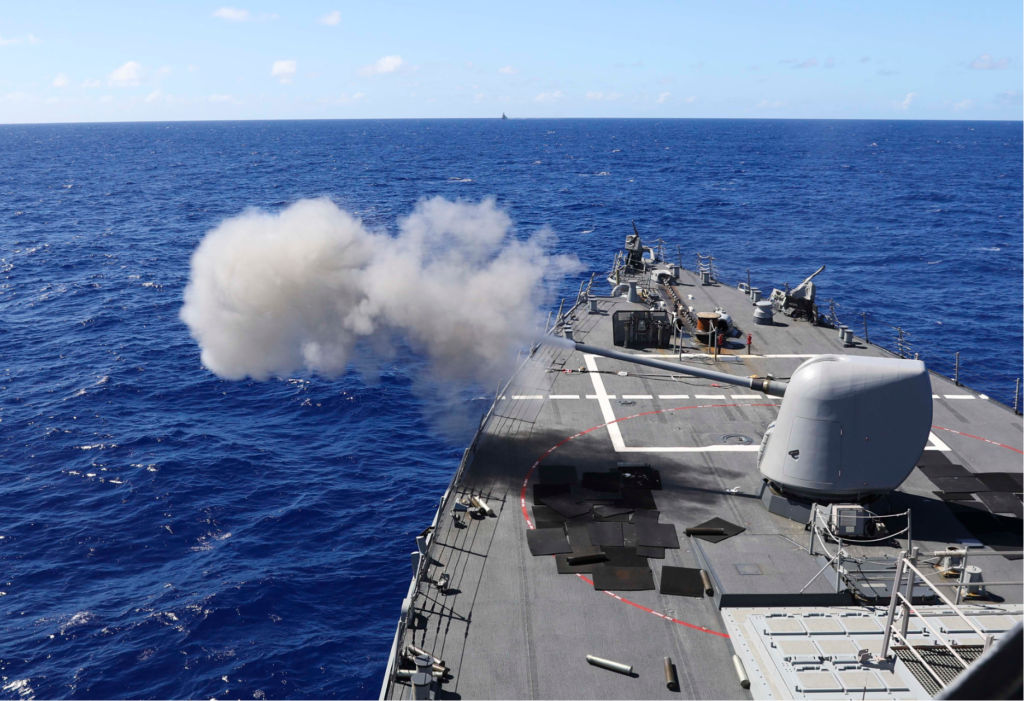
PHILIPPINE SEA (March 5, 2021) The Arleigh Burke-class guided-missile destroyer USS Benfold (DDG 65) fires its MK45 5-inch gun for a live-fire exercise during the annual U.S.-Japan Bilateral Advanced Warfighting Training (BAWT) Exercise. BAWT focuses on joint training and interoperability of coalition forces, and enables real-world proficiency and readiness in response to any contingency. (U.S. Navy photo by Mass Communication Specialist 2nd Class Deanna C. Gonzales)

Release from BAE Systems 

***** 

LOUISVILLE, Ky. — Jan. 8, 2024 — BAE Systems was awarded a contract by the Commonwealth of Australia to upgrade existing Mk 45 Mod 2 naval gun systems on Anzac class frigates with a Common Control System (CCS). The upgrade modifies existing Mk 45 systems to eliminate obsolescence issues and extend the life of the gun system.   

The CCS upgrade replaces electronics on earlier Mk 45 Mod 1 and Mod 2 gun systems to be compatible with the Mk 45 Mod 4, the latest configuration used by the U.S. Navy. In addition to delivering commonality and interoperability with the U.S. Navy’s gun systems, the upgrade will equip the Mk 45s with the capability to integrate future extended-range precision guided munitions, such as the hypervelocity projectile. 

“The Common Control System upgrade is the most cost-effective way to extend the life of Mk 45 gun systems, enabling them to provide critical ship naval fires and creating a configuration that allows for the integration of future precision guided munitions,” said Brent Butcher, vice president of weapon systems at BAE Systems. “We are committed to modernizing and equipping allied nations with enhanced Mk 45 gun systems to address current and future threats.” 

The cost-effective CCS upgrade ensures that Mk 45 gun systems remain supportable for decades to come and ready to integrate the latest, most innovative technology features to support advanced munitions and future mission capabilities for a significantly lower cost than a new gun.   

Work on the contract will take place at the BAE Systems production facility in Louisville, Kentucky with the first delivery planned in early 2026.  


HII Touts Banner Year, but Carrier Scheduling Doubts Loom

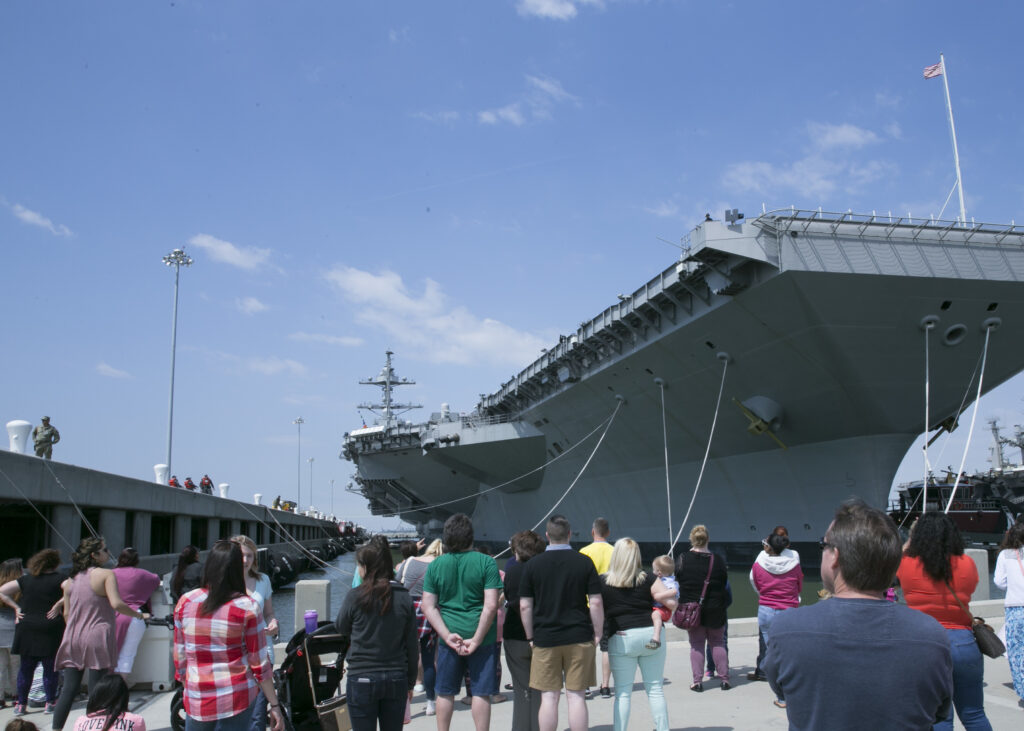
A Pre-Commissioning Unit Gerald R. Ford (CVN 78) arrives at Naval Station Norfolk in 2017. Delays to contracting for a follow-on ship of the class could cause supply chain trouble, according to shipbuilder HII. U.S. Navy | Mass Communication Specialist 2nd Class Kristopher Ruiz

ARLINGTON, Virginia ꟷ Shipbuilding giant HII had higher than usual growth through the third quarter of fiscal 2023, but a potential delay in contracting for two new aircraft carriers could lead to supply chain disruptions, the company CEO said in a media briefing on Jan. 8 in advance of the Surface Navy Association symposium this week.

“The company’s actually doing pretty great,” said CEO Christopher D. Kastner, who took over the company reins in March 2022. HII racked up 5% growth through Q3 of fiscal 2023, higher than its historical average of 3%.

“We’ve had a very solid 2023, we’ve grown at about 5% year-over-year through Q3, raised guidance on our top line for sales and free cash flow on our Q3 earnings call, so … we’re kind of at an inflection point from a growth standpoint,” he said.

Kastner said some company priorities appear to be supported in the pending fiscal 2024 defense authorization, including the LPD 33 amphibious warship. “Keeping the amphib line is very important to Ingalls” shipbuilding, Kastner said.

The company’s two shipyards have 41 ships in production and its Mission Technologies division, which builds and develops unmanned systems, AI systems and others, had more than $5 billion in awards during the year, including a $350 million contract for small unmanned underwater vehicles.

Seventeen submarines will go under contract in the next year to 18 months, and progress is being made on the AUKUS program to provide Australia with nuclear-powered submarines.

“We expect revenue to flow in 2024,” Kastner said. “We don’t believe it will be financially material in ’24, but there could be revenue flowing in ’24.”

Carrier Schedule

One potential fly in the ointment is the possibility of the next two-ship aircraft carrier buy being shifted by a year or two, from 2028 to 2029 or even 2030. In 2019, the Navy contracted for two carriers, CVN 80 and 81, the future Enterprise and Doris Miller.

“I think there’s a broad understanding that the supply chain is a material risk to achieving the production schedules on future Navy programs. And our job as shipbuilders is to manage risk,” Kastner said. “If we can eliminate one of those risks, or significantly reduce one of those risks by getting advanced procurement in place, well ahead of the ship being ordered, it only makes sense to do it. We know the ships are going to be built, they have broad support, so let’s eliminate risk, let’s get the major suppliers under contract early enough so they can plan and they can make their production schedules.”

A Newport News Shipbuilding executive, who asked not to be named, said the company is promoting a 2-3-4 concept for USS Gerald Ford-class aircraft carriers to create a “stable, predictable and consistent cadence within our industrial base.” That means a two-ship buy; at least three years of advanced procurement funding; and four-year build intervals between ships. “I believe the 2-3-4 strategy needs to be codified as the standard moving forward,” he said.

A delay in the procurement of CVN 82 is “extremely disappointing,” and could break the momentum of a rebuilding carrier production line “and have a detrimental impact on the entire nuclear shipbuilding industry, including submarine construction,” he said.


Admiral James Kilby Assumes Role as Vice Chief of Naval Operations

***** 

By VCNO Public Affairs 

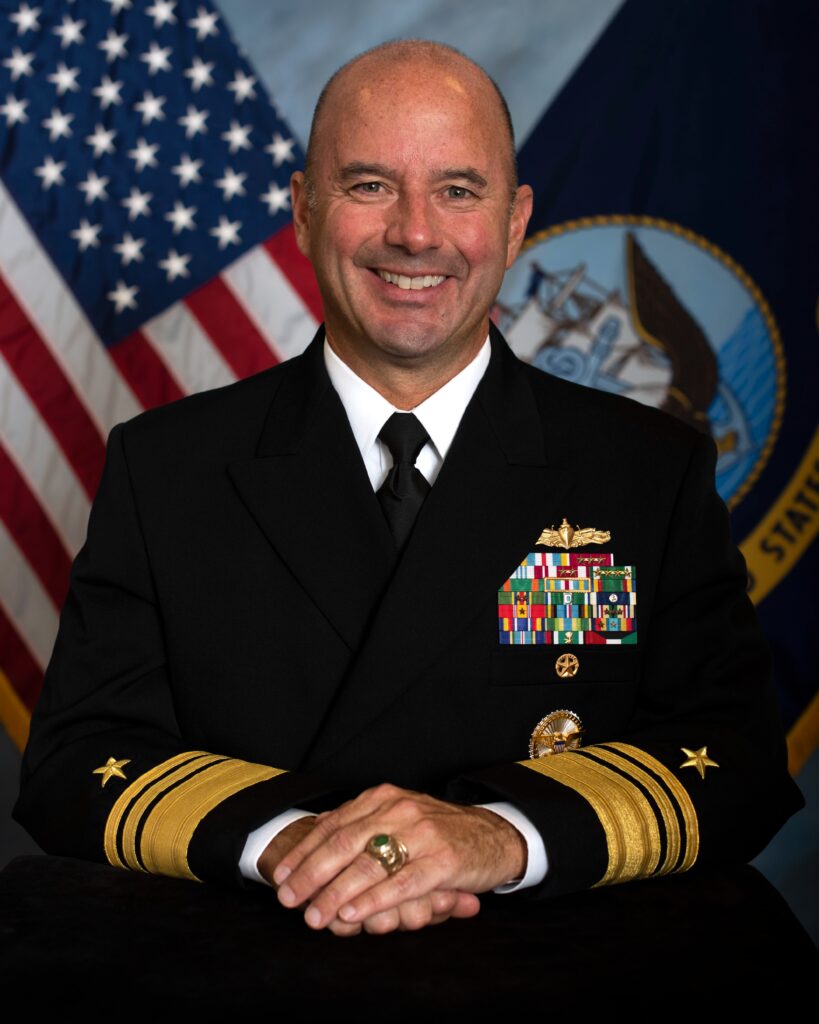
Chief of Naval Operations Adm. Lisa Franchetti welcomed Adm. James Kilby as the 43rd Vice Chief of Naval Operations in a ceremony at the Pentagon, Jan. 5.  

Kilby most recently served as the deputy commander, U.S. Fleet Forces in Norfolk, Virginia. He is a native of Pound Ridge, New York, and a 1986 graduate of the United States Naval Academy. He has commanded at unit and strike group levels and is the recipient of the Vice Adm. James B. Stockdale Award for inspirational leadership. 

“Adm. Kilby is an exceptional leader who is truly committed to our Sailors and meeting the needs of the Fleet,” said Franchetti. “His extensive operational experience combined with his deep requirements and force development expertise will help accelerate change across the force. I am thrilled to have him on board as we lead the Navy through this decisive decade, and I am grateful that he and his family continue to serve the Navy.” 

Kilby was promoted to the rank of admiral prior to the assumption of office. 

“I am honored and humbled to assume this position at such a critical time for our Navy and our nation,” said Kilby. “I am excited at the opportunity to support our CNO to ensure the Navy remains the most capable and powerful maritime force in the world.” 

His biography and photo can be found here: https://www.navy.mil/Leadership/Flag-Officer-Biographies/BioDisplay/Article/2236251/admiral-james-kilby/ 


Houthi Explosive USV Detonated in Red Sea Attack

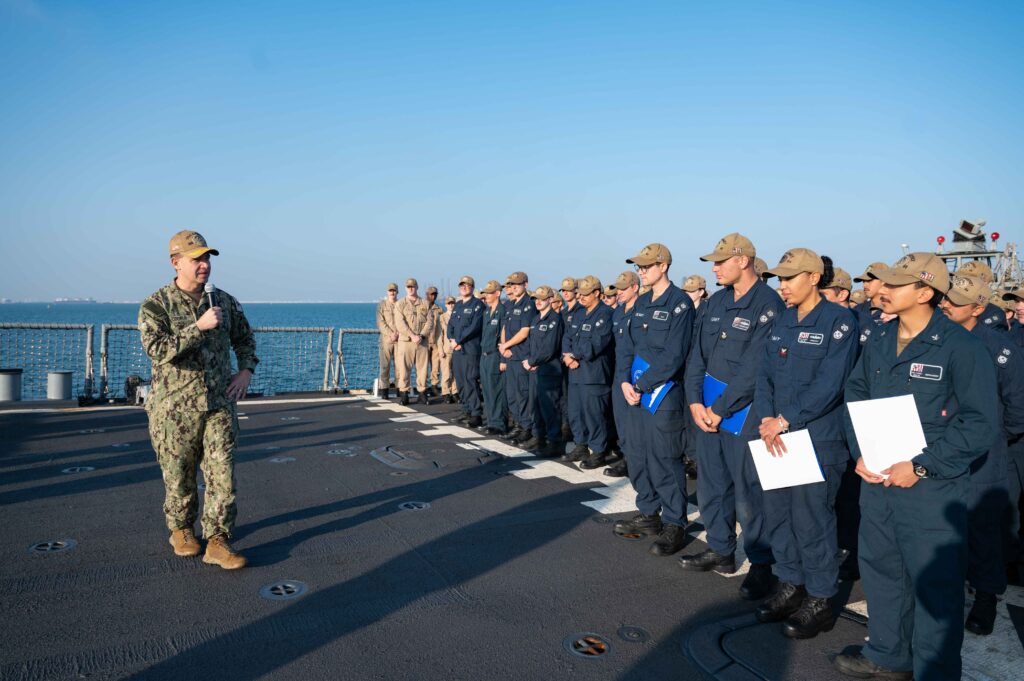
BAHRAIN (Jan. 2, 2024) Vice Adm. Brad Cooper, commander of U.S. 5th Fleet, speaks with Sailors aboard the Arleigh Burke-class guided-missile destroyer USS Carney (DDG 64) after presenting combat medals to Sailors while the ship is in Bahrain, Jan. 2, 2024. Cooper also recognized the whole Carney crew with the Combat Action Ribbon. On Dec. 16, Carney Sailors shot down 14 Houthi unmanned aerial vehicles in the Red Sea. (U.S. Navy photo by Mass Communication Specialist 2nd Class Jacob Vernier) 

By Richard R. Burgess, Senior Editor 

ARLINGTON, Va.—An uncrewed surface vessel (USV) was detonated in the international shipping lanes Jan. 4 in the latest attack launched from Yemen by Houthi rebels. 

“Fortunately, there were no casualties, and no ships were hit, but the introduction of a one-way attack USV is of concern,” said U.S. Navy Vice Admiral Brad Cooper, commander, U.S. Fifth Fleet and commander, U.S. Naval Forces Central Command, and commander, Combined Maritime Forces, speaking to reporters in a June 4 teleconference. 

The attack was the 25th against merchant ships in the Red Sea since mid-November.  

In response to the attacks, Secretary of Defense Lloyd J. Austin III on Dec. 18 launched Operation Prosperity Guardian, a multinational effort to protect shipping through the Red Sea and Bab-el-Mandeb Strait. The Combined Maritime Forces under Commander, Task Force 153, are conducting the operation.  

Cooper said that the coalition forces had shot down 11 drones, two cruise missiles, and two antiship ballistic missiles launched from Yemen since the operation began. In addition, three of four Houthi attack boats, which fired on U.S. Navy helicopters, were then destroyed by U.S. Navy MH-60 helicopters from the Arleigh Burke-class guided-missile destroyer USS Gravely and the aircraft carrier USS Dwight D. Eisenhower. 

Cooper said a total of 61 drones and missiles had been shot down by U.S. Navy destroyers and F/A-18 Super Hornet strike fighters over the last two months. Other drones and missiles have been shot down by ships of the Royal Navy and French Navy. 

Cooper made three key points in the conference: 

“By number one, the number of nations participating has grown. Their contributions are meaningful, and our partners are doing great work at sea. Number two, about 1,500 merchant ships have safely transited the waters of the Red Sea since the operation began. And then number three, our collaboration with the maritime shipping industry has increased dramatically. We’re reassuring them through persistent communications that are characterized as two-way, both before and during transits, so that’s going well. 

“Now, having said this, the Houthi ruthless attacks have continued, as you know, and there are no signs their irresponsible behavior is abating,” he said. 


SAIC to Support the U.S. Navy’s Hypersonics Advanced Concepts and Strategic Missions Programs

Release from SAIC 

***** 

January 4, 2024

Company will provide research, development, test and evaluation for Strategic Systems Programs and the Naval Surface Warfare Center Crane 

RESTON, Va.–(BUSINESS WIRE)– Science Applications International Corp. (NYSE: SAIC) has been awarded a $63 million contract from the U.S. Navy to support hypersonics advanced concepts and strategic mission solutions for the Navy’s Strategic Systems Programs (SSP) and the Naval Surface Warfare Center (NSWC) Crane, Ind., Strategic Systems Hardware Division (GXW). 

“Every day, SAIC provides expertise in systems integration and delivery solutions in support of the U.S. Navy’s strategic priorities,” said Barbara Supplee, senior vice president, Navy Business Group at SAIC. “We look forward to furthering the full lifecycle of research and development, technology maturation, test and evaluation and eventually the insertion of next-generation technology for hypersonics through our work at the Navy’s Crane facility and other key performance locations.” 

Under the new contract, SAIC will enhance hypersonics advanced concepts and strategic missions focused on next-generation systems, subsystems, components, features and technologies to include Hardware-in-the-Loop (HWIL) and Software-in-the-Loop (SWIL) simulations, manufacturing techniques and other strategic mission areas. 

SAIC’s continuing support to NSWC Crane will also include developing unique test capabilities, assessing and addressing technology gaps, recommending requirements and solutions for hypersonics advanced concepts and strategic mission areas, identifying critical enabling technologies and assessing a technology’s suitability for specific applications including flight qualification. SAIC will assist SSP and NSWC Crane in driving quick-reaction analysis and rapid engineering principals across Department of Defense hypersonic advanced concepts and strategic mission initiatives to enable continued technological superiority. 

Additional support by SAIC will include developing improvements to leading-edge technologies, including new technical approaches and opportunities for technology transfer and integration, as well as inserting, enhancing, modernizing and sustaining state of the art hypersonics advanced concepts and strategic mission technologies to keep pace with continually emerging and evolving threats. 


GA-ASI Completes First Lifetime for Full-Scale Fatigue Test on MQ-9B  

***** 

SAN DIEGO – 03 January 2024  

On Dec. 5, 2023, General Atomics Aeronautical Systems, Inc. (GA-ASI) completed a major milestone with the full-scale fatigue testing of an MQ-9B Remotely Piloted Aircraft (RPA). The team completed the “first lifetime” of fatigue testing – equivalent to 40,000 operating hours – and represents an important step in validating the design of the airframe system. The testing is part of the aircraft certification to the NATO standard STANAG 4671, where the aircraft will ultimately be tested through three lifetimes, thereby proving the 40,000 hour lifetime of the airframe.  

The full-scale fatigue test simulates the aircraft’s design service through the application of repeated structural loading on the assembled airframe. The testing identifies any potential structural deficiencies ahead of fleet usage and assists in developing inspection and maintenance schedules for the airframe. The results of the test will be used as a part of the documentation for certification, as well as form the basis for in-service inspections of structural components.  

MQ-9B is GA-ASI’s most advanced RPA and includes the SkyGuardian® and SeaGuardian® models, as well as the new Protector RG Mk 1 that is currently being delivered to the U.K. Royal Air Force. 

“Full-scale fatigue testing is an integral part of validating the airframe design and a key input to the certification of the airframe prior to going into service,” said Chris Dusseault, Vice President of MQ-9B in Europe. “The completion of the fatigue test builds confidence for our MQ-9B customers that the SkyGuardian/SeaGuardian airframe meets the stringent design rigor and is a mature system at Entry into Service.”  

The testing is the validation of years of design and analysis efforts. This is the first of three lifetimes of testing for the airframe. Two of the lifetimes simulate the operation of an aircraft under normal conditions, and the third lifetime has intentional damage inflicted on the airframe’s critical components to demonstrate its resistance to operational damage that may occur in the lifetime of the air vehicle.  

Testing was conducted Dec. 13, 2022-Dec. 5, 2023, at Wichita State University’s National Institute for Aviation Research in Wichita, Kan. The airframe tested is a production airframe purpose-built to support the test campaign.