Sikorsky Completes Flight Tests of Three Hellenic Navy MH-60R Helicopters
OWEGO, N.Y.,Feb. 7, 2024 – Sikorsky, a Lockheed Martin company, has completed testing of the integrated mission systems and sensors aboard three MH-60R Seahawk helicopters purchased by the Hellenic Navy.
Completed in early December 2023, the tests verify each MH-60R aircraft is an efficient and effective air weapon system capable of performing anti-submarine and anti-surface warfare missions from land or naval ship.
“Commonality of these Hellenic Navy MH-60R Seahawk aircraft with 330 MH-60R and 250 MH-60S Seahawk aircraft, and with the global Black Hawk helicopter fleet, enables Sikorsky and the U.S. Navy to continue sustaining and upgrading this proven weapon system for maximum threat deterrence and operational capability,” said Sikorsky President Paul Lemmo.
Greece is the seventh country to receive the U.S. Navy’s MH-60R maritime helicopter. In Europe, Denmark operates nine MH-60R aircraft. Spain and Norway placed orders in 2023 for a combined 14 MH-60R aircraft.
Arrival in Greece The first three MH-60R aircraft will arrive in Greece during 2024 aboard U.S. Navy transport planes. Four additional aircraft will arrive in 2025 to complete the Hellenic Navy’s seven-aircraft purchase.
Hellenic Navy MH-60R aircraft will join 11 existing S-70B Seahawk aircraft at the Kotroni Naval Air Station. Known as Aegean Hawks, the older maritime helicopters were acquired direct from Sikorsky between 1994 and 2005.
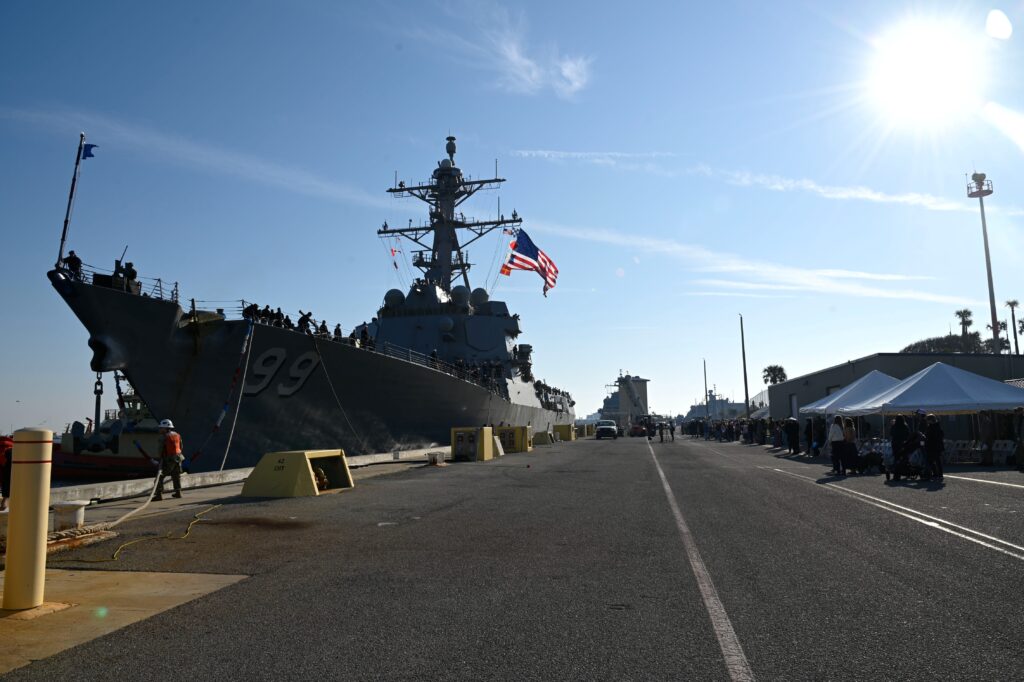
NAVAL STATION NORFOLK, Virginia ꟷ The Arleigh-Burke class guided-missile destroyer USS McFaul (DDG 74) returned to Norfolk, Virginia, Jan. 4 after an eight-month deployment to the Atlantic Ocean and U.S. 5th Fleet areas of operations.
McFaul served as an independently deployed ship in the U.S. 5th Fleet area of operations and an air defense unit in the Gerald R. Ford Carrier Strike Group (GRFCSG) off the coast of Israel. McFaul completed 34 Strait of Hormuz transits to ensure freedom of navigation for commercial traffic in a highly transited and politically sensitive area of the world. McFaul also conducted 17 close escorts for maritime allies and assets, in support of U.S. maritime security objectives in the Middle East and Europe.
“USS McFaul is a family,” said Quartermaster 2nd Class Jose Vispo, a member of the ship’s crew. “Through the adversity and struggles, we still made it through with our chins held high. I believe that we were able to get through this very long deployment with such success because every member of the crew is treated like a brother or a sister. That family mentality turns any challenge, no matter how difficult, into a simple task. I think McFaul answered the call just as our namesake suggests: with courage, honor and sacrifice.”
In 250 days, the crew of McFaul conducted 26 replenishments at sea, sailed over 50,000 nautical miles and safely transferred over 5,500,000 gallons of fuel. McFaul transited the Atlantic Ocean and began patrols the Gulf of Oman and Southern Arabian Gulf after transiting through the Suez Canal.
“McFaul and Team 74 return to our families and loved ones today from a record-setting eight-month deployment to Fifth and Sixth Fleet Areas of Responsibility,” said Commander Antonia Shey, the commanding officer of McFaul. “During our 192 days in 5th Fleet, McFaul prevented the Iranian seizure of two motor tankers, completed an unprecedented 34 Strait of Hormuz transits, conducted rescue and assistance of distressed mariners, and escorted numerous merchant vessels to ensure free flow of commerce. Additionally, McFaul participated in joint and bi-lateral exercises strengthening partnerships and building relationships with five nations and the U.S. Air Force. The grit, determination, and hard work from every member of Team 74 contributed to McFaul’s successful deployment and I could not be prouder of Team 74.”
McFaul crew conducted maritime security operations and engaged with allied and partner nations in the 5th Fleet area of operations. McFaul navigated throughout the region providing assurance and deterring aggression, especially in the wake of the Oct. 7 terrorist attacks on Israel. While conducting patrols in the Gulf of Oman and Southern Arabian Gulf, McFaul conducted more than 130 hours of UAV operations. McFaul also hosted officers from the Kingdom of Saudi Arabia, participated in joint operations with the U.S. Air Force, operated at sea with a Qatari ship and joined bi-lateral exercises with the Omanis in order to strengthen ties in the region.
Strengthening partnerships during the deployment to the Naval Forces Central Command area of operations builds enduring relationships and emphasizes the shared commitment to promoting safety and stability within the region, while seeking opportunities to enhance interoperability as close allies.
The GRFCSG is on a scheduled deployment in the U.S. Naval Forces Europe-Africa area of operations, employed by U.S. 6th Fleet and U.S. 5th Fleet to defend U.S., allied, and partner interests.
The Gerald R. Ford Carrier Strike Group is comprised of its flagship and namesake, the Ford-class aircraft carrier USS Gerald R. Ford (CVN-78), Carrier Air Wing Eight (CVW-8), Destroyer Squadron Two (DESRON-2), the Ticonderoga-class guided-missile cruiser USS Normandy (CG-60), and the Arleigh Burke-class guided-missile destroyers USS Ramage (DDG 61), USS McFaul (DDG 74), and USS Thomas Hudner (DDG 116).
Coast Guard Cutter Resolute Returns Home, Offloads $55M Worth of Drugs in Tampa Bay
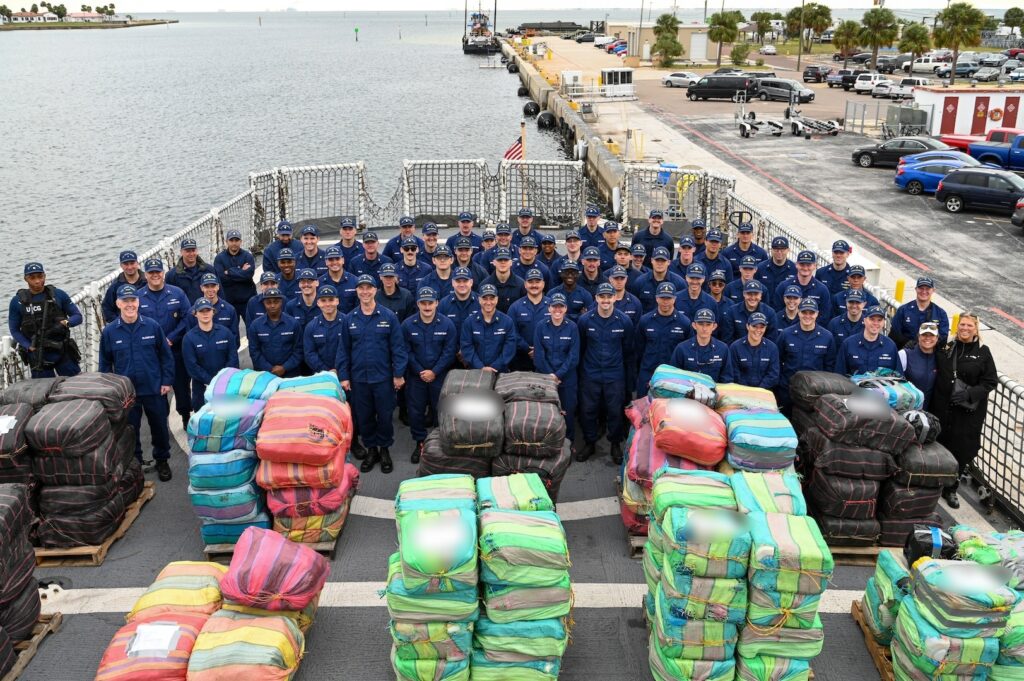
ST. PETERSBURG, Florida — Coast Guard Cutter Resolute (WMEC 620) and crew returned from a 60-day counterdrug patrol and offloaded approximately $55 million worth of illicit narcotics, Monday, in St. Petersburg.
Patrolling in support of Joint Interagency Task Force - South, the Resolute crew stopped two suspected drug trafficking ventures, preventing 6,565 pounds of marijuana and approximately 3,700 pounds of cocaine from entering the United States, and detained six suspected traffickers. The drugs were seized in the international waters of the Eastern Pacific Ocean.
Supporting the Resolute was an embarked MH-65 Dolphin helicopter and crew from the Coast Guard Helicopter Interdiction Tactical Squadron, and a law enforcement detachment from Tactical Law Enforcement Team - South.
During the patrol, Resolute’s crew met with Panama’s National Aeronaval Service to strengthen the partnership between the United States and Panama, and discuss strategies to combat illegal, unreported, and unregulated fishing.
“The pride and dedication of Resolute’s crew was evident throughout the entirety of our patrol,” said Cmdr. Matthew R. Kolodica, commanding officer of Resolute. “Despite being deployed throughout the holiday season, the crew served with professionalism. The result of their collected effort was an extremely successful patrol which kept $55 million dollars of drugs from reaching its intended destination. Every Resolute sailor and their loved ones should be proud; they are a living example of the Coast Guard’s motto, “Semper Paratus – Always Ready.” It is an honor to lead such a fine ship and crew.”
The fight against drug cartels in the Eastern Pacific Ocean and the Caribbean Sea requires a unity of effort in all phases, from detection and monitoring to interdiction and apprehension, through criminal prosecutions by international partners and U.S. Attorneys’ Offices in districts across the nation. Joint Interagency Task Force – South in Key West, Florida conducts the detection and monitoring of aerial and maritime transit of illegal drugs. The law enforcement phase of counter-smuggling operations in the Eastern Pacific Ocean is conducted under the authority of the Coast Guard 11th District, headquartered in Alameda, California, and the law enforcement phase of operations in the Caribbean is conducted under the authority of the Coast Guard 7th District, headquartered in Miami. The interdictions, including the actual boardings, are led and conducted by members of the U.S. Coast Guard.
These interdictions relate to Organized Crime Drug Enforcement Task Forces (OCDETF) designated investigations. OCDETF identifies, disrupts, and dismantles the highest-level criminal organizations that threaten the United States using a prosecutor-led, intelligence-driven, multi-agency approach. Additional information about the OCDETF program can be found at https://www.justice.gov/OCDETF.
Resolute is a 210-foot, Reliance-class medium endurance cutter homeported in St. Petersburg with a crew of 80. The cutter’s primary missions include law enforcement, search and rescue, protection of living marine resources, homeland security and defense operations, international training and humanitarian operations throughout the Western hemisphere.
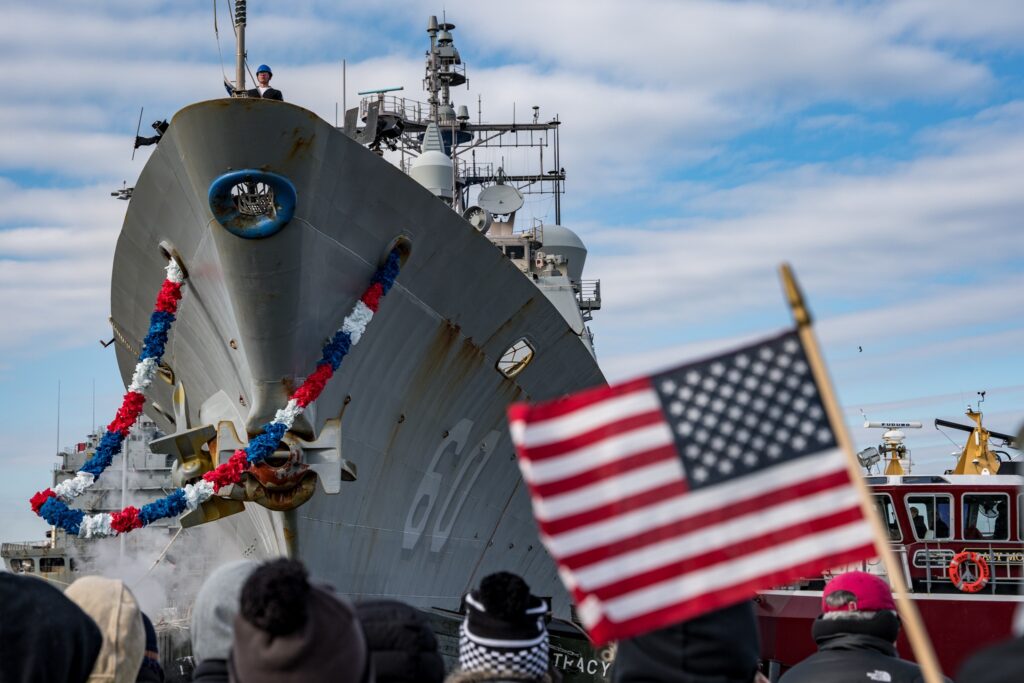
NAVAL STATION NORFOLK, Virginia ꟷ The Ticonderoga-class guided-missile cruiser USS Normandy (CG 60), part of the Gerald R. Ford Carrier Strike Group (GRFCSG), returned to homeport in Norfolk after an eight-month deployment to the U.S. Naval Forces Europe area of operations, Jan. 20.
Normandy steamed more 61,000 nautical miles while serving as the air defense commander for the strike group.
“From the North Sea to the Eastern Mediterranean, this deployment has enhanced and reinforced regional stability, as we worked with our allies and partners to uphold our mutual commitment to maritime security,” said Captain Errol A. Robinson, Normandy’s commanding officer. “Our Sailors expertly executed complex multi-ship maneuvers with our allies and tactically controlled aircraft and the airspace, while maintaining the material readiness of the ship. During my two tours aboard Normandy, as division officer and 23 years later as her commanding officer, I can say that my Sailors’ tireless and exacting performance was in keeping with Normandy’s 34 years of superb service.”
Over the course of 262 days, Normandy’s crew conducted over 40 replenishments-at-sea, and manned flight quarters 670 times. Normandy’s embarked air detachment, the “Spartans” of Helicopter Maritime Strike Squadron (HSM) 70, flew 393 sorties, totaling 1,132 hours flown.
Normandy’s culinary team prepared and served over 388,500 meals, which included over 68,619 pounds of fresh fruits and vegetables, 4,382 pounds of steak, 10,520 hot dogs, 3,207 pounds of bacon, 89,000 individual eggs and 800 pounds of coffee.
Throughout deployment, Normandy’s crew embraced numerous opportunities to strengthen partnerships with allied navies, hosting crew exchanges with the U.K. royal navy Duke-class frigate HMS Kent (F 78), the Italian navy Carlo Bergamini-class frigate ITS Carabiniere (F 593), the Turkish navy Gabya-class frigate TCG Gökçeada (F 494), and the first-in-class Hellenic navy frigate HS Elli (F 450). In addition to these crew exchanges, the 2023 deployment saw Normandy steam with frigates of the Croatian, Dutch, French, Norwegian, Polish, Spanish, and Swedish navies, demonstrating a shared commitment to promoting safety and stability in Europe.
Port visits in the U.S. 6th Fleet area of operations made Normandy’s Sailors de facto ambassadors, as the ship moored in Gothenburg, Sweden; Koper, Slovenia; Rijeka, Croatia; Aksaz, Türkiye; Bar, Montenegro; and Athens, Greece. Office calls to local navy leadership, and community relations events in nearly every country Normandy visited, bolstered valuable partnerships. In Bar, Montenegro, Normandy hosted Nicole Otallah, the charges d’affaires of the U.S. embassy in Montenegro, at a reception for Montenegrin civil and military leaders held on the ship’s flight deck.
Following the Oct. 7 Hamas attacks on Israel from the Gaza Strip, Normandy and the strike group were ordered to the Eastern Mediterranean by the secretary of defense to provide a constant and stabilizing presence that would prevent regional escalation of the conflict.
“For almost 70% of Normandy’s crew, this was their first deployment,” said Command Master Chief William Palmer. “That did not deter them from seizing opportunities to excel and gain further expertise in their fields. Normandy’s Sailors are returning home more accomplished and more resilient, and their families should be proud of the work they have done.”
The GRFCSG is comprised of its flagship and namesake, the Ford-class aircraft carrier USS Gerald R. Ford (CVN 78), Carrier Air Wing Eight (CVW-8), Destroyer Squadron Two (DESRON-2), the Ticonderoga-class guided-missile cruiser USS Normandy (CG-60), and the Arleigh Burke-class guided-missile destroyers USS Ramage (DDG 61), USS McFaul (DDG 74), and USS Thomas Hudner (DDG 116).
The squadrons of CVW-8 embarked aboard Gerald R. Ford are the “Tridents” of Helicopter Sea Combat Squadron (HSC) 9, the “Spartans” of Helicopter Maritime Strike Squadron (HSM) 70, the “Bear Aces” of Airborne Command and Control Squadron (VAW) 124, the “Ragin’ Bulls” of Strike Fighter Squadron (VFA) 37, the “Blacklions” of VFA-213, the “Golden Warriors” of VFA-87, the “Tomcatters” of VFA-31, the “Gray Wolves” of Electronic Attack Squadron (VAQ) 142, and the “Rawhides” of Fleet Logistics Support Squadron (VRC) 40.
VMFA-542 Becomes First F-35B Squadron on East Coast to Achieve Initial Operational Capability
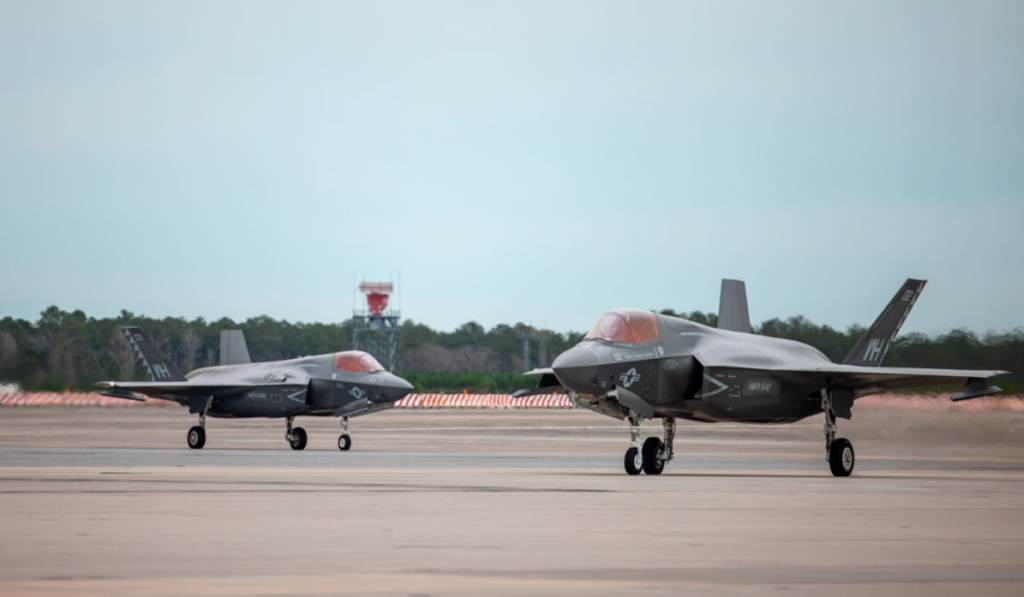
Two U.S. Marine Corps F-35B Lightning II jets with Marine Fighter Attack Squadron (VMFA) 542 taxi at Marine Corps Air Station Cherry Point, North Carolina, Dec. 28, 2023. U.S. Marine Corps | Warrant Officer Akeel Austin
MARINE CORPS AIR STATION CHERRY POINT, North Carolina – Marine Fighter Attack Squadron (VMFA) 542, 2nd Marine Aircraft Wing (MAW), became the first East Coast F-35B Lightning II Joint Strike Fighter squadron in the Fleet Marine Force to achieve initial operational capability, Feb. 5.
Initial operational capability means that VMFA-542 has enough operational F-35B Lightning II aircraft, trained pilots, maintainers, and support equipment to self-sustain its mission essential tasks (METs). These METs include conducting close-air support, offensive anti-air warfare, strike coordination and reconnaissance, and electronic attacks.
“VMFA-542 is the first operational fifth-generation squadron in II Marine Expeditionary Force, giving the aviation combat element the most lethal, survivable, and interoperable strike fighter in the U.S. inventory,” said Lieutenant Colonel Brian Hansell, commanding officer of VMFA-542. “The F-35B is unmatched in its capability to support Marines against the advanced threats that we can expect in the future.”
The F-35 is a fifth-generation fighter jet with advanced stealth, agility and maneuverability, sensor and information fusion, and provides the pilot with real-time access to battlespace information. It is designed to meet an advanced threat while improving lethality, survivability, and supportability. The F-35B Lightning II is the short-takeoff and vertical-landing F-35 variant. This capability allows the aircraft to operate from amphibious assault ships and expeditionary airstrips less than 2,000 feet long.
“I am extremely proud of the Marines and Sailors of VMFA-542,” said Colonel James T. Bardo, commanding officer of Marine Aircraft Group 14, the parent command of VMFA-542. “Achieving initial operational capability at the pace and precision of which they did truly demonstrates what an exceptional unit this is. This milestone demonstrates their hard work, ingenuity, and perseverance.”
Achieving initial operational capability also means that VMFA-542 is one step closer to achieving full operational capability and completing its F-35B Lightning II transition, a process that began in December 2022.
VMFA-542 is a subordinate unit of 2nd MAW, the aviation combat element of II Marine Expeditionary Force.
U.S Coast Guard Cutter Steadfast decommissioned after 56 years of service
Feb. 6, 2024
ASTORIA, Ore. — The Coast Guard decommissioned the U.S. Coast Guard Cutter Steadfast (WMEC 623) during a ceremony, Thursday, Feb. 1, 2024, in Astoria.
Rear Adm. Brendan McPherson, deputy commander, Coast Guard Pacific Area, presided over the ceremony honoring the 56 years of service Steadfast and its crews provided to the nation.
Commissioned in 1968, Steadfast was one of 16 Reliance-class medium endurance cutters built for search and rescue, counter-narcotic operations, and migrant interdiction.
“The cutter Steadfast has been a stalwart ship for the Coast Guard, frequently conducting lifesaving missions, contributing to our national security and protecting our Marine Transportation System.” said McPherson. “I am immensely proud of Steadfast’s crew for their dedication to duty while enhancing our nation’s maritime safety and security throughout the Pacific Ocean.”
During the cutter’s most recent deployment, the crew transited 11,742 nautical miles on a 64-day multi-mission deployment, from Oregon to several hundred miles off the coast of Central Mexico conducting training, law enforcement, recruiting and public affairs missions, along with helicopter operations.
“Steadfast has an incredible legacy of honorable service to our nation,” said Cmdr. Brock Eckel, Steadfast’s commanding officer. “I am grateful to have had the opportunity to lead such an amazing crew through dynamic patrols and high-risk counter-narcotics operations. I want to thank the crew for their dedication, camaraderie, and desire to serve our country; they are what make this ship so special.”
As part of the U.S. Coast Guard’s Foreign Military Sales Program, Steadfast will transfer to Baltimore where she will be available for transfer to another country as an Excess Defense Article.
Steadfast was one of the Coast Guard’s 13 remaining 210-foot, Reliance-class medium endurance cutters. As part of the Coast Guard’s acquisition program, the 360-foot Heritage-class offshore patrol cutters and the 154-foot fast response cutters will replace the Coast Guard’s 270-foot and 210-foot medium endurance cutters. The offshore patrol cutters will provide the majority of offshore presence for the Coast Guard’s cutter fleet, bridging the capabilities of the 418-foot national security cutters, which patrol the open ocean, and the 154-foot fast response cutters, which serve closer to shore
SECNAV Del Toro Stresses DON’s Support of Small Businesses During National 8(a) Conference
06 February 2024
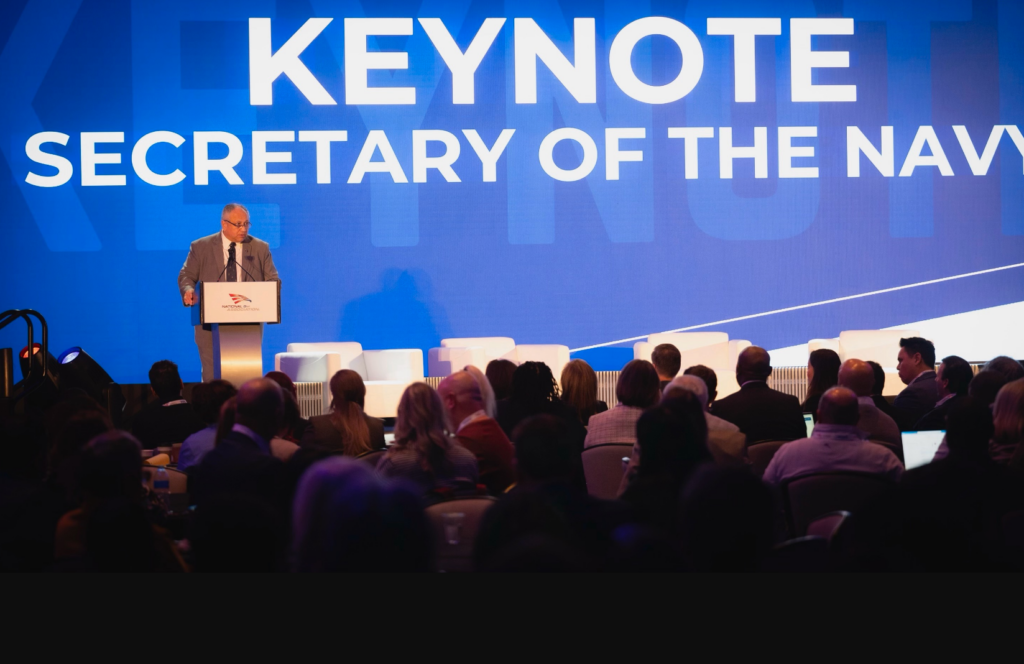
Secretary of the Navy Carlos Del Toro today spoke to hundreds of small business owners at the National 8(a) Association Small Business Conference in Atlanta, Feb. 6.
The National 8(a) Association is a non-profit that provides education and guidance for small businesses including minority, aspiring, current and graduate 8(a), HUBZone, SDVOB, VOSB, SDB, WOSB, DBE, and teaming partnerships.
Secretary Del Toro stressed the Department of the Navy’s Office of Small Business Program’s (DON OSBP) proven commitment to aggressively expanding small business opportunity to partner with the DON on its significant procurement investments for goods and services.
“In fiscal year 2023, we spent $20.1 billion on contracts with small businesses, exceeding our target goal for the year by over 17 percent,” said Secretary Del Toro. “Furthermore, we exceeded our sub-category goals for service-disabled Veteran-owned, women-owned, and HUBZone, and came within 0.04% of meeting our small, disadvantaged business goal. And this year, we are well on our way to meeting our goals, and we’re not even at the halfway point, with billions of dollars committed to contracts with small businesses across all categories.”
Secretary Del Toro also discussed the importance the DON’s puts on supporting the small business community.
“The National 8(a) Association and other organizations like it play a critical role in educating, guiding, and supporting small businesses as they prepare to work with the federal government, and we are grateful for the role they play in our small business ecosystem,” said Secretary Del Toro. “From my vantage point as Secretary of the Navy, a healthy, diverse industrial base made up of companies of all sizes—founded by American entrepreneurs from all walks of life—is absolutely crucial to the success of our Navy and our Marine Corps.”
Secretary Del Toro reiterated his commitment to working with small businesses to provide the Navy and Marine Corps team with the support, systems, and platforms needed to confront the global challenges we face today.
“Strengthening maritime dominance is focused on ensuring our Sailors and Marines have the right mix of platforms and capabilities so that they are prepared to deter our nation’s potential adversaries, and, if called upon, fight and decisively win our Nation’s wars,” said Secretary Del Toro. “In terms of cutting-edge capabilities, we are working with small businesses to secure our advantages in technology areas such as artificial intelligence and machine learning, cybersecurity, and unmanned systems.
Before leaving the conference in Atlanta, Secretary Del Toro hosted a roundtable with about two dozen small business owners to continue the dialogue on how small businesses and the DON can support each other.
“For the companies represented here that are focused on improving the lives of our personnel, whether it be through delivering world-class education and training, or providing resources to support the health and resiliency of our Navy and Marine Corps communities, we welcome the opportunity to learn more about your offerings during or after this week’s conference,” said Secretary Del Toro.
Atlanta is the first leg a travel for Secretary Del Toro this week. Next, he travels to Puerto Rico, where he will participate in a U.S. Department of Commerce Minority Business Development Agency Business Roundtable and a joint U.S. Departments of Defense and Navy Business Roundtable. He’ll also have key leader engagements and national call to service events.
Secretary Del Toro’s full remarks from the National 8(a) Association Small Business Conference can be found here.
Coast Guard Sails to Islands of Federated States of Micronesia with Needed Equipment, Supplies
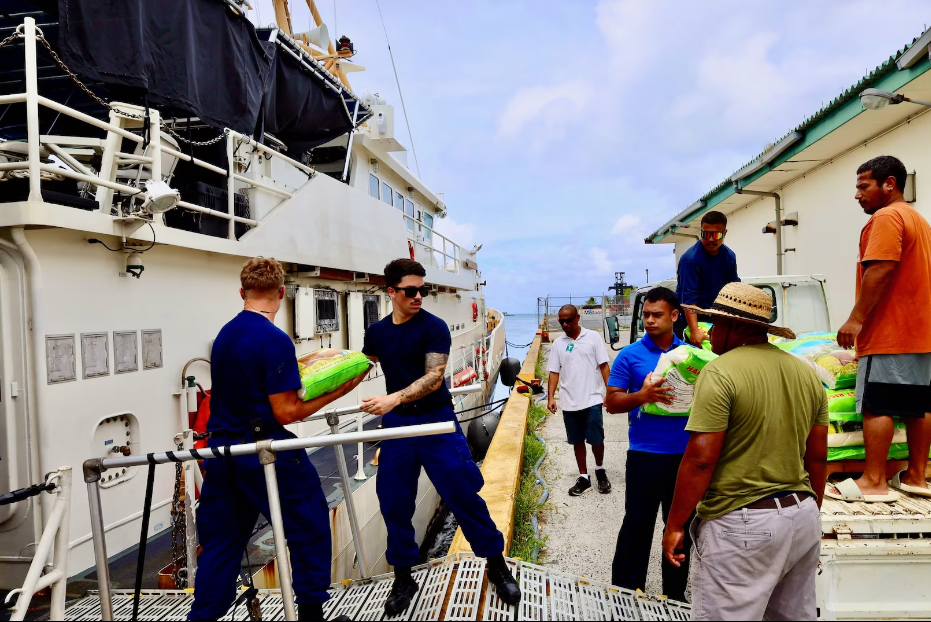
POHNPEI, Federated States of Micronesia — The USCGC Oliver Henry (WPC 1140) crew arrived at Dekhitik Harbor in Pohnpei on Feb. 1 as part of an international effort to deliver essential supplies and equipment to the drought-affected outer islands of Nukuoro and Kapingamarangi Atolls.
Due to the El Niño weather phenomenon, these remote communities required immediate assistance, including water purification solutions, to combat the scarcity of potable water.
Embarked on this vital mission were RO technicians Mr. Dudley Lorrin from the International Organization for Migration (IOM) and Mr. Jimmy Edward from the Pohnpei Department of Public Safety (DPS). The mission was critical in providing immediate relief, including the transportation and operational setup of Reverse Osmosis (RO) units capable of converting seawater into drinkable water. These units, crucial for the survival of the island communities, can produce up to 350 gallons of fresh water daily and are powered by solar panels or high-capacity batteries.
Significantly, the deployment was supported by various partners. The U.S. Navy Seabees repaired an IOM Reverse Osmosis unit in preparation for the mission. The Government of Australia’s Pacific Maritime Security Program donated specialized heavy-duty batteries to ensure the RO units’ functionality. Additionally, the Pohnpei State Government contributed one ton of rice, emphasizing the collaborative nature of this humanitarian operation.
Upon reaching Nukuoro, the USCGC Oliver Henry crew swiftly made an existing RO unit operational with the newly transported batteries, demonstrating adaptability and technical proficiency. Petty Officer 1st Class Kai Ruiz, an electrician’s mate, connected two 12V batteries to the island’s RO pump using spare parts from both the cutter and the local community—a testament to the crew’s resourcefulness and commitment to the mission.
In Kapingamarangi, the crew performed a successful systems check on the local RO unit, confirming its full mission capability. Troubleshooting efforts also extended to the solar system and HF radio, identifying the need for replacement of the decade-old solar batteries and the HF radio antenna—issues earmarked for future attention by local government authorities.
The mission’s cargo included 2,000 lbs of rice, two RO generator kits, three solar panel kits, and medical supplies, directly addressing the immediate needs of Nukuoro and Kapingamarangi. Upon departure, three medical kits, 80 gallons of bottled water donated by U.S. Coast Guard members and brought from Guam, diesel fuel, and various paper products were offloaded in Kapingamarangi, reflecting a comprehensive approach to aid delivery.
“Our visit was more than a delivery mission; it was an opportunity to strengthen ties with the island communities,” said Lt. Ray Cerrato, commanding officer of Oliver Henry. “The crew’s engagement with local schools and villages left a lasting impression, underscoring the U.S. Coast Guard’s commitment to the well-being of these remote populations. The gratitude expressed by the village chiefs and the anticipation of future visits highlight the enduring relationships fostered by these endeavors.”
This mission exemplifies the U.S. Coast Guard’s dedication to humanitarian aid and international cooperation, ensuring the well-being of vulnerable communities in the Pacific. The collective effort of all parties involved, from the initial loading in Guam to the final delivery and operational support on the islands, showcases a unified response to the challenges faced by Nukuoro and Kapingamarangi, reinforcing the U.S. Coast Guard’s role as a pivotal force for good in the region.
USCGC Oliver Henry’s crew is conducting the first U.S. Coast Guard Forces Micronesia/Sector Guam expeditionary patrol of 2024 under Operation Rematau and Operation Blue Pacific. The Oliver Henry is the 40th 154-foot Sentinel-class Fast Response Cutter named for Oliver T. Henry, Jr., an enlisted African American Coast Guard member first to break the color barrier of a then-segregated Service. It homeports in Guam, working with U.S. Coast Guard Forces Micronesia/Sector Guam, which comprises nearly 300 personnel to provide a significant portion of the U.S. Coast Guard’s enduring regional presence in Oceania.
USNS Brunswick Returns Home After 7 Years in the Western Pacific
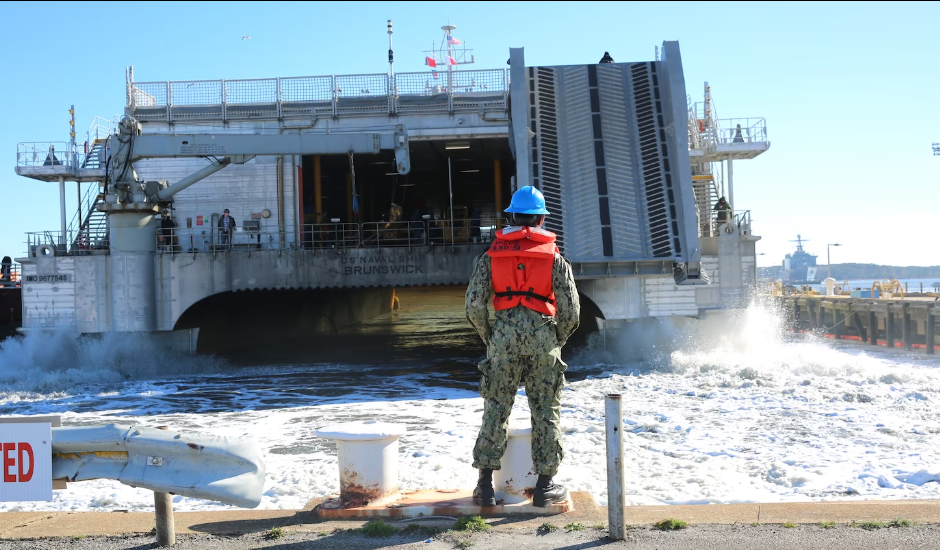
Military Sealift Command’s sixth expeditionary fast transport vessel USNS Brunswick shifted its hub port in Saipan to Joint Expeditionary Base Little Creek – Fort Story, Virginia, Feb. 3.
NORFOLK, Va. ꟷ Military Sealift Command’s sixth expeditionary fast transport vessel USNS Brunswick (T-EPF 6) shifted its hub port in Saipan to Joint Expeditionary Base Little Creek – Fort Story, Va., Feb. 3. The evolution signified the completion of a seven-year forward deployment that began Jan. 30, 2017, in support of military logistics operations in U.S. 7th, 5th, and 3rd Fleets’ areas of operation.
While steaming more than 21,600 nautical miles in support of a variety of high visibility, multinational U.S. Navy and partner nation operations in several Pacific countries, including Australia, Canada, Japan, Malaysia, Peru, the Philippines, South Korea, Thailand, and the United Kingdom, Brunswick circumnavigated the globe, a first for the vessel and a first for an EPF.
Built for its speed and its capacity to support a wide range of operational maneuver and sustainment, relief operations in small or damaged ports, global fleet stations operations, flexible logistics support and rapid transport as an alternative to airlift, Brunswick’s performance remained rock-solid throughout its seven-year deployment.
2017
While supporting military logistics operations in U.S. 3rd Fleet, Brunswick participated in Operation Triggerfish 2017, conducted several port calls to Pohnpei and Chuuk in the Federated States of Micronesia and Guam, and hosted distinguished visitors such as Robert Riley, U.S. ambassador to Micronesia. This vital cargo and passenger operation fostered relationships with the islands visited and provided potential sites for future military infrastructure projects.
2018
Brunswick operated from Saipan in support of military operations throughout the western Pacific Ocean in 2018. While there, Brunswick visited places such as Guam, Yap, Thailand and Malaysia as part the 2018 Pacific Partnership, an annual mission focused on disaster preparedness and humanitarian assistance, conducted in the Indo-Pacific with more than 500 personnel from several Pacific countries, including Australia, Canada, Japan, Malaysia, Peru, the Philippines, South Korea, Thailand and the United Kingdom. The EPF also participated in several port visits to Lumut and Kuching and Malaysia. The crew took advantage of the opportunity to experience Malaysia’s rich culture and strengthen ties with the local population. Port visits such as these serve as an important element in the U.S. Navy’s theater security cooperation efforts by enhancing solid relationships with partner nations throughout the region.
2019
In addition to participating in its second Pacific Partnership in 2019, Brunswick, together with sister ship Fall River (T-EPF 4), conducted engineering projects, hosted medical events, and oversaw humanitarian assistance and disaster response training exercises throughout the pacific region.
EPFs, working together, bridge the gap between high-speed, low-capacity airlift, low-speed, and high-capacity sealift in order to provide for the movement of personnel, equipment, and supplies over operational distances and the sustainment of joint theater and multinational logistics that help to augment MSC’s combat logistics force. Additionally, Brunswick docked in the Lower Mortlock Islands to support local communities recovering from the aftermath of Typhoon Wutip, a Category 5 super typhoon that affected Guam, Federated States of Micronesia and the Northern Mariana Islands. The typhoon claimed the lives of 86 people and injured hundreds of others.
2020
The Brunswick crew was recognized in 2020 for their extraordinary support and contributions to the Typhoon Wutip relief efforts. U.S. Maritime Administration Administrator Rear Adm. (Ret.) Mark H. Buzby presented the crew with the Merchant Marine Medal for Outstanding Achievement. In addition, Brunswick supported the Valiant Shield 2020, a joint force training exercise to protect the Indo-Pacific. During the exercise, more than 11,000 Soldiers, Marines, Sailors, and Airmen synchronized to train in a real-world environment to demonstrate their readiness to respond to any contingency at a moment’s notice.
2021
Brunswick took part in Noble Jaguar, in 2021, an integrated naval exercise in and around Japan that included units from the III Marine Expeditionary Force (III MEF), along with elements of U.S. 7th Fleet.
2022
Brunswick, along with sister ships USNS Millinocket (T-EPF 3) and USNS Puerto Rico (T-EPF 11), in 2022, supported the CARAT exercise, Resolute Dragon, Koa Moana, Valiant Shield, and various other regional security cooperation exercises for III MEF.
2023
The expeditionary fast transport vessel played an instrumental role in exercises Talisman Sabre, Balikatan, Keen Sword and Kamandag for III MEF in 2023. Marines and other members of the U.S. military routinely embark on ships like Brunswick to transport cargo, equipment, and personnel expeditiously. Likewise, Brunswick supported I MEF for three months during its Marine Rotational Force – Southeast Asia deployment. EPFs provide warfighters flexibility as the ship’s storage capacity can be tailored to meet mission objectives.
While in U.S. 5th Fleet, Brunswick accomplished a humanitarian assistance mission that resulted in the movement of 836 evacuees from 18 nations, including 168 U.S. citizens, from the Port of Sudan to Jeddah, Saudi Arabia in support of the Department of State’s efforts to evacuate and assist U.S. citizens and other civilians during the civil war in Sudan.
Throughout this seven-year deployment, the superb work performed by the Brunswick crew helped to improve interoperability and foster trust and cooperation with partner nations, all of which is in keeping with the Navy’s goal to enhance regional preparedness for crisis response.
MSC operates approximately 120 non-combatant civilian-crewed ships that replenish U.S. Navy ships, conduct specialized missions, and strategically preposition combat cargo at sea around the world while moving military cargo and supplies used by deployed U.S. forces and coalition partners.
To learn more about MSC visit: https://sealiftcommand.com.
USS Farragut Returns Home Following Successful SOUTHCOM Deployment
NAVAL STATION MAYPORT, Florida ꟷ Farragut, along with the “Valkyries” of Helicopter Maritime Strike Squadron (HSM) 50 Det 2 deployed in September 2023 to support Joint Interagency Task Force (JIATF)-South’s counter-narcotics operations in the Caribbean Sea.
During the deployment, Farragut, with her embarked U.S. Coast Guard Law Enforcement Detachment (LEDET), apprehended or disrupted an estimated 1,770 kilograms of cocaine worth an estimated street value of more than $44 million and the detention of 18 suspected illicit drug runners.
“Every Sailor and Coast Guardsmen had a role in this team effort,” said Farragut Commanding Officer Cmdr. Tom Roberts. “We, alongside allies and partners, seized the opportunity to advance regional and strategic objectives in the area of operations, supporting our nation and our Navy. I could not be more proud of our team and their accomplishments.”
Farragut, the LEDET, and HSM 50 Det 2 conducted operations with the Dominican Navy and British Royal Navy to assist with the apprehension and transfer of personnel and cargo. Farragut also conducted deck landing qualifications with Joint Task Force Bravo (JTF-B) Soldiers, qualifying 18 UH-60A Black Hawk helicopter pilots for maritime operations.
Farragut’s port visits included Willemstad, Curacao, where the ship hosted local students and military personnel to showcase the capabilities of Farragut and discuss the daily lives of Sailors onboard a U.S. naval warship.
“The crew of USS Farragut demonstrated tremendous proficiency and professionalism while executing theater security cooperation events and counter illicit trafficking operations throughout their extended 4-month deployment.” said Capt. Bryan Gallo, Commodore of Task Force FOUR FIVE.
CTF 45 is the U.S. 4th Fleet surface task force charged with executing combined naval operations, building and strengthening regional maritime partnerships, and acting as a DoD-ready service provider to JIATF-South in support of counter-illicit trafficking operations in Central and South American waters.
U.S. Naval Forces Southern Command/U.S. 4th Fleet is the trusted maritime partner for Caribbean, Central and South America maritime forces leading to improved unity, security and stability.