U.S. Navy deployment puts Leidos autonomy on display
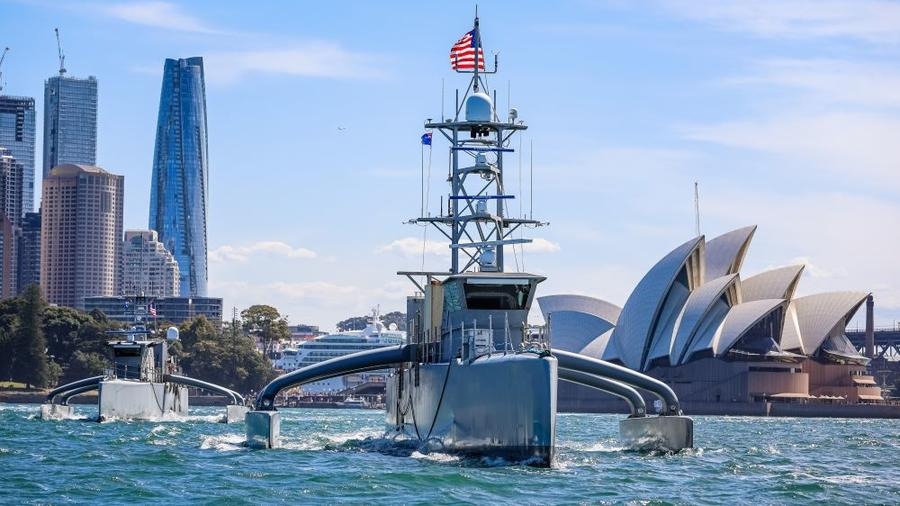
Unmanned surface vessel Seahawk arrives at Sydney Harbor as part of Integrated Battle Problem 23.2. Photo: U.S. Navy/Ensign Pierson Hawkins 

Release from Leidos

***** 

November 28, 2023 

A U.S. Navy task group including four unmanned surface vessels (USVs) reached Sydney Harbor late last month after crossing the Pacific Ocean for the first time and visiting several western Pacific ports

Each of the fleet’s unmanned vessels (Seahawk, Sea Hunter, Ranger and Mariner) are designed and outfitted with state-of-the-art Leidos autonomy technology. 

The deployment, named Integrated Battle Problem (IBP) 23.2, marks a number of historic milestones in naval autonomy. 

Retired U.S. Navy Vice Admiral David Lewis, Leidos Sr. Vice President for Maritime Operations, said it’s the first time these vessels have operated together as a task group, traveled beyond Hawaii, crossed the International Date Line, crossed the Equator and visited a Western Pacific foreign port. 

Before IBP 23.2, they operated extensively in the Caribbean Sea and Panama Canal and on numerous Eastern Pacific tours. 

Lewis said he sees many comparisons to President Theodore Roosevelt’s voyage of the Great White Fleet, a group 16 U.S. Navy battleships that sailed around the world from 1907-1909 in a display of American naval power. 

  • “In many ways, this deployment is showing the world that the U.S. Navy has embraced autonomy, the next generation of maritime high technology,” he said. “This isn’t just a few ships out on a short cruise. This deployment brings together autonomy and multidomain task group operations. I see it as the operational debut of 21st century American technology on the world stage, which is what the Great White Fleet represented in its day.” 

Lewis added that the deployment signals a transition of advanced technology out of the laboratory and prototype stages and into the heart of today’s most stressing maritime operational environment, the Western Pacific. 

Gerry Fasano, Leidos Defense Group President, emphasized the significance of USVs actively enhancing the fighting envelope of U.S. Navy surface combatants in an organized Surface Action Group. 

  • “The integration of autonomous surface vessels with manned combatants on display in this deployment will give fleet commanders much-needed enhancements to maritime domain awareness, accelerating the speed and lethality of existing maritime kill chains,” says Fasano. 

An historic learning opportunity: Lewis said the deployment will reveal a lot about how autonomous vessels operate on deployment. 

  • “We have significant knowledge about cruisers, destroyers and submarines, which we’ve deployed for decades,” he said, “but when you do things you’ve never done before, like deploy a Surface Action Group of autonomous warships across the vast Pacific, unexpected things will happen, and that’s the point. We’re going to learn a lot, and that’s a very good thing.” 

Lewis also emphasized the importance of cohesive and continuous maintenance for autonomous systems to support naval operations. 
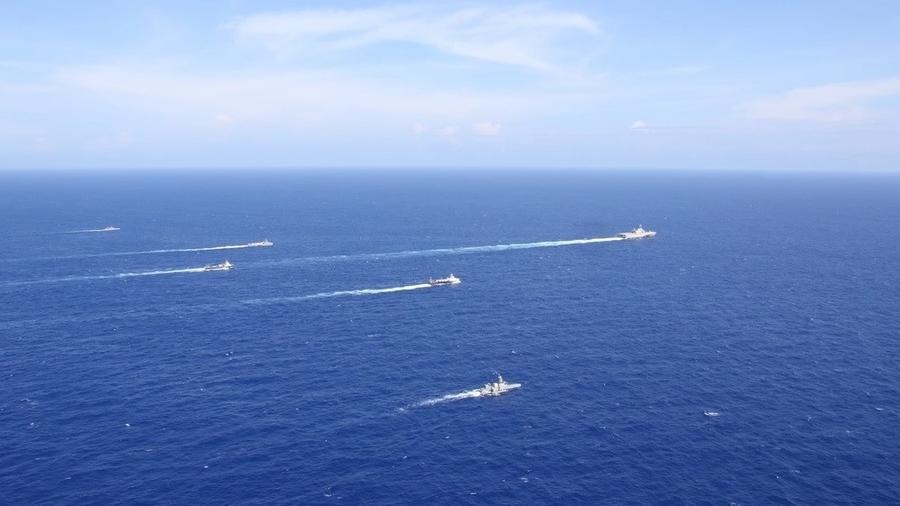
The task group of IBP 23.2 crossing the Pacific Ocean. Photo: U.S. Navy/Ensign Pierson Hawkins

Ray Sheldon, Gibbs & Cox President, said before the deployment, Ranger and Mariner had logged nearly 100,000 miles in supervised autonomy near U.S. shores. 

“The Western Pacific has some of the roughest seas in the world,” says Sheldon, “so they’re being put to the test like never before. They’re being asked to operate dependably over a great deal of sheer distance and operational time. All four vessels have a remarkably high reliability record, but not necessarily when exposed to rough waters on the high seas, and that can make a big difference. It’s a harsher operating environment than anything we’ve tested, but these are the types of conditions we’ve been preparing for.” 
Dan Brintzinghoffer, Leidos Vice President and Division Manager in the Leidos Maritime Business, said that because the deployment will last for several months, his team has positioned hundreds of spare parts aboard Ranger and Mariner. 

“Whether it’s harsh operating conditions, severe weather or other mission factors, it’s safe to say we will learn a lot during the extended time at sea,” says Brintzinghoffer. “We know we will experience individual systems issues and learn from those occurrences. The question is, as you stress the system of systems, how do the vessels respond? Normally, there is crew onboard to assist if there are any system issues, but this assistance now must come in the form of an autonomous or semi-automated response. We believe we have the right parts, technology and software in place to keep system availability high.” 
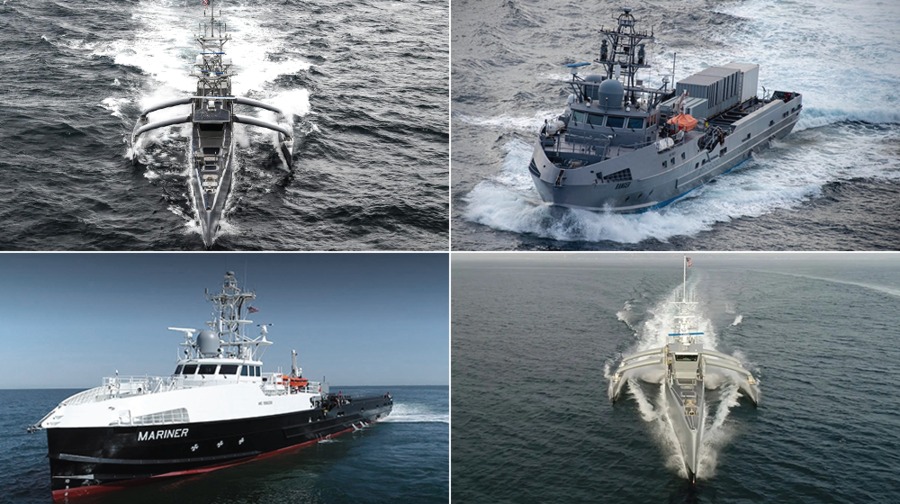
Clockwise from top left: Unmanned surface vessels Seahawk, Ranger, Sea Hunter and Mariner. Photos: Leidos

Meet the fleet: Sea Hunter, a fully autonomous vessel, was the first of the four ships to be completed in 2015. In 2019, Fortune called Sea Hunter “the first of a new class of warships that use artificial intelligence in place of a crew.” 

Seahawk, also fully autonomous, was the second. Like Sea Hunter, Leidos designed Seahawk to be completely autonomous from the hull up. The company supervised construction of the vessel, which joined the Navy’s Surface Development Squadron One in 2021. 

“Seahawk and Sea Hunter are autonomous down to the pump, motor and engine, capable of self-reconfiguration and decision-making about how to operate apart from human guidance,” says Lewis. 
Ranger, a large semi-autonomous platform, is a fast supply vessel (FSV) converted to operate autonomously by Leidos subsidiary Gibbs & Cox. Leidos purchased Ranger partially completed, selected the shipyard and oversaw the reconstruction effort. 

Mariner, also semi-autonomous, is the newest ship in the fleet, a converted FSV that incorporates lessons learned from Ranger into its mechanical and electrical designs to make them more reliable and conducive to autonomy. 

“Ranger and Mariner, while not as autonomous as Seahawk and Sea Hunter, can navigate effectively without a crew, but because they weren’t originally designed for autonomy, they aren’t quite at the same level,” said Lewis. “However, these are platforms with substantial capacity. They’ve done surveillance missions, but they also have the potential to be weapons platforms.” 

Looking ahead: Beyond the deployment, Lewis sees fully autonomous mission planning as the ultimate form of naval autonomy. 

“If the vessel was on a wartime mission and took damage or encountered severe weather, for example, the truly autonomous ship can replan itself to carry out the mission despite damage or equipment casualties without human reprogramming,” he said. “That’s a huge challenge, and it’s something we’re working on implementing every day at Leidos.” 


USS Paul Ignatius (DDG 117) Completes Second Forward-Deployed Naval Forces-Europe Patrol

Release from Commander, U.S. 6th Fleet 

Dec. 1, 2023 

By Ensign Karolyn Batista, USS Paul Ignatius Public Affairs Officer 

ROTA, Spain  –  The Arleigh Burke-class guided-missile destroyer USS Paul Ignatius (DDG 117) returned to Rota, Spain, on November 28, 2023, following a six-month deployment throughout the U.S. Naval Forces Europe-Africa (NAVEUR-NAVAF) and U.S. Sixth Fleet area of operations and marking the completion of its second Forward-Deployed Naval Forces-Europe (FDNF-E) patrol. 

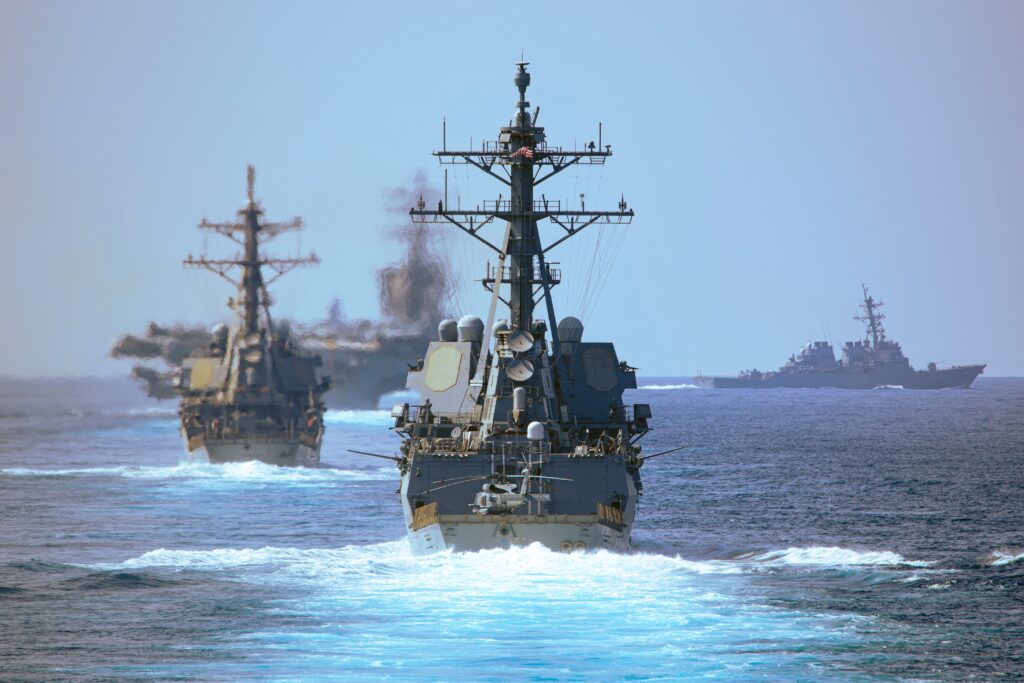
During their extended deployment, USS Paul Ignatius Sailors participated in various critical missions aimed at deterrence, safeguarding national security interests, and promoting global stability. The ship participated in various port visits, exercises, bilateral and multinational operations throughout the European and African theaters, contributing to maritime security and defense cooperation. Most recently, the ship integrated into the Gerald R. Ford Carrier Strike Group currently deployed to the eastern Mediterranean Sea. 

Under the leadership of commanding officer Cmdr. Corry Lougee, Paul Ignatius’ crew displayed professionalism, expertise, and unwavering commitment to their mission, country, and allies and partners throughout their deployment. 

“From conducting maritime exercises and missions in the Baltic Sea to extended operations in the Eastern Mediterranean Sea and providing a strong deterrence, this crew gave 117% effort and finished our patrol strong,” said Lougee. “Getting extended on deployment can be tough for the crew and our families, but our time under the Gerald R. Ford Carrier Strike Group brought us closer together as a team, and our mission and sense of purpose was clear.” 

Paul Ignatius completed a demanding and unpredictable deployment, exemplifying the U.S. Navy’s steadfast commitment to ensuring the safety and security interests of our nation, our allies, and our partners. 

Family and friends warmly greeted the ship’s arrival and its Sailors. The reunion was a joyous occasion, celebrating not only the safe return home Paul Ignatius but also the significant and historic contributions the crew made. 

Four U.S. Navy destroyers, including Paul Ignatius, are based in Rota, Spain and are assigned to Commander, Task Force 65 in support of NATO’s Integrated Air Missile Defense architecture. These FDNF-E ships have the flexibility to operate throughout the waters of Europe and Africa, from the Cape of Good Hope to the Arctic Circle, demonstrating their mastery of the maritime domain. 

For more than 80 years, NAVEUR-NAVAF has forged strategic relationships with our Allies and partners, leveraging a foundation of shared values to preserve security and stability. 

Headquartered in Naples, Italy, NAVEUR-NAVAF operates U.S. naval forces in the U.S. European Command (USEUCOM) and U.S. Africa Command (USAFRICOM) areas of responsibility. U.S. Sixth Fleet is permanently assigned to NAVEUR-NAVAF and employs maritime forces through the full spectrum of joint and naval operations. 


Canada Selects Boeing’s P-8A Poseidon as its Multi-Mission Aircraft

Release from Boeing 

***** 

• Partnership with Canadian industry will deliver long-term economic prosperity to Canada 
• With the P-8, Canada secures NORAD and Five Eyes allied interchangeability 
• First deliveries expected in 2026 
 
ARLINGTON, Va., Nov. 30, 2023 /PRNewswire/ — The Government of Canada has signed a Foreign Military Sales Letter of Offer and Acceptance for up to 16 Boeing P-8A Poseidon aircraft as part of the Canadian Multi-Mission Aircraft project. Canada joins eight defense partners, including all of the Five Eyes allies, the intelligence alliance that also includes the United States, United Kingdom, Australia, and New Zealand, and becomes the fifth NATO nation to have selected the P-8 as its multi-mission aircraft. First delivery is expected in 2026. 
 
“The P-8 will bolster Canada’s defense capability and readiness and we look forward to delivering this capability to the Royal Canadian Air Force,” said Heidi Grant, president, Business Development for Boeing Defense, Space & Security. “Together with our Canadian partners, we will deliver a strong industrial and technological benefit package that guarantees continued prosperity to Canada’s aerospace and defense industry.” 
 
The P-8 is the only proven, in-service, and in-production solution that meets all CMMA requirements, including range, speed, endurance, and payload capacity. This decision will benefit hundreds of Canadian companies and bring decades of prosperity to Canada through platform sustainment delivered by our Canadian industry partners. 
 
The P-8 acquisition will generate benefits of nearly 3,000 jobs and $358 million annually in economic output to Canada, according to a 2023 independent study by Ottawa-based Doyletech Corporation. 
 
“This is a very important day for the Royal Canadian Air Force and for Boeing,” said Charles “Duff” Sullivan, managing director, Boeing Canada. “The P-8 offers unmatched capabilities and is the most affordable solution for acquisition and life-cycle sustainment costs. There’s no doubt the P-8 will protect Canada’s oceans and its borders for future generations.” 
 
Team Poseidon forms the cornerstone of Boeing’s P-8 Canadian industry partnership, consisting of CAE, GE Aviation Canada, IMP Aerospace & Defence, KF Aerospace, Honeywell Aerospace Canada, Raytheon Canada, and StandardAero. The team builds on the existing 81 Canadian suppliers to the P-8 platform and to more than 550 Boeing suppliers across all provinces contributing to the company’s annual ~CAD $4 billion in economic benefit to Canada, supporting more than 14,000 Canadian jobs. 
 
With more than 160 aircraft delivered or in service, and 560,000 collective flight-hours, the P-8 has proven capabilities for anti-submarine warfare; anti-surface warfare; intelligence, surveillance, and reconnaissance; and humanitarian assistance/disaster relief response. 
 
As a leading global aerospace company, Boeing develops, manufactures and services commercial airplanes, defense products, and space systems for customers in more than 150 countries. As a top U.S. exporter, the company leverages the talents of a global supplier base to advance economic opportunity, sustainability, and community impact. Boeing’s diverse team is committed to innovating for the future, leading with sustainability, and cultivating a culture based on the company’s core values of safety, quality, and integrity. 


GA-ASI AND USMC COMPLETE FIRST MQ-9A WTI TRAINING CLASS

Release rom GA-ASI 

***** 

MAWTS-1 Graduates Will Be Employed as MQ-9A Experts  

SAN DIEGO – 30 November 2023 – General Atomics Aeronautical Systems, Inc. (GA-ASI) and the U.S. Marine Corps (USMC) teamed up to conduct flight training for Marines that was completed on Oct. 29, 2023. The seven-week course on the operation of MQ-9A Block 5 Unmanned Aircraft System was given to Marine Aviation Weapons and Tactics Squadron One (MAWTS-1) at Marine Corps Air Station Yuma, Arizona. The students participated in Weapons and Tactics Instructor (WTI) Course 1-24, which is a comprehensive course designed for selected pilots and enlisted aircrew that incorporates Marine Corps planning along with implementation of advanced air and ground tactics.  

WTI, recognized as an advanced, graduate-level program, provided standardized, advanced tactical training, and played a crucial role in developing and employing aviation weapons and tactics both over land and in maritime environments. The Marines were trained using a GA-ASI-supplied MQ-9A, and the graduates of WTI will now go on to be the experts in MQ-9A Block 5 employment in their squadrons.  

The training is a critical part of the Marine Air-Ground Task Force (MAGTF) Unmanned Expeditionary (MUX) Medium-Altitude, High-Endurance (MALE) program meeting Full Operational Capability (FOC). GA-ASI is a committed partner in helping the USMC meet this critical program milestone.  

“We congratulate the new graduates of WTI and Semper Fi,” said GA-ASI Vice President of DoD Strategic Development Patrick Shortsleeve. “GA-ASI is proud to support the training of the MAWTS-1 aircrews in the use and utility of the MQ-9A platform.” 

Renowned for its fault-tolerant flight control system and triple-redundant avionics system architecture, the MQ-9A UAS embodies the industry’s highest standards of reliability and performance, surpassing those of many manned aircraft.  

GA-ASI has delivered nine MQ-9A UAS to the USMC so far. Four of these MQ-9A aircraft are actively engaged in operational missions, playing a vital role in supporting mission-critical Marine Corps objectives. The USMC awaits delivery of 11 additional aircraft, which will fulfill their goal of three squadrons by 2025. 


Navy to Christen Amphibious Assault Ship Bougainville

Release from the U.S. Department of Defense 

***** 

Dec. 1, 2023  

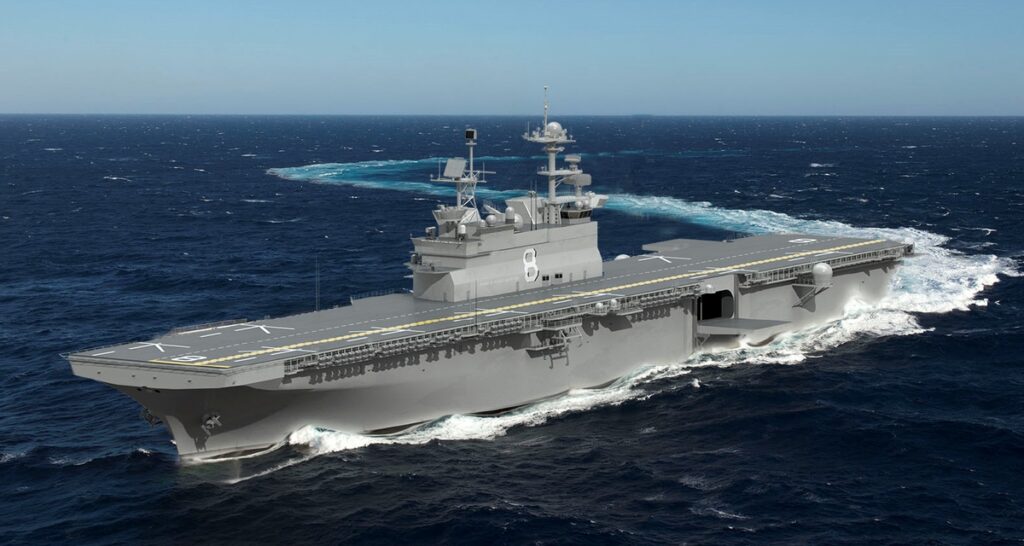
The Navy will christen its newest America-class amphibious assault ship, the future USS Bougainville (LHA 8), during a 9 a.m. CST ceremony Saturday, Dec. 2, in Pascagoula, Mississippi. 

Under Secretary of the Navy Eric Raven will deliver the christening ceremony’s principal address. Remarks will also be provided by Vice Adm. Del Crandall Jr., Judge Advocate General of the Navy, Maj. Gen. James H. Adams III and Mrs. Kari Wilkinson, Executive Vice President of HII and President of Ingalls Shipbuilding. The ship’s sponsor is Mrs. Ellyn Dunford, wife of Gen. Joseph F. Dunford Jr., USMC (Ret.), 19th Chairman of the Joint Chiefs of Staff and 36th Commandant of the Marine Corps. 

Bougainville is the third ship of the America-class of amphibious assault ships built to facilitate forward presence and power projection. LHA 8 is the first Flight I ship of the America-class with a reincorporated well deck to increase operational flexibility while maximizing the aviation capability inherent on the Flight 0 ships, USS America (LHA 6) and USS Tripoli (LHA 7).  

Designed to support the Marine Corps tenets of Operational Maneuver from the Sea and Ship to Objective Maneuver, America class ships are capable of rapid combat power buildup ashore. The America class also accommodates the Marine Corps’ Air Combat Element including F-35B Joint Strike Fighter and MV-22 Osprey, essential to maintaining power projection, air superiority and theater logistics.   

LHA 8 is the second Navy ship to be named Bougainville. The name honors and commemorates the site of a major World War II campaign during which Navy and Marine Corps forces captured the Island of Bougainville, isolating Japan’s Rabaul air base and assisting in providing an advantage to the Allied forces.  

The ceremony will be live streamed at: https://youtube.com/live/H-NPeY_NZ_I?feature=share and https://fb.me/e/3QC53JWbD. The links becomes active approximately 30 minutes prior to the event at 9:50 a.m. CST. 

Media may direct queries to the Navy Office of Information at (703) 697-5342. More information on the amphibious assault ship program can be found at: https://www.navy.mil/Resources/Fact-Files/Display-FactFiles/Article/2169814/amphibious-assault-ships-lhdlhar/ 


Navy to Christen Amphibious Assault Ship Bougainville

Release from the U.S. Department of Defense 

***** 

Dec. 1, 2023  

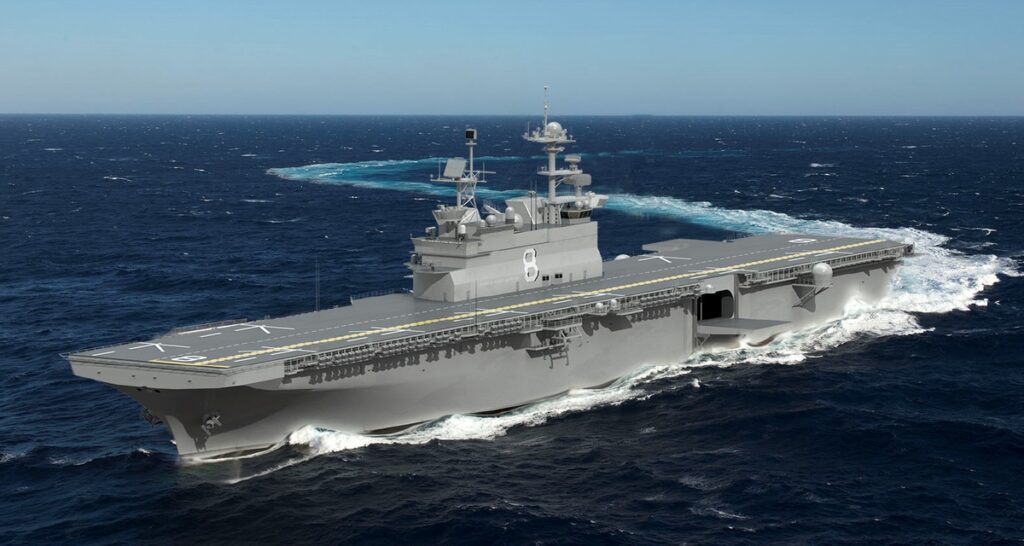
The Navy will christen its newest America-class amphibious assault ship, the future USS Bougainville (LHA 8), during a 9 a.m. CST ceremony Saturday, Dec. 2, in Pascagoula, Mississippi. 

Under Secretary of the Navy Eric Raven will deliver the christening ceremony’s principal address. Remarks will also be provided by Vice Adm. Del Crandall Jr., Judge Advocate General of the Navy, Maj. Gen. James H. Adams III and Mrs. Kari Wilkinson, Executive Vice President of HII and President of Ingalls Shipbuilding. The ship’s sponsor is Mrs. Ellyn Dunford, wife of Gen. Joseph F. Dunford Jr., USMC (Ret.), 19th Chairman of the Joint Chiefs of Staff and 36th Commandant of the Marine Corps. 

Bougainville is the third ship of the America-class of amphibious assault ships built to facilitate forward presence and power projection. LHA 8 is the first Flight I ship of the America-class with a reincorporated well deck to increase operational flexibility while maximizing the aviation capability inherent on the Flight 0 ships, USS America (LHA 6) and USS Tripoli (LHA 7).  

Designed to support the Marine Corps tenets of Operational Maneuver from the Sea and Ship to Objective Maneuver, America class ships are capable of rapid combat power buildup ashore. The America class also accommodates the Marine Corps’ Air Combat Element including F-35B Joint Strike Fighter and MV-22 Osprey, essential to maintaining power projection, air superiority and theater logistics.   

LHA 8 is the second Navy ship to be named Bougainville. The name honors and commemorates the site of a major World War II campaign during which Navy and Marine Corps forces captured the Island of Bougainville, isolating Japan’s Rabaul air base and assisting in providing an advantage to the Allied forces.  

The ceremony will be live streamed at: https://youtube.com/live/H-NPeY_NZ_I?feature=share and https://fb.me/e/3QC53JWbD. The links becomes active approximately 30 minutes prior to the event at 9:50 a.m. CST. 

Media may direct queries to the Navy Office of Information at (703) 697-5342. More information on the amphibious assault ship program can be found at: https://www.navy.mil/Resources/Fact-Files/Display-FactFiles/Article/2169814/amphibious-assault-ships-lhdlhar/ 


Combined Multinational Effort Averts Attempted Seizure in the Gulf of Aden

Release from U.S. Naval Forces Central Command Public Affairs  

***** 

By U.S. Naval Forces Central Command Public Affairs | November 30, 2023 

MANAMA, Bahrain – A combined naval effort between multiple nations thwarted an attempted seizure of an oil tanker in the Gulf of Aden, Nov. 26. 

The Arleigh Burke-class guided-missile destroyer USS Mason (DDG 87) assigned to Task Force (TF) 55, a P8 patrol and reconnaissance aircraft from TF-57, a Japan Maritime Self-Defense Force destroyer JS Akebono (DD 108), a JMSDF P-3C maritime surveillance aircraft, and the Republic of Korea Navy destroyer ROKS Yang Man-chun (DDH 973), all working with Combined Maritime Forces’ Philippine-led Combined Task Force (CTF) 151, responded to reports of a seizure of the M/V Central Park, an oil tanker, as the ship was transiting in international waters. 

Working in coordination with U.S. Naval Forces Central Command, the aircraft kept a watchful eye on events until surface units could converge on Central Park’s location. After several hours the perpetrators, unable to gain control of the ship, abandoned the vessel and attempted to escape on their skiff. 

Tracking their movements, the international force cornered the skiff and the individuals surrendered to Sailors from Mason and were taken into custody in accordance with international law. 

“This was an international effort and the textbook definition of teamwork,” said Vice Adm. Brad Cooper, NAVCENT commander. “We remain deeply committed to ensuring maritime security to support the free flow of commerce and safe navigation.” 

U.S. Naval Forces Central Command/U.S. 5th Fleet’s area of operations encompasses about 2.5 million square miles of water area and includes the Arabian Gulf, Red Sea, Gulf of Oman, Gulf of Aden, Arabian Sea and parts of the Indian Ocean. This expanse, comprising 21 nations, includes three critical choke points at the Strait of Hormuz, the Suez Canal and the Strait of Bab al Mandeb. 


USCGC Frederick Hatch concludes historic patrol with engagements in the Philippines, fisheries enforcement in Republic of Palau, Papua New Guinea

Release from U.S. Coast Guard Forces Micronesia/Sector Guam 

***** 

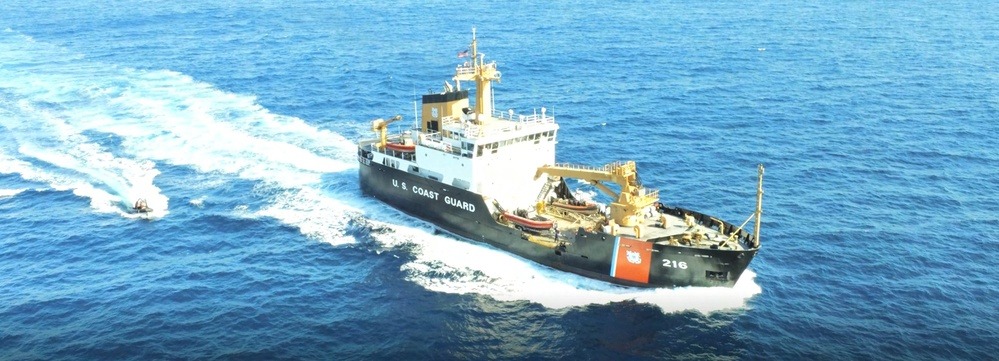
SANTA RITA, Guam — The USCGC Frederick Hatch (WPC 1143) successfully concluded a routine 47-day expeditionary patrol covering more than 8,200 nautical miles under Operation Blue Pacific, returning to Guam on Thanksgiving, distinguished by a series of historic and strategic engagements across the Western Pacific and Oceania. 
 
“USCGC Frederick Hatch’s highly successful patrol is a testament to the diligence and expertise of the crew onboard, always remaining positive and overcoming numerous challenges to continually set the standard for Coast Guard operations in the Pacific. Their efforts to keep our equipment functioning properly, go over the rail regularly for boardings, and cook meals in heavy seas is what makes the U.S. Coast Guard’s commitment to the Indo-Pacific region so strong. Our people are the best at what they do and always ready to go above and beyond when asked, which is the basis for being a trusted partner and fostering strong international alliances,” said Lt. Patrick Dreiss, commanding officer of the Frederick Hatch.  
 
Historic First Visit to Tacloban, Philippines 
A highlight of the patrol was Frederick Hatch’s historic visit to Tacloban, Philippines, in mid-October, marking a significant milestone in U.S.-Philippines relations. The visit coincided with the 79th anniversary of the Battle of Leyte Gulf. In addition to the commemoration observance, the crew engaged in various activities, including a maritime law enforcement exchange supported by U.S. Coast Guard Maritime Security and Response Team West, community interactions, including a visit with the mayor, and cultural immersion. 
 
Maritime Security and Fisheries Patrol 
The second half of the patrol focused on countering illegal fishing and enhancing partnerships in the Republic of Palau and Papua New Guinea. While en route to Palau, the crew conducted critical observation reports highlighting potential threats to maritime governance and fishery management. These reports included observations of four Philippine-flagged fishing vessels at the boundary of Palau’s Exclusive Economic Zone (EEZ) and the high seas, with one vessel within the Palauan EEZ when detected. Notably, these vessels needed permits to operate under the Western and Central Pacific Fisheries Commission (WCPFC) on the high seas or Palau EEZ, and their Philippine permits expired. Their presence and activities represent potential serious violations under the WCPFC regulations. 
 
The following day, the crew reported two additional Philippine-flagged vessels fishing without permits in WCPFC-governed waters again near the Palau EEZ, adding to the count of serious violations. Following a port call in Palau on a subsequent patrol of the Palau EEZ, the crew identified only one vessel actively fishing, recently boarded, and detected no further unauthorized incursions. In response to a request from the Palau Joint Operations Center, the crew also disposed of two fish aggregating devices found within the Palau EEZ, addressing concerns over illegal local fishing practices. 
 
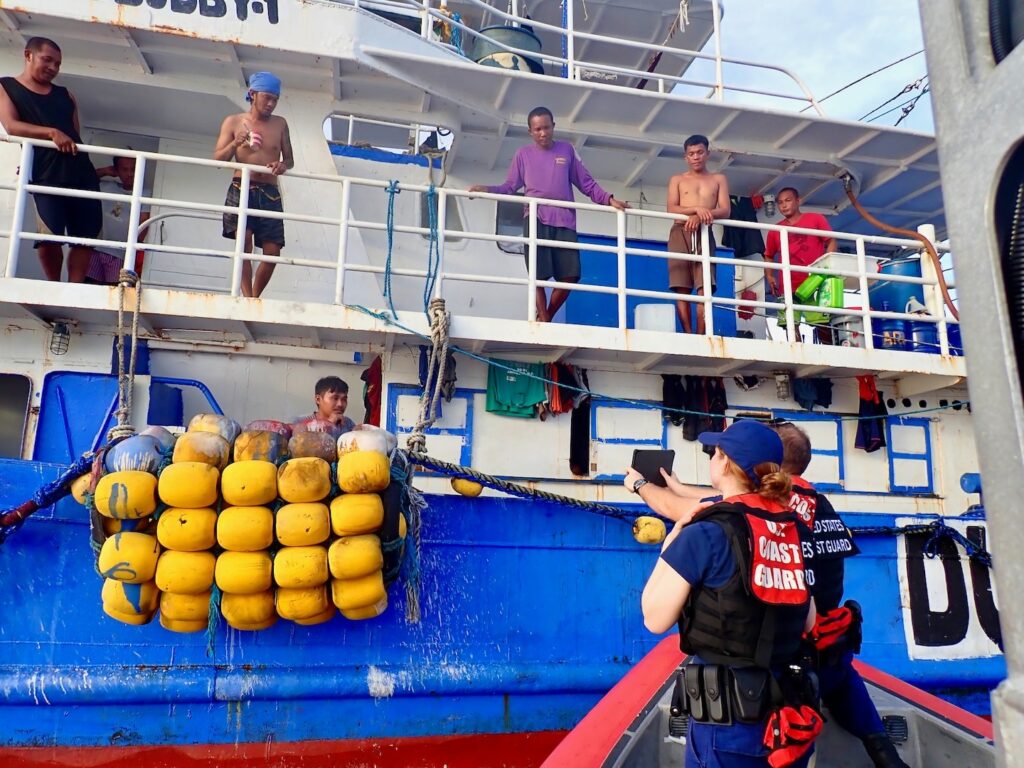
While en route to Papua New Guinea (PNG), Frederick Hatch’s crew conducted one boarding on the high seas under WCPFC authority, reporting three potential violations. The crew then welcomed two PNG boarding officers, one from the Customs Services and one from the National Fisheries Authority, and together, they conducted nine additional PNG-led boardings within their EEZ under the bilateral maritime law enforcement agreement. These boardings undertaken in the eastern EEZ resulted in 16 issued violations and two warnings, addressing a range of issues such as exceeding crew occupancy limits based on available berthing, improper crew compositions due to a lack of required PNG crew expired seafarers’ credentials, and poor vessel markings. The vessels’ flags include the People’s Republic of China, Vanuatu, and the Philippines.  
 
“This proactive enforcement and monitoring underscore the importance of upholding good maritime governance and preserving sustainable fishing practices, critical for the ecological and economic health of the region,” said Capt. Nick Simmons. “The relationships we’re building in Oceania and the Western Pacific are crucial for our continued commitment to our allies. This patrol exemplifies our dedication to maintaining stability and security in these waters.” 
 
Engagement and Cooperation in Papua New Guinea 
Frederick Hatch’s visit to Papua New Guinea (PNG) exemplified increased bilateral defense and security cooperation, as highlighted by the recent signing and ratification of the Defense Cooperation Agreement. The crew’s interactions with PNG fisheries, customs officers, and the local community underscore the ongoing effort to strengthen regional relationships. 
 
“This patrol was our crew’s first time working with PNG Customs and Fisheries, and we look forward to working with them again in the future. Thank you to our two shipriders, Mr. Roger Sivlanduo and Mr. Jeremy Nelson, both skilled professionals and great people to have onboard to enrich the relationship between our agencies. It was an important opportunity to learn from each other and develop new tactics to address the IUU-F threat throughout Melanesia in the future while also carrying out several very successful boardings counteracting those threats in the present,” said Dreiss. 
 
Support from DOL-X Team 
The U.S. Coast Guard’s newly created DOL-X team was pivotal in supporting the Frederick Hatch’s logistics, including repairs and maintenance, ensuring the cutter’s operational readiness throughout the patrol. The team met the cutter during two port calls, hand-carrying critical parts to address casualties and augmenting the cutter’s engineers to repair the issues.  
 
About the U.S. Coast Guard in the Pacific Region: 
The U.S. Coast Guard is vital to ensuring maritime safety, security, and stewardship across a vast Pacific expanse, spanning six continents, 71 countries, and 74 million square miles of ocean. U.S. Coast Guard Pacific Area leads coordination and integration efforts in this vast region, promoting collaboration with partners through the actions of the U.S. Coast Guard 14th District and U.S. Coast Guard Forces Micronesia/Sector Guam teams.  
 
The Frederick Hatch is the 43rd 154-foot Sentinel-class fast response cutter named for a surfman and lighthouse keeper who was a two-time Gold Life Saving Medal recipient. They regularly patrol Oceania, fostering international cooperation and supporting maritime safety, security, and stewardship. 


USCGC Alder returns to home port after conducting first high-seas boardings off the coast of Peru, under new SPRFMO measure

Release from U.S. Coast Guard District 11 

***** 

Nov. 29, 2023 

ALAMEDA, Calif. — The crew of the Coast Guard Cutter Alder, along with the crews of the Terrell Horne and an HC-130 Hercules aircraft recently completed the first high-seas boardings and inspections, in the Eastern Pacific Ocean, under a newly adopted conservation and management measure to monitor and inspect fishing and supply vessel operations at-sea in the South Pacific Regional Fisheries Management Organization (SPRFMO) Convention Area.  

The crew of the Alder performed many new operations that took them south of the equator, where they would participate in SPRFMO inspections, conducting boardings and overflights within the SPRFMO Convention Area on the high seas off the coast of Peru. For years, the Coast Guard has executed counter-illegal, unreported, and unregulated (IUU) fishing operations and participated in high seas boarding and inspections (HSBI) around the globe. This operation was significant as it was timed to implement newly adopted rules in the SPRFMO Convention Area, which comprises nearly a quarter of the Earth’s high seas. The SPRFMO Commission consists of 17 members from Asia, Europe, the Americas, and Oceania, as well as two cooperating non-contracting parties. 

The Alder crew also conducted counter narcotics operations, trained two crew members for aerial drone missions launched from the cutter, and sailed with four small boats attached to maintain maximum operational capability during the patrol. The crew also hosted numerous high- level officials while in Paita and Lima, Peru.  

The Alder crew participated in GALAPEX 2023, a recurring joint and multinational exercise hosted by Ecuador and executed in the vicinity of the Galapagos Islands. The crew conducted communications exercises, practiced counter-narcotics boarding scenarios, and hosted observers from Peru, Ecuador, and Brazil. GALAPEX culminated with full-scale exercises focused on a coordinated multinational response to counter IUU fishing. At the conclusion of the exercise, the Coast Guard patrolled south to focus on high seas boarding inspections off the coast of Peru. 

IUU fishing has replaced piracy as the leading global maritime security threat. Areas out on the high seas, beyond any country’s exclusive economic zone, can be exploited by fishers engaged in IUU fishing, as they fish beyond the reach of most law enforcement entities. The Coast Guard’s actions provide inspection presence on the high seas among a distant water fishing fleet made up of more than 400 fishing and transshipment vessels. Much of the fishing in the Eastern Pacific is accomplished by these distant water fishing vessels, some which remain at sea for years at a time, and many of which are supported by supply vessels. The Coast Guard’s recent operation directly supported Central and South American partners and their desire to monitor and expand maritime domain awareness of fishing activity near their exclusive economic zones. 

“Unprecedented missions like this give cutter crews purpose and meaning,” said Lt. Cmdr. Paul Ledbetter, commanding officer U.S. Coast Guard Cutter Alder. “They help the Coast Guard’s retention, and they give our sailors stories that they will carry with them forever. Suffice to say, our crew understood the importance of what we were doing, and we are proud of what we accomplished.”  


Iranian UAV Creates Safety-of-Flight Risk to IKE Carrier Strike Group in Arabian Gulf

***** 

U.S. Naval Forces Central Command public affairs 

MANAMA, Bahrain – Statement from the commander of U.S. Naval Forces Central Command, Vice Adm. Brad Cooper: 

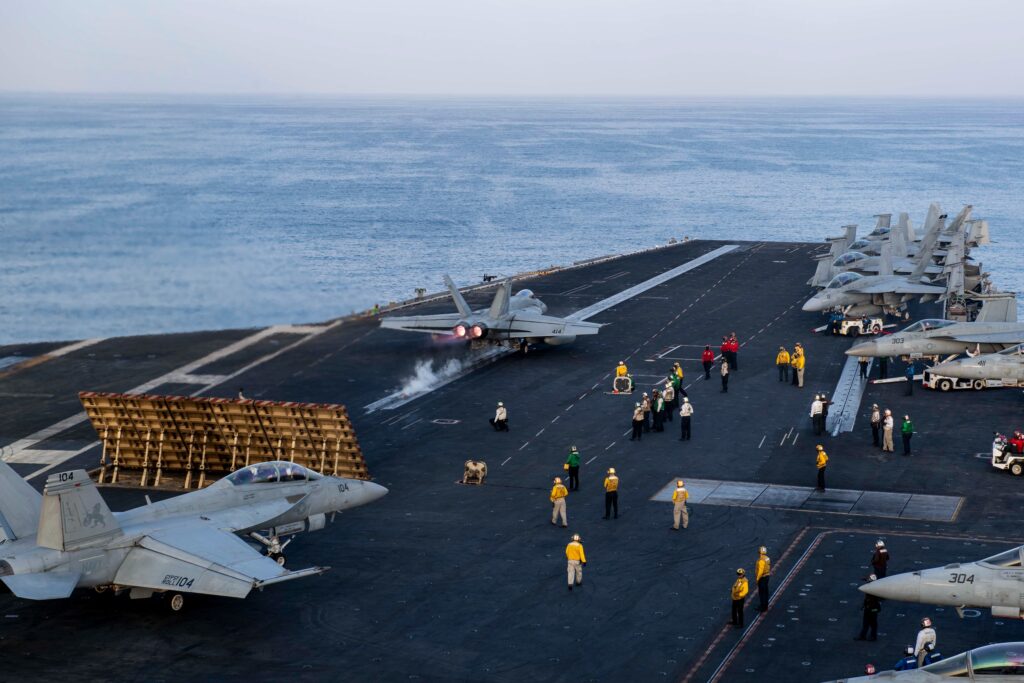
“Iranian unmanned aircraft took unsafe and unprofessional actions near USS Dwight D. Eisenhower (CVN 69) (IKE) during the course of routine flight operations in international waters, Nov. 28. 

“The Dwight D. Eisenhower Carrier Strike Group (IKECSG) was conducting routine flight operations in the international waters of the Central Arabian Gulf when it detected an unmanned aerial vehicle (UAV). The UAV was visually identified as Iranian. Its closest point of approach to IKE was approximately 1,500 yards. Multiple hails and warnings were ignored by Iran. 

“This Iranian action violated safety precautions outlined in a daily Notice to Airmen (NOTAM). The NOTAM directed manned and unmanned aircraft to remain greater than 10 nautical miles from the aircraft carrier in order to ensure safety of flight of military and civilian aviation. 

“No injuries were reported and no aircraft was damaged. 

“This unsafe, unprofessional, and irresponsible behavior by Iran risks U.S. and partner nation lives and needs to cease immediately. 

“U.S. naval forces remain vigilant and will continue to fly, sail and operate anywhere international law allows while promoting regional maritime security.”