General Dynamics Electric Boat and the Metal Trades Council Agree  to a New Contract

Release from General Dynamics Electric Boat 

***** 

GROTON, Conn. (October 6, 2023) – General Dynamics Electric Boat, a business unit of General Dynamics (NYSE: GD), and the Metal Trades Council (MTC) announced today union members ratified a new, five-year collective bargaining agreement. The MTC represents more than 3,400 employees in the skilled trades at the company’s Groton shipyard which includes welders, electricians, machinists, pipefitters, laborers, painters, transportation services and administrative support.  

The agreement provides for significant increases in compensation and benefits, including: 

  • General wage increases for all MTC members totaling 21.4% over the term of the contract. 
  • Retention and sign on bonuses with the opportunity to earn up to $6,000. 
  • A one-time, $2,500 contribution to the employee’s 401k retirement savings account.  
  • Continuation of a comprehensive, competitive medical plan with modest premium and deductible increases. 
  • Increases to vacation days and paid sick time for most members. 

The contract is effective as of September 30, 2023. 

“This is the largest wage package in more than 30 years and demonstrates the value we place on the skills and experience necessary to build the world’s finest submarines,” said Kevin Graney, president of General Dynamics Electric Boat. “This investment in our people complements investments by General Dynamics in our facilities and infrastructure and is a key element of our strategy to grow our production rate to deliver more submarines faster to the U.S. Navy.” 

“Ratification of this robust contract is a five-year ironclad guarantee of economic security for the Electric Boat metal trades workforce, which they richly deserve. It also sends a powerful message to the Navy and Congress, who fund their work, that the Groton waterfront is in for the long haul as our nation grows its undersea fleet, a decades-long enterprise. Kudos to Peter Baker and the Metal Trades Council team, and Shawn Coyne from Electric Boat Human Resources who spent months hammering out the many details of this historic contract,” said U.S. Rep. Joe Courtney (CT-02).  

“This new agreement will help attract and retain new employees while providing for the current membership,” said Peter Baker, president of the Metal Trades Council. “This will also provide Electric Boat with a stable workforce that will continue to build our nation’s defense. We want to thank the membership for their support throughout the negotiations process.” 

Electric Boat is in the midst of an unprecedented expansion to increase production of Virginia-class fast-attack submarines and the Columbia class of ballistic missile submarines. The company is the prime contractor for the Columbia class, designated by the U.S. government as the nation’s number one defense priority. Electric Boat plans to hire 5,750 new employees in 2023. Interested applicants should visit EBCareers.com to see available positions. 


U.S. 5TH FLEET ENHANCES MIDDLE EAST MARITIME SECURITY WITH UNMANNED CAPABILITIES

Release from U.S. Naval Forces Central Command Public Affairs 

***** 

By U.S. Naval Forces Central Command Public Affairs | 

06 October 2023 

MANAMA, Bahrain – Last month, naval forces in the Middle East region successfully integrated unmanned platforms with traditionally crewed ships and aircraft to conduct enhanced maritime security operations in the waters surrounding the Arabian Peninsula. 

Seven task forces falling under U.S. 5th Fleet integrated 12 different unmanned platforms with manned ships for “manned-unmanned teaming” operations, tracking Iranian Navy and Islamic Revolutionary Guard Corps Navy (IRGCN) ships and small boats over several days during routine patrols in and around the Strait of Hormuz.  

This operation bolstered presence in and around a critical chokepoint that in recent months has seen Iran unlawfully seize internationally flagged merchant ships. 

Unmanned underwater vehicles (UUVs), unmanned surface vehicles (USVs) and unmanned aerial vehicles (UAVs) were involved in the operation. 

“We have been operating UAVs and UUVs in the region for years,” said Capt. Joe Baggett, Director of Maritime Operations for U.S. Naval Forces Central Command and U.S. 5th Fleet. “Adding our new USVs, and then integrating all of these platforms into fleet operations, is how we expect to fly and sail well into the future.”  

Sailors, Marines, Coast Guardsmen, ships and aircraft from Task Force 51/5 (Amphibious/Marine), Task Force 52 (Mine Countermeasures), Task Force 53 (Logistics), Task Force 55 (Surface Warfare), Task Force 56 (Expeditionary), Task Force 57 (Patrol/Reconnaissance) and Task Force 59 (Unmanned/Artificial Intelligence) conducted the operations.  

“The integration of new, multidomain unmanned platforms into routine fleet operations provides more ‘eyes on the water,’ enhancing maritime domain awareness and increasing deterrence in the region,” said Vice Adm. Brad Cooper, Commander, U.S. Naval Forces Central Command and U.S. 5th Fleet. 
 
Cooper added that collectively, these platforms support the safe navigation and free flow of commerce through vital regional chokepoints, particularly around the Strait of Hormuz. 

“This enhanced maritime security serves as a deterrent against malign activity and strengthens regional stability, which is good for everybody,” he said. 

U.S. Naval Forces Central Command/U.S. 5th Fleet’s area of operations encompasses about 2.5 million square miles of water area and includes the Arabian Gulf, Red Sea, Gulf of Oman, Gulf of Aden, Arabian Sea and parts of the Indian Ocean. This expanse, comprising 21 nations, includes three critical choke points at the Strait of Hormuz, the Suez Canal and the Strait of Bab al Mandeb. 


HII’s Ingalls Shipbuilding Launches Amphibious Assault Ship Bougainville (LHA 8) 

Release from HII 

***** 

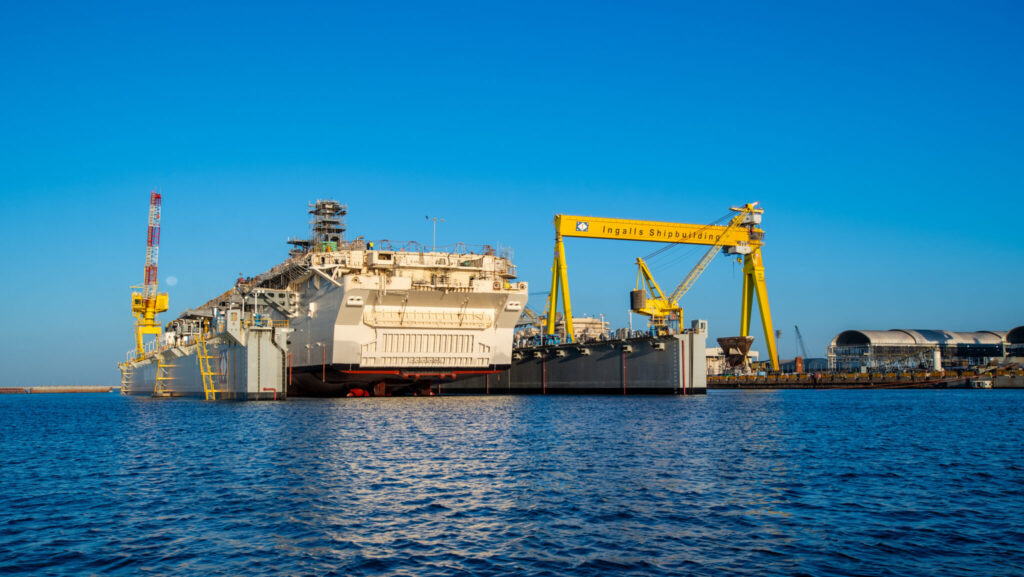
PASCAGOULA, Miss., Oct. 06, 2023 (GLOBE NEWSWIRE) — HII’s (NYSE: HII) Ingalls Shipbuilding division announced the successful launch of the Navy’s third America-class amphibious assault ship Bougainville (LHA 8) from its floating dock into the Pascagoula River on Saturday. 

“This launch is a significant accomplishment for our entire LHA shipbuilding team, and we are honored to be building such a versatile ship for our Navy and Marine Corps partners,” Ingalls Shipbuilding Amphibious Ship Program Manager Gene Miller said. “It is also a testament to the outstanding teamwork we see every day as our shipbuilders continue the critical work of preparing Bougainville for delivery.” 

On Sept. 9, Bougainville was translated from land to the company’s floating dry dock using translation railcars to support the ship. While in the dry dock, the Ingalls team completed final prep work for launch. 

Bougainville is the first ship in the America class to be built with a well deck. The ship will retain aviation capabilities while adding the surface assault capability of a well deck and a larger flight deck configured for F-35B Joint Strike Fighter and MV-22 Osprey aircraft. These large-deck amphibious assault ships also include top-of-the-line medical facilities with full operating suites and triage capabilities. 

A video and photos accompanying this release are available at: https://hii.com/news/hii-ingalls-shipbuilding-launches-amphibious-assault-ship-bougainville-lha-8

The America class is a multi-functional and versatile ship that is capable of operating in a high density, multi-threat environment as an integral member of an expeditionary strike group, an amphibious task force or an amphibious ready group. 

Ingalls has delivered 15 large-deck amphibious ships to the U.S. Navy. The shipyard delivered the first in the new America class of amphibious assault ships (LHA 6) in 2014. The second ship in the America class, USS Tripoli (LHA 7), was delivered to the Navy in early 2020. In addition to Bougainville, Fallujah (LHA 9) is also under construction, and the company authenticated the keel during a ceremony in September 2023. 


Navy to Commission Future Guided-Missile Destroyer USS Jack H. Lucas 

Release from the U.S. Department of Defense 

***** 

OCT. 6, 2023 

The Navy will commission the future USS Jack H. Lucas (DDG 125) as the newest Arleigh Burke-class guided-missile destroyer during a 10 a.m. EDT ceremony on Saturday, Oct. 7, 2023, at Port Tampa Bay, Berth 150, Tampa, Florida. 

The Honorable Erik Raven, under secretary of the Navy, will deliver the commissioning ceremony’s principal address. Remarks will also be provided by the Honorable Kathy Castor, U.S. representative, Florida’s 14th District; Adm. Daryl Caudle, commander, U.S. Fleet Forces Command; Sgt. Maj. Carlos Ruiz, Sergeant Major of the Marine Corps; the Honorable Jane Castor, mayor of Tampa, Florida; and Ms. Kari Wilkinson, president of Ingalls Shipbuilding and executive vice president, HII. The ship’s sponsors are Ruby Lucas, widow of the ship’s namesake, and philanthropist Catherine B. Reynolds. 

DDG 125 is the 73rd Arleigh Burke-class guided-missile destroyer to be commissioned and the first in the Flight III configuration. She is the first naval warship to bear the name of USS Jack H. Lucas. USS Jack H. Lucas received its name on Sept. 17, 2016. DDG 125 is named for Pfc. Jack Lucas, who served in the U.S. Marines during World War II, earning the Medal of Honor for his heroism at Iwo Jima, when he was just 17 years old. Lucas was the youngest Marine and youngest serviceman in World War II to be awarded the United States’ highest military decoration for valor. In 1961, he returned to military service as a captain in the U.S. Army and trained younger troops headed for Vietnam. Lucas passed away on Jun. 5, 2008, in Hattiesburg, Mississippi. The selection of Jack H. Lucas is a constant reminder of the immense impact that actions taken by any sailor or marine can truly have. 

Arleigh Burke-class destroyers are the backbone of the U.S. Navy’s surface fleet. These highly capable, multi-mission ships conduct various operations, from peacetime presence to national security. DDGs provide a wide range of warfighting capabilities in multi-threat air, surface, and subsurface environments. 

USS Stethem (DDG 63), USS Higgins (DDG 76), USS Shoup (DDG 86), USS Dewey (DDG 105), USS Rafael Peralta (DDG 115), USS Thomas Hudner (DDG 116), USS Paul Ignatius (117), USS Ralph Johnson (DDG 114), and USS Momsen (DDG 92) are currently deployed overseas. These deployed Arleigh Burke-class destroyers contribute to various manned, unmanned, joint and maritime operations in support of operational commanders’ strategic vision. 

The ceremony will be live streamed at https://www.dvidshub.net/webcast/32606. The link becomes active approximately ten minutes prior to the event (9:50 a.m. EDT) 

Media may direct queries to the Navy Office of Information at (703) 697-5342. More information on the destroyer program can be found at https://www.navy.mil/Resources/Fact-Files/Display-FactFiles/Article/2169871/destroyers-ddg-51/ 


U.S. Navy Selects Lockheed Martin to Develop Integrated Combat System 

Lockheed Martin’s Integrated Combat System is a scalable combat management system for the U.S. Navy that uses common software and computer infrastructure to rapidly field capability across all domains to the surface fleet. Rendering: Lockheed Martin.

Release from Lockheed Martin  

***** 

MOORESTOWN, N.J., Sept. 28, 2023 – The U.S. Navy selected Lockheed Martin (NYSE: LMT) as its Integrated Combat System (ICS) Systems Engineering and Software Integration (SESI) agent. Lockheed Martin will design integrated warfare system architecture and capabilities so that software updates can be delivered in real time across the Navy’s surface fleet of Aegis destroyers, cruisers, and frigates, plus carriers and amphibious ships. 

“Our 21st Century Security strategy is delivering capabilities like the Integrated Combat System, a next generation of combat management system capabilities to give decision-makers the tools needed to determine a course of action and then execute their critical missions,” said Joe DePietro, vice president and general manager for Multi-Domain Combat Solutions at Lockheed Martin. “By leveraging the best of industry, we are creating the environment to quickly develop and field capabilities that will keep the Navy ready for current and future threats.”  

Lockheed Martin continues to support the U.S. Navy’s vision to transform into a fully cohesive ICS by connecting multi-domain assets and driving to a common architecture across the surface fleet. 

Digital Transformation and Innovation 

In support of the ICS, Lockheed Martin is utilizing a digital thread that encompasses the entire ecosystem, leveraging Artificial Intelligence (AI), DevSecOps and model-based engineering to manage new upgrades and cyber security considerations from the beginning of the development cycle through sustainment. 

The ICS SESI program is formerly known as the Surface Combatant Combat Systems Engineering Agent role. Lockheed Martin has over five decades of experience providing the Aegis Weapon System to the Navy and international navies, and as the current provider of the Ship Self Defense System on large deck amphibious ships. 


U.S. 5th Fleet Enhances Middle East Maritime Security with Unmanned Capabilities  

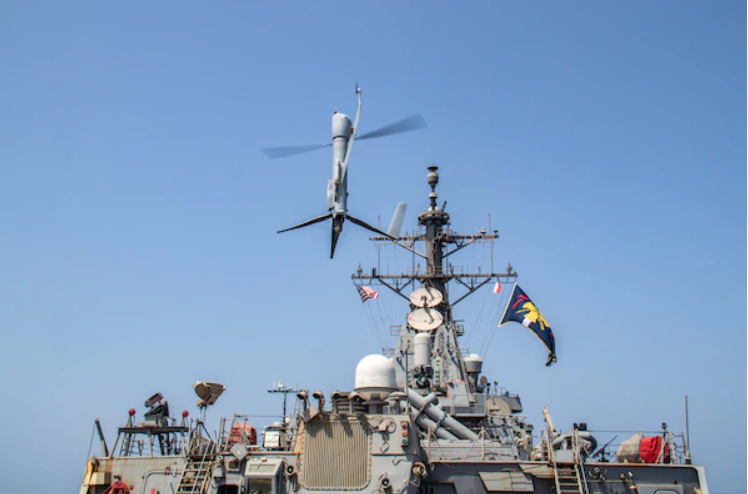
GULF OF OMAN (Oct. 6, 2023) An Aerovel Flexrotor unmanned aerial vehicle launches from the deck of the Arleigh Burke-class guided-missile destroyer USS McFaul (DDG 74) in the Gulf of Oman, in an image released Oct. 6. U.S. 5th Fleet forces recently conducted an operation integrating unmanned platforms with traditionally crewed ships and aircraft to conduct enhanced maritime security operations in the waters surrounding the Arabian Peninsula. Seven task forces falling under U.S. 5th Fleet integrated 12 different unmanned platforms with manned ships for “manned-unmanned teaming” operations tracking Iranian Navy and Islamic Revolutionary Guard Corps Navy (IRGCN) ships and small boats over several days during routine patrols in and around the Strait of Hormuz. (Photo by U.S. Naval Forces Central Command Public Affairs)

Release from U.S. Naval Forces Central Command public affairs 

*****

MANAMA, Bahrain – Last month, naval forces in the Middle East region successfully integrated unmanned platforms with traditionally crewed ships and aircraft to conduct enhanced maritime security operations in the waters surrounding the Arabian Peninsula. 

Seven task forces falling under U.S. 5th Fleet integrated 12 different unmanned platforms with manned ships for “manned-unmanned teaming” operations, tracking Iranian Navy and Islamic Revolutionary Guard Corps Navy (IRGCN) ships and small boats over several days during routine patrols in and around the Strait of Hormuz.  

This operation bolstered presence in and around a critical chokepoint that in recent months has seen Iran unlawfully seize internationally flagged merchant ships. 

Unmanned underwater vehicles (UUVs), unmanned surface vehicles (USVs) and unmanned aerial vehicles (UAVs) were involved in the operation. 

“We have been operating UAVs and UUVs in the region for years,” said Capt. Joe Baggett, Director of Maritime Operations for U.S. Naval Forces Central Command and U.S. 5th Fleet. “Adding our new USVs, and then integrating all of these platforms into fleet operations, is how we expect to fly and sail well into the future.”  

Sailors, Marines, Coast Guardsmen, ships and aircraft from Task Force 51/5 (Amphibious/Marine), Task Force 52 (Mine Countermeasures), Task Force 53 (Logistics), Task Force 55 (Surface Warfare), Task Force 56 (Expeditionary), Task Force 57 (Patrol/Reconnaissance) and Task Force 59 (Unmanned/Artificial Intelligence) conducted the operations.  

“The integration of new, multi-domain unmanned platforms into routine fleet operations provides more ‘eyes on the water,’ enhancing maritime domain awareness and increasing deterrence in the region,” said Vice Adm. Brad Cooper, Commander, U.S. Naval Forces Central Command and U.S. 5th Fleet. 
 
Cooper added that collectively, these platforms support the safe navigation and free flow of commerce through vital regional chokepoints, particularly around the Strait of Hormuz. 

“This enhanced maritime security serves as a deterrent against malign activity and strengthens regional stability, which is good for everybody,” he said. 

U.S. Naval Forces Central Command/U.S. 5th Fleet’s area of operations encompasses about 2.5 million square miles of water area and includes the Arabian Gulf, Red Sea, Gulf of Oman, Gulf of Aden, Arabian Sea and parts of the Indian Ocean. This expanse, comprising 21 nations, includes three critical choke points at the Strait of Hormuz, the Suez Canal and the Strait of Bab al Mandeb. 


Curtiss-Wright Awarded $34 Million Contract to Provide Airborne Data Recorder Technology to the U.S. Navy 

Release from Curtiss-Wright 

***** 

DAVIDSON, N.C. – October 5, 2023 –Curtiss-Wright Corporation (NYSE: CW) today announced that it has been awarded a five-year, $34 million firm-fixed-price indefinite delivery, indefinite quantity (IDIQ) contract by the Naval Surface Warfare Center (NSWC) to provide Modular Open Systems Approach (MOSA) based airborne data recorder technology for use on U.S. and Australian manned and unmanned maritime aircraft.  

Under the agreement, Curtiss-Wright will provide and service Keyed Broad Area Maritime Surveillance Airborne Recorder (K-BAR) Network Attached Storage (NAS) solutions including chassis, docking stations, removable storage modules and lab cable sets. 

“We are pleased to have been selected by the Naval Surface Warfare Center to provide our rugged airborne network attached storage technology and support services for Naval manned and unmanned aircraft programs,” said Lynn M. Bamford, Chair and CEO of Curtiss-Wright Corporation. “This award reflects our commitment to provide the most advanced and reliable open architecture data storage systems in support of our warfighters.” 

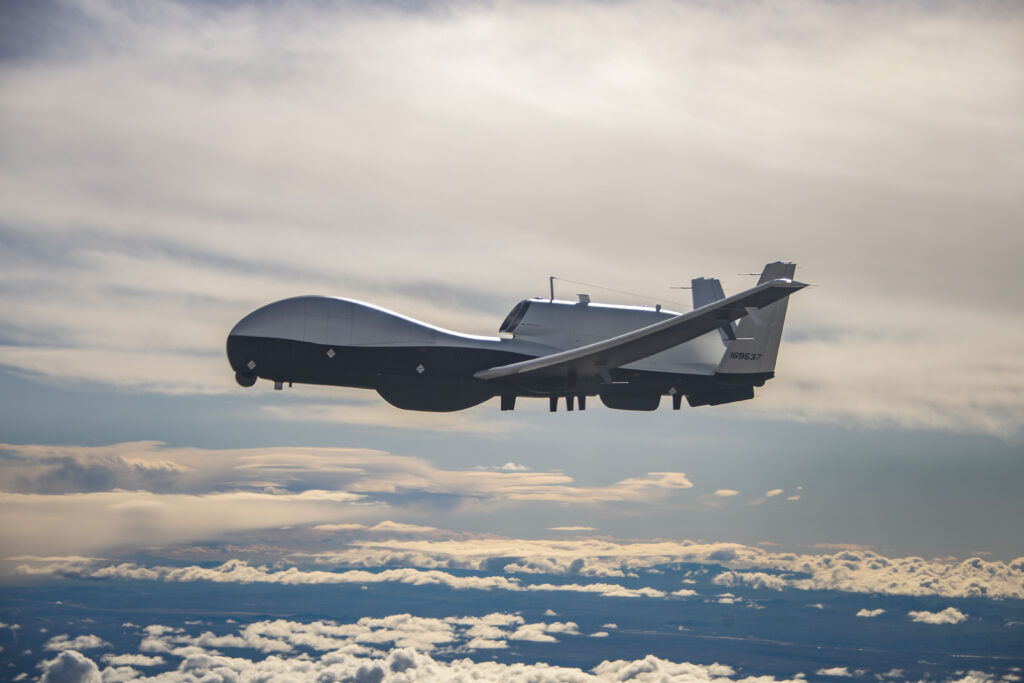
As a leading supplier of MOSA based encrypted, solid-state network-attached storage subsystems, Curtiss-Wright is providing the NSWC with commercial-off-the shelf (COTS) open architecture K-BAR NAS equipment supporting MQ-4C Triton and future PMA-290 aircraft. The sole source contract provides training and engineering services support to the K-BAR equipment. 


Marine Corps XQ-58A Valkyrie completes first flight

Release from Headquarters Marine Corps 

***** 

HEADQUARTERS MARINE CORPS, Va. – The Marine Corps XQ-58A Valkyrie, a highly autonomous, low-cost tactical unmanned air vehicle successfully completed its first test flight October 3, 2023, at Eglin Air Force Base, Florida. The Marine Corps partnered with the Office of the Undersecretary of Defense for Research and Engineering (OUSD(R&E)), the Naval Air Systems Command and Naval Air Warfare Center Aircraft Division (NAWCAD) to facilitate the ongoing research, development, test and evaluation of the Marine Corps XQ-58A Valkyrie.  

This joint collaboration was supported by the 40th Flight Test Squadron, 96th Test Wing and the NAWCAD. This flight marks a key milestone in the Marine Corps’ Penetrating Affordable Autonomous Collaborative Killer – Portfolio (PAACK-P) program. Future test flights inform Marine Corps XQ-58A Valkyrie requirements for the Marine Air-Ground Task Force Unmanned Aerial System Expeditionary (MUX) Tactical Aircraft (TACAIR).   

“This XQ-58A test flight and the data collected today not only help to inform future requirements for the Marine Corps,” said Scott Bey, a prototyping and experimentation portfolio manager at OUSD(R&E). “It fuels continued joint innovation and experimentation opportunities and demonstrates the agility that can be achieved through partnership.”  

The aircraft performed as expected. The XQ-58A has a total of six planned test flights with objectives that include evaluating the platform’s ability to support a variety of intelligence, surveillance, and reconnaissance (ISR) missions; the effectiveness of autonomous electronic support to crewed platforms; the potential for AI-enabled platforms to augment combat air patrols; and continuing to mature other manned-unmanned teaming (MUM-T) capability objectives.  

The Marine Corps received the first of two XQ-58A unmanned aerial systems (UAS) on March 14, 2023, to support platform prototyping and integration efforts for the PAACK-P program.  

“The Marine Corps constantly seeks to modernize and enhance its capabilities in a rapidly evolving security environment,” said Lt. Col. Donald Kelly, Headquarters Marine Corps Aviation Cunningham Group and Advanced Development Team. “Testing the XQ-58 Valkyrie determines requirements for a highly autonomous, low-cost tactical UAS that compliments the need for agile, expeditionary and lethal capabilities in support of both the Marine Corps’ stand-in force operations in austere environments and the Joint Force.”  


Ford Strike Group Strengthens Interoperability with Italy

***** 

By Mass Communication Specialist 1st Class Brian T. Glunt, USS Gerald R. Ford (CVN 78) Public Affairs 

05 October 2023 

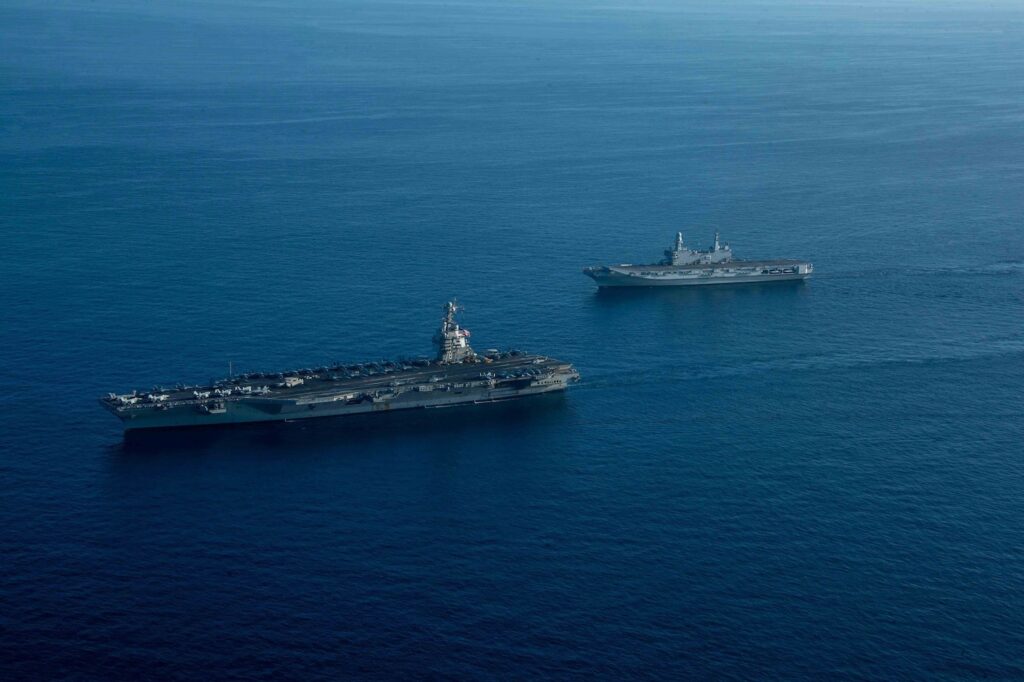
IONIAN SEA – The Gerald R. Ford Carrier Strike Group (GRFCSG) concluded a series of high-end training events with Italian naval forces in the Ionian Sea, Oct. 4, 2023, to increase interoperability as NATO allies and strengthen regional stability in the Mediterranean region. 

 “This opportunity to train with the Italian Navy again builds on our previous interactions during our current deployment and strengthens our interoperability skills as members of NATO,” said Rear Adm. Erik Eslich, Commander, Carrier Strike Group (CSG) 12. “The exercise demonstrates our continued commitment to promote our shared interests of security, stability, and prosperity in the region and I am proud of our collective work to sustain this effort.” 

The world’s largest aircraft carrier USS Gerald R. Ford (CVN 78), the Ticonderoga-class guided-missile cruiser USS Normandy (CG 60), the Arleigh Burke-class guided-missile destroyer USS Ramage (DDG 61), and squadrons assigned to Carrier Air Wing (CVW) 8 participated with Italian Navy flagship ITS Cavour (CVH 550), Italian Orizzonte-class guided-missile destroyer ITS Caio Duilio (D 554), and Italian Bergamini-class guided-missile frigate ITS Virginio Fasan (F 591). 

The bilateral training events included multi-ship formation sails, cross-deck personnel training, helicopter cross-deck evolutions, various simulated defense exercises and airborne interoperability exercises between CVW-8 assets and ITS Cavour airwing. 

“I am beyond proud of the work and training the Italian Carrier Strike Group has executed together with the Gerald R. Ford Carrier Strike Group throughout their deployment. It has reinforced the interoperability and interchangeability within our naval forces and air assets, vital to the alliance. Our current multi-carrier operations continue to promote our shared dedication to the security and freedom of the seas in the Wider Mediterranean region” said RADM Giacinto Sciandra, Commander, Second Naval Division/Italian Maritime Forces. 
 
Sailors assigned to Gerald R. Ford and Normandy participated in cross-deck evolutions with their foreign counterparts aboard Cavour and Duilio, further enhancing mutual understanding of operations and capabilities. 

The GRFCSG is conducting a scheduled deployment in the U.S. Naval Forces Europe-Africa (NAVEUR-NAVAF) area of operations in support of interoperability and maritime security. The GRFCSG provides an inherently flexible naval force capable of deploying across combatant commands to meet emerging missions, deter potential adversaries, reassure allies and partners, enhance security and guarantee the free flow of global commerce. In total, the GRFCSG is deployed with more than 5,000 Sailors across all platforms ready to respond globally to combatant commander tasking. 

Gerald R. Ford is the U.S. Navy’s newest and most advanced aircraft carrier. As the first-in-class ship of Ford-class aircraft carriers, CVN 78 represents a generational leap in the U.S. Navy’s capacity to project power on a global scale. 

U.S. 6th Fleet, headquartered in Naples, Italy, conducts the full spectrum of joint and naval operations, often in concert with allied and interagency partners, in order to advance U.S. national interests and security and stability in Europe and Africa. 

For more information about USS Gerald R. Ford (CVN 78), visit https://www.airlant.usff.navy.mil/cvn78/ and follow along on Facebook: @USSGeraldRFord, Instagram: @cvn78_grford, Twitter: @Warship_78, DVIDS www.dvids.net/CVN78 and LinkedIn at USS Gerald R. Ford (CVN 78). 


Northrop Grumman Develop New Guided Ammunition for the US Navy

Release from Northrop Grumman 

***** 

PLYMOUTH, Minn. – Oct. 4, 2023 – The U.S. Navy has awarded Northrop Grumman Corporation a development contract for the company’s newly designed 57mm guided high explosive ammunition. Designated for use with the Mk110 Naval Gun Mount, the company will test and mature the munition for qualification.  

The 57mm guided high explosive ammunition has the unique ability to continuously maneuver in-flight as it moves toward a designated target. Designed to defend against fast moving surface threats, drones and swarming threats, the guided 57mm ammunition features an on-board seeker to acquire moving targets and a fuze with the ability to self-select for either proximity or point-detonation mode to best engage and defeat the intended target. 

“Our new 57mm guided ammunition is truly innovative in its ability to identify, track and guide itself to a target,” said Dave Fine, vice president, armament systems, Northrop Grumman. “The Navy will gain a greater capability to defend against moving threats and a new level of accuracy to defeat them.”  

As the newest addition to Northrop Grumman’s advanced ammunition portfolio, the 57mm round leverages the company’s expertise in guided munitions, such as the Precision Guidance Kit. Utilizing seekers and an aft-maneuver system, the round provides continuous trajectory guidance no matter how often the target may pivot. This new guided ammunition will give the Navy greater stand-off range and a cost-effective solution against small, fast-moving threats, without any weapon system modifications.