Armchair experts and motivational speakers the world over are fond of saying that Rome wasn’t built in a day. Less an historical account of Roman expediency, the saying is meant to convey the idea that great things take time. Civilizations don’t happen overnight. And certainly, building a city represents a commitment to an idea.
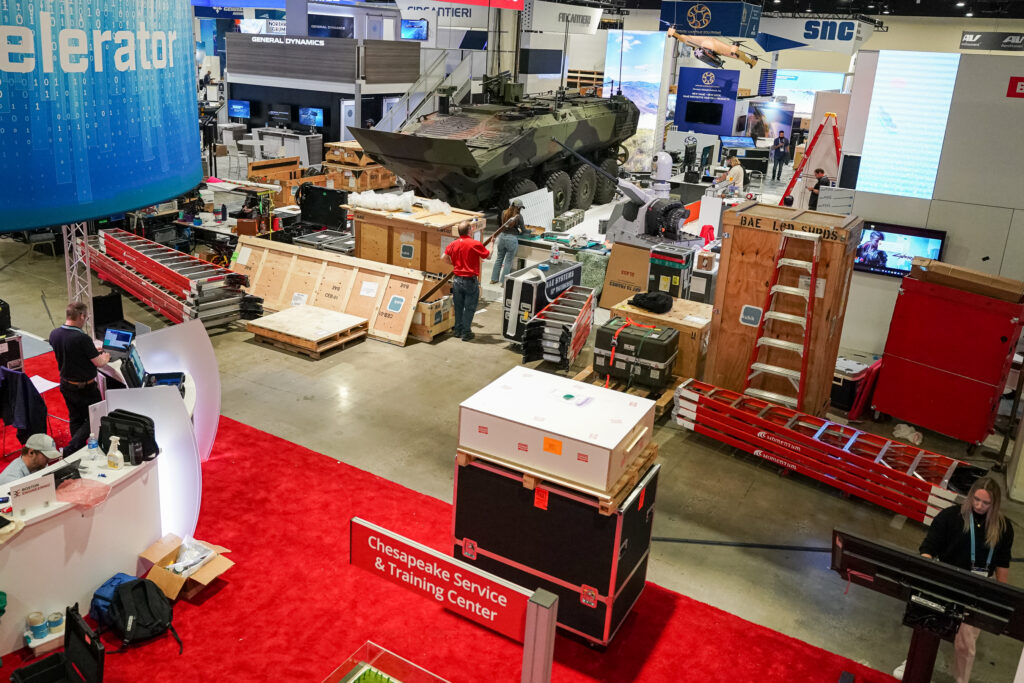
The sprawling city you see before you here at Sea-Air-Space 2023 also wasn’t built in a day. But close. It took three.
Last Thursday, these exhibit halls were empty shells. Footsteps rang across football-field expanses, voices echoed, and dust motes — not bands — played in ballrooms. We got to work. Everyone, from Navy League staff to contractors and vendors, to exhibit builders, to operations and logistics experts rolled up their sleeves and began the process of turning nothing into something. And not just any something, but something amazing.
The exhibition booths themselves are an incredible feat on their own. They showcase possibilities, and in many cases, fantastic realities of technology and innovation that will bulwark our sea services and support their missions in the years to come. The panel discussions and other events are built as well, and not only with the physical infrastructure of microphones, lights, speakers, and chairs. Our Navy League team built these events with dedication, with people, and with a commitment to an idea.
Our idea is this: What if we amass the best and brightest together for three days once a year, put our collective heads together, and create real solutions that affect the viability of our seapower. What if we change our world. What if.
Welcome to our city.
Q&A with Naval Supply Systems Command
Seapower magazine interviews Vice Commander Kurt J. Wendelken
What are the roles of the Naval Supply Systems Command?
NAVSUP and the Supply Corps conduct and enable supply chain, acquisition, operational logistics and Sailor & family care activities with our mission partners to generate readiness and sustain naval forces worldwide to prevent and decisively win wars.
How is the era of great power competition affecting NAVSUP’s roles and responsibilities?
As Navy’s end-to-end supply chain integrator, NAVSUP is working hard to maximize efficiencies and effectiveness in Navy’s supply chains. One major initiative is Naval Sustainment System-Supply (NSS-S). Naval Sustainment System (NSS) is a combination of commercial best practices, process improvements, governance and oversight to maximize efficiencies and effectiveness within available means. NSS-Supply embraces industry best practices tailored for specific Navy needs and fleet operations in order to reduce maintenance turnaround times, increase end-to-end velocity of spares, repairs, and reduce costs.
Why does the Navy’s supply chain need the transformation of the Naval Sustainment System-Supply?
NSS-Supply seeks to strengthen Navy’s supply chain in order to increase readiness, thus enhancing combat capability and creating a model of sustainment that will allow the Navy to effectively generate readiness and sustain global navy power.
How does NAVSUP fit in the Navy’s push for more distributed maritime operations and in the Marine Corps’ expeditionary advance base operations?
Combined with the most robust, end-to-end logistics doctrine that the world has ever seen, NAVSUP provides uninterrupted (despite contested environment) supply chain management, bulk and aviation fueling capability, material handling equipment, contracting, hazardous material management, household goods and vehicle processing and postal operations to fleet, installation and other service components throughout every area of operations.
How will management of the supply chain be more integrated and streamlined with the warfighting commands?
By extension, NSS-Supply embraces industry best practices tailored for specific Navy needs and fleet operations in order to reduce maintenance turnaround times, increase end-to-end velocity of spares, repairs, and reduce costs.
What major segments of the supply chain are not owned by NAVSUP? How does the Defense Logistics Agency’s roles compare with those of NAVSUP?
NAVSUP and the Supply Corps conduct and enable service specific supply chain, acquisition, operational logistics, and Sailor & family care activities with our mission partners to generate readiness and sustain naval forces worldwide to prevent and decisively win wars. The Defense Logistics Agency is the DoD executive agent for specific classes of supply that are common across the military services like food, fuel, construction material, and medical supplies. They also provide extensive warehousing services across DoD.
What are that current challenges that NAVSUP faces with the defense industry in executing the supply chain?
Executing an effective naval supply chain is increasingly challenging, in part due to the Defense Department’s pressure on industry to become lean. We now face raw material shortages, weapon systems obsolescence, a shrinking skilled labor pool, excessive acquisition lead times, and a dwindling sub vendor base with a heavy reliance on sole source vendors. Maintaining our current warfighting edge requires better collaboration and transparency with industry. We need to invest in sustainment up front, consider where prepositioning materials makes sense, and work better to reverse the current trends deteriorating material lead times.
What new technologies look promising in aiding NAVSUP in streamlining the supply chain?
NAVSUP manages Navy’s globally distributed, highly complex, and increasingly digital supply chains. LOG IT and Supply Chain systems are critical enablers in generating and sustaining readiness. NAVSUP is proactively taking steps to deliver modern digital solutions that support real-time operations to include system modernization, leveraging internet of things (IOT) technology and machine learning/artificial intelligence to improve asset visibility.
What can be done to expand competition among suppliers?
NAVSUP contracting offices attempt to enhance competition through early outreach in an effort to identify as many potential sources as possible. The use of Industry Days is also a popular method among NAVSUP contracting offices for specific types of procurements, such as ship repair or husbanding. These are established days where potential sources are invited to attend and learn as NAVSUP provides guidance on doing business with the government. This is a way to ease private sector concerns and generate interest.
What can the defense industry do to help the Navy improve its supply chain?
Just as the Navy has incorporated a “Get Real, Get Better” mantra, so we ask industry to embrace the same. We are all working towards a collective goal of supporting national defense, and it is imperative to operate with transparency and honesty, not distrust. Short-term, be accurate with contract schedules and deliver on time in accordance with contractual commitments. Increase the number and scope of strategic contracts to help offset material, labor, and financial stressors. Long-term, deepen the partnership with the Navy to create a more effective sustainment environment earlier in weapons system development. With more agility and cooperation, we can identify, plan, and overcome supply chain barriers to better support our fleet, which is the ultimate goal.
Navy Prioritizes Mental Health with New Playbook
The U.S. Navy has always been dedicated to ensuring that the bodies and minds of its Sailors are ready and prepared to win in combat. But there have been challenges over the years in helping Sailors with mental-health resources during active service, and as they transition out of the Navy into civilian life.
The Navy Culture and Resilience Office, N17, Office of the Chief of Naval Operations is addressing those challenges through its new Mental Health Playbook. This 28-page playbook, which was released in February, is designed to put mental health tools and resources into the hands of every Navy leader, no matter what their rank.
“Our goal is that everyone in our great Navy develops a shared understanding about how to conduct mental-health and preventative maintenance for our people, and then where to go for additional resources,” said Rear Admiral Brett Mietus, director of N17. “It’s an incredibly important topic to me and all of the Navy’s senior leadership.”
The Navy already offers a variety of mental-health resources. Navy N9 quality-of-life programs include Morale, Welfare and Recreation (MWR); Wounded Warrior; Mind Body Mental Fitness (MBMF); and Sailor Assistance and Intercept for Life (SAIL). There are also family advocacy programs, childcare and relocation programs, assistance programs, non-medical counseling at fleet and family-support centers, and more.
The Navy League of the United States has mental-health resources as well. For example, Sea-Air-Space’s Transition Connection Job Fair, which will be held from 10 a.m. to 2 p.m. on Monday in the Cherry Blossom Ballroom, is one of the ways the Navy League helps with transitioning Sailors’ overall well-being.
The Mental Health Playbook complements all these efforts through its mission to create a “climate of trust and respect with open, two-way communication; challenging inappropriate conduct or poor leadership; and eliminating stigma for seeking help.” The Playbook is organized into five sections:
Roles and Responsibilities, which is geared toward helping commanders create, “a community of support, where sailors feel connected to the mission, the command and each other.”
Conversations That Matter, which provides strategies for conducting mental-health discussions.
Identifying and Responding to a Mental Health Related Concern, which discusses what to do when sailors are in mental or emotional distress.
Navigating Support Systems, which helps sailors find the right support at the right time.
Navy’s Mental Health Capabilities and Resources, which describes the clinical and non-clinical tools available both inside and outside the military and provides contact information for a variety of programs.
“Most of the resources that are in the playbook have been out there, but they just haven’t been put together in a way that’s easily digestible and then usable by a fleet leader,” Mietus said.
Mietus said the playbook is a response to requests and concerns from fleet members about the Navy’s approach to mental health. He noted that while older Sailors aren’t necessarily used to acknowledging or discussing mental-health issues, younger generations are much more attuned to their mental and emotional needs.
“Our goal is to eliminate stigma when it comes to mental-health care. I think the important thing for us all is to normalize conversations around it,” he said.
Small Businesses Make Big Waves
The demand for small business innovation, technology, and solutions has never been higher
If rural western Massachusetts looks like something out of a Norman Rockwell painting, it’s because that’s where Rockwell kept his studio. But in addition to the picturesque college towns, quaint villages, covered bridges, and magnificent scenery, the region also has a long history of heavy industry that dates to the industrial revolution. These industries historically harnessed rivers for power and created mill towns that made textiles, paper, leather goods, electrical components, automobiles, and guns.
Pittsfield, Massachusetts is located 40 miles from Albany, New York and 140 miles from Boston. With a population of about 44,000, it is the county seat of Berkshire County (pop. 129,000). For many years the town’s business was defined by its largest employer, the General Electric Company, which manufactured transformers, electronics and plastics, and employed 10,000 workers. Like much of western Massachusetts’ heavy industry, it has moved elsewhere.
When General Electric left, it took many good paying jobs with it. But today, General Dynamics Mission Systems (GDMS) has a large, state-of-the-art facility involved in the design and manufacturing of complex electronics for defense purposes, such as submarine combat systems. In fact, General Dynamics’ business is growing, attracting new and highly skilled workers, and providing an economic engine for Pittsfield and its surrounding communities.
Global Threats Push Innovation
According to Ann Rusher, GDMS vice president of supply chain management, there have been unprecedented changes in the national security business, largely because, “China and Russia are introducing new technology and new capability at an alarming rate.”
To counter that trend, Rusher said defense companies have had to accelerate the pace of innovation to work closely and more collaboratively with smaller businesses, including those that have not previously worked in the defense sector. “We need that innovative spirit and agility that small businesses can bring.”
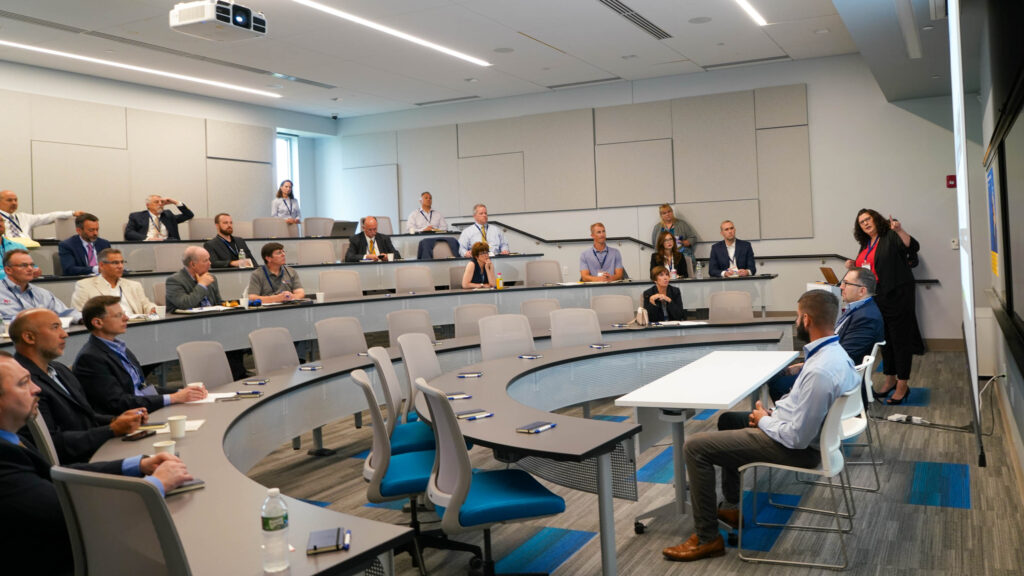
To accomplish that, GDMS is fostering better ties with the community and its supplier base. The company brought together vendors and partners — particularly small businesses — to the Berkshire Innovation Center (BIC) for a “Supplier Day.”
Rusher said the event was aimed at reestablishing connections and relationships, and to make small companies aware of the resources in and around the Pittsfield area, as well as across the country, to help them, “learn about, grow, and partner with us.”
She said that big companies like General Dynamics truly rely on small companies, with their innovation and agility. Rusher said that today, more than 60% of GDMS current active supplier base are small businesses. “We added 104 small businesses to our active database just in 2021. And across all categories of small business, we’ve increased our spend over the last five years by over 15%. And every single one of the categories of small business — the HUBZone, service disabilities, veterans, and women owned — they’ve all been increasing, from five percent all the way to doubling.”
Supply Chain Challenges
Rusher said General Dynamics not only wants to foster relationships between the company and small businesses, but also wants to facilitate the growth of those small businesses so that they can provide support to the entire defense industry. “By doing that, we can be a force multiplier for the government, and we can bring that innovative spirit, not just to us, but to the to the betterment of the country.”
“We’re a very successful company with an extremely talented workforce, but sometimes we need partners to help to solve some difficult problems,” Rusher said. “Not only have these small companies helped us solve tough technical issues, but they often bring a technology or a capability that’s so unique and state-of-the-art that when combined with the mission knowledge that General Dynamics has, it really is the differentiator to solve a problem and deliver exceptional capability.”
However, while the demand for innovative technology and solutions has never been higher, the number of small companies in the defense sector has declined precipitously.
According to Inside Cybersecurity, Deputy Assistant Secretary of Defense for Industrial Policy Jesse Salazar acknowledged that small businesses are under immense market pressures.
“The number of DIB (defense industrial base) small businesses has shrunk by more than 40 percent over the past decade,” Salazar said. “One of seven believe they will never return to pre-pandemic levels of performance.”
“Just when we need them the most, the supply chain is shrinking,” Rusher said.
Rusher admits that it might be a little intimidating for a small company to establish a relationship and work with a large defense contractor like General Dynamics. “It might even be tempting to think that we like to go it alone. True, General Dynamics can do a lot of things. And we can do many of the things that perhaps a small business could do. But the reality is the small businesses we work with bring something very different, and way more than what we can do by ourselves,” she said.
“We don’t just want to work with you; we need to work with you,” she said to the Supplier Day attendees.
BIC Innovation Hub
The BIC in Pittsfield is a multimillion-dollar collaborative initiative between the Commonwealth of Massachusetts, private industry, local colleges, and local government that opened in 2020. BIC serves as a confluence of technology and ideas. It offers conference rooms, offices and laboratory space, all designed to bring people together so they share knowledge and expertise to address challenges and seize opportunities.
“We offer world-class research and development facilities and equipment, interactive training and conference facilities, and shared access to advanced technology for local manufacturers,” said Ben Sosne, BIC’s executive director. “We can do more together.”
Innovation centers like the BIC can offer online advanced manufacturing courses and access to content that serves companies and students, both locally and elsewhere. When potential employees learn about the technology being developed in the Pittsfield area, it can attract new qualified workers to companies like General Dynamics.
According to Sosne, a workforce with higher digital skills can command higher wages, but it also attracts more employers looking for people with those skills. “When we have a pipeline of new talent through apprenticeships, and the adoption of new technology, the higher the wages you can offer, and the more that you can attract that new talent. By working with local employers like General Dynamics and developing a curriculum that teaches methods and processes that meet their needs, you are essentially graduating an industry-ready group of engineering professionals and technologists.”
“Employers like General Dynamics are an economic engine and a jobs-multiplier,” said Benjamin Lamb Director of Economic Development with 1Berkshire. “One manufacturing job in the Berkshires supports 4.8 other jobs in the county.”
The official regional economic development organization and regional tourism council of Berkshire County, 1Berkshire, represents the Berkshire business community and offers a powerful network of resources for members and companies. “This is where the synergy of marketing and economic development within the same organization in the same building with the same team can become very powerful,” said Lamb.
Small Businesses are Essential Partners
“General Dynamics designs, engineers and makes all kinds of systems that are used for national security, so we take a lot of pride in that,” said Pittsfield Mayor Linda Tyer. “They are an essential partner here in the city of Pittsfield and throughout the Berkshires. They are a large employer, providing 1,600 skilled jobs for our community. But there are many opportunities for our small companies to be part of the supply chain that serves General Dynamics, so that we are strengthening the economy here in Pittsfield and the Berkshires. Our plastics manufacturers and engineering companies help provide plenty of opportunity for those small businesses to benefit from the presence of General Dynamics.”
Tyer said that workforce development is an essential part of the future and the success of General Dynamics and small businesses, no matter what kind of work they are doing. “It’s incumbent upon academic institutions like our community colleges and four-year colleges, as well as institutions like the Berkshire Innovation Center (BIC), as well as the state agencies that provide workforce training opportunities and internship programs, to make sure they are partnering with each other and the employers who need talent and have the job opportunities,” she said. “That’s why having the BIC here is so important to the future of the innovation economy here in Pittsfield.”
State Representative Tricia Farley-Bouvier, who represents Pittsfield, agrees. “General Dynamics reaches throughout the region to bring new talent to the Berkshires, not only with intellect and their skills, but the energy that they bring to our community. They spend their dollars in the outdoors and arts economy and in our shops and cafes, and volunteer in the Berkshire County. We want to ensure that we have a reliable local supply chain for this global company of General Dynamics, and ensure that the pipeline is a short one,” she said. “I think workforce development is the biggest challenge right now, and that’s across the board in every industry here in western Massachusetts. But we’re very well positioned in Berkshire County because our high schools are producing really good workers and launching them into STEM careers, and that is an excellent source of talent for General Dynamics.”
Farley-Bouvier cautioned that General Dynamics can’t stand back and wait for the workforce to come to them. “General Dynamics has been and needs to continue to be part of that solution. They need to continue to be in at Taconic High School, MCLA (Massachusetts College of Liberal Arts), and Berkshire Community College and be part of those solutions. One of the most successful things that General Dynamics has done, and other smaller companies around Berkshire County have copied, is to provide paid internships. Paid internships are critically important because they level the playing field. It used to be that everybody took unpaid internships because there weren’t a lot of jobs out there. But the only people who could take an unpaid internship were those students whose families could support them. The young people who were economically distressed had to take those low paying service jobs over the summer because they had to pay their bills,” she said.
“Fortunately, General Dynamics is really invested in these students, and it’s paid off for them,” said Farley-Bouvier. “And we need to do a lot more of that to ensure that we have a reliable local supply chain for this global company of General Dynamics.”
Navy Orders Third Lot of Next-Generation Jammer Pods
*****
ARLINGTON, Va. — The U.S. Navy has placed an order with Raytheon for the third lot of ALQ-249 Next-Generation Jammer-Mid-Band (NGJ-MB) pods.
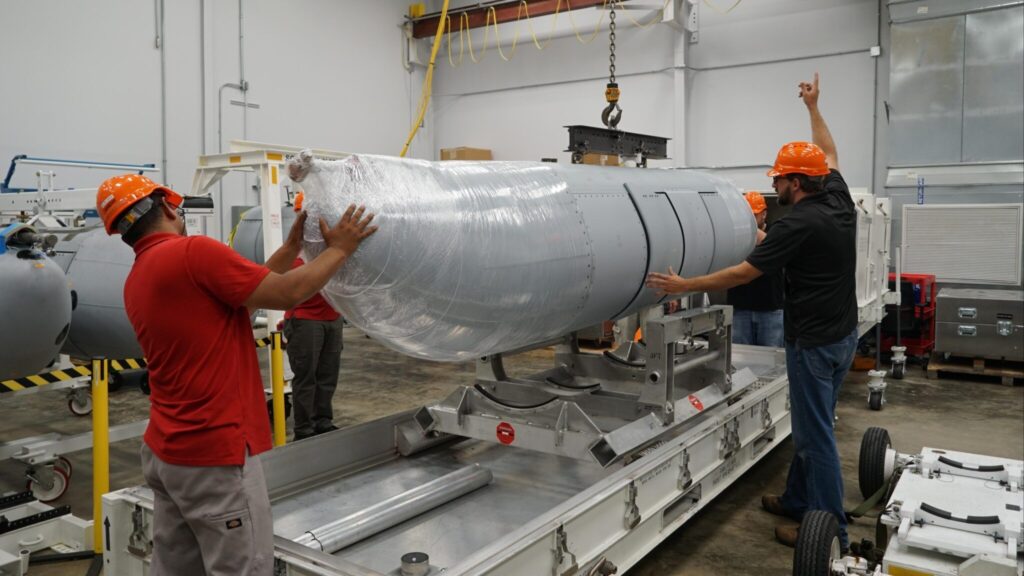
The Naval Air Systems Command awarded a $650 million fixed-price incentive (firm target) and cost-plus-fixed-fee contract to Raytheon, “for the production and delivery of low-rate initial production (LRIP) Lot III Next Generation Jammer (NGJ) Mid-Band (MB), to include 15 NGJ-MB LRIP ship sets (2 pods per ship set), 11 for the Navy and four for the government of Australia,” a March 30 Defense Department contract announcement said.
The contract also includes “associated spares, support equipment, non-recurring engineering and associated data.”
The NGJ-MB is a portion of the overall NGJ program that will replace the legacy ALQ-99 jamming pods on board the EA-18G aircraft. When the NGJ is combined with the EA-18G’s comprehensive suite of radar and communications receivers, electronic warfare officers can detect, analyze and react to current and future threat systems.
Raytheon delivered two production-representative NGJ-MB pods to the Navy’s Airborne Electronic Attack Systems Program Office (PMA-234) pod shop in July 2022 where they were used for testing.
Initial operational capability of the NGJ-MB was scheduled for fall 2023, according to information obtained in 2022.
Coast Guard Cutter Warren Deyampert commissions in Boston
Coast Guard Cutter Warren Deyampert commissions in Boston
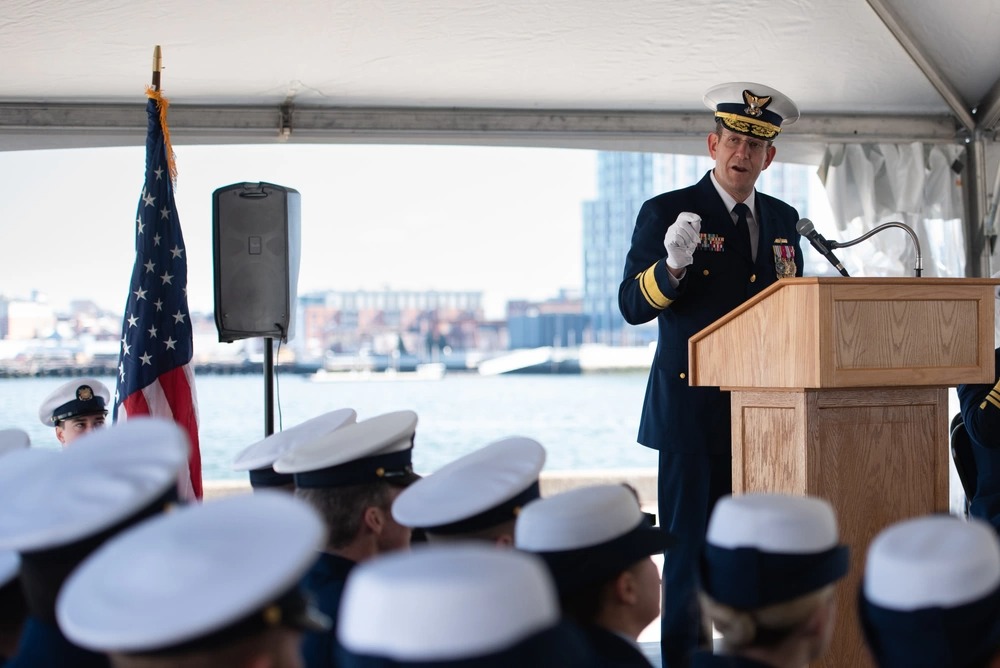
BOSTON — The Coast Guard’s newest cutter, the Coast Guard Cutter Warren Deyampert (WPC-1151), was commissioned at Coast Guard Base Boston, March 30.
Chief Warrant Officer Lance DeFoggi, assumed command of the cutter during a ceremony presided over by Vice Admiral Kevin Lunday, the Coast Guard Atlantic Area commander. The Warren Deyampert is the second of six Fast Response Cutters that will be homeported in Boston, serving along the 1st Coast Guard District.
“This is truly a special moment in our lives and a milestone for our family’s history that will be remembered for generations to come,” said Pamela Jackson, a cousin of Deyampert, and the ship’s sponsor “To the crew, congratulations on the commissioning of the 51st Fast Response Cutter that will bear the name of my cousin, Warren Deyampert. I am so honored to serve as the sponsor and know that this crew will always have a special place in my heart.”
The Sentinel-class fast response cutter (FRC) is designed for multiple missions, including drug and migrant interdiction; ports, waterways and coastal security; fishery patrols; search and rescue; and national defense. The Coast Guard has ordered 65 FRCs to replace the 1980s-era Island-class 110-foot patrol boats. The FRCs feature advanced command, control, communications, computers, intelligence, surveillance and reconnaissance equipment; over-the-horizon cutter boat deployment to reach vessels of interest; and improved habitability and seakeeping.
“Now, we are standing ready, to get underway to perform all of the missions we have been training for in the birthplace of the Coast Guard,” said DeFoggi. “We will strive to embody the words of our motto, ‘Gallantry during grave peril’, as what was written on Deyampert’s award citation”.
Born in Attalla, Alabama, the cutter’s namesake joined the Coast Guard at age 19, and served aboard the Coast Guard Cutter Escanaba during World War II, beginning in August, 1941. Deyampert’s primary role was within the food service rating, but he also served as one of the ship’s three rescue swimmers.
Following a torpedo attack on the U.S. Army transport ship Dorchester in North Atlantic waters on Feb. 3, 1943, Deyampert swam in absolute darkness to rescue survivors in the freezing waters of the North Atlantic. His efforts affected the rescue of more than 100 crewmembers, many of whom were hypothermic and unable to swim.
Four months later, June 13, 1943, the Escanaba sank, following an explosion onboard that was believed to be from a torpedo attack. All but two crewmembers were killed in the explosion. Deyampert was posthumously awarded the Navy and Marine Corps Medal and Purple Heart Medal for his heroic rescue of the Dorchester crew.
Navy to Commission Future Littoral Combat USS Ship Santa Barbara
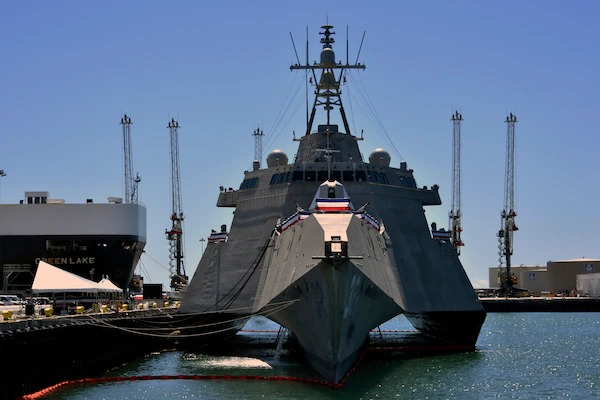
The Navy will commission the future USS Santa Barbara (LCS 32) as the newest Independence- variant littoral combat ship (LCS) during a 10:00 a.m. PST ceremony on Saturday, April 1, in Port Hueneme, Calif., near its namesake city.
The principal speaker is Admiral Samuel Paparo, Commander, U.S. Pacific Fleet. Additional speakers include the Honorable Julia Brownley, U.S. Representative, California’s 26th district; the Honorable Russell Rumbaugh, Assistant Secretary of the Navy, financial management and comptroller; the Honorable Randy Rowse, Mayor of Santa Barbara, Calif; Rear Adm. Casey Moton, program executive officer for unmanned and small combatants; and Mr. Larry Ryder, vice president of business development and external affairs for Austal USA. The ship’s sponsor is Mrs. Lolita Zinke, a Santa Barbara native and wife of the Honorable Ryan Zinke, U.S. Representative, Montana’s first district and former U.S. Interior Secretary.
“The city of Santa Barbara is rich in history, spanning hundreds of years of change and progress that make Santa Barbara an iconic location and a fitting name for LCS 32,” said Secretary of the Navy Carlos Del Toro. “During the second World War, it was home to a Marine Corps Air Station and a Naval Reserve Center. Today, many Veterans and their families continue to call Santa Barbara ‘home.’ Though our Navy and Marine Corps footprint is smaller than in decades past, the spirit of military service and connection with the city of Santa Barbara remains strong.”
LCS 32 is the third United States ship to bear the name Santa Barbara. The first Santa Barbara was a single-screw steel freighter built in 1916 by William Cramp and Sons of Philadelphia. Ordered and taken over by the Navy on February 1, 1918 from the Atlantic & Pacific Steamship Co. of New York, it was commissioned there on April 15, 1918. The second Santa Barbara, a Kilauea-class ammunition ship, was laid down on December 30, 1966 by the Bethlehem Steel Corp., Sparrows Point, MD, launched on January 23, 1968, and commissioned on July 11, 1970.
The LCS class consists of two variants, the Freedom and the Independence, designed and built by two industry teams. Austal USA leads the Independence-variant team in Mobile, Al., for LCS 6 and the subsequent even-numbered hulls, including the future USS Santa Barbara. Lockheed Martin leads the Freedom-variant team, the odd-numbered hulls, in Marinette, Wis.
Littoral Combat Ships are fast, optimally-manned, mission-tailored surface combatants that operate in near-shore and open-ocean environments, winning against 21st-century coastal threats. LCS integrate with joint, combined, manned and unmanned teams to support forward-presence, maritime security, sea control and deterrence missions around the globe.
USS Santa Barbara is homeported at Naval Base San Diego.
The ceremony will be live streamed at: www.dvidshub.net/webcast/31155. The link becomes active approximately ten minutes prior to the event (9:50 a.m. EST).
From by Mark Wright, Missile Defense Agency Public Affairs
PACIFIC OCEAN – The U.S. Missile Defense Agency, in cooperation with the U.S. Navy, successfully conducted Flight Test Aegis Weapon System 31 Event 1a (FTM-31 E1a).
The test demonstrated the capability of a ballistic missile defense (BMD)-configured Aegis ship to detect, track, engage, and intercept a medium range ballistic missile (MRBM) target in the terminal phase of flight utilizing the Standard Missile–6 (SM-6) Dual II with Software Upgrade (SWUP) in a single salvo of two interceptors.
FTM–31 E1a was the third successful flight test of an Aegis BMD-equipped vessel using the SM–6 Dual II missile and the first Aegis Baseline 9.C2.0 (BMD 5.1) intercept of an MRBM target using the SM-6 Dual II SWUP missile.
FTM-31 E1a highlights adjustments made after FTM-31 E1, conducted in May 2021, which did not meet all its objectives. The successful execution of this mission validates that the upgraded SM-6 Dual II SWUP capability is now ready for use by the warfighter in order to defend and protect our allies and deployed forces worldwide.
“This was an incredible accomplishment and key milestone for the Sea-based defense program,” said MDA Director Vice Adm. Jon Hill. “This test proved our capabilities in an operationally realistic scenario, which is a critical step in increasing capability to outpace emerging threats. My congratulations to the entire test team, including our Sailors and our industry partners, who helped us to achieve this milestone.”
The target was launched from the Pacific Missile Range Facility, located on Kauai, Hawaii. The firing ship used for this test was the USS DANIEL INOUYE (DDG 118), which launched two SM-6 Dual II missiles and successfully intercepted the MRBM.
SM-6 delivers over-the-horizon, air defense capability and can perform anti-air warfare, ballistic missile defense, and anti-surface warfare missions. The SM–6 Dual II SWUP missile is designed to defend against short-to-medium range ballistic missiles in the terminal phase of flight.
The Sea Based Terminal (SBT) program, with the Aegis Baseline 9 Weapon System and SM-6 missile, is instrumental in MDA’s efforts to deliver a capability to the Navy to defend high value assets at sea and ashore against advanced threats in the terminal phase of flight. SBT is an incremental and evolving capability for ballistic and regional hypersonic defense capability.
Additional information about all elements of the U.S. Missile Defense System can be found at www.mda.mil.
Please direct all media related queries to Mark Wright, MDA director of public affairs, at 571-231-8212, [email protected] or Nancy Jones-Bonbrest, public affairs officer at 571-231-8211, [email protected].
USCGC Northland returns home following 62-day Florida Straits and Windward Passage patrol
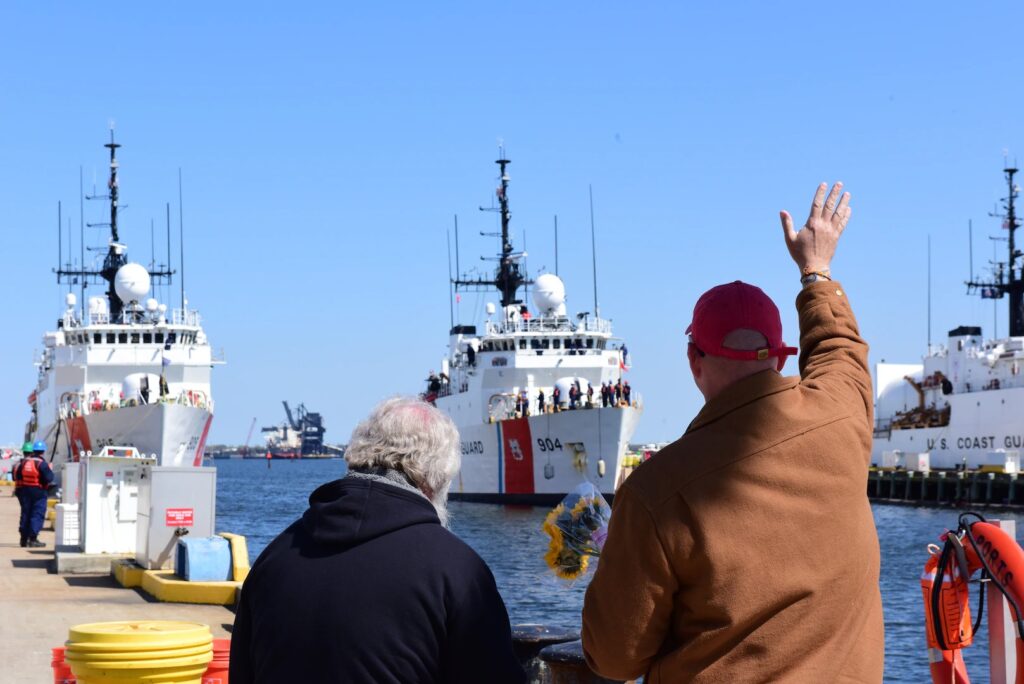
PORTSMOUTH, Va. — The crew of the USCGC Northland (WMEC 904) returned to their home port in Portsmouth, Thursday, following a 62-day maritime safety and security patrol in the Florida Straits and Windward Passage.
Patrolling in support of Homeland Security Task Force – Southeast and Operation Vigilant Sentry in the Seventh Coast Guard District’s area of responsibility, Northland’s crew conducted maritime safety and security missions while working to detect, deter and intercept unsafe and illegal maritime migration ventures bound for the United States.
Northland’s crew interdicted multiple unsafe and overloaded migrant vessels during the patrol, providing food, water, shelter and medical aid to 515 migrants. In one case, Northland partnered with additional Coast Guard air and surface assets to intercept an overloaded, tugboat-style vessel attempting to reach the United States. In another case, Northland was one of the primary assets to respond to a report of multiple people in the water just south of Key West, Florida, rescuing 27 migrants.
“I am immensely proud of the Northland crew,” said Cmdr. Andrew Dennelly, commanding officer of Northland. “Day in and day out, the crew demonstrated they are always ready to deliver exceptional service to the nation. Their inspirational vigilance, professionalism and actions saved hundreds of lives.”
Northland is a 270-foot, Famous-class medium endurance cutter. Its primary missions include law enforcement, search and rescue, drug interdiction, fisheries enforcement, migrant interdiction, homeland security, international training, defense and humanitarian operations. Northland patrols the offshore waters from Maine to Florida, the Gulf of Mexico, the Eastern Pacific and the Caribbean Sea.
For information on how to join the U.S. Coast Guard, visit www.gocoastguard.com to learn more about active duty and reserve officer and enlisted opportunities. Information on how to apply the U.S. Coast Guard Academy can be found here.
Coast Guard crew offloads $166 million worth of counternarcotics in San Diego
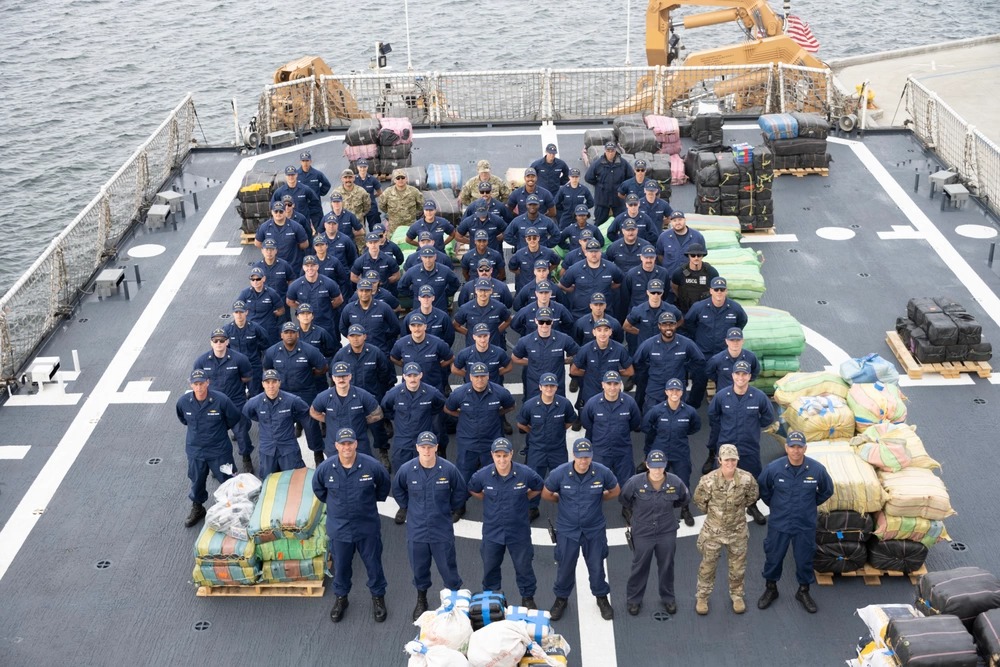
SAN DIEGO — The Coast Guard Cutter Waesche (WMSL 751) crew offloaded more than 6,325 pounds of cocaine and more than 13,220 pounds of marijuana worth more than $166 million, Wednesday, in San Diego.
The five interdictions occurred in international waters in the Eastern Pacific Ocean off the coasts of Central and South America in February and March.
“The Coast Guard is dedicated to preventing illicit drugs from entering our country via the maritime environment,” said Rear Adm. Andrew Sugimoto, Eleventh District commander. “These transnational criminal networks will be met on the water by our vigilant service members, like the crew of the Waesche, at every turn and brought to justice by the U.S. Attorney’s office.”
The counternarcotics were interdicted by the following U.S. Coast Guard cutters:
• Waesche’s crew was responsible for two interdictions seizing approximately 881 pounds of cocaine and 9,500 pounds of marijuana.
• Coast Guard Cutter Steadfast (WMEC 623) crew was responsible for one interdiction, seizing approximately 3,300 pounds of cocaine.
• Coast Guard Cutter Active (WMEC 618) crew was responsible for two interdictions seizing approximately 2,116 pounds of cocaine and 3,716 pounds of marijuana.
“This marks Waesche’s first counter-narcotics patrol in several years and the crew did an outstanding job to work with international and inter-agency partners to successfully prevent $166 million dollars’ worth of illicit drugs from entering our country, cities, and neighborhoods,” said Capt. Robert Mohr, commanding officer of the Waesche. “I am extremely impressed with the crew’s dedication throughout this dynamic patrol. They overcame multiple challenges with collective hard work, ingenuity, and positive attitudes to keep us in pursuit of these cartels and their dangerous drugs. I couldn’t be prouder of this remarkable crew and what they do to protect our communities.”
Numerous U.S. agencies from the Departments of Defense, Justice and Homeland Security cooperate in the effort to combat transnational organized crime. The Coast Guard, Navy, Customs and Border Protection, FBI, Drug Enforcement Administration, and Immigration and Customs Enforcement, along with allied and international partner agencies, play a role in counternarcotic operations.
The fight against drug cartels in the Eastern Pacific Ocean requires unity of effort in all phases from detection, monitoring, and interdictions, to criminal prosecutions by international partners and U.S. Attorneys’ Offices in districts across the nation. The law enforcement phase of counter-smuggling operations in the Eastern Pacific Ocean is conducted under the authority of the Eleventh Coast Guard District, headquartered in Alameda. The interdictions, including the actual boardings, are led and conducted by members of the U.S. Coast Guard.
“Like the United States Coast Guard and our other law enforcement partners, we are always ready to bring drug smugglers to justice in court,” said Sean P. Costello, United States attorney for the Southern District of Alabama. “Disrupting and dismantling the organizations responsible for transporting and distributing this poison remains among our highest priorities.”
The Waesche is the second Legend-class cutter of the U.S. Coast Guard and is homeported at Coast Guard Island in Alameda. The Waesche is 418 feet long with a top speed of 28 knots and a range of 12,000 nautical miles. It is equipped with a flight deck and hangars capable of housing two multi-mission helicopters, and outfitted with the most advanced command, control, and communications equipment.