U.S. Central Command Supports Partner Forces in Major Iranian Weapons Seizure 

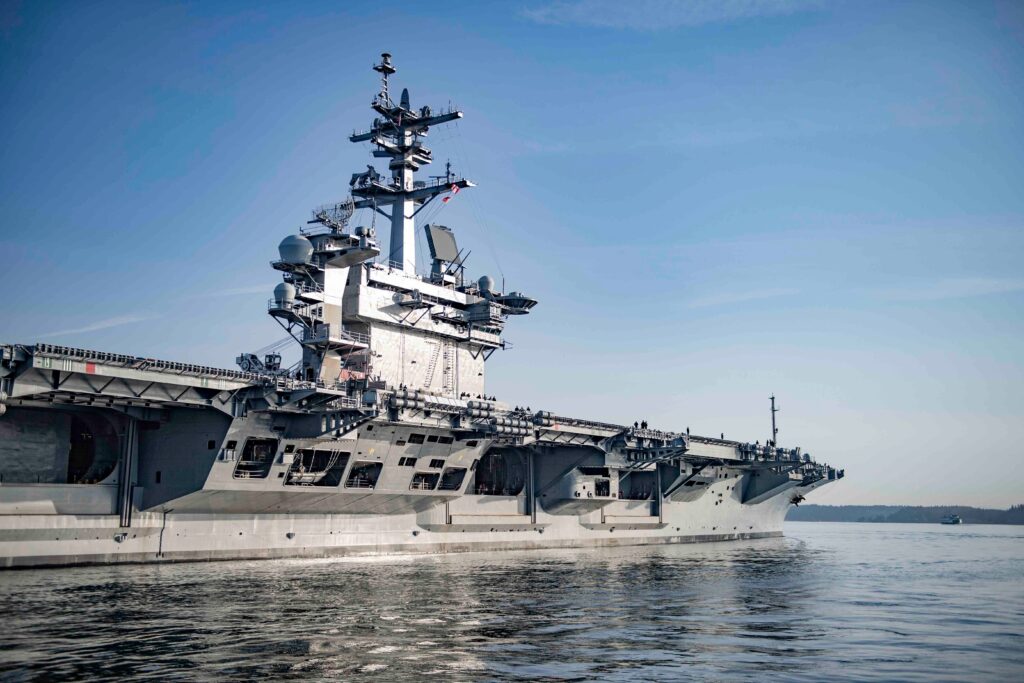
Seized weapons displayed on the flight deck of a U.S. Navy ship in the U.S. 5th Fleet area of operations, Feb. 1

Release from U.S. Central Command Public Affairs

******* 

By U.S. Central Command Public Affairs | February 02, 2023 

TAMPA, Fla. — 

U.S. Central Command supported a maritime interdiction earlier this month that resulted in the seizure by partner naval forces of weapons that originated in Iran and were bound for Yemen. 

The interdiction took place in the Gulf of Oman on Jan. 15, along routes historically used to traffic weapons unlawfully from Iran to Yemen. More than 3,000 assault rifles, 578,000 rounds of ammunition and 23 advanced anti-tank guided missiles were recovered. 

CENTCOM and partner naval forces regularly conduct regional maritime security operations. The seizure is one of four significant illicit cargo interdictions over the past two months that have prevented more than 5,000 weapons and 1.6 million rounds of ammunition from reaching Yemen. 

CENTCOM forces previously intercepted a fishing vessel Jan. 6 in the Gulf of Oman and discovered it smuggling more than 2,100 assault rifles along a maritime route from Iran to Yemen. 

In 2021, CENTCOM prevented 9,000 illegal weapons from reaching Yemen, representing a 200% increase in the number of weapons seized over the previous year. In 2022, CENTCOM Maritime assets and partner forces seized weapons components for the same type of cruise missiles launched in attacks against Saudi Arabia and the United Arab Emirates earlier in the year. In December 2022, U.S. naval forces also seized explosive precursor materials that included 140 tons of urea fertilizer, 70 tons of ammonium perchlorate, and 50 tons of ammunition rounds, fuses, and propellants for rockets. 


MSC CHARTERED SHIP MV OCEAN GIANT CONDUCTS CARGO OPERATIONS AT MCMURDO STATION ANTARCTIC IN SUPPORT OF OPERATION DEEP FREEZE 2023 

Materials are staged to be loaded onto the Military Sealift Command chartered ship MV Ocean Giant.

Release from Military Sealift Command 

******* 

By Sarah Cannon, MSC Pacific

31 January 2023 

PORT HUENEME, Calif. –  

Military Sealift Command-chartered container ship MV Ocean Giant is currently conducting cargo offloads in one of the most remote and challenging environments on the planet; McMurdo Station, Antarctica. The operation is part of MSC’s annual resupply mission in support of Operation Deep Freeze, the Joint Task Force Support for Antarctica mission to resupply the remote scientific outpost. 
 
Seabees from Navy Cargo Handling Battalion ONE (NCHB -1) and NCHB 5 are working around-the-clock offloading the cargo which consists of 443 pieces of cargo, which include containers filled with mechanical parts, vehicles, construction materials, office supplies and electronics equipment and vehicles. The supplies will provide nearly 80 percent of the items needed for survival over the severe arctic winter over period when the station is cutoff from the rest of the world. The Cargo Handlers work with Ocean Giant’s crew, and the MSC representative, to execute a safe and efficient offload and backload of a variety of cargo, as well as with the Antarctic Support Contract logistics team who manage the loads and stow plans for United States Antarctic Program, as well as the New Zealand Defense Force who assist with rigging and transporting loads from the pier to designated laydown areas. 
 
Ocean Giant’s mission began in late December in Port Hueneme, Calif., where the ship was loaded with cargo. From Port Hueneme, the ship sailed to Lyttelton, New Zealand where they took on additional cargo and then transited to Antarctica. 
 
In years past, Ocean Giant would have arrived at the ice-pier at McMurdo Station; a structure made up of rebar and frozen seawater, where cargo offloads were conducted. Due sever damage, the ice-pier was unavailable this year, so Ocean Giant delivered a Marine Causeway System. The 65-ton pier consists of ten, 24-foot, pre-assembled pieces. Six string units were assembled on deck placed into the water and then and joined into two sections. These sections were attached to the others to form the final pier. 
 
Upon completion of their cargo offload, Ocean Giant will load containers of retrograde as well as ice-core samples for scientific study, and return to Port Hueneme. 
 
Operation Deep Freeze is a joint service, on-going Defense Support to Civilian Authorities activity in support of the National Science Foundation (NSF), lead agency for the United States Antarctic Program. Mission support consists of active duty, Guard and Reserve personnel from the U.S. Air Force, Navy, Army, and Coast Guard as well as Department of Defense civilians and attached non-DOD civilians. ODF operates from two primary locations situated at Christchurch, New Zealand and McMurdo Station, Antarctica. An MSC-chartered cargo ship and tanker have made the challenging voyage to Antarctica every year since the station and its resupply missions were established in 1955. 


New Deputy Commander for the Supervision of Shipbuilding, Conversion, and Repair Established 

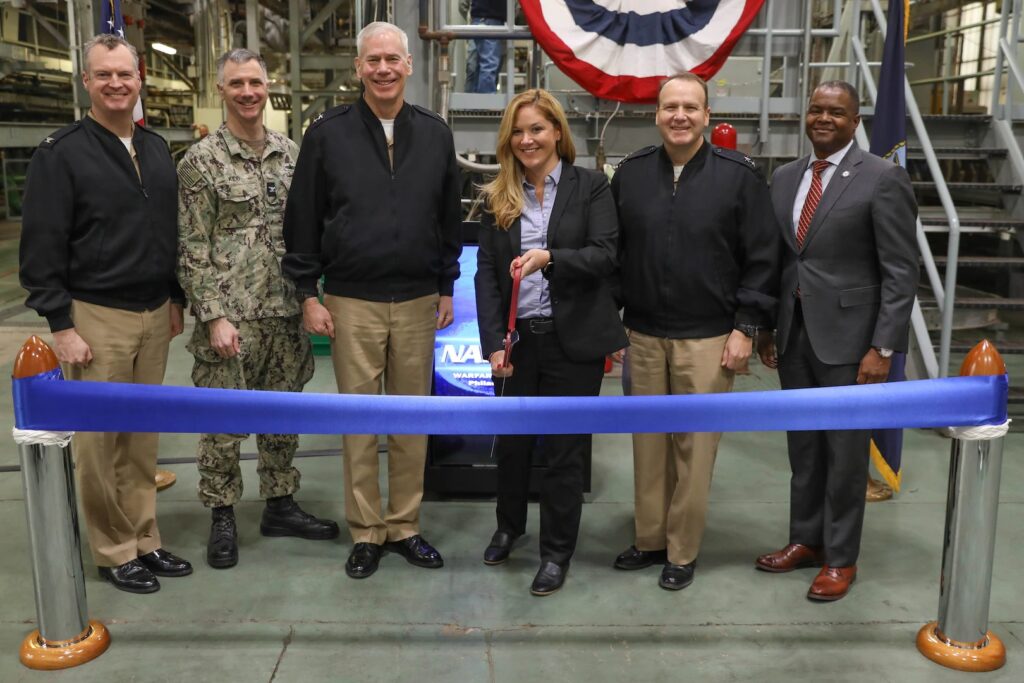
Ms. Karen M. Davis
Executive Director, Surface Warfare Naval Sea Systems Command

Release from Naval Sea Systems Command  

******* 

By NAVSEA Office of Corporate Communications 

WASHINGTON — In accordance with the Fiscal 2022 National Defense Authorization Act (NDAA), Naval Sea Systems Command (NAVSEA) established a new position, Deputy Commander for the Supervision of Shipbuilding, Conversion, and Repair (SUPSHIP). 

Acting Assistant Secretary of the Navy for Research, Development, and Acquisition, Frederick J. Stefany, designated that the Senior Executive Service (SES) member who serves as the NAVSEA’s Executive Director for Industrial Operations (NAVSEA 04B) will also serve as the Deputy Commander for SUPSHIPs. Ms. Karen M. Davis now serves as the first dual-hatted Deputy Commander for SUPSHIPs and NAVSEA 04 Executive Director. 

“This new position elevates supervisor of shipbuilding by having an SES serve as the conduit between the supervisors and the NAVSEA Commander,” said Vice Adm. Bill Galinis, NAVSEA commander. “This change helps ensure NAVSEA is better focused on delivering ships to the Fleet on time.” 

The responsibilities of the new deputy commander will include oversight of the independent administration and management of the execution of the Department of Defense contracts awarded to commercial entities for shipbuilding, conversion, and repair at the facilities of such entities; oversight of the designated contract administration office of the department responsible for performing contract administration services for such contracts; and enforcement of requirements of such contracts to ensure satisfaction of all contractual obligations.  

To learn more about NAVSEA, please visit us at https://www.navsea.navy.mil/ and stay connected with us on social media at http://www.facebook.com/NAVSEA; http://twitter.com/NAVSEA; and http://www.linkedin.com/company/NAVSEA


DARPA Selects Performer Teams for Liberty Lifter X-Plane Program 

First phase will define the seaplane’s design and capabilities 

Release from Defense Research Projects Agency 

******* 

Two teams — General Atomics working with Maritime Applied Physics Corporation and Aurora Flight Sciences working with Gibbs & Cox and ReconCraft — will develop designs for DARPA’s Liberty Lifter Seaplane Wing-in-Ground Effect full-scale demonstrator. The Liberty Lifter program aims to demonstrate a leap-ahead in operational capability by designing, building, floating, and flying a long-range, low-cost X-Plane capable of seaborne strategic and tactical heavy lift. 

The planned Liberty Lifter demonstrator will be a large flying boat similar in size and capacity to the C-17 Globemaster III transport aircraft. Goals include takeoff and land in Sea State 4, sustained on-water operation up to Sea State 5, and extended flight close to the water in ground effect with the capability to fly out of ground effect at altitudes up to 10,000 feet above sea level. 

“We are excited to kick off this program and looking forward to working closely with both performer teams as they mature their point-of-departure design concepts through Phase 1,” said DARPA Liberty Lifter Program Manager Christopher Kent. “The two teams have taken distinctly different design approaches that will enable us to explore a relatively large design space during Phase 1.” 

The General Atomics team has selected a twin-hull, mid-wing design to optimize on-water stability and seakeeping. It employs distributed propulsion using twelve turboshaft engines. 

Aurora Flight Sciences point-of-departure design more closely resembles a traditional flying boat, with a single hull, high wing and eight turboprops for primary propulsion. 


GA-ASI FLIGHT TESTS LEO SATCOM ON MQ-9A  

Release from GA-ASI 

******* 

Capability Provides Global Coverage That Enables Operations Anywhere in the World 

SAN DIEGO – 02 February 2023 – On Dec. 22, 2022, General Atomics Aeronautical Systems, Inc. (GA-ASI) and the Air National Guard (ANG), with joint support from the U.S. Marine Corps (USMC) and U.S. Air Force (USAF), flight tested an MQ-9A remotely piloted aircraft (RPA) equipped with a Low Earth Orbit (LEO) satellite communications (SATCOM) Command and Control system. This groundbreaking capability provides global coverage and connectivity that will enable pole-to-pole operations for GA-ASI’s family of RPA – including models such as the MQ-9B SkyGuardian®/SeaGuardian®, MQ-9A Reaper, and Gray Eagle 25M.  

“This is truly game-changing for our platforms,” said GA-ASI President David R. Alexander. “Using LEO SATCOM not only keeps GA-ASI aircraft connected from the North Pole to the South Pole to allow operations in the most austere environments, but it will also provide resilient connectivity that allows operators to pass much more data to and from the aircraft.” 

Early testing indicates LEO SATCOM significantly reduces latency and can be used in all phases of flight. For customers across the MQ-9 family of systems, LEO SATCOM should decrease operational costs, and the smaller hardware footprint will ultimately increase flexibility and reduce future payload integration costs.  

The MQ-9A flight test was based out of GA-ASI’s Gray Butte Flight Operations Facility near Palmdale, Calif., and followed several weeks of ground testing.  


BAE Systems part of contract award supporting CANES program 

Release from BAE Systems 

******* 

BAE Systems part of contract award supporting CANES program 

MCLEAN, Va. – Feb. 2, 2023 – BAE Systems has been awarded a contract by the Naval Information Warfare Systems Command (NAVWAR) for the Consolidated Afloat Networks and Enterprise Services (CANES) program. The total value of the 10-year indefinite delivery, indefinite quantity (IDIQ) contract is $4.1 billion. BAE Systems is one of eight companies that will be competing for work on the IDIQ program.  

“We look forward to continuing to support the Navy’s CANES mission to update shipboard networks to improve fleet operations,” said Lisa Hand, vice president and general manager of BAE Systems Integrated Defense Solutions. “Our team has a legacy of exceptional quality and production support to NAVWAR, ensuring timely and critical modernization of the afloat networks.”  

CANES is the Navy’s next-generation tactical afloat network and represents a key aspect of the service’s modernization planning by upgrading cybersecurity, command and control, communications, and intelligence systems afloat, and by replacing unaffordable and obsolete networks. Under the terms of the contract, BAE Systems will be responsible for the procurement and production of afloat network devices, spares, laboratory equipment, initial software, software renewal, and maintenance services for surface, shore, and submarine platforms. 

BAE Systems has been supporting the CANES program for the past eight years by sourcing, assembling, testing, and delivering CANES production units for large deck surface ships in Summerville, South Carolina.  


Textron Systems’ Aerosonde® Unmanned Aircraft System (UAS) Takes First Maritime Flight Aboard USS Miguel Keith (ESB 5)  

Release from Textron Systems 

******* 

“Having an unmanned aircraft system operational aboard the ship acting as a remote sensor contributes to overall maritime domain awareness and mission success,” said Wayne Prender, Senior Vice President, Air Systems. “The Aerosonde system is providing added reach beyond the horizon and an ability to operate multi-INT ISR consistently, both great examples of the benefits of teaming unmanned aircraft with manned ships.”  

In addition to the USS Miguel Keith, the Aerosonde unmanned system supports maritime operations aboard the USS Hershel “Woody” Williams (ESB 4) and two DDG-class ships, bringing the total number of U.S. Navy ships supported by the system to four.  

The Aerosonde system has amassed more than 600,000 flight hours while serving multiple U.S. customers and international allies. It is designed for expeditionary land- and sea-based operations in austere environments and is equipped for multiple payload configurations.  


Navy Is Sustaining 10 Operational MQ-8C Fire Scout UAVs; Rest in Storage

******* 

ARLINGTON, Va. — The U.S. Navy is operating and sustaining 10 MQ-8C Fire Scout unmanned aerial vehicles (UAVs), having place the rest in storage, from which the service can easily restore them to service. The Navy also has retired its fleet of smaller MQ-8B versions of the Fire. 

According to information provided by the Navy’s Program Executive Office for Strike and Unmanned Aviation, the Navy will keep in service 10 MQ-8Cs in service of the 38 procured and keep the remaining MQ-8Cs in Level 2 preservation. 

Last year the Navy moved to keep all MQ-8Cs on the West Coast, operated by Helicopter Sea Combat Squadrons 21 and 23. The decision is congruent with the stationing on the West Coast of the Independence-class littoral combat ships on which the Navy will deploy the Mine Countermeasures Mission Package. The MQ-8C, built by Northrop Grumman, is an integral module of that mission package.  

“As Fire Scout’s mission sets continued to evolve, an MQ-8C Endurance Upgrade Rapid Deployment Capability (RDC) effort was approved in Feb 2012,” the Navy said. “The larger MQ-8C, based on the Bell 407 airframe, incorporates the same control avionics as the MQ-8B but with an increased payload capacity and increased endurance. The air vehicles share a common mission control system, which is integrated with the ship’s combat systems. Additionally, the MQ-8 can be controlled by the Mobile Mission Control Station from land-based and larger ship-based sites and has developed a “portable” MCS (MCS-P) that is host platform agnostic. 

“Designed to operate from the Littoral Combat Ship (LCS) and Suitably Equipped air-capable Ships, the MQ-8C Fire Scout system is capable of more than eight hours of operations providing coverage out to 150 nautical miles from the host ship,” the Navy said. “A baseline payload that includes electro-optical/infrared sensors and a laser designator enables Fire Scout to find, track and designate tactical targets, accurately provide targeting data to strike platforms and perform battle damage assessment. The system provides a significant improvement to organic surveillance capability.”  

The Navy will add an optical mine countermeasures payload to the MQ-8C in the future. 

The first deployments of the MQ-8C began in 2022 on USS Milwaukee in the 4th Fleet and USS Jackson in the 7th Fleet during 2022.  

The Navy retired its fleet of MQ-8Bs by October 2022 after 13 years of operations, including operations from frigates off Libya and two years of operations inside Afghanistan. The MQ-8B deployed on board an LCS for the first time in 2014. The Navy procured a total of 30 MQ-8Bs from Northrop Grumman. 


RMC Appoints Retired Four-Star Navy Admiral James Foggo III as Board Chair 

Release from RMC

******* 

Appointment reflects firm’s growth trajectory in defense and commercial markets   

ARLINGTON, Va., Jan. 31, 2023 RMC, the leader in Mission Assurance, Risk Management and Industrial Cybersecurity solutions, today announced the appointment of Admiral James Foggo III, U.S. Navy (Ret.) as Chairperson of its Board of Directors. The appointment will support the company’s high-growth trajectory in the defense and commercial markets. Foggo, a senior executive, industry leader and distinguished military officer, has served on the RMC Board since 2021.  

Foggo is an accomplished strategist, innovator, diplomat and technology integrator who achieved the rank of four-star admiral, formerly serving as commander of the U.S. Naval Forces Europe and Naval Forces Africa as well as the U.S. Sixth Fleet. He currently is Dean of the Center for Maritime Strategy at the Navy League of the United States and a distinguished fellow of the Center for European Policy Analysis and the Council on Competitiveness.  

“Admiral Foggo sits at the intersection of federal, commercial and public interests, providing a unique and expert perspective on the dynamic threats facing our world,” said Vince Kuchar, CEO of RMC. “We are grateful for his invaluable leadership as we expand our mission assurance work and bring military-grade industrial cybersecurity expertise to the commercial sector.”  

Mission Assurance 

RMC has been delivering mission assurance and cybersecurity solutions to U.S. military leaders worldwide for more than a decade. As cyber adversaries increasingly gain malicious access through neglected and unsecured operational technology and industrial control systems, the company has been supporting a growing number of defense and commercial organizations to better protect their operational assets and critical infrastructure.  

“In our growing and complex global threat environment, RMC is helping reduce risks to the critical systems upon which our way of life depends,” said Foggo. “I’m excited to support RMC in harnessing their immense expertise for efficient, accelerated growth.”   

About RMC 

RMC provides a full lifecycle of Mission Assurance and Risk Management solutions, with deep expertise in Critical Infrastructure Protection and Industrial Cybersecurity, to protect our country’s most important and vital assets. Operating worldwide, RMC provides federal government and commercial organizations the analysis, assessments, strategy and remediation required to protect personnel, facilities, networks and critical infrastructure. Founded in 2011, RMC’s headquarters is in Arlington, Virginia. www.RMCGlobal.com 


U.S., International Forces Seize Illegal Drugs in Gulf of Oman

GULF OF OMAN (Jan. 30, 2023) Illicit drugs interdicted by USCGC Emlen Tunnell (WPC 1145) sit on the deck of a fishing vessel for inventory as the U.S. Coast Guard cutter sails in the Gulf of Oman, Jan. 30. (U.S. Coast Guard photo) (Photo by U.S. Coast Guard)

Release from U.S. Naval Forces Central Command Public Affairs 

******* 

By U.S. Naval Forces Central Command Public Affairs | January 31, 2023 

MANAMA, Bahrain — 

A U.S. Coast Guard vessel seized illegal drugs worth a total estimated U.S. street value of $33 million from a fishing vessel transiting international waters in the Gulf of Oman, Jan. 30. 

U.S. Coast Guard cutter USCGC Emlen Tunnell (WPC 1145) was patrolling regional waters in support of Combined Task Force (CTF) 150 when it seized 4,000 kilograms of hashish and 512 kilograms of methamphetamine from the smuggling vessel. 

Currently led by the United Kingdom Royal Navy, CTF 150 is one of four task forces organized under the Combined Maritime Forces (CMF). This was the first drug seizure in 2023 for CMF. 

“This is just the beginning of our work in delivering maritime security operations in the region to stop illicit activities and drug smuggling,” said UK Royal Navy Capt. James Byron, the CTF 150 commander. “This comes as a result of a valued partnership between CTF 150 and all partner nations in Combined Maritime Forces.” 

Byron assumed command of the multinational task force Jan. 18 after Royal Saudi Navy Rear Adm. Abdullah Al-Mutairi led the unit for six months. 

Under Al-Mutairi’s leadership, CTF 150 ships logged more than 10,000 hours on regional patrols and intercepted six shipments of illegal drugs that included opium, heroin, hashish and amphetamines. The combined estimated value of the seized drugs totaled more than $250 million. 

Since 2021, CMF has interdicted $1 billion worth of illicit narcotics during maritime patrols. CMF is the largest international naval partnership in the world consisting of 38 member-nations and partners.