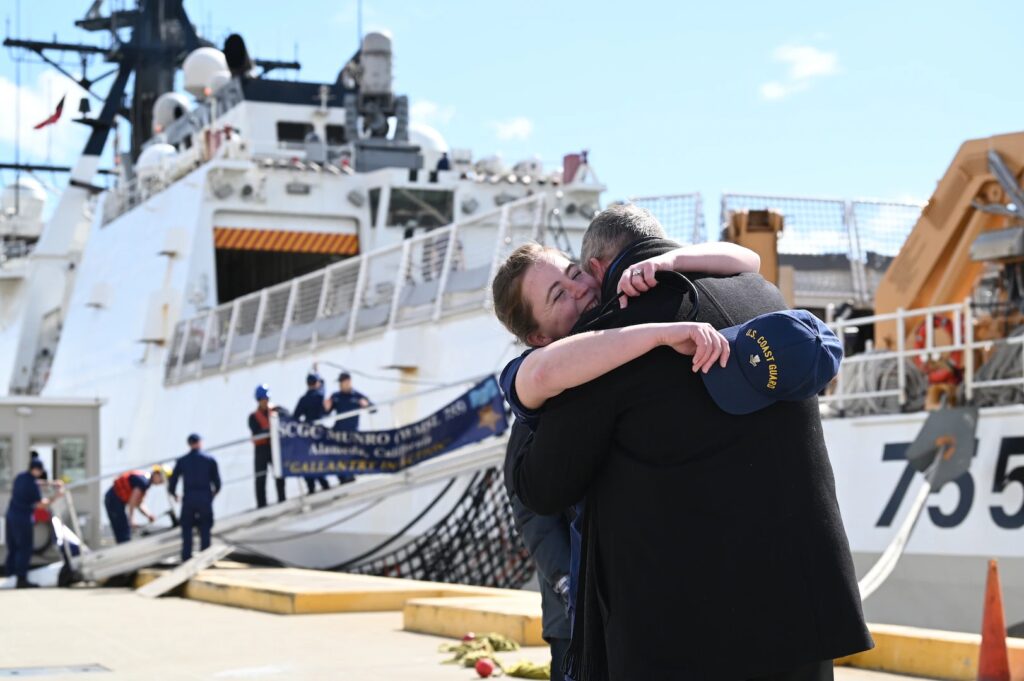
ALAMEDA, Calif. — The Coast Guard Cutter Munro (WMSL 755) and crew returned home to Alameda, Monday, following a 105-day, 10,000-nautical mile Alaska patrol.
Munro partnered with NOAA Office of Law Enforcement personnel to conduct 24 boardings of commercial fishing vessels with the goal of enforcing sustainable fishing practices and ensuring compliance with federal regulations.
During the patrol, the Munro and crew served as the primary search and rescue (SAR) asset in the Bering Sea.
“The continued existence of these fisheries depends on a healthy and productive ecosystem,” said Capt. Rula Deisher, Munro’s commanding officer. “As a federal law enforcement agency, it is the Coast Guard’s responsibility to ensure the longevity of these resources and safety of the fishing fleet. We’re happy to do our part combating unsustainable fishing and promoting maritime commerce that is essential to a strong U.S. economy.”
The crew performed 452 flight evolutions with five separate aircraft from Air Station Kodiak, Alaska, qualifying seven pilots and ensuring SAR readiness in the region.
“A winter patrol in the Bering Sea is the ultimate test of the cutter and crew,” said Deisher. “I am so proud of the women and men of the Munro who braved the elements, operating in the Arctic region to protect our nations resources and fishers.”
Commissioned in 2017, Munro is named for Signalman First Class Douglas A. Munro, the only Coast Guardsman awarded the Congressional Medal of Honor in 1942 for his actions and sacrifice in the defense, rescue, and evacuation of a U.S. Marine battalion from Point Cruz at Guadalcanal in the Solomon Islands.
Munro is one of four Legend-class national security cutters homeported in Alameda. National security cutters are 418-feet long, 54-feet wide, and have a 4,600 long-ton displacement. They have a top speed of more than 28 knots, a range of 12,000 nautical miles, endurance of up to 90 days, and can hold a crew of up to 170. These cutters are the centerpiece of the U.S. Coast Guard’s fleet, capable of executing the most challenging operations, including supporting maritime homeland security and defense missions at home and abroad.
SECNAV Renames Pathfinder-class Oceanographic Survey Ship USNS Maury after Marie Tharp
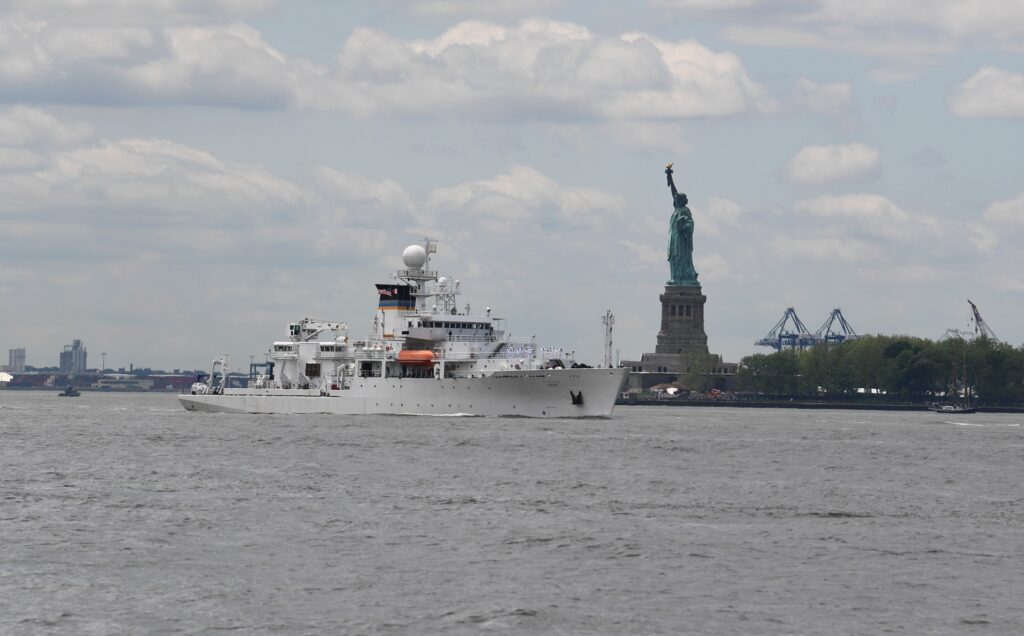
During the parade of ships, USNS Maury (T-AGS 66) passes Lady Liberty on the way into port as part of Fleet Week New York, May 23, 2018. Marines, Sailors, and Coast Guardsmen are in New York to interact with the public, demonstrate capabilities and teach the people of New York about America’s sea services. (U.S Marine Corps photo by Sgt. Annika Moody)
SECNAV Renames Pathfinder-class Oceanographic Survey Ship USNS Maury after Marie Tharp
08 March 2023
Today, on International Women’s Day, Secretary of the Navy (SECNAV) Carlos Del Toro announced that the Pathfinder-class oceanographic survey ship formerly named USNS Maury (T-AGS 66) has been renamed USNS Marie Tharp (T-AGS 66).
This renaming honors Marie Tharp, a pioneering geologist and oceanographic cartographer who created the first scientific maps of the Atlantic Ocean floor and shaped our understanding of plate tectonics and continental drift.
The decision arrived after a congressionally mandated Naming Commission outlined several military assets across all branches of service that required renaming due to confederate ties. In September 2022, Secretary of Defense Lloyd Austin accepted all recommendations from the naming commission and gave each service until the end of 2023 to rename their assets.
“I’m pleased to announce the former USNS Maury will be renamed in honor of pioneering geologist and oceanographic cartographer, Marie Tharp. Her dedication to research brought life to the unknown ocean world and proved important information about the earth, all while being a woman in a male-dominated industry,” said Del Toro. “As the history of our great Nation evolves, we must put forth the effort to recognize figures who positively influenced our society. This renaming honors just one of the many historic women who have made a significant impact on not only our Navy, but our Nation.”
Tharp was born in 1920 and graduated from the Ohio University in 1943. Due to WWII, more women were recruited into a variety of professions, prompting the University of Michigan to open their geology program to women, resulting in Tharp completing her master’s degree in 1944. After working in her field for a few years, Tharp became one of the first women to work at the Lamont Geological Observatory. During this time she met Bruce C. Heezen (namesake of T-AGS 64) and worked together using photographic data to locate downed military aircraft from WWII. Between 1946 and 1952, Woods Hole Oceanographic Institute’s research vessel, Atlantis, used sonar to obtain depth measurements of the North Atlantic Ocean, which Tharp, in collaboration with her colleague, Heezen, used to create highly detailed seafloor profiles and maps. While examining these profiles, Tharp noticed a cleft in the ocean floor that she deduced to be a rift valley that ran along the ridge crest and continued along the length of its axis, evidence of continental drift. At the time, the consensus of the U.S. scientific community held continental drift to be impossible, but later examination bore out Tharp’s hypothesis. Her work thus proved instrumental to the development of Plate Tectonic Theory, a revolutionary idea in the field of geology at the time. Owing to this and other innovative mapping efforts (some which the Navy funded), the National Geographic Society awarded Tharp its highest honor, the Hubbard Medal, placing her among the ranks of other pioneering researchers and explorers such as Sir Ernest Shackleton, Charles Lindbergh, and Rear Admiral Richard E. Byrd.
The logistical aspects associated with renaming the ship will begin henceforth and will continue until completion with minimal impact on operations and the crew.
T-AGS 66 was accepted in 2016 and named USNS Maury (T-AGS 66) after Commander Matthew Fontaine Maury, the “Father of Modern Oceanography” who resigned from his Navy career to accept a command in the Confederate States Navy. The former USNS Maury was the only US Navy Vessel named after a Confederate military officer. T-AGS 66 is currently assigned to Military Sealift Command and is in the Persian Gulf.
ONE TEAM, NSWC PCD brings flexibility to the future of diving
ONE TEAM, NSWC PCD brings flexibility to the future of diving
By Jeremy Roman, NSWC PCD Public Affairs
PANAMA CITY, Fla. –
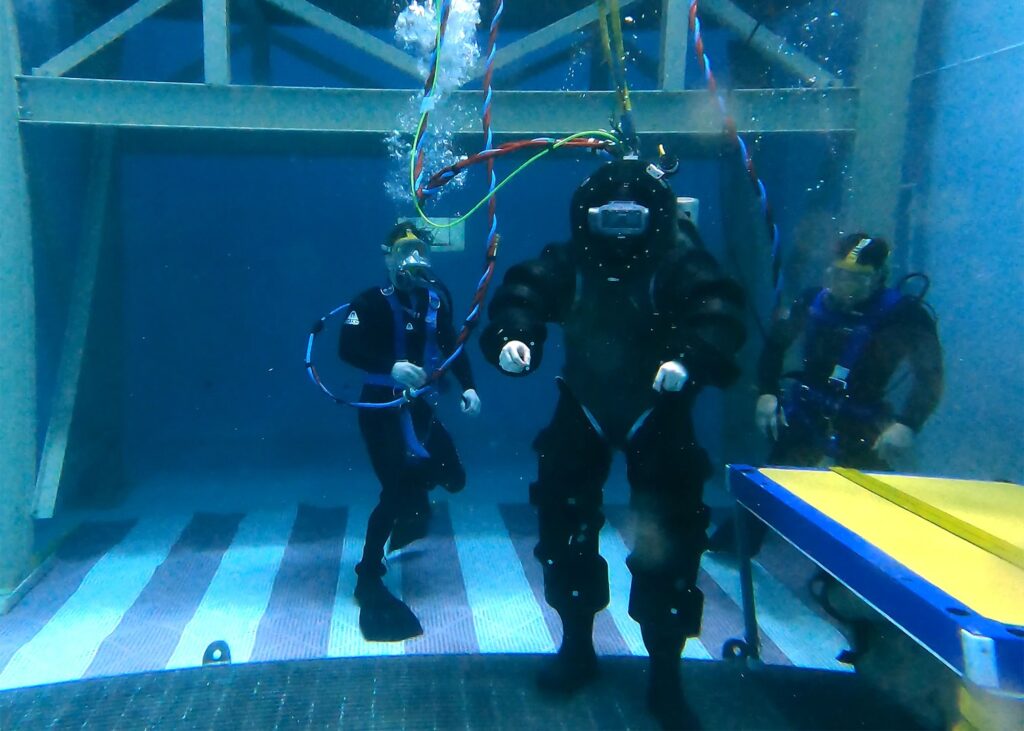
After months of planning, the mission to rapidly deliver solutions to ensure warfighting dominance moved one step closer during the Deep Sea Expeditionary with No Decompression (DSEND) Suit In-Water Concept Demonstration held at the U.S. Navy Experimental Diving Unit (NEDU), Feb. 7 – 8.
The DSEND demo tested the capabilities of a new concept suit aimed to help divers navigate their environment more efficiently. Allie Williams, Naval Surface Warfare Center Panama City Division (NSW PCD) Fleet Diving In-Service Engineering Agent, explained some of the highlights from this successful demonstration.
“This test was conducted as a proof of concept demonstrating the DSEND suit’s flexibility and maneuverability under the diver’s own power,” said Williams. “The operator was [also] wearing a Divers Augmented Vision Display (DAVD) system inside the suit to demonstrate the future permanent integration of DAVD, as well.”
While performance-capable, the current Atmospheric Diving Suit (ADS) is also heavy, lacks maneuverability and requires relatively large sea craft for deployment. This project aims to innovate the previous ADS on several fronts including improvements to its current rotary joint design. For example, the current ADS does not allow movement in the same direction as natural human joints, which can contribute to diver fatigue. This new suit concept would enhance a diver’s range of motion, without considerable strain or force, while providing the added benefit of allowing the user to swim independent of propulsion systems.
An additional program objective is to develop a swimmable dive suit that maintains atmospheric pressure internal to the suit and can withstand pressures up to 300 feet of seawater (fsw). Further development could enable it to greater depths.
“The demo went well and served as a good proof of concept for the project. We received good feedback and it was valuable to have the chance for follow-on testing,” said Williams. “This program will provide new capabilities to the warfighter by creating a more flexible and lightweight ADS, compared to the previous more costly and burdensome capabilities.”
Not only does this demonstration move the project closer to interoperability capability, it also strengthens partnerships through the organizational collaboration of Naval Sea Systems Command 00C3, Office of Naval Research 342, NSWC PCD, Naval Undersea Warfare Center Keyport, Nuytco Research, Mide Technology, Coda Octopus and NEDU. They will continue their respective work to complete their primary objective, which is to develop a suit that will replace the 300 fsw Mixed Gas Diving Systems and eventually go to greater depths.
Secretary of Defense Lloyd J. Austin III announced today that the president has made the following nomination:
Navy Vice Adm. Karl O. Thomas for reappointment to the grade of vice admiral, and assignment as deputy chief of naval operations for information warfare, N2/N6, Office of the Chief of Naval Operations; and director of naval intelligence, Washington, D.C. Thomas is currently serving as commander, Seventh Fleet, Yokosuka, Japan.
Saildrone surveyed more than 45,000 square kilometers of previously unknown ocean floor around Alaska’s Aleutian Islands and off the California coast to address ocean exploration gaps in remote areas.
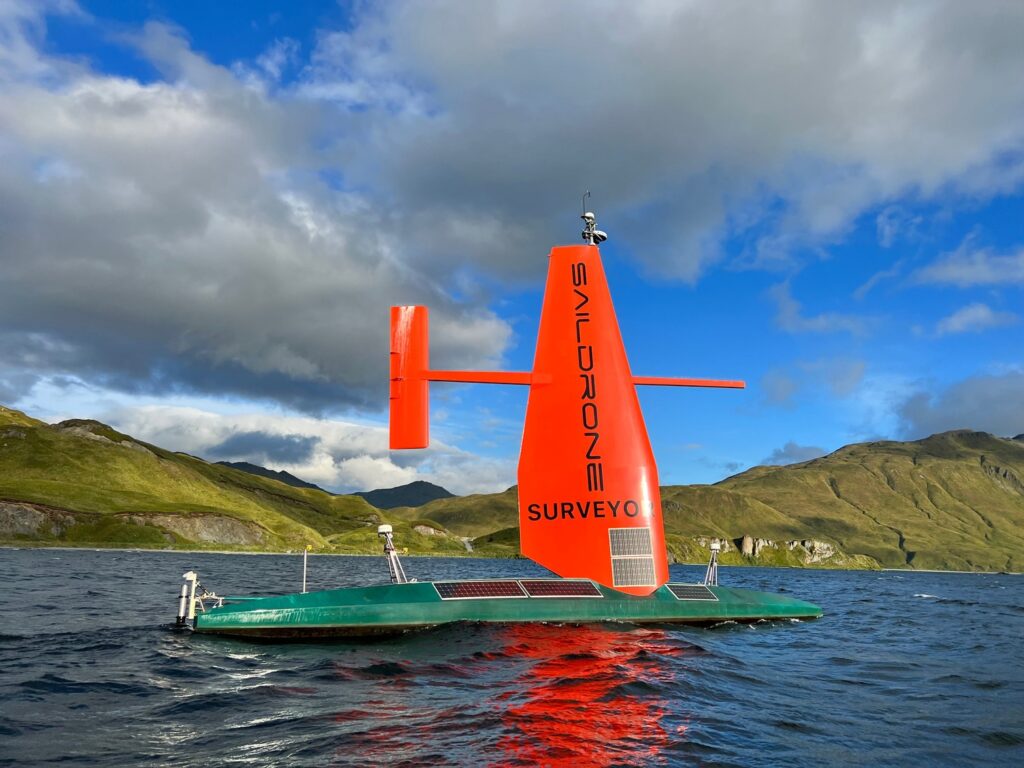
(March 7, 2023 – ALAMEDA, CA) – The Saildrone Surveyor, the world’s largest uncrewed ocean mapping vehicle, has completed a months-long survey around Alaska’s Aleutian Islands and off the coast of California as part of a multi-agency public-private partnership funded by the National Oceanic and Atmospheric Administration (NOAA) and the Bureau of Ocean Energy Management (BOEM) to address ocean exploration gaps in remote areas with uncrewed surface vehicles (USVs).
The United States Exclusive Economic Zone (EEZ), stretching from the coast to 200 nautical miles from shore, is one of the largest in the world, but it is largely still unmapped, unobserved, and unexplored. In terms of area, Alaska is by far the least mapped region of the US EEZ.
Saildrone Surveyor SD 1200 departed Saildrone HQ in Alameda, CA, to sail across the North Pacific to the survey area in July 2022. Between August and October, it mapped 16,254 square kilometers (4,739 square nautical miles) of unknown seafloor around the Aleutian Islands over 52 days. During the mission, the Surveyor also carried technology from the Monterey Bay Aquarium Research Institute (MBARI) to sample environmental DNA (eDNA). Outfitted with the Environmental Sample Processor (ESP) — a groundbreaking “lab in a can” — the Surveyor was able to collect important clues about marine biodiversity and ocean health from the genetic “fingerprints” left behind by marine life.
Severe weather is the norm in the Aleutian region, but the Surveyor continued to collect high-quality data even in 35-knot winds and wave swells over 5 meters (16 feet) — conditions that would have proved too challenging for most crewed survey vessels.
The Surveyor is a force multiplier to the existing ocean exploration paradigm and can be combined with a traditional survey ship to cost-effectively broaden operations: Collected data will be used to optimize dive targets during upcoming expeditions on NOAA Ship Okeanos Explorer.
“Every American, in one way or another, depends on the ocean—from protein from fish to feed animals or humans, to deep-sea cables that make the internet possible. The only way the US can maximize our ocean resources is to understand what’s there. This mission is the first step to mapping the seafloor of key regions in Aleutian waters in high resolution. The beauty of the Surveyor is getting that initial exploration step done faster, cheaper, and without as much staff,” said Dr. Aurora Elmore, Cooperative Institute Manager at NOAA Ocean Exploration.
During the second half of the mission off the coast of California, the Surveyor mapped an additional 29,720 square kilometers (8,665 square nautical miles) of the US EEZ and discovered a previously unknown seamount standing approximately 1,000 meters (3,200 feet) high. Identifying such seamounts improves our understanding of the physical processes of the ocean and identifies areas needing further exploration as unique habitats.
“Surveyor brings a new and exciting capability for ocean exploration and mapping. Mapping in the Aleutians is not trivial, and the conditions there can be austere any time of year. The Surveyor weathered the storms, collected high-resolution bathymetry, and put no humans at risk. This mission proves that long-endurance USVs provide a viable option to achieve the goals of the National Ocean Mapping, Exploration, and Characterization Strategy. This is the future of ocean mapping,” said Brian Connon, Saildrone VP of Ocean Mapping.
The project was operationally managed through NOAA’s Ocean Exploration Cooperative Institute (OECI), including its partner institution, the University of New Hampshire. Its mission was to gather data on several large, unexplored areas off the Aleutian chain identified as high priority for NOAA, BOEM, the US Geological Survey, and the broader federal Interagency Working Group on Ocean Exploration and Characterization.
The data collected around the Aleutian Islands will be publicly available through NOAA’s National Centers for Environmental Information once post-processing has been completed by the Center for Coastal and Ocean Mapping at the University of New Hampshire.
SD 1200 is the first of Saildrone’s Surveyor class vehicles. An additional four Surveyor-class ocean mapping vehicles will be built by Austal USA in Mobile, AL, this year to meet increasing global demand for uncrewed survey vehicles. Meet the Saildrone team at US Hydro in Mobile, AL, March 12 – 16.
HII Receives Additive Manufacturing Approval from Naval Sea Systems Command
NEWPORT NEWS, Va., March 07, 2023 (GLOBE NEWSWIRE) — Global all-domain defense partner HII (NYSE: HII) announced today that its Newport News Shipbuilding division recently received approval as a vendor to provide some additive manufacturing components to Naval Sea Systems (NAVSEA) platforms.
The certification enables NNS to use additive manufacturing, or 3D printing, to fabricate pipefittings or other potential components for use on aircraft carriers, submarines and other NAVSEA platforms.
“Innovation is driving our business transformation at Newport News Shipbuilding,” NNS Vice President of Engineering and Design Dave Bolcar said. “Our continued advances in additive manufacturing are revolutionizing naval engineering and shipbuilding. This will continue to propel our progress in efficiency, safety and affordability as we remain steadfast in our mission to deliver the critical ships our Navy needs to protect peace around the world.”
In 2018, NAVSEA approved the technical standards for 3D printing after extensive collaboration with HII and industry partners that involved the rigorous printing of test parts and materials, extensive development of an engineered test program and publishing of the results.
The first 3D-printed metal part, a piping assembly, was delivered to the U.S. Navy for installation on the NNS-built USS Harry S. Truman (CVN 75) in January 2019. Since then, NNS has received approval for several other metal 3D-printed parts on U.S. Navy ships of varying criticality.
This most recent certification is for stainless steel (316/316L grade) additively manufactured pipefittings. NNS is also pursuing approvals that will enable broader use and implementation of additive manufacturing across the naval enterprise. The highly digitized process could lead to cost savings and reduced production schedules for naval ships.
NNS is the only builder and refueler of nuclear-powered U.S. Navy aircraft carriers and one of just two shipyards building nuclear-powered submarines for the Navy.
BAE Systems receives $256 million full-rate production contract from U.S. Marine Corps for additional Amphibious Combat Vehicles
FALLS CHURCH, Va. – March 6, 2023 – The U.S. Marine Corps (USMC) has awarded BAE Systems a $256.8 million contract for additional Amphibious Combat Vehicles (ACVs) under a third order for full-rate production (FRP). This award covers production, fielding, and support costs for the ACV Personnel (ACV-P) variant and the Command variant (ACV-C). The contract exercises existing contract options, which include $145.3 million for more than 25 ACV-P vehicles, and $111.5 million for more than 15 ACV-C vehicles.
The ACV is an 8×8 platform that provides true open-ocean amphibious capability, land mobility, survivability, payload, and growth potential to accommodate the evolving operational needs of the USMC. The Marine Corps approved full rate production on the ACV-P vehicle in 2021, and the vehicle is currently being fielded to Marine Corps Fleet Marine Force units. The ACV-C variant, which will provide multiple workstations for Marines to maintain and manage situational awareness in the battle space, is also in full-rate production and will begin fielding later this year.
“The ACV is an extremely versatile platform that continues our commitment to equip the Marines with the vehicle to meet their expeditionary needs,” said Garrett Lacaillade, vice president of amphibious programs at BAE Systems. “Today, with our strategic partner Iveco Defence Vehicles, we are delivering this critical capability to the Marines. Together, we are working to introduce new and future capabilities into the ACV family of vehicles.”
BAE Systems is also under contract for two other ACV mission role variants: ACV-R; and ACV-30. The ACV Recovery (ACV-R) variant will replace the legacy Assault Amphibious Vehicle recovery variant (AAVR7A1), and will provide direct field support, maintenance, and recovery to the ACV family of vehicles. The ACV-30 mounts a stabilized, medium caliber Remote Turret System manufactured by KONGSBERG that provides the lethality and protection the Marines need while leaving ample room for troop capacity and payload.
The company has also received task instructions from the USMC to complete a study of incorporating Advanced Reconnaissance Vehicle Command, Control, Communication and Computers/Unmanned Aerial Systems mission payload onto an ACV variant. The ACV C4/UAS variant was delivered to the Marine Corps in January of 2023 for testing.
ACV production and support is taking place at BAE Systems locations in: Stafford, Virginia; San Jose, California; Sterling Heights, Michigan; Aiken, South Carolina; and, York, Pennsylvania.
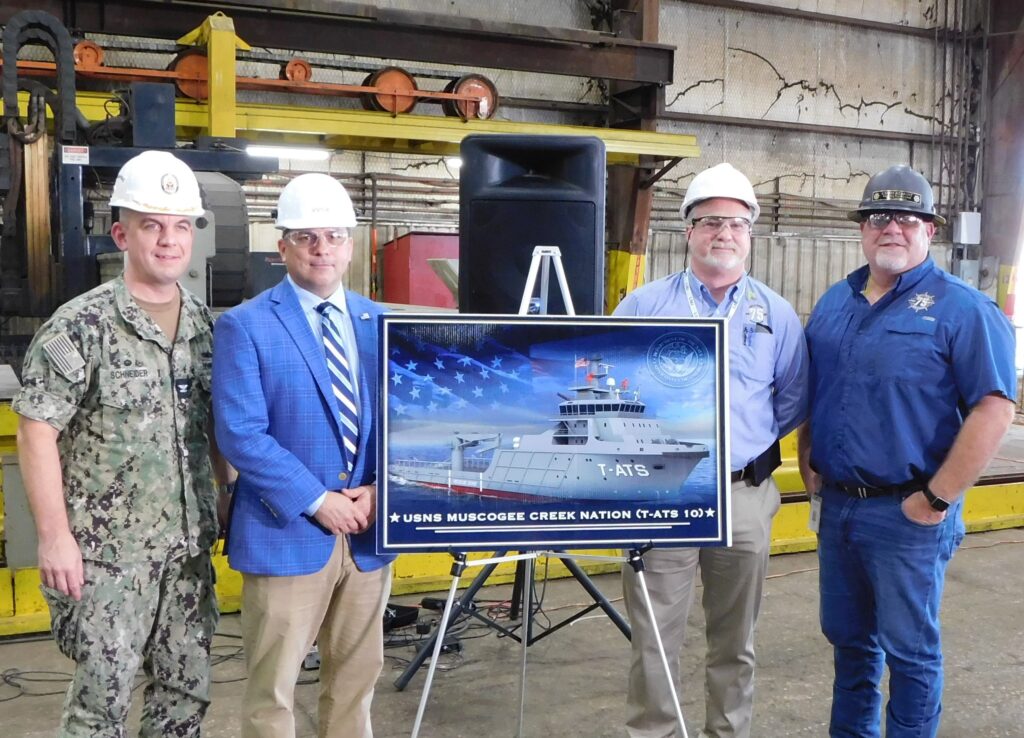
BOLLINGER KICKS OFF CONSTRUCTION OF T-ATS 10 WITH STEEL CUTTING CEREMONY
Release from Bollinger Shipyards
*****
USNS MUSCOGEE CREEK NATION is the fifth Bollinger-built T-ATS
T-ATS to replace the aging Safeguard-class rescue and salvage ships and Powhatan-class tugboats
Pascagoula, MS — (March 7, 2023) – Joined by senior U.S. Navy officials at Bollinger Mississippi Shipbuilding, Bollinger Shipyards LLC (“Bollinger”) last week officially commenced construction of the future USNS MUSCOGEE CREEK NATION, the tenth Navajo-class Towing, Salvage and Rescue Ship (“T-ATS”) and the fifth T-ATS vessel being constructed by Bollinger since acquiring the program in April of 2021.
“Bollinger is honored to be entrusted by the Navy to build the Navajo-class Towing, Salvage and Rescue Ship. We’re excited to be able to utilize our newly acquired facility in Pascagoula to maximize our mobility and efficiency on the T-ATS program as we officially kick off construction on the fifth of five T-ATS ships to be built by Bollinger,” said Ben Bordelon, President and CEO of Bollinger Shipyards. “The T-ATS program is an important part of our expanding portfolio and relationship with the Navy as we work to support critical fleet modernization efforts. Maximizing Bollinger Shipyards resources across the Gulf Coast is something we’re incredibly proud of. This program sustains jobs in both our facilities between Houma and Pascagoula.”
The Navajo-class provides ocean-going tug, salvage, and rescue capabilities to support fleet operations, and are tasked with coming to the aid of stricken vessels. Their general mission capabilities include combat salvage, lifting, towing, retraction of grounded vessels, off-ship firefighting, and manned diving operations. The T-ATS platform replaces and fulfills the capabilities that were previously provided by the Powhatan-class Fleet Ocean Tug (T-ATF 166) and Safeguard-class Rescue and Salvage Ships (T-ARS 50) class ships.
Named for the Muscogee Creek Nation, the ship honors the self-governed Native American tribe located in Okmulgee, Oklahoma. The Muscogee people are descendants of not just one tribe, but a union of several. Muscogee Creek Nation is the largest of the federally recognized Muscogee tribes, which is the fourth largest tribe in the U.S. with more than 86,000 citizens – some of which have or continue to serve across the U.S. Armed Forces. This will be the first Navy vessel to carry the name Muscogee Creek Nation.
In addition to T-ATS 10, Bollinger is constructing USNS Navajo (T-ATS 6), USNS Cherokee Nation (T-ATS 7), USNS Saginaw Ojibwe Anishinabek (T-ATS 8) and the USNS Lenni Lenape (T-ATS 9).
About the Navajo-class Towing, Salvage and Rescue Ship Platform
The Navajo-class is a new series of towing, salvage and rescue ships (T-ATS) being constructed for the U.S. Navy. The Navajo-class is a multi-mission common hull platform that will be deployed to support a range of missions such as towing, rescue, salvage, humanitarian assistance, oil spill response and wide-area search and surveillance operations using unmanned underwater vehicles (UUV) and unmanned aerial vehicles (UAV). The vessels will replace the existing Powhatan-class T-ATF fleet ocean tugs and Safeguard-class T-ARS rescue and salvage ships in service with the US Military Sealift Command.
About Bollinger Shipyards LLC
Bollinger Shipyards LLC (www.bollingershipyards.com) has a 76-year legacy as a leading designer and builder of high performance military patrol boats and salvage vessels, research vessels, ocean-going double hull barges, offshore oil field support vessels, tugboats, rigs, lift boats, inland waterways push boats, barges, and other steel and aluminum products from its new construction shipyards as part of the U. S. industrial base. Bollinger has 14 shipyards, all strategically located throughout Louisiana with direct access to the Gulf of Mexico, Mississippi River and the Intracoastal Waterway. Bollinger is the largest vessel repair company in the Gulf of Mexico region.
Australia Announces Formation of MQ-4C Triton UAS Squadron
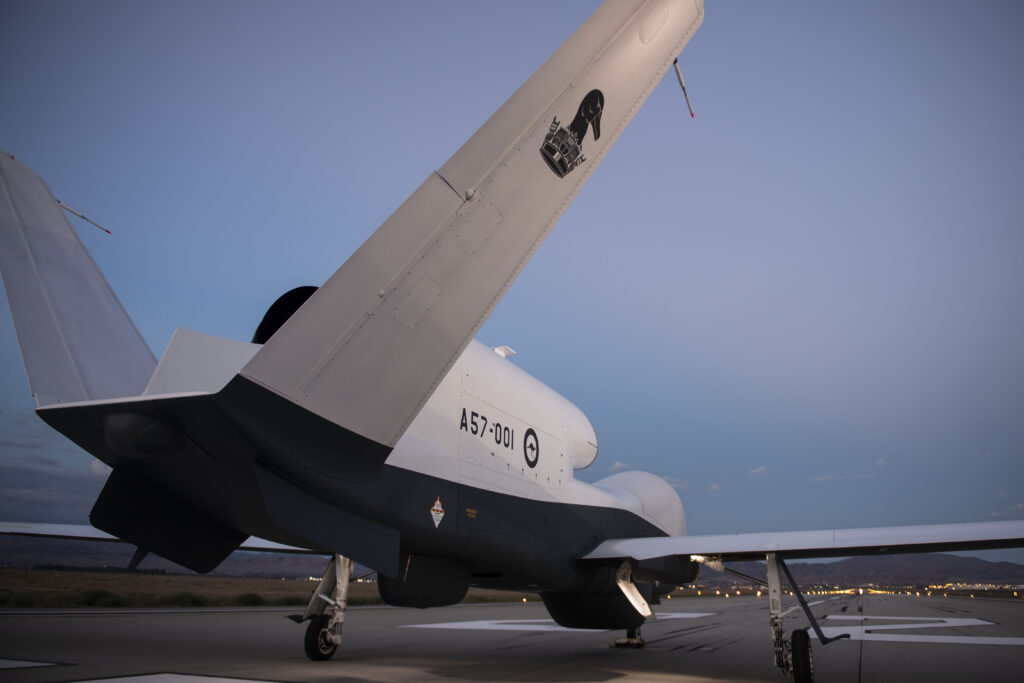
Australia’s first MQ-4C Triton autonomous maritime patrol aircraft poses for its first offical portraits after emerging from the Northrop Grumman Palmdale paint booth.
*****
ARLINGTON, Va. — The Royal Australian Air Force has re-activated a historic squadron to operate its forthcoming MQ-4C Triton high-altitude, long-endurance unmanned aircraft systems (UAS).
Deputy Prime Minister Richard Marles announced at the Avalon Air Show last week that 9 Squadron is “being re-formed after a break of 34 years,” according to a release from the Australian Department of Defence of a March 3 transcript of an interview with Australian officials at the air show.
“There’s a lot of lineage to this Squadron,” Marles said. “9 Squadron was originally formed in 1939. It did maritime surveillance during the Second World War. It saw service during the Vietnam War and for the keen military historians among you, you will have noticed that 9 Squadrons insignia is on the tail of the Triton. And 9 Squadron will be reformed to operate this capability the Triton uncrewed aircraft. It will be based at RAAF base Edinburgh although the airframes that you see behind me will actually operate out of Tindal.”
Marles said the Triton “will be able to provide the persistent reconnaissance and surveillance, of our northern maritime approaches which is so important in terms of the defence of our nation. It’s also going to be really useful in terms of surveilling illegal fishing both in our own waters, but also the waters of our Pacific neighbours. So, it’s a really exciting capability.”
Air Marshal Robert Chipman, chief of the Royal Australian Air Force, noted that 9 Squadron saw operational service in World War II with the Navy, “flying from our cruisers, HMA Ships, Hobart, Perth, Sydney, Canberra and Australia from the Arctic all the way down to the Southwest Pacific. And 22 serviceman lost their lives in World War II serving with 9 Squadron. In Vietnam, the Squadron was involved in some of the most iconic battles with the Australian Army, including the Battle of Long Tan, and two crewman lost their lives in the Vietnam War. So, it is a Squadron have a lot of history. On the emblem, you’ll see an Australian native bird- it’s the black browed albatross. The black browed albatross is renowned for spending a long time on in overwater flights, which makes it the perfect symbol, for the perfect Squadron for us to establish the MQ-4 Triton capability.”
Australia has three Tritons — built by Northrop Grumman — on order. The first is scheduled for delivery in 2024. Chipman said that the Air Force has had personnel training to operate and maintain the Triton for “a number of years.”
“Congratulations to the Royal Australian Air Force on the reactivation of the historic No. 9 Squadron,” said Jane Bishop, vice president and general manager, global surveillance, Northrop Grumman. “We’re honored the squadron will be operating Australia’s MC-4C Triton uncrewed aircraft for their most demanding maritime ISR missions, and we look forward to delivering the first RAAF Triton in 2024.”
USS John Finn joins Task Force 71 in Japan
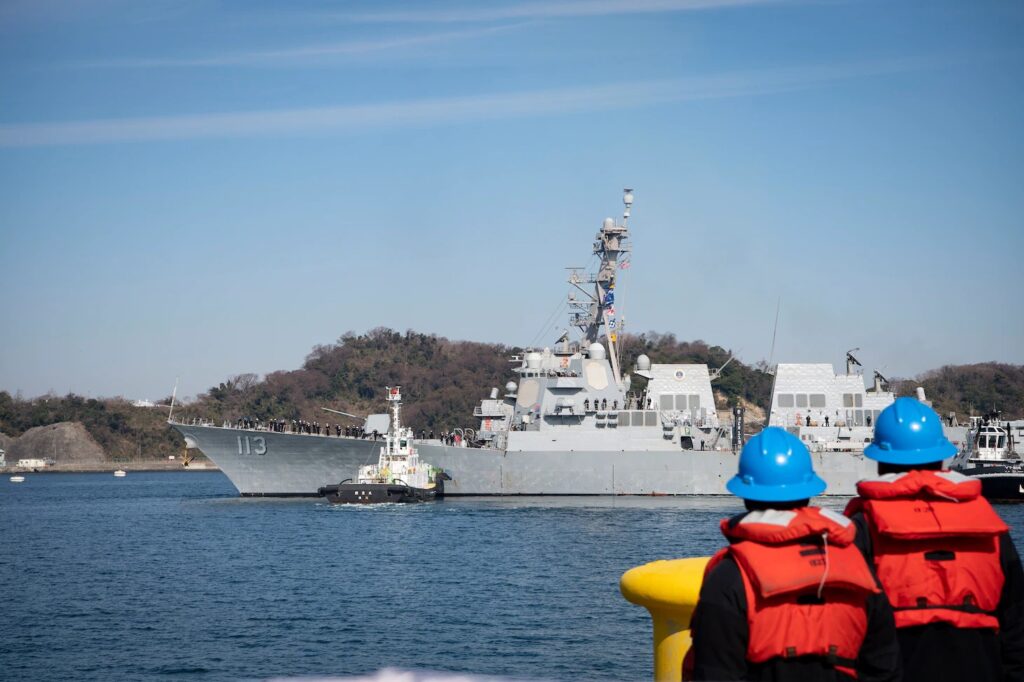
The Arleigh Burke-class guided-missile destroyer USS John Finn (DDG 113) arrives at Commander Fleet Activities Yokosuka (CFAY). Finn arrives from Naval Base San Diego to CFAY, becoming the latest forward-deployed asset in the U.S. 7th Fleet. For 75 years, CFAY has provided, maintained, and operated base facilities and services in support of the U.S. 7th Fleet’s forward-deployed naval forces, tenant commands, and thousands of military and civilian personnel and their families. (U.S. Navy photo by Mass Communication Specialist 1st Class Kaleb J. Sarten)
Release from Commander, Task Force 71 / Destroyer Squadron 15 Public Affairs
From Lt. Cmdr. Joseph Keiley, Commander, Task Force 71 / Destroyer Squadron 15 Public Affairs
YOKOSUKA, Japan - The Arleigh Burke-class guided-missile destroyer USS John Finn (DDG 113) arrived in its new forward-deployed location of Yokosuka, Japan, March 4, joining Commander, Task Force (CTF 71)/Destroyer Squadron (DESRON) 15.
The forward presence of John Finn enhances the national security of the United States and improves its ability to protect strategic interests. John Finn is a multi-mission ship with air warfare, submarine warfare, and surface warfare capabilities. It is designed to operate independently or with carrier strike groups, surface action groups, and amphibious ready groups.
“John Finn is another fantastic addition to our team here in Japan,” said Capt. Walter Mainor, commander, Task Force 71. “The dedicated crew will be a key part of our mission to work with our Allies and partners, and ensure we remain committed to maritime security in the region and uphold the promise of a free and open Indo-Pacific.”
The United States values Japan’s contributions to the peace, security, and stability of the Indo-Pacific and its long-term commitment and hospitality in hosting U.S. forces forward deployed there. These forces, along with their counterparts in the Japan Self-Defense Forces, make up the core capabilities needed by the Alliance to meet common strategic objectives.
Maintaining the most advanced ships and a forward-deployed naval force (FDNF) capability supports the United States’ commitment to the defense of Japan and the security, stability, and prosperity of the Indo-Pacific region. This allows the most rapid response times possible for maritime and joint forces, and brings the most capable ships with the greatest amount of striking power and operational capability to bear in the timeliest manner.
“We are excited for the opportunity to join 7th Fleet and the FDNF ships in Yokosuka, Japan” said Cmdr. Angela Gonzales, John Finn’s commanding officer. “Our Sailors have trained diligently over the past few years in preparation for this transition. We are ready to support our Allies and partners in the region in maintaining maritime security. Additionally, we are appreciative of the hospitality shown to our families who arrived in Japan earlier this year. We are eager to arrive in Yokosuka.”
John Finn is a Flight IIA Arleigh Burke-class Aegis guided-missile destroyer that can deploy with two MH-60 variant helicopters. It also has improved ballistic missile defense, anti-air and surface warfare capabilities. The ship is 155 meters in length; displacing approximately 9,200 tons, with a crew size of approximately 270 Sailors. The ship was commissioned July 15, 2017.
CTF 71/DESRON 15 is the Navy’s largest forward-deployed DESRON and the U.S. 7th Fleet’s principal surface force. 7th Fleet is the U.S. Navy’s largest forward-deployed numbered fleet, and routinely interacts and operates with Allies and partners in preserving a free and open Indo-Pacific region.