Task Force 59 Launches Aerial Drone from Coast Guard Ship in Middle East
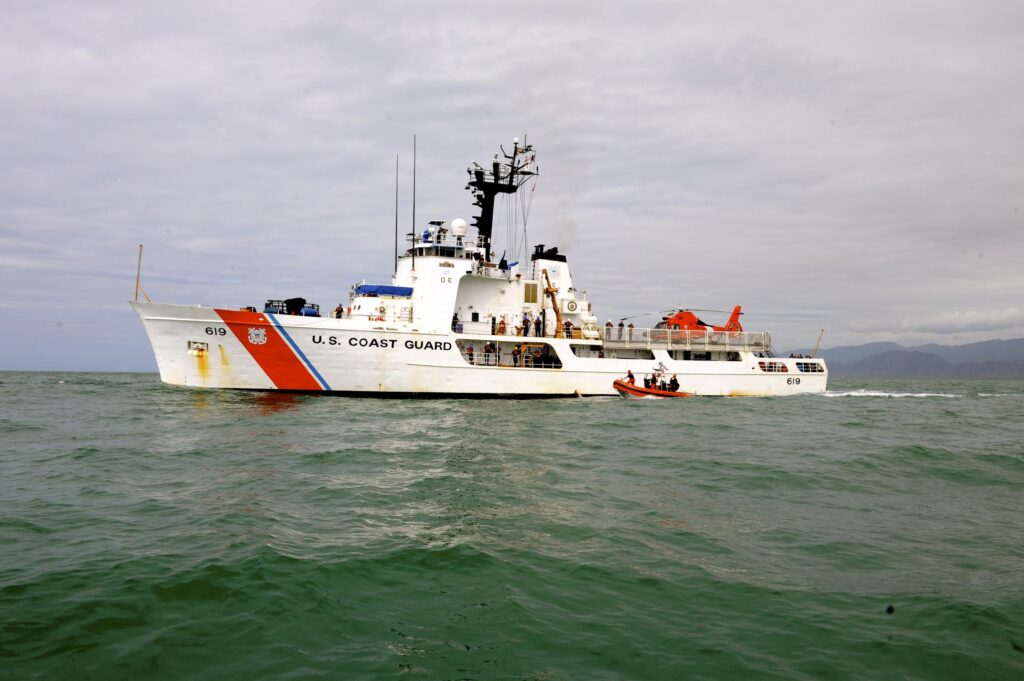
An Aerovel Flexrotor unmanned aerial vehicle (UAV) takes off from U.S. Coast Guard fast response cutter USCGC Emlen Tunnell transiting the Arabian Gulf, Dec. 7. U.S. NAVY
MANAMA, Bahrain — A U.S. Navy unmanned task force in the Middle East launched an aerial drone from a U.S. Coast Guard vessel operating the Arabian Gulf, Dec. 7, U.S. Naval Forces Central Command / U.S. 5th Fleet Public Affairs said in a release.
U.S. 5th Fleet’s Task Force 59 launched an unmanned aerial vehicle (UAV) from U.S. Coast Guard Cutter Emlen Tunnell (WPC 1145), marking a first for the task force with a U.S. Coast Guard vessel since the task force’s establishment in September 2021.
The launch also demonstrated close collaboration between the U.S. Coast Guard and Task Force 59 as U.S. 5th Fleet rapidly integrates unmanned systems and artificial intelligence to enhance monitoring of regional waters.
Task Force 59 is conducting Digital Horizon, a three-week event focused on integrating new unmanned and artificial intelligence platforms, including 10 that are in the region for the first time.
“Each day during Digital Horizon we have pushed to discover new capabilities, fast,” said Capt. Michael Brasseur, commodore of Task Force 59. “I am so proud of the team for their steadfast commitment to not only imagine new possibilities, but to deliver them.”
An Aerovel Flexrotor successfully took off and landed vertically aboard Emlen Tunnell, showcasing close collaboration between Navy, Coast Guard and industry partners to advance technology integration.
“We are so excited to be part of Digital Horizon and play a critical role by helping integrate new technologies into the fleet,” said Lt. Patrick Kelly, Emlen Tunnell’s commanding officer. “I am so proud of the crew for their dedication, commitment and professionalism, which made today’s success possible.”
The Flexrotor can support intelligence, surveillance and reconnaissance (ISR) missions day and night using a daylight or infrared camera to provide a real-time video feed.
In addition to providing ISR capability, UAVs like the Flexrotor enable Task Force 59 to enhance a resilient communications network used by unmanned systems to relay video footage, pictures and other data to command centers ashore and at sea.
U.S. 5th Fleet established Task Force 59 more than 14 months ago. Since its launch, the task force has deployed a suite of new unmanned systems while integrating artificial intelligence at operational hubs in Jordan and Bahrain.
Emlen Tunnell is one of the Coast Guard’s newest Sentinel-class fast response cutters forward-deployed to Bahrain where U.S. 5th Fleet is headquartered. The ship helps ensure maritime security and stability across the Middle East.
Navy Authenticates Keel for Future Attack Submarine USS Arizona
The future USS Arizona will be similar to this Virginia-class attack submarine shown in the General Dynamics Electric Boat shipyard in Groton, Connecticut. GENERAL DYNAMICS
WASHINGTON — Senior Navy leaders, elected officials and industry partners gathered at General Dynamics Electric Boat’s Quonset Point Facility, Dec. 7, to attend a keel-authentication ceremony for future Virginia-class submarine USS Arizona (SSN 803), Team Submarine Public Affairs said in a release.
The submarine will be the first U.S. naval vessel to bear the name Arizona since battleship USS Arizona (BB 39) was sunk during the attack on Pearl Harbor on Dec. 7, 1941. After being struck with several bombs, Arizona burned for two days and more than 1100 of her crew were lost. The lives lost during the attack are now permanently memorialized by the USS Arizona Memorial, erected over her sunken hull in the berth she has occupied since that historic day.
“The boats in this class are the most advanced attack submarines ever designed. Their stealth, firepower and maneuverability are superior to every other attack submarine force in the world. Additionally, Arizona will be the first of the Virginia-class equipped with the Virginia Payload Module, enabling the submarine to deliver an even wider variety of capabilities,” said Rear Adm. Jonathan Rucker, Program Executive Officer, Attack Submarines. “Building, operating and maintaining Arizona and other Virginia-class subs is crucial to ensuring the Navy’s ability to project power in an ever-shifting global threat environment, and to maintaining peace and the free operation of our sea lanes.”
The ship’s sponsor, Nikki Stratton, is the granddaughter of Donald Stratton, who was serving as a Seaman First Class aboard Arizona during the 1941 attack. Badly burned, he was discharged in 1942, but successfully reenlisted in 1944 and returned to the Western Pacific serving aboard destroyer USS Stack (DD 406) to fight in New Guinea, the Philippines and the Battle of Okinawa. Stratton spent the remainder of his life helping honor those who gave their lives during the attack on Pearl Harbor and other battles. He died at the age of 97, in February 2020.
Per Navy tradition, the ship’s sponsor’s initials were welded onto a steel plate to be permanently mounted in a place of honor on the completed vessel.
Arizona will be the 30th Virginia-class submarine. Boats in this class can hit shore-based targets with highly accurate Tomahawk cruise missiles and are capable of long-term, stealth surveillance of sea forces, littoral waters or ground targets. Their design also provides for Special Forces delivery and support, mine delivery and minefield mapping, and anti-submarine and anti-ship warfare.
Arizona’s Virginia Payload Module will comprise four large-diameter, vertical payload tubes in a new hull section inserted into the existing Virginia-class submarine design. The tubes enable the submarine to deliver a variety of capabilities, including weapons, unmanned undersea vehicles and other undersea payloads.
Keel Authenticated for Future USNS Robert F. Kennedy
The Honorable Kathleen Kennedy Townsend etched her initials into the keel plate for the future USNS Robert F. Kennedy Dec. 5. U.S. NAVY
WASHINGTON — The keel for the future USNS Robert F. Kennedy (T-AO 208), the Navy’s 4th John Lewis-class fleet replenishment oiler, was laid at General Dynamics National Steel and Shipbuilding Company Dec. 5, Team Ships Public Affairs said in a release.
A keel laying is the recognition of the start of a ship’s construction. It is the joining together of a ship’s modular components and the authentication or etching of an honoree’s initials into a ceremonial keel plate. The ship’s sponsor, the Honorable Kathleen Kennedy Townsend, etched her initials into the keel plate.
“We are excited to celebrate this milestone as we work to bring another oiler to the fleet to support at-sea operations,” said Jana Polzin, deputy program manager, Auxiliary and Special Mission Shipbuilding Program Office. “The USNS Robert F. Kennedy will bring significant contributions to the fleet as the primary fuel pipeline to refuel ships at sea.”
USNS Robert F. Kennedy is based on commercial design standards and will recapitalize the current T-AO 187 Class Fleet Replenishment Oilers to provide underway replenishment of fuel to U.S. Navy ships and jet fuel for aircraft assigned to aircraft carriers.
The oilers feature substantial volume for oil, a significant dry cargo capacity, aviation capability and a speed of 20 knots. NASSCO designed the new vessels with double hulls to protect against oil spills and strengthened cargo and ballast tanks. The new T-AOs will add capacity to the Navy’s Combat Logistics Force and become the cornerstone of the fuel delivery system.
NASSCO is currently in production on the future USNS Lucy Stone (T-AO 209) as well as in production on two Expeditionary Sea Bases (ESB) – the future USS John L. Canley (ESB 6) and USS Robert E. Simanek (ESB 7). They also have the future USNS Sojourner Truth (T-AO 210), the future USNS Thurgood Marshall (T-AO 211) and the future USNS Ruth Bader Ginsburg (T-AO 212) as well as ESB 8 under contract.
SECDEF Announces Marine Corps General Officer Nominations
ARLINGTON, Va. — Secretary of Defense Lloyd J. Austin III announced on Dec. 6 that the president has made the following nominations:
Marine Corps Brig. Gen. Marcus B. Annibale for appointment to the grade of major general. Annibale is currently serving as director, Expeditionary Warfare (N95), Naval Operations, Washington, D.C.
Marine Corps Brig. Gen. Lorna M. Mahlock for appointment to the grade of major general. Mahlock is currently serving as deputy director of Cybersecurity for Combat Support, National Security Agency, Fort Meade, Maryland.
Marine Corps Brig. Gen. Joseph A. Matos III for appointment to the grade of major general. Matos is currently serving as deputy commanding general, U.S. Marine Forces Cyber; and deputy commander, Joint Task Force-Ares, Joint Force Headquarters-Cyber, Fort Meade, Maryland.
Marine Corps Brig. Gen. David L. Odom for appointment to the grade of major general. Odom is currently serving as deputy director for Current and Integrated Operations, J-3, Joint Staff, Washington, D.C.
Marine Corps Brig. Gen. Thomas B. Savage for appointment to the grade of major general. Savage is currently serving as deputy director for Operations, U.S. Africa Command, Stuttgart, Germany.
Marine Corps Brig. Gen. William H. Swan for appointment to the grade of major general. Swan is currently serving as deputy director for Operations, National Joint Operations/Intelligence Center, Team 3, J-3, Joint Staff, Washington, D.C.
Marine Corps Brig. Gen. Brian N. Wolford for appointment to the grade of major general. Wolford is currently serving as commander, U.S. Marine Corps Forces Korea, Camp Humphreys, Korea.
Marine Corps Brig. Gen. Calvert L. Worth Jr. for appointment to the grade of major general. Worth is currently serving as commanding general, 2nd Marine Division, Camp Lejeune, North Carolina.
Marine Corps General: Strategic Overseas Bases Critical to Deterring Adversaries
U.S. Marines with the Maritime Raid Force, 31st Marine Expeditionary Unit, tread water during a limited scale raid on Camp Hansen, Okinawa, Japan, Nov. 21, 2022. U.S. MARINE CORPS / Lance Cpl. Manuel Alvarado
WASHINGTON — The commanding general of the U.S. Marine Corps Warfighting Laboratory and Futures Directorate says overseas bases are an underestimated key to deterring competitors from aggression and coercion against friendly nations and allies in the Pacific region.
The value of strategic basing “deserves more attention in any discussions of deterrence,” Brigadier Gen. Kyle B. Ellison told the U.S. Naval Institute (USNI)’s Defense Forum at the Spy Museum Dec. 6. Overseas bases are “one of the most critical aspects of the deterrence effort, in my opinion,” said Ellison, who is also vice chief of Naval Research in the Office of Naval Research.
Speakers at the USNI event focused on integrated deterrence, one of three ways cited by the 2022 National Defense Strategy to achieve Defense Department goals that include defending the homeland against the growing multi-domain threat posed by the People’s Republic of China (PRC). Integrated deterrence seeks to bring a whole of government approach across services, government agencies, regions, commands and Ally or partner organizations to thwarting competitors’ aggression.
The other paths to attaining Defense goals are through campaigning and building enduring advantage.
“While we modernize our power projection capabilities, we must not lose focus on broadening our stance in the Pacific or hardening our forward installations,” Ellison said. “The value of our overseas bases cannot be overstated and our investment in the resilience of these overseas locations will have a far-reaching impact on our ability deter.”
Another aspect of integrated deterrence is a stand-in force operating inside a weapons engagement zone, a point that emerged from the Marines’ Force Design 2030 plan. While China has increased the challenges of anti-access/aerial denial over the mainland and created stand-off areas and protective bubbles in the littorals, Ellison said U.S. Allies and partner stand-in forces “will survive in this high threat environment” because they are “nimble, moving often and avoiding enemy intelligence collection efforts.”
The stand-in force could include, not just Marines, but elements of the Navy, special operations, Allies and partner nations. To support the consistent persistence of the stand-in force, Ellison said the Marines were reducing their sustainment burdens and maximizing maneuverability by “reducing logistics demands across the life cycle of the stand-in forces. This will give them a position of strength and advantage in coordination with Allies and partners.”
Maritime Domain Awareness Starts with Seeing What’s on the Sea
An Elbit Systems Seagull unmanned surface vessel operates alongside the patrol coastal ship USS Monsoon (PC 4) in the Arabian Gulf, Nov. 29, during Digital Horizon 2022. The three-week unmanned and artificial intelligence integration event involves employing new platforms in the region for the first time. U.S. ARMY / Sgt. Brandon Murphy
MANAMA, Bahrain — The U.S. Fifth Fleet’s Task Force 59 is conducting Digital Horizon, an unmanned systems demonstration featuring a flotilla of different unmanned surface vessels to help build maritime awareness.
Digital Horizon is one of the ways that Task Force 59 is moving ahead with its objective of establish an international fleet of 100 unmanned systems by next summer.
While several platforms are currently operationally deployed by TF 59, Digital Horizon brought 10 new systems to Bahrain to work together to use their sensors and unique capabilities to share data to TF 59’s shore-based Robotics Operations Center (ROC) by means of a communication “mesh network.” At the ROC, the information is processed and analyzed using artificial intelligence and machine learning to sift through the voluminous data and determine what is normal activity and what is extraordinary so the abnormal contacts can be further investigated.
The unmanned surface vehicles (USVs) taking part in Digital Horizon include Elbit Systems’ Seagull; Exail DriX; L3Harris Arabian Fox and MAST-13; Marine Advanced Robotics WAM-V; MARTAC’s MANTAS T-38 and Devil Ray T-12; Ocean Aero TRITON; Open Ocean Robotics Data Xplorer; Saildrone Explorer; Seasats X3; and SeaTrac SP-48. Unmanned aerial vehicles (UAVs) are also participating in Digital Horizon, including two vertical take-off and landing systems, Aerovel’s Flexrotor and Shield AI’s V-BAT, as well as Easy Aerial’s tethered UAV, which is carried in a container on top of one of the USVs.
Silvus Technologies is providing the line-of-sight radio communications system and Accenture Federal Services and Big Bear AI are providing data integration and artificial intelligence systems for the exercise. An Ocius USV is also operating off Western Australia and linking into the network.
Each of the different participating platforms offer unique specialized capabilities and attributes. All carried basic sensors such as cameras and AIS transponders. Some had more sophisticated sensor payloads like radar and meteorological. Some are relatively large and fast, while others are small but able to remain at sea for extended periods. Some could deploy small USVs or small aerial surveillance drones, and one could submerge and operate underwater. The USVs had various means of power and propulsion, including diesel engines, solar panels and sails.
The companies that have brought their systems to the exercise responded to a call for industry partners to share their technology and help TF 59 learn how to build effective networks and evaluate commercially available systems capable of performing well in the harsh at-sea environment in the Fifth Fleet area of operations. A selection committee of experts from different disciplines measured the dozens of candidate systems and technologies against a set of criteria to pick the companies to come and take part in Digital Horizon.
For Digital Horizon, Capt. Michael Brasseur, commander of Task Force 59, said TF 59 and the industry partners are taking a methodical approach. “For the purposes of our exercise, we are at the early stages, getting our communications and network established. Then we’ll start daytime operations, and then we’ll go 24/7. What we’re trying to do is not easy to accomplish with these different platforms and technologies, particularly here in the challenging operating environment of the Arabian Gulf.”
While reporters were able to see USVs on the pier, being placed in the water, and operating at sea, Brasseur said the exercise will later employ the UAVs, with the information from each of the platforms “all integrated on a single pane of glass” at the ROC.
“We’ll be running a series of vignettes that emulate real-world operations around this region to test how these systems perform and how the data is integrated,” Brasseur said. “We’ve been working through our communications and making sure we were able to receive and present live video and radar feeds, and making sure that data flow could be integrated into the system where we can leverage the machine learning and AI moving forward with the exercise. The scenarios and the challenges will become more complex as the exercise progresses. We’ll have a better understanding of the limitations of the sensors and the communications, as well as the power of the machine learning and AI to make sense of all the data.”
TF 59 is already deploying USVs from operational hubs in Bahrain and Aqaba, Jordan, with the objective of having 100 operational platforms by summer 2023. According to Brasseur, meeting that goal will be achieved by including partner nations in the region with a shared interest in creating the most complete understanding of the maritime environment. Digital Horizon will inform how best to employ the available technology to achieve that goal.
“The pace of innovation is amazing,” said Brasseur. “We are challenging our industry partners in one of the most difficult operational environments, and they are responding with enhanced capability, fast.”
Textron BELL V-280 Valor Chosen as New U.S. Army Long-Range Assault Aircraft
PROVIDENCE, R.I. — Textron Inc. announced Dec. 5 that Bell Textron Inc., a Textron company, has been awarded the development contract for the U.S. Army’s Future Long-Range Assault Aircraft (FLRAA) program. The award is based on Bell’s V-280 Valor tiltrotor that was developed and tested as part of the Joint Multi-Role Technology Demonstrator (JMR TD) program that began in 2013. The V-280 progressed through design, manufacturing, and more than three years of rigorous flight testing that provided extensive data validating the technical and operational advantages of the aircraft for the long-range assault mission.
“We are honored that the U.S. Army has selected the Bell V-280 Valor as its next-generation assault aircraft,” said Scott C. Donnelly, Textron’s chairman and chief executive officer. “We intend to honor that trust by building a truly remarkable and transformational weapon system to meet the Army’s mission requirements. We are excited to play an important role in the future of Army Aviation.”
“This is an exciting time for the U.S. Army, Bell and Team Valor as we modernize the Army’s aviation capabilities for decades to come,” said Mitch Snyder, president and CEO of Bell. “Bell has a long history supporting Army Aviation and we are ready to equip Soldiers with the speed and range they need to compete and win using the most mature, reliable and affordable high-performance long-range assault weapon system in the world.”
This award builds on a decade of the V-280 Valor’s progress through design, manufacturing, and thorough testing to demonstrate that this aircraft will deliver on the FLRAA program requirements. Bell and its industry partners have systematically validated the V-280 aircraft and their modular open systems approach in collaboration with the Army.
“For the past several years the Bell team demonstrated the exceptional operational capabilities, digital thread synergies and platform affordability enhancements the V-280 provides,” said Keith Flail, executive vice president, Advanced Vertical Lift Systems at Bell. “Bell stands ready with our world-class manufacturing facilities to apply our nearly seven decades of tiltrotor expertise to deliver a modern FLRAA fleet to the Army.”
The initial contract refines the weapon system design, sustainment, digital enterprise, manufacturing, systems integration, flight-testing and airworthiness qualification.
INDOPACOM’s Aquilino: Ukraine Situation Could Happen in Taiwan
Ships from the U.S. Navy, Japan Maritime Self-Defense Force (JMSDF), Royal Navy, Royal Australian Navy and Royal Canadian Navy break away from formation after Keen Sword 23 in the Philippine Sea, Nov. 14, 2022. U.S. NAVY / Mass Communication Specialist 2nd Class Louis Thompson Staats IV
SIMI Valley, Calif. — The situation in Ukraine could easily happen in Taiwan if the main actors aren’t careful, a top admiral warned during comments at the Reagan National Defense Forum here on Dec. 3.
Adm. John C. Aquilino, commander of U.S. Indo-Pacific Command, said that while people were “surprised” at what happened in Europe with Russia’s invasion of Ukraine, many aspects of it could be repeated in Taiwan should a conflict there erupt.
“This could happen in the Pacific region,” he said. “We shouldn’t be surprised that it can happen.”
He said that he takes several lessons from the conflict in Ukraine that apply to Taiwan.
“Once the fight starts, it’s going to be really hard to end,” Aquilino said. “Which means we ought to take action now. We need a sense of urgency to deliver the force, the capabilities, the industrial base, the budgets and what is needed now to move as fast as possible to deliver deterrence and sustain our deterrence efforts.”
When asked why Taiwan was worth sending U.S. troops to die over a conflict there, Aquilino said Taiwan is “geographically and strategically important” to the United States.
“There’s economic capabilities there that are important to the United States economy,” he said. “There’s a number of reasons why we believe it’s important.”
Aquilino said he hopes that his counterparts in China are also watching the Ukraine conflict and taking lessons from it, such as the necessity to avoid underestimating how difficult of an undertaking it would be to take Taiwan, and the fact that it will cost “blood and treasure.”
He also warned China that the United States could enact sanctions that could have “500 times more devastating effects” than those on Russia because of how interconnected China was with the global economy. When the moderator pointed out that the same could be said of the United States and such sanctions could have a rebound effect, Aquilino said he was confident that the combined power of the United States, Japan and South Korea economies would “dwarf” China’s economy.
Aquilino pledged that the Navy will continue to perform military exercises in China’s backyard, claiming that the Navy performs 150 exercises in the Indo-Pacific region each year with allies.
CNO on China: Shipbuilders Can Expect High Revenue for Foreseeable Future
Chief of Naval Operations Adm. Mike Gilday salutes as he passes through sideboys while visiting the Arleigh Burke-class guided-missile destroyer USS Rafael Peralta (DDG 115) moored at Commander, Fleet Activities Yokosuka. U.S. NAVY / Mass Communication Specialist 1st Class Deanna C. Gonzales
SIMI VALLEY, Calif. — The defense contractors who run U.S. Navy shipyards can expect plenty of revenue in the coming years as the Navy faces off with China, Chief of Naval Operations Adm. Michael Gilday said Dec. 3 at the Reagan National Defense Forum here.
Addressing a question about the U.S. Navy’s ability to counter China, Gilday said that the Navy had submitted to Congress the “largest shipbuilding budget in the history of the United States” at $27.5 billion, and that is likely to continue for the foreseeable future.
“You cannot throw much more money at the seven shipbuilders that build U.S. warships in the United States of America right now,” Gilday said. “Their capacity is about at max, and Congress is helping us max them out. I would say the same thing for weapons production.”
Gilday said that the Navy is very focused on supporting industry during this ramp-up in weapons production.
“If you take a look at our budget and where we’re putting money, we are trying to send a very strong signal to industry that we need consistent, stable production lines for weapons with range and speed for a long time,” he said.
Gilday did not directly answer the moderator’s question about whether the Navy was prepared to counter a Chinese move on Taiwan, instead opting to tout the Navy’s presence across the globe and readiness to react to any developing situation.
“About a third of the Navy is at sea today,” Gilday said. “We have more ships in the European theater than the rest of the NATO nations combined — more than 25 ships. … We have ships right now in the Taiwan Strait and the South China Sea.
“We have significant overmatch in that domain against any competitor,” he added.
He also appeared to imply that the U.S. Navy was in constant contact with the People’s Liberation Army Navy (PLAN).
“The U.S. Navy is in contact with peer competitors on the sea, under the sea and in the air every single day,” Gilday said. “You see snippets of it with ships going through the Taiwan Strait and going nose-to-nose with Chinese ships. You see it with our aircraft in the eastern Mediterranean or by the Sea of Japan with the Russians.”
U.S. Seizes 1.1 Million Rounds of Ammunition, Illegal Weapons in Gulf of Oman
Bags containing more than 50 tons of fuses and propellants for rockets and ammunition rounds sit on the flight deck of expeditionary sea base USS Lewis B. Puller (ESB 3), Dec. 3. U.S. NAVY
MANAMA, Bahrain — On Dec. 1, U.S. naval forces in the Middle East intercepted a fishing trawler smuggling more than 50 tons of ammunition rounds, fuses and propellants for rockets in the Gulf of Oman along a maritime route from Iran to Yemen, U.S. Naval Forces Central Command Public Affairs said in a Dec. 3 release.
Navy personnel operating from expeditionary sea base USS Lewis B. Puller (ESB 3) discovered the illicit cargo during a flag verification boarding, marking U.S. 5th Fleet’s second major illegal weapons seizure within a month.
Forces from Lewis B. Puller found more than 1 million rounds of 7.62mm ammunition; 25,000 rounds of 12.7mm ammunition; nearly 7,000 proximity fuses for rockets; and over 2,100 kilograms of propellant used to launch rocket propelled grenades.
“This significant interdiction clearly shows that Iran’s unlawful transfer of lethal aid and destabilizing behavior continues,” said Vice Adm. Brad Cooper, commander of U.S. Naval Forces Central Command, U.S. 5th Fleet and Combined Maritime Forces. “U.S. naval forces remain focused on deterring and disrupting dangerous and irresponsible maritime activity in the region.”
The direct or indirect supply, sale or transfer of weapons to the Houthis in Yemen violates U.N. Security Council Resolution 2216 and international law.
U.S. 5th Fleet previously intercepted a fishing vessel illegally shipping lethal aid from Iran to Yemen on Nov. 8. U.S. Coast Guard ship USCGC John Scheuerman (WPC 1146) and guided-missile destroyer USS The Sullivans (DDG 68) intercepted the vessel in the Gulf of Oman.
A weeklong search assisted by patrol coastal ship USS Hurricane (PC 3) and Navy explosive ordnance disposal technicians from U.S. 5th Fleet’s Task Force 56 discovered more than 70 tons of ammonium perchlorate, a powerful oxidizer commonly used to make rocket and missile fuel as well as explosives. U.S. forces also found more than 100 tons of urea fertilizer, a chemical compound with agricultural applications that is also known for use as an explosive precursor.
The U.S. 5th Fleet operating area includes 21 countries, the Arabian Gulf, Gulf of Oman, Red Sea, parts of the Indian Ocean and three critical choke points at the Strait of Hormuz, Bab al-Mandeb and Suez Canal.