Marine Corps Adjusts Interim Guidance for ACV Waterborne Operations following Training Incident
U.S. Marines assigned to the 3rd Assault Amphibian Battalion, 1st Marine Division, conduct waterborne training with an Amphibious Combat Vehicle (ACV) from shore to loading amphibious transport dock ship USS Anchorage (LPD 23) at Marine Corps Base Camp Pendleton, California, Feb. 12, 2022. U.S. MARINE CORPS / Lance Cpl. Willow Marshall
HEADQUARTERS, U.S. MARINE CORPS — Following a training incident, the Marine Corps has adjusted Amphibious Combat Vehicle (ACV) waterborne operations guidance, ceasing water operations involving surf zone transit to allow for additional testing and evaluation.
On Oct. 13, 2022, at approximately 7:45 p.m. PST, an Amphibious Combat Vehicle assigned to Assault Amphibian School was conducting normal scheduled training operations when it rolled over in the surf zone after a reported mechanical malfunction near Camp Pendleton, California. Of the three crew members inside the vehicle, none sustained injuries or required medical attention. The incident is currently under investigation.
“We’re taking a deliberate and methodical approach to fielding this platform,” said Lt. Gen. David H. Furness, deputy commandant for Plans, Policies and Operations. “This adjustment to current guidance ensures our Marines have the ability to safely train and maintain proficiency with the platform while we work to conduct additional testing.”
Suspension of ACV surf zone transit will remain in effect until additional testing data can be collected and analyzed. In support of this, surf zone operations for Amphibious Vehicle Testing Branch-sponsored testing is authorized.
Navy Demos Wide Range of VTOL Systems for Future Operations
A vendor demonstrates the vertical takeoff and landing capability of a small unmanned aircraft system during a PMA-263 sponsored technical assessment Sept. 20 in California, Md. U.S. NAVY
PATUXENT RIVER, Md. — The Navy and Marine Corps Small Tactical Unmanned Aircraft Systems (PMA-263) program team put Vertical Takeoff and Landing (VTOL) systems through their paces during a two-week technical demonstration in mid-September, the Naval Air Systems Command said in an Oct. 17 release.
More than a dozen vendors attended the event to help inform the Navy Expeditionary Warfare community of the functions and capabilities available on the commercial market. The VTOL systems represented a wide range of configurations including outdoor, indoor, hybrid VTOL/fixed wing and tethered flight capability.
In partnership with the University of Maryland UAS Test Site, PMA-263’s Family of Small UAS (FoSUAS) team evaluated each system against a standard test card to determine its suitability for expeditionary combat support. In addition to basic measurements like length, height, weight and pack-up size, performance data was collected for ease of operation, range, endurance, audibility, electro-optical and infrared imagery quality and other unique capabilities of each system.
“The goal was to understand what the state of the market is today,” said Col. Victor Argobright, PMA-263 program manager. “We want to show off what is available right now for future procurements to our Navy Expeditionary community.”
Participants representing the Naval Special Warfare, Navy Explosive Ordnance Disposal, and Naval Construction Force communities and their Joint Service counterparts were given the opportunity to engage directly with the participating vendors and to observe the flight demonstrations. Each participant was also asked provide their feedback on the potential of each system to fulfill their unique mission requirements.
“Flight demonstration events like this are a critical market research function for the PMA and help us to validate performance data reported by vendors,” said Lt. Cmdr. Ben Whatley, PMA-263 FoSUAS military lead. “We want to put these systems through their paces while also providing a venue for end-users to learn about existing and emerging SUAS technology. Moreover, events where operators from the supported Navy communities come together to collaborate and exchange information about their unique SUAS program needs provide added value to the PMA by ensuring unity of vision and a corresponding unity of acquisition effort.”
The majority of systems demonstrated last month are currently in production and available for procurement. Vendors also had the opportunity to showcase additional developmental capabilities, though these systems were not evaluated against any of the standardized test cards.
“Unmanned systems technology is advancing at an incredible pace,” Argobright said. “To ensure that our Navy and Marine Corps teams are able to adapt to and outmatch the capability advancements of our adversaries, it is imperative that we leverage rapid acquisition solutions in order to put relevant technology in the hands of the warfighter faster.”
PMA-263 will use University of Maryland UAS Test Site’s assessment data and observer feedback from the event to inform the program’s priorities for follow-on engineering assessments, potential for operational testing, and inclusion of new platforms within the FoSUAS programs of record.
The PMA-263 FoSUAS integrated product team currently supports Group 1 and 2 SUAS including the PD-100 Black Hornet 3, Skydio X2D, SkyRaider R80D and RQ-20B Puma.
U.S. Navy Supports Australia’s Indo-Pacific Deployment Alongside Canada, Japan in the South China Sea
The Arleigh Burke-class guided-missile destroyer USS Milius (DDG 69) conducts a trilateral training exercise with the Japan Maritime Self Defense Force Murusame-class destroyer JS Kirisame (DD-104), the Royal Australian Navy Supply-class auxiliary replenishment oiler HMAS Stalwart (A304) and the Hobart-class air warfare destroyer HMAS Hobart (DDG 39) while operating in the South China Sea, Oct. 07. U.S. NAVY / Mass Communication Specialist 2nd Class Richard Cho
SOUTH CHINA SEA — Maritime forces from Canada, Japan and the United States concluded exercises in the South China Sea in support of Royal Australian Navy forces, Oct. 17, Commander, Task Force 71/Destroyer Squadron 15 Public Affairs said in a release.
This is the first time all four nations have trained together in the South China Sea exercising complex, maritime operations in the region.
This exercise builds on the previous bilateral and trilateral exercises from recent months conducted in the South China Sea. Throughout the naval exercises, participants trained together and conducted integrated operations designed to increase the allies’ collective ability to maintain maritime security and readiness to respond to any regional contingency. Integrated events included surface, subsurface and air defense exercises that included Maritime Patrol Reconnaissance Aircraft (MPRA) from several participating nations.
Representing Commander, Task Force 71 are U.S. Navy Arleigh Burke-class guided-missile destroyers USS Milius (DDG 69) and USS Higgins (DDG 76).
“Working with our Australian, Canadian and Japanese allies in the South China Sea has been an invaluable experience and opportunity,” said Cmdr. Matthew Hays, commanding officer of USS Milius. “Combined maritime exercises help us strengthen interoperability and increase collective war-fighting readiness. It was great to be able to work with these 3 fine navies and to demonstrate our unwavering strong support for their increasing role in the region and our commitment to a free and open Indo-pacific.”
Professional engagement and cooperation with allies and partners is the foundation of regional stability, which fosters peace and prosperity for all nations.
Australia was represented by the Royal Australian Navy, HMAS Arunta (FFH 151) and HMAS Hobart (DDG 39).
Japan was represented by the JS Suzutsuki (DD 117) and JS Kirisame (DD 104).
Representing Canada was the Royal Canadian Navy Halifax-class frigate HMCS Winnipeg (FFH 338).
“HMCS Winnipeg’s deployment in the Indo-Pacific on Operation PROJECTION is aimed at conducting forward naval presence operations in the region as well as participating in cooperative deployments and naval exercises with allied and partner nations,” said Commander Annick Fortin, commanding officer of HMCS Winnipeg. “These exercises are an excellent example as they demonstrate our interoperability with other navies and provides opportunities to learn as well as prove our abilities to work seamlessly together. It is a prime example of our motto ‘one with the strength of many;’ working together, we are stronger.”
Fairbanks Morse Defense to Provide Engines Featuring Common Rail Technology for LPD 32
BELOIT, Wis. — Fairbanks Morse Defense (FMD), a portfolio company of Arcline Investment Management (Arcline), has been awarded a purchase order by Huntington Ingalls Industries to build and deliver four main propulsion diesel engines featuring common rail technology to power the U.S. Navy’s newest Landing Platform/Dock (LPD) ship, LPD 32, the company announced in an Oct. 11 release. FMD’s common rail system technology maximizes performance through enhanced fuel efficiency and reduced carbon emissions.
“For many decades, the engineers and entrepreneurs who built Fairbanks Morse Defense have been proving the quality of our engines while improving real-world results,” said FMD CEO George Whittier. “Today, the U.S. fleet and its allies rely on our onboard solutions for global technical support to maximize mission confidence, which is why we remain as committed as ever to designing, developing and delivering the best naval power and propulsion systems on the planet.”
Manufactured in the U.S. and serviced worldwide, FMD’s proven marine technology is engineered for excellence to ensure reliable operation, extended asset lifecycles, and minimal downtime. In addition to delivering its power and propulsion systems, the defense contractor has been selected by the Navy and Military Sealift Command time and again to provide mission-critical marine technology, turnkey services and OEM parts throughout the vessel.
FMD previously provided engines with common rail technology for LPD 30 and LPD 31.
This year FMD is celebrating its 150th anniversary, having served for almost 100 years the U.S. Navy, Military Sealift Command and the U.S. Coast Guard. Today, an FMD product is now on every single American naval platform as a result of their expanded portfolio of product offerings through acquisitions and organic growth.
A U.S. Navy MQ-4C Triton assigned to Unmanned Patrol Squadron (VUP) 19 prepares to take off from the flightline at Marine Corps Air Station (MCAS) Iwakuni, Japan, Oct. 5, 2022. U.S. MARINE CORPS / Lance Cpl. David Getz
ARLINGTON, Va. — The commander of the Navy’s largest forward-deployed numbered fleet said the MQ-4C Triton high-altitude, long-endurance unmanned aerial vehicle currently deployed in the Western Pacific is proving to be a benefitting to his fleet’s operations.
“Any sensor is goodness in my fleet,” said Vice Adm. Karl Thomas, commander, U.S. 7th Fleet, speaking Oct. 14 at the U.S. Naval Institute in Annapolis, Maryland, in a Maritime Security Dialogue, a series conducted by the U.S. Naval Institute and the Center for Strategic and International Studies and sponsored by HII. “It’s a huge AOR [area of responsibility] and to have something that has that kind of legs [range] and that persistence really helps.”
“We’ve obviously been operating in theater with Triton for quite some time,” Thomas said. “We’re getting close to the IOC [Initial Operational Capability] level with Triton.
“We’re going to use Triton as a replacement for some of our surveillance aircraft,” he said. “So, the biggest benefit it brings clearly is its tremendous endurance. We’ve operated it out of Guam routinely. We’ve started to operate it out of various places in Japan, trying to not only make sure we have numerous places to take-off and land.”
The admiral said the fleet is working to build up an orbit “to learn our way through some of the capabilities that an EP-3 [Aries II Orion electronic reconnaissance aircraft] might bring back. It will be a different way of processing the information than we do with our EP-3s, so we’re working as a Navy to see how we seamlessly transition.”
U.S. Naval Forces in Middle East Interdict $29 Million in Illegal Drugs
Personnel from U.S. Coast Guard fast response cutter USCGC Charles Moulthrope (WPC 1141) interdict a fishing vessel smuggling illicit drugs in the Gulf of Oman, Oct. 12. U.S. COAST GUARD / Information Systems Technician 1st Class Vincent Aguirre
MANAMA, Bahrain — A U.S. Coast Guard fast response cutter seized an estimated $29 million worth of illicit narcotics from a fishing vessel while patrolling the Gulf of Oman, Oct. 12, two weeks after another sizable interdiction, U.S. Naval Forces Central Command Public Affairs said in an Oct. 13 release.
USCGC Charles Moulthrope (WPC 1141) confiscated 2,980 kilograms of opium and 400 kilograms of methamphetamines as the fishing vessel transited international waters. The Coast Guard cutter was operating in support of Combined Task Force 150, which oversees maritime security operations for Combined Maritime Forces in the Arabian Sea, Gulf of Oman and Gulf of Aden.
“A success like this is a team effort. I am proud of each and every member of our crew,” said Lt. Cmdr. Stephen Hills, Charles Moulthrope’s commanding officer. “We remain committed to countering the flow of illegal contraband and promoting security and stability across the region.”
Hills’ crew previously interdicted another fishing vessel Sept. 27 while patrolling the Gulf of Oman, which led to the seizure of $85 million worth of illegal drugs.
Charles Moulthrope arrived in the Middle East in May and operates from the U.S. Navy base in Bahrain where U.S. Naval Forces Central Command, U.S. 5th Fleet and Combined Maritime Forces are headquartered.
Vigor Begins Work on USS Tulsa, Wins USS Michael Murphy Challenge
PORTLAND, Ore. — Vigor, a Titan company, is beginning work on two major docking selected restricted availabilities (DSRA) awarded this year, at both Swan Island in Portland, as well as Pearl Harbor Naval Shipyard (PHNSY), the company said in an Oct. 14 release. USS Tulsa recently arrived at Swan Island for its DSRA, while Vigor successfully challenged and was awarded USS Michael Murphy in Hawaii. In total, these two projects will employ more than 350 skilled workers in family wage jobs at both locations, as well as subcontractors and others providing support throughout.
“These two large awards reflect Vigor’s strong reputation for quality and on-time performance for the U.S. Navy,” said Adam Beck, Vigor executive vice president of Ship Repair. “Our skilled workers repeatedly show why Vigor is an industry leader in ship repair, and we are very proud to support our national defense and our service members.”
USS Michael Murphy will be Vigor’s third DSRA completed at PHNSY in as many years, after completing the first two ahead of schedule. Vigor’s impeccable safety record on these projects, completed at the Naval facility, included zero injuries on USS William P. Lawrence and recognition from the Shipbuilders Council of America with a Significance in Safety Achievement award.
This is the first major dry docking for USS Michael Murphy since its post-shakedown availability. It will have shafts, hubs and propeller blades removed and overhauled; a full underwater hull and freeboard preservation; overhaul and replacement of all sea valves; as well as other work completed directly by Vigor and in partnership with the Navy. Approximately 150 people will work on the project each day, through early May 2023.
In Portland, USS Tulsa will undergo a full blasting and painting of the underwater hull and flight deck, including a new type of coating for the hull, and with blasting completed using Vigor’s new more environmentally friendly and efficient system; new decking systems in the staterooms and crew spaces, among others; cleaning and painting of all fuel tanks; and other preventative maintenance. It is scheduled to be at Swan Island for approximately nine months, with more than 200 Vigor employees working on the project.
“These are large, complex projects which our skilled workers at Vigor have become highly adept at in recent years,” Beck said. “Our great ship repair teams not only complete great work on time, they have made Vigor an industry leader in safety. Our Vigor Values of Truth, Responsibility, Evolution, and Love drive us to those two goals each day, and we will continue to live by them as we work to get these two vessels back in service for the Navy.”
In addition to these two major U.S. Navy projects, work is ongoing at Vigor’s Harbor Island shipyard on USS Chosin, USS Cape St. George and USS Omaha, as well as support for Washington State Ferries. The Ketchikan Shipyard, also operated by Vigor, is continuing repair and maintenance work for the Alaska Marine Highway System, marking a busy summer across Vigor’s shipyard operations.
USCGC Spencer Returns Home After 57-day Multi-Mission Patrol
PORTSMOUTH, Va. — The crew of the USCGC Spencer (WMEC 905) returned to their homeport in Portsmouth Sept. 25, following a 57-day patrol in the mid-Atlantic Ocean and Caribbean Sea, the Coast Guard Atlantic Area said in an Oct. 13 release.
During the patrol, Spencer’s crew conducted fisheries enforcement, search and rescue, and migrant interdiction operations in support of the Coast Guard’s Fifth and Seventh Districts.
In response to a rise in maritime migration from Cuba, Spencer was surged to the Caribbean to detect, deter and intercept unsafe and illegal ventures to the United States. Spencer’s crew intercepted and cared for 100 migrants across multiple cases.
“Spencer’s crew expertly demonstrated the multi-mission capability of our Coast Guard by quickly adapting to the mission changing from fisheries enforcement to migrant interdiction. I am honored to serve with such a dedicated crew who maintained high morale throughout the patrol despite the changes, and difficult nature of migrant interdiction operations,” said Cmdr. Corey Kerns, commanding officer of Spencer.
Spencer is a 270-foot medium-endurance cutter homeported in Portsmouth with 100 crewmembers. The cutter’s primary missions are counter drug operations, migrant interdiction, enforcing federal fishery laws and search and rescue in support of Coast Guard operations throughout the Western Hemisphere.
Navy Transferred Remaining RQ-4A BAMS-D UAVs to NASA
The RQ-4A Broad Area Maritime Surveillance Demonstrator returned from 5th Fleet to Patuxent River, Maryland, last summer after accruing more than 42,500 flight hours and over 2,000 oversea missions during a 13-year deployment. NORTHROP GRUMMAN
ARLINGTON, Va. — The Navy has transferred its three remaining RQ-4A BAMS-D high-altitude, long-endurance unmanned aerial vehicles (UAVs) to the National Aeronautics and Space Administration (NASA).
“All three currently reside at NASA’s Armstrong Flight Research Center and will be operated by NASA for the DoD Test Resource Management Center (TRMC, the new aircraft custodian),” said Jamie Cosgrove, a spokeswoman for the Navy’s Program Executive Office – Strike and Unmanned Aviation and Strike Weapons. “The remaining ground control equipment for the system, as well as all the RQ-4A non-payload spares, have likewise been transferred to TRMC.”
The last of the three RQ-4As had returned to its home base, Naval Air Station Patuxent River, Maryland, last summer from deployment to the U.S. 5th Fleet area of responsibility, culminating a 13-year span of operations that began as a six-month experiment.
The Navy had deployed the RQ-4A to Southwest Asia since 2009 as a component of the BAMS-D program. Five Block 10 RQ-4As were acquired from the U.S. Air Force and were based at Patuxent River and operated in sequence over the years by detachments of Patrol Reconnaissance Wings 5, 2 and 11. The detachment kept at least one RQ-4A in the rotation to a base in the Persian Gulf region. One was lost in a mishap in Maryland in June 2012. Another was shot down June 19, 2019, in an unprovoked attack in international airspace over the Strait of Hormuz by an Iranian surface-to-air missile.
BAMS-D provided more than 50% of maritime intelligence, surveillance and reconnaissance in theater accruing over 42,500 flight hours in 2,069 overseas missions, the Navy said.
In the Navy’s 2022 budget request, divestment of the RQ-4A Global Hawk Broad-Area Maritime Surveillance-Demonstrator UAV had been planned for acceleration from 2023 to 2022, with the savings invested in higher priorities.
The BAMS-D is being replaced by a Global Hawk derivative, the MQ-4C Triton, which has been deployed to the Western Pacific in an Early Operational Capability deployment. The Triton with an upgraded sensor capability will be deployed in 2023.
Vice Admiral: U.S. Navy Seeks 100-USV Fleet Patrolling Middle East Waterways by Next Summer
Saildrone Explorer unmanned surface vessels (USV) operate with the guided-missile cruiser USS Delbert D. Black (DDG 119), the Royal Navy Sandown-class minehunter HMS Bangor (M109), HMS Chiddingfold (M37) and the U.S. Coast Guard Sentinel-class cutter USCGC Robert Goldman (WPC 1142) in the Arabian Gulf during exercise Phantom Scope. U.S. NAVY / Chief Mass Communication Specialist Roland Franklin
ARLINGTON, Va. — The U.S. Navy hopes to have a fleet of 100 unmanned service vessels (USVs) patrolling the waterways of the Middle East region by the summer of 2023, said Vice Adm. Brad Cooper, commander of U.S. Naval Forces Central Command, during a media roundtable on Oct. 12.
Cooper said that he estimates about 20% of those USVs to be controlled by the United States, and the remaining 80% to be controlled by countries in the region.
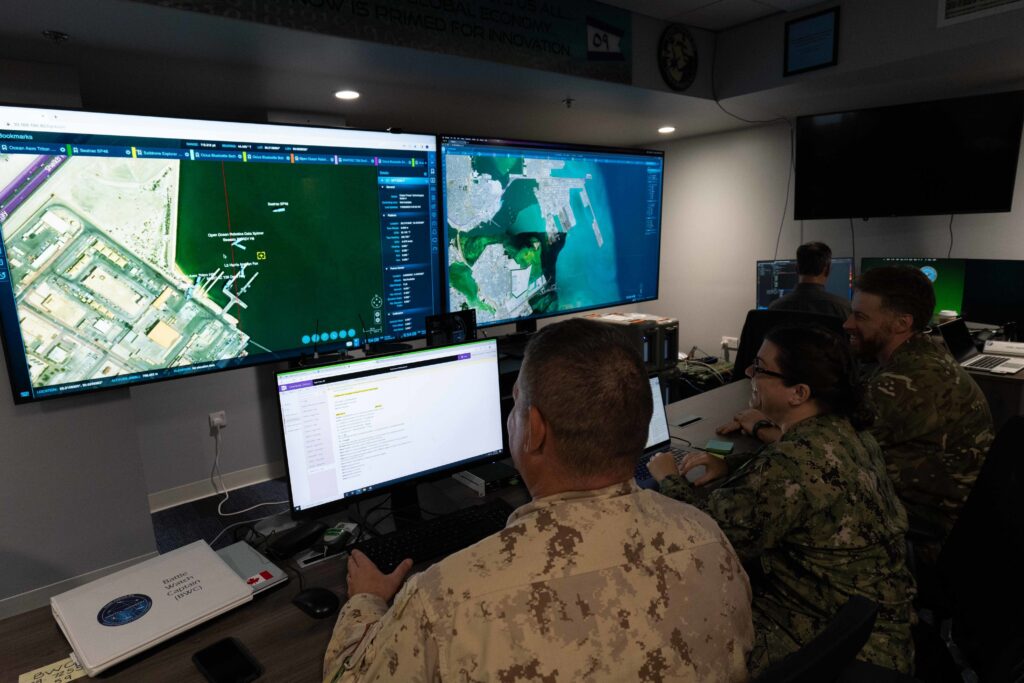
This fleet of USVs will “map the pattern of life that’s happening around them” throughout the region,” he said. When this network spots something different in the pattern, they’ll take pictures and alert a U.S. Navy command center where a human being can make a decision about how to use that information.
This is enabled by the use of artificial intelligence (AI), which allows the Navy to monitor the thousands of ships that are underway in the region at any given time — something human beings could not do on their own, Cooper said.
“We can use manned ships much more efficiently, much more effectively,” he said.
Cooper said he has seen a growth in the practicality of USVs and AI to enhance the Navy’s control over the region.
“There’s no single navy alone that can patrol [the waters around the Arabian peninsula],” he said. “We all know the criticality of the waters to the greater flow of commerce throughout the region, and so we think the best way to cover that and expand maritime domain awareness is … [by] using unmanned sensors through the theater along with AI.”
Cooper also noted that U.S. Naval Forces Central Command has been engaged in other activities in the region, calling the two most important initiatives “accelerating innovation” — which involved the aforementioned USV efforts — but also “strengthening partnerships.”
He pointed to initiatives by the Navy such as the Combined Maritime Forces and the International Maritime Security Construct, which are consortiums that gather nations in the region to cooperate with the Navy in achieving the sea service’s objectives. He also brought up the IMX exercise, an 18-day biennial naval training event led by the command that took place earlier this year and drew participation from dozens of countries.
“We lead two of the largest coalition task forces in the world — each of them will grow in membership and partnership,” Cooper said, noting that in 2021 the command did 33 exercises with countries in the region and will double that figure by the end of this year.