BAE Systems Demonstrates Effectiveness of APKWS Against Agile, High-Speed Military Drones
70mm rockets guided by APKWS guidance kits went 5 for 5 against agile, high-speed Class-2 unmanned aerial systems in testing. BAE SYSTEMS
HUDSON, N.H. — BAE Systems completed additional ground-to-air test firings to prove the effectiveness of 70mm rockets guided by APKWS guidance kits against Class-2 unmanned aerial systems (UAS) that weigh roughly 25-50 pounds and can travel at speeds exceeding 100 miles per hour, the company said in a Nov. 29 release.
During the demonstration in Southern Arizona, five APKWS-guided counter-UAS rockets were fired from a containerized weapon system and destroyed all targets, including fast-moving drones. The test results further demonstrate APKWS guidance kits’ ability to enable low-cost, precision strikes against airborne threats.
“Militarized drones are becoming more prevalent in conflicts around the world, and we’re giving our customers an efficient way to counter them without wasting expensive missiles,” said Greg Procopio, director of Precision Guidance and Sensing Solutions at BAE Systems. “Our tests demonstrate that APKWS guidance kits have the flexibility to engage a variety of targets to meet the evolving mission needs of the warfighter.”
The 70mm rockets can destroy Class-2 aerial drones by combining standard motors and warheads with APKWS guidance kits and proven proximity/point-detonation fuzes. The resulting precision munition is a low-cost, supersonic, lock-on-after-launch strike weapon with a large 10-pound warhead that can destroy large drones in a matter of seconds with or without direct contact.
Combat-proven APKWS-guided rockets are highly effective against a variety of soft and armored stationary and moving targets. They can be fired by many different platforms, including jets, helicopters, trucks, boats and weapon stations, and stowed APKWS guidance kits protect seeker optics from adjacent rocket fire, unlike nose-mounted seeker optics. APKWS guidance kits are the only U.S. government program of record for 70mm laser-guided rockets. The kits are available to all U.S. armed forces, as well as U.S. allies via Foreign Military Sales.
APKWS guidance kits are produced at BAE Systems manufacturing facilities in Hudson, New Hampshire and Austin, Texas.
SeeByte to Extend U.S. Navy Autonomous Systems and Machine Learning Capability
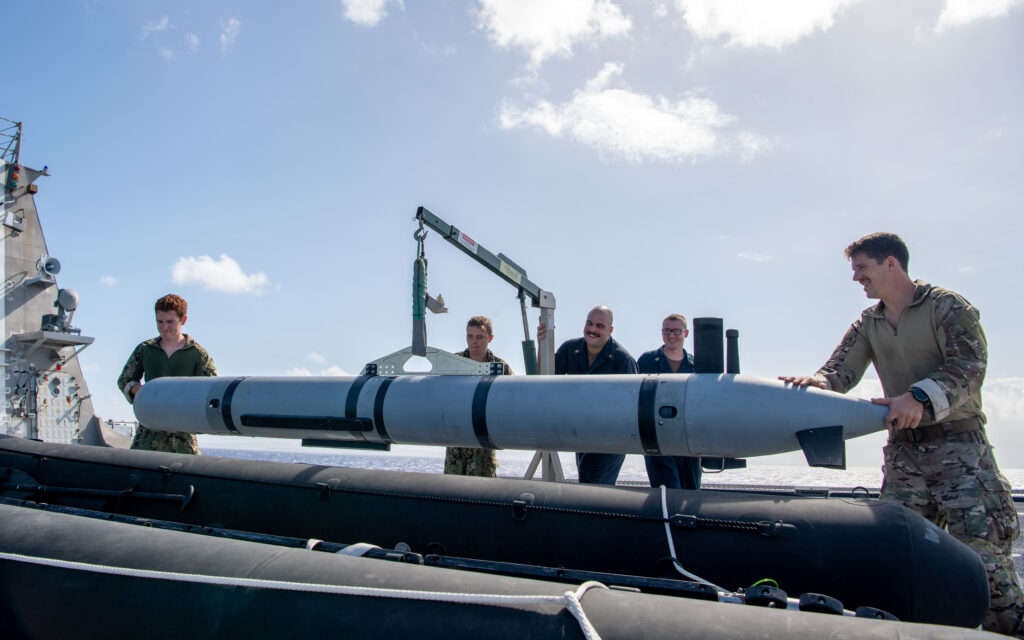
Sailors assigned to the Independence-variant littoral combat ship USS Charleston (LCS 18) and Explosive Ordnance Disposal Mobile Unit 5 transport a simulated Mark 18 Mod 2 Kingfish unmanned underwater vehicle during a mine countermeasures exercise. U.S. NAVY / Mass Communication Specialist 2nd Class Ryan M. Breeden
EDINBURGH — SeeByte Ltd, a developer of smart software solutions for uncrewed maritime systems, has been awarded an indefinite-delivery/indefinite-quantity (IDIQ) contract to support the U.S. Navy’s Mk18 Uncrewed Underwater Vehicle Family of Systems program, the company announced in a Nov. 29 release.
The awarded IDIQ has a total potential value of $87 million and a duration of up to 10 years. Under this contract, SeeByte will provide engineering, technical support, training and simulation services including upgrades to SeeByte’s Mission-Level Autonomy system, Neptune, development of Automatic Target Recognition modules and a bespoke training and simulation toolkit (Unmanned Systems Simulator).
The U.S. Navy uses the Mk18 Mod 1 Swordfish and Mk1 Mod 2 Kingfish UUVs for mine countermeasures.
7th Fleet Cruiser Conducts Freedom of Navigation Operation in South China Sea
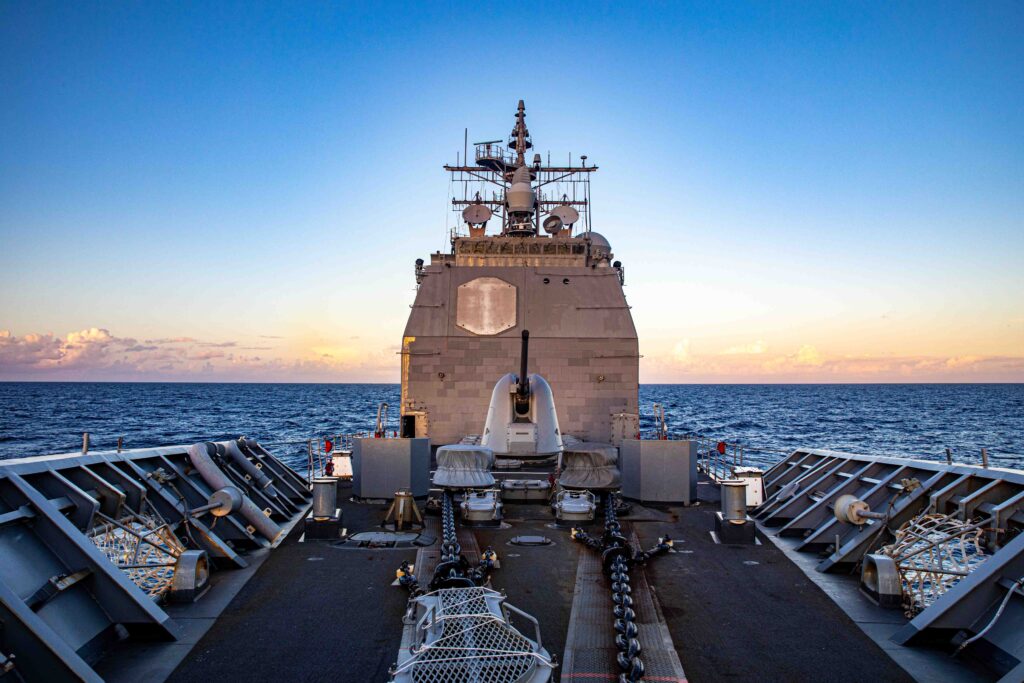
Ticonderoga-class guided-missile cruiser USS Chancellorsville conducts routine underway operations in the South China Sea, Nov. 29, 2022. U.S. NAVY
SPRATLY ISLANDS, South China Sea — On Nov. 29, 2022, USS Chancellorsville (CG 62) asserted navigational rights and freedoms in the South China Sea near the Spratly Islands, consistent with international law, U.S. 7th Fleet Public Affairs said in a release.
At the conclusion of the operation, USS Chancellorsville exited the excessive claim area and continued operations in the South China Sea. The freedom of navigation operation (“FONOP”) upheld the rights, freedoms and lawful uses of the sea recognized in international law by challenging restrictions on innocent passage imposed by the People’s Republic of China (PRC), Vietnam and Taiwan.
Unlawful and sweeping maritime claims in the South China Sea pose a serious threat to the freedom of the seas, including the freedoms of navigation and overflight, free trade, and unimpeded commerce, and freedom of economic opportunity for South China Sea littoral nations.
USS Chancellorsville conducted this FONOP in accordance with international law and then continued on to conduct normal operations in waters where high seas freedoms apply. The operation reflects continued commitment to uphold freedom of navigation and lawful uses of the sea as a principle. The United States is defending every nation’s right to fly, sail and operate wherever international law allows, as USS Chancellorsville did here.
The PLA Southern Theater Command’s statement about the operation is the latest in a long string of PRC actions to misrepresent lawful U.S. maritime operations and assert its excessive and illegitimate maritime claims at the expense of its Southeast Asian neighbors in the South China Sea. The PRC’s behaviors stands in contrast to the United States’ adherence to international law and our vision of a free and open Indo-Pacific region. All nations, large and small, should be secure in their sovereignty, free from coercion, and able to pursue economic growth consistent with accepted international rules and norms.
The PRC’s statement about this mission is false.
The United States challenges excessive maritime claims around the world regardless of the identity of the claimant. Customary international law of the sea as reflected in the 1982 Law of the Sea Convention provides for certain rights and freedoms and other lawful uses of the sea to all nations. The international community has an enduring role in preserving the freedom of the seas, which is critical to global security, stability and prosperity.
The United States upholds freedom of navigation for all nations as a principle. As long as some countries continue to claim and assert limits on rights that exceed their authority under international law, the United States will continue to defend the rights and freedoms of the sea guaranteed to all. No member of the international community should be intimidated or coerced into giving up their rights and freedoms.
The PRC, Vietnam, Taiwan, Malaysia, Brunei and the Philippines each claim sovereignty over some or all of the Spratly Islands. The PRC, Vietnam and Taiwan purport to require either permission or advance notification before a foreign military vessel engages in “innocent passage” through the territorial sea. Under customary international law as reflected in the Law of the Sea Convention, the ships of all states — including their warships — enjoy the right of innocent passage through the territorial sea. International law does not allow for the unilateral imposition of any authorization or advance-notification requirement for innocent passage, so the United States challenged these requirements. By engaging in innocent passage without giving prior notification to or asking permission from any of the claimants, the United States challenged the unlawful restrictions imposed by the PRC, Taiwan and Vietnam. The United States demonstrated that innocent passage is not subject to such restrictions.
U.S. forces operate in the South China Sea on a daily basis, as they have for more than a century. They routinely operate in close coordination with like-minded allies and partners who share our commitment to uphold a free and open international order that promotes security and prosperity. All of our operations are conducted safely, professionally and in accordance with international law. These operations demonstrate that the United States will fly, sail and operate wherever international law allows — regardless of the location of excessive maritime claims and regardless of current events.
Bollinger Shipyards Announces Leadership Changes
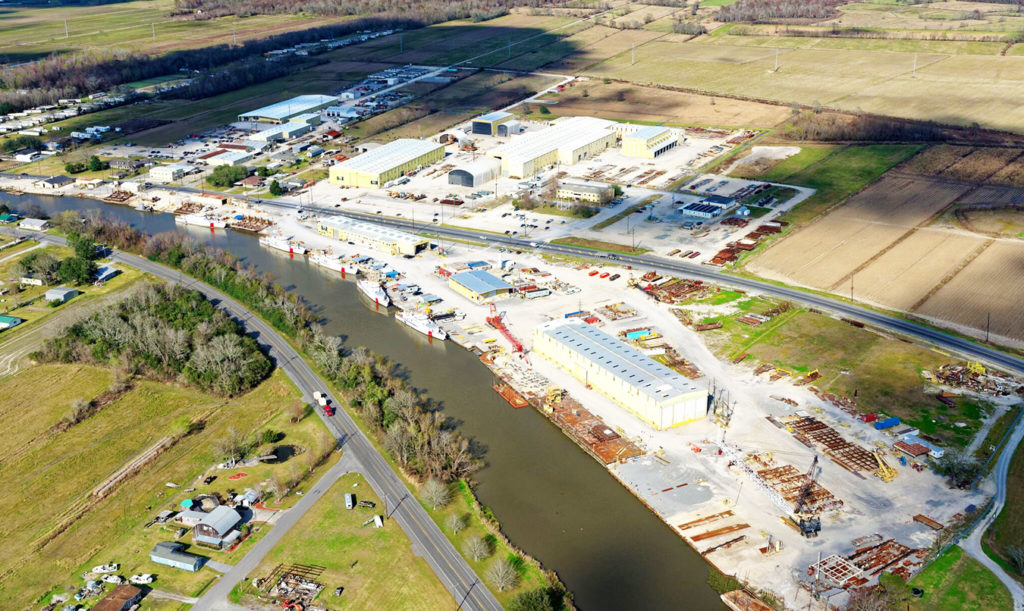
Aerial image of Bollinger’s shipyard at Lockport, Louisiana. BOLLINGER SHIPYARDS
LOCKPORT, La. — Bollinger Shipyards LLC made a number of leadership announcements following the recent acquisition of Bollinger Mississippi Shipbuilding (BMS) and Bollinger Mississippi Repair (BMR), the company announced in a Nov. 29 release. The announcements reflect leadership changes at BMS and BMR, as well as Bollinger Lockport New Construction and Bollinger Marine Fabricators in order to best align titles and functions across all 14 Bollinger facilities.
“I’ve always said Bollinger’s greatest strength is its people and I believe that wholeheartedly,” said Ben Bordelon, president and CEO of Bollinger Shipyards. “As we grow and expand, it’s important that the leadership team grow and reflect the organization — both where it is today and where we’re heading in the future. Today’s announcements strengthen our team, provide opportunities for efficiency and enhance growth within organization. I’m confident that we have the people, skills, capability and dedication to meet the needs of our customers, no matter how big or complex, and provide them with the highest levels of quality, support and service in our industry.”
Chris Remont has been named executive vice president and general manager of Bollinger Mississippi Shipbuilding (BMS). In this role, Chris will oversee the facility’s ongoing and future programs and is responsible for execution and delivery. Chris was previously EVP for New Construction Programs at Bollinger.
Bob Merchant has been named vice president of Operational Strategy & Integration. Bob will be responsible for the strategic overview of companywide functional business units. Specifically, he will review performance, synergies and operations plans to ensure support of Bollinger’s optimal strategy and best enable future growth and success. Bob previously served as president and CEO of VT Halter Marine. Bob spent most of his career at Ingalls Shipbuilding leading programs critical to both the business and the U.S. Navy and Coast Guard.
While Tim Martinez will remain the executive vice president of Repair for Bollinger, he will now oversee Bollinger Mississippi Repair (BMR).
Geoffrey Green has been named executive vice president of Government and External Affairs, where he will oversee all state and federal government relations, community relations, communications and marketing activities. Geoffrey previously served as vice president for Government Affairs for Bollinger.
Mark Matta has been named director of Program Management for Bollinger Lockport New Construction and Bollinger Marine Fabricators. Mark will be responsible for program execution of the U.S. Coast Guard Fast Response Cutter (FRC), U.S. Navy Mine Countermeasures Unmanned Surface Vessel (MCM USV) program, as well as multiple projects in support of the U.S. Navy Columbia-class Submarine program.
Jeffrey Gehrmann has been named the general manager of Bollinger Mississippi Repair.
Earlier this month, Bollinger announced the acquisition of Bollinger Mississippi Shipbuilding and Bollinger Mississippi Repair, formerly VT Halter Marine and STEHMO. The transaction enhances Bollinger’s new construction and repair capabilities so that it can better serve its key defense and commercial customers.
Notably, all ongoing programs at VT Halter Marine and STEHMO were conveyed with the transaction, including the Polar Security Cutter program for the U.S. Coast Guard and the Auxiliary Personnel Lighter-Small (APL(S)) program for the U.S. Navy. Those programs will continue to be built at Bollinger Mississippi Shipbuilding.
U.S. Launches New Unmanned & AI Systems Integration Event
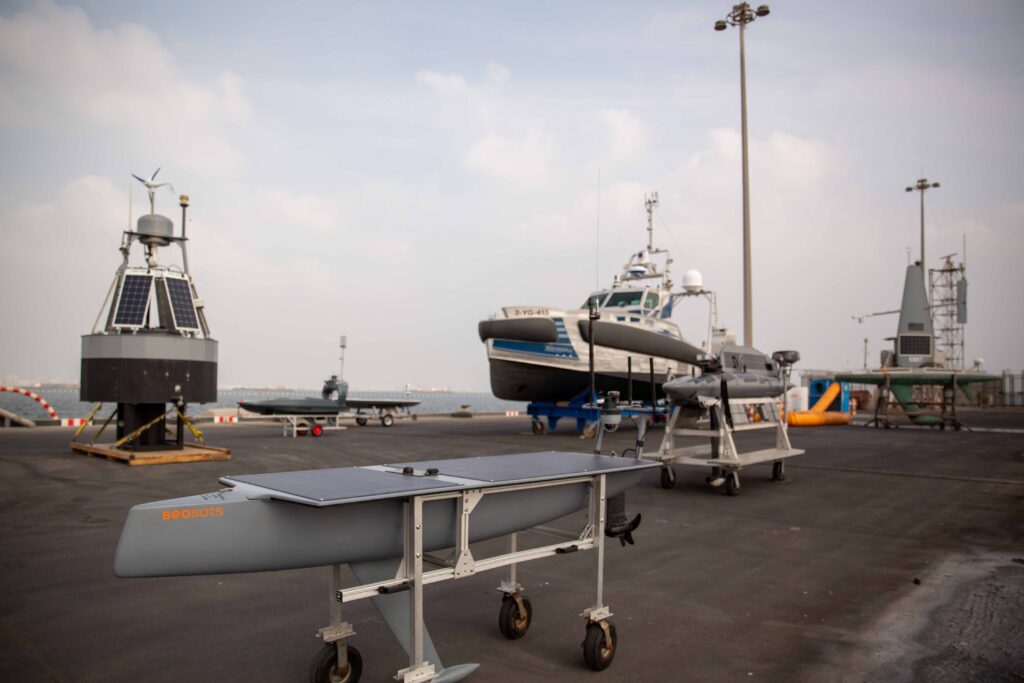
Various unmanned systems sit on display in Manama, Bahrain, Nov. 19, prior to exercise Digital Horizon 2022. The three-week unmanned and artificial intelligence integration event, beginning Nov. 23, will involve employing new platforms in the region for the first time. U.S. ARMY / Sgt. Brandon Murphy
MANAMA, Bahrain — U.S. 5th Fleet began a three-week unmanned and artificial intelligence integration event in Bahrain, Nov. 23, that will involve employing new platforms in the region for the first time, U.S. Naval Forces Central Command (NAVCENT) Public Affairs said in a Nov. 23 release.
The event, called Digital Horizon, will advance the command’s efforts to integrate new unmanned technologies while establishing the world’s first unmanned surface vessel fleet by end of next summer. U.S. 5th Fleet’s efforts are focused on improving what U.S. and regional navies are able to see above, on and below the water.
“I am excited about the direction we are headed,” said Vice Adm. Brad Cooper, commander of U.S. Naval Forces Central Command, U.S. 5th Fleet and Combined Maritime Forces. “By harnessing these new unmanned technologies and combining them with artificial intelligence, we will enhance regional maritime security and strengthen deterrence. This benefits everybody.”
Cooper established a staff called Task Force 59 in September 2021 to speed new tech integration across U.S. 5th Fleet. Since its launch, the task force has deployed a suite of new unmanned systems from operational hubs in Bahrain and Aqaba, Jordan.
Digital Horizon will include 17 industry partners bringing 15 different types of systems, 10 of which will operate with U.S. 5th Fleet for the first time.
The unmanned aerial vehicles will include two vertical take-off and landing systems, Aerovel’s Flexrotor and Shield AI’s V-BAT as well as Easy Aerial’s tethered UAV. The unmanned surface vessels will include the Elbit Systems Seagull, Exail DriX, L3Harris Arabian Fox MAST-13, Marine Advanced Robotics WAM-V, MARTAC T-38 Devil Ray, Ocean Aero TRITON, Open Ocean Robotics Data Xplorer, Saildrone Explorer, Seasats X3 and SeaTrac SP-48.
Industry partners Accenture Federal Services and Big Bear AI will also employ data integration and artificial intelligence systems during the event, and Silvus Technologies will provide line-of-sight radio communications while an unmanned surface vessel from Ocius participates from off the coast of Western Australia.
“The pace of innovation is amazing,” said Capt. Michael Brasseur, commander of Task Force 59. “We are challenging our industry partners in one of the most difficult operational environments, and they are responding with enhanced capability, fast. I am extremely proud of the entire team, including our many partners across government, academia, and industry for their commitment to Digital Horizon, as we discover new capability together.”
Over the past year, Task Force 59 operated USVs in regional waters for more than 25,000 hours, which equates to 12 years of nine-to-five testing five days a week. The Saildrone Explorer USV in particular has operated at sea for as long as 220 consecutive days without refueling or maintenance.
NAVCENT is headquartered in Manama, Bahrain and includes maritime forces operating in the Arabian Gulf, Gulf of Oman, Red Sea, parts of the Indian Ocean and three critical choke points at the Strait of Hormuz, Suez Canal and Bab al-Mandeb.
II MEF Marines Deploy On Board USNS Trenton in the Mediterranean Sea
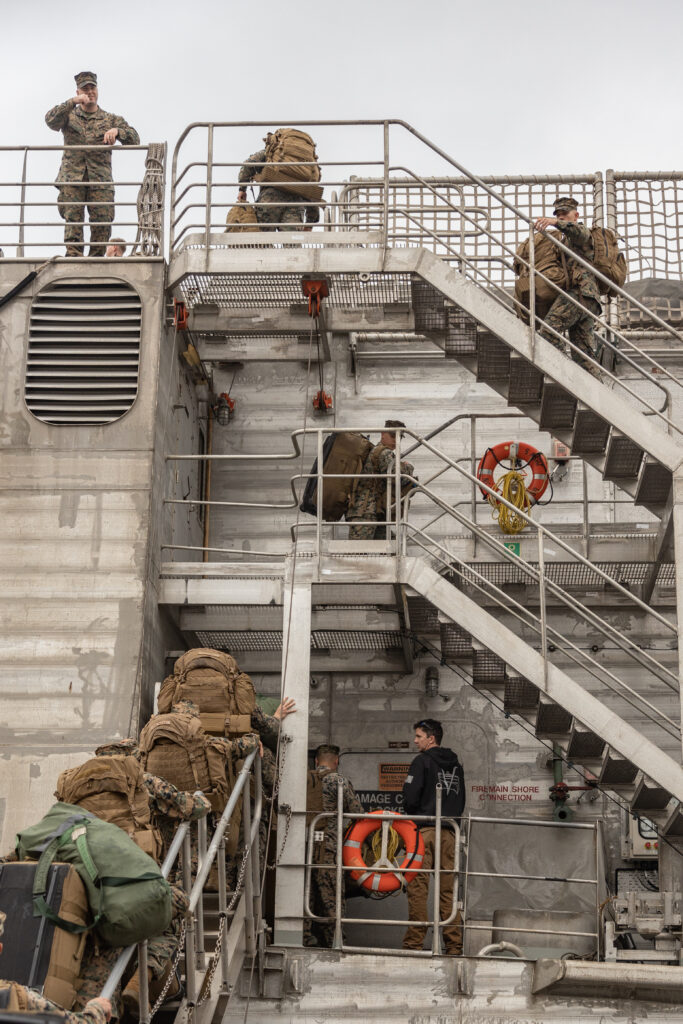
U.S. Marines assigned to II Marine Expeditionary Force board the Spearhead-class expeditionary fast transport USNS Trenton (T-EPF 5) in Koper, Slovenia, Nov. 16, 2022. U.S. MARINE CORPS / Sgt. Scott Jenkins
KOPER, Slovenia — Approximately 50 U.S. Marines from II Marine Expeditionary Force (II MEF), based out of Camp Lejeune, North Carolina, embarked on Military Sealift Command Europe and Africa (MSCEURAF)/Commander Task Force 63 (CTF-63) expeditionary fast transport ship USNS Trenton (T-EPF 5) for a one-month deployment, Nov. 17, said 1st Lt. Jasmine Scott of II MEF.
Their mission exercises II MEF’s ability to rapidly deploy Marines into the European theater aboard an expeditionary fast transport ship. This event is one way II MEF exercises its flexibility and commitment to the European theater, ability to embark on board non-standard platforms, and operate in a maritime environment filled with island chains and choke points.
“This deployment is an example of the many opportunities II MEF Marines have to travel the world, experience different cultures, and train and build camaraderie with fellow service members from our partner nations,” said Maj. Joshua Ramirez.
The majority of the Marine force comes from 8th Engineer Support Battalion, 2d Marine Logistics Group, and 8th Communication Battalion, II MEF Information Group. These two units are deploying combat engineering and communication specialists, respectively. This detachment of Marines will visit several Mediterranean Allies where they will train to improve their unit-level readiness and military-to-military cooperation.
This agile force showcases the dynamic nature of U.S. military presence, while fostering our naval integration and exercise planning capabilities. II MEF deployed forces can scale up in size or composite with other naval, joint or allied forces.
“We are very excited to have the II MEF aboard,” said Trenton’s Officer in Charge Cmdr. Timothy Rustico. “This deployment is a perfect way to demonstrate our ship’s unique transport capabilities and interoperability with the movement of Marines and their equipment.”
Trenton is on a scheduled deployment in the U.S. Naval Forces Europe-Africa (NAVEUR-NAVAF) area of operations, employed by U.S. Sixth Fleet to defend U.S., allied and partner interests.
Gerald R. Ford Carrier Strike Group Returns to Homeport Concluding Inaugural Deployment
The USS Gerald R. Ford (CVN 78) returns to Naval Station Norfolk after completing their inaugural deployment to the Atlantic Ocean with the Gerald R. Ford Carrier Strike Group Nov. 26. U.S. NAVY / Mass Communication Specialist First Class Nathan T. Beard
NORFOLK — The first-in-class aircraft carrier USS Gerald R. Ford (CVN 78), flagship of the Gerald R. Ford Carrier Strike Group (GRFCSG), returned to Naval Station Norfolk, after successfully completing its inaugural deployment throughout the Atlantic while conducting exercises and port visits with allies and partners, Nov. 26, the U.S. 2nd Fleet said in a release
The flagship set sail from Norfolk, Virginia, Oct. 4, and traveled more than 9,275 nautical miles with GRFCSG.
During the scheduled deployment, Ford operated with eight allies and partners — Canada, Denmark, Spain, France, Germany, the Netherlands, Finland and Sweden — to strengthen interoperability, while conducting a range of maritime operations and exercises.
“This deployment brought together an incredible group of Allies and partners with one single focus — to contribute to a peaceful, stable and conflict-free Atlantic region through our combined naval power,” said Vice Adm. Dan Dwyer, commander, U.S. 2nd Fleet and Joint Force Command Norfolk. “Opportunities to interoperate and integrate make our nations, our navies, and the NATO Alliance stronger.”
While deployed, GRFCSG participated in Exercise Silent Wolverine, demonstrating high-end naval warfare and integrated NATO interoperability in the maritime approaches to Europe. Silent Wolverine was an opportunity for Ford to train and test capabilities while demonstrating the U.S. commitment to Allies and partners through seamless integration.
“We sailed with our Allies and partners and trained together, tirelessly, day and night, and we are stronger for it,” said Capt. Paul Lanzilotta, Ford’s commanding officer. “Through integrated and combined operations such as live and inert ordnance expenditure by Carrier Air Wing (CVW) 8, anti-submarine warfare, anti-surface warfare, and air defense, we set the stage for operating with Ford-class technologies in a deployed environment. We completed more than 1,250 sorties, expended 78.3 tons of ordnance, and completed 13 underway replenishments – and we accomplished this because of what Ford-class aircraft carriers bring to the fight.”
The Sailors participating in Ford’s first deployment integrated multiple foreign nations’ ships into the strike group to operate together efficiently.
“Leading the men and women of the Gerald R. Ford Strike Group has been awe-inspiring. Every day these Sailors committed themselves 100% to a safe and successful inaugural deployment of Ford and the strike group,” said Rear Adm. Greg Huffman, commander, Carrier Strike Group (CSG) 12. “This deployment laid a strong foundation for the strike group, created momentum to carry us forward for future operations, and has prepared us to answer our nation’s call when needed.”
Ford made their first international port visit in Halifax, Nova Scotia, and their first European port visit in Portsmouth, U.K. For Ford Sailors, these port visits offered a long-awaited opportunity to explore and learn from different cultures.
Boatswain’s Mate 3rd Class Selena Penaloza, from Orlando, Florida, assigned to Ford’s deck department, has been stationed aboard Ford for three years before deploying for the first time.
“It was amazing getting to see the [ship’s] first deployment and my first port visit. This deployment has been a new experience for everyone onboard”, said Penaloza. “We’ve been working more than on other underways and standing more watch, and it’s all for a great cause.”
Ford is the first new U.S. aircraft carrier designed in more than 40 years, introducing 23 new technologies that offer impressive advances to its aircraft launch system, propulsion, power generation, ordnance handling and more. Ford’s advanced technologies reduce the amount of personnel required to maintain and operate the ship’s systems compared to Nimitz-class carriers.
“On our ship, you don’t hear Sailors saying, ‘that’s the way we’ve always done it’ because we’re using new gear, new technologies,” said Lanzilotta. “Our Sailors are the ones who make all of these new technologies real. The Sailors make it come to life. I am so proud of all their hard work and dedication that made Ford operational and allowed the Gerald R. Ford Carrier Strike Group to conduct a successful first deployment.”
While operating in the Atlantic, Ford hosted 215 distinguished visitors, 175 foreign dignitaries, 46 NATO flag officers and senior enlisted leaders and more than 60 U.S. and international reporters aboard.
The U.S. commands and units that participated in the GRFCSG deployment include; CSG 12, CVW 8, Destroyer Squadron 2, Ticonderoga-class guided-missile cruiser USS Normandy (CG 60), Arleigh Burke-class guided missile destroyers USS McFaul (DDG 74) and USS Ramage (DDG 61) stationed at Naval Station Norfolk in Norfolk, Virginia, and USS Thomas Hudner (DDG 116) stationed at Naval Station Mayport in Mayport, Florida.
The nine U.S. aircraft squadrons assigned to CVW-8 that embarked Ford for this deployment were Strike Fighter Squadron (VFA) 213, Strike Fighter Squadron (VFA) 31, Strike Fighter Squadron (VFA) 37 and Strike Fighter Squadron (VFA) 87 stationed at Naval Air Station Oceana in Virginia Beach, Virginia; Electric Attack Squadron (VAQ) 142 stationed at Naval Air Station Whidbey Island in Whidbey Island, Washington; Airborne Command and Control Squadron (VAW) 124; Fleet Logistics Support Squadron (VRC) 40; Helicopter Maritime Strike Squadron (HSM) 70; and Helicopter Sea Combat Squadron (HSC) 9, stationed at Naval Station Norfolk in Norfolk, Virginia.
Coast Guard Cutter Stratton Returns Home Following 97-Day Arctic Deployment
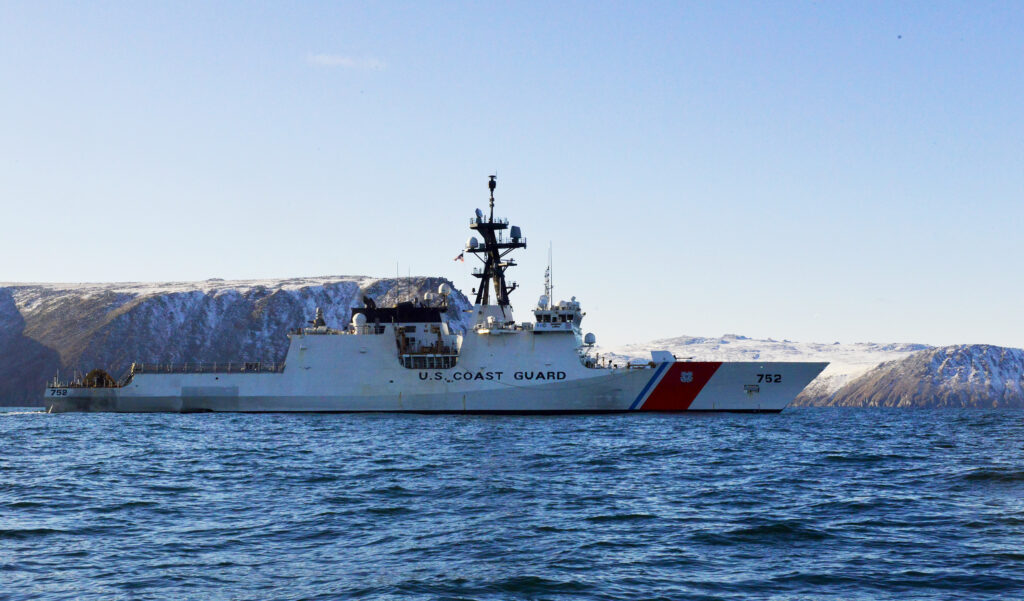
Crew from the U.S. Coast Guard Cutter Stratton (WMSL 752) patrol the U.S.-Russian Maritime Boundary Line near the Diomede Islands, Oct. 9, 2022. U.S. COAST GUARD / Petty Officer 2nd Class Melissa Mckenzie
ALAMEDA, Calif. — The U.S. Coast Guard Cutter Stratton (WMSL 752) and crew returned to Alameda, Nov. 23, following a 97-day, multi-mission deployment to the Arctic Ocean and Bering Sea, the Coast Guard Pacific Area said in a release.
In August, the cutter and crew departed Alameda to project U.S. sovereignty throughout U.S. Arctic waters, provide search and rescue capabilities in the region, and meet with Alaskan communities.
Stratton repeatedly operated along the length of the U.S.-Russian maritime boundary line (MBL) from the Diomede Islands to well above the Arctic Circle, while they patrolled within the U.S. Arctic zone. Stratton also patrolled the U.S.-Canadian MBL in the Beaufort Sea, demonstrating a presence in the distant regions of the Arctic.
On Sept. 26, the Stratton and the Coast Guard Cutter Kimball (WMSL 756) became the first national security cutters to jointly patrol the U.S.-Russian MBL above the Arctic Circle. The operational intent was the protection of the sovereign rights of the U.S. and the promotion of international maritime norms through Coast Guard presence and influence in this increasingly strategic and competitive region.
Stratton’s crew supported multiple search and rescue cases during their patrol, including rescuing two fishermen from a disabled vessel 180 miles off the Oregon coast while Stratton was transiting to the Arctic. The crew towed a 66-foot disabled fishing vessel toward shore and then transferred the vessel and survivors to a Coast Guard Station Coos Bay 47-foot Motor Lifeboat crew, approximately 45 miles offshore Coos Bay, Oregon.
Stratton’s crew also coordinated with Air Station Kodiak aircrews and the Alaska State Troopers to help locate a family stranded on the remote shores of Kotzebue Bay, Alaska, after their boat capsized.
The Stratton and the Canadian Coast Guard Ship Sir Wilfrid Laurier crews conducted an Arctic search-and-rescue exercise near Point Hope, Alaska. The crews exercised bilateral coordination to locate a simulated vessel in distress using Stratton’s Scan Eagle unmanned aerial system and operations specialists aboard Stratton, who directed the Canadian small boat crew toward the distressed vessel while watching a live feed from the overhead drone. The Canadian small boat located, recovered and returned the distressed vessel to the Stratton.
While operating near and above the Arctic Circle, Stratton’s crew conducted multiple outreach events with community members and key leaders in Kaktovik and Utqiagvik on Alaska’s North Slope. The crew also visited the village of Savoonga on Saint Lawrence Island, Alaska.
“I’m extremely proud of this crew and all they have accomplished,” said Capt. Stephen Adler, Stratton’s commanding officer. “The U.S. Coast Guard provides the nation’s most active and visible maritime presence in the high latitudes, and coordinates with our international partners through joint exercises and professional exchanges to maintain a safe and prosperous Arctic region. The Coast Guard remains ‘Always Ready’ to preserve and protect our northern shores and waters. As more ships and people move into the Arctic, the Coast Guard will be there to ensure safety of navigation and preserve our national sovereignty, as it always has. The crew has truly lived up to our ship’s motto of ‘We Can’t Afford Not To’ throughout our patrol.”
Stratton is a 418-foot national security cutter (NSC) capable of extended, worldwide deployment in support of homeland security and defense missions. NSCs routinely conduct operations from South America to the Arctic, where their combination of range, speed and ability to operate in extreme weather provides the mission flexibility necessary to conduct vital strategic missions.
Cutter Oliver Berry Completes Living Marine Resources Patrol in South Pacific
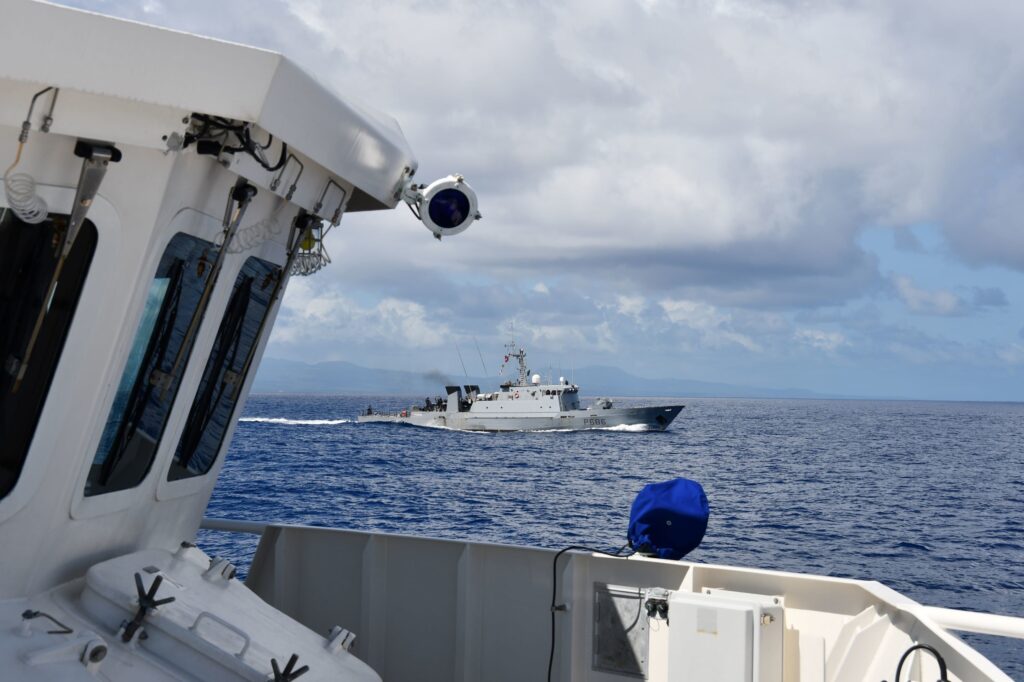
The FS La Glorieuse sails alongside the U.S. Coast Guard Cutter Oliver Berry during formation steaming exercise. The U.S. Coast Guard Cutter Oliver Berry crew returned to homeport in Honolulu Nov. 22, 2022 following a 38-day expeditionary patrol across the South Pacific. U.S. Coast Guard Cutter Oliver Berry
HONOLULU — The U.S. Coast Guard Cutter Oliver Berry crew returned to homeport in Honolulu Nov. 22 following a 38-day expeditionary patrol enforcing international living marine resources treaties and conducting joint operations with partner nations across the South Pacific, the Coast Guard 14th District said in a Nov. 23 release. During the 7,000 nautical-mile patrol, the Oliver Berry crew conducted 12 fisheries boardings, identified 16 fishery and safety violations and completed 18 community relation events while sailing from Honolulu, Hawaii to Kiribati, Samoa, the Kingdom of Tonga and American Samoa before returning to homeport.
During the first port call of the patrol at Kiritimati Island, Kiribati, the Oliver Berry crew delivered COVID-19 personal protective equipment donated by the U.S. Indo-Pacific Command’s Office of Global Health Engagement before conducting a contactless fueling evolution. The PPE supplies included face masks, thermometers, gloves and face shields to assist the island in their COVID-19 readiness and ensure the safety of its 7,000 citizens. While patrolling Kiribati’s Exclusive Economic Zone (EEZ), the Oliver Berry provided patrol coverage to support the country’s maritime law enforcement efforts.
The Oliver Berry’s next port visit to Apia, Samoa was the first by a U.S. Coast Guard cutter since 2018. During the port call, the crew of Oliver Berry participated in community engagement and outreach events, to include ship tours for partner maritime organizations and students, a visit to the Samoa Victims Support Group at Faleata to donate school supplies and hygiene products donated by the crew and the Honolulu Chief Petty Officer’s Association, a meeting with students from the National Maritime School to discuss life underway and a beach clean-up around the harbor of Apia. The crew of Oliver Berry also attended a welcoming reception for U.S. Embassy Apia Chargé d’Affaires Noriko Horiuchi, who recognized the crew for assisting Samoa in strengthening its maritime governance and security and highlighted the important role ship rider operations play in promoting maritime resource security. Prior to transiting to Tonga, the Oliver Berry crew also conducted a Passing Exercise with the FS La Glarieuse, a French Patrol Boat homeported in New Caledonia. The event included a crewmember exchange, formation steaming, simulated fishery and counter-narcotic boardings.
During the Oliver Berry’s time in Samoa and the Kingdom of Tonga, the crew also exercised Bilateral Law Enforcement agreements by hosting local law enforcement officers and conducting boardings in the country’s EEZs. While in Samoa, the crew partnered with officers from the Maritime Police Department and the Fisheries Department to patrol Samoan EEZ for two days, conducting four boardings and identifying six safety and fisheries violations on foreign and Samoan flagged vessels. While in the Kingdom of Tonga, Oliver Berry crew hosted officers from the Tongan Navy and Tongan Police Department to complete two boardings and identify one violation.
“The importance of exercising U.S. Coast Guard Bilateral Law Enforcement Agreements with our Pacific Island partners can’t be understated,” said Lt. Cmdr. Micah Howell, the commanding officer of the Oliver Berry. “These agreements allow us the opportunity to strengthen our partnerships and work closely with our maritime counterparts to collectively ensure maritime governance and security across the Blue Pacific.”
In addition to boardings being conducted in Samoan and Tongan EEZ’s, Oliver Berry crew also patrolled international waters in the South Pacific to detect, deter and suppress non-compliance with international treaties and conservation and management measures outlined by the Western Central Pacific Fisheries Commission (WCPFC). Oliver Berry crew conducted four WCPFC boardings in an effort to identify and counter illegal, unreported and unregulated fishing (IUU-F) activity, resulting in one fisheries violation.
The Oliver Berry is one of six highly capable FRCs stationed across District 14. Their crews provide year-round search and rescue and maritime law enforcement coverage across a 15 million square mile area of responsibility, demonstrating the United States Coast Guard’s enduring commitment to our partner nations across Oceania.
Leonardo DRS Announces Closing of Merger with RADA
ARLINGTON, Va. — Leonardo DRS Inc., a leading mid-tier defense technology provider, announced Nov. 28 the successful completion of the all-stock merger between Leonardo DRS and RADA Electronic Industries Ltd. to become a combined public company.
The combined company will be aligned to fast growing segments of the U.S. Department of Defense budget with market leading positions in advanced sensing, force protection, network computing, and electric power & propulsion. Further, the combined company’s mid-tier position provides meaningful scale coupled with agility to respond to customer needs with affordable and differentiated solutions. Pro forma revenue and Adjusted EBITDA in 2021 for the combined company was approximately $2.7 billion and $305 million, respectively.
“We look forward to bringing Leonardo DRS’s mid-tier strength to the public markets with the addition of RADA’s leading tactical radar capabilities,” said William J. Lynn III, chairman & CEO of Leonardo DRS. “Leonardo DRS’s broad exposure to fast growing segments in the defense market and market leading positions in advanced sensing, force protection, network computing and electric power & propulsion make us a unique defense contractor with a compelling growth outlook, margin expansion capabilities and a largely unlevered balance sheet.”
“We are pleased to have received strong shareholder support for this transaction,” commented Dov Sella, CEO of RADA. “It has always been our goal to maximize shareholder value, and the RADA team and Board believe this merger represents an excellent outcome for the company. The RADA team looks forward to continuing to penetrate the tactical radar market within the strong Leonardo DRS platform.”