Inaugural Navy Exercise Tests Dozens of Ship Maintenance Technologies

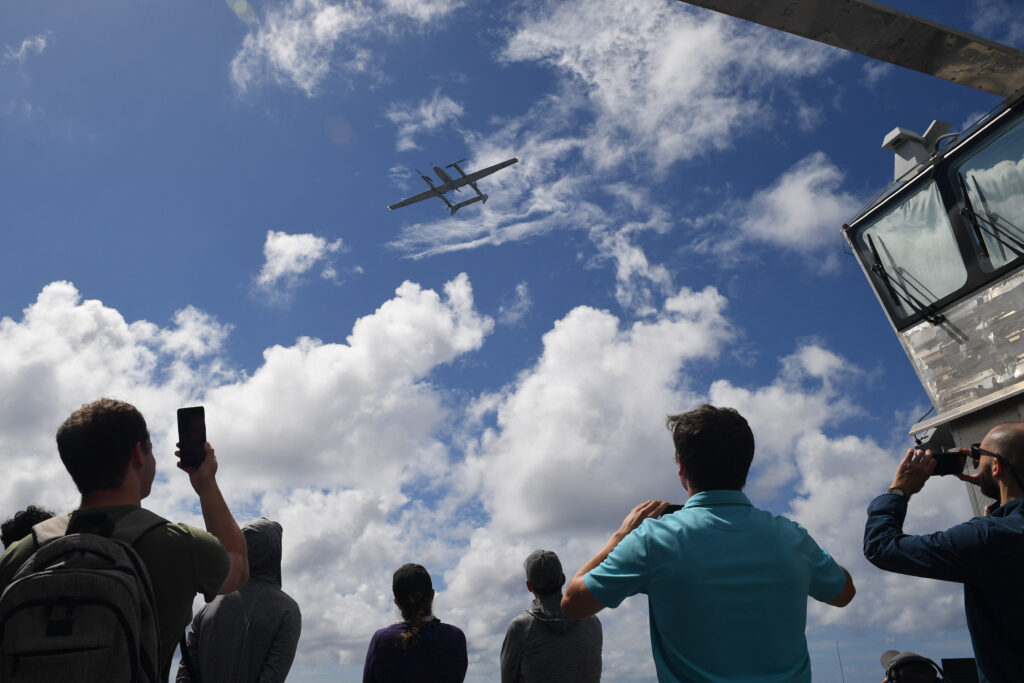
From left: Subin Varghese, a doctoral student in electrical engineering at the University of Houston, and Vedhus Hoskere, assistant professor of civil engineering at the university, launch a Skydio X2E unmanned aerial vehicle to scan the Self Defense Test Ship as Electrician’s Mate 2nd Class Somantha Him-Gross and Hull Maintenance Technician 2nd Class Marco Perez of the Navy’s Surge Maintenance program look on while underway off the coast of Port Hueneme, California, during the Repair Technology Exercise, or REPTX, on Aug. 29. U.S. NAVY / Eric Parsons

NAVAL BASE VENTURA COUNTY, Calif. — A variety of robots crawling in, on and below a decommissioned U.S. Navy destroyer, as well as replacement parts being additively manufactured on site, comprised just a small part of the activity that took place during the first-ever U.S. Navy Repair Technology Exercise, or REPTX, held Aug. 22-Sept. 1 at Naval Base Ventura County in Ventura County, California.

Teams from various companies as well as academic and government laboratories arrived from around the world with their technology applications to conduct demonstrations and field experiments aboard the decommissioned Spruance-class destroyer, known as the Self Defense Test Ship. The ship is operated by personnel from Naval Surface Warfare Center, Port Hueneme Division (NSWC PHD) in Port Hueneme, California, a field activity of Naval Sea Systems Command and located at NBVC.

NAVSEA’s Naval Systems Engineering and Logistics Directorate Technology Office (NAVSEA 05T) sponsored REPTX 2022, which was hosted by NSWC PHD and held both pierside and aboard the SDTS, which took to the sea for the second week of the event.

The purpose of the inaugural exercise was to see if the technology can tackle real-world fleet maintenance and battle-damage related repairs of ships while operating in a true maritime environment — boosting the Navy’s ability to keep ships at sea by aiding Sailors in carrying out needed repairs.

“The format provides a realistic fielding environment, both pierside and underway, allowing teams the chance to field, adjust, learn and retest their solutions,” said Janice Bryant, sustainment technology program manager at NAVSEA 05T.

“REPTX didn’t just showcase technology but applied it to solve Navy challenges,” Bryant added. “It was a problem-centric event that promoted collaboration rather than competition. Many problems require a complex solution, and multiple participants have independent pieces of that solution.”

The more than 60 REPTX participants demonstrated technologies designed to address four focus areas: visualization, command and control aids, forward manufacturing and expeditionary maintenance.

The technology also needed to be capable of taking on a “day job” — in other words, serving a purpose that adds value to Navy ships and crew on a routine basis. And, it has to be user-friendly enough for a ship’s crew to learn quickly.

“Our priorities as a warfare center are to deliver and sustain readiness, modernize and maintain the current fleet, and field the surface fleet of the future,” said Capt. Andrew Hoffman, NSWC PHD commanding officer. “REPTX demonstrates these priorities by allowing both industry, government and academia to work side-by-side while exploring innovative maintenance concepts that we can rapidly deliver to our forward-deployed warfighters.”

Approximately 20 reservists from the Navy’s Surge Maintenance (SurgeMain) program provided that ship’s crew perspective as they got hands-on with much of the technology, learning how to operate the remote-controlled robotics, wearing augmented reality (AR) headsets to view repair instructions and videos, measuring corrosion on the deckplate of the SDTS, and more.

“The SurgeMain sailors typically don’t get chances like this to provide input on new technologies, so it was hugely important for them to have that opportunity,” said REPTX Project Manager Suzie Simms. “At the end of the event, all of the SurgeMain sailors who participated said they want to be involved again next year.”

Scenarios where reservists were able to remotely control robots included identifying unknown objects on the side of the ship’s hull, detangling a fouled propeller, measuring the depth of metal wastage due to corrosion using ultrasonic waves, and inspecting tight spaces that would be difficult or dangerous for a human to go into.

Several companies brought AR technology to the SDTS, providing both communication and real-time visuals during simulated battle damage assessment scenarios as well as repair work instructions and videos that can be viewed through the headset while simultaneously looking at the damaged area.

Additive manufacturing technology installed in compact shipping containers both pierside and aboard the SDTS provided the capability to 3D print replacement parts as needed in a variety of materials.

Sarcos Mechanical Engineer Parker Hill (left) focuses on a monitor while guiding a remotely operated vehicle through an underwater demonstration as Hull Maintenance Technician Petty Officer 2nd Class Remedios Verduzconuñez with the Navy’s Surge Maintenance program observes the ROV’s progress on Aug. 25 at Naval Surface Warfare Center, Port Hueneme Division. The demonstration aboard the Self Defense Test Ship tested the ROV’s ability to clear a rudder or propeller fouled by debris. U.S. NAVY / Eric Parsons

Other scenarios involved ship-to-shore communication systems, inspection and repair tools, and above- and below-water visualization devices.

Technology suppliers assisted SurgeMain reservists in using and demonstrating the technology aboard the SDTS during week two — this time in a true maritime environment as the vessel went underway off the coast of Port Hueneme. Unmanned aerial vehicle (UAV) operators got a chance to fly their camera-equipped drones around the ship to inspect it.

The main goals of the UAV demonstrations during REPTX were to identify issues like corrosion and misplaced items and to test the UAVs’ capabilities to aid in battle damage assessment and repair — a key focus area for the Navy — by rapidly creating digital models, among other things.

In one scenario, a flange with a leaky gasket was the focus of a collaborative effort on the last underway day of REPTX. The SDTS crew had identified the issue in the ship’s state room, and several technology suppliers worked on a fix with SurgeMain sailors.

A reservist used an AR headset during the scenario to connect remotely with a subject matter expert elsewhere to help inspect and measure the faulty flange.

Armed with measurements of the flange assembly, two additive manufacturing companies participating in REPTX later 3D-printed parts that could be used to replace the flange and gasket in the state room.

Other underway demonstrations tested, repaired and monitored vital equipment on the ship.

Participants and organizers agreed that some of the best things to come out of REPTX were the spontaneous collaborations between attending organizations that revealed more efficient uses of their individual technologies when used together.

Along with the focus on collaboration, organizers designed the event to be educational for everyone involved.

“REPTX facilitated learning on both the government and participant sides,” said Jason Bickford, research manager at NSWC PHD. “We’ve heard unanimous positive feedback from participants that it was a valuable experience for them.”

The learning experience was impactful in that it was hands on, operationally based and held aboard an active ship.

Bryant said that next steps include determining how to invest $2 million in follow-on funding to further develop technologies for fielding in the fleet. The REPTX team will also release to the public a comprehensive after action report on the event.

Meanwhile, discussions are underway for a sequel.

“Events like REPTX enable NAVSEA to be more agile and competitive in the future fight,” Bryant said. “Providing access to Navy assets, crew and problems allows traditional and non-traditional players to engage together, quickly and effectively. Continuing efforts like REPTX are essential as the Navy looks to build a more resilient and sustainable fleet and innovative and responsive industrial base.”


USS Zumwalt Operates with 7th Fleet for the First Time 

USS Zumwalt (DDG 1000) approaches the Gov. William Preston Lane Memorial Bridge, also known as the Chesapeake Bay Bridge, as the ship travels to its new home port of San Diego, California, in 2016. U.S. NAVY / Liz Wolter

ARLINGTON, Va. — The guided-missile destroyer USS Zumwalt (DDG 1000) is operating under the command of the U.S. 7th Fleet for the first time, according to a Navy release.  

The Zumwalt completed its first port call in Guam on Sept. 19, according to Commander, Task Force 71/Destroyer Squadron 15 Public Affairs. This “marks the farthest it’s ever been from its home port of Naval Base San Diego since its commissioning,” the squadron’s release said.  

While in the region, the Zumwalt is assigned to Task Force 71/Destroyer Squadron 15, the 7th fleet’s principal surface force. 

The Zumwalt is the lead ship of a three-ship class of DDGs, two of which have been commissioned and one is still under construction. All three are or will be assigned to Surface Development Squadron One in San Diego. 

The Zumwalt class has been selected to be the initial platform for the Navy’s Conventional Prompt Strike capability. The ships’ Advanced Gun Systems will be removed to make way for Large Missile Vertical Launch Systems to handle hypersonic missiles because the ship’s existing Mk57 launchers for its Standard and Tomahawk missiles are too small to accommodate the CPS missile.   

The Zumwalt will be the first ship to receive the modifications. The Navy’s Supervisor of Shipbuilding, Conversion, and Repair, Bath, Maine, awarded General Dynamics Bath Iron Works a $20 million cost-plus-fixed-fee contract modification “for procurement of long-lead time material for the Large Missile Vertical Launch System [LMVLS] launch module fabrication on DDG 1000,” an Aug. 18 Defense Department contract announcement said. Work is expected to be completed by June 2024.   

The Navy plans to field the Conventional Prompt Strike capability on the Zumwalt in 2025. The Conventional Prompt Strike capability will be fielded later in the decade on the Block V version of the Virginia-class attack submarine.  

The Zumwalt is commanded by Capt. Amy McInnis. 


Cruiser USS Monterey Decommissioned 

Sailors assigned to the USS Monterey (CG 61) man the rails during its decommissioning ceremony. Monterey was commissioned on June 16, 1990, and was a U.S. Navy warship for 32 years. U.S. NAVY / Mass Communication Specialist 3rd Class Rodrigo Caldas

NORFOLK, Va. — The crew of the guided-missile cruiser USS Monterey (CG 61) held a decommissioning ceremony onboard Naval Station Norfolk, Virginia, Sept. 16, USS Dwight D. Eisenhower (CVN 69) public affairs said in a release. 

Plankowners, including the ship’s commissioning commanding officer Capt. Joel Heaton, as well as former crew members, joined hundreds of attendees to celebrate the ship’s distinguished 32-year history of naval service. 
 
“Unique to the Navy, when we serve on a ship, it becomes part of us — I mean who we are, how we act, think and live. Similarly, we all in turn become part of that ship — it is a tremendously powerful legacy. This is most definitely the case with USS Monterey, she is certainly a testament to her excellent crews and she has been ‘rough in battle and ready in peace,'” said Vice Adm. Jim Kilby, deputy commander, U.S. Fleet Forces Command. 
 
“Monterey executed 14 deployments, many availabilities, and as many training cycles. She was modified over her life to continue to be a relevant and a key ship in our fleet. She will leave a great legacy for many years in the future as those who proudly call themselves Monterey Sailors continue to serve our Nation.” 
 
Monterey’s current Commanding Officer, Cmdr. David M. Schaller, spoke of the powerful bond between Sailors and their ships and the lives shaped aboard.

“Nobody joins the Navy to decommission a ship,” said Schaller. “The Monterey crew performed their duties of putting her to rest in the most professional and exemplary manner, honoring her storied history and service to our nation.” 
 
Monterey was built at Bath Iron Works in Bath, Maine, and commissioned in Mayport, Florida, June 16, 1990. Monterey’s namesake commemorates the battle fought Sept. 20, 1846, in the war with Mexico. 
 
“She has served her crews and her nation well and rightfully takes her place among the ships that, for well over 200 years, have played an indispensable role in protecting the United States of America and serving her strategic interests across the world,” said Schaller. “This ship and her crews will forever share a legacy that will be felt across the fleet for years to come.” 


7th Fleet Destroyer Transits Taiwan Strait with Canadian Frigate 

The guided-missile destroyer USS Higgins (DDG 76) conducts a routine Taiwan Strait transit Sept. 20. Higgins is forward-deployed to the U.S. 7th Fleet area of operations in support of a free and open Indo-Pacific. U.S. NAVY / Mass Communication Specialist 1st Class Donavan K. Patubo

TAIWAN STRAIT — The Arleigh Burke-class guided-missile destroyer USS Higgins (DDG 76), in cooperation with Royal Canadian Navy Halifax-class frigate HMCS Vancouver (FFH 331), conducted a routine Taiwan Strait transit Sept. 20 (local time) through waters where high seas freedoms of navigation and overflight apply in accordance with international law, U.S. 7th Fleet Public Affairs said Sept. 20. 

The ships transited through a corridor in the Strait beyond the territorial sea of any coastal state. Higgins’ and Vancouver’s transit through the Taiwan Strait demonstrates the commitment of the United States and its allies and partners to a free and open Indo-Pacific.


Navy Evaluates New Crash Crane for Carrier Decks 

The Navy’s Common Aviation Support Equipment program office (PMA-260) is currently evaluating electromagnetic environmental effects on a crash and salvage crane at the Aircraft Anechoic Test Facility in Patuxent River. U.S. NAVY

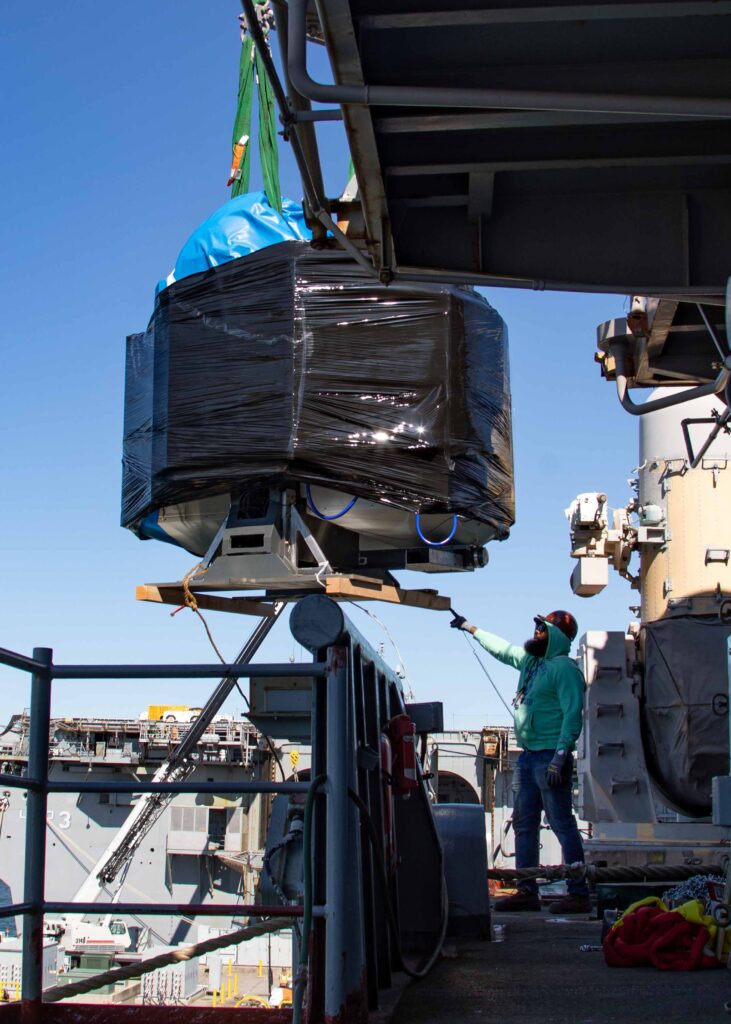
PATUXENT RIVER, Md.—The Navy’s Common Aviation Support Equipment program office (PMA-260) is currently evaluating electromagnetic environmental effects on a crash and salvage crane at the Aircraft Anechoic Test Facility in Patuxent River, the Naval Air Systems Command said Sept. 20. 

Electromagnetic waves within the radio frequency spectrum are used for communication, radar and information networks aboard ships. The E3 evaluation currently underway in the Aircraft Anechoic Test Facility will determine the crane’s compatibility with the RF environment. 

RF cannot be seen or felt, but it can negatively affect other electrical systems if those systems are not properly protected. Testing will determine if the crane has an appropriate level of emissions, can withstand a general level of radiation across the whole RF spectrum, and can withstand high levels of radiation tailored to frequencies in its operational environment. 

“The new amphibious and carrier CSC designs will ensure the warfighter has the safest, most modern and reliable equipment possible for years to come,” said Jim Choflet, PMA-260 crash crane team lead. 

Crash and salvage cranes are critical pieces of equipment because no flight operations are allowed on ships without an operational CSC running on standby. They are used for lifting and moving disabled aircraft on carriers and landing helicopter dock flight decks. The new version, designed by industry partner Allied Systems Co., replaces the legacy carrier and amphibious assault crash cranes. 


Bell Selects Sierra Nevada Corp. for its High-Speed VTOL Development Team 

An artist’s conception of Bell Textron’s High-Speed Vertical Takeoff and Landing aircraft. BELL TEXTRON

National Harbor, Md. — Bell Textron Inc. has entered into a teaming agreement with Sierra Nevada Corp. for Bell’s High-Speed Vertical Takeoff and Landing aircraft, Bell announced Sept. 19. As part of the collaboration, SNC will specifically support the design and development of mission systems for HSVTOL variants.   

Bell’s HSVTOL vehicles blend the hover capability of a helicopter with the speed, range and survivability features of fighter aircraft, with low downwash hover capability and jet-like speeds of more than 400 knots. This family of scalable aircraft concepts is designed to carry out U.S. Air Force and Special Operations Command missions across the full spectrum of conflict and political scenarios, including personnel recovery, contested logistics and intelligence, surveillance and reconnaissance and strike.  

“In an effort to advance technical maturity and deliver HSVTOL capability to warfighters sooner, Bell is assembling a team of industry-leading partners. We’re thrilled to have SNC onboard,” said Jason Hurst, vice president, Innovation, Bell. “We’ve made significant progress in Bell’s HSVTOL technology development in 2022, and we look forward to showing this progress in the upcoming year.”  

Bell is currently executing its HSVTOL risk reduction effort and participating in the AFWERX HSVTOL Concept Challenge, a crowdsourcing effort for the Air Force and Special Operations Command. Bell is one of 11 companies from more than 200 challenge entrants selected to receive market research investments aimed at advancing HSVTOL technology. 


GA-ASI Flies MQ-20A Avenger UAS Completely Autonomously 

An Avenger MQ-20A, which recently flew using an artificial intelligence pilot. GENERAL ATOMICS AERONAUTICAL SYSTEMS

SAN DIEGO — General Atomics Aeronautical Systems Inc. used a company-owned Avenger MQ-20A unmanned aircraft system to fly a military aircraft using an artificially intelligent pilot deployed on an operationally relevant, open mission systems software stack on Sept. 12, the company said. 

The Avenger’s completely autonomous flight used the AI pilot for close to 30 minutes as a part of a cooperating live, virtual and constructive UAS swarm. The flight was performed as part of GA-ASI’s ongoing commitment and investment into the development of advanced autonomy of AI and machine learning for UAS. 

The flight made use of GA-ASI’s novel Reinforcement Learning architecture to develop and validate an RL agent in an operationally relevant environment. RL agents provide a new and innovative tool for next-generation military platforms to make decisions under dynamic and uncertain real-world conditions. The team flew “chase and avoid behavior” where real-time updates were made to the flight path to avoid adversaries using live fused tracks. Live tracks were provided to the system using the Infrared Search and Track sensor network supplied by Lockheed Martin.  

“The flight was a tremendous success and demonstrated a number of groundbreaking capabilities in the race to operationalize autonomy for collaborative combat aircraft,” said GA-ASI Senior Director of Advanced Programs Michael Atwood. “It’s exciting to see how AI can be used to advance how and where we fly unmanned systems as the complexity of the battlespace increases. Our ‘chase and avoid’ agent’s ability to dynamically update the flight path as threats were identified is the first step towards building an ecosystem of collaborative autonomous combat aircraft.”  

TacIRST is a new class of multifunction, embeddable sensor system with an open architecture. It was developed by Lockheed Martin to provide a range of capabilities for both crewed and uncrewed aircraft. “We anticipated the need for passive, long-range threat detection by autonomous aircraft and are proud to see this capability integrated successfully on the Avenger,” said Terry Hoehn, Director of Lockheed Martin’s Advanced Threat Warning Systems. “We look forward to further collaboration and testing with GA-ASI.” 

The team used a government-furnished CODE autonomy engine and the government-standard OMS messaging protocol to enable communication between the RL agent and the Tactical IRST. By utilizing government standards, such as CODE and OMS, rapid integration of autonomy for collaborative combat aircraft becomes possible. 

General Dynamics Mission Systems also supplied key technologies to the flight. The mission computer used to host the OMS software is part of the Digital Backbone Node family of systems from General Dynamics Mission Systems. The DBN architecture enables rapid and secure deployment of evolving capabilities needed for CCA through application of the latest government open architectures, high-performance computing, advanced cooling, and a high-speed backplane with multi-level security to maximize battlefield collaboration between platforms.  

This flight was another in an ongoing series of autonomous flights performed by GA-ASI using internal research and development funding to prove out important AI/ML concepts for advanced UAS.  


ONR SCOUT Tests Tech for Monitoring Illicit Maritime Cargo 

Vessels participate in an ONR SCOUT-sponsored experimentation event at Joint Expeditionary Base Little Creek-Fort Story, Virginia, at the entrance of the Chesapeake Bay. U.S. NAVY / Max Hopkins, Demonstration Assessment Team, Naval Surface Warfare Center Indian Head Division

ARLINGTON, Va. — To improve capabilities for monitoring aircraft and vessels carrying illicit maritime cargo such as drugs, for longer periods of time and over greater distances, the Office of Naval Research-sponsored SCOUT initiative recently conducted a dynamic experimentation event at Joint Expeditionary Base Little Creek-Fort Story, Virginia, at the entrance of the Chesapeake Bay. 

The goal of the event was to find creative solutions to pinpoint “dark targets” — aircraft or watercraft operating with little to no radio-frequency signatures — found in maritime operating areas covered by the Joint Interagency Task Force South, ONR said in a Sept. 19 release. It sought ways to use unmanned technologies to expand intelligence, surveillance and reconnaissance capabilities beyond those of traditional maritime patrol aircraft such as the P-3 Orion and P-8 Poseidon.  
 
JIATF-S currently works with U.S. Southern Command and partner naval forces to leverage all-domain technologies and unmanned capabilities to target, detect and monitor illicit drug trafficking in the air and maritime domains. This facilitates interdiction and apprehension to reduce the flow of drugs, as well as degrade and dismantle transnational criminal organizations. 
 
ONR SCOUT is an ongoing, multiagency experimentation campaign for identifying alternative ways to bring unmanned technologies to warfighter problems, operationalize them and bring them to scale. SCOUT is committed to getting nontraditional, commercial-off-the-shelf, government-developed and/or government-sponsored technologies to the fleet rapidly. 
 
“SCOUT is an innovation vehicle and investment strategy for the rapid development of autonomous platforms that address today’s warfighter challenges,” said Chief of Naval Research Rear Adm. Lorin Selby. “Through experimentation with partners like JIATF-S, we can connect innovators, industry, acquisition professionals and fleet stakeholders to attack and solve key operational problems.” 
 
“This is a pressing issue for JIATF-S because every day multiple suspect vessels are near and in the area of operations conducting illicit trafficking,” said U.S. Coast Guard Lt. Cmdr. Duane Zitta, JIATF-S chief of operational demonstration and experimentation. “Because of this vast area, JIATF-S is looking for alternative capabilities and technologies to provide unmanned counter-operations that can detect and monitor suspect activity, ultimately helping prevent illegal movement to the United States.” 
 
The JEB Little Creek-Fort Story experimentation event was a partnership involving ONR SCOUT, JIATF-S, the Naval Research and Development Establishment, and industry partners in the Chesapeake Bay area. It was one of multiple sprint events (scenario-based demonstrations of technology capabilities and characteristics) held this year that will lead to a large-scale main experimentation event in March 2023. 
 
During the Chesapeake Bay event, participants engaged in simulated drug-running and -hunting scenarios during “cat-and-mouse” games involving a specialized vessel owned by SOUTHCOM and JIATF-S, a “Gotcha” boat formerly used by drug traffickers and seized by JIATF-S, and various targets of interest. 
 
Participants employed sophisticated sensor systems and technologies, ranging from coordinated unmanned aircraft systems to wide-area motion imagery. Data collected during the exercises was fed into an onsite maritime operations center and synthesized, providing operators with real-time information about targets and each technology’s performance. 
 
The technology tested at JEB Little Creek-Fort Story will undergo further refinement and improvement before the March 2023 main experimentation event. 


USCGC Oliver Henry Concludes Operation Blue Pacific Expeditionary Patrol 

The Sentinel-class fast response cutter USCGC Oliver Henry (WPC 1140) accesses the mooring ball in Apra Harbor Sept. 18, following more than 16,000 nautical mile patrol through Oceania. U.S. COAST GUARD / Petty Officer 2nd Class Sean Ray Blas

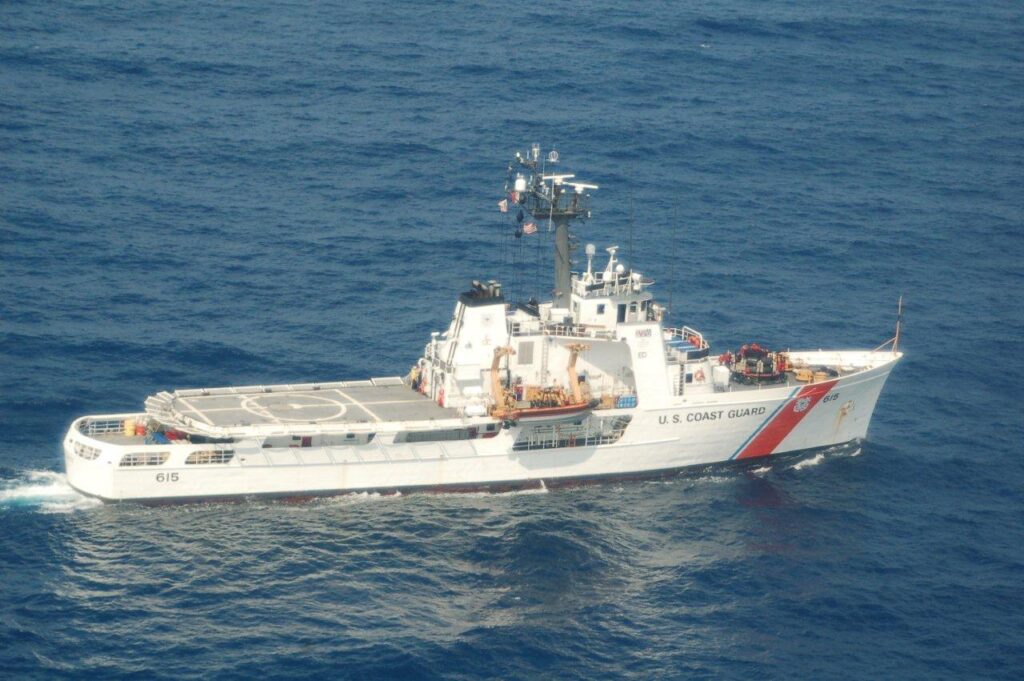
SANTA RITA, Guam — The Sentinel-class fast response cutter USCGC Oliver Henry (WPC 1140) arrived at homeport in Guam on Sept. 19, following a patrol across Oceania, U.S. Coast Guard Forces Micronesia said in a release. 

“The crew of Oliver Henry just completed a 43-day historic patrol across Oceania, where we patrolled and visited ports in the Federated States of Micronesia, Papua New Guinea and Australia. We also patrolled the exclusive economic zones of those countries and Solomon Islands during our time,” said Lt. Freddy Hofschneider, commanding officer of Oliver Henry. “Our trip was significant in that we validated the capability of the fast response cutters homeported here in Apra Harbor, Guam, showing what we can do to promote regional stability in terms of fisheries and continue to build a better relationship with our regional partners. 

The crew conducted training, fisheries observations, community and key leader engagements and a multilateral sail. They covered more than 16,000 nautical miles from Guam to Cairns, Queensland, Australia, and returned with several stops in Papua New Guinea and one in the Federated States of Micronesia. 

“The fact that we can take these 154-foot ships with a crew of 25 and a lieutenant commanding officer and push them so far over the horizon, even as far as Australia — which is what Oliver Henry just did — is an incredible capability for the region,” said Capt. Nick Simmons, commander of U.S. Coast Guard Forces Micronesia/Sector Guam.

In Papua New Guinea, the crew spent time on Manus Island and Port Moresby. They visited HMPNGS Tarangau School, spent time in the community, and engaged with Papua New Guinea Defence Force and local officials. 

In Cairns, they conducted engagements with Australian Defence and Home Affairs partners, the mayor of Cairns, and Cairns Regional Council representatives. They also took time to engage with the International Marine College. Upon departure, they participated in a multilateral formation sail with crews from Australia and Fiji as the other ships departed for Exercise Kakadu off Darwin. 

During their stop in Pohnpei, Oliver Henry’s crew hosted the U.S. Embassy team and an FSM National Oceanic Resource Management Authority – Fisheries Compliance Division representative to cover patrol highlights and future opportunities. The Oliver Henry commanding officer visited the FSM National Police Maritime Wing headquarters to discuss multilateral efforts. Finally, members of the cutter’s engineering team conducted a subject matter expert exchange with the crew of FSS Palikir, the last active Pacific-class patrol boat, on shipboard repairs and preventative maintenance. 

The Oliver Henry is the 40th Sentinel-class fast response cutter. The ship was commissioned along with its sister ships, Myrtle Hazard (WPC 1139) and Frederick Hatch (1143), in Guam in July 2021.


International Naval Forces Partner in Seychelles to Build Cooperation

Cutlass Express participating forces perform visit, board, search, and seizure training in Victoria, Seychelles, Feb. 15. Cutlass Express, sponsored by U.S. Africa Command and conducted by U.S. Naval Forces Africa, is designed to improve regional cooperation among participating nations in order to increase maritime safety and security in the East Africa regions. U.S. NAVY / Mass Communication Specialist 2nd Class Daniel Charest

MANAMA, Bahrain — The world’s largest multinational naval partnership, Combined Maritime Forces (CMF), launched a two-week mission in the Indian Ocean island nation of the Seychelles with other international organizations Sept. 18 to strengthen regional collaboration and enhance operational readiness, said Combined Maritime Forces public affairs. 

CMF is leading Operation Southern Readiness in partnership with the Seychelles People’s Defence Force, European Union Naval Force, United Nations Office on Drugs and Crime, and India which began partnering with CMF earlier this year. This is CMF’s first iteration of Operation Southern Readiness. 

“Seychelles is a strong regional maritime partner and we are very grateful for them hosting this new opportunity,” said Vice Adm. Brad Cooper, commander of U.S. Naval Forces Central Command, U.S. 5th Fleet and CMF. “We are also excited to work with other international partners, including India, to train and build capacity in a vibrant way.” 

Nations including Australia, Canada, France, India, Italy, New Zealand, Saudi Arabia, Seychelles, the United Kingdom and the United States are slated to participate with personnel, ships and aircraft during several training events. 

Multinational forces will conduct training on visit, board, search and seizure techniques; search and rescue operations; maritime law and information sharing. 

“The training is designed to enable our partners to meet face-to-face and learn from one another and is only possible because of the teamwork and commitment from all partners,” said Royal Canadian Navy Cmdr. Alexis Dieryckx, CMF’s senior mission planner. “It’s all about building relationships because relationships are the fundamental building blocks for greater collaboration at sea.” 

CMF consists of 34 member nations whose forces operate in the Red Sea, Gulf of Aden, Northern Arabian Sea, Gulf of Oman, Arabian Gulf and Indian Ocean. 

CMF nations are united in upholding international rules-based order to protect the free flow of commerce, ensure regional maritime security and deter illicit activity by non-state actors.