Hawaii-based Coast Guard Units Conclude RIMPAC 2022 Participation 

A U.S. Navy Sailor directs Navy and U.S. Coast Guard Sailors to a U.S. Navy MH-60R Seahawk helicopter during flight operations during Rim of the Pacific 2022. U.S. COAST GUARD / Petty Officer 3rd Class Taylor Bacon

PEARL HARBOR — Four Hawaii-based Coast Guard units concluded operations contributing to the largest Coast Guard participation in the history of RIMPAC and returned to service of the residents of Hawaii and the Pacific region on Aug. 4, the Coast Guard 14th District said in a release. 

U.S. Coast Guard Cutters Midgett and William Hart, the Pacific Dive Locker, and Maritime Safety and Security Team Honolulu partnered with military members from Australia, Peru, Republic of Korea, Canada, France and Japan throughout the in-port and at-sea portions of the Rim of the Pacific 2022, which ran from late June to early August. The exercise marked a series of “firsts” for Coast Guard participation. 

Coast Guard Cutter Midgett conducted a broad spectrum of operations with the Japan Maritime Self Defense Force Ship Izumo, the USS Chafee, USS Gridley, French Navy Frigate FS Prairial, and Peruvian Navy BAP Guise. The combined team of Midgett, William Hart, Izumo and USS Essex completed RIMPAC’s first mass rescue operation, successfully partnering to find, recover and provide medical assistance to 10 simulated people in the water. 

Following RIMPAC, Midgett’s crew will depart on a western Pacific patrol to build on the regional partnerships demonstrated here and conduct international training and fisheries law enforcement. William Hart’s crew will conduct necessary maintenance, complete training, and resume their role as a standby search-and-rescue asset for vessels in distress in the waters around Hawaii, a role it shares with the other two fast response cutters in Honolulu, Cutter Joseph Gerczak and Cutter Oliver Berry. 

This year’s RIMPAC featured the first Coast Guard-led humanitarian assistance and disaster relief exercise. The exercise tested reopening a harbor that had been struck by a simulated hurricane. A boat crew from Coast Guard MSST Honolulu partnered with underwater survey teams from the U.S. and Royal Australian Navies to conduct underwater scans of Honolulu Harbor to identify hidden hazards. After that, divers from the Coast Guard Pacific Dive Locker collaborated with divers from the U.S. Army and Republic of Korea Navy to remove the hazards and practice maintaining aids to navigation underwater. 

Following RIMPAC, the Pacific Diver Locker will focus on training and preparations for annual safety inspections and provide support to local Coast Guard assets and aids to navigation missions.

“This was an incredible opportunity to work alongside our partners in the Blue Pacific to strengthen our relationships,” said Coast Guard 14th District Commander Rear Adm. Michael Day. “Our ability to come together for RIMPAC 22, in person, has helped reconnect within and beyond the region. It is through those connections and relationships that we will move forward to bolster impactful engagement opportunities.”  


Mark Fleming to Lead New VideoRay Defense and Government Business Unit  

VideoRay’s Mark Fleming. VIDEORAY

POTTSTOWN, Pa. — VideoRay, a global leader in underwater remotely operated vehicle technology, has established a Defense and Government business unit to further develop the company’s successful defense and government program, the company said Aug. 4.

Mark Fleming will lead the unit as vice president, defense and government, responsible for all strategic business development and customer support.  

Fleming, who served in the U.S. Navy specializing in explosive ordnance disposal and attained the rank of chief warrant officer five (CW5), joined VideoRay 10 years ago to increase government sales. Building on the company’s relationship with the U.S. Coast Guard, Fleming established new connections that led to contracts with the U.S. Navy, foreign navies and other governmental entities. He has built these relationships through his deep understanding of the challenges that defense personnel face in underwater missions and his strong customer service ethic. 

VideoRay has been experiencing substantial growth over the past two years, due in part to multimillion-dollar contracts with the U.S. Navy for Mission Specialist Defender ROV systems.  

“Defense and government sales of our Mission Specialist systems have grown because our capabilities are proven to be extremely valuable and unique for underwater explosive ordnance disposal. Mark is the driving force behind this success,” said Chris Gibson, vice president, sales and marketing.  

Fleming added, “I’m looking forward to advancing VideoRay’s defense and government outreach and developing new ROV technology to support safe underwater missions around the world.” 

Under Fleming’s direction, VideoRay will conduct a search for a new salesperson for the business unit.  

The Mission Specialist Defender ROV system is designed for precise control of the vehicle position and orientation, heavier payloads and demanding intervention applications. With seven thrusters, the Defender ROV system can move in any direction and maintain active pitch to face the vehicle in an upward or downward orientation, making it ideal for dangerous or heavy-duty missions. In addition, these submersible ROV systems use interchangeable modular components that reside on a single platform, which enables operators to integrate tooling, sensors and payloads quickly and easily in the field to meet mission objectives and maximize uptime.  


Bollinger Delivers 50th Fast Response Cutter to Coast Guard 

The Coast Guard Cutter William Chadwick in Key West. BOLLINGER SHIPYARDS

LOCKPORT, La. — Bollinger Shipyards LLC has delivered the Coast Guard Cutter William Chadwick to the U.S. Coast Guard in Key West, Florida, the company said Aug. 4. This is the 176th vessel Bollinger has delivered to the U.S. Coast Guard over a 35-year period and the 50th fast response cutter delivered under the current program.  

“It’s incredibly meaningful that we could deliver the 50th FRC, the USCGC William Chadwick, on the Coast Guard’s 232nd birthday and that she’ll be homeported in Sector Boston, the birthplace of the Coast Guard,” said Bollinger President and CEO Ben Bordelon.

“Pound for pound, the quality and capabilities of the FRC platform is unmatched and can be looked upon as a model government acquisition program. Our unique experience building for the Coast Guard is unparalleled and has shown time and time again that we can successfully deliver the highest quality vessels on a reliable, aggressive production schedule and cost, even in the most challenging circumstances. We look forward to continuing our historic partnership with the U.S. Coast Guard.” 

Chadwick will be the first of six FRCs to be homeported in Sector Boston, responsible for coastal safety, security and environmental protection from the New Hampshire-Massachusetts border southward to Plymouth, Massachusetts out to 200 nautical miles offshore. Sector Boston directs over 1,500 active duty, Reserve and Auxiliary members whose mission is to protect and secure vital infrastructure, rescue mariners in peril at sea, enforce federal law, maintain navigable waterways, and respond to all hazards impacting the maritime transportation system and coastal region. 

Each fast response cutter is named for an enlisted Coast Guard hero who distinguished themselves in the line of duty. William P. Chadwick served as keeper of the Green Island Lifeboat Station in New Jersey and was awarded the Gold Lifesaving Medal for the rescue of the crew of the schooner George Taulane on Feb. 3, 1880.  Even after suffering a debilitating injury from flying debris, Chadwick directed the repeated efforts to save the crew of the broken Taulane as they battled mother nature’s high winds, heavy rains and dangerous surf. Finally, after five and a half hours, Chadwick’s men were able to erect a breeches buoy.  Within a half hour all the Taulane’s crew were safely ashore. 


USS Delbert D. Black Under Way for First Deployment 

The Arleigh Burke-class guided missile destroyer USS Delbert D. Black (DDG 119) departs Naval Station Mayport for deployment, Aug 2. USS Delbert D. Black is homeported at Naval Station Mayport. U.S. NAVY / Mass Communication Specialist 2nd Class Juel Foster

JACKSONVILLE, Fla. — The Arleigh Burke-class guided-missile destroyer USS Delbert D. Black (DDG 119) departed Naval Station Mayport Aug. 2 on the ship’s inaugural deployment, U.S. 2nd Fleet said Aug. 4. 

The ship completed all training phases of the Optimized Fleet Response Plan with Destroyer Squadron 26 and Carrier Strike Group 10. 

“Our ship and crew have trained for this moment for more than four years,” said Cmdr. Mark Gallagher, commanding officer, Delbert D. Black. “We are prepared for any mission directed to us. The crew and ship are the finest the Navy has to offer, and I am proud to sail with each one of these fine men and women.”  

Commissioned in September 2020, the ship’s crew is comprised of more than 50 officers and nearly 300 enlisted Sailors. 

Delbert D. Black is the 68th Arleigh Burke-Class guided-missile destroyer delivered to the Navy and the first to bear its name. The ship honors the first master chief petty officer of the Navy. Black is known for initiating the master chief program, ensuring enlisted leadership was represented Navy-wide. 

“It is an honor and a privilege to take this ship and crew on its maiden deployment,” said Delbert D. Black Command Master Chief Christopher Bartley. “We are following in the footsteps of our trailblazing namesake, making Del and Ima Black proud.” 

Ima Black, Black’s widow and a former Sailor, serves as the ship’s sponsor. She served during World War II in the Navy WAVES (Women Accepted for Volunteer Emergency Service). 

A detachment from Helicopter Maritime Strike Squadron 48 will remain embarked aboard Delbert D. Black. 

Delbert D. Black provides the nation multiple warfighting capabilities as one of the Navy’s newest destroyers that maintains maritime stability and security to ensure access, deter aggression, and defend U.S., allied and partner interests as part of the George H.W. Bush Carrier Strike Group. 


U.S. Navy Delivers First Upgraded CN-235 Aircraft to RMAF 

The U.S. Navy has delivered the first of three Royal Malaysian Air Force CN-235 military transport aircraft converted to a maritime patrol platform.  U.S. NAVY

PATUXENT RIVER, Md. — The U.S. Navy has delivered the first of three Royal Malaysian Air Force CN-235 military transport aircraft converted to a maritime patrol platform, the Naval Air Systems Command said Aug. 3. This comes just three and a half years after the U.S. signed a letter of offer and acceptance to begin increasing the capability and interoperability of U.S. and Malaysian forces. 

The effort was facilitated by the U.S. Navy’s Building Partner Capacity program, aligned with the U.S. government’s Maritime Security Initiative, which is intended to assist the Malaysian government in increasing maritime security and maritime domain awareness within the Malaysian Exclusive Economic Zone. 

The project to integrate an intelligence, surveillance and reconnaissance upgrade into the aircraft was undertaken by the Malaysian air force in cooperation with the Naval Air Systems Command’s Security Cooperation Office and Naval Air Warfare Center Aircraft Division’s AIRWorks. 

“Our collective international team has overcome tremendous challenges during the recent worldwide pandemic to deliver this capability. We are excited to deliver this first aircraft,” said Gerald Swift, who leads AIRWorks, NAWCAD’s office focused on rapidly and effectively delivering warfighter capability to meet immediate and emergent warfighter needs. 

The upgrade includes a maritime surveillance mission suite, maritime surveillance radar, an electro-optical infrared turret, line-of-sight datalink and a roll-on/roll-off mission system operator station. Compatible mobile and fixed ground stations are also being delivered to increase the Malaysian air force’s ISR capability. 

The project’s CN-235s were flown to Indonesia for completion and testing in Sept. 2020 amid COVID-19 restrictions and first flight took place in October 2021. Work on the two remaining CN-235 aircraft and multiple ground stations continues and is expected to be completed in 2022. 


Exercise PANAMAX 2022 Kicks Off in Mayport, Florida 

Argentine Navy Rear Adm. Marcelo Fernandez, PANAMAX 2022 Combined Force Maritime Component Commander, throws the ceremonial first pitch at a Jacksonville Jumbo Shrimp minor league baseball game for the start of PANAMAX 2022, in Jacksonville, Florida, Aug. 2. U.S. NAVY / Mass Communication Specialist 3rd Class Jahlena Royer

MAYPORT, Fla. — U.S. Naval Forces Southern Command/U.S. 4th Fleet is hosting the Combined Force Maritime Component Command Staff participating in exercise PANAMAX 2022, in Mayport, Florida, Aug. 1-12. 

Exercise PANAMAX 2022 is a U.S. Southern Command-sponsored exercise that provides important training opportunities for nations to work together and build upon the capability to plan and conduct complex multinational operations. The exercise scenario involves security and stability operations to ensure free flow of commerce through the Panama Canal. 
 
U.S. forces participating in this year’s exercise include staff elements from Southern Command, U.S. Army South, U.S. Marine Forces South, Special Operations Command South, 12th Air Force (Air Forces Southern), and U.S. Naval Forces Southern Command/U.S. 4th Fleet, along with participants from 23 partner nations. 
 
Approximately 300 Sailors, Marines and public security forces will serve on the CFMCC staff under the leadership of Argentine Rear Adm. Marcelo Fernandez, who serves as Commander, Atlantic Naval Area for the Argentine Navy. 
 
“PANAMAX demonstrates our ability to ensure regional security and stability through multi-national maritime operations in support of the Panama Canal,” said Fernandez. “I look forward to the opportunity to work together with the U.S. and our other partner nations during this important exercise.” 
 
Under the exercise scenario, a multinational force has formed to execute a United Nations Security Council resolution calling for defense of the Panama Canal. The force includes air, land and special-forces components, in addition to the maritime component, which will plan and conduct simulated operations in and around the canal and its surrounding waters in the Eastern Pacific Ocean and the Caribbean Sea. 
 
There are no live forces in this year’s PANAMAX. Instead, component staffs will work through a computer-aided scenario in support of the Multinational Forces South Commander, Maj. Gen. William Thigpen, Commanding General, U.S. Army South. 
 
Forces will participate in the training at various U.S. locations including Joint Staff Exercise Directorate at Suffolk, Virginia; U.S. Southern Command, Doral, Florida; Fort Sam Houston, San Antonio, Texas; Homestead Air Reserve Base, Homestead, Florida; Davis-Monthan Air Force Base, Tucson, Arizona; and Naval Station Mayport, Florida.
 
For the fifth straight PANAMAX, the air, land and maritime component commanders for the exercise are partner nation flag or general officers. 


SIOP Contract Awarded for Dry Dock Upgrade, Berth Repairs at NNSY 

The aircraft carrier USS Harry S. Truman (CVN 75), front, passes the aircraft carrier USS George H. W. Bush (CVN 77) as it departs Norfolk Naval Shipyard after completing a 10-month regularly scheduled extended carrier incremental availability. U.S. NAVY / Mass Communication Specialist 2nd Class Steven Edgar

NORFOLK, Va. — Naval Facilities Engineering Systems Command (NAVFAC) Mid-Atlantic awarded AECOM Technical Services Inc. a $91.5 million firm-fixed-price with award fee task order July 29 under a previously-awarded multiple-award construction contract for berth repairs at Norfolk Naval Shipyard (NNSY) in Portsmouth, Virginia, the Naval Facilities Engineering Systems Command Mid-Atlantic Public Affairs said Aug. 3. 

Repairs to Berths 40 and 41 and the accompanying Dry Dock 8 upgrades will directly support the mission of NNSY to perform maintenance on Gerald R. Ford-class aircraft carriers and are part of the Navy’s Shipyard Infrastructure Optimization Program (SIOP). 

The award of this contract is a crucial step to ensuring that NNSY has the infrastructure needed to service future fleet platforms and demonstrates the importance of the SIOP program for the Navy. SIOP remains committed to improving fleet operational availabilities at the nation’s four public shipyards to ensure they can effectively continue to serve the national defense. 

SIOP is a holistic investment plan that integrates infrastructure investments at the Navy’s four public shipyards to meet fleet maintenance requirements and improve Navy maintenance capabilities by expanding shipyard capacity and optimizing shipyard configuration. 

The work to be performed provides for repairs to Berths 40 and 41 structural components by replacing deteriorated pile systems, cast-in-place concrete systems, pile caps, concrete beams, and fender pile systems. 


USS Bulkeley Departs Norfolk for Homeport Shift to Rota 

Sailors aboard the USS Bulkeley (DDG 84) cast off lines as they depart Naval Station Norfolk Aug. 4 for the ship’s scheduled homeport shift to Rota, Spain, as part of the U.S. Navy’s long-range plan to gradually rotate the Rota-based destroyers. U.S. NAVY / Mass Communication Specialist 1st Class Theodore Green

NAVAL STATION NORFOLK — The Arleigh Burke-class guided-missile destroyer USS Bulkeley (DDG 84) departed Naval Station Norfolk Aug. 4, commencing the ship’s scheduled homeport shift to Rota, Spain, as part of the U.S. Navy’s long-range plan to gradually rotate the Rota-based destroyers, U.S. Fleet Forces Command said Aug. 4. 
 
Bulkeley will join destroyers USS Arleigh Burke (DDG 51), USS Roosevelt (DDG 80), USS Paul Ignatius (DDG 117) and Helicopter Maritime Strike Squadron (HSM) 79 as Forward Deployed Naval Force-Europe (FDNF-E) assets stationed in Rota. 
 
“The Bulkeley crew has been working extremely hard the past year to prepare to join our forward deployed forces in Rota and work with our partners and allies in the region,” said Capt. Mac Harkin, commanding officer, USS Bulkeley. “We are excited to join our sister ship and aviation units already at the tip of the spear, to assure our allies, respond to threats as required and ensure support to global operations.” 
 
U.S. Navy ships assigned to FDNF-E demonstrate national resolve, strengthen alliances, dissuade potential adversaries and enhance the ability to respond quickly to contingencies. Rota offers a world-class port facility that provides an excellent location for multi-mission Aegis ships to support NATO and U.S. missions, exercises and engagements. 
 
“Bulkeley is a highly capable, multi-warfare platform that is joining a substantial force of FDNF-E assets already in place,” said Harkin. “When combined with our partners and allies, we are collectively ready to perform a myriad of tasks, including NATO ballistic missile defense, the full spectrum of maritime security operations, bi-lateral and multi-lateral training exercises, and NATO operations and deployments.” 
 
The rotation of the FDNF-E ships serves to keep these multi-mission capable ships forward deployed to better support maritime security operations in the region as well as Ballistic Missile Defense (BMD) of U.S. and allied units and personnel. 
 
With Bulkeley’s arrival, along with Paul Ignatius’ arrival earlier this year, USS Ross (DDG 71) and USS Porter (DDG 78) will shift homeports from Rota to Norfolk in the coming months, marking the final scheduled homeport shifts in the long-planned FDNF-E rotation. 


HMAS Canberra Stows an Osprey for The First Time at Sea 

The aviation support team from Royal Australian Navy landing helicopter dock HMAS Canberra (L02) transfer an embarked U.S. Marine Corps MV-22B Osprey into the ship’s hangar during Rim of the Pacific 2022. ROYAL AUSTRALIAN NAVY / Petty Officer Chris Szumlanski

PACIFIC OCEAN — Royal Australian Navy landing helicopter dock ship HMAS Canberra (L02) embarked two MV-22B Osprey military aircraft onboard and successfully moved the Osprey off the flight deck into the hangar for the first time at sea during Rim of the Pacific 2022, Commander, U.S. 3rd Fleet public affairs said in a release.

The MV-22Bs operated from Canberra for the duration of RIMPAC in another first for the ship. The aircraft are onboard for the duration of the tactical phase and are one in many types of helicopters to land and take off from Canberra’s flight deck during the exercise.

A team of staff from the Aircraft Maintenance and Flight Trials Unit (AMAFTU) have embarked for RIMPAC and, in a first for Canberra, the aircraft have been moved and stowed onboard.

Australian Army Maj. David Ellson said what the unit is achieving has taken some work by AMAFTU to get to this point but is important for future capability and a great achievement to see.

“This is the first time at sea we have taken a MV-22B down from the flight deck onto the elevator lift and into the hangar,” Ellson said. “It all forms part of the trials for AMAFTU to enable coalition aircraft to routinely embark on our ships. The evolution to move and stow the MV-22B involved approximately 10 crew and provided an opportunity for AMAFTU and the MV-22B crew to observe which is what this phase of RIMPAC is about, the interchangeability between Australia and coalition nations such as the United States.”

Canberra has not only embarked the two aircraft but their pilots, ground crew and maintainers. The 25 members are living onboard and integrating into life with fellow Aussies. 

“Moving and stowing the Osprey was done at a careful slower pace with our Canberra crew working alongside the Osprey crew as it’s a big aircraft and the crews have not done this at sea, we needed to ensure the aircraft could be stowed inside the ship and achieved safely,” Ellson said.


Ready-to-Fight Force Conducts Amphibious Assault During RIMPAC 2022

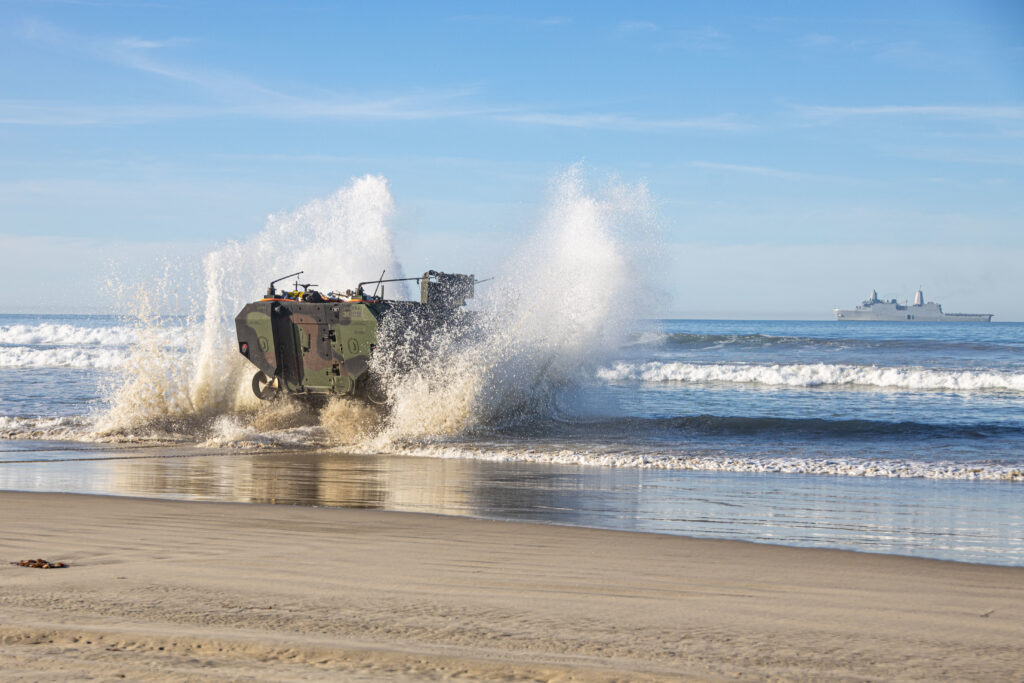
Republic of Korea Marine Corps Amphibious Assault Vehicles cover and conceal during an amphibious raid for a multinational littoral operations exercise as part of Rim of the Pacific 2022, Aug. 1. U.S. MARINE CORPS / Sgt. Melanye Martinez

MARINE CORPS BASE HAWAII — With the theme of “Capable Adaptive Partners,” the 2022 Rim of the Pacific exercise has featured a wide range of capabilities, projecting the inherent flexibility of maritime forces and helping to promote a free and open Indo-Pacific, culminating with an amphibious assault in Hawaii.

During the exercise, 26 nations, 38 surface ships, four submarines, nine national land forces, more than 30 unmanned systems, approximately 170 aircraft and more than 25,000 personnel trained together while operating in and around the Hawaiian Islands and Southern California, June 29 to Aug. 4.

Following weeks of workups, and then intensive training together when the exercise began, RIMPAC amphibious forces conducted a simulated assault on a beach and airfield at Marine Corps Base Hawaii at Kaneohe Bay on the island of Oahu in Hawaii.

RIMPAC has been led by the commander of U.S. 3rd Fleet, Vice Adm. Michael Boyle. Republic of Korea navy Rear Adm. Sangmin An served as the commander of Combined Task Force 176, RIMPAC’s amphibious task force, aboard his flagship, amphibious assault ship USS Essex (LHD 2). His deputy was  U.S. Navy Rear Adm. Michael Baze, commander of Expeditionary Strike Group (ESG) 3.

In the scenario, a fictional armed radical organization known as Draco has captured a beach and airfield and adjacent areas from a fictional friendly nation called Orion. The amphibious task force employed a multi-domain assault to capture it back.

By definition, an amphibious assault involves the establishment of a landing force on a hostile or potentially hostile shore. An amphibious force consists of an amphibious task force and a landing force. Both partner and partner nations and allies provide the forces that are organized equipped and trained for these specialty mission sets.

According to Col. Ricardo Miagany, assistant chief of staff for operations with Marine Forces Pacific, the ship-to-shore phase showcases multilateral interoperability approach.

“A flotilla of coalition naval vessels is supporting this amphibious assault. Each ship possesses unique capabilities that will be harnessed to dislodge the occupying forces,” he said.

In addition to Essex, the assault force included the ROKN landing helicopter platform ROKS Marado (LPH-6112); the Royal Australian Navy landing helicopter dock HMAS Canberra (L02); and the Mexican navy landing ship tank ARM Usumacinta (A412), the ex-USS Frederick (LST-1184).

“Each ship possesses unique capabilities that will be harnessed to dislodge the occupying forces. Today’s training highlights some of the capabilities of the forces of the amphibious partners in the region as we operate together for a collection of naval platforms and functioning as one joint naval task force,” said Miagany.

USMC F/A-18 Hornets and AH-1Z and UH-1 aircraft provided fire support, and USMC CH-53E Super Stallions and MV-22 Ospreys delivered troops to the landing zone, USAF A-10 Thunderbolt IIs, a USAF MQ-9 Reaper and a USAF C-17 airlifter.

The ground assault included forces from Australia, the Republic of Korea, Mexico, Sri Lanka, Chile, Indonesia, Malaysia, the Kingdom of Tonga and the U.S.

Miagany said the “ready-to-fight force embarked on amphibious assault vehicles, small boats and aircraft, and attacked from the sea to the shore in one of the most complex and difficult form of maneuver and amphibious operations.”

Force Modernization

“For years we have practiced amphibious operations together, and many of the participants in sporting experience have experience working with Marine Expeditionary Unites. These will remain key facets of our crisis response roles in support of our alliances and security partnerships in the years ahead,” Miagany said. “These challenges in the constant evolution of military technology are focusing the Marine Corps and many of our partners on force modernization efforts. Marine Corps investment and experimentation efforts will enhance our collective security and improve U.S. crisis response capabilities.”

Miagany said “the amphibious assault today demonstrates the flexibility and strength of integrated and interoperable amphibious forces, the synergy of network allies and partners, the enduring value of amphibious crisis response capabilities, and provides a glimpse of the U.S. Marine Corps’ emerging core mission of providing stand-in forces which defend our allies and partners.”

According to Miagany, amphibious assaults are one of the most complex of all military operations.

“Only a small collection of militaries around the world are capable of planning and executing them. This form of a maneuver warfare projects naval forces from ship to shore into contested spaces. Accomplishing this requires a tremendous amount of professionalism, partnership, compatible operating concepts and interoperable technology. When training and practicing these maneuvers throughout Hawaii in preparation for this mission, our nations are building relationships with each other and strengthening our interoperability. For years we have practiced amphibious operations together, and many of the participants this morning have experience working with Marine Expeditionary Units. These will remain key facets of our crisis response roles in support of our alliances and security partnerships in the years ahead.”

In addition to the operational demonstration, Marines from the 3d Littoral Combat Regiment displayed  their tactical systems, including sensors such as the AN/TPS-80 Ground/Air Task Oriented Radar and weapons such as the High Mobility Artillery Rocket System.

At the conclusion of the demonstration, Lt. Gen. Steven R. Rudder, commander, U.S. Marine Corps Forces, Pacific and commanding general of Fleet Marine Force, Pacific, congratulated the forces that had been training on the ground for the past month and a half, and referred to the assault as the “RIMPAC graduation exercise.” 

“The blue water ops that have been  that have been transpiring has been shaping this environment so that we can conduct this amphibious assault today,” Rudder said. “It’s the first time we’ve done an amphibious assault with nine countries during the RIMPAC exercise. Although bilateral is such a key part of all of our nation’s military exercising in the Indo-Pacific,  the biggest operations are by nature joint, and are by nature multilateral.”