USCGC Decisive Returns Home after 58-Day Interdiction Patrol
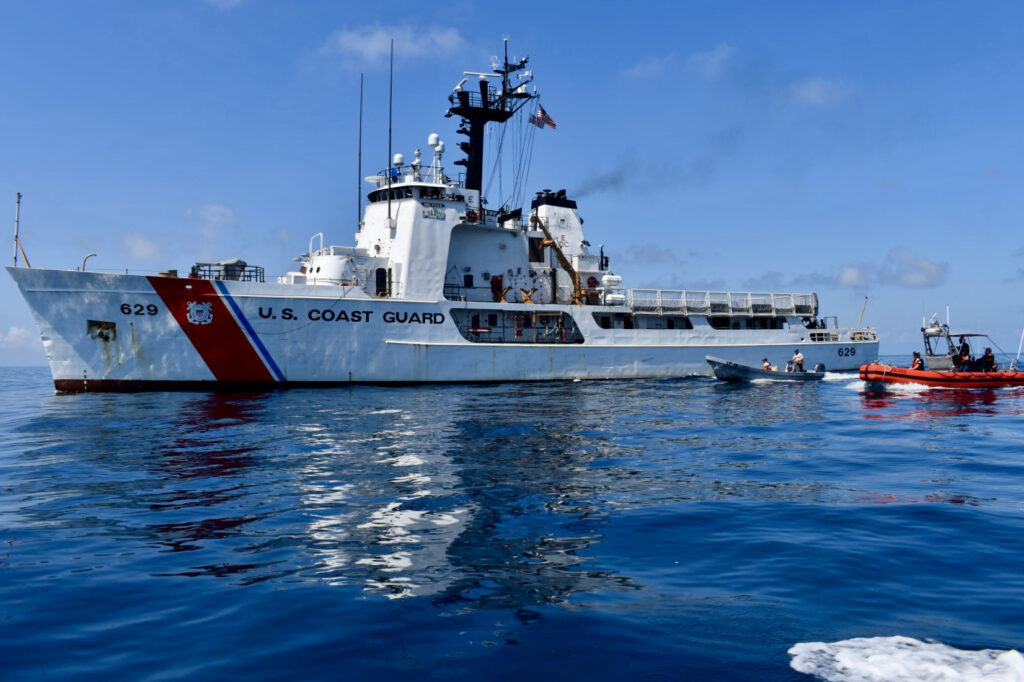
The Reliance-class medium endurance cutter USCGC Decisive (WMEC 629) shown in the territorial seas of Guatemala in October 2021. U.S. COAST GUARD
PENSACOLA, Fla. — The crew of the USCGC Decisive (WMEC 629) returned to Pensacola, Florida, Aug. 20 after assisting in the repatriation of 203 Cuban migrants following 14 interdictions off Florida’s coast, the Coast Guard Atlantic Area said Sept. 6.
In support of the 7th Coast Guard District, the 58-day maritime law enforcement and search and rescue patrol took place in the Windward Passage between Haiti, Cuba and the Straits of Florida, south of Key West, disrupting illegal migrant ventures while supporting national security operations.
“Individuals illegally migrating to the United States face a potentially fatal journey, often traveling on unstable and dangerously overcrowded sailing vessels constructed of repurposed materials,” said Cmdr. David Smith, Decisive’s executive officer. “Decisive’s crew extends its appreciation to Coast Guard cutters William Flores, Palbo Valent and Robert Yered for their support to ensure operations were safe, effective and successful.”
As the primary holding platform for migrants awaiting repatriation, Decisive had 432 migrants cross its decks over eight days and disrupted three ventures during the 58-day patrol.
Once aboard a cutter, all migrants receive food, water, shelter and essential medical attention.
Decisive is a 210-foot medium-endurance cutter homeported in Pensacola. The cutter’s primary mission areas include homeland security, law enforcement, counterdrug, search and rescue, migrant interdiction, and fisheries enforcement in support of U.S. Coast Guard operations throughout the Western Hemisphere.
Making Space for Women Aboard Coast Guard Cutters Helps with Retention, Careers
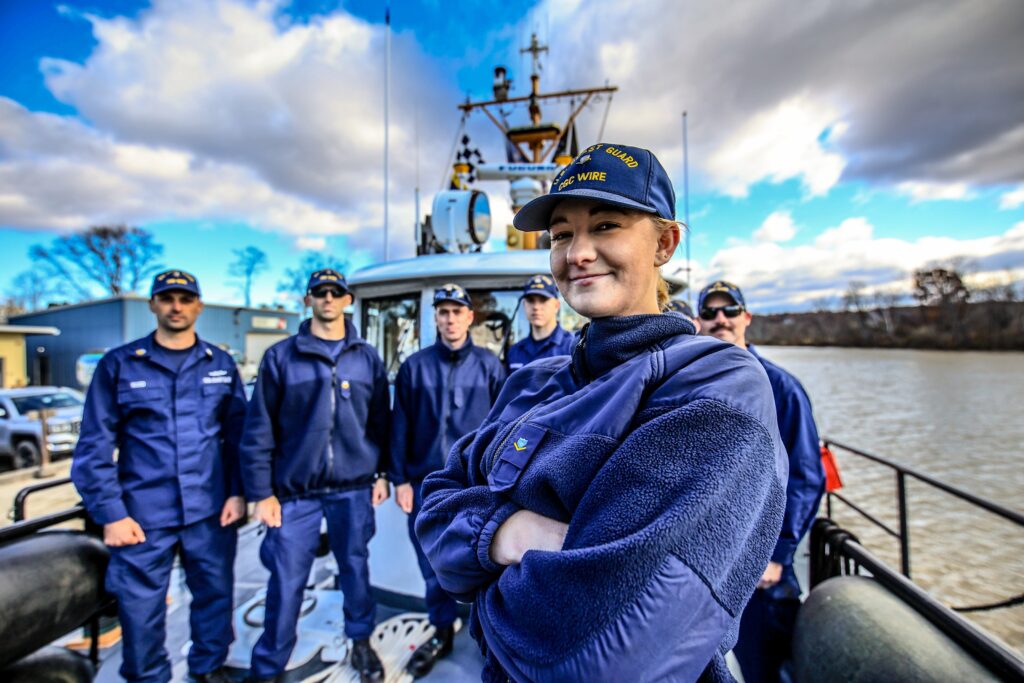
BM3 Hailey LaRue of the U.S. Coast Guard Cutter Wire in Saugerties, New York, in 2021. LaRue was able to serve on the Wire after Senior Chief Petty Officer Ramona Mason worked with service officials to create extra rack space. U.S. COAST GUARD / Daniel Henry
On June 1, the Coast Guard made history with the ascension of Adm. Linda Fagan to its top position as commandant, relieving outgoing commandant Adm. Karl Schultz. She took over as the first woman to head the Coast Guard and the first woman to head any U.S. military service.
Fagan arrived at that position at a time when there are still a few Coast Guard cutters afloat where women can’t serve due to a lack of rack space. That’s an issue the service has been working to eradicate for years and is on the cusp of doing so, a move expected to help boost women’s careers in the service and increase retention.
Of the service’s approximately 260 cutters, only 50 are male only, according to the Coast Guard, and those cutters are slated to be replaced. All new cutters coming online are able to accommodate male and female crewmembers.
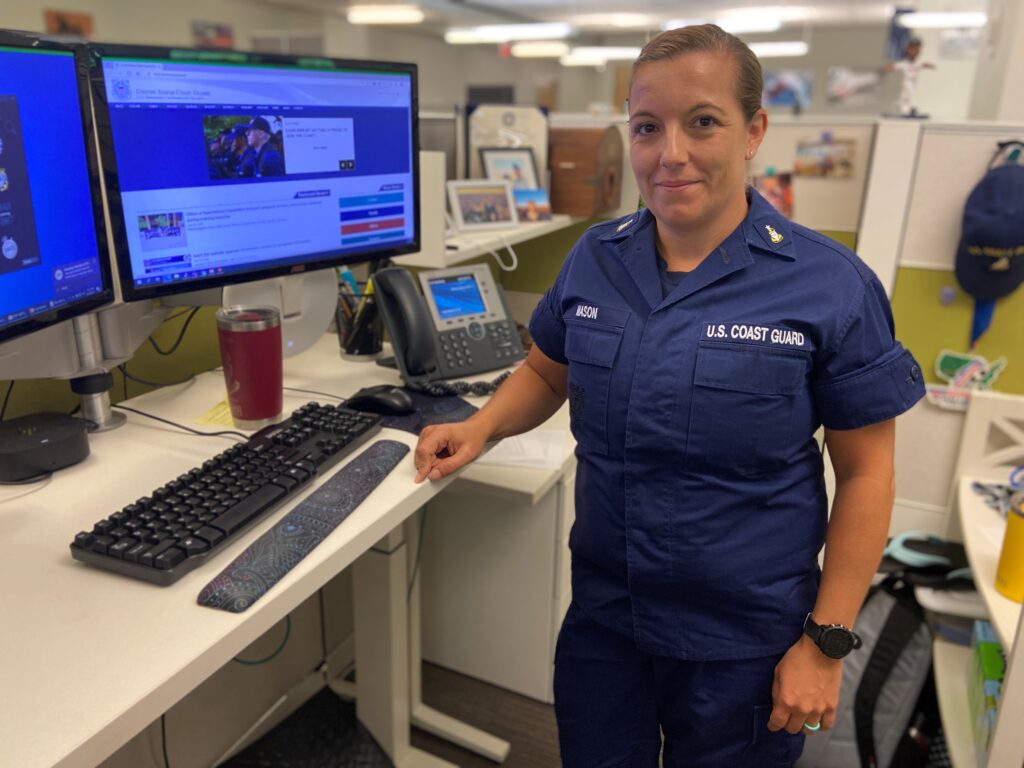
“With the modernization of our fleet, that will all be taken care of. All the newer cutters are being built with mixed crews on board in mind,” said Senior Chief Petty Officer Ramona Mason, the enlisted women afloat coordinator at Coast Guard headquarters in Washington, D.C. “All these new ones are already mixed-gender berthing.”
Even before all the cutters are ready, “We have gotten extremely creative, to create more opportunities for female enlisted members to serve underway,” she said.
“With all these creative ways that we have come up with, our afloat numbers for enlisted women afloat has gone up. We have way more females serving on afloat platforms now than we ever did before, and the numbers have gone up every year,” Mason told Seapower. “And it’s all because they are choosing, they wanted to go afloat. We’re giving them the opportunities now.”
“Today more women are remaining in our service longer,” Schultz said in his annual State of the Coast Guard speech in 2022. “Today we have 375 more women in the service at the critically important E6/E7 and O-4 mid-grade leadership ranks than we had five years ago in 2017… that’s a 28% increase of women at these mid-career pay grades, and a trend that outpaces their male counterparts.”
He also said the service is “making progress” on the acquisition of 30 Waterways Commerce Cutters, tenders that will maintain 28,000 aids that mark more than 12,000 miles of navigable inland waterways.
“And, for the first time in history, our entire inland fleet will be able to accommodate mixed-gender crews, providing all junior enlisted members these unique afloat experiences,” Schultz said.
President Joe Biden spoke at the Coast Guard change of command ceremony when Fagan took the service’s top spot.
“When Admiral Fagan commissioned in 1985, only five years after the first women graduated from the academy, she was one of just 16 commissioned female ensigns — only 8 percent of her graduating class. She was the only woman aboard Polar Star for the first set of orders,” Biden said.
“Currently, the Corps of Cadets at the Academy — more than 1,000 cadets strong — 40 percent are women.
Forty percent are women.”
Even as more women enter the service, keeping them there can be a challenge.
A recent study by the RAND Corp., “Why Do Women Leave the Coast Guard, and What Can Be Done to Encourage Them to Stay?” listed a variety of issues that answered the title question, among them the lack of berthing.
“Female focus groups cited issues with advancement, including the perception of bias in subjective evaluations, as influencing decisions. Furthermore, participants noted that berthing restrictions for women can limit opportunities,” the study says.
Mason said it’s important to provide as many afloat opportunities as possible to female Coast Guard members, as it can affect their career.
“Certain rates have requirements that you have to have a certain amount of years afloat, so it is a requirement for advancement. It’s a requirement for certain ratings or certain competencies that you can only earn afloat,” she said.
And while anyone in the Coast Guard can go afloat at any point in their careers, and are encouraged to do at least one tour afloat, “in order for advancement, in certain rates you have to receive the afloat time at a certain point in your career,” she said.
Making even smaller Coast Guard cutters able to accommodate mixed crews has other benefits that can aid in retention, Mason said.
“We’ve opened up a lot of the smaller cutters with enlisted females, which have always been in higher demand for the females due to the shorter underway time and the family life you can have when you’re only away for two to three weeks versus two to three months,” she said. “With us opening the smaller space to females, it has helped with retention, because they now see they can get under way on small platforms and not be such a family burden.”
Senior Chief Petty Officer Ramona Mason has worked to find rack space aboard Coast Guard cutters to enable women to serve on them. U.S. COAST GUARD / Richard J. Kolko
Making Room
Part of Mason’s job is to find room on Coast Guard cutters for women even if they aren’t designed with separate living quarters. She does that by sometimes repurposing space.
In a 2021 post to the Defense Visual Information Distribution Service, Chief Petty Officer Ryan Burger recounts how he got a call from Mason after he was appointed officer in charge of the Coast Guard Cutter Wire, a 65-foot ice-breaking tug. She asked if he could accept a female Boatswains Mate Third Class. He said yes. When she asked if he could accept another female as well, he said they had to do some work.
They ended up removing a convertible fold-out rack that had been used for executive petty officers and revamping it to hold two racks. They then proceeded to make a similar change to two other 65-foot cutters operated by Sector New York.
“We’ve assigned women to these cutters in command cadre positions in the past, however, assigning a third-class boatswains mate aboard is new,” Mason told writer Daniel Henry. “For the first time, a woman in a non-command position has received orders to the Coast Guard Cutter Wire.”
Petty Officer Third Class Hailey LaRue, a boatswains mate who was then able to serve on the Wire and reported there in the summer of 2020, said the move broadened the learning opportunities available to her, which wouldn’t have been possible on the 87-foot cutter she had served on previously.
“I knew I wanted to go afloat out of A-school to get rated sea time so that it would help me in my future career,” LaRue said. “It’s smaller and it’s a tight knit crew. There are tons of learning opportunities on both deck and engineering side so you’ll become a better-rounded individual in your [rating]. There are opportunities you’ll get here that you won’t necessarily get on a bigger cutter where you’re focused on a specific area.”
Vice Adm. Linda L. Fagan is promoted to the rank of admiral during a ceremony at Coast Guard Headquarters, June 18, 2021. Fagan is the Coast Guard’s first woman to serve as a four-star admiral. U.S. COAST GUARD / Lt. j.g. Pamela Manns
Cmdr. John Singletary, Chief of Waterways Management for Sector New York, told Henry, “providing this mixed gender berthing gives those members the opportunity to start their careers out early. They get to lead as a BM3 or a BM2. Eventually that path will lead to XPO positions on the new waterways commerce cutters that are being commissioned in late 2024.”
Not Just Afloat
The need to create berthing space for female Coast Guard members isn’t just for the water. In late September 2021, Coast Guard Station Morro Bay in California, part of Sector Los Angeles/Long Beach, made such an addition, according to the Coast Guard.
The station is home to 27 Coast Guard members and two 47-foot motor life boats. The station constructed a one-story, 806 square foot addition to the existing facility, creating room for up to six additional crewmembers and allowing overnight duty crews to be made up of men and women.
Women had been assigned to Morro Bay previously, but couldn’t always be accommodated for some of their duties due to a lack of berthing.
“We needed a dedicated accommodation for [women] and we now have that with the building expansion,” Petty Officer 1st Class Joshua Sheppard said in a My CG blog post. Women “can now be completely integrated as a member of the unit without being excluded from missions or opportunities and without posing a significant burden to the operational readiness.”
Mason wasn’t part of that effort — her duties extend only to women who serve afloat — and said the part of her job devoted to finding female berthing is coming to an end as the Coast Guard continues its modernization.
“The coordination part will go away, but the advocacy for women afloat will stay. My job is somewhat more transitioning into a women afloat career counseling position as well,” she said.
“I do year-round career counseling with all the females in the Coast Guard that are interested in afloat assignments,” working on resumes and timetables for them to go afloat, “when should they get underway, when do they have to get underway.
“So, the counseling part will stay around for the enlisted women of the Coast Guard.”
Boeing Demos Open Autonomy Architecture for Manned-Unmanned Teaming with MQ-25
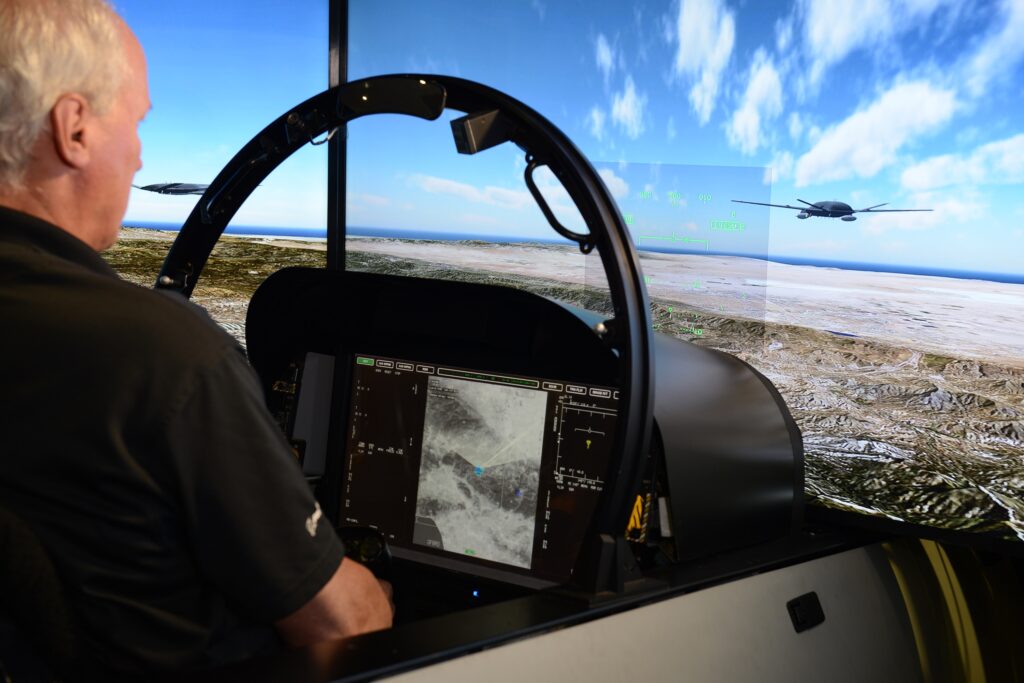
Boeing’s MUM-T demonstration included three different naval aircraft tasking four virtual, autonomous MQ-25s to conduct intelligence, surveillance and reconnaissance missions. Here a simulated F/A-18 Super Hornet interacts with a simulated MQ-25. BOEING
ST. LOUIS — Boeing has digitally demonstrated a new open autonomy architecture for MQ-25 that will allow the U.S. Navy to increase mission effectiveness by integrating manned-unmanned teaming (MUM-T) capability at speed and scale, the company said Sept. 6.
The non-proprietary architecture, based on the government-owned Open Mission System specification, is the foundation for advanced MUM-T. A Boeing-led team virtually demonstrated how other aircraft can use MQ-25’s architecture and task it to conduct tanking and intelligence, surveillance and reconnaissance missions — all within the mission airspace and without traditional communications with the ship-based ground control station.
Boeing’s MUM-T demonstration included Northrop Grumman’s E-2D Advanced Hawkeye command and control aircraft, Boeing’s P-8A Poseidon maritime patrol and reconnaissance aircraft and Boeing’s F/A-18 Block III Super Hornet fighter. Using their existing operational flight program software and data links, the aircraft safely and efficiently tasked four virtual, autonomous MQ-25s to conduct ISR missions. The F/A-18 also used its advanced tactical data links and Boeing’s conceptual “Project Black Ice” crew vehicle interface, which significantly reduced aircrew workload.
“Large swaths of ocean could be surveilled, identified and targeted when MQ-25 is teamed with carrier-based assets such as the E-2D or the land-based P-8A patrol aircraft,” said Don “BD” Gaddis, director, MQ-25 Advanced Design. “Through this demonstration, our customers saw how this digital, open approach to MUM-T is key to fielding critical warfighting capability at much lower cost and with greater speed and agility.”
For example, the demonstration showed how both the P-8A and E-2D could easily task an MQ-25 teammate with an ISR mission specifying only the search area and no-fly zones. Using an onboard autonomy framework developed by Boeing subsidiary Aurora Flight Sciences, the MQ-25 autonomously did the rest – including validating the command against its operational constraints, planning its route and conducting its search pattern, among many other tasks.
Aurora also created and demonstrated a prototype platform abstraction layer — a software boundary that decouples MQ-25’s flight safety and flight critical components from mission software and sensor hardware. This commercial best practice allows third-party “app” integration on MQ-25. Using an Aurora-provided software development kit, Naval Air Warfare Center Aircraft Division created a new radar search application for MQ-25 that was successfully used during the demonstration.
“Aurora’s robust software development kit enables our Navy teammates to rapidly integrate new capabilities,” said Graham Drozeski, vice president of Government Programs for Aurora Flight Sciences. “The platform abstraction demonstration met test objectives for resource sharing between multiple onboard systems and supervisors, and these efforts will greatly reduce government test and certification costs as new capabilities are added over time.”
The demonstration was aligned to the future warfighting capabilities in the Navy’s Unmanned Campaign Framework. Boeing will continue to refine the autonomy, sensors, interface exchanges and crew vehicle interfaces required for MUM-T.
USNS Burlington Conducts Theater Security in Caribbean
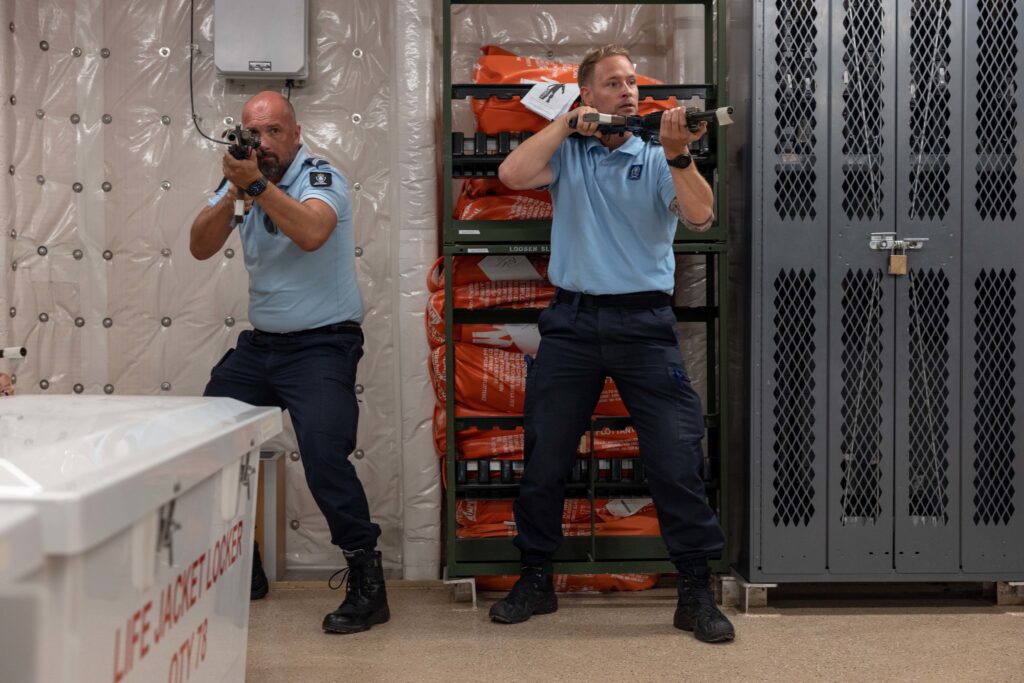
Dutch military police practice room clearing techniques aboard the Spearhead-class expeditionary fast transport ship USNS Burlington (T-EPF-10), during a theater security cooperation event, Aug. 9. U.S. MARINE CORPS / Sgt. Brendan Mullin
ORANJESTAD, Aruba — The Spearhead-class expeditionary fast transport ship USNS Burlington (T-EPF-10) arrived in the port of Oranjestad on the island of Aruba, Aug. 7, during its deployment to the U.S. 4th Fleet area of operations, the fleet’s public affairs office said Sept. 3.
Its mission is to provide expeditionary maintenance to deployed littoral combat ships operating in the region, conduct theater security cooperation engagements to maintain access, enhance interoperability with the Dutch military, and build enduring partnerships in the Caribbean, Central and South American areas of responsibility.
“Theater security cooperation events are important because every single one of our allies and partners brings a unique perspective and background to the table,” says Lt. Christopher Martinez, the officer-in-charge of the military detachment aboard the Burlington. “It increases each of our capabilities as a whole as we learn from each other.”
The crew aboard Burlington invited the Dutch Marines and military police to tour the vessel to demonstrate some of the capabilities the ship possesses. Events like these help reaffirm the United States’ commitment to its allies and partner nations with tangible actions and assets.
While aboard the Burlington, the Dutch military police performed active shooter response drills with the U.S. Navy embarked personnel.
“Working with the Dutch proves there’s more than one solution to a problem,” says Chief Master-At-Arms Robert Abreu. “We both approached the problem a bit differently, and after coming together to talk a bit more, we came up with some techniques that we were both satisfied with.”
USCGC Mohawk Completes Maritime Security Deployment in Gulf of Guinea
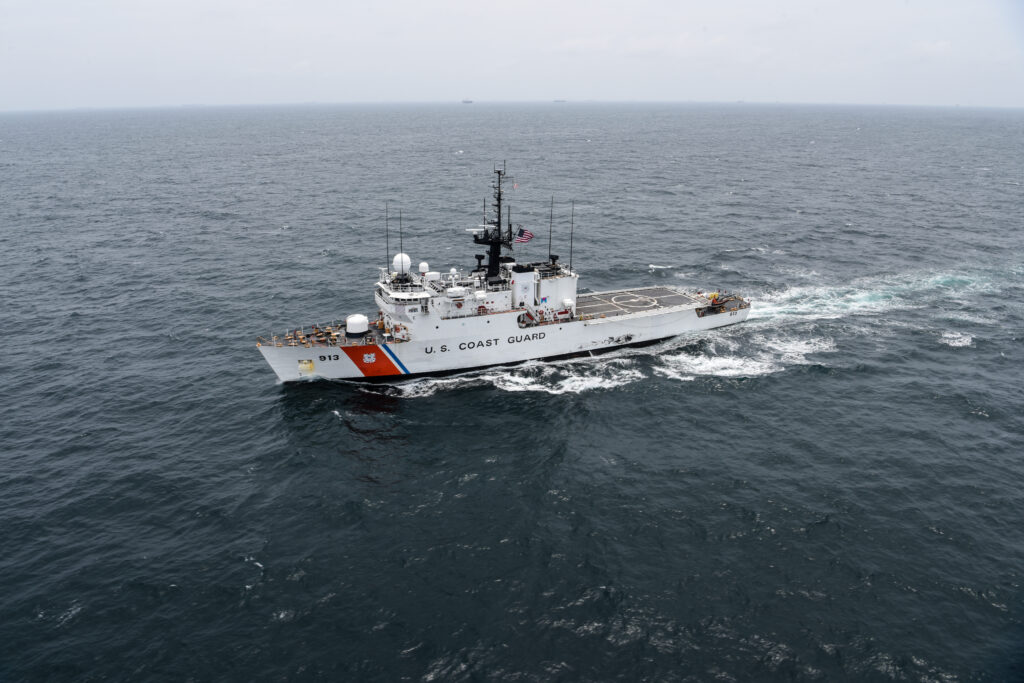
USCGC Mohawk (WMEC 913) sails in the Atlantic Ocean, Aug. 22. Mohawk is on a scheduled deployment in the U.S. Naval Forces Africa area of operations, employed by U.S. Sixth 6th to defend U.S., allied and partner interests. U.S. COAST GUARD / Petty Officer 3rd Class Jessica Fontenette
ATLANTIC OCEAN — The Famous-class medium endurance USCGC Mohawk (WMEC 913) completed a regularly scheduled deployment to the Gulf of Guinea on Sept. 2, U.S. Naval Forces Europe-Africa public affairs said Sept. 6.
From July to September, Mohawk conducted maritime security and law enforcement operations as well as continued building valued relationships with allies and partners from Cabo Verde, Gabon, Ghana, Equatorial Guinea, Sierra Leone and Spain.
“I am extremely proud of this crew and all they have accomplished over the last three months,” said Cmdr. Andrew Pate, commanding officer of the Coast Guard Cutter Mohawk. “We are operating in a global Coast Guard and Mohawk’s ability to deploy across the Atlantic Ocean, and work alongside our European and African partners to combat piracy and illegal, unregulated, and unreported fishing drives home the United States’ commitment to security, stability, and prosperity in the region.”
Mohawk’s deployment also demonstrated the United States’ longstanding commitment of supporting African partners with addressing their security challenges in the maritime domain. The U.S. maritime services routinely work with allied and partner nations to foster a united, global effort to safeguard free and open access to international waterways.
“The successful deployment of USCGC Mohawk to the Gulf of Guinea highlights our continued commitment to our West African partners,” said Vice Adm. Kevin Lunday, commander of U.S. Coast Guard Atlantic Area. “The U.S. Coast Guard is a valued member of the Joint Force, providing unique authorities and capabilities to aid partner nations as they address security and prosperity challenges. Our collaboration and sharing of best practices with our West African counterparts allows us to assist in combating narcotics smuggling, promoting freedom of commerce, and deterring illegal, unreported, and unregulated fishing in their waters.”
Mohawk was forward-deployed to the U.S. Naval Forces Africa (NAVAF) area of operations, and employed by U.S. 6th Fleet. This is the latest of several U.S. Coast Guard cutter deployments to the region.
Cutter Vigorous Returns Home after 53-Day Pacific Interdiction Patrol
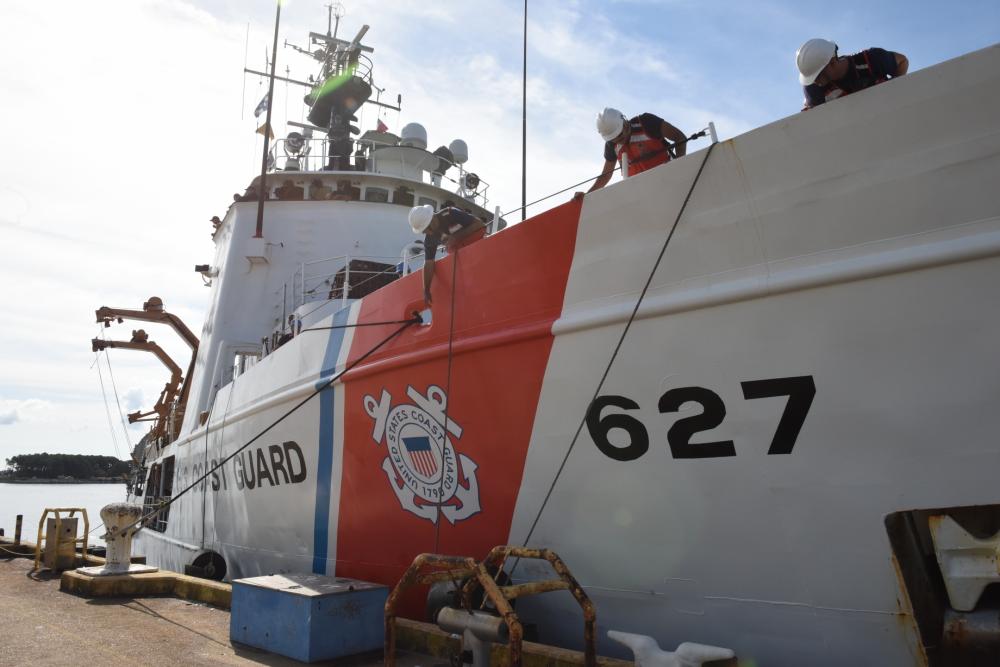
The Coast Guard Cutter Vigorous returned to its Virginia Beach homeport on Sept. 5. U.S. COAST GUARD
PORTSMOUTH, Va. — The USCGC Vigorous (WMEC 627) returned to its home port of Virginia Beach, Sept. 5, following a 53-day patrol in the Eastern Pacific Ocean, the Coast Guard Atlantic Area said in a release.
Throughout the patrol, Vigorous operated in support of the Coast Guard’s 11th District and Joint Interagency Task Force-South, aiding in missions to interdict and disrupt the flow of illegal drugs and migrant trafficking while supporting national security and strengthening relationships with regional partners.
Vigorous seized approximately 1,256 pounds of marijuana worth nearly $2 million that was offloaded in Miami on Aug. 302. In addition, Vigorous’ crew rescued a person in distress more than 100 miles off the coast of Colombia, providing food and mechanical assistance while awaiting a Colombian Navy asset to return the person safely to shore.
Vigorous also conducted a joint training exercise with the Colombian Navy. The training allowed the Coast Guard and Colombian Navy to exercise interagency communication and compare drug interdiction tactics, techniques, and procedures.
After completing almost 50 days of counter-narcotics operations, Vigorous responded to a need for more Coast Guard cutter coverage in the Straits of Florida, south of the Florida Keys. Over the course of 24 hours, Vigorous interdicted 31 Cuban migrants before transferring them to a Florida-based cutter.
“I’m proud of the hard work and professionalism demonstrated by the Vigorous crew,” said Commander Ryan Waters, the cutter’s commanding officer, “that made this challenging patrol successful and memorable.”
Vigorous is a 210-foot Reliance-class medium endurance cutter homeported in Virginia Beach with a crew of 66. Vigorous’ primary mission areas include homeland security, law enforcement, counterdrug, search and rescue, migrant interdiction, and fisheries enforcement in support of U.S. Coast Guard operations throughout the Western Hemisphere.
5th Fleet Ships Free Saildrone USVs from Iranian Navy Ship
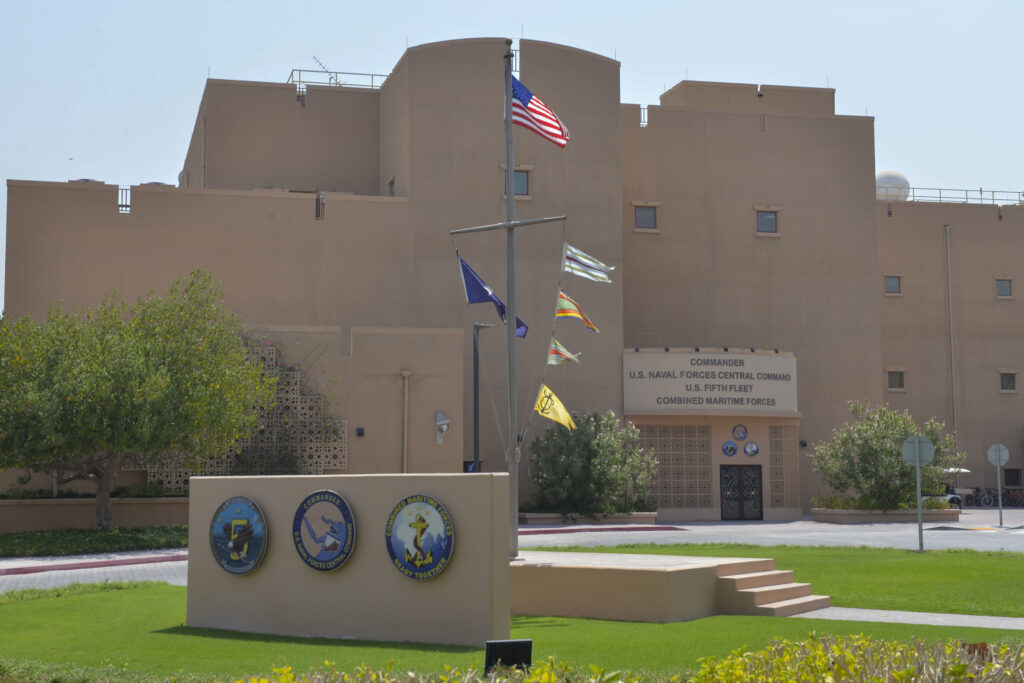
File photo of U.S. Naval Forces Central Command, U.S. 5th Fleet and Combined Maritime Forces headquarters on Naval Support Activity Bahrain. U.S. NAVY
MANAMA, Bahrain — The U.S. Navy intercepted an Iranian warship that seized and detained two U.S. unmanned surface vessels operated by U.S. 5th Fleet in the Red Sea, Sept. 1, two days after Iran was unsuccessful in seizing a similar vessel in the Arabian Gulf, the fleet said Sept. 2.
Jamaran (FFLG 76), an Islamic Republic of Iran Navy ship, seized two Saildrone Explorer unmanned surface vessels operating near one another in international waters before returning the vessels to the U.S. Navy the next day.
The unmanned surface vessels were unarmed and taking unclassified photos of the surrounding environment while loitering in an assigned patrol area at least four nautical miles from the nearest maritime traffic lane. The vessels posed no risk to naval traffic and had been operating in the general vicinity of the Southern Red Sea for more than 200 consecutive days without incident.
At around 2 p.m. (local time) on Sept. 1, U.S. 5th Fleet detected the Iranian ship approaching both unmanned vessels and removing them from the water. U.S. Navy guided-missile destroyers USS Nitze (DDG 94) and USS Delbert D. Black (DDG 119) were operating nearby and immediately responded. Nitze and Delbert D. Black also each launched an MH-60R Sea Hawk from Helicopter Maritime Strike Squadron 48.
Nitze and Delbert D. Black remained on scene communicating with the Iranian warship to deescalate the situation and recover the seized Saildrones. The Iranian warship released the Saildrones at 8 a.m. on Sept. 2.
Vice Chief of Naval Operations Changes Office
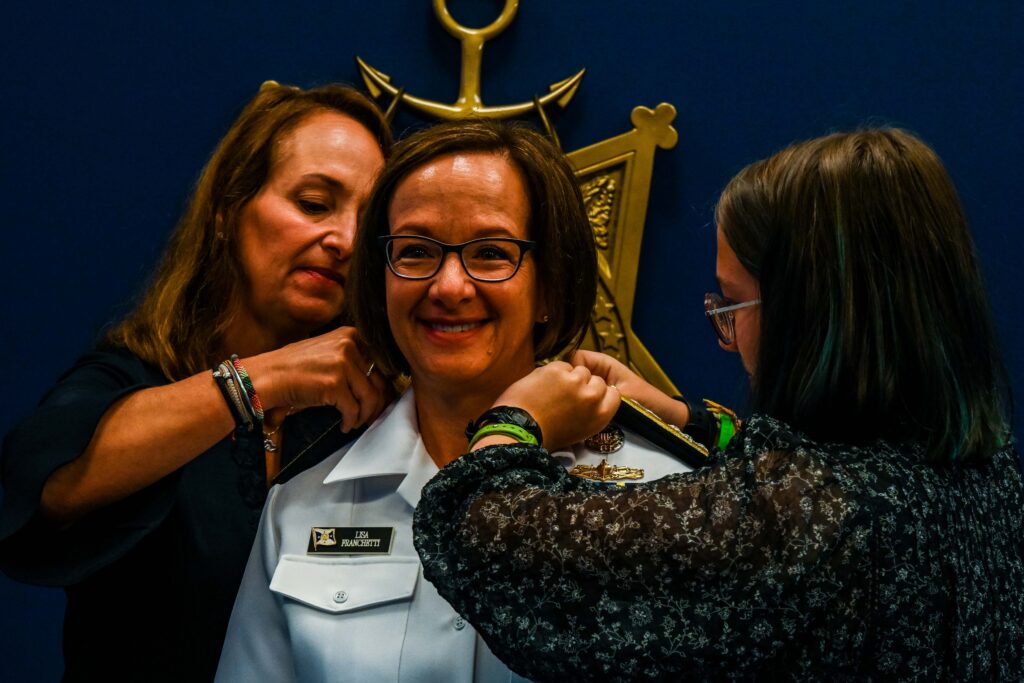
Adm. Lisa Franchetti promotes to the rank of Admiral with her family during the change of office ceremony for the Vice Chief of Naval Operations held at the Pentagon, Sept. 2. U.S. NAVY / Mass Communication Specialist 1st Class Michael B. Zingaro
ARLINGTON, Va. — Adm. Lisa Franchetti was sworn in as the 42nd Vice Chief of Naval Operations when she assumed duties from Adm. William Lescher in a ceremony at the Pentagon, Sept. 2, the Navy said in a release.
“I am grateful for all that Adm. Bill Lescher has done for our Navy and our nation,” said Chief of Naval Operations Adm. Michael Gilday. “Bill always led by example, ensuring our warfighting culture is one focused on continuous improvement and teamwork. His leadership, guidance and initiatives will positively impact the maritime balance of power for years to come.”
“The Navy and the nation are grateful for you and your family’s service,” Gilday added.
Lescher, who served as VCNO from May 2020 to now, is retiring after 42 years of naval service.
“It has been a privilege to serve as Vice Chief. I am grateful for the opportunity to lead, and serve alongside, so many exceptional Sailors throughout my time in the Navy. Our focus has always been on accelerating the Navy’s warfighting advantage by unleashing the power of our people,” said Lescher. “I know that Adm. Lisa Franchetti is the right leader to help guide our Navy to further advantage in this critical decade. She will be exceptional.”
Franchetti was promoted to the rank of admiral by Gilday prior to the change of office.
“Adm. Franchetti is a true leader with unrelenting commitment to the Fleet,” said Gilday. “She demonstrates operational excellence, strong character, diverse perspectives and resilience in all she does — and I look forward to working together to ensure our Navy remains the world’s premier maritime force.”
“It continues to be an honor to serve as a leader in our Navy,” Franchetti said. “My focus remains on supporting the most powerful Navy in the world, ready for the future fight.”
In her previous position, Franchetti served on the Joint Staff as Director for Strategy, Plans and Policy (J-5). As the Joint Staff J5, she was responsible for strategy, plans, and policy recommendations to the Chairman of the Joint Chiefs of Staff to support his provision of military advice across the full spectrum of national security concerns to the President and other national leaders.
U.S. Maritime Forces Arrive for UNITAS LXIII hosted by Brazil
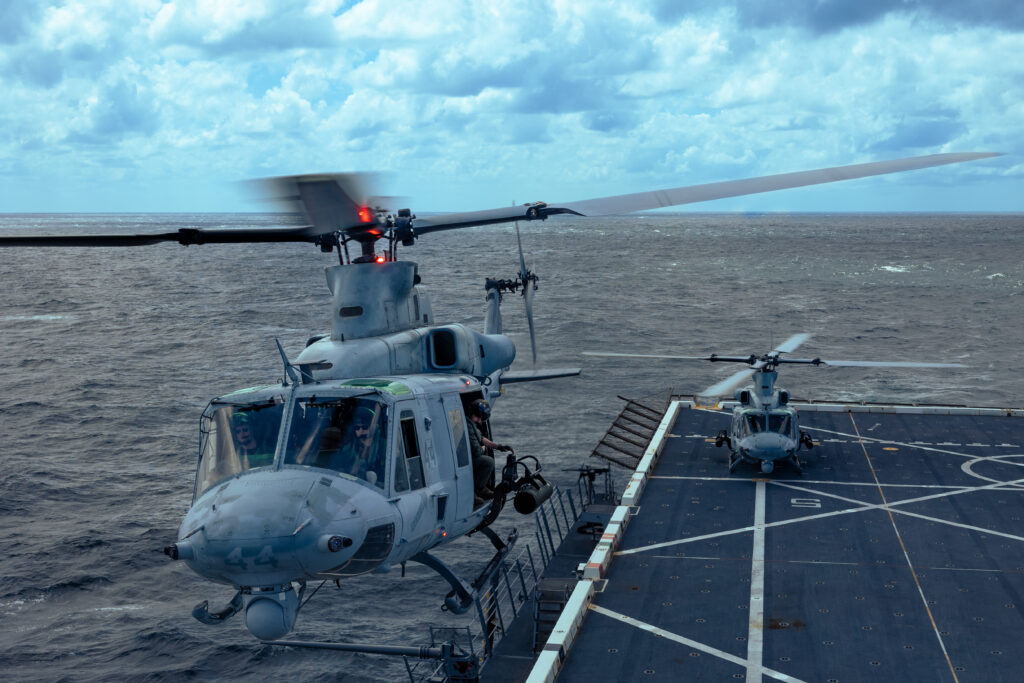
A U.S. Marine Corps UH-1Y Venom helicopter assigned to Light Attack Helicopter Squadron (HMLA) 773 hovers above the landing pad of the San Antonio class dock landing ship USS Mesa Verde (LPD 19) in the North Atlantic Ocean, Aug. 16. HMLA 773 launched three UH-1Y Venom and two AH-1Z Viper helicopters from McGuire Air Force Base and embarked them aboard the USS Mesa Verde for transit to Brazil in support of exercise UNITAS LXIII hosted by the Brazilian Navy and Marine Corps. U.S. MARINE CORPS / Cpl. Colton K. Garrett
RIO DE JANEIRO, Brazil — Navy and Marine forces are set to arrive in Rio de Janeiro in support of UNITAS LXIII, the world’s longest-running multinational maritime exercise scheduled to take place Sept. 8-22, the U.S. Naval Forces Southern Command / U.S. 4th Fleet said in a Sept. 1 release.
This year’s exercise is hosted by the Brazilian navy and will included 20 participating nations, 19 ships, one submarine, 21 aircraft, accounting for approximately 5,500 total military personnel that will conduct operations principally off the coast of Rio de Janeiro.
UNITAS, Latin for “unity,” was conceived in 1959 and has taken place annually since first conducted in 1960. This year marks the 63rd iteration. This year, Brazil will host UNITAS in conjunction and celebration of the bicentennial anniversary of both their nation’s independence and navy’s founding.
“This exercise is an incredible opportunity for all participating nations to come together as professional mariners on the sea, under the sea, in the air and in the littorals, to operate and grow as a team in order to strengthen our partnerships and enhance our collective maritime posture,” said Rear Adm. Jim Aiken, commander U.S. Naval Forces Southern Command/U.S. 4th Fleet. “Congratulations to Brazil on 200 years of independence and excellence in the maritime domain on the sea and on the land.”
In addition to the United States, UNITAS LXIII will bring together 19 nations from across Central and South Americas, the Caribbean, Europe, and Africa to train forces in joint maritime operations that enhance tactical proficiency and increase interoperability. Participating nations include Belize, Brazil, Cameroon, Chile, Colombia, Dominican Republic, Ecuador, France, Guyana, Jamaica, Mexico, Namibia, Panama, Paraguay, Peru, South Korea, Spain, United Kingdom and Uruguay.
“Exercise UNITAS is a highly anticipated premier training opportunity for all the participating nations’ navies and marine corps in the Western Hemisphere,” said Lt. Gen. David Bellon, commander of U.S. Marine Corps Forces, South and Marine Forces Reserve. “UNITAS highlights the foundation of our partnerships and our dedication to building and sustaining the social and military relationships necessary to achieve common objectives and regional security.”
The initial in-port phase will include cultural exchanges, sporting events, community relations projects and the opportunity for UNITAS LXIII partners to participate in bicentennial events such as the Bicentennial Naval Parade scheduled for Sept. 7 along the coast of Rio de Janeiro.
Following opening ceremonies on Sept. 8, naval forces will conduct combined and joint operations as a multi-national task force, executing an event-driven scenario to train in multiple warfare areas. Ships and sailors will head to sea for maritime operation training and Marines will move inland to conduct amphibious training ranges before coming back together in support of a culminating multinational amphibious landing.
A significant focus of UNITAS LXIII is the cooperation and integration of the multinational navy forces with marine corps and naval infantries. The maritime domain includes the littorals that incorporates the ocean and the area inland from the shore which can be supported and defended directly from the sea.
U.S. forces participating in UNITAS LXIII include USS Lassen (DDG 82), USS Mesa Verde (LPD 19), USS Albany (SSN 753), Commander, Amphibious Squadron Eight (COMPHIBRON 8), Helicopter Sea Combat Squadron 22 (HSC 22), Helicopter Maritime Strike Squadron 70 Detachment 2 (HSM 70 Det 2), Patrol Squadron Sixteen (VP-16), Special Boat Team 22 (SBT 22), Mobile Diving and Salvage Unit (MDSU) Det 2, Seal Platoon from Seal Team 8, Explosive Ordnance Disposal Mobile Unit Two (EODMU-2), Beachmaster Unit Two (BMU-2), USCG Pacific Area Tactical Law Enforcement Team (PAC AREA TACLET), Commander, Destroyer Squadron 40, (COMDESRON 40), Fleet Surgical Team (FST) 8, 25th Marine Regiment, 3d Battalion 25th Marine Regiment, 3d Force Reconnaissance Company, 4th Light Armored Reconnaissance Company (4th LAR), 4th Combat Engineer Battalion (4th CEB), 6th Engineer Support Battalion (6th ESB), 4th Air Naval Gunfire Liaison Company (ANGLICO), 4th Civil Affairs Group (4th CAG), Marine Aircraft Group 49 (MAG-49), U.S Marine Corps Forces South (MARFORSOUTH), and USNAVSO/FOURTHFLT.
U.S. Naval Forces Southern Command/U.S. 4th Fleet supports U.S. Southern Command’s joint and combined military operations by employing maritime forces in cooperative maritime security operations to maintain access, enhance interoperability, and build enduring partnerships in order to enhance regional security and promote peace, stability and prosperity in the Caribbean, Central and South American region.
U.S. Marine Corps Forces, South is the Marine Corps component to U.S. Southern Command, is responsible for planning exercises, operation, and overall Marine Corps support for the SOUTHCOM assigned area of responsibility.
U.S. Navy Completes First BQM-177A Target Intercept during Missile Launch
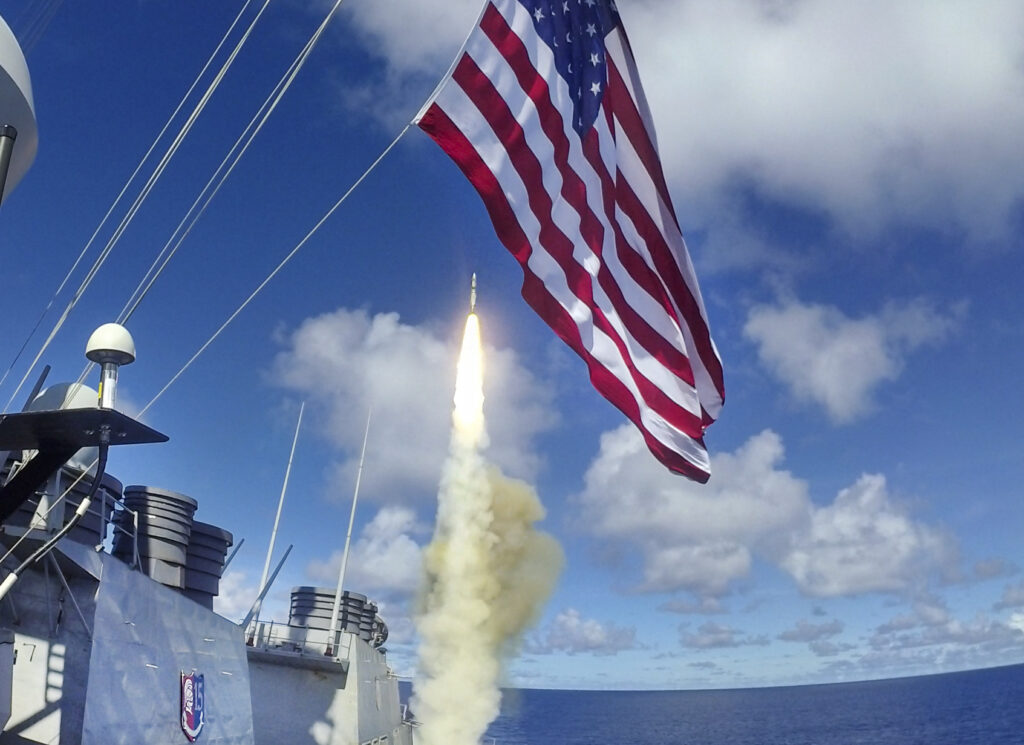
The guided-missile destroyer USS Barry (DDG 52) launches a Standard Missile 2 during a live-fire missile exercise as part of Pacific Vanguard 22, Aug. 28. U.S. NAVY / Mass Communication Specialist 1st Class Deanna Gonzales
PHILIPPINE SEA — The U.S. Navy’s next-generation subsonic aerial target, the BQM-177A, reached full operational capability during a successful standard missile launch and intercept while participating in Pacific Vanguard 2022 in the Philippine Sea on Aug. 28, U.S. 7th Fleet said Sept. 1.
The target drones were launched from the Lewis and Clark-class dry cargo ship USNS Alan Shepard (T-AKE 3) and engaged with missiles launched from Arleigh Burke-class guided-missile destroyer USS Barry (DDG 52) and Royal Australian Navy Anzac-class frigate HMAS Perth (FFH 157), marking the first time the BQM-177A has been used in the Western Pacific region and highlighting the drones achieving full operational capability.
“Not only am I glad the [Commander, Task Force] CTF 71 team was the first to have a successful missile launch against a brand-new type of target drone, but I am extremely grateful that we got to do it side by side with our allies and partners in the region,” said Capt. Walter Mainor, commander, Task Force 71. “I’m proud of all of the participants who worked hard to make this happen, but I’m especially proud of the crews of USS Barry, USNS Alan Shepard, and our coalition partner HMAS Perth.”
The BQM-177A is an advanced high-subsonic, recoverable aerial target system that imitates advanced subsonic anti-ship cruise missile threats to test the effectiveness of shipboard air defense systems and is used for fleet training. It is unmatched in its performance capabilities when it comes to delivering realistic anti-ship missile threat emulation, according to program managers at Naval Air Systems Command.
“Our primary focus in the targets community is effective, affordable training and test for the U.S. Navy,” said Don Blottenberger, the Navy’s Aerial Targets program manager. “The efforts of the team, including partnership with MSC and the target operations organizations, represents the best of our community. The BQM-177, now fully capable, will provide quality service to our warfighters for decades to come.”
Pacific Vanguard 2022 is the fifth iteration of the quadrilateral exercise series between Australia, Japan, Republic of Korea and U.S. Naval forces. This exercise is focused on improving the capabilities of the countries participating to respond together as a naval force against crises and contingencies in the region. The purpose is for the participating navies to continue to refine their skills operating as an integrated force ready to respond to a changing and complex maritime environment in the Indo-Pacific region.