Four Crew Members Survive MH-60S Crash 

An MH-60S Seahawk Helicopter flies over the Pacific Ocean in this 2018 photo. U.S. NAVY

ARLINGTON, Va. — A Navy MH-60S Seahawk helicopter crashed June 9 near El Centro, California, but all four crew members on board survived and were safely recovered, commander, Naval Air Force Pacific public affairs office, said in a release. One crew member suffered non-life-threatening injuries. 

The MH-60S was assigned to Helicopter Sea Combat Squadron Three based at Naval Air Station North Island, California. HSC-3 if the fleet replacement squadron for the U.S. Pacific Fleet’s MH-60S squadrons. 


Coast Guard, DHS Partners Establish Joint Coordination Center in Houston 

Leaders from Coast Guard Sector Houston-Galveston, Homeland Security Investigations Houston, U.S. Customs and Border Protection Houston and Transportation Security Administration Houston commemorate the establishment of a Joint Intelligence and Operations Coordination Center June 7. U.S. COAST GUARD / Tim Oberle

HOUSTON — Leaders from Coast Guard Sector Houston-Galveston, Homeland Security Investigations Houston, U.S. Customs and Border Protection Houston and Transportation Security Administration Houston announced June 9 the establishment of a Joint Intelligence and Operations Coordination Center. 

Located within Sector Houston-Galveston, the new multi-agency coordination center will directly support the Southeast Texas and Southwest Louisiana Regional Coordinating Mechanism and be staffed with personnel from the Coast Guard, HSI, CBP and TSA. JIOCC staff will include a full-time counterdrug analyst from the Texas National Guard whose focus will be providing analytical support to DHS components. 

The JIOCC’s primary purpose is to act as a unified control center and coordinate operations between participating agencies to bolster interoperability and deconflict where an agency’s operations may overlap with others. Additionally, the JIOCC will serve as a ready-made event command post in the event of a natural disaster or other emergency, such as a strong hurricane. 

The establishment of the JIOCC is part of DHS efforts to modernize the Maritime Operations Coordination Plan by establishing coordination cells in strategic locations around the country to facilitate intelligence sharing and coordinate operations for an efficient, effective and unified departmental response to threats against the United States in the maritime environment. 

“By bringing together and leveraging each agency’s unique strengths, authorities and capabilities, we are better postured to protect the ports and waterways of Southeast Texas and Southwest Louisiana,” said Coast Guard Capt. Jason Smith, commander, Sector Houston-Galveston and ReCoM executive committee member. “The establishment of this JIOCC illustrates our commitment to enhancing maritime homeland security by improving intelligence and information sharing and increasing operational integration and deconfliction.” 


CNO Hosts Israel’s Head of Navy, Focused on Partnership and Maritime Security 

Chief of Naval Operations Adm. Mike Gilday meets with Commander in Chief of the Israeli Navy Vice Adm. David Saar Salama during an office call at the Pentagon, June 8. U.S. NAVY / Mass Communication Specialist 2nd Class T. Logan Keown

WASHINGTON — Chief of Naval Operations (CNO) Adm. Mike Gilday hosted the commander in chief of the Israeli Navy, Vice Adm. David Saar Salama, in Washington, D.C., for a formal counterpart visit, June 8-9, the CNO’s public affairs office said in a release.  

The two leaders discussed several topics of shared interest including force design, strategic competition, unmanned technologies and regional security efforts.  

The two-day visit included a full honors ceremony, meetings with senior U.S. Navy leadership and a visit to the United States Holocaust Memorial Museum. 

“Our strategic partnership with Israel is ironclad and enduring,” said Gilday. “United by our commitment to a rules-based international order, free and open seas, and advancing collective capabilities, our two navies have never been more aligned than they are today. I look forward to working closely with Adm. Salama to strengthen our partnership and interoperability.”   

“‏The cooperation between the Israeli Navy and the U.S. Navy, led by my friend Adm. Mike Gilday, is another testament to the strength of the strategic partnership and friendship between the two navies,” said Salama. “The joint work with the U.S. Navy, especially with the 5th and 6th Fleets, will continue to yield many achievements for Israel and overall maritime security. Together, we will continue to face the challenges ahead in order to maintain stability at sea.” 

U.S. Navy and Israeli Naval Forces regularly operate together around the world, particularly in the U.S. 5th and 6th Fleet Area of Operations. Most recently, the U.S. Navy and the Israeli Navy participated in Intrinsic Defender 22, a bilateral exercise focused on maritime security operations, explosive ordnance disposal, health topics and unmanned systems integration. 

On Sept. 1, 2021, the U.S. Department of Defense officially reorganized Israel within the area of responsibility of U.S. Central Command. 

This was the first meeting between Gilday and Salama. 


Navy Orders Advance Data Transfer Systems from Mercury Systems  

ANDOVER, Mass. — Mercury Systems Inc. has received a three-year basic ordering agreement worth up to $50 million from the Naval Air Systems Command for engineering services and products relating to Mercury’s Advanced Data Transfer System for deployment across multiple rotary-wing and tilt-rotor platforms, the company announced June 9.

The ADTS, a rugged data, video, and audio loader and recorder with cybersecurity capability, is used for moving mission data securely to and from the aircraft for pre- and post-mission analysis. 

The agreement was received in Mercury’s fiscal 2022 third quarter and has a period of performance of three years covering ADTS hardware such as data transfer units, data transfer devices, encryption modules, and other key components, with work to be performed at the Company’s Torrance, California, facility. 

“We value our long-standing relationship with NAVAIR and the opportunity to make trusted, secure mission-critical technologies profoundly more accessible to aerospace and defense,” said Jay Abendroth, vice president and general manager of Mercury Mission. “As an independent domestic supplier of key open mission systems, this BOA enables Mercury to fulfill our commitment to deliver critical purpose-built solutions to the Naval air fleet in support of their mission to enhance pilot and mission safety.” 


Navy SSBN PEO: Data Clearly Supports Building More than 12 Columbia Subs 

General Dynamics Electric Boat welder Maria Betance-Pizarro welds the initials of the sponsor of the future U.S. Navy ballistic missile submarine District of Columbia onto a metal plate at a ceremony at the Electric Boat facility in Quonset Point, Rhode Island, June 4. Looking on are the ship’s sponsor, U.S. Rep. Eleanor Holmes Norton (D-District of Columbia), and officials from Electric Boat, other members of Congress, and officers of the U.S. Navy. U.S. NAVY / GENERAL DYNAMICS ELECTRIC BOAT

ARLINGTON, Va. — The admiral in charge of building the Navy’s next-generation nuclear-powered ballistic-missile submarine said there may be an advantage to building more than the 12 planned boats. 

“I have clear data that says, ‘It clearly makes more sense to have more than 12 [Columbia-class SSBNs] to meet the current requirements that [U.S.] Strategic Command has defined for us,’” said Rear Adm. Scott Pappano, program executive officer for Strategic Submarines, speaking during a June 9 Hudson Strategic Forces Seminar in Washington. 

“I have the data that will show the risks of what the current program of record is, and here is how those risks are mitigated if I go to 13 or 14 or 15 or 16, how that affects those requirements,” Pappano said. “It’s probably a late ‘20s decision, sometimes before the end of the next block that we are doing.” 

The current U.S. Nuclear Posture Review defines the requirement for “at least” 12 Columbia-class SSBNs. 

Pappano said building extra SSBNs would not be a technological problem but a matter making decisions early enough to keep submarine programs on schedule. 

“It’s really getting both the cadence for the Columbia class and to be able to get back on cadence for Virginia [attack submarine],” he said.  

The contract for building the first new SSBN, the future USS District of Columbia, calls for delivery 84 months of formal program start. Pappano’s goal is to deliver the boat in 78 months. With the construction started during the COVID-19 pandemic, construction “got a little bit slower start than we wanted” so it was lagging slightly behind 78 months but still ahead of the required maximum of 84 months. 

“It’s not only delivering [the lead ship] on time … but we’ve got to get the cadence right for the rest of the class,” he said. “We have to be delivering Columbia class at a one-per-year cadence [in fiscal 2026].” 

With the future USS District of Columbia and USS Wisconsin under contract, the Navy originally had planned to build the next three boats in the next block to get economic order quantity of the SSBNs and the Virginia-class SSNs.  

“We’re working right now with our stakeholders to include five boats in the second block,” he said, to make that block buy in 2026 and “at least a five-ship block” for the third block.  

The 12 Columbia-class SSBNs will be replacing the 14 Ohio-class SSBNs that each are scheduled to be retired at 42 years of service. The first of the Ohio SSBNs to be retired will be inactivated in 2027.  

“There is going to be a period of time [for] much of the ‘30s we have to have 10 ships ready for sea, out of a depot period, and we’re going to have exactly 10 for a lot of that time,” Pappano said. “If you look at it month by month, there are periods where we might dip below nine.” 

He said the Navy is looking at starting advance procurement for each boat “a little bit early… about six monthsish” for Columbia boats two through 12, a plan supported in the 2023 budget request.  

The first Columbia-class SSBN is required to be on patrol in the first quarter of fiscal 2031. Pappano said the Navy is looking at squeezing more service life out of five Ohio-class boats with short service-life extensions of the boats that are in the best condition. The admiral said that fiscal 2026 would be the time to make the decision, with the first Ohio extension completed in fiscal 2029, and each taking three years. 

Pappano said one advantage of extending an Ohio-class boat is during the 2036-2039 time frame, a submarine will be needed to test-launch the D5LE2 version of the Trident ballistic missile in support of the Strategic Systems Program. This would avoid having to take a submarine off the strategic deterrence patrol cycle to test the missiles. 


Navy, Marine Corps Dismissals for Refusing COVID-19 Vaccinations Now Total More Than 3,000

Hospital Corpsman 3rd Class Darion Wilson, left, administers a COVID-19 test in the vehicle stowage area aboard amphibious assault carrier USS Tripoli (LHA 7), May 19. Tripoli is underway conducting routine operations in U.S. 7th Fleet. U.S. NAVY / Mass Communication Specialist 3rd Class Maci Sternod

ARLINGTON, Va. — More than 2,000 U.S. Marines and 1,000 Sailors have been separated from the sea services for refusing vaccination against the COVID-19 coronavirus since the Defense Department ordered mandatory vaccinations late last year.

In its weekly COVID-19 Update on June 8, the U.S. Navy reported 1,099 separations for COVID-19 vaccine refusal. They included 980 active component Sailors, 98 Reservists, and 22 entry-level separations of new recruits during their initial training periods.

The Marine Corps, which shifted from a weekly to a monthly COVID update in mid-April, announced June 2 that 2,715 Marines have been separated from the Corps for vaccine refusal. There was no breakdown showing how many of those dismissed were active duty, reservists or recruits.

The fiscal 2022 National Defense Authorization Act enacted in December 2021 requires discharges of military personnel for vaccine refusal must be either honorable or general under honorable conditions.

According to the weekly Defense Department COVID update, 6,417 Marines and 6,806 Sailors are at least partially vaccinated and 194,639 Marines and 383,564 Sailors are fully vaccinated as of June 8. Both the Navy and Marine Corps, as well as the Pentagon, consider COVID-19 a readiness issue requiring full vaccination for all military personnel.

The Navy said 3,906 active duty Sailors and 3,279 personnel in the Ready Reserve remain unvaccinated as of June 1. The Marine Corps report doesn’t give specific figures, only stating fully and partially vaccinated percentages that indicate just 2% of the active force and 7% of reservists remain unvaccinated.

The Navy has granted 227 medical exemptions for COVID vaccination to active duty Sailors, all but 14 of them temporary. Only one of the 79 medical exemptions granted reservists was permanent. The Marine Corps said 742 requests for medical or administrative exemption from vaccination have been approved. As of June 1, the Marine Corps has received 3,719 requests for vaccination exemption on religious grounds. Only seven have been approved.

The Navy has gotten religious accommodation requests from 3,351 active duty Sailors and 864 in the Ready Reserve. Only 13 of the reservists’ requests have been conditionally approved and just one active duty Sailor’s was approved.

The Navy has been unable to discharge vaccine refusers since a federal judge in Texas granted a preliminary injunction in March barring the Navy from acting against the thousands of Sailors seeking exemption from vaccination on religious grounds. The U.S. Supreme Court later ruled the Navy could consider a Sailor’s vaccination status in making deployment and other operational decisions while a lawsuit on the Pentagon’s mandatory vaccination policy moves through the courts.


Navy Awards L3Harris $205M for New Passive EO/IR Capability  

The Arleigh-Burke class destroyer USS Decatur (DDG 73), approaches the aircraft carrier USS Nimitz (CVN 68) for a refueling at sea. A team led by L3Harris Technologies will provide the Shipboard Panoramic Electro-Optic/Infrared system to destroyers and other ships. U.S. NAVY / Mass Communication Specialist 3rd Class Justin McTaggart

MELBOURNE, Fla. — A team led by L3Harris Technologies has been selected to provide the Shipboard Panoramic Electro-Optic/Infrared (SPEIR) system to the U.S. Navy that will provide improved fleet protection, the company said June 7.

The initial $205 million contract has a potential value of $593 million if all options are exercised through March 2031. 

L3Harris will serve as systems integrator and prime contractor, delivering capabilities for mission areas including anti-ship cruise missile defense, counter-unmanned aerial systems, counter-fast attack craft/fast in-shore attack craft, mobility, anti-terrorism/force protection and operational tasking visual information. This new system is targeted for installation on destroyers, carriers, frigates, amphibious and landing helicopter assault ships to provide a critical warfighting capability. 

The team includes Lockheed Martin and BAE Systems and will provide an L3Harris solution known as Spatial that provides a scalable 360-degree EO/IR passive automatic detection and tracking solution, enhancing combat systems and navigation capabilities to the U.S. Navy. 

The program was awarded by the Program Executive Office Integrated Warfare Systems 2.0. 

“The SPEIR program leverages the technologies demonstrated as part of the Office of Naval Research’s Future Naval Capability effort known as CESARS [Combined EO/IR Surveillance and Response System] and a strong heritage of maritime electro-optical sensor systems combined with L3Harris internal investment to provide a SPEIR capability to the fleet faster, with less risk and cost than other solutions,” said Sean Stackley, president, Integrated Mission Systems, L3Harris.

“Passive persistent surveillance capability is a significant step forward in protecting the surface fleet, safe navigation and force protection by enabling operations in an emissions-controlled environment.” 

BAE Systems employs image processing development from CESARS that provides a fully automated image processing detection capability that reduces operator workload. 

“BAE Systems is leveraging our expertise in machine learning and automation capabilities to maritime defense systems,” said Frank Crispino, director of Active Protection Solutions for BAE Systems. 

Lockheed Martin brings combat system interface experience to ease integration into existing ship systems. 

“The SPEIR program builds on Lockheed Martin’s legacy of proven integrated combat system and electro-optical sensor solutions for PEO IWS,” said Rick Cordaro, vice president, Lockheed Martin Advanced Product Solutions. 


Langley Nominated to Head U.S. Africa Command 

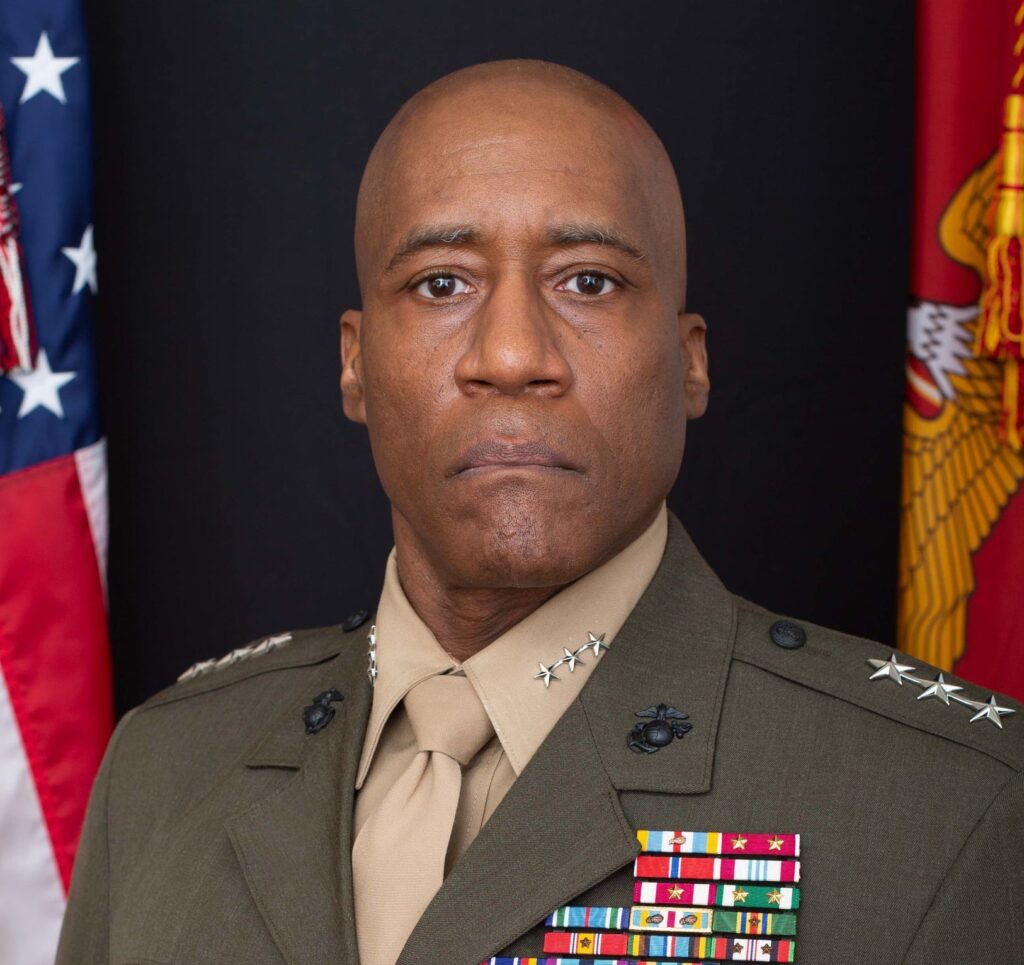
Gen. Michael E. Langley. U.S. MARINE CORPS

ARLINGTON, Va. — Secretary of Defense Lloyd J. Austin III announced June 9 that the president has nominated Marine Corps Lt. Gen. Michael E. Langley for appointment to the grade of general, with assignment as commander, U.S. Africa Command in Stuttgart, Germany.

Langley is currently serving as commander, U.S. Marine Corps Forces Command; commanding general, Fleet Marine Force Atlantic; and commander, Marine Corps Forces North, Norfolk, Virginia. 

A native of Shreveport, Louisiana, Langley graduated from the University of Texas at Arlington and commissioned in 1985. He commanded at every level from platoon to regiment, including Battery K, 5th Battalion, 11th Marines in support of Operations WILDFIRE in Western United States; battalion and regimental commands in 12th Marines forward deployed in Okinawa, Japan; and both the 201st Regional Corps Advisory Command-Central and Regional Support Command – Southwest in support of Operation Enduring Freedom in Afghanistan.  

As a general officer, his command assignments include deputy commanding general, II Marine Expeditionary Force and commanding general, 2d Marine Expeditionary Brigade; commander, Marine Forces Europe and Africa; and deputy commanding General, Fleet Marine Force, Atlantic and Deputy commander, Marine Forces Command and Marine Forces Northern Command. 

Langley’s staff and joint assignments include serving as a division officer for Marine Corps Institute, Marine Barracks 8th and I; deputy G-1, 1st Marine Division deployed in support of Operation RESTORE HOPE in Somalia; naval surface fire support requirements officer in the Expeditionary Warfare Division (N75) and joint integration officer in the Surface Warfare Division (N76), Office of the Chief of Naval Operations; policy action officer in the Strategic Plans and Policy Directorate, J-5; Iraq desk officer in the Joint Staff Response Cell, J-3 Operations Directorate; deputy executive assistant to the Chairman of the Joint Chiefs of Staff; assessments branch head, Programs and Resources, Headquarters, Marine Corps; assistant division commander of 3d Marine Division; deputy director for Operations, J-3, Joint Staff; assistant deputy commandant for Programs and Resources, Headquarters, Marine Corps; and director for Strategy, Plans, and Policy, J-5, U.S. Central Command. 

Langley’s formal military education includes U.S. Marine Corps Amphibious Warfare School and College of Naval Command and Staff.  He holds multiple advanced degrees including Masters in National Security Strategic Studies from the U.S. Naval War College and Strategic Studies from the U.S. Army War College. 

Langley assumed the duties of commanding general, Fleet Marine Force, Atlantic and commander, Marine Forces Command and Marine Forces Northern Command on Nov. 3, 2021. 


Navy Satellite Center Disestablished, Transferred to U.S. Space Force  

Vice Adm. Ross Myers, commander, U.S. Fleet Cyber Command/U.S. 10th Fleet, left, shakes hands with U.S. Space Force Lt. Gen. Stephen Whiting, commander, Space Operations Command, during the Naval Satellite Operations Center disestablishment ceremony. U.S. NAVY / Ensign Drew Verbis

POINT MUGU — Naval Satellite Operations Center, onboard Naval Base Ventura County, transferred to the U.S. Space Force under Space Delta 8 and was designated as the 10th Space Operations Squadron during a historic Disestablishment and Assumption of Command Ceremony June 6, said Naval Base Ventura County Public Affairs in a June 8 release. 

Vice Adm. Ross Myers, commander of U.S. Fleet Cyber Command and U.S. 10th Fleet, presided over the ceremony. 

“For 60 years NAVSOC has advocated and advanced American maritime superiority,” said Myers. “NAVSOC enabled satellite communications to afford the United States and her allies the crucial ability to provide defensive measures, conduct over the horizon monitoring and targeting, and project combat power in areas of conflict and instability around the globe.” 

NAVSOC was the first military space operations command in history, commissioned in April 1962 as the Navy Astronautics Group. Tasked with operating the Navy’s satellites, the unit commanded TRANSIT, the world’s first satellite navigation system. Navy Astronautics Group was re-designated as NAVSOC in June 1990. 

“As we look toward the future of space operations, we see the domain is both crowded and growing,” said Myers. “To lead this next phase of the space race, the United States established the Space Command with the budget and authorities to consolidate joint-capabilities and harness cross-cutting disciplines and services.” 

The Space Force is a separate and distinct branch of the armed services, organized under the Department of the Air Force in a manner very similar to how the Marine Corps is organized under the Department of the Navy. 

“It’s hard to overstate how impactful this mission is and the critical role this team plays in linking the force across air, land, and sea,” said U.S. Space Force Lt. Gen. Stephen Whiting, commander, Space Operations Command. “This activation marks the beginning of the Department of Defense’ consolidation of all narrow-band, wide-band, and protected SATCOM to include all associated responsibilities for training, acquisition, and sustainment activities under a single military service for the first time in history.” 

In addition to the command operation center, NAVSOC transferred the Laguna Peak Facility (three miles from the Point Mugu), which supports the Space-Ground Link System and satellite TT&C operations, and 13 satellites to include 1-FLTSAT, 5-UFO, 5-MUOS and 2-POLAR. 

According to Space Delta 8, the new unit is intentionally numbered the 10th Space Operations Squadron to pay honor to its heritage under U.S. 10th Fleet. 

“Space has become highly contested,” said U.S. Space Force Col. Matthew Holston, commander, Space Delta 8. “Our adversaries recognize our reliance on space, and they are actively seeking ways to create vulnerabilities to take away our competitive advantage. It is the 10th Space Force Operation Squadron that is on the front lines to guaranteeing our American way of life.” 

The Space Force is expected to grow from 2,400 active-duty service members to 6,400 by the end of the year, according to a statement made by Chief of Space Operations Gen. John Raymond. 

“Today we complete the first chapter in military space operations,” said Myers. “Our military stands better connected, more informed, faster, and able to operate with greater precision because of NAVSOC.”


Navy Air Reserve Begins Transition to P-8A Poseidon Aircraft 

A P-8A and P-3C fly over Naval Air Station Patuxent River, Maryland, in 2010. U.S. NAVY / Liz Goettee

ARLINGTON, Va. — The Navy Air Reserve has begun to retire its P-3C Orion maritime patrol aircraft and upgrade to the P-8A Poseidon MPA. 

Current and former members of Patrol Squadron 62 (VP-62), based at Naval Air Station Jacksonville, Florida, gathered June 4 at the squadron’s hangar to bid farewell to the squadron’s P-3Cs as the squadron begins its transition to the P-8A. 

The transition will leave VP-69 at NAS Whidbey Island, Washington, as the last reserve VP squadron to operate the Orion. VP-69 is scheduled to begin transition to the P-8A in fiscal 2023. 

The 12 active-component fleet VP squadrons began transition in 2012 and completed the upgrade to the P-8A in 2020.  

For many years, the Navy was uncertain as to whether the two reserve VP squadrons would be able to upgrade to the P-8A. Eventually, the Navy’s program of record was increased to procure enough P-8As to equip the two reserve squadrons. 

The two reserve VP squadrons are very active in augmenting the fleet squadrons in operations and exercises. With more than 300 Sailors assigned, VP-62 is manned by a staff of full-time support personnel, selective reservists and a few active-component personnel. 

At the height of the Cold War, the Navy Reserve fielded 13 VP squadrons equipped with Orions.