Navy Unmanned Task Force Lead: Common Control System Critical to Enable Artificial Intelligence
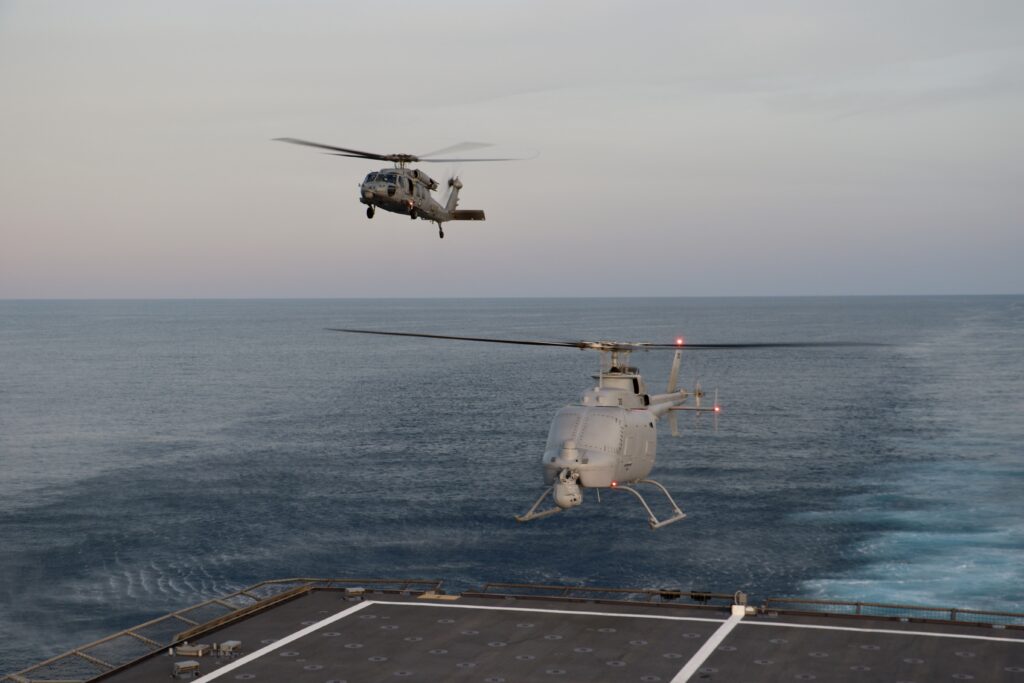
An MH-60S Sea Hawk and MQ-8C Fire Scout unmanned aerial vehicle, assigned to Helicopter Sea Combat Squadron 23, conduct concurrent flight operations as a manned-unmanned team while embarked on the Independence-variant littoral combat ship USS Jackson (LCS 6). U.S. NAVY / Lt. j.g. Alexandra Green

ARLINGTON, Va. — The head of the Navy’s Unmanned Task Force said a control system common for aerial, surface and underwater unmanned systems is still the goal as the Navy develops and fields unmanned systems for the fleet, and is critical to enabling artificial intelligence for data management.

“Certainly,” said Michael Stewart, leader of the Unmanned Task Force, speaking to reporters May 25 at the Pentagon, when asked if the Common Control System is progressing to operate for all three domains.  

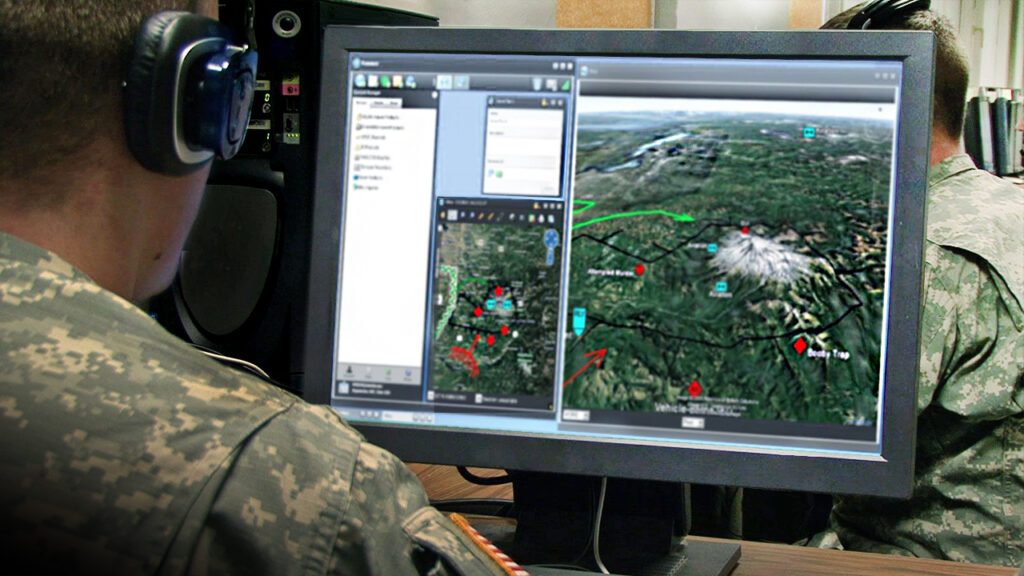
“If you’re going to enable AI [artificial intelligence], if you’re going to have multiple sensors, you have to solve the open-architecture data management problem and you have to have a common control system so that you can take all of this sensor data and then put it in something where you can run algorithms,” Stewart said.

“We’ve talked with some of our allies of their journey through that it only highlighted that that is the critically important thing,” he said. “When I showed up at NATO at first, some people were talking about standards and open architecture, I really didn’t understand the importance of it.

“Now that I’ve seen it in operation with some of the allies, I understand critically why it’s important and why we have to go do that right, because if you want to make AI a thing with a whole bunch of different sensors, you’ve got to be able to do that,” he said.

The Unmanned Task Force is a team of teams with the mission of “bending the curve” of fielding unmanned systems to solve operational problems and deliver solutions more rapidly.

“We’re doing unmanned to solve operational problems; we’re doing artificial intelligence to solve operational problems,” Stewart said. 

He also said funding had to be very agile to move funding around portfolios to achieve rapid development where it is needed most.

Stewart said the task force wants experimentation to establish the relative value of various unmanned concepts and systems while “dispelling the mythology of unmanned and AI.”

“Let’s let them prove what we think they can do,” he said.
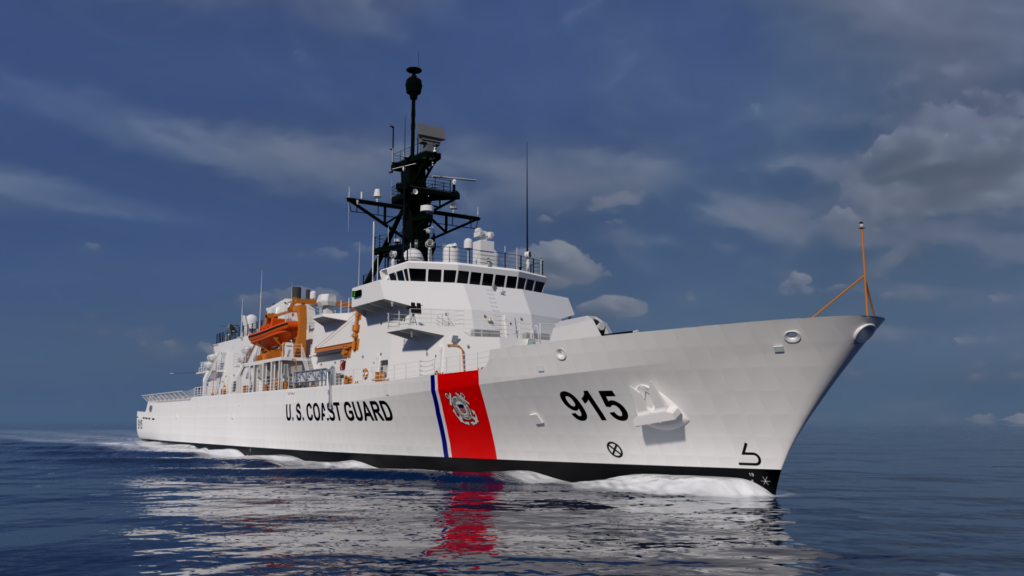


Northrop Grumman Integrating Systems for Coast Guard’s Offshore Patrol Cutter 

Northrop Grumman is integrated the control systems for the Coast Guard’s Offshore Patrol Cutters, such as the USCGC Argus, shown here. NORTHROP GRUMMAN

ARLINGTON, Va. — Northrop Grumman is integrating the control systems for the U.S. Coast Guard’s Offshore Patrol Cutters being built by the Eastern Shipbuilding Group in Panama City, Florida.

The systems are being readied for installation in the four cutters when they are ready to receive the systems. The company is also looking beyond to other programs, including the Navy’s DDG(X) next-generation destroyer program  

Northrop Grumman is “the prime ship integrator for the OPC, amongst delivering many other capabilities to that platform, to include the navigation system, the bridge systems, the machinery control systems,” said Rudy Fernandez, director for Strategy and Business Development, Naval and Oceanic Systems, Northrop Grumman Mission Systems, in an interview with Seapower. “So, we integrate all of that, plus other systems for the platform.” 

Northrop Grumman has had plenty of experience integrating systems on other warships, Fernandez said, including bridge and navigation system for the Navy’s Arleigh Burke-class guided-missile destroyers, including the WSN-7 and WSN-12 inertial navigation systems and the machinery control systems. 

“The new role for us is the system integrator role, which we really value in the partnership we have with ESG to be able to carry out that role in support of this very critical Coast Guard program,” he said.  

Northrop Grumman’s Maritime Systems and Integration Operating Unit is part of its Naval and Oceanic Systems Business Unit, which is part of the Maritime Land Systems and Sensors Division in Charlottesville, Virginia. The company competed for the OPC contract as part of the Eastern Shipbuilding Group team. 

Northrop Grumman built a land-based test facility and a test and integration facility in Charlottesville that is used to test equipment before it is shipped to ESG. 

“Working with ESG, we’ve also been able to build a mock-up of the [OPC’s] bridge and navigation center so that we could test all the equipment that we are delivering in a much more integrated fashion before it goes on the ship itself,” Fernandez said, noting that the facility is at one of ESG’s shipyards and is helping to reduce risk in the program.  

Fernandez said his company is involved in pursuing the contract for the second batch of OPCs, but he was not at liberty to discuss which builder it was teamed with, “but I can tell you we’re very anxious to see that award come through.” 

He said the down-select was expected “in the near term.” 

Northrop Grumman is looking at the Coast Guard’s Waterways Commerce Cutter program, but Fernandez was not free to provide any details of the company’s plans. The company also is looking at potential work of future contract awards for polar security cutters. Fernandez also said his company was “very attuned” to the Navy’s future DDG(X) program.  

“DDG(X) is an exciting opportunity for us … and we’ve interacted with our customer on several occasions already to understand better where they’re going,” he said, noting Northrop Grumman already delivers the power systems for the SPY-6 radar and SLQ-32 Surface Electronic Warfare Improvement Program. The effort is focused on the DDG(X)’s integrated power system.  

“We’ve already done a tremendous amount of risk reduction for that platform,” he said. “We’re making as a company tremendous investment in that area.” 

Fernandez also said his company is very interested in developing or adapting power systems and controls for the Navy’s future unmanned surface vessels.  

“That’s going to take a bit of ingenuity because automation and reliability have to come into play,” he said.  


Navy: Mine Countermeasures Mission Packages to Be Available for Vessels of Opportunity 

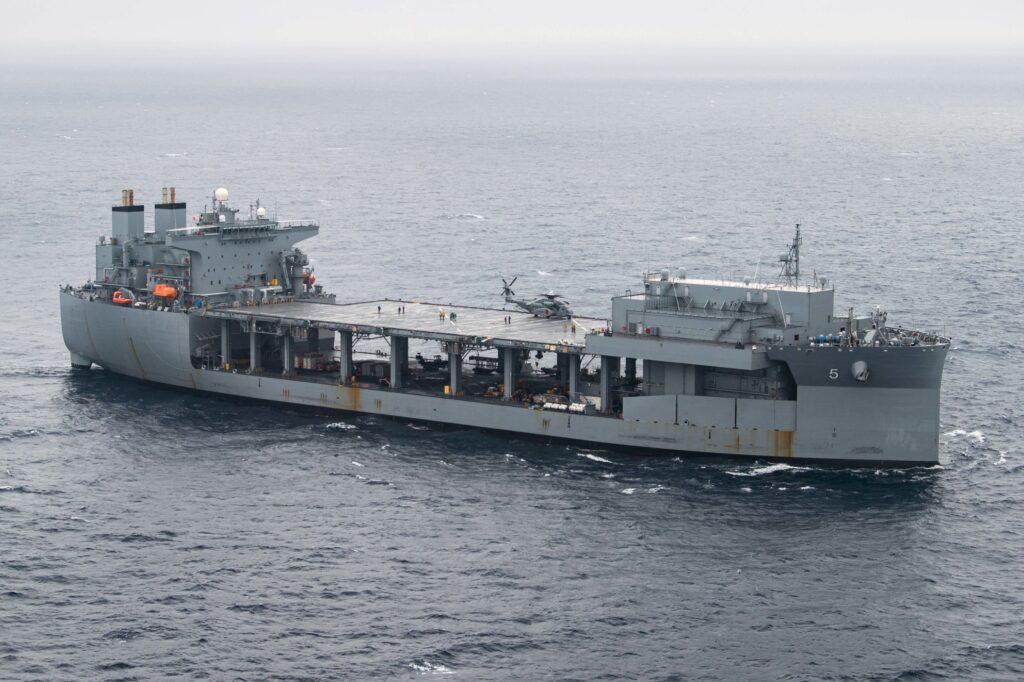
The expeditionary sea base ship USS Miguel Keith (ESB 5) conducts flight operations during Exercise Noble Vanguard. ESBs are likely vessels of opportunity for mine countermeasure packages. U.S. NAVY / Mass Communication Specialist 2nd Class Gregory A. Pickett II

ARLINGTON, Va. — The Navy’s mine countermeasures mission packages will be available not only to littoral combat ships but to other vessels and units, a Navy official said.   

Capt. Mike Egan, branch head for mine warfare in the Office of the Chief of Naval Operations, speaking May 24 in Monterey, California, at the 2022 International Mine Warfare Technology Symposium of the Mine Warfare Association, said the MCM mission package is on track to achieve initial operational capability in the fall of 2022 and the Navy plans to procure a total of 24 packages. 

The Navy plans to equip 15 Independence-class littoral combat ships with the MCM mission package, which will leave an additional nine mission packages for use elsewhere.  

Egan said those excess mission packages won’t be sitting around in a warehouse. 

“We’re going to put them on vessels of opportunity, put them ashore, we’re going to integrate them into ExMCM [expeditionary MCM] companies to use those and try to make sure [to] step up MCM capability to be expeditionary, to be scalable [and] modular,” he said. “That’s where we’re headed.”    

The Navy’s expeditionary sea-base ships, which already host MCM forces, are considered likely vessels of opportunity for an MCM mission package. These ships host MH-53E MCM helicopters and mine-hunting craft and unmanned underwater vehicles. 

The Navy has commissioned three Lewis-B. Puller-class ESBs and has two more under construction. 


Charles River Analytics: Artificial Intelligence is Challenged in Arena of Competition 

The intuitive user interface of the Explainability and Terrain Reasoning for Autonomy (EXTRA) effort will deliver human-understandable explanations of deep reinforcement learning software behavior. CHARLES RIVER ANALYTICS

ARLINGTON, Va. — A small company developing artificial intelligence technology for the Office of Naval Research is halfway through a 24-month contract performance toward demonstrating its AI technology for the Navy.  

“It’s all about trying to develop technologies that can help decision makers,” said Jeff Druce, senior research scientist at Charles River Analytics, in an interview with Seapower. “They have lot on their plate as far as the watch-floor commanders, making decisions with limited, partial, incomplete information. 

“AI has shown — at least in an academic setting — promise at being able to reason about these complex scenarios and make really effective decisions in a variety of arenas,” Druce said, noting rhetorically that with autonomy, “Can you have a system that gives information about the world and tries to take actions that are going to beneficial to the entity in some way? 

“There’s not a lack of information out there; it is getting the right information in the right format to be useful,” he said. “What is the relevant information, especially if you’re in a divided-attention task, it becomes like a human-factors problem, as in, ‘What is the most useful information to provide this person in what format that they can use it to make better decisions?’” 

Druce envisions AI “as not taking over at all but very much a collaborative human-machine teaming where AI can handle these processes that require a lot of attention and are time consuming but sort of easy to be done in that there’s no incredibly challenging reasoning that has to be done but ultimately will help with the attention problem of the human user.” 

Charles River Analytics started out with Small Business Innovative Research Phase 1 work, Druce said, but “a lot of that technology and that motivation ended up going into this larger, EXTRA [Explainability and Terrain Reasoning for Autonomy] effort [for ONR]. 

“We’re trying to bring in some of the modern AI tools” to the effort, he said. “The deliverables are mostly demonstrations and software based. These things are pretty leading edge.” 

Druce said a “demonstration in a representative domain that these autonomous agents are doing reasonable things could lead towards a good performance in the physical environment.” 

He said the technology his company develops needs to be demonstrated in an “arena of competition … pitting AIs against each other to see how they perform. … Can you take your technology and pit it against somebody else’s in a less-controlled environment … and see how it does?”  

Druce said AI is challenging to his company’s workers, but the challenge is what promotes their best work. 

“These are hard questions with unknown answers,” he said. “When you give smart people these challenging problems, you can see that [with] doing cool things, they motivate themselves.” 


U.S. Navy Releases Command Investigation into USS Connecticut Grounding 

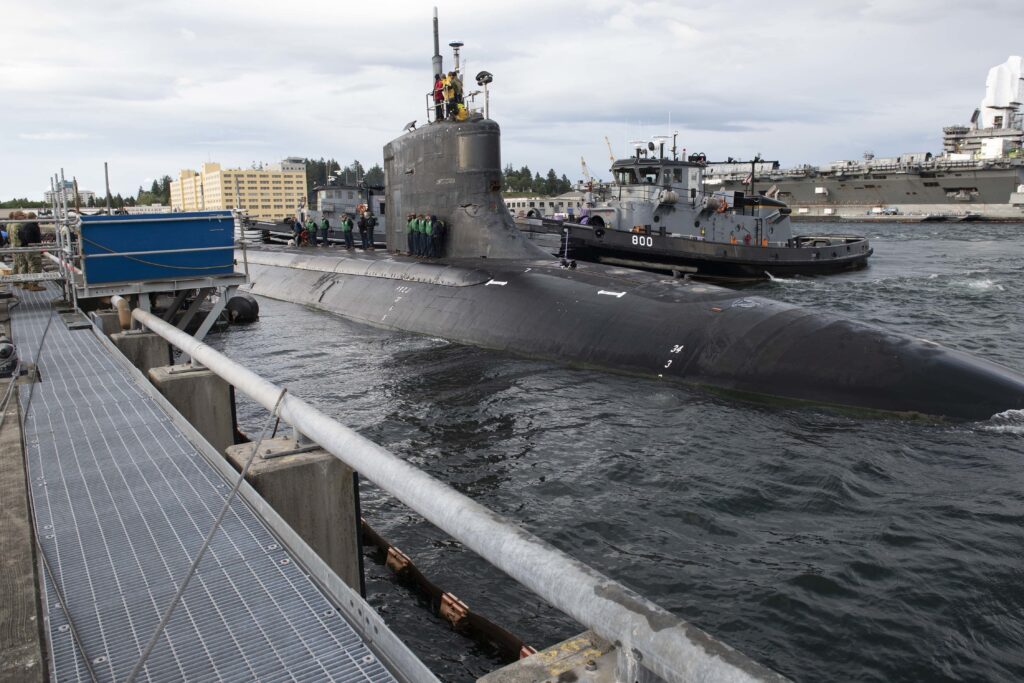
The Seawolf-class fast-attack submarine USS Connecticut (SSN 22) departs Naval Base Kitsap-Bremerton for deployment, May 27, 2021. Its underwater collision happened a few months later. U.S. NAVY / Lt. Mack Jamieson

PEARL HARBOR — The U.S. Navy has released the command investigation into the USS Connecticut (SSN 22) grounding that occurred Oct. 2, 2021, the U.S. Pacific Fleet said May 23.

USS Connecticut grounded on an uncharted seamount while operating submerged in a poorly surveyed area in international waters in the Indo-Pacific region. The investigation determined the grounding was preventable. Specifically, the grounding resulted from an accumulation of unit-level errors and omissions in navigation planning, watch team execution and risk management, all of which were deemed to fall far below U.S. Navy standards. 

The investigation and endorsements describe what happened, promulgate lessons learned, memorialize completed corrective actions, document accountability actions and delineate pending actions that must be finalized with a sense of urgency.

In addition to addressing the unit-level errors that caused the grounding, the investigation highlighted specific areas for improvement in the deployment training and certification process, and the Navy is urgently implementing these improvements across the Submarine Force. This investigation delineates 28 corrective actions, of which 14 actions are complete, 13 actions are in progress, and one is enduring. 

In implementing these significant improvements, the Navy said it will become a more effective fighting force.


Leaders Honor Merchant Marine Bravery in World War II, Ongoing Pandemic for National Maritime Day

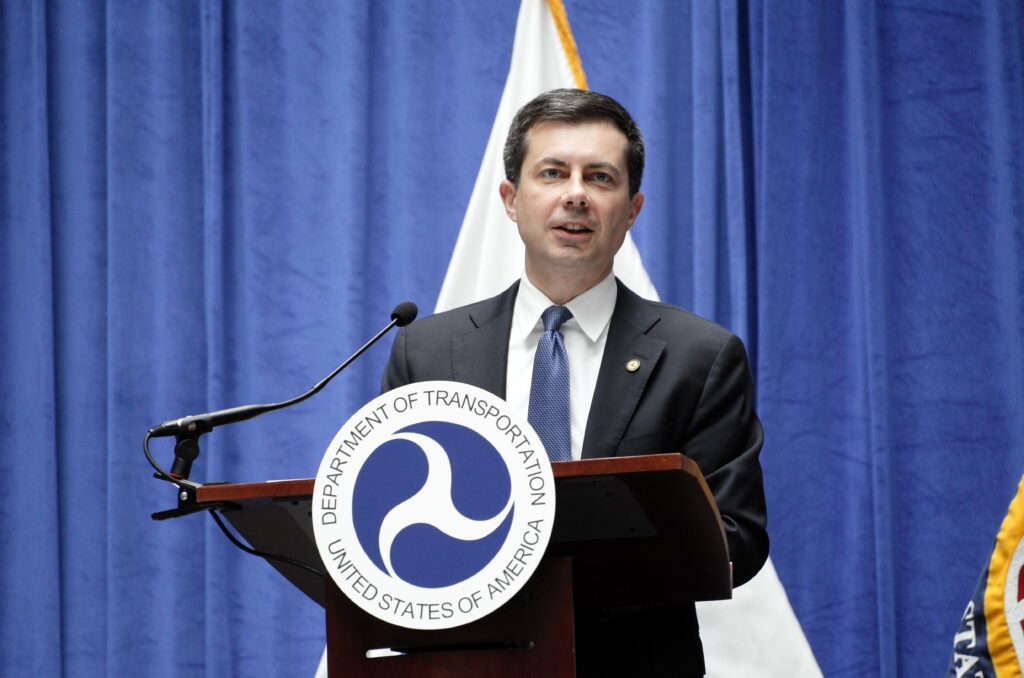
Secretary of Transportation Pete Buttigieg speaks at the DOT’s National Maritime Day observance. SEAPOWER / Brett Davis

WASHINGTON, D.C. — Transportation and military officials observed the annual National Maritime Day on May 24, saying the Merchant Marines were the unsung heroes of the second world war and continue to be heroes by shipping vital supplies during the ongoing pandemic.

“We have always been, and always will be, a nation whose destiny is connect to the sea,” Secretary of Transportation Pete Buttigieg said during the ceremony at the Department of Transportation headquarters.

The ceremony especially honored the Merchant Mariners who helped win World War II, losing their lives at a higher rate than any other services. On May 18, congressional leaders revealed a new Congressional Gold Medal for American Merchant Mariners.

During World War II, they delivered an average 17 million pounds of cargo to the armed forces every hour, and “often they did so without protection against U Boats, destroyers and the aircraft that menaced the waters,” Buttigieg said.

Now, during a pandemic, “you have kept America afloat,” he said.

Daniel Maffei. left, Ann Phillips, the new administrator of the Maritime Administration, and Polly Trottenberg, the deputy secretary of transportation, during the presentation of a wreath to honor fallen Merchant Marines. SEAPOWER / Brett Davis

Daniel Maffei, chairman of the Federal Maritime Commission, said the COVID pandemic put current mariners to the test again, and “they put their lives on the line for our country.” Americans stayed home to help fight the spread of the virus, but “thanks especially to the workers in our ports, America was never cut off.”

Retired Navy Rear Adm. Ann Phillips, sworn in as the 20th administrator of the Maritime Administration on May 16, also cited maritime bravery during World War II and said, “today, our mariners continue to navigate historic challenges” such as the pandemic and supply chain disruptions.

Strengthening the maritime services is critical, said outgoing Coast Guard Commandant Adm. Karl Schultz.

Maritime officials like to talk about ships and boats and ports, he said, but “it’s really the mariners. It’s not the steel, it’s not the concrete … mariners deserve the best support we as a nation can provide,” including updated technology, streamlined induction processes and a renewed fight against sexual assault to create a safe environment for all mariners.

Rear Adm. Michael A. Wettlaufer, command of Military Sealift Command, said his service is also embarking on modernization to improve the environment for the maritime fleet. He cited the 2021 delivery of a component from a Navy ship and Coast Guard vessel as an example, and said in the future “I expect to be able to deliver key components between ships” at distances of up to several hundred miles.


Raytheon awarded $423 Million Navy Contract for SPY-6 Family of Radars 

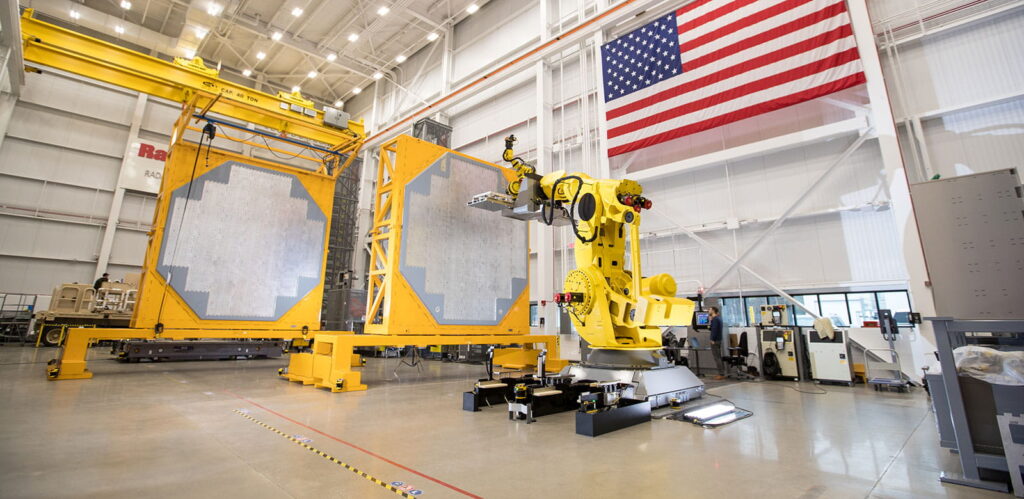
Raytheon’s SPY-6 radar. RAYTHEON MISSILES & DEFENSE

TUCSON, Ariz. — Raytheon Missiles & Defense has been awarded a $423 million contract to continue to produce SPY-6 radars for the U.S. Navy, the company said May 23. This is the first option exercised from the March 2022 hardware, production and sustainment contract that is valued up to $3.16 billion over five years. 

“SPY-6 is the premiere surface naval radar in the world, and contracts like this ensure Sailors across the fleet will be equipped with the information, tracking and detection it provides,” said Kim Ernzen, president of Naval Power at Raytheon Missiles & Defense. “SPY-6 radar arrays have already been delivered to multiple ships with installation ongoing.” 

The SPY-6 family of radars can defend against ballistic missiles, cruise missiles, hostile aircraft and surface ships simultaneously. They provide several advantages over legacy radars, including significantly greater detection range, increased sensitivity and more accurate discrimination. Their scalable and modular radar arrays reduce cost and sustainment needs, while meeting the mission requirements of seven classes of ships. 


Airbus Wins Contract for Continuing Lakota Helicopter Fleet Support 

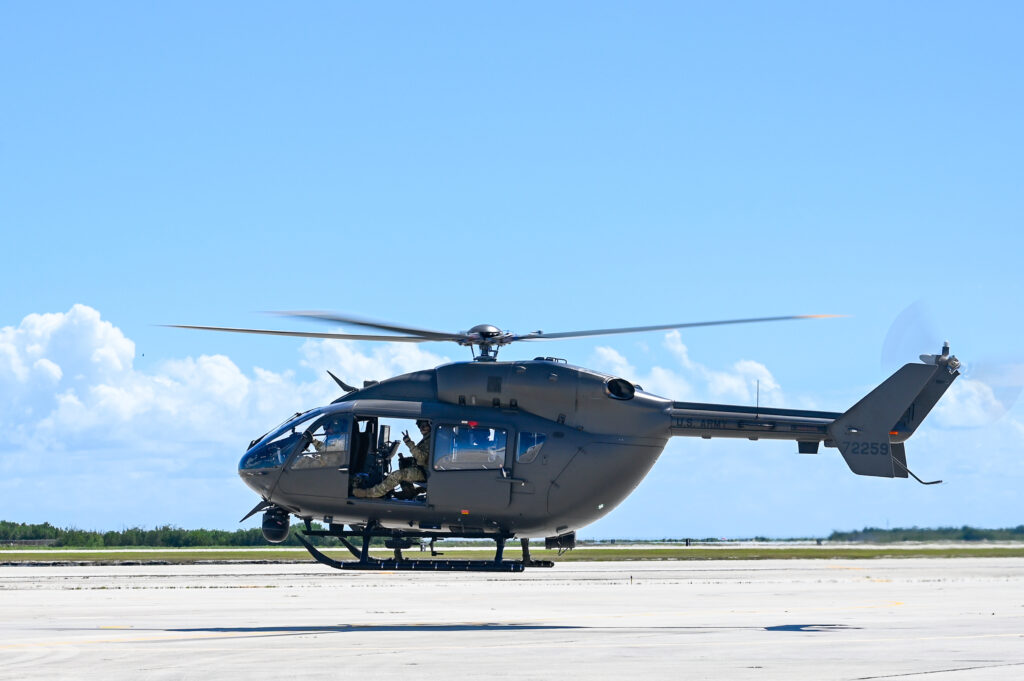
A UH-72A Lakota helicopter attached to the U.S. Army 112th Aviation Regiment takes off from Naval Air Station Key West’s Boca Chica Field in Key West, Florida, on March 3. U.S. NAVY / Mass Communication Specialist 2nd Class Nicholas V. Huynh

GRAND PRAIRIE, Texas — Airbus has signed a follow-on contractor logistics support contract with the U.S. Army to provide spare parts, material, and engineering support for the Army’s entire UH-72A and UH-72B Lakota fleet of 482 utility and training helicopters. The fleet includes several UH-72As on loan to the U.S. Naval Test Pilot School. 

The contract includes a six-month base and 4.5 option years, with a potential total value of more than $1.5 Billion. Airbus will provide support across 67 Lakota sites in the U.S. and overseas. This includes National Guard bases in 43 states, and Fort Rucker in Alabama, where the UH-72A performs the Army’s Initial Entry Rotary Wing mission. 

The CLS contract with the U.S. Army is the largest helicopter performance-based support contract managed by Airbus worldwide.      

“Airbus has provided exceptional product and support services in the UH-72A for nearly two decades,” said Col. Calvin Lane, U.S. Army Utility project manager. “This contract underscores the Army’s trust in the aircraft’s  capabilities, and we look forward to the continued support this contract provides to the UH-72 fleet.” 

The contract will be managed by Airbus U.S. Space & Defense. Headquartered in Arlington, Virginia.


HII’s Newport News Shipbuilding Hiring Thousands 

Newport News Shipbuilding contractor Justice Gibson, from Franklin, Virginia, welds a bulkhead aboard the aircraft carrier USS John C. Stennis (CVN 74), in Newport News, Virginia, April 28. U.S. NAVY / Mass Communication Specialist Seaman Curtis Burdick

NEWPORT NEWS, Va. — Global defense and technologies partner HII announced May 23 that the company’s Newport News Shipbuilding division plans to hire approximately 5,000 people this year to meet the shipbuilding needs of the Navy.

The shipyard anticipates hiring nearly 21,000 people within the next decade as HII fulfills orders for U.S. aircraft carriers and submarines. 

“We at NNS are driven to support the men and women in uniform, to serve the nation, by delivering great ships,” said Xavier Beale, vice president of Human Resources and Trades for Newport News Shipbuilding. “This is not just a job. It is a mission to serve national security, and we are committed to investing in our people so those who choose this mission can create a long and rewarding career.” 

Newport News Shipbuilding intends to hire nearly 3,000 skilled trades in 2022, including entry-level positions and trainee fitters and welders. 

Entry-level trade positions at Newport News can pay $21 plus per hour; no experience is required and training is provided. Candidates may be eligible for $500 sign-on bonuses and up to $1,500 for relocation. Newport News is also offering weekly paychecks, comprehensive benefits, an on-site health center and employee discounts. 

For more information on all open positions and benefits, visit buildyourcareer.com


Navy’s MQ-8C Fire Scout Operating in Westpac; MQ-8Bs to Be Retired  

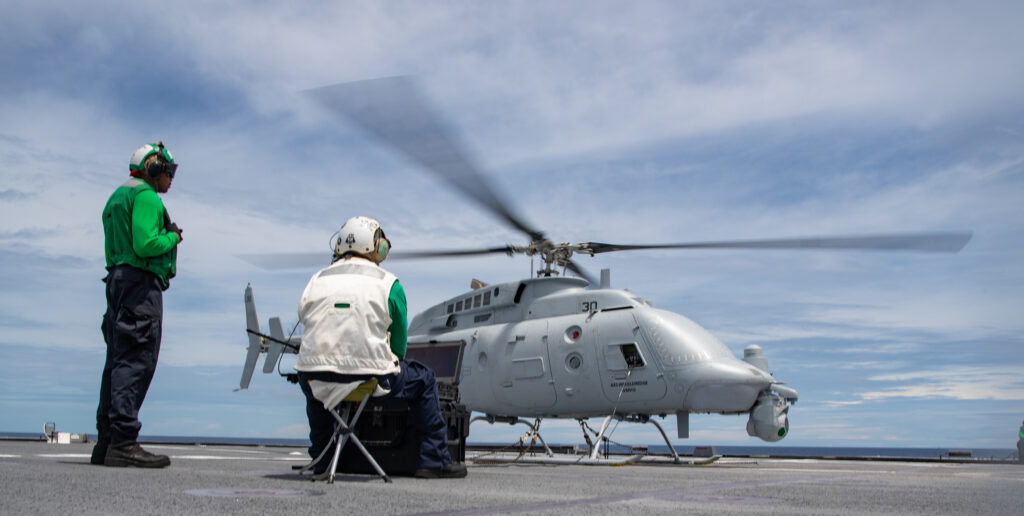
Aviation Electronics Technician 1st Class Corie Wooldridge, from San Marcos, California, performs ground turns on an MQ-8C Fire Scout, attached to the “Wildcards” of Helicopter Sea Combat Squadron 23, assigned to the Independence-variant littoral combat ship USS Jackson (LCS 6). U.S. NAVY / Mass Communication Specialist 3rd Class Charles DeParlier

ARLINGTON, Va. — The Navy’s MQ-8C version of its Fire Scout unmanned helicopter is now operating on its first deployment to the Western Pacific, the second deployment of the type so far. Meanwhile, the Navy is proceeding with plans to accelerate retirement of the fleet of older MQ-8B versions in fiscal 2023. 

The Independence-class littoral combat ship USS Jackson (LCS 6) is operating with a detachment from Helicopter Sea Combat Squadron 23, which includes an MQ-8C. The Jackson in the first LCS deployed to the Western Pacific since the summer of 2020 and began operations with the MQ-8C on April 20. Two other LCSs are deployed in the Indo-Pacific region with the older MQ-8B version 

The Northrop Grumman MQ-8C, based on the Bell 407 airframe, can carry the Leonardo ZPY-8 Osprey radar, the Teledyne FLIR Brite Star II electro-optical/infrared sensor and the Automatic Information System for surface search and tracking, said Scott Weinpel, Northrop Grumman’s business development director for Fire Scout, in a May 23 interview with Seapower. It can augment the MH-60S Seahawk manned helicopter also deployed with the helicopter squadron detachment. 

Weinpel said the COBRA II (Coastal Battlefield Reconnaissance and Analysis II) sensor is being developed to give the MQ-8C a day/night mine-hunting capability over a larger area and in a deeper water column than the COBRA I deployed on the MQ-8B.   

The MQ-8C first deployed in December 2021 on the Freedom-class LCS USS Milwaukee (LCS 5) in the U.S. 4th Fleet area of operations. 

The Navy has 36 MQ-8Cs on strength. In the Navy’s fiscal 2023 budget request, the service plans to place about half of the MQ-8Cs in long-term preservation, Weinpel said, attributing the decision to the Navy’s budget priorities. 

“We really are hoping that, with our mission extension efforts and the capabilities and enhancements that we want to incorporate with Fire Scout, that the future looks bright, especially as we look towards the future [Constellation-class] frigate, where Fire Scout is incorporated into [the Navy’s] Capabilities Development Documents for FFG 62,” he said. “We fully expect that we will be a part of that requirement. 

“It would be an appropriate time to pull those [MQ-8Cs] out of preservation and incorporate them with that [frigate] fleet,” he said, noting that the MQ-8C could easily pivot to the antisubmarine warfare mission set, deploying sonobuoys and relaying the acoustic data that they would collect to the mother ship or another ASW platform.    

Weinpel also said Northrop Grumman could relatively easily restart production of the MQ-8C if required.  

He also confirmed the Navy’s decision to accelerate retirement of its fleet of MQ-8Bs to fiscal 2023 from 2024, also a result of budget pressure. He said the retired MQ-8Bs could be adapted to homeland security roles, including service with Customs and Border Protection. 

Weinpel said the MQ-8C performed well on its first deployment. 

“We had great feedback from the operators of the HSC-22 detachment,” he said. “They were able to use the radar and EO/IR, [and] had great TCDL [Tactical Common Data Link] operational use, so they were able to fly out to the maximum range of the Fire Scout and then they were also distribute some of the information that was getting down to the Fire Scout control station to other areas of the ship where it became relevant as they were able to conduct some counter-narcotics missions.”   

Earlier this month, an MQ-8C provided bomb hit analysis for a Hellfire Longbow missile shoot from the Independence-class LCS USS Montgomery (LCS 8).