Coast Guard is Upping its Game on Cyber, Human Resources and Equipment, Panelists Say
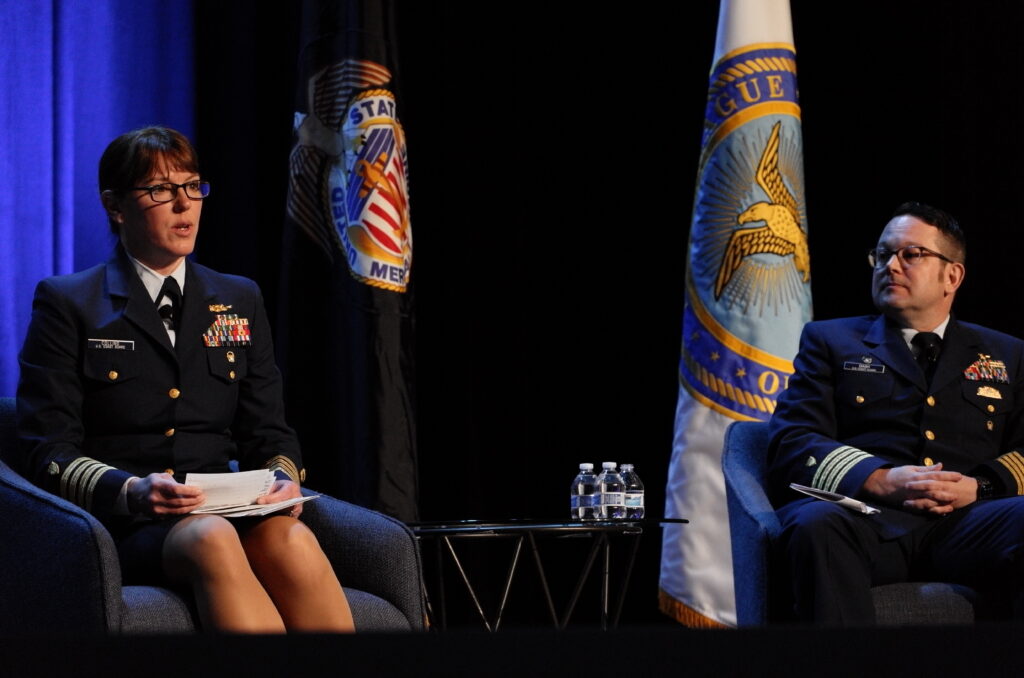
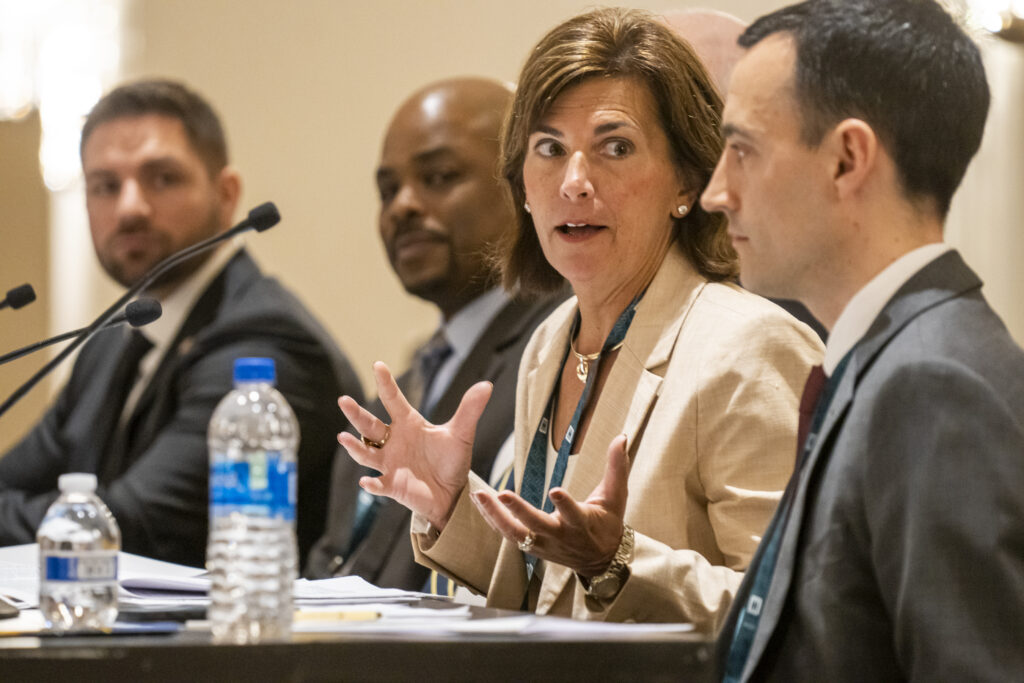
Capt. Laura D. Collins, acting director of civilian human resources at the Diversity and Leadership Directorate, discusses Coast Guard advances in training while Capt. Russell E. “Rusty” Dash, the C51 Service Center commanding officer, looks on. BRETT DAVIS

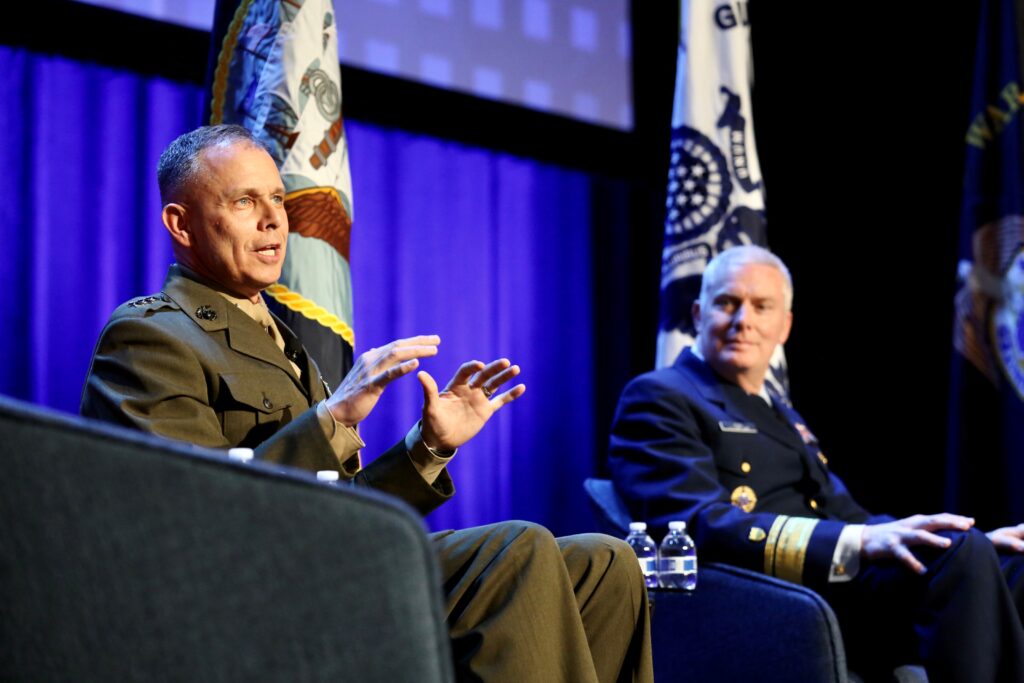
NATIONAL HARBOR, Md. — In his last Sea-Air-Space visit in uniform, U.S. Coast Guard Commandant Karl Schultz led a panel discussion about the service, which is rapidly seeking to upgrade its equipment, software and human resources to keep up in a competitive world.

“The demand for Coast Guard services, at home and abroad, has never been higher,” Schultz said.

He introduced his nominated successor, Adm. Linda Fagan, the current vice commandant, and her nominated vice commandant, Vice Adm. Steven D. Poulin.

“I will sleep well at night,” Schultz said. “They are rock stars and we are in good hands.”

Schultz guided the panel through a discussion of how the service is upping its game when it comes to connectivity, human resources and equipment, including ships to replace or augment an aging fleet.

Capt. Russell E. “Rusty” Dash, the C51 Service Center commanding officer, said under Shultz’s direction the Coast Guard kicked off a “tech revolution” in March 2020, to try to get away from the service’s reputation of delivering “yesterday’s technology tomorrow.

“The tech revolution is about empowering the people of the Coast Guard with reliable, mobile and integrated capabilities so they can better do their job,” he said, noting that most Coast Guard work doesn’t take place behind a desk.

It’s a mobile-first approach that gives Coasties the hardware and apps they need to “do their work wherever they do their work,” and includes beefing up cutter connectivity as well as on-shore networks.

The service is also getting ready to turn on a “software factory,” based on the Air Force software factory model, to promote “software developed by Coasties for Coasties in a standard way,” Dash said.

Capt. Laura D. Collins, acting director of civilian human resources at the Diversity and Leadership Directorate, said the service is taking a similar approach with its people.

“We want a best-in-class workforce for a best-in-class Coast Guard,” she said, building on a document called Ready Workforce 2030, which calls for modernized learning and training tailored to the individual.

“In order to be the employer of choice, we’ve got to train to retain,” she said, including on-demand e-learning not just training at dedicated centers.
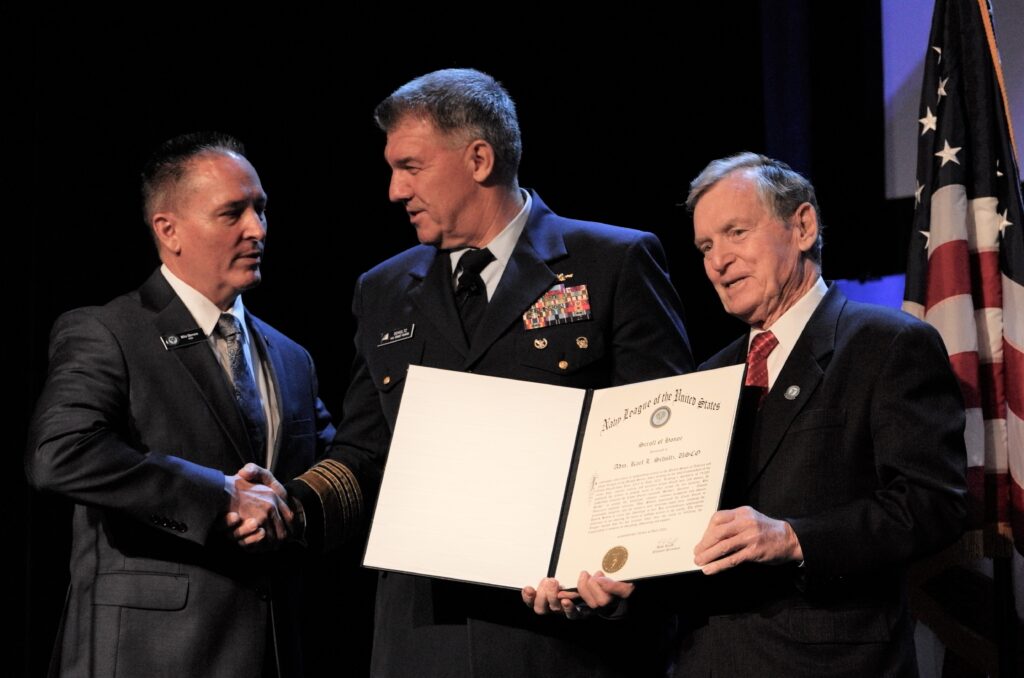
Navy League CEO Mike Stevens, left, and National President David Reilly, right, present Coast Guard Commandant Adm. Karl Schultz with the Navy League Scroll of Honor. BRETT DAVIS

Rear Adm. Douglas Schofield, assistant commandant for acquisition and chief acquisition officer, highlighted new ships coming on line, include the offshore patrol cutter and a new icebreaker.

The offshore patrol cutter joins new national security cutters and fast response cutters, and will complement them through its presence in exclusive economic zones and beyond.

“It is critical for that multi-mission presence that you always talk about, sir,” and has “outstanding human system integration,” including common boat launch systems and helicopter accommodations.

Schultz noted there is significant conversations about how many ships the U.S. Navy has, but the question of how many ships the Coast Guard has tends to fall under the radar.

“We’re going to have a fleet of 100 new ships here. When you roll in these 11 national security cutters … 64, now 66, fast response cutters, 25 OPCs, that is a fleet of 100 very capable ships … I think that 100 is going to continue to up our game.”

At the end of the breakfast, Schultz was presented with the Navy League Scroll of Honor by National President David Reilly and CEO Mike Stevens.


Coast Guard Offloads $20 Million in Cocaine Following At-Sea Drug Bust Near P.R.

Coast Guard Cutter Donald Horsley’s crew offloaded approximately 1,000 kilograms of seized cocaine, valued at $20 million dollars, at Coast Guard Base San Juan April 4, 2022, following the interdiction of a go-fast vessel March 30, 2022, in the Caribbean Sea near Puerto Rico. U.S. COAST GUARD

SAN JUAN, Puerto Rico — The Coast Guard Cutter Donald Horsley crew and Drug Enforcement Administration special agents offloaded approximately 1,000 kilograms of seized cocaine at Coast Guard Base San Juan April 4, following the interdiction of a go-fast vessel in the Caribbean Sea near Puerto Rico, the Coast Guard 7th District said in a release. 

This interdiction is the result of multi-agency efforts involving the Caribbean Border Interagency Group and the Caribbean Corridor Strike Force. The seized cocaine has an estimated wholesale value of approximately $20 million dollars. 

During a routine patrol March 30, the crew of a Customs and Border Protection multi-mission enforcement aircraft sighted a suspect vessel near Aguadilla, Puerto Rico. Coast Guard watchstanders in Sector San Juan diverted the cutter Donald Horsley that arrived on scene and interdicted a 35-foot go-fast vessel. The vessel was carrying two men, Dominican Republic nationals and multiple bales of suspected contraband, which tested positive for cocaine. The cutter Donald Horsley crew apprehended the two men and seized 33 bales of cocaine. 

“This case highlights the Coast Guard’s unwavering resolve and that of our fellow partners to interdict drug smuggling vessels at sea and safeguard the nation’s southernmost maritime border,” said Capt. Gregory H. Magee, Sector San Juan commander. “These partnerships are key to achieving to protecting our citizens in Puerto Rico and the U.S. Virgin Islands from drug trafficking and other smuggling threats in the Caribbean.” 

Drug Enforcement Administration Special Agents received custody of the detainees and the seized contraband, and they are leading the investigation into this case. 

Cutter Donald Horsley is a 154-foot fast response cutter homeported in San Juan, Puerto Rico. 


Coast Guard Begins Multi-Month Fisheries Enforcement Operation With Bermuda

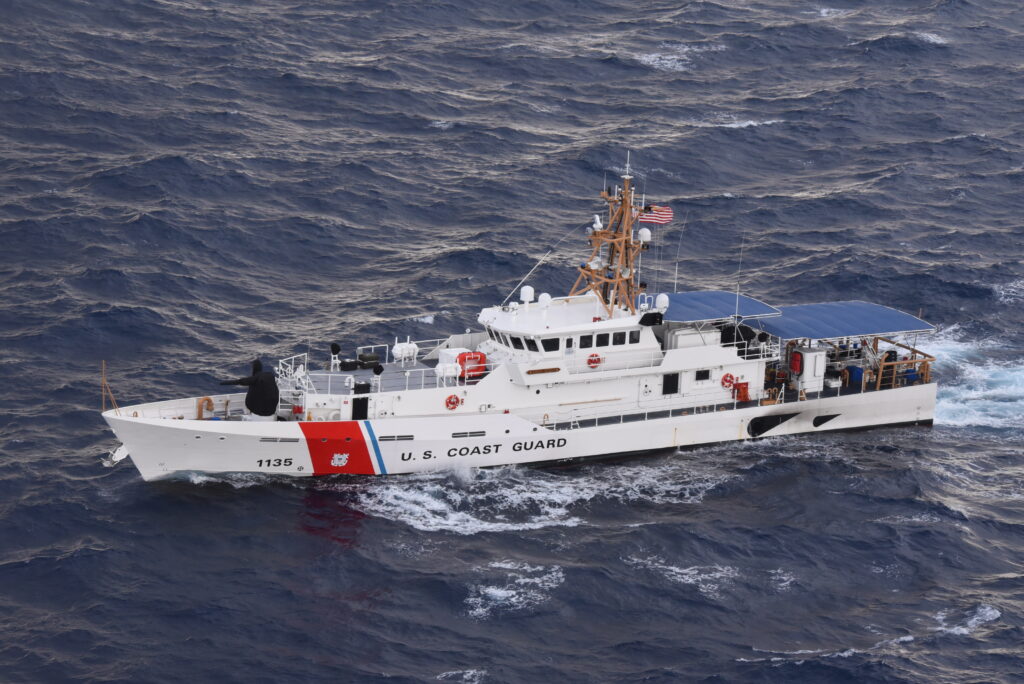
Coast Guard Cutter Angela McShan crew underway near Miami, Sept. 20, 2019. U.S. COAST GUARD / Petty Officer 3rd Class Brandon Murray

PORTSMOUTH, Va. — U.S. Coast Guard Cutter Angela McShan (WPC-1135) is scheduled to arrive in Bermuda on April 6 as part of a multi-month fisheries enforcement operation in concert with the Bermuda Department of Environment and Natural Resources, Royal Bermuda Regiment, Bermuda Coast Guard and Bermuda Police Services, the Coast Guard 5th District said in a release.  

The cutter will be the first of three Coast Guard ships that will patrol seaward of the Bermuda Exclusive Economic Zone, which extends 230 miles from shore. The joint operation will expand upon the long-standing U.S.-Bermuda partnership, as well as emphasize protection of the environment and living marine resources in this region.  

The operation is a result of recent meetings between Bermuda’s Deputy Governor Alison Crocket, Deputy Premier Walter Roban, Permanent Secretary in Bermuda’s Ministry of Home Affairs Rozy Azhar, U.S. Consul General in Bermuda Karen Grissette and Rear Adm. Laura Dickey, the U.S. Coast Guard Fifth District Commander.  The professional exchange focused on increasing efforts to counter illegal, unreported and unregulated fishing, a global issue recently detected in the Mid-Atlantic.   

“It was an honor to meet Rear Admiral Dickey and her staff, along with the U.S. consul and her staff,” noted Deputy Premier Roban. “This operation begins a new chapter of cooperation with the U.S. government in supporting illegal, unreported fishing and other unacceptable activity in our waters. All is as a result of a meeting held with the National Climate Advisor to U.S. President Biden, Gina McCarthy, at COP26 where we discussed matters important to Bermuda and the United States. The willingness of the United States to support Bermuda in our effort to oversee our EEZ is in step with our centuries’ long relationship as neighbors. My gratitude on behalf of the people of Bermuda extends to the U.S. Consul’s Office in Bermuda for facilitating these meetings and the support we will get from the United States Coast Guard.”  

As the worldwide demand for fish as a protein source continues to grow, IUU fishing will have a profound impact on the security of all countries with a maritime boundary. Left unenforced, IUU fishing will threaten global geopolitical security, undermine maritime governance and impact a nation’s ability to achieve domestic food security. 

“We’re excited to join with Bermuda to help detect and monitor potential IUU fishing in the region,” said Rear Adm. Dickey.  “As we each work to safeguard our respective Exclusive Economic Zones, we’re fortunate to build on our long-standing relationship to partner together in this effort to protect global fish stocks and promote adherence to international rules.” 

“The United States is proud to partner with Bermuda to promote security and lawful conduct in the Atlantic region,” added U.S. Consul General Karen Grissette. “Reinforcing the United States’ security partnership with Bermuda is one of my top priorities, so I am proud to welcome these U.S. Coast Guard cutters to advance our shared interests. This important operation is one more tangible demonstration of the close security collaboration between Bermuda and the United States.”    

The Sentinel-class fast response cutter (WPC) is a key component of the Coast Guard’s offshore fleet that is capable of deploying independently to conduct missions that include port, waterways and coastal security, fishery patrols, search and rescue, and national defense. 


Early Days in the Sea Services Helped Focus Their Careers, Women Leaders Say

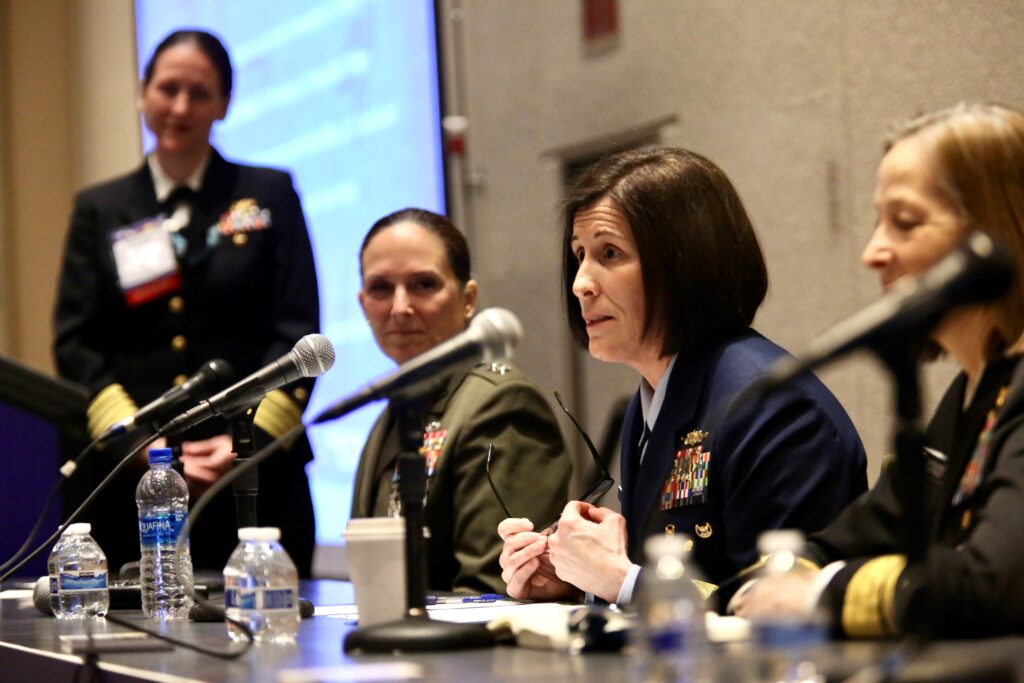
Rear Adm. Megan Dean, director of government and public affairs at the Coast Guard, makes a point during the Women’s Leadership session. LISA NIPP

NATIONAL HARBOR, Md. — Senior-level women from across the sea services shared personal and professional insights and anecdotes about their earliest days in the military, and what helped guide them to the tops of their fields, in a panel discussion on Women’s Leadership on April 5 at Sea-Air-Space 2022.

U.S. Navy Capt. Emily Bassett, serving as moderator of the panel, also hosted the event on behalf of the Sea Service Leadership Association. Bassett is president of SSLA, the only nonprofit, national, volunteer-driven organization dedicated to the promotion, advancement and mentorship of women in the U.S. Navy, Marine Corps, Coast Guard, and National Oceanic and Atmospheric Association.

“Today’s event is a women’s panel, but really it’s about people,” Bassett said. “It’s not just about diversity of gender, it’s about diversity of thought and it’s about bringing our whole selves to the table. Today’s focus will be women leaders … who have made it to the top of their teams [and] who are willing to share their story.”

Maj. Gen. Bobbi Shea is the legislative assistant to the Commandant of U.S. Marine Corps. Shea described herself as a “distracted youth” when she was a child growing up.

“I spent a lot less time in high school than … I should have,” Shea said. “So, I enlisted in the Marine Corps really not knowing what I was getting into. But I will tell you when I put my feet on those yellow footprints in Paris Island, I tell people it was like coming home. Coming home to place that I had never been before. The discipline, the challenges, the rigor, the teamwork — all of these standard, base concepts quite frankly were foreign to me growing up.”

Shea said what she learned early on at boot camp was that meeting the challenges and standards was not so much about personal ambition, but “what you could bring to the team.” She said this thinking, more than personal ambition, drove her behavior and informed how hard she worked and how hard she tried.

Rear Adm. Megan Dean, director of government and public affairs for U.S. Coast Guard, said she wasn’t sure she was a good fit for the Coast Guard when she attended the U.S. Coast Guard Academy. Her feelings changed shortly after she graduated.

“I will tell you, I graduated, I got my commission. I showed up to my first unit, which was a 210-foot Coast Guard Cutter,” Dean said. “Our mission was mainly search and rescue and law enforcement all up and down the East Coast to the Caribbean, and I will tell you that I felt like I fit — that my talents matched those of my chosen profession.”


HII Official: Company is Confronting Challenges of Inflation and Workforce 

Shipyard workers watch as the upper bow unit of the future aircraft carrier USS John F. Kennedy (CVN 79) is fitted to the primary structure of the ship, July 10, 2019, at HII Newport News Shipbuilding. HII / Matt Hildreth

NATIONAL HARBOR, Md. — A senior HII official said he is optimistic for the company’s future, despite the increasing price inflation of materials and the difficulties of attracting skilled labor. 

HII will “make the ships we deliver more effective and more protected” said the official, speaking on background to reporters at the Navy League’s Sea-Air-Space expo at National Harbor, Maryland, as he addressed the challenges and concerns that also affect much of the shipbuilding industry.  

The official said price inflation is affecting long-lead materials, not so much for ships nearing completion but for newer-construction ships recently started or those for which long-lead materials have been ordered. He said locking in a price is essential to avoid delays. In some cases, the sequence of building a ship has to be changed to avoid slowdowns in the build cycle. 

The two-carrier procurement by the Navy for CVN 80 and CVN 81 allowed HII to lock in prices for materials for CVN 80; for CVN 81, the carrier is “not as exposed as it might have been” to price inflation. HII expects to lay the keel of CVN 80 this year and begin construction on CVN 81 as well. 

The official said the Navy’s fiscal 2023 budget made good steps in funding to support the supplier base and developing skilled workers. 

“Once they’re gone, they’re gone forever,” he said of suppliers who go out of business. 

The workforce may even be a tougher issue because of the effects of the COVID-19 pandemic. HII never shut down during the pandemic, but some employees left the workforce and the number of applicants dropped significantly. 

The official said that HII needs to get “labor back in the yard.” 

The company is investing in developing talent and runs what it says is the premier apprentice school in the nation and perhaps the world. HII also is building shop facilities for high schools to attract students to skilled artisan programs.  

HII has found that many potential workers who “walk in” for jobs don’t last because they did not realize how hard shipbuilding is. The company found that for workers who have been in the yard for 18-20 months, if they stay another two years, their earnings go up significantly and they settle into a long career. 

Language also is less of a barrier for a prospective worker than might be presumed. HII instructs in both English and Spanish. The official said the company would love to hire more Mexicans with green cards and would welcome Ukrainian refugees to apply. 

CEO Appearance

“HII is well set up for the future,” said Christopher D. Kastner, who became president and CEO of Newport News-based HII March 1. He met briefly with reporters April 5 at Sea-Air-Space 2022.  

HII, the nation’s builder of aircraft carriers and co-builder of submarines, has a very deliberate strategy for the next five to eight years, with $40 billion worth of orders on the books and recent acquisition of Hydroid and Alion, with which the company has expended into unmanned systems, autonomy, artificial intelligence, machine learning and sensors and anticipates growth of 7% to 9%. 

With the recent acquisition, HII is now the lead developer of the Minotaur mission system that will be fielded on more systems, and will expand more into intelligence, surveillance and reconnaissance “on the edge” and counter-ISR as well. 


Northrop Grumman Looks to Expand Fire Scout Missions 

Sailors attached to Helicopter Sea Combat Squadron (HSC) 23, assigned to the Independence-variant littoral combat ship USS Jackson (LCS 6) and Naval Engineering Technology (NET) technicians perform ground turns on an MQ-8C Fire Scout on the flight deck of Jackson. U.S. NAVY / Mass Communication Specialist 3rd Class Andrew Langholf

NATIONAL HARBOR, Md. — With all 36 planned MQ-8C Fire Scout unmanned helicopters delivered to the Navy, the manufacturer, Northrop Grumman, is looking at expanding the range of missions the Fire Scout could provide. 

Scott Weinpel, Northrop Grumman’s business development official for the Fire Scout program, said the company will continue to support MQ-8C deployments on littoral combat ships. He also is looking forward to the MQ-8C’s deployment on the Constellation-class guided-missile frigates; operation of the MQ-8C is included in the Capability Development Document for the frigate. 

Weinpel also said the Fire Scout may have a role in operating from shore sites under the Expeditionary Advance Base Operations concept, including in a logistics cargo role. 

Potential future roles for the MQ-8C include mine countermeasures and anti-submarine warfare. The Coastal Battlefield Reconnaissance and Analysis Block II, is the next-generation MCM sensor for the MQ-8C (the Block I is flown on the older MQ-8B version. 

A Bell 407 helicopter, acting as a surrogate for the MQ-8C, has demonstrated the capability to drop ASW G-size sonobuoys. Weinpel said the MQ-8C could be modified to carry an ASW torpedo, although carriage would result in some loss of endurance of the MQ-8C. The UAV also could monitor a sonobuoy field as an RF signal relay. 

The MQ-8C currently flies with the Brite Stat II electro-optical/infrared sensor turret, the ZPY-8 radar, and the Automatic Information System. 

Weinpel said the Navy so far has not indicated any plans to arm the MQ-8C, which has been tested to fire Advanced Precision Kill Weapon System rockets.   


Corporate Cybersecurity Expert Says Think Like an Attacker to Improve Information Security

“You’ve got to be able to take a punch in this environment,” said Lt. Gen. Matthew Glavy, the Marine Corps Deputy Commandant for Information. LISA NIPP

NATIONAL HARBOR, Md. — The U.S. government, military and private sector need to change the way they perceive cybersecurity and look at it from the attacker’s point of view, the global head of IBM’s X-Force said.

“I think that we will look back at 2022 as a tipping point for information security and the way we work with each other: private sector, public sector. Really, all of these silos which we’ve built up are meaningless for attackers,” Charles Henderson said April 5 during a panel discussion on maritime cybersecurity at Sea-Air-Space 2022.

“They care about their rules, not yours,” he continued. “All too often in information security, whether it’s public sector, private sector or somewhere in between, we tend to think of our own goals and not the goals of the attacker. I think if we’re going to be successful, we need to turn that on its head and start looking at everything through the eyes of an attacker.”

All of the panelists agreed that keeping information secure is essential to maintaining an advantage over adversaries and keeping them from gaining an advantage.

Navy Rear Adm. John Okon, the head of the Warfare Integration Directorate (N2/N6F) in the Office of the Chief of Naval Operations, said “Cybersecurity is really about warfighting. It’s important that we get cybersecurity right, up front, if we’re going to be a lethal, agile and ready force.” To underscore its importance, Okon called cybersecurity “commanders’ business,” but he added that “everyone that puts their fingers on a keyboard has a role in responsibility and accountability for cybersecurity.”

Okon said the Navy Department needed to shift its culture from compliance to readiness. “Expect what you inspect. That’s walking the deck plates every day, looking at your network every day.” Making sure  that the speed from when a vulnerability is identified to a patch is in place comes not in weeks, “but minutes or seconds.”

Lt. Gen. Matthew Glavy, the Marine Corps Deputy Commandant for Information, said the side that is able to maintain the information advantage “has an edge.” That edge could be system overmatch, a good prevailing narrative of “trusted, competent, delivered with trade craft,” or resiliency. “You’ve got to be able to take a punch in this environment,” Glavy said “and the side that can take that punch and either counterpunch or begin anew, creates an edge.”

The Marines are in the final stage of crafting a new information doctrine, Marine Corps Doctrinal Publication 8 Information “all founded on our warfighting construct of maneuver warfare.”

“Protecting your own backyard, you’ve got to have a good defensive perimeter and terrain that you can defend to ensure your capabilities are available where and when you need them. That’s job one for us,” said Rear Adm. Mike Ryan, commander of Coast Guard Cyber. He said the Coast Guard was following the lead of U.S. Cyber Command, generating forces that allow the agency to provide the entire spectrum of capabilities to protect the homeland, ensure mariner safety and secure the $5.4 trillion economic activity that arrives on U.S. shores by maritime commerce.


Marine Corps CH-53K Set for Initial Operational Capability in 2022 

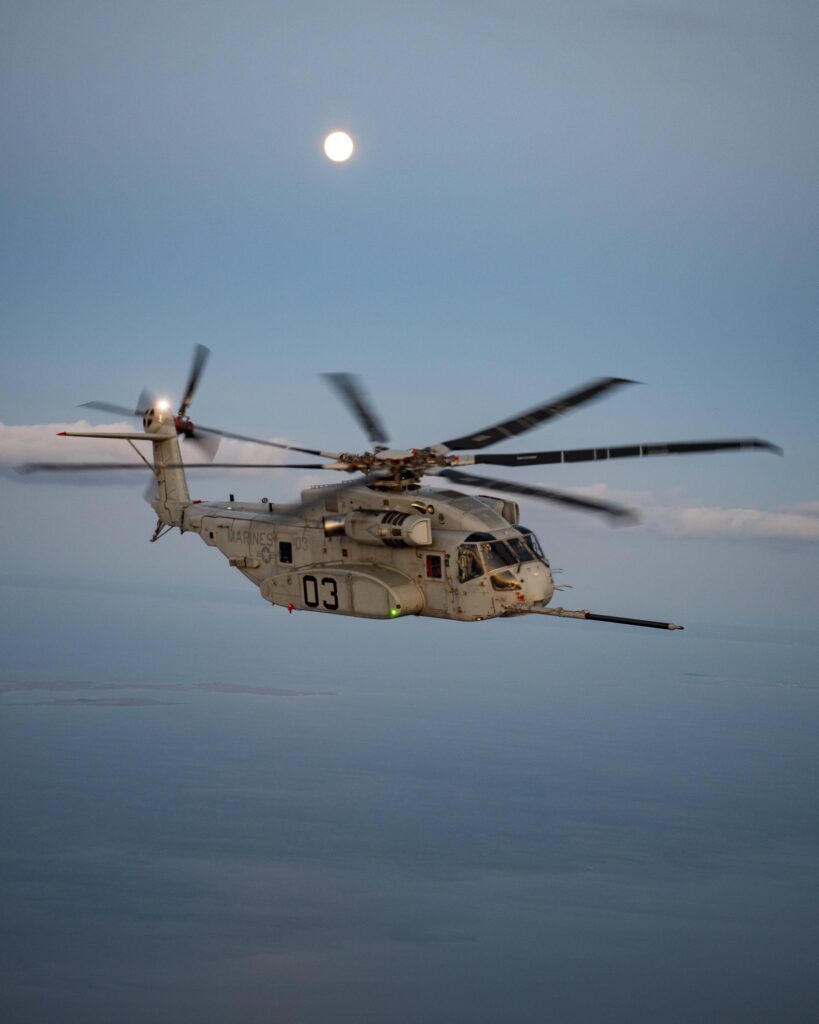
The CH-53K King Stallion. LOCKHEED MARTIN SIKORSKY

NATIONAL HARBOR, Md. — The Marine Corps expects the CH-53K King Stallion heavy-lift helicopter to reach initial operational capability “in several months,” the Navy program manager said. 

Marine Col. Jack Perrin, the program manager, said that the first fleet CH-53K squadron, HMH-461, will have four CH-53Ks by the end of April, the minimum number needed to reach IOC and the number needed for a detachment to deploy with a Marine Expeditionary Unit. 

The first deployment of the CH-53K is set for 2024. The Corps plans to field 5.25 fleet HMH squadrons with CH-53Ks. Perrin said the “.25” is an extra four aircraft for one of the squadrons, with each of the other four squadrons to be equipped with 16 helicopters. Other CH-53Ks will be assigned to a fleet replacement squadron and test squadrons, while others will be in process through the maintenance pipeline. 

The Marine Corps’ eight HMH squadrons equipped with the older CH-53E in recent years have operated with only 12 helicopters instead of 16 because of attrition over the years. Three of these squadrons will be de-activated in the course of the commandant’s Force Design 2030 plan. 

The Marine Corps has a requirement for 200 CH-53Ks. Full-rate production is planned for 2023. Full operational capability is scheduled for 2029. 

In addition to the two low-rate initial production CH-53Ks delivered in October and February, there are seven in the Lockheed Martin Sikorsky production line in Stratford, Connecticut. Currently 46 aircraft ae under contract, including four for Israel. Long-lead materials are on order for another 14 CH-53Ks. Deliveries in 2022 will total four, followed by eight in 2023 and 16 in 2024. The production rate will reach two per month for the Marine Corps, plus one per month for foreign customers as needed. 

Israel is the only foreign customer for the King Stallion so far. Potential customers include Germany, the Republic of Korea, and Switzerland, plus others who have expressed interest. Germany plans to run a competition that is expected to occur in 2022. 

Perrin, who has flown more than 30 different types of aircraft, said the CH-53K, with its digital flight controls, is the easiest aircraft to fly in his experience. The stability afforded by the flight controls enables the CH-53K to easily land in a degraded visual environment such as dust cloud. It also makes aerial refueling more stable and reduces swaying of an external load. 


DoD Addresses Supply Chain Woes Both Pre- and Post-Pandemic

Karen Fenstermacher, with Naval Supply Systems Command, talks during the Supply Chain Risk Roundtable. SOLARES PHOTOGRAPHY

NATIONAL HARBOR, Md. — The COVID pandemic has spiked consumer interest in supply chain issues. But for the Department of Defense, supply chain problems have existed for decades, said panelists during the Supply Chain Risk Roundtable held April 5 at Sea-Air-Space.

Chris Espenshade, director of small business for Naval Supply Systems Command, kicked off the roundtable discussion with an examination of the issues affecting global supply-chain resiliency. Everything from big data analytics to port closures and border delays impact the supply chain, he said. Specifically, lack of depth and competition among suppliers is hampering cost and quality.  

“For example, today, 90% of our missiles come from only three sources,” Espenshade said.

Shortages in energy, labor and raw materials are key drivers of supply-chain disruption. In particular, Espenshade said, environmental issues, climate change and natural disasters, global health and pandemic response, social unrest, trade and tariff policies, and political unrest and terrorism have resulted in increased cost and price inflation.

As a result of President Biden’s February Executive Order 14017 on America’s Supply Chains, the Department of Defense is actively building a deeper understanding of its supply chains and industrial base capabilities, with a holistic approach to resilience, Espenshade said. 

But there are two key issues, said Kurt Wendelken, vice commander for NAVSUP.

“There are a limited number of suppliers, and we’re fighting obsolescence on a daily basis,” he said. “Both of these need to inform how we think about procurement and if cost is the right solution.” 

Both Wendelken and Karen Fenstermacher, executive for strategic initiatives for NAVSUP, emphasized the “one Navy” concept when communicating with suppliers.

“The Navy is really 19 navies. We have very well-carved stovepipes in the Navy. But we want to have a single Navy voice to industry on the key challenges we’re facing and our strategies to work together,” Fenstermacher said.

This includes creating a conversation during the acquisition process about how the Department of Defense is going to sustain the systems it’s purchasing. “The acquisition policy is tremendously complex and voluminous,” Fenstermacher said. “One thing that’s exciting is the low-cost framework we’ve established.”

From an industry standpoint, supply chain has traditionally been thought of as a back-office function, but now has come to the forefront. “I see that both as a challenge and a great opportunity,” said Clark Dumont, senior director of global procurement for BAE Systems.

Panelists also emphasized the importance of including small businesses in the supply chain.

“We’re open for business; the money is there,” said Jimmy Smith, director of the Department of the Navy Office of Small Business Programs. He noted that last year, the Department of Defense spent $17.1 billion on small-business programs.

In particular, Smith mentioned the DoD’s Mentor-Protégé Program, a partnership between large and small manufacturing businesses.

“The government will give a large partner up to $3 million to help a small business partner, but in many cases I can’t find partners from industry to do this,” Smith said. “I encourage you to step forward and take this opportunity.”


Panelists: Tackling Challenges, Building Trust Will Proliferate Unmanned Capabilities

Vice Adm. Scott Conn (middle) discusses issues during the Unmanned Advancements in Warfighting session. SOLARES PHOTOGRAPHY

NATIONAL HARBOR, Md. — As unmanned systems continue to proliferate on the battlefield, understanding of their value has increased accordingly. They are force multipliers and perform dangerous missions that otherwise would place human operators in harm’s way. Their capabilities are increasing exponentially it would seem, as new technologies emerge and are incorporated into the inventory.

But these impressive tools come with a new set of challenges as well, which a panel of uniformed and industry experts addressed during a April 5 discussion at Sea-Air-Space 2022.

“Risks involve things like communications, logistics, training and infrastructure,” said Dr. Andrew Mara, the moderator, vice president for Federally Funded Research and Development Centers at the Center for Naval Analysis. 

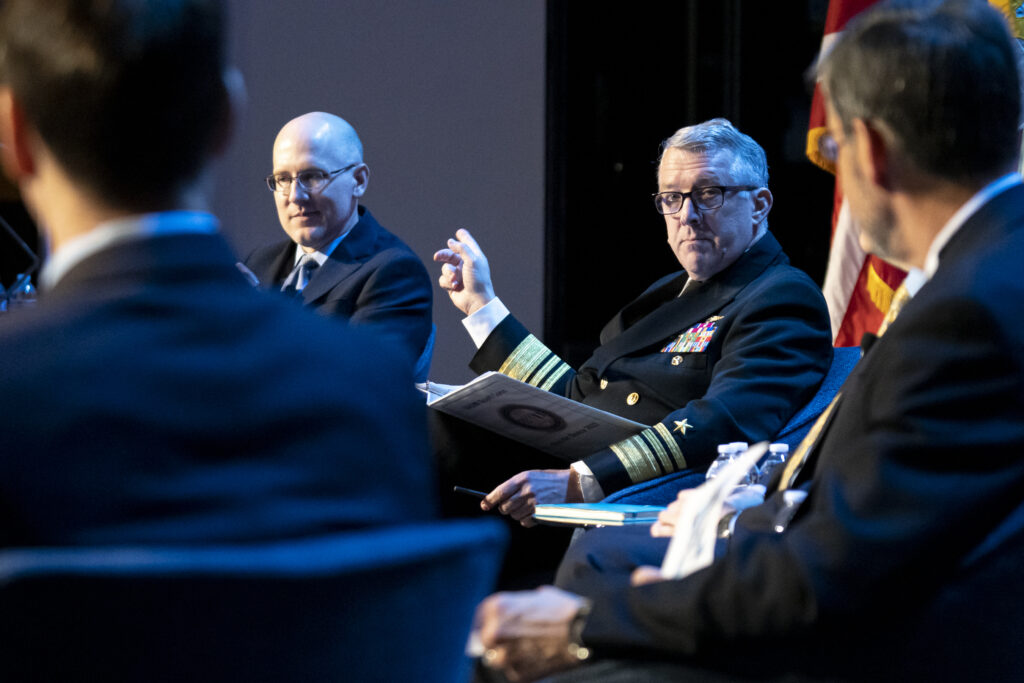
Vice Adm. Scott Conn, the Deputy Chief of Naval Operations for Warfighting Requirements and Capabilities, outlined the ongoing work of the service’s unmanned task force. Their job, he said, is to find ways to solve key operations problems across all domains. 

“I’m a firm believer [that] some really clear, innovative solutions are going to come from the fleet,” Conn said. “Give them the tools. Let them learn. Let them provide us in the Pentagon and industry with feedback.”

As he described the ongoing work with unmanned undersea vehicles, gliders, surface vessels and other platforms, DARPA’s Dr. Kenneth Plaks emphasized the importance of having human operators trust their robotic assistants.

“I can see a future where it’s a human on the loop that says, ‘OK, go take care of that threat and let me know when it’s done,’ and it just does it.”

Plaks also mentioned the emergence of swarms of as many as 1,000 robotic vehicles and how managing them would require critical human command and control.

“We can accelerate unmanned in all domains,” said Dave Johnson, vice president of strategy at L3Harris, alluding to several projects in the works that would conduct live fire, counter-mine and other systems.

“There is a real progression of unmanned capability,” Johnson said.

It is important to keep in mind the missions that can be enhanced when developing unmanned platforms, said Jeffrey Hoyle, vice president of maritime systems at Elbit Systems of America. 

“We need to continue to build trust, putting weapons on unmanned surface vehicles to do the types of things that platforms can do under guidance,” Johnson said. “The way to do that is to continue with this campaign of prototyping and experimentation. Extending reach, increasing lethality and enhancing the survivability of our people and existing platforms are the things we’re focused on.”