Service Chiefs: ‘Keep Your Eye on China’
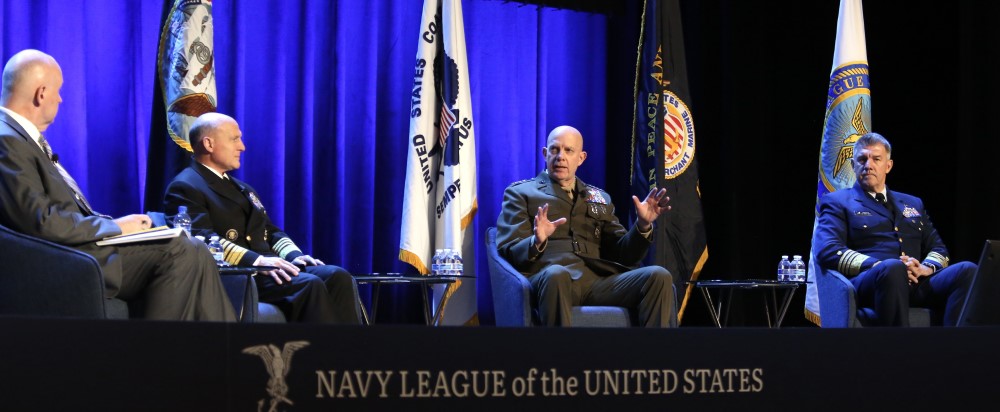
All three service chiefs discussed the newly released defense budget, which Marine Corps Commandant Gen. David Berger described as “strategy-driven.” LISA NIPP

NATIONAL HARBOR, Md. — The top leaders of the Navy and Marine Corps sought to justify their force structure decisions, arguing April 4 that it was necessary to cut some current platforms and systems to be able to buy the capabilities they believe will be needed for a likely future fight against a new peer competitor.

“I think the three of us are saying, keep your eye on China,” said Chief of Naval Operations Adm. Michael Gilday, which was echoed by Marine Corps Commandant Gen. David Berger and Coast Guard Commandant Adm. Karl Schultz in the opening session of the Navy League’s 2022 Sea-Air-Space exposition.

All three of the maritime leaders highlighted their priorities in the newly released 2023 defense budget, which Berger noted was released within days of the new National Defense Strategy and the Nuclear Posture Review.

“It’s very clear to me this is a strategy-driven budget,” Berger said. “If we need to fight in the South China Sea, the force has to be relevant.”

“In order to understand how you resource the fleet, you have to think about how you plan to use the fleet, how you will fight the fleet,” Gilday said, adding that that was done “in the content of strategy.”            

The new Navy budget proposes deeper cuts in the surface fleet than previous proposals, and the Marine Corps’ funding plan continues the reductions and changes in the Corps’ forces to make it lighter and more mobile to operate in a contested littoral environment.

Gilday said the Navy needs “a more ready force rather than a less ready larger force. If you look at the budget, we’re trying to buy back a ready force,” that has ammunition in its magazines with a priority on longer range weapons.

“I personally think we are on the right path.,” he said, while acknowledging that the budget “is not popular with many in the fleet and in this room.”

If you are going to match the change in the character of warfare, Berger said, “you have to divest some resources.”
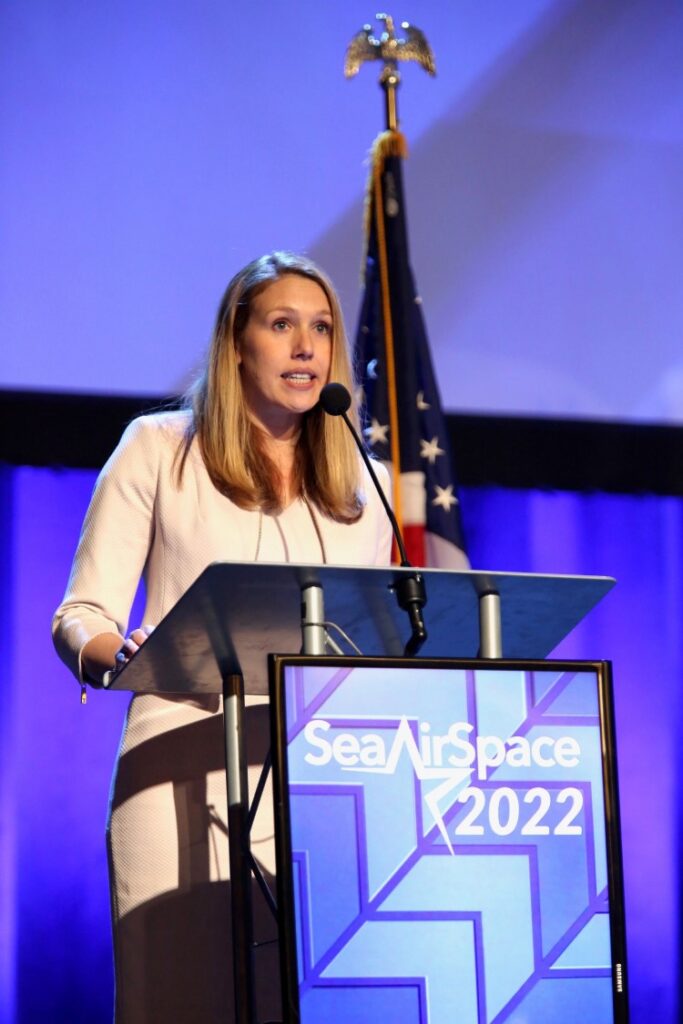
Meredith Berger, performing the duties of Undersecretary of the Navy, kicked off the opening ceremony prior to the chiefs panel on Monday. She said the Navy’s priorities “are empowering our people” with a focus on warfighting and “strengthening our maritime power.” She noted the areas the Department of Navy is operating in are changing to include the information environment and cyberspace. LISA NIPP

Schultz noted the recent signing by all three of the maritime leaders of a new maritime security strategy, which continues the growing integration of his service with the Navy and Marine Corps in the efforts to counter a stronger and more aggressive China.

Schultz said the changing national security and global economic growth has put unprecedented demands on the Coast Guard.

He emphasized the Coast Guard’s uncommonly strong shipbuilding program, which includes finishing the National Security Cutter fleet, buying more of its Offshore Security Cutters and planning a new ice breaker.

Gilday said the long-term shipbuilding program would produce increased capabilities in the surface and undersea fleets with the new models of the Arleigh Burke destroyers and Virginia-class attack submarines, the future guided missile frigates and a wide variety of unmanned surface and subsurface systems.
Collins Aerospace Awarded Risk Reduction Contract for Navy’s E-XX Program    

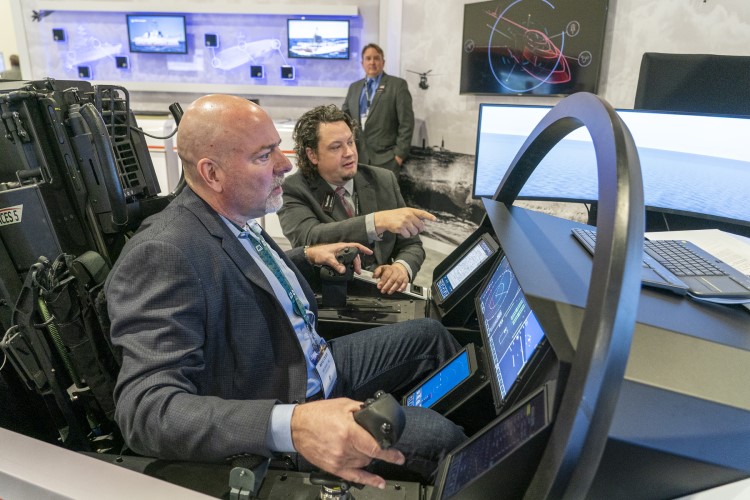
Mark Cejer sits at the controls of a flight simulator as Tracy Miller of Collins Aerospace gives him instructions. The simulator showcases Collins Aerospace’s avionics. SOLARES PHOTOGRAPHY

NATIONAL HARBOR, Md. — Collins Aerospace (Booth 701) has been awarded development of a very-low-frequency communication system for the E-6B Recapitalization Program (E-XX) as part of the Navy’s Take Charge and Move Out Weapons System, the company said April 4. 

The contract provides developmental design and risk reduction engineering efforts for airborne VLF system modernization in support of Airborne Strategic Command, Control, and Communications Program Office (PMA-271) capability requirements. The development efforts and resulting system features enhanced security measures to address advanced and emerging threats.

This award is the first award of a series for the new E-XX test program. The open systems approach ensures that the terminal and remaining portions of the weapons systems can be easily integrated on the platform. Additionally, the new systems are easier to maintain and upgrade over the life of the aircraft making it a potential long-term solution for the Navy.

“This sole-source award underscores the recognized technical expertise that Collins brings to the TACAMO community,” said Heather Robertson, vice president and general manager of Integrated Solutions for Collins Aerospace. “As we are seeing the accelerated need for command, control and communication capabilities, our DoD partners can rely on Collins to deliver ready-now, comprehensive, integrated and durable solutions.”    

The work will be completed at Collins’ Richardson, Texas, and Cedar Rapids, Iowa, facilities.


Admiral on EMALS and AAG Programs: ‘It Works’

Chief Aviation Boatswain’s Mate (Equipment) Louis Mountain Jr., from Seat Pleasant, Maryland, assigned to USS Gerald R. Ford’s (CVN 78) air department, signals the EMALS to launch during no load testing on the ship’s flight deck. U.S. NAVY / Mass Communication Specialist 3rd Class Zachary Melvin

A Navy admiral says that despite reports to the contrary, the Electromagnetic Aircraft Launch System and Advanced Arresting Gear systems aboard the USS Gerald R. Ford (CVN-78) are working just fine.

Rear Adm. Shane G. Gahagan, program executive officer for tactical aircraft programs (PEO-T) at Naval Air Systems Command, said Monday, April 4 at Sea-Air-Space that the system had achieved 8,500 “cats and traps” on the Ford over the past two years.

The EMALS system has struggled with reliability issues over the years, but Gahagan insisted that it is performing well today.

“It works,” Gahagan said. “I read in the press … that it doesn’t work. It works day in and day out with cats and traps, and now it’s like every other program: How are we going to sustain it for the fight we need?”

He said the EMALS and AAG systems have a “lot of great capability” and that Sailors “love it.”


Bell Offers Manned, Unmanned Tiltrotors for Navy’s Next Rotorcraft 

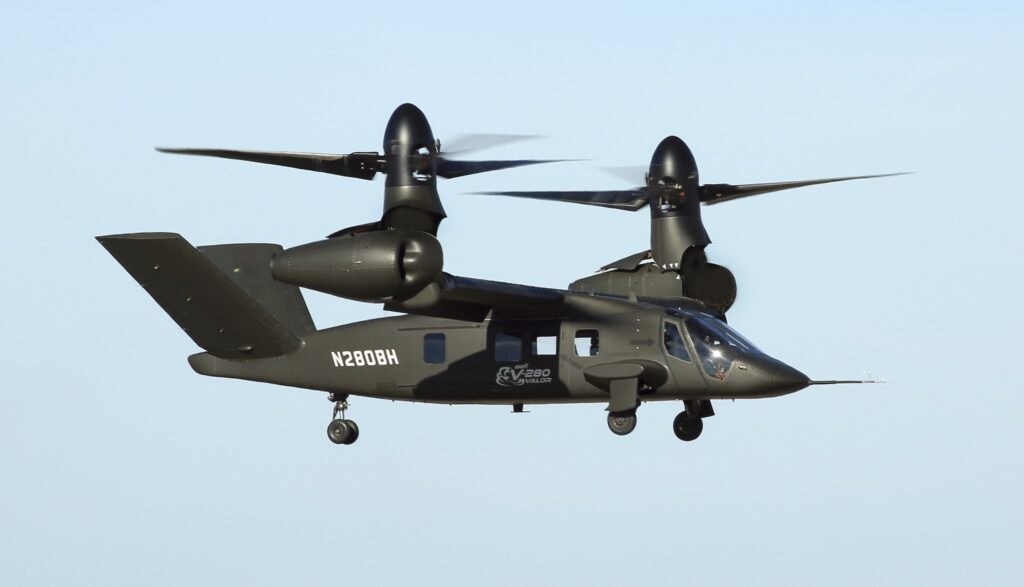
The Bell 280 Valor is currently offered as a replacement for the U.S. Army’s H-60 helicopters, and Bell proposes they would be an ideal component of the Navy’s DMO concept. Bell

NATIONAL HARBOR, Md. — Bell, a Textron company, is marketing its manned and unmanned tiltrotor aircraft to be the eventual replacements for the Navy’s MH-60R/S helicopters. 

Carl Forsling, Bell’s senior manager for military sales and strategy, told Seapower April 4 at the Navy League’s Sea-Air Space expo that the Bell tiltrotors would be ideal for implementation of the Navy’s Distributed Maritime Operations concept because of their speed, range and payload. 

The two tiltrotors are the versions of the unmanned Bell 247 Vigilant and the manned Bell 280 Valor.  

The Valor, currently offered as a replacement for the U.S. Army’s H-60 helicopters, is larger than the 247 and is designed to carry 8-12 passengers. It has two engines, one each at the wingtips driving a tiltrotor. Unlike those on the Bell-Boeing V-22 Osprey, the engines do not pivot, simplifying the mechanics of the movement and reducing cost. The marinized Valor would have a pivoting wing like the V-22 for storage in a ship’s hangar. The aircraft would be hardened for electromagnetic protection and be marinized for corrosion control in the salt-water environment. It would assume the roles of the MH-60S, including plane guard, rescue, medical evacuation and logistics. 

The marinized unmanned Vigilant would replace the MH-60Rs on surface warships such as guided-missile destroyers. The folding rotors and pivoting wing would allow storage in a warships’ small helicopter hangars. The Vigilant could be used for roles including surveillance, antisubmarine warfare, precision strike and aerial refueling. 

With both aircraft replacing helicopters, the speed and range advantage would allow the tiltrotors to cover more area at a faster rate, Forsling said, while carrying heavier payloads.   


Navy’s CVM-22B Aircraft Adds Medevac Speed to Carrier Strike Group 

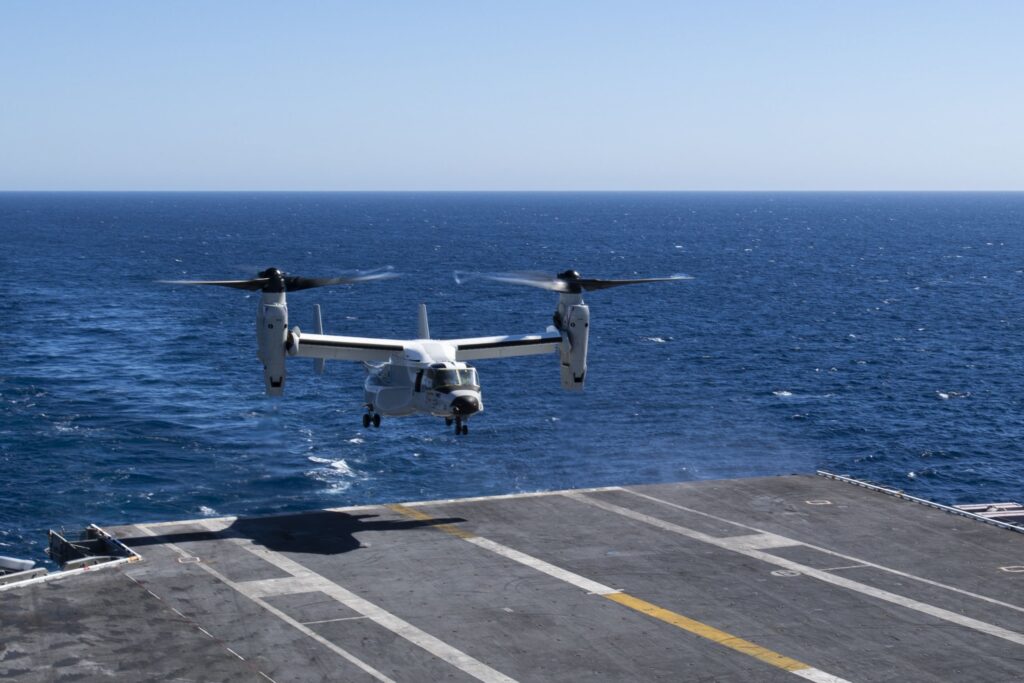
A CVM-22B Osprey, from the “Sunhawks” of fleet logistics multi-mission squadron (VRM) 50, lands on the flight deck of the aircraft carrier USS Nimitz (CVN 68). At a Sea-Air-Space briefing, the V-22 program manager discussed the aircraft’s usefulness as a medevac solution. U.S. Navy / Mass Communications Specialist 3rd Class Joseph Calabrese

NATIONAL HARBOR, Md. — The U.S. Navy’s new CMV-22B Osprey tiltrotor carrier-onboard delivery aircraft’s capabilities have been a game-changer for medical evacuation from a carrier strike group, the Navy’s V-22 program official said. 

The CMV-22B, which is replacing the catapult-launched C-2A Greyhound COD aircraft in the fleet, takes off and lands vertically. It is less dependent on carrier launch-and-recover cycles and, therefore, more flexible in its ability to quickly launch from the aircraft carrier and carry a medical patient to facilities ashore. 

In addition to quicker launch capability, the range of the CMV-22B — which can be refueled in flight—give it an added ability to reach land-based medical facilities from farther out. 

Marine Col. Brian Taylor, the Navy’s V-22 program manager, speaking April 4 to reporters at a Naval Air Systems Command (Booth 947) briefing the Navy League’s Sea-Air Space expo at National Harbor, Maryland, spoke of a medevac from the one of the two CMV-22B detachments from that have deployed on aircraft carriers to the Indo-Pacific region so far from Fleet Logistics Multimission Squadron 30 (VRM-30). A CVM-22B launched from the carrier with a medevac patient and was able to land in a helicopter landing pad at the naval hospital in Camp Foster, Okinawa, a feat that the C-2A would not have been able to accomplish. 

Taylor MV-22B integrated well with carrier operations. He also said the Marine Corps’ MV-22B Osprey has qualified to operate from the hospital ship USNS Mercy. 

The Osprey is operated by the U.S. Marine Corps, Air Force, and Navy and by the Japanese Self-Defense Force. 

Taylor said the Osprey is expected to be in service through 2055. It reached initial operational capability in 2007. Under current contracts, production is expected to end in late 2024. The program office is focusing on sustainment and keeping the flow of parts and other resources necessary to keep the Osprey fleet operational through its service life. 

Last year the Marine Corps deactivated one MV-22B squadron — VMM-166 — as part of Commandant Gen. David Berger’s Force Design 2030 initiatives. Faced with the possibility of excess MV-22Bs in inventory, Taylor said his office is looking at inventory management of the fleet to develop a long-term plan, with an option that some Ospreys may be placed in storage, available as attrition aircraft. 


CMS Outlook: What’s in a Name? Understanding the Indo-Pacific and Its Challenges for the U.S.

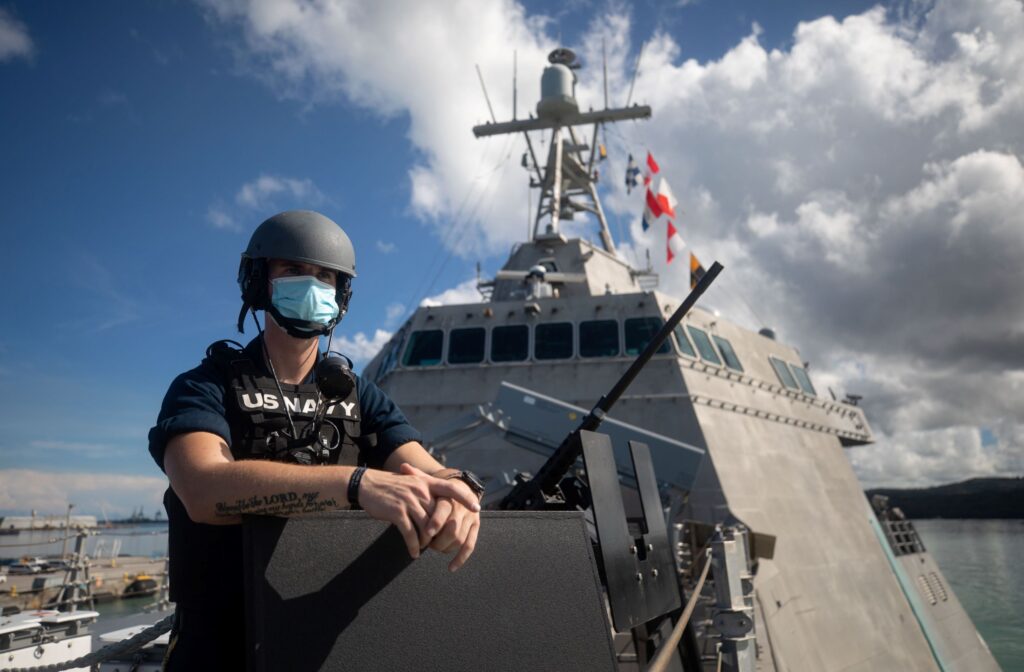
Mineman 2nd Class Jeffrey Langston stands security watch during sea-and-anchor aboard the Independence-class littoral combat ship USS Tulsa (LCS 16). Tulsa, part of Destroyer Squadron Seven, is on a rotational deployment, operating in the U.S. 7th Fleet area of operations to enhance interoperability with partners and serve as a ready-response force in support of a free and open Indo-Pacific region. U.S. NAVY / Mass Communication Specialist 1st Class Devin M. Langer

NATIONAL HARBOR — We have often seen the rise and fall of new terminology to express renewed, or sometimes diminished, value placed upon different regions of the globe as the geography of national interests waxes and wanes. Until recently, the geographical expression that dominated foreign and national security policy documents of the United States in the Pacific region was “Asia-Pacific.” This term, however, is increasingly giving way to “Indo-Pacific” in national security policy documents and discourse, as can be seen in the Sea-Air-Space Show Guide and Directory.

What is prompting this evolution in geospatial conception? In large part, the shift to Indo-Pacific has been driven by two key factors: an observed increase in China’s interests in the Indian Ocean region and the increasing commercial, cultural, political, and security interconnections between the Indian and Pacific Ocean communities. The symbolic change to recognizing the Indo-Pacific as the now-dominant strategic region in the areas adjoining eastern Asia began with the Obama administration’s late 2011 “Pacific Pivot,” and continued with the Trump administration’s 2017 concept, the “Free and Open Indo-Pacific.” A year later, U.S. Pacific Command was renamed as the Indo-Pacific Command. Now, the Biden administration has published its own “Indo-Pacific Strategy of the United States,” with remarkable similarities to the strategies of the previous administrations.

It’s worth considering though, what does the “Indo-Pacific” entail? Geographical concepts are inevitably contestable, as their construction is tailored to suit the purposes of the name-giver. In its most expansive interpretation, the Indo-Pacific can be thought of as the world’s largest region, spanning the distance from Russia’s Siberian coastal frontier and the beaches of California to the shores of South Africa and Oman. The broadly defined Indo-Pacific covers roughly half of the Earth’s surface and more than half its population. It is home to the world’s largest economies — the United States, China, Japan — and its smallest – Palau, Nauru, Tuvalu. The world’s two largest countries by population, India and China, and some of the smallest also reside within the scope of the Indo-Pacific.

What this vast expanse of sea and land holds for the United States is the largest and perhaps most dynamic international environment where American companies and military units operate. While the United States is undoubtedly a Pacific power, its ability to access the epicenter of Pacific activity in East and Southeast Asia is severely constrained by the nature of the same expansive geography. The continental United States is some 6,600 miles removed from Taiwan, 6,200 miles from Okinawa, 6,000 miles from Guam, 5,800 miles from South Korea and 5,300 miles from the main islands of Japan. The realities of these distances between the United States and its major Pacific allies, outposts, and partners are seldom considered, let alone understood. That a voyage by ship from San Francisco to the American military base at Okinawa may take anywhere from six to more than 14 days is a major complicating factor in the ability of the United States to fulfill its commitments to Pacific allies and partners.

The physical separation of the United States from its many allies and partners in the Western Pacific serves as the foundation for the forward positioning of major military assets. Indeed, the military, joint INDOPACOM command oversees roughly 375,000 military and civilian personnel across its area of responsibility. The primary naval means of maneuvering personnel and material as well as projecting power across the vast seascape of the region, the U.S. 7th Fleet, must operate with between just 50 and 70 vessels to manage almost 50 million square miles of sea, the largest area of responsibility of any forward-stationed American fleet. The strain on the fleet is compounded when one considers the need to counter the rapid and continuing expansion of the People’s Liberation Army Navy, coast guard and maritime militia.

The result has been a continuing fixation of American regional assets on the Western Pacific despite Washington’s ostensible recognition of the Indo-Pacific as a region of much greater scope in its official policy documents. Perhaps the most promising solution is the revival of the 1st Fleet, a concept most recently suggested by former Navy Secretary Ken Braithwaite to be based in both Singapore and Darwin, Australia. This new formation would take over the area of responsibility in the Indian Ocean and Southeast Asia from the 7th Fleet, thereby alleviating its divided attention between China and the Indian Ocean region — a region of growing interest but where little force structure or action has thus far been applied. Even if the 1st Fleet is returned to service, the massive mandate of American forces in the Indo-Pacific necessitates greater presence and mobility that can only be provided by more naval platforms. If the “Indo” of Indo-Pacific is to be anything more than a genuflection towards the Indian Ocean’s existence, the Navy needs to be empowered to maintain a credible presence in the West Pacific as well as the Indian Ocean.

The Center for Maritime Strategy, housed inside the Navy League of the United States, conducts and supports policy research and advocacy efforts across a broad spectrum of issues that impact the United States’ position as a maritime nation. CMS is hosting a ticketed breakfast at Sea-Air-Space 2022 on Tuesday, April 5.


Navy’s Flight I/II DDGs Get UAS Capability with Textron’s Aerosonde 

The Aerosonde UAS has been deployed on a Navy Arleigh Burke-class guided missile destroyer in the 7th Fleet. TEXTRON SYSTEMS

ARLINGTON, Va. — The Aerosonde unmanned aerial system has been deployed on a U.S. Navy Arleigh Burke-class guided-missile destroyer serving in the U.S. 7th Fleet, giving the Flight I/II DDG — which does not have the organic helicopter facilities of the Flight IIA and subsequent versions of the DDG — an organic aerial surveillance capability. 

Wayne Prender, Textron Systems’ vice president for Air Systems, told Seapower March 31 the DDG — which he was not at liberty to name — deployed with an Aerosonde system on board in March. The system is being operated under a contractor-owned/contractor-operated arrangement. 

Prender said a second DDG would deploy with an Aerosonde system later this year. He also said that for three years an Aerosonde system has been operational on board the Lewis B. Puller-class expeditionary sea base ship USS Hershel “Woody” Williams in support of the U.S. 2nd Fleet. 

Prender said the deployments are “helping to set the calculus for real-world operations.” 

The Aerosonde can carry a variety of sensors including an electro-optical camera, an Automatic Information System receiver, and other special payloads. The UAS can perform wide-area search, expanding the search horizon of the host ship. The system is fully integrated into the ship’s combat information center.  

The UAS uses less fuel — about one pound per hour — than an MH-60 helicopter, which burns about 1,000 pounds per hour. The Aerosonde uses heavy fuel, the same fuel used by the ship’s turbines, so no provision for a different fuel is needed. 

An Aerosonde can be operated by a team of three contractor personnel. The fixed-wing version can be launched and recovered in Sea State 4 and is recovered by a net rigged on the host ship. A vertical takeoff and landing version, which carries a lighter payload but can be launched more quickly, will be deployed on a ship later this year.     


President, First Lady Celebrate Commissioning of USS Delaware  

President Joe Biden and First Lady Jill Biden, the ship sponsor, celebrated the commissioning of the Virginia-class fast attack submarine USS Delaware (SSN 791) Saturday, April 2. U.S. NAVY

WILMINGTON, Delaware — President Joe Biden and First Lady Jill Biden, the ship sponsor, celebrated the commissioning of the Virginia-class fast attack submarine USS Delaware (SSN 791) Saturday, April 2, in a ceremony in Wilmington, Delaware. 

Biden previously represented the state of Delaware for 36 years in the U.S. Senate. 
 
Due to COVID restrictions in place at the time, there was no traditional commissioning ceremony held when USS Delaware was commissioned administratively on April 4, 2020. On that day, the submarine was underway and became the first U.S. Navy ship commissioned while submerged. 
 
Saturday’s ceremony followed the script of a traditional commissioning and was held in commemoration of the milestone. 
 
“This latest Navy ship to carry the Delaware name is part of a long tradition of serving our nation proudly and strengthening our nation’s security,” Biden said. “Not just us, but our allies and partners around the world as well.” 
 
As the ship sponsor, Jill Biden performed the traditional honor of calling for the crew to man the ship and “bring her to life,” a ceremonial procession following the commemorative setting of the first watch. 
 
“This vessel will always uphold the First State’s motto of ‘Liberty and Independence,’” she said. “It’s difficult to put into words what it means to be a part of the USS Delaware family. It’s an incredible honor that I take seriously. I’ve seen the heart of this crew and it makes me proud and humbled to be your shipmate for life.” 
 
USS Delaware is the 18th Virginia-class submarine built, as well as the eighth and final Block III Virginia-class sub. The Block III submarines are notable for replacing 12 vertical launch tubes for Tomahawk Land Attack Missiles with two larger, 87-inch diameter launch tubes, capable of carrying larger payloads, among other advancements. 
 
“The men who serve — and will serve — aboard the USS Delaware will bear our state’s name for decades to come as they defend our nation,” said U.S. Sen. Tom Carper of Delaware, the event’s keynote speaker. “Through their sacrifice and service, may we grow even closer to that more perfect union.” 
 
USS Delaware is homeported at Submarine Base New London in Groton, Connecticut, where it operates under Submarine Squadron 12 and its Commodore, Capt. Matthew Boland. 
 
The submarine is the seventh U.S. Navy ship to be named for the First State, but first in more than a century. The first ship to be named Delaware was a 24-gun frigate launched in July of 1776, the month the Continental Congress adopted the Declaration of Independence. 


Kid-Friendly Expo Showcases STEM to Kick Off Sea-Air-Space 2022

(Left to right) Trisha Anand, 8, and Mary Bodoh, 9, enjoy playing with bubbles after a science experiment at STEM Expo 2022. SOLARES PHOTOGRAPHY

The 2022 STEM Expo, which kicked off Sea-Air-Space 2022 April 3, marked the largest crowd yet for the science- and fun-focused event, geared to students in the fifth to 12th grades.

The popular expo featured hands-on “mad science” demonstrations with dry ice, electricity, chemical reactions, robots, military animals and more, including nearly two dozen exhibits.

A performance by the U.S. Coast Guard Drill Team led the event, which also included a large and very popular version of the game Battleship; a nitrogen ice cream station, an edible version of some of the mad science experiments; and a unique building event with Tinker Man, who builds large, complex structures from children’s toys.

“It is great to see so much attention at the booth,” said Heather Deagle, a member of HII’s STEM team. “These kids are the future. It is their talent and contributions that will have an impact on shaping future technologies — and being part of this STEM event is a great opportunity to display our commitment to the education of these future generations.”

The expo encourages students to pursue coursework and careers in STEM and reaches underserved communities to promote STEM education.

The “champion” sponsor for the event was HII, whose booth included everything from a 3D printer to a REMUS unmanned underwater vehicle. Sponsors included CACI, L3Harris, Raytheon Technologies and Lockheed Martin.

Through the years, HII has made numerous investments in STEM education programs; partnerships with local high schools, community colleges and technical schools to develop trade-based curriculum; summer internships for both students and teachers; and industry-leading apprentice schools at the company’s two shipyards.


Free Service Helps Vets Launch Civilian Careers

Don Fried, a Marine Corps veteran who now serves as director of branding and marketing for VetJobs, says the service has surpassed 75,000 verified job placements, and currently have more than 3 million job listings. VetJobs

In 2004, Deb Kloeppel left her executive job at American Airlines to make an overseas permanent change of station with her husband, U.S. Navy Rear Adm. Dan Kloeppel. She hoped to further her career in her new location but discovered the opportunities were virtually nonexistent.

Kloeppel realized she wasn’t alone. She met other highly trained and educated military spouses  who also had to choose between their careers or their devotion to family and country. So, with a $323 investment, she started the Military Spouse Corporate Career Network, or MSCCN, to help support people like her. 

MSCCN was so successful that in 2010, the Kloeppels cofounded CASY: Corporate America Supports You. CASY’s goal was to provide free vocational training and job placement services for people transitioning from all military services, veterans and members of the National Guard and Reserves.

By 2019, CASY and MSCCN had helped more than 57,000 members of the military and their spouses find new civilian careers. That year, the two organizations acquired VetJobs, an online military job board, and launched MilitarySpouseJobs.org. The company is one of the resource partners featured at today’s Transition Connection job fair, being held in Cherry Blossom Ballroom from 11 a.m. to 5 p.m. This Sea-Air-Space hiring event focuses on providing job opportunities to those with a military family or defense background.

Today, VetJobs.org and MilitarySpouseJobs.org are the largest free online job training, counseling and placement resources for all members of the military and their spouses. Last year, they surpassed 75,000 verified job placements, and currently have more than 3 million job listings, says Don Fried, a Marine Corps veteran who now serves as director of branding and marketing for VetJobs.

“When I separated out in 1999, there were nowhere near the resources we have today,” he says. “I think we had a three-day TAPS [transition assistance program] class. Now, people start planning their transition six to 12 months before they leave the service.”

This is key, Fried says, because statistics show that more than 60% of former service members work at different types of jobs than they did in the military.

“It’s sometimes hard to know your interests and what to look for in a civilian job,” he says. “VetJobs can help with that.”

Any current or former member of the military or their spouses can use VetJobs’ and MilitarySpouseJobs’ online employment listings, job assessment quiz and video job training resources for free. If they register with the sites, they also have access to a free career specialist who can help them navigate a new career search. They can get a direct introduction to employers with job openings, and can also participate in mentorships with industry partners.

Fried estimates that 400 to 700 people use VetJobs every week. The organization is funded by charitable foundations, grants and sponsorship by corporations like Microsoft, Amazon, IBM, Boeing, Wells Fargo, Prudential, Deloitte and Swift Transportation. Job listings are provided by the nonprofit DirectEmployers Association.

Fried says companies like to hire service members for a variety of reasons.

“In a time when employers are having a hard time putting butts in seats, we show up. We have an air of maturity and discipline, and we’re contributors,” he says. “Employers like those types of soft skills. They can take our soft skills and then train us in the technical aspects of a job.”