NGC Begins Full-Rate Production of Link-16 for the Marine Corps H-1 Fleet 

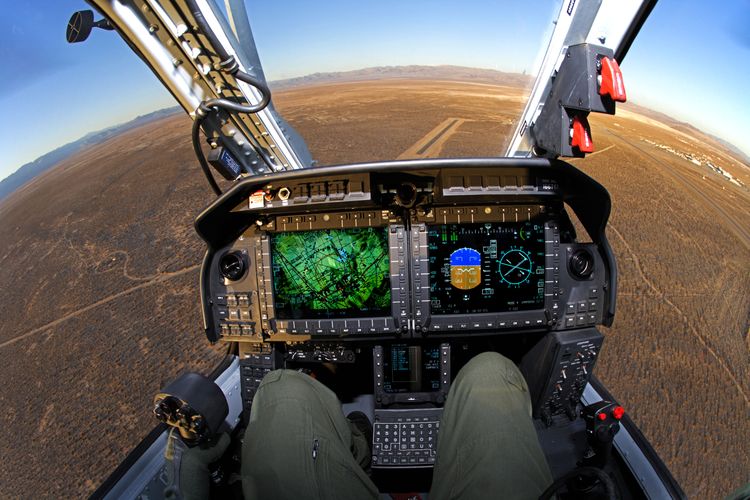
Link-16 will give the AH-1Z and UH-1Y the ability to share data and communications securely with other aircraft and users of military networks. NORTHROP GRUMMAN

WOODLAND HILLS, Calif. — Northrop Grumman has been awarded a $65 million contract by the U.S. Navy to execute the full-rate production of Link-16 for the U.S. Marine Corps AH-1Z and UH-1Y aircraft, which will involve the integration of data link hardware across the fleet, the company said March 9. 

“As lead technology integrator for H-1 Avionics, we are expanding our long-standing partnership with the Marine Corps to modernize electronic systems across the fleet through an open systems architecture approach,” said Lindsay McEwen, vice president, navigation, targeting and survivability at Northrop Grumman. “Link-16 full-rate production is the starting point.” 

Link-16 is a secure data link that allows H-1 crews to share data and communications with other aircraft and users on military networks. This capability is a critical mission enabler as the Department of Defense moves to joint all-domain command and control. 

The company said the processes, capabilities and open architecture developed for the H-1 fleet are directly applicable to other platforms and could be used in future aircraft development programs such as Naval Air Command’s Vertical Take Off and Landing Family of Systems, MUX and others. 


Russian Navy Blockades Ukraine’s Coast, Continues Missile Strikes 

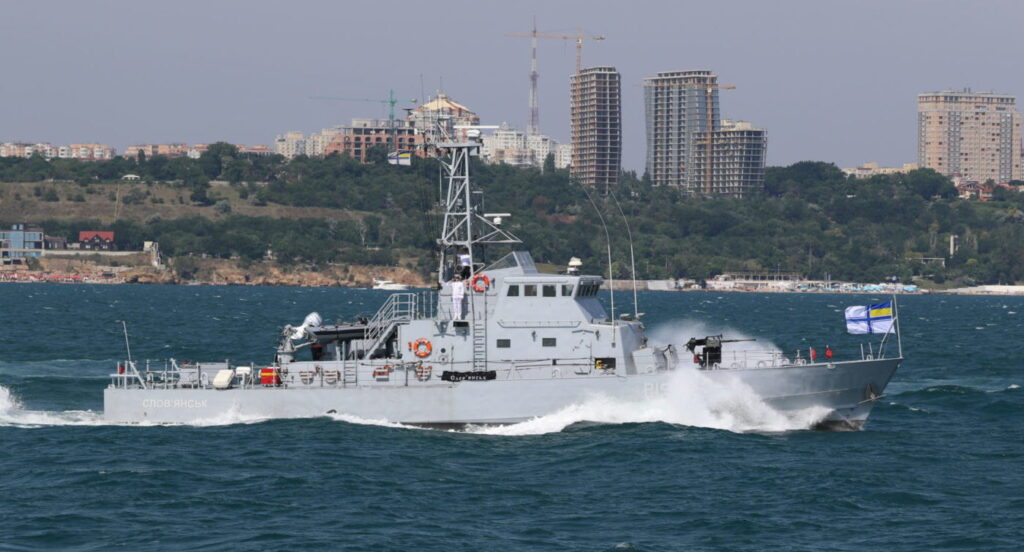
The Ukrainian Slovyansk, formerly the U.S. Coast Guard Island-class cutter Cushing, was reportedly destroyed on March 3. WIKIPEDIA

ARLINGTON, Va. — The Russian Black Sea Fleet has set up a naval blockade of Ukrainian ports along the Black Sea, a United Kingdom defense official said, and is continuing fire support of the Russian invasion of Ukraine. 

“The [U.K.] Ministry of Defence’s Defence Intelligence said Russian naval forces have established a distant blockade of Ukraine’s Black Sea coast, effectively isolating Ukraine from international maritime trade,” Air Vice-Marshal Mick Smeath, British defence attaché in Washington, said in a March 13 release.  

While the Russian navy has taken a lesser role than its army counterparts in the invasion of Ukraine, it has taken part in offensive operations and amphibious warfare. 

“Russian naval forces are also continuing to conduct missile strikes against targets throughout Ukraine,” Smeath said.  

Some Russian navy warships are equipped with Kalibr cruise missiles. 

Russian naval infantry — the equivalent of U.S. Marines — have landed ashore in Ukraine to participate in the campaign in southeastern Ukraine. 

“Russia has already conducted one amphibious landing in the Sea of Azov and could look to conduct further such operations in the coming weeks,” Smeath said. 

Ukraine’s main port on the Black Sea, Odesa, remains in Ukrainian hands.  

Press reports have said that a Ukrainian patrol boat — the Slovyansk, formerly the U.S. Coast Guard Island-class cutter Cushing — was destroyed by a Russian aircraft on March 3. 

A Russian patrol boat, the Vasily Bykov, reportedly was severely damaged and sunk on March 7 by rockets launched by a Ukrainian battery, according to press reports.  

Some of the Russian ships in the region entered the Black Sea after a transit from Russia’s Baltic Sea and Northern Fleet. These included several amphibious warfare ships and missile-armed surface warships.  


Future Attack Submarine USS Montana delivered to U.S. Navy 

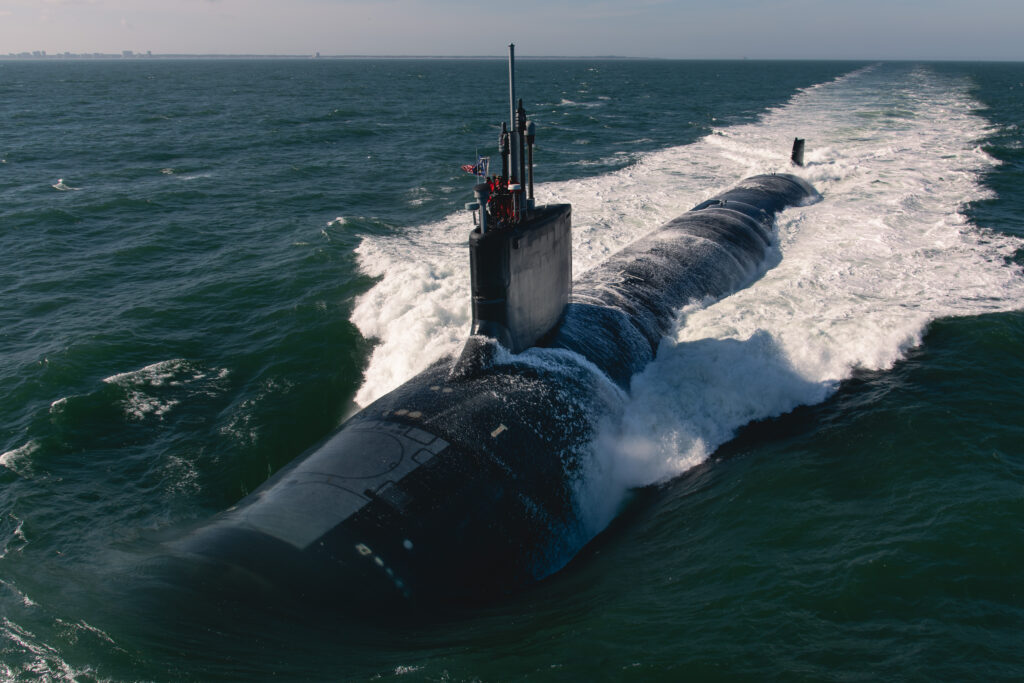
The future USS Montana was delivered to the Navy on March 12. HUNTINGTON INGALLS INDUSTRIES / Ashley Cowan

NEWPORT NEWS, Va. — The Submarine Force’s newest attack submarine, the future USS Montana (SSN 794), delivered to the U.S. Navy on March 12, Team Submarines Public Affairs said March 14.

PCU Montana is the 21st Virginia Class submarine co-produced by General Dynamics Electric Boat and Huntington Ingalls Industries’ Newport News Shipbuilding through a long-standing teaming agreement. Montana is the 10th Virginia-class delivered by the shipbuilding team and the third Block IV configured submarine. 

“The delivery of this ship reflects an enormous effort across the Navy and Industry shipbuilding teams,” said Capt. Todd Weeks, the Virginia-class program manager who rode the boat during sea trials. “This is an exciting time for the program, Montana’s crew and the Navy. This is the second Virginia-class submarine to deliver in less than a month and it is in excellent condition. Continued deliveries of attack submarines are critical to the fleet and our National Maritime Strategy.” 

Virginia-class aubmarines are built to operate in the world’s littoral and deep waters while conducting anti-submarine warfare; anti-surface ship warfare; strike warfare; special operations forces support; intelligence, surveillance and reconnaissance; irregular warfare; and mine warfare missions. Their inherent stealth, endurance, mobility and firepower directly enable them to support five of the six maritime strategy core capabilities — sea control, power projection, forward presence, maritime security, and deterrence. 

The submarine’s sponsor is Sally Jewell, former secretary of the United States Department of Interior. 

Montana is the second U.S. Navy ship to honor the state. The first USS Montana (ACR 13), an armored cruiser, was also built at Newport News Shipbuilding and commissioned July 1908. It served in the Atlantic and Mediterranean, landed Marines during unrest in Haiti in 1914 and escorted convoys during World War I. It was decommissioned in 1921. Two other battleships (BB 51 and 67) were to have been named Montana but were canceled in 1922 and 1943, respectively. 


Navy Accepts Delivery of the Future USS Fort Lauderdale 

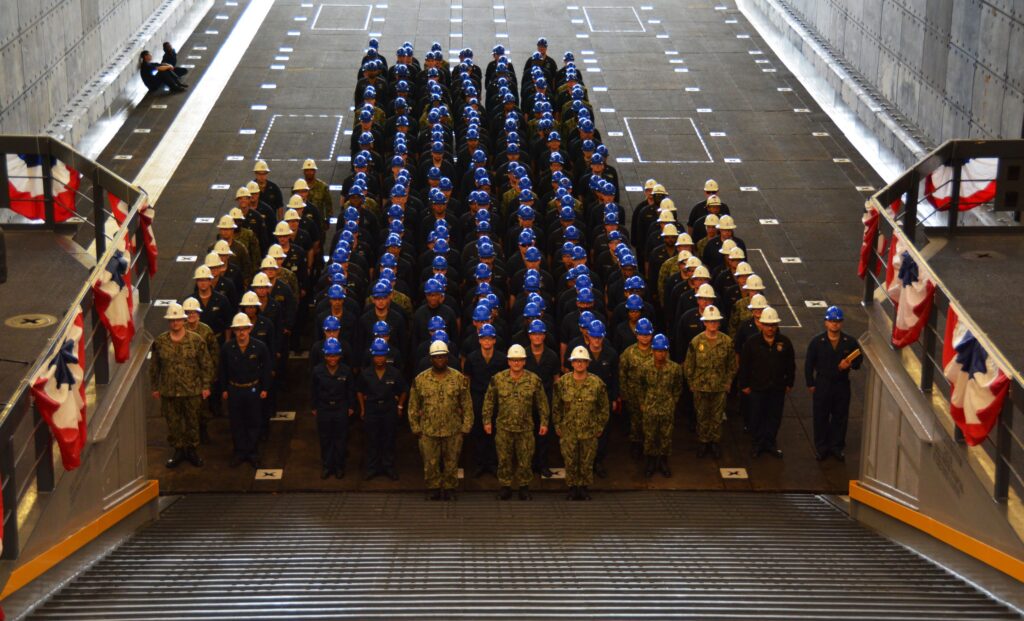
Pre-Commissioning Unit Fort Lauderdale (LPD 28) Commanding Officer Capt. James Quaresimo (front center), Command Master Chief James Magee (front left) and Acting Executive Officer Cmdr. Charles Marshall pose with the crew in the well deck after accepting delivery of the ship. U.S. NAVY / Mass Communications Specialist 2nd Class Dustin Knight

WASHINGTON — The Navy accepted delivery of the future USS Fort Lauderdale (LPD 28), the 12th San Antonio class-amphibious transport dock ship, from Huntington Ingalls Industries’ Ingalls Shipbuilding Division, March 11, Team Ships Public Affairs said March 14. 

Delivery of LPD 28 represents the official transfer of the ship from the shipbuilder to the Navy. Prior to delivery, the ship successfully conducted a series of at-sea and pier-side trials to demonstrate its material and operational readiness.  

“Following successful builder’s and acceptance trials, LPD 28 will soon be ready to join the fleet to provide critical readiness and capacity to our Sailors,” said Capt. Cedric McNeal, program manager, Amphibious Warfare Program Office, Program Executive Office Ships. “This ship will help expand our advantage in the maritime domain and brings critical capability now and in the future.” 

The San Antonio-class is designed to support embarking, transporting, and landing Marines and their equipment by conventional or air-cushioned landing craft. The ship’s capabilities are further enhanced by its flight deck and hangar, enabling the ship to operate a variety of Marine Corps helicopters and the MV-22 Osprey tilt-rotor aircraft. Because of the ships’ inherent capabilities, they are able to support a variety of amphibious assault, special operations, expeditionary warfare, or disaster relief missions, operating independently or as part of Amphibious Readiness Groups, Expeditionary Strike Groups or Joint Task Forces. 

In addition to LPD 28, HII’s Ingalls Shipbuilding Division is currently in production on the future USS Richard S. McCool (LPD 29) and the future USS Harrisburg (LPD 30), with start of fabrication for future USS Pittsburgh (LPD 31) planned for later this spring. 


Navy Announces Flag Officer Assignments 

ARLINGTON, Va. — The secretary of the Navy and chief of naval operations announced March 11 the following assignments: 

Rear Adm. Michael D. Bernacchi Jr. will be assigned as deputy commander, 10th Fleet, Fort George G. Meade, Maryland. Bernacchi is currently serving as director, Plans and Policy, J-5, U.S. Space Command, Peterson Air Force Base, Colorado. 

Rear Adm. Keith B. Davids will be assigned as commander, Naval Special Warfare Command, San Diego, California. Davids is currently serving as commander, Special Operations Command South, U.S. Southern Command, Homestead, Florida. 

Rear Adm. Leonard C. Dollaga will be assigned as chief of legislative affairs, Washington, D.C. Dollaga is currently serving as commander, Submarine Group 7; commander, Task Force 74; and commander, Task Force 54, Yokosuka, Japan. 

Rear Adm. Christopher S. Gray will be assigned as commander, Navy Region Mid-Atlantic, Norfolk, Virginia. Gray is currently serving as commander, Navy Region Europe, Africa, Central; and commander, Maritime Air Forces Naples, Naples, Italy. 

Rear Adm. Nancy S. Lacore will be assigned as commandant, Naval District Washington, Washington, D.C. Lacore is currently serving as chief of staff, U.S. Naval Forces Europe/U.S. Naval Forces Africa/6th Fleet, Naples, Italy. 

Rear Adm. Fred I. Pyle will be assigned as director, Surface Warfare Division, N96, Office of the Chief of Naval Operations, Washington, D.C. Pyle is currently serving as director, Maritime Operations, U.S. Fleet Forces Command, Norfolk, Virginia. 

Rear Adm. Michael W. Studeman will be assigned as director, National Maritime Intelligence Integration Office; and commander, Office of Naval Intelligence, Washington, D.C. Studeman is currently serving as director, J-2, U.S. Indo-Pacific Command, Camp H.M. Smith, Hawaii. 

Rear Adm. (lower half) Anthony C. Carullo, selected for promotion to rear admiral, will be assigned as director, Plans and Policy, U.S. Strategic Command, Offutt Air Force Base, Nebraska. Carullo is currently serving as director, Plans and Operations, U.S. Naval Forces Europe Sixth Fleet; deputy commander, 6th Fleet; and commander, Submarine Group 8, Naples, Italy. 

Rear Adm. (lower half) Robert M. Gaucher, selected for promotion to rear admiral, will be assigned as director, Strategic Integration, N2/N6T, Office of the Chief of Naval Operations, Washington, D.C. Gaucher is currently serving as commander, Submarine Group 9, Silverdale, Washington. 

Rear Adm. (lower half) Nicholas M. Homan, selected for promotion to rear admiral, will be assigned as director of intelligence, J-2, U.S. Central Command, Tampa, Florida. Homan is currently serving as director of intelligence, J-2, U.S. Special Operations Command, MacDill Air Force Base, Florida. 

Rear Adm. (lower half) Scott F. Robertson, selected for promotion to rear admiral, will be assigned as director of plans, Policy and Strategy, J-5, North American Aerospace Defense Command and U.S. Northern Command, Colorado Springs, Colorado. Robertson is currently serving as commander, Carrier Strike Group 2, Norfolk, Virginia. 

Rear Adm. (lower half) Curt A. Renshaw, selected for promotion to rear admiral, will be assigned as director of operations, J-3, U.S. Central Command, MacDill Air Force Base, Florida. Renshaw is currently serving as commander, Carrier Strike Group 8, Norfolk, Virginia. 

Rear Adm. (lower half) Christopher M. Engdahl, selected for promotion to rear admiral, will be assigned as commander, Naval Safety Command, Norfolk, Virginia. Engdahl is currently serving as commander, Expeditionary Strike Group 7; commander, Task Force 76; and commander, Amphibious Force, 7th Fleet, Yokosuka, Japan. 

Rear Adm. (lower half) John S. Lemmon, selected for promotion to rear admiral, will be assigned as program executive officer for Tactical Aircraft Programs, Patuxent River, Maryland. Lemmon is currently serving as commander, Naval Air Warfare Center, Aircraft Division; and assistant commander for research and engineering, Naval Air Systems command (AIR-4.0), Patuxent River, Maryland. 

Rear Adm. (lower half) Michael J. Vernazza, selected for promotion to rear admiral, will be assigned as commander, Fleet Information Warfare Command Pacific/Information Warfare Task Force, Pacific, Pearl Harbor, Hawaii. Vernazza is currently serving as commander, Naval Information Warfighting Development Center, Norfolk, Virginia. 

Rear Adm. (lower half) Kristin Acquavella will be assigned as director, Logistics Fleet Supply and Ordnance, N4, U.S. Pacific Fleet, Pearl Harbor, Hawaii. Acquavella is currently serving as director, Audits, Naval Supply Systems Command, Mechanicsburg, Pennsylvania. 

Rear Adm. (lower half) Bradley J. Andros will be assigned as commander, Navy Expeditionary Combat Command, Virginia Beach, Virginia. Andros is currently serving as director J10 – Directorate of Countering Weapons of Mass Destruction, U.S. Special Operations Command, Fort Belvoir, Virginia. 

Rear Adm. (lower half) Stephen D. Barnett will be assigned as commander, Navy Region Hawaii; and commander, Naval Surface Group Middle Pacific, Pearl Harbor, Hawaii. Barnett is currently serving as commander, Navy Region Southwest, San Diego, California. 

Rear Adm. (lower half) Mark D. Behning will be assigned as commander, Submarine Group 9, Silverdale, Washington. Behning is currently serving as deputy director, Strategic Targeting and Nuclear Mission Planning, J5N, U.S. Strategic Command, Offutt Air Force Base, Nebraska. 

Rear Adm. (lower half) Richard T. Brophy Jr. will be assigned as chief of naval air training, Corpus Christi, Texas.  Brophy is currently serving as commander, Carrier Strike Group 4, Norfolk, Virginia. 

Rear Adm. (lower half) Scott M. Brown is assigned as deputy commander, Logistics, Maintenance, and Industrial Operations (NAVSEA 04), Naval Sea Systems Command, Washington, D.C. Brown previously served as director, Fleet Maintenance, U.S. Pacific Fleet, Pearl Harbor, Hawaii. 

Rear Adm. (lower half) Susan Bryerjoyner will be assigned as deputy director, Command, Control, Communications, and Computers/Cyber Systems, J-6, Joint Staff, Washington, D.C. Bryerjoyner is currently serving as Navy Cyber Security Division director, Office of the Chief of Naval Operations, Washington, D.C. 

Rear Adm. (lower half) Thomas R. Buchanan will be assigned as commander, Submarine Group 10, Kings Bay, Georgia. Buchanan is currently serving as deputy director for Plans and Policy, U.S. Central Command, MacDill Air Force Base, Florida. 

Rear Adm. (lower half) Joseph F. Cahill III, will be assigned as commander, Carrier Strike Group 15, San Diego, California. Cahill is currently serving as deputy director for resources and acquisitions, J-8, Joint Staff, Washington, D.C. 

Rear Adm. (lower half) Brad J. Collins will be assigned as commander, Navy Region Europe, Africa, Central; and commander, Maritime Air Forces Naples, Naples, Italy. Collins is currently serving as commander, Navy Region Northwest, Silverdale, Washington. 

Rear Adm. (lower half) Jeffrey J. Czerewko, will be assigned as commander, Carrier Strike Group 4, Norfolk, Virginia. Czerewko is currently serving as director, Fleet Integrated Readiness and Analysis, N02R, U.S. Fleet Forces Command, Norfolk, Virginia. 

Rear Adm. (lower half) Dion D. English will be assigned as vice director for logistics, J-4, Joint Staff, Washington, D.C. English is currently serving as director, Logistics, Fleet Supply and Ordnance, N4, U.S. Pacific Fleet, Pearl Harbor, Hawaii. 

Rear Adm. (lower half) Christopher A. Kijek will be assigned as commander, Patrol and Reconnaissance Group, Norfolk, Virginia.  Kijek is currently serving as director, Operations and Plans, N3, Office of the Chief of Naval Operations, Washington, D.C. 

Rear Adm. (lower half) Kevin P. Lenox, will be assigned as commander, Carrier Strike Group 3, Bremerton, Washington. Lenox is currently serving as deputy director for Operations, J-3, U.S. Central Command, MacDill Air Force Base, Florida. 

Rear Adm. (lower half) Oliver T. Lewis will be assigned as director, Plans and Operations, U.S. Naval Forces Europe – 6th Fleet; deputy commander, 6th Fleet; and commander, Submarine Group 8, Naples, Italy. Lewis is currently serving as deputy director for Political-Military Affairs (Europe, NATO, Russia), J-5, Joint Staff, Washington, D.C. 

Rear Adm. (lower half) Daniel P. Martin will be assigned as director, Maritime Operations (DMOC/N04), U.S. Pacific Fleet, Pearl Harbor, Hawaii. Martin is currently serving as commander, Carrier Strike Group 1, San Diego, California. 

Rear Adm. (lower half) Mark A. Melson will be assigned as commander, Logistics Group, Western Pacific; and commander, Task Force 73, Singapore.  Melson is currently serving as deputy director, Joint Force Development and Design Integration, J-7, Joint Staff, Washington, D.C. 

Rear Adm. (lower half) Marc J. Miguez, will be assigned as commander, Carrier Strike Group 2, Norfolk, Virginia. Miguez is currently serving as deputy director for Operations, National Joint Operations Intelligence Center, Operations Team Two, J3, Joint Staff, Washington, D.C. 

Rear Adm. (lower half) Benjamin G. Reynolds will be assigned as director, Operations and Plans, N3, Officer of the Chief of Naval Operations, Washington, D.C. Reynolds is currently serving as director of maritime headquarters, U.S. Naval Forces Europe/Africa/6th Fleet, Naples, Italy. 

Rear Adm. (lower half) Carlos A. Sardiello will be assigned as commander, Carrier Strike Group 1, San Diego, California. Sardiello is currently serving as director, Joint and Fleet Operations, U.S. Fleet Forces Command, Norfolk, Virginia. 

Rear Adm. (lower half) Michael S. Sciretta will be assigned as commander, Standing NATO Maritime Group 2, Naples, Italy. Sciretta is currently serving as deputy commander, Joint Interagency Task Force-South, U.S. Southern Command, Key West, Florida. 

Rear Adm. (lower half) Richard E. Seif Jr. will be assigned as commander, Submarine Group 7; commander, Task Force 74; and commander, Task Force 54, Yokosuka, Japan. Seif is currently serving as commander, Undersea Warfighting Development Center, Groton, Connecticut. 

Rear Adm. (lower half) Paul C. Spedero Jr. will be assigned as commander, Carrier Strike Group 8, Norfolk, Virginia. Spedero is currently serving as commander, Joint Enabling Capabilities Command, U.S. Transportation Command, Norfolk, Virginia. 

Rear Adm. (lower half) Stephen R. Tedford will be assigned as program executive officer for unmanned aviation and strike weapons, Patuxent River, Maryland. Tedford is currently serving as commander, Operational Test and Evaluation Force, Norfolk, Virginia. 

Rear Adm. (lower half) Derek A. Trinque will be assigned as commander, Expeditionary Strike Group 7; commander, Task Force 76; and commander, Amphibious Force, 7th Fleet, Yokosuka, Japan. Trinque is currently serving as assistant commander for Career Management, PERS-4, Navy Personnel Command, Millington, Tennessee. 

Rear Adm. (lower half) Dennis Velez will be assigned as commander, Carrier Strike Group 10, Norfolk, Virginia. Velez is currently serving as commander, Navy Recruiting Command, Millington, Tennessee. 

Rear Adm. (lower half) Darryl L. Walker will be assigned as commander, Combined Joint Task Force CYBER, 10th Fleet, Fort Meade, Maryland.  Walker is currently serving as deputy director, Operations, J-3, U.S. Cyber Command, Fort Meade, Maryland. 

Rear Adm. (lower half) Robert D. Westendorff will be assigned as director, Fleet Integrated Readiness and Analysis, N02R, U.S. Fleet Forces Command, Norfolk, Virginia. Westendorff is currently serving as chief of naval air training, Corpus Christi, Texas. 

Rear Adm. (lower half) Jeromy B. Williams will be assigned as commander, Special Operations Command Pacific, Camp H.M. Smith, Hawaii. Williams is currently serving as deputy director, Special Operations and Counter Terrorism, J-3, Joint Staff, Washington, D.C. 

Rear Adm. (lower half) Thomas R. Williams II will be assigned as commander, Expeditionary Strike Group 2, Virginia Beach, Virginia. Williams is currently serving as director, Plans, Policy and Integration, N5, Office of the Chief of Naval Operations, Washington, D.C. 

Capt. Brian H. Bennett, selected for promotion to rear admiral (lower half), will be assigned as assistant commander-operations, Joint Special Operations Command, U.S. Special Operations Command, Fort Bragg, North Carolina. Bennett is currently serving as executive officer to Commander, U.S. Special Operations Command, Tampa, Florida. 

Capt. Maximilian Clark, selected for promotion to rear admiral (lower half), will be assigned as assistant chief of staff (J3), Joint Forces Command, Naples, Italy. Clark is currently serving as executive assistant to director, Air Warfare, N98, Office of the Chief of Naval Operations, Washington, D.C. 

Capt. Kavon Hakimzadeh, selected for promotion to rear admiral (lower half), will be assigned as director, Joint/Fleet Operations, U.S. Fleet Forces Command, Norfolk, Virginia. Hakimzadeh is currently serving as programs and policy director, Aircraft Branch Head, N0980C, Office of the Chief of Naval Operations, Washington, D.C. 

Capt. Kevin M. Kennedy, selected for promotion to rear admiral (lower half), will be assigned as assistant commander for career management, PERS-4, Navy Personnel Command, Millington, Tennessee. Kennedy is currently serving as director, Surface Warfare Officer Distribution, (PERS-41), Navy Personnel Command, Millington, Tennessee. 

Capt. Brett W. Mietus, selected for promotion to rear admiral (lower half), will be assigned as director, 21st Century Sailor Office, N17, Office of the Chief of Naval Operations, Arlington, Virginia. Mietus is currently serving as director of the Chief of Naval Operations Strategic Integration Group, Office of the Chief of Naval Operations, Washington, D.C. 

Capt. Martin J. Muckian, selected for promotion to rear admiral (lower half), will be assigned as commander, Undersea Warfighting Development Command, Groton, Connecticut. Muckian is currently serving as chief of staff to commander, U.S. Submarine Forces, U.S. Pacific Fleet; and chief of staff, U.S. Strategic Command Special Activities Pacific, Pearl Harbor, Hawaii. 

Capt. Gregory D. Newkirk, selected for promotion to rear admiral (lower half), will be assigned as deputy director for operations, National Joint Operations Intelligence Team 2, J3, Joint Staff, Washington, D.C. Newkirk is currently serving as executive assistant, U.S. Indo-Pacific Command, Camp H.M. Smith, Hawaii. 

Capt. Matthew C. Paradise, selected for promotion to rear admiral (lower half), will be assigned as deputy director, Operations, J-3, U.S. Cyber Command, Fort Meade, Maryland. Paradise is currently serving as chief of staff, Naval Air Forces, U.S. Pacific Fleet, San Diego, California. 

Capt. Chase D. Patrick, selected for promotion to rear admiral (lower half), will be assigned as director of Maritime Headquarters, U.S. Naval Forces Europe/Africa/6th Fleet, Naples, Italy. Patrick is currently serving as director, Navy Senate Liaison Office, Office of Legislative Affairs, Washington, D.C. 

Capt. Bradley N. Rosen, selected for promotion to rear admiral (lower half), will be assigned as commander, Navy Region Southwest, San Diego, California. Rosen is currently serving as chief of staff, Navy Installations Command, Washington, D.C. 

Capt. Alexis T. Walker, selected for promotion to rear admiral (lower half), will be assigned as commander, Navy Recruiting Command, Millington, Tennessee. Walker is currently serving as commanding officer, Surface Warfare Officer School Command, Newport, Rhode Island. 

Capt. David P. Walt, selected for promotion to rear admiral (lower half), will be assigned as deputy director for resources and acquisitions, J-8, Joint Staff, Washington, D.C. Walt is currently serving as director, Operations Division, Office of the Assistant Secretary of the Navy for Financial Management and Comptroller; and director, Operations Division, Fiscal Management Division, N821, Office of the Chief of Naval Operations, Washington, D.C. 

Capt. Robert E. Wirth, selected for promotion to rear admiral (lower half), will be assigned as deputy director, Strategic Targeting and Nuclear Mission Planning, J5N, U.S. Strategic Command, Offutt Air Force Base, Nebraska. Wirth is currently serving as director, Submarine/Nuclear Power Distribution (PERS-42), Navy Personnel Command, Millington, Tennessee. 

Capt. Michael S. Wosje, selected for promotion to rear admiral (lower half), will be assigned as chief of staff, Naval Striking and Support Forces, NATO, Lisbon, Portugal. Wosje is currently serving as executive assistant to the Deputy Chief of Naval Operations for Warfighting Requirements and Capabilities, N9, Office of the Chief of Naval Operations, Washington, D.C. 


HII Celebrates 170 Graduates of The Apprentice School  

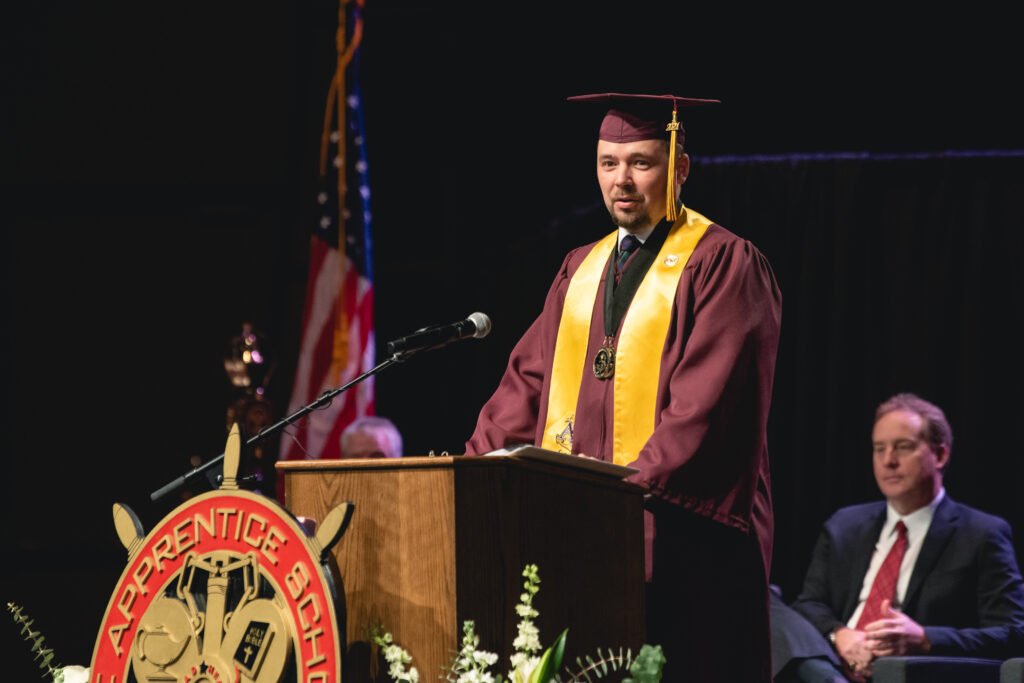
Chris Rose, recipient of the Homer L. Ferguson Award, speaks during the 2022 Apprentice School Commencement ceremony held March 12. HUNTINGTON INGALLS INDUSTRIES 

NEWPORT NEWS, Va. — Global engineering and defense technologies provider Huntington Ingalls Industries hosted commencement exercises March 12 for 170 graduates of the company’s Apprentice School at Newport News Shipbuilding, the company said in a release. The ceremony was held at Liberty Live Church in Hampton. 

“I want you to know how proud I am of each of you for everything that you’ve accomplished,” said Newport News Shipbuilding President Jennifer Boykin. “Today is just the next step towards your leadership role at Newport News Shipbuilding, and we and our country need you more than ever. As shipbuilders, we take on the truly unique honor of building vessels that protect our country and go into harm’s way.” 

The commencement address was delivered by Karen Henneberger, program manager for New Ship Design at Naval Reactors, a joint Department of Energy and Department of Navy program. She told graduates at the heart of The Apprentice School and their development is craftsmanship, leadership and scholarship. During her address she offered a deep Naval Reactors’ perspective on each of these tenets as they relate to the graduates’ current responsibilities at Newport News Shipbuilding, and their impact beyond the shipyard gates. 

Like Boykin, Henneberger, emphasized the Navy needs shipbuilders. 

“We need shipbuilders more than ever. We need to find ways to put more ships to sea, to maintain our nuclear-powered submarines and aircraft carriers in more efficient ways and to deploy innovative capabilities,” she said.

Speaking next, in Apprentice School tradition, was the apprentice receiving the Homer L. Ferguson Award, which recognizes the graduate with the highest honors. This year it was Christopher S. Rose, a deck electrician who began his career in 2017 at NNS. He has supported a variety of projects in the Virginia-class program, as well as the Nimitzclass and Ford-class programs, and is currently working on USS George Washington (CVN 73). 

“Always watch for your step, plan where you are going, and put the journey before the destination,” Rose said. “No matter what you’re doing, the most important step is the next one. Once you know what you need to do, it’s just a matter of logistics.” 

As the event closed, Boykin reminded the graduates what they heard at the ceremony.

“Your critical role in the defense of our nation cannot be understated,” she said. “The Navy depends on us to deliver capable, reliable vessels that help keep our sailors safe. And I’m depending on you to bring your skill, your experience, your knowledge and your heart to every challenge that you face. So always do your absolute best. Never settle for good enough and always keep learning. If you do this, I know that our nation’s future will be safer and brighter.” 


Coast Guard Cutters Conclude Operation Aiga in Oceania 

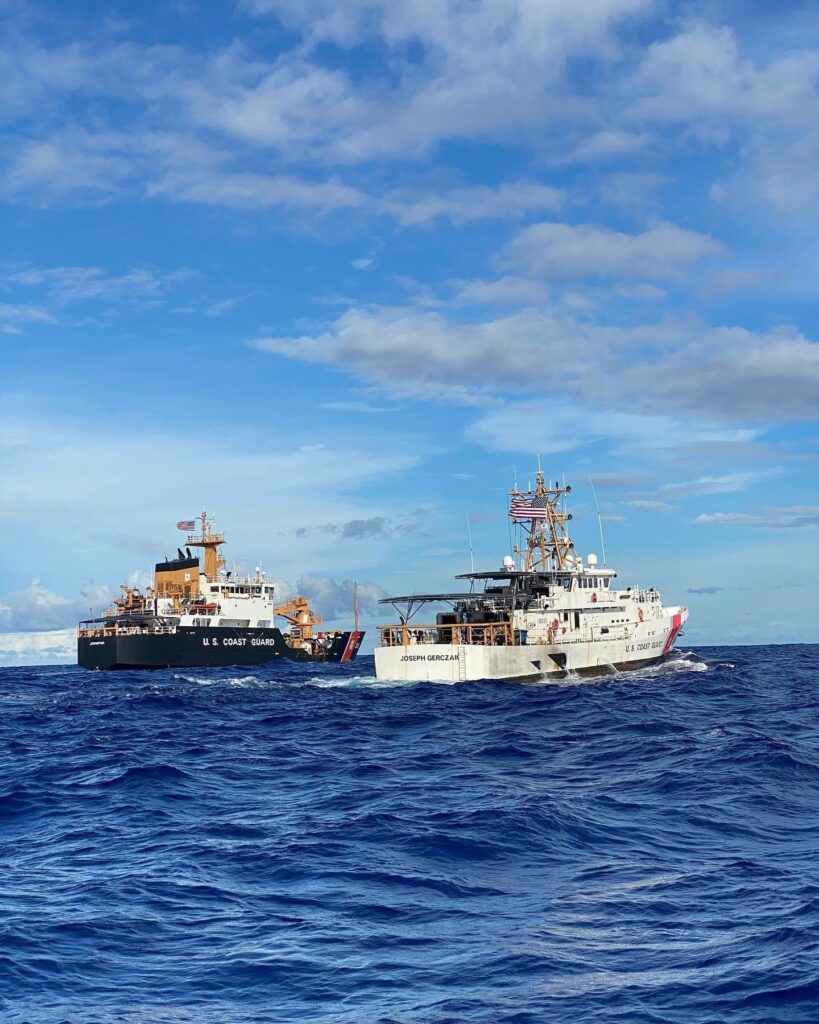
The crews of the Coast Guard Cutters Juniper and Joseph Gerczak return to Honolulu after completing a 42-day patrol in Oceania in support of Operation Aiga, March 7. U.S. COAST GUARD

HONOLULU — The crews of the Coast Guard Cutters Juniper and Joseph Gerczak returned to Honolulu March 7 after completing a 42-day patrol in Oceania in support of Operation Aiga, the Coast Guard 14th District said March 11.  

Both crews deployed on a combined 14,000-mile patrol to provide maritime support and patrol coverage for Samoa and American Samoa’s exclusive economic zones as well as conducted joint-training operations with the armed forces in French Polynesia. 

Operation Aiga, the Samoan word for family, is designed to integrate Coast Guard capabilities and operations with Pacific Island County partners to effectively and efficiently protect shared international interests, combat illegal, unreported and unregulated fishing and strengthen maritime governance in Oceania.  

“The Coast Guard remains committed to combating IUU fishing as fish stocks remain a critical component to maritime sovereignty and resource security for many nations, especially those in the Pacific,” said Cmdr. Jeff Bryant, chief of enforcement for Coast Guard District Fourteen. “The Juniper and Joseph Gerczak were able to establish stability for our partners on the high seas and while patrolling their EEZs in support of Operation Aiga.” 

While underway, both cutters conducted hoist training with French Dauphin N3 helicopter crews designed to increase interoperability on the high seas. Additionally, both cutter commanding officers met with Rear Adm. Jean-Matthieu Rey, commander of armed forces in French Polynesia, in Tahiti to discuss the importance of regional maritime security partnerships to maintain a free and open Indo-Pacific.  

“We had the privilege to integrate our capabilities and strengthen existing partnerships with the French, while protecting global resources on the high seas and exclusive economic zones of our regional partners,” said Cmdr. Christopher Jasnoch, commanding officer of the Juniper. “I am extremely proud of the crew of Juniper for their hard work preparing for this patrol, resiliency in overcoming the challenges of COVID-19 and their dedication to protecting national interests in Oceania while modeling professional maritime behavior to our partners and competitors.” 

Additionally, the Juniper and Joseph Gerczak crews helped fill an operational presence, conducting security patrols in Samoa’s EEZ throughout the month of February to protect fisheries and other natural resources while Samoa’s Nafanua II patrol boat was down.  

The Joseph Gerczak made an inaugural visit in Pape’ete, Tahiti, marking the first time a Coast Guard fast response cutter conducted vital port calls on the island. 

“Although Coast Guard missions, new cutters, and adventure make serving afloat attractive, the top incentive remains having the opportunity to serve alongside the most talented and humble men and women our country has to offer,” said Lt. Joseph Blinsky, commanding officer of the Joseph Gerczak. “Without the skill and hard work from Joseph Gerczak’s crew, our more than 2,300 NM transit to Tahiti from Honolulu would not have been possible. Coupled with first-class support from District 14, Sector Honolulu, and Juniper, made executing this expeditionary patrol a reality.”  


Submarine Program ‘Alive and Well,’ Lawmakers Tell Industry Leaders

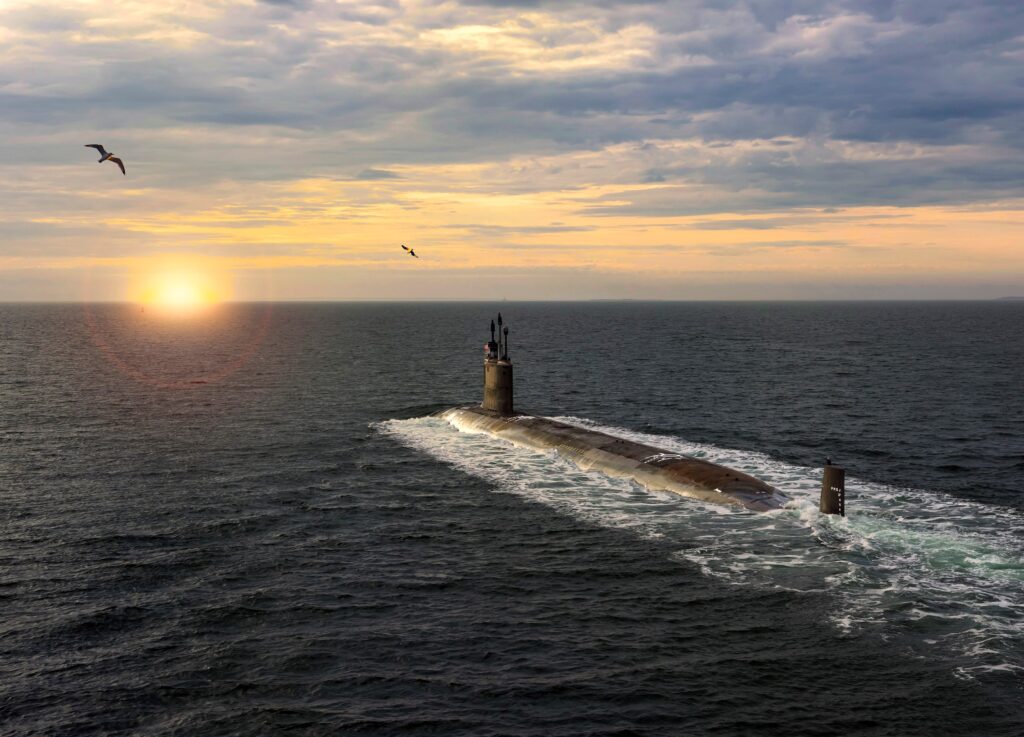
The future USS Oregon (SSN 793) heading out from Groton, Connecticut, on sea trials in December 2021. GENERAL DYNAMICS ELECTRIC BOAT

WASHINGTON, D.C. — Navy new submarine construction is on track, members of the Submarine Industrial Base Council were told by federal lawmakers during a visit to Washington.

Virginia-class submarines and the new Columbia class are moving forward, thanks in part to the efforts of the council, said Rep. Joe Courtney (D-Connecticut), chairman of the House Armed Services Committee’s Seapower and Projection Forces subcommittee and co-chair of the Submarine Caucus.

“The submarine program is alive and well. Your presence here today to make sure that Congress understands that … I think that’s a really big part of why that success is actually happening today,” Courtney said. “If you look at the momentum, in terms of both full funding for two per year for Virginia, and the eye-watering progress with Columbia.”

Courtney, whose district includes the General Dynamics Electric Boat Shipyard in Groton, Connecticut, acknowledged the progress with the fiscal year 2022 defense budget, which is going to show a 6% increase in spending. Courtney said the broad, bipartisan support the Columbia program enjoys is evident because its funding was exempted from the effects of the continuing resolution, which freezes spending at previous-year levels.

Courtney talked about the importance of maintaining a high-tempo submarine production rate, possibly going even higher. He mentioned the aspirational goal of three Virginia-class Block V submarines per year, which his committee approved.

AUKUS Opportunity

In addition to U.S. submarine programs, Courtney said the Australia-U.S.-U.K nuclear submarine program called AUKUS will also provide opportunities for American companies. By law, sharing nuclear technology with other nations must be approved by Congress, something that was done for the United Kingdom in 1958, and will be required for Australia — Courtney said he’s confident that will happen.

AUKUS will be a huge program and a boon to Australia’s industrial base, he said. But Courtney, who also chairs the Friends of Australia Caucus, said some of that capability and capacity will need to be provided here in the U.S.

“Australia is an incredible ally. But it isn’t reasonable to expect that a country of 30 million people can do it all by themselves. The spirit is there, but it’s probably a reach that they just can’t get to with their own indigenous workforce,” he said.

While the technicalities of an agreement with Australia need to be worked out, Courtney said it is his personal opinion that Australian naval officers should already be training at the Nuclear Power School in Charleston, South Carolina.

“They have good submariners, but they’re obviously familiar with diesel electrics, and they need to start getting people over to South Carolina and connected with the system,” he said. “You can’t just snap your fingers and have nuclear trained submariners.”

Courtney talked about major investments in infrastructure at Electric Boat’s shipyard in Groton and facility in Quonset Point, Rhode Island, as well as Huntington Ingalls Newport News Shipbuilding, where work is being performed on the Virginia and Columbia classes.

Courtney said he takes a keen interest in workforce development nor only because of the necessity of having a trained employment base to support submarine construction, but also because he’s on the education and labor committee. He said the current omnibus spending package will include 30% more  funding for registered apprenticeships, which can support defense companies, as well as workforce development money in the defense budget on top of that.

“We’re also slated to update the large federal job training plan called the Workforce Investment Opportunity Act, WIOA. It’s a five-year reauthorization process that’s coming up this year and will support pre-apprenticeship programs,” he said. “Giving young people a pathway to a skill and a job is almost existential for our economy right now.”

Courtney said that some of the new shipyard structures literally change the local skyline. “It’s just unbelievable what’s happening. But the fact is, we need more, in my opinion.”

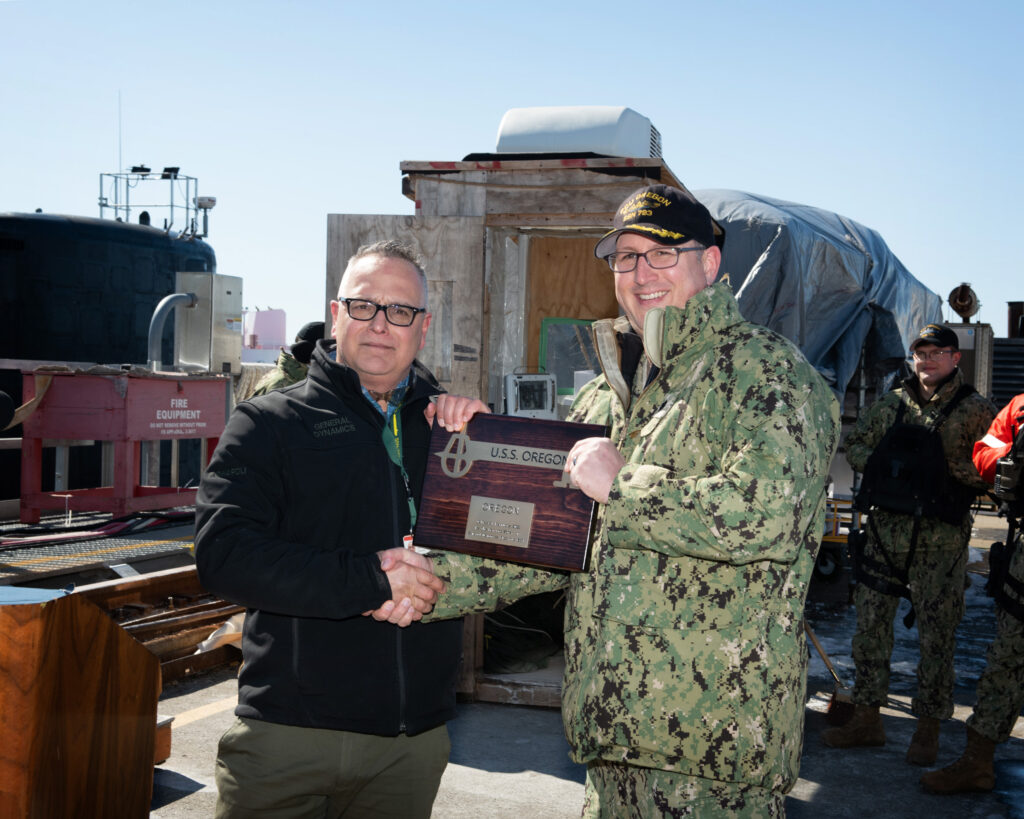
General Dynamics Electric Boat delivered the nuclear-powered attack submarine Oregon (SSN 793) to the U.S. Navy on Feb. 26. GENERAL DYNAMICS ELECTRIC BOAT

Budget Issues

Rep. Elaine Luria (D-Virginia), vice chair of the House Armed Services Committee and the Seapower and Projection Forces and Readiness subcommittees, said bureaucratic and legislative foot-dragging is having an impact on getting the defense budget completed.

Luria represents the Hampton Roads area, which conducts 25% of the shipbuilding and repair in the United States.

“It’s 42% of our local economy,” she said. “So, we’ve got to get this defense bill passed.”

She talked about hearing consistent testimony from Navy leadership about the threat, particularly from China in the Indo-Pacific region.

“In order to confront that threat, we need to grow our Navy, and the place we maintain that strategic advantage is our submarine fleet,” she said. “But the budget we got wanted to decommission more ships than we proposed to build.”

The Navy proposed decommissioning seven Ticonderoga class cruisers, which Luria said represents the loss of more than 400 vertical launch system cells that can fire Tomahawk land attack missiles.

“In an environment where we are confronting a rising and increasingly aggressive China, it made absolutely no sense,” she said.

Luria reiterated Courtney’s comments on the Columbia-class ballistic missile submarine to replace the aging Ohio-class fleet.

“We all understand that the Columbia-class submarine is the cornerstone of our national defense. As we sit today, we see the importance of that capability with the other events that are happening in the world. And we have to keep the Columbia class program on track. It’s absolutely essential.”

Luria also followed up on Courtney’s remarks about the AUKUS nuclear submarine program.

“It’s a huge opportunity. It’s also a huge risk. If you think about it, it’s a huge message to the Chinese. It’s a message to the Chinese that we are collaborating with Australia — that the U.S., Britain and Australia are cooperating, we’re building nuclear submarines, and we’re going to have this presence in the Pacific.”

Luria told the industry representatives they will be part of that effort to develop the plan and deliver support to Australia to build those submarines. The risk lies in the size of the project, she said.

“As you know, there is not the infrastructure, the training or the industrial base within Australia to just start from scratch and build a nuclear submarine program akin to what either we or the British have,” she said.

Although the U.S. is investing in infrastructure upgrades, including shipyards, Luria said the nation needs to make more investments in its public yards. She cited issues with the Norfolk Naval Shipyard where the drydocks are old and rising sea levels are affecting ship maintenance.

“The infrastructure there needs to really be brought up into the 21st century,” Luria said.

Asked about the Navy’s long-term shipbuilding plans, Luria said the service’s 30-year shipbuilding plan is usually obsolete by year five. The plan needs to be more compelling, she said.

“We need maritime strategy that lays out why  we need a Navy, and this is where we need the Navy to be and be deployed,” she said.

China Deterrent

Rep. Mike Rogers (R-Alabama), the ranking Republican on the House Armed Services Committee, told the attendees about the importance of the Indo-Pacific region and the need for the nation to build a modern, credible deterrence to counter ongoing Chinese aggression.

“Effective military strength in the Indo-Pacific is essential to the security of our allies, global trade and democracy,” he said. “The strength of our Navy is central to that effort.”

Rogers said China is rapidly growing and modernizing its navy.

“Our fleet of 296 ships has already been eclipsed by the Chinese fleet of 350 ships and submarines. China is no longer far off threat; they are a pacing threat,” he said. “China is rapidly modernizing its navy, and building a fleet to project power far beyond the South China Sea. By the end of this decade, China could equal our numbers of ballistic missile submarines and have a substantial fleet of attack submarines.”

Rogers said the U.S. “must recapitalize our submarine fleet to maintain our strategic advantage, and we should be expanding and modernizing our naval capabilities.”

Unfortunately, he said, the Navy’s shipbuilding budget doesn’t come close to meeting the strategic requirements. He agrees with the assessments that the Navy needs 500 ships, both manned and unmanned vessels.

“This includes increasing our attack submarine fleet from 49 to 66, and building a ballistic missile fleet of at least 12,” he said. “Our attack submarine fleet will be on the front lines in any conflict that we have with China.

“We need to expand our industrial base to support three attack submarines per year,” Rogers said. “Doing that with multi-year construction contracts will save money and deliver the capability we need quicker.  We’ve got to also fully fund the Columbia class. Columbia class is going to cost over $110 billion — and that’s a lot of money — but they are a central part of our [nuclear] triad.”

“We need this administration to publicly commit to rapidly expanding our submarine and surface fleet,” Rogers said. “And we need to see that reflected in the shipbuilding plan.”


Center for Maritime Strategy Dean Foggo Accepts Canadian Meritorious Service Cross

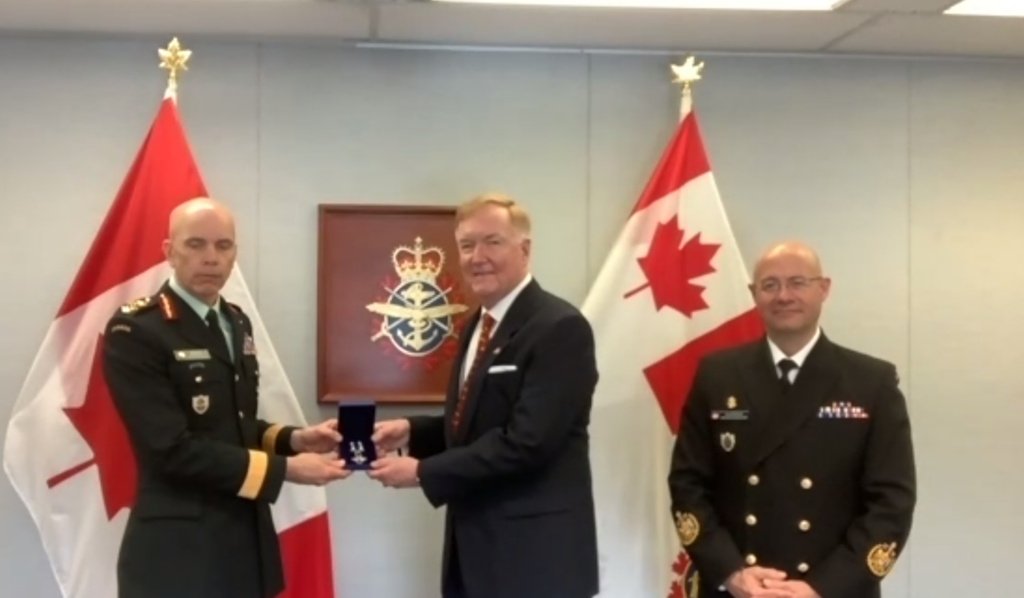
Foggo, center, accepts the Meritorious Service Cross from the Canadian Department of National Defence.

OTTAWA, Canada — Retired four-star Navy Adm. Jamie Foggo, dean of the new Center for Maritime Strategy at the Navy League of the United States, accepted the Meritorious Service Cross from the Canadian Department of National Defence on May 11 for his work with NATO.

Foggo’s last active duty assignment included three commands with a span of control over U. S. Navy maritime and Joint NATO Forces in Europe, Africa and the Middle East. 

Created by Queen Elizabeth II, Meritorious Service Decorations are an important part of the Canadian Honours System and highlight remarkable achievements accomplished over a limited period of time. Foggo was awarded the cross in 2020 for his work in planning a critical component of Canada’s commitment to NATO, and was presented it March 11 after speaking at the Ottawa Conference on Security and Defence.

During a ceremony, Foggo noted he “grew up in a Canadian forces family,” as his father and grandfather both served in Canada’s military. During his years working with NATO, Foggo noted, “Canadians were by my side.”

Foggo has been presented numerous other awards, including the Distinguished Service Medal, Defense Superior Service Medal, Legion of Merit and NATO Meritorious Service Medal. In addition, he is the recipient of the French Chevalier de l’Ordre National de Merité and the Legion d’Honneur, the Cross of Saint George (Portugal), the White Cross of the Naval Order of the Spanish Armada, the rank of Commendatore from the President of Italy and Knight of the Grand Cross of Kingdom of Two Sicilies.


Keel Authenticated for Future Destroyer USS Ted Stevens 

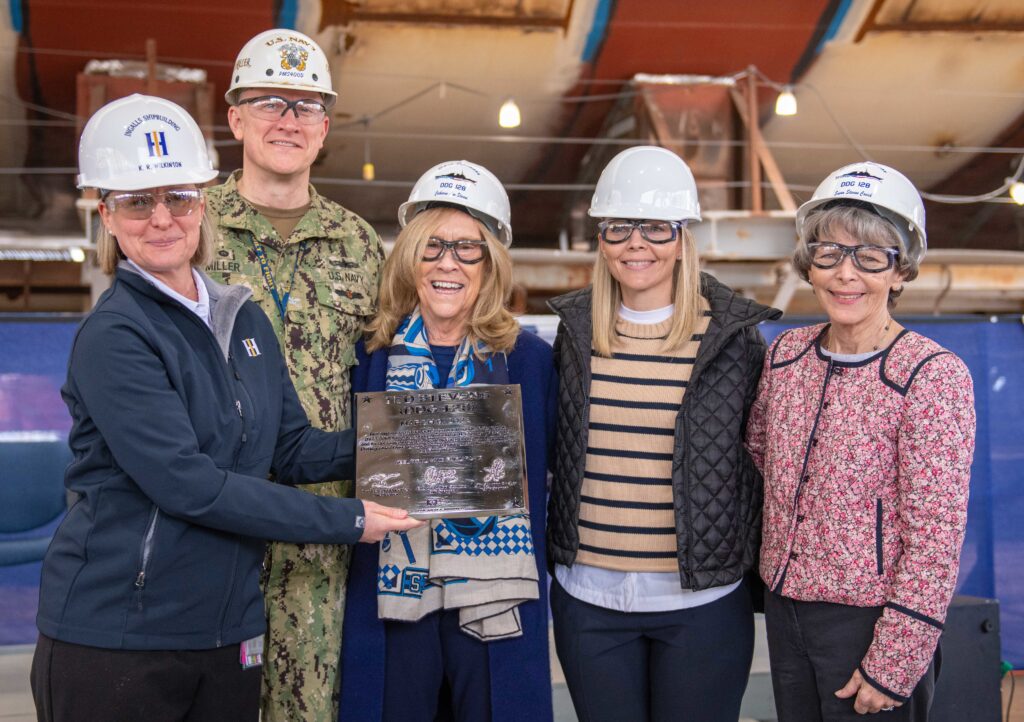
Ship sponsors Catherine Ann Stevens, Susan Stevens Covich and Lily Stevens Becker, Ingalls Shipbuilding President Kari Wilkinson and Capt. Seth Miller, DDG 51 class program manager, Program Executive Office Ships, at the rear, pose with the keel plate of the future USS Ted Stevens. HUNTINGTON INGALLS INDUSTRIES.

WASHINGTON — The keel of future USS Ted Stevens (DDG 128), the 78th Arleigh Burke-class guided-missile destroyer, was ceremonially laid at Huntington Ingalls Industries Ingalls Shipbuilding, March 9, Team Ships Public Affairs said in a release. 

The ship is named for the late Sen. Ted Stevens from Alaska. Stevens was the longest-serving Republican U.S. senator in history at the time he left office and was the third senator to hold the title of president pro tempore emeritus. He was the president pro tempore of the United States Senate in the 108th and 109th Congresses. 

The contemporary keel laying ceremony represents the joining together of a ship’s modular components at the land level. The keel is authenticated with the ship sponsors’ initials etched into a ceremonial keel plate as part of the ceremony. Sponsors of DDG 128 are Catherine Stevens, wife of the ship’s namesake, and Susan Stevens Covich and Lily Stevens Becker, daughters of the namesake. 

“The Flight III upgrade fulfills a critical need for the Navy. Flight III ships like the future USS Ted Stevens will serve as a deterrent to our adversaries using the ship’s increased power projection capability as a result of the upgraded Aegis Combat System and Air and Missile Defense Radar,” said Capt. Seth Miller, DDG 51 class program manager, Program Executive Office Ships. “We are honored to have the Stevens family with us today as we mark this important milestone in building the Navy’s and the nation’s next great warship.” 

The DDG 51 Flight III upgrade is centered on the AN/SPY-6(V)1 Air and Missile Defense Radar and incorporates upgrades to the electrical power and cooling capacity plus additional associated changes to provide greatly enhanced warfighting capability to the fleet. Flight III is the latest flight upgrade in the more than 30-year history of the class, building on the proud legacy of Flight I, II and IIA ships before it. 

HII’s Ingalls Shipbuilding is also in production on the future USS Lenah Sutcliffe Higbee (DDG 123), USS Jack H. Lucas (DDG 125), USS Jeremiah Denton (DDG 129), and USS George M. Neal (DDG 131).