Radar Integration Determined Deployment Timing of Navy’s MQ-8C Fire Scout 
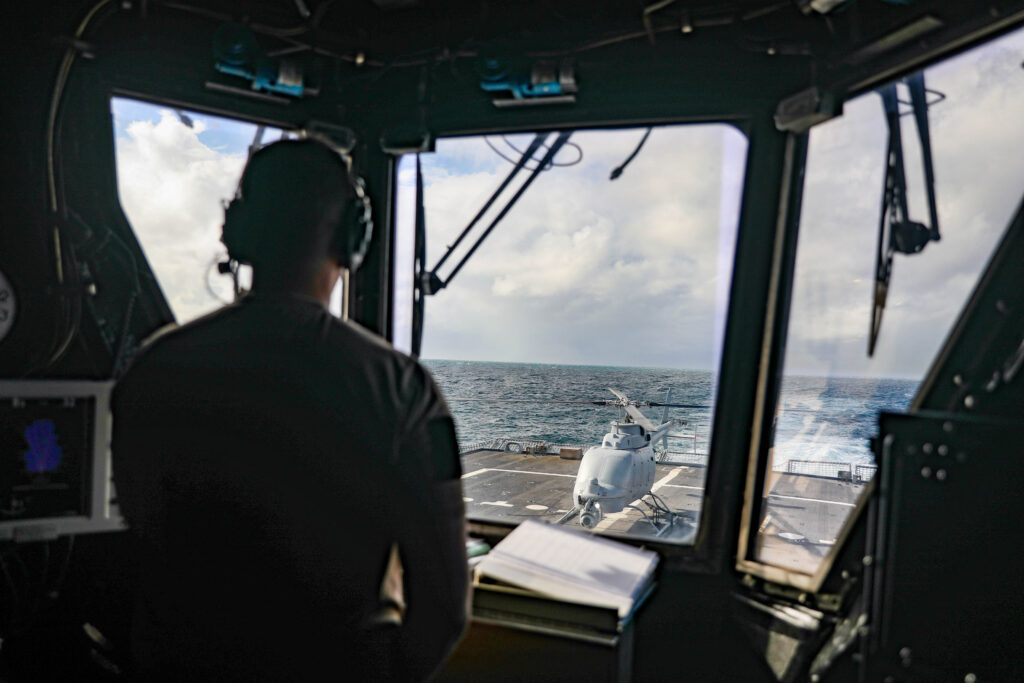
Lt. Cmdr. Joe Johnson assigned to the “Sea Knights” of Helicopter Sea Combat Squadron (HSC) 22, Detachment 5, mans the flight deck control tower during flight quarters aboard the Freedom-variant littoral combat ship USS Milwaukee (LCS 5), Dec. 15, 2021. U.S. NAVY / Mass Communication Specialist 2nd Class Danielle Baker

ARLINGTON, Va. — The U.S. Navy’s MQ-8C Fire Scout unmanned helicopter reached initial operational capability more than 2.5 years ago but made its first operational deployment only last month. The reason, the Navy’s program manager explained, centered on the integration of a radar into the new Fire Scout version. 

Navy Capt. Eric Soderberg, the Navy’s Fire Scout program manager, speaking to reporters Jan. 25, explained the MQ-8C as a platform reached initial operational capability in June 2019, but the service decided to wait until it could complete integration of the Leonardo ZPY-8 surface search radar on the MQ-8C, which has now been accomplished. The radar already was integrated on the older MQ-8B version, which the MQ-8C is scheduled to replace. 

Soderberg said that “the fleet made a decision that a radar-equipped Bravo [MQ-8B] was more suitable to deploy than a non-radar-equipped Charlie [MQ-8C]. Now that we have that radar on the Charlie, it becomes a pretty clear answer that the Charlie is the superior platform, and that’s why we’re accelerating the transition from the 8B to the 8C.”  

An MQ-8C, built by Northrop Grumman, was deployed operationally on Dec. 14 on board the Freedom-class littoral combat ship USS Milwaukee (LCS 5), which is deployed in the U.S. 4th Fleet’s area of operations in support of Joint Interagency Task Force South’s mission, which includes counter-illicit drug trafficking missions in the Caribbean and Eastern Pacific, according to the caption.   

Soderberg said the MQ-8C was “performing up to expectations” on the deployment. 

The Leonardo ZPY-8 on the Fire Scout gives the host ship a far greater ability to detect and track surface contacts and maintain over-the-horizon situational awareness.  

The MQ-8C’s larger airframe and greater fuel load gives it an endurance is 10 to 12 hours, far greater than the four to five hours of the MQ-8B. 

The improved software on the MQ-8C system eases the workload on the controllers. The software integrates the radar, electro-optical sensor, and Automatic Information System in the MQ-8C. 

The MQ-8C on the Milwaukee is teamed with an MH-60S Seahawk helicopter, which is not equipped with a radar. Both aircraft are operated by the “Sea Knights” of Helicopter Sea Combat Squadron (HSC) 22, Detachment 5.  

Soderberg said although the detachment’s officers all can control the Fire Scout, one officer is assigned as the main specialist for the system. The Navy also is qualifying MQ-8B and MQ-8C operators separately now, as opposed to personnel operating both types. 

The program manager also said a data link designed to allow the MQ-8C to share sensor data with multiple platforms is being introduced, but some budget uncertainty is slowing that process.  

He said there is a well-defined need for a mine-countermeasures sensor with both littoral surf zone and deeper water capabilities. The COBRA II sensor, equipped with lidar, is considered suitable.   

A passive electronic warfare sensor for the platform is under discussion. Soderberg also said there is a “technical way forward” to arm the MQ-8C with weapons such as rockets, but there are “no funded efforts to implement” a weapons  

He also said the MQ-8C is ready if needed for on the Lewis B. Puller-class expeditionary sea base ship. The mobile mission-control station is ready and certified for the ship.  


Northrop Grumman Delivers MYP-1’s Final E-2D to U.S. Navy; Begins MYP-2 

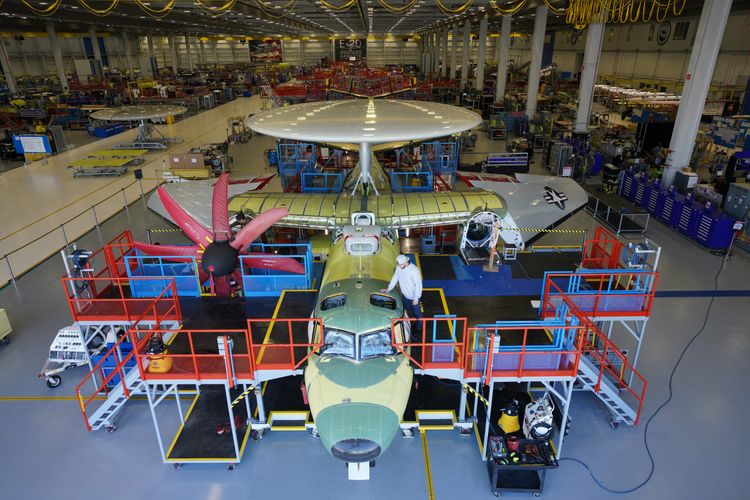
Northrop Grumman successfully delivered the 51st U.S. Navy E-2D Advanced Hawkeye production aircraft, AA-52. The aircraft represents the last to be delivered under the Multi-Year Procurement 1 contract. NORTHROP GRUMMAN

ARLINGTON, Va. — Northrop Grumman has successfully delivered the 51st E-2D Advanced Hawkeye for the U.S. Navy. The aircraft is the final one of a Multi-Year Procurement-1, the company said Jan. 21. 

The E-2D, numbered AA-52 in company production, is equipped with the Delta System/Software Configuration Build 3, which provides an additional leap in operational effectiveness and technology for the E-2D with the incorporation of aerial refueling and a dwell-based tracker, the release said. 

MYP-1, awarded in June 2014, called for the production of 25 E-2Ds, later increased to 26. 

The E-2D now equips six of the Navy’s nine fleet airborne command and control squadrons and eventually will replace the E-2C in the remaining three squadrons.  

Northrop will begin deliveries this year of E-2Ds through MYP-2, which was awarded in April 2019 for 24 E-2Ds. 

The Navy’s program of record is for 86 E-2Ds. Japan has ordered 13 E-2Ds, and France has ordered four. 


Marine Squadron First to Complete Transition to CH-53K 

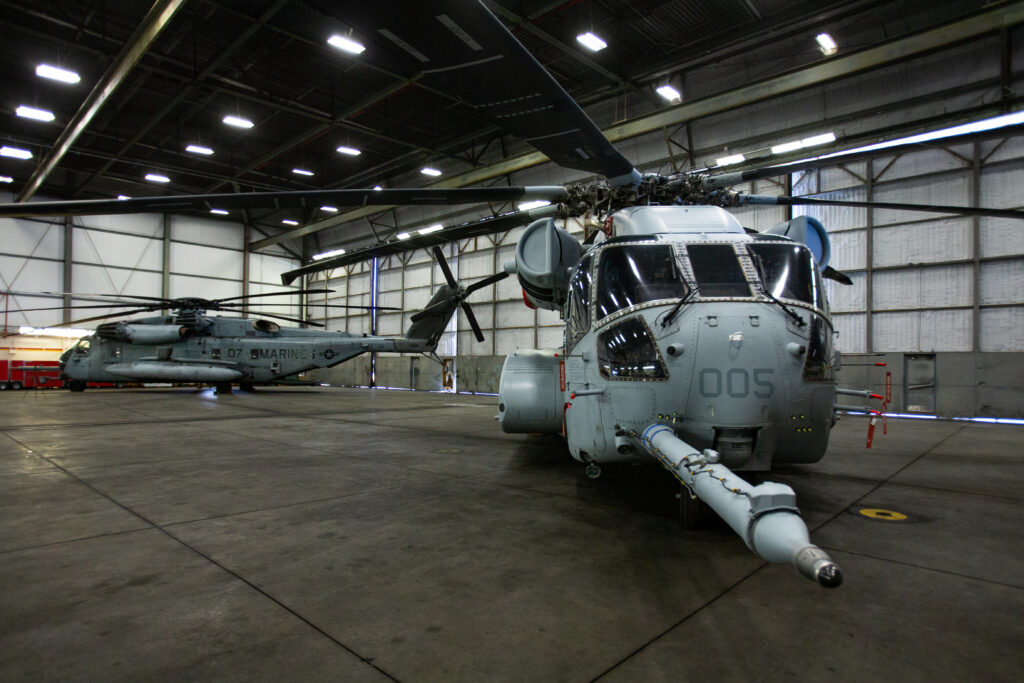
A CH-53K King Stallion (right) and a CH-53E Super Stallion are staged during a redesignation ceremony at Marine Corps Air Station New River, North Carolina, Jan. 24, 2022. U.S. MARINE CORPS / Lance Cpl. Elias E. Pimentel III

MARINE CORPS AIR STATION NEW RIVER, N.C. — The CH-53K King Stallion heavy-lift helicopter now equips an operational Marine heavy helicopter squadron, the 2nd Marine Aircraft Wing said Jan. 25.   

A Jan. 24 ceremony at New River marked the transition of Marine Heavy Helicopter Squadron 461 (HMH-461) from the CH-53E Super Stallion to the CH-53K. 

“Today our Marine Corps got a little stronger,” said Maj. Gen. Michael Cederholm, commanding general of 2nd Marine Aircraft Wing, described the significance of HMH-461’s transition to the CH-53K. “It is only appropriate that 2nd Marine Aircraft Wing, and in particular Marine Corps Air Station New River, would be the first to receive the newest land and sea-based heavy helicopter because this is the home of the Marine Corps’ assault support. Placing the CH-53K King Stallion into the hands of our warfighters will ensure we capitalize on the unique qualities and characteristics of the 53K and will allow 2nd MAW to continue to provide the best aviation support to the Marine Air-Ground Task Force right now, and well into our future.” 

The CH-53K is designed to lift nearly 14 tons (27,000 pounds) at a mission radius of 110 nautical miles, in high and hot environments. It can lift almost triple the baseline CH-53E lift capability. It is also designed to have a smaller shipboard footprint, lower operating costs per aircraft and less direct maintenance man hours per flight hour. The CH-53K is expected to externally lift two up-armored high mobility multipurpose wheeled vehicles, light armored vehicles and dual joint light tactical vehicles. It features a cabin section 12 inches wider than the CH-53E that can internally load two AMC 463L pallets or five AMC 463L half-pallets or internally load a Humvee.  

The CH-53K leverages a next-generation glass cockpit Common Avionics Architecture System open-architecture design; utilizes triple redundant fly-by-wire flight controls adding additional survivability, safety and maintenance improvements; includes fourth-generation high-efficiency composite rotor blades with swept anhedral tips; and leverages a low-maintenance elastomeric rotor head. 

“Quite simply, 2nd MAW will be able to move more troops and equipment, at higher altitudes, faster speeds, and in more austere environments than ever before,” Cederholm said. “We continue to become a more modernized and lethal force so, when the time comes, we will deliver on II Marine Expeditionary Force’s motto: ‘Come to Fight — Come to Win.’ I am so proud of the Marines and Sailors of 2nd MAW and find it appropriate that they are a part of this moment in Marine Corps aviation history.”   

The Marine Corps plans to stand up eight active-duty squadrons, one training squadron and two reserve squadrons to support operational requirements. The CH-53K is currently on track to deploy to the fleet as needed by the Marine Corps in fiscal 2024. 


Turkish frigate serving as flagship for NATO Operation Sea Guardian in Mediterranean

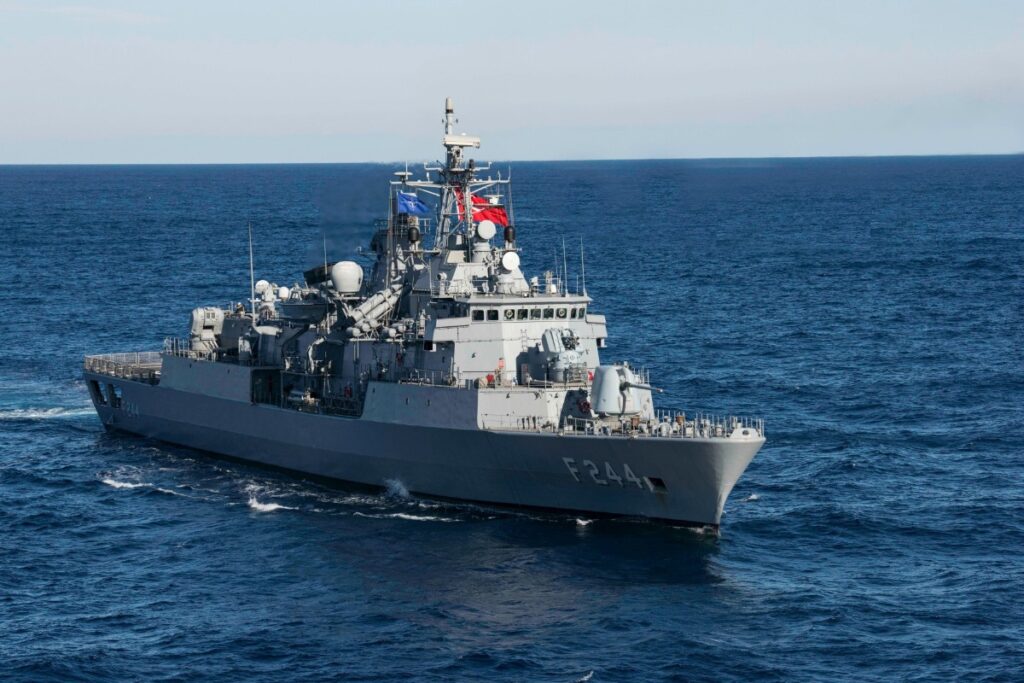
The Turkish frigate TCG Barbaros is serving as flagship for NATO’s Operation Sea Guardian focused patrol. NATO ALLIED MARITIME COMMAND

MEDITERRANEAN SEA — NATO is continuing its Operation Sea Guardian with its first focused patrol for 2022.

Turkish frigate TCG Barbaros is currently deployed to the Eastern Mediterranean Sea and is serving as flagship for NATO’s current OSG focused patrol.

According to a statement from NATO Allied Maritime Command, Barbaros’s three-week deployment is the first of six Operation Sea Guardina-focused operations scheduled this year and will run until Feb. 12, 2022.

“This focused patrol incorporates maritime patrol aircraft from Greece, Poland and Turkey in addition to submarines from Greece and Turkey in support of the flagship,” the statement said. “Simultaneously, Standing NATO Maritime Group 2 comprised of the flagship ITS Margottini,  ESPS Blas de Lezo and TCG Goksu will be deployed in the Eastern Mediterranean Sea, contributing NATO’s maritime situational awareness efforts.” 

According to MARCOM, Operation Sea Guardian is a non-Article 5, “collaborative, year-round maritime security operation designed to maintain maritime situational awareness, deter and counter terrorism activity and build capacity and interoperability among NATO Allies and partners.”

Aimed at working with Mediterranean stakeholders and partners, the operation has been conducting focused patrols at specific areas of interest in the Mediterranean Sea. Operation patrols commenced in 2016 to “maintain an accurate picture of the maritime environment and contribute to the safety and security in the region.”

NATO’s website states that “Operation Sea Guardian is a flexible operation that can potentially cover the full range of NATO’s maritime security operation tasks. At present, it is operating in the Mediterranean and is conducting three MSO tasks: maritime security capacity building and support to maritime situational awareness and to maritime counter-terrorism.”

As needed, Operation Sea Guardian can also be directed to uphold freedom of navigation, conduct maritime interdiction, fight the proliferation of weapons of mass destruction and protect critical infrastructure.

“I cannot think of a better example that speaks to the relevance of inter-agency cooperation than Operation Sea Guardian,” said Allied MARCOM’s commander, Royal Navy Vice Adm. Keith Blount, speaking at the NATO Maritime Security Conference last year at Souda Bay, Crete. “Our obligation to ensure maritime security in the Mediterranean requires a multitude of actions, in collaboration with our allies and partners, and represents the full spectrum of capabilities that we possess.”


Canadian Coast Guard Conducts Sea Trials of V-BAT UAS  

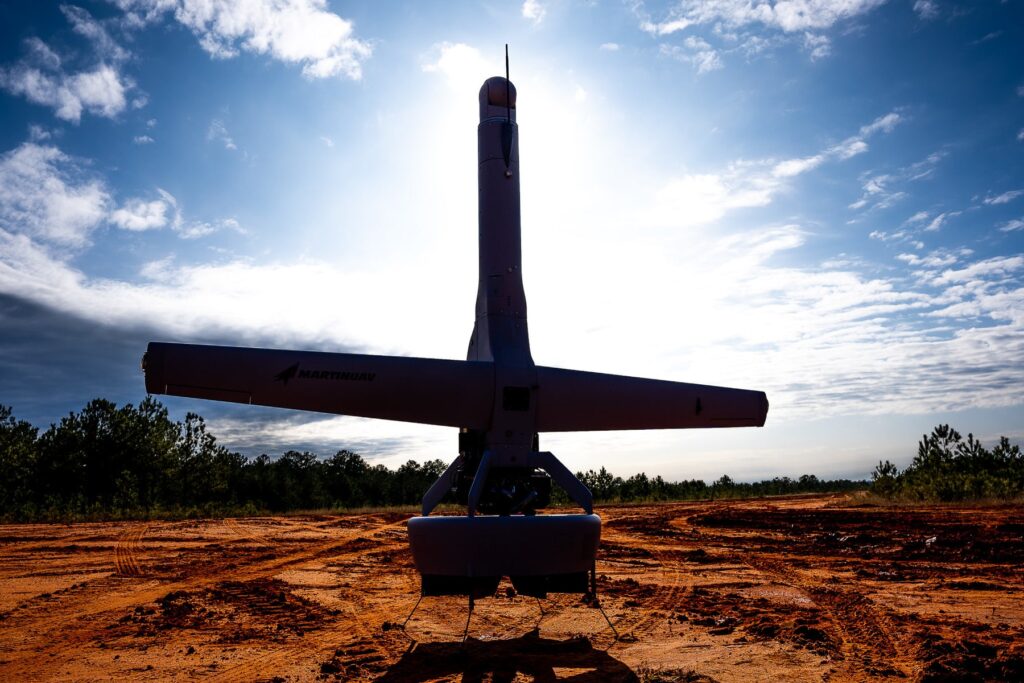
A V-BAT vertical takeoff and landing unmanned vehicle. MARTIN UAV

OTTAWA, Ontario — Kongsberg Geospatial has successfully conducted sea trials of the Shield AI V-BAT unmanned aerial system on behalf of the Canadian Coast Guard, operating from a small cargo vessel far offshore in international waters, Kongsberg announced Jan. 25. 
 
The Canadian Coast Guard is conducting trials of the long-endurance, vertical takeoff and landing UAS surveillance system for possible deployment on Canadian Coast Guard Vessels under a project funded by Defence Research and Development Canada. The Shield AI V-BAT aircraft was selected due to its unique ability to combine VTOL from the small confines aboard ship with the long endurance of a fixed-wing aircraft while carrying multiple sensors. 
 
Kongsberg Geospatial teamed with Shield AI to deploy the V-BAT VTOL UAS for a three-day sea trial in international waters in the Gulf of Mexico. The trials tested the capability of the aircraft to provide rapid launch and recovery, long endurance, and confined space takeoff and landing from a moving vessel in a variety of weather conditions, during the day and night. In addition to tracking and identifying other ships at long ranges, the flights conducted a variety of simulated missions designed to emulate real-world situations where the Canadian Coast Guard would use the drones. These included locating and tracking dye patches that simulated wreckage or oil spills and locating life preservers in choppy seas and in a variety of weather conditions. 
 
The V-BAT operators used Kongsberg Geospatial’s IRIS UxS software to safely pilot the aircraft at long ranges from the launch vessel. The IRIS software provides a comprehensive situational awareness picture of the operational airspace, data from a variety of sensors and data feeds and shows the location of other aircraft and surface ships, as well as the launch vessel and the “ownship,” or drone being operated. 
 
Sensor data feeds from the cameras and sensors carried by the UAS were ingested, at real-time, into the Kongsberg Geospatial Modular ISR Data Analysis and Storage system. The MIDAS system records video and other data from the UAS, and serves as a “mission intelligence coordinator” to view current and historical sensor feeds of the UAS within a temporal and geospatial context to increase sensor utilization effectiveness. 
 
“While the sea conditions were perhaps a little rougher than expected, they were ideal for testing the launch and recovery capabilities of the V-BAT from a small ship under the kind of conditions you might expect during real operations,” said Rex Hayes, a retired U.S. Navy and Coast Guard officer and the director of Unmanned Systems at Kongsberg Geospatial. “We were also very pleased with the performance of IRIS and the MIDAS system when handling integrated sensor data feeds from extended missions.” 
 
Trials like these are important to the continued health of the industry, according to Brandon Tseng, Shield AI’s cofounder and former U.S. Navy SEAL. “We love supporting our allies. It will take strong partnerships — technological, military, and economic — to maintain stability during challenging times. Sharing tech like the V-BAT strengthens strategic relationships and contributes to global stability. Our recent engagement with the Canadian Coast Guard and Kongsberg exemplifies our commitment to ensuring our allies have the cutting-edge technology and products they need.” 
 
This series of endurance trials is the second set of flight trials of the Shield AI V-BAT conducted by the Canadian Coast Guard. The first series of flight trials were conducted at a UAS test range in Oklahoma last year to establish flight characteristics of the aircraft. The V-BAT was developed by Martin UAV, which was acquired by Shield AI last year. Kongsberg Geospatial is a subsidiary of Kongsberg Defence & Aerospace. 


Navy Delayed Announcement of First MQ-8C Deployment Five Weeks

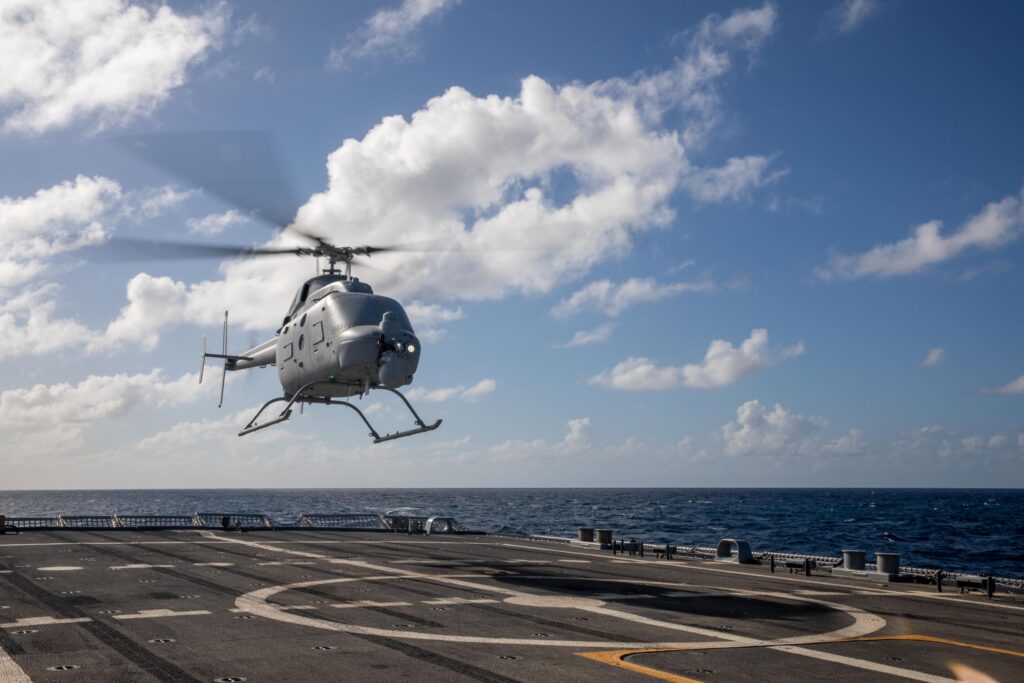
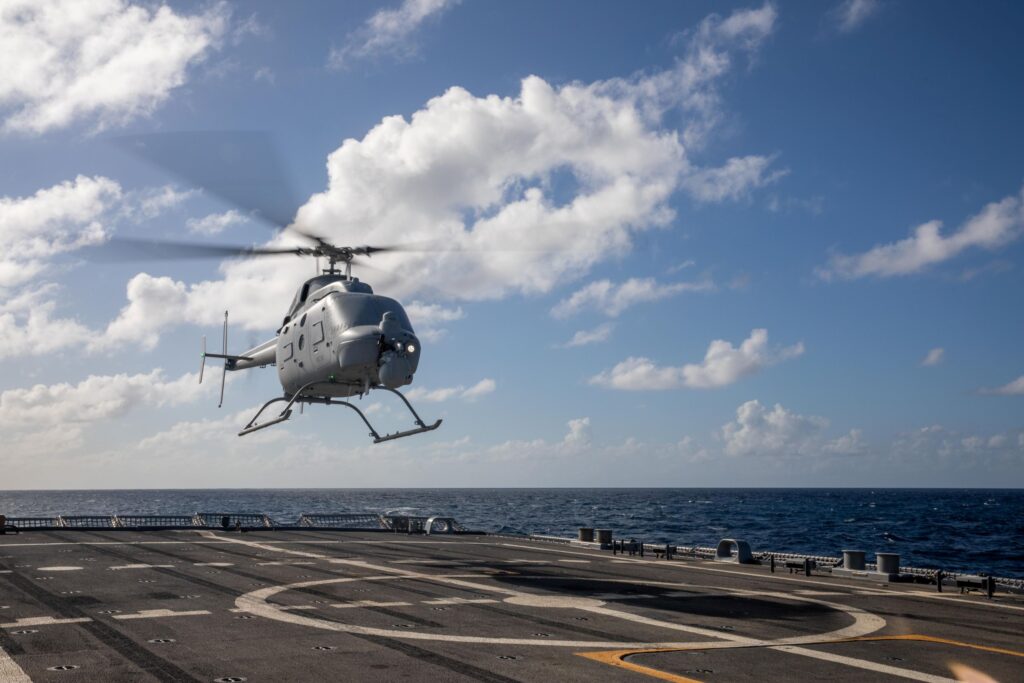
An MQ-8C Fire Scout attached to the “Sea Knights” of Helicopter Sea Combat Squadron (HSC) 22, Detachment 5, takes off from the flight deck of the Freedom-variant littoral combat ship USS Milwaukee (LCS 5), Jan. 6, 2022. U.S. NAVY / Petty Officer 2nd Class Danielle Baker

ARLINGTON, Va. — The Navy has deployed the MQ-8C version of its Fire Scout unmanned helicopter for the first time but waited five weeks to make the announcement. 

An MQ-8C, built by Northrop Grumman, was deployed operationally on Dec. 14 on board the Freedom-class littoral combat ship USS Milwaukee (LCS 5), the Navy and Northrop Grumman announced in Jan. 24 releases. 

The deployment was apparent before Jan. 24 in a series Navy photographs taken Jan. 6 while the MQ-8C was operating from the USS Milwaukee in the Caribbean Sea. The ship was deployed in the U.S. 4th Fleet’s area of operations in support of Joint Interagency Task Force South’s mission, which includes counter-illicit drug trafficking missions in the Caribbean and Eastern Pacific, according to the caption.  

The Milwaukee had departed Naval Station Guantanamo Bay, Cuba, on Jan. 3 after two weeks in port following an outbreak of the COVID-19 virus in the crew.   

The MQ-8C was being operated by the “Sea Knights” of Helicopter Sea Combat Squadron (HSC) 22, Detachment 5. The squadron also operates the MH-60S Seahawk manned helicopter and is using both aircraft in counter-narcotics operations.  

The Fire Scout “will identify targets of interest and refine surveillance data of existing targets of interest, allowing for enhanced capabilities for counter illicit drug trafficking missions,” the Navy said in a release.    

“This is a significant milestone in the MQ-8C Fire Scout program,” said Navy Capt. Eric Soderberg, the Navy’s Fire Scout program manager. “The transition from the MQ-8B to the MQ-8C Fire Scout has brought improved sensors and more than doubles the on-station endurance. Advances in Fire Scout’s capabilities further our successful integration of unmanned platforms at sea and the Navy and Marine Corps unmanned campaign plan.” 

“Our partnership with the U.S. Navy has been critical in developing Fire Scout’s multi-mission autonomous capabilities which provide greater situational awareness to the joint force,” said Lance Eischeid, director, Fire Scout program, Northrop Grumman. “With the ability to operate from a range of surface ships, MQ-8C Fire Scout is a powerful platform that allows the U.S. Navy to increase the detection and tracking of targets through its onboard sensors and integration with manned assets.” 

“Fire Scout is a force multiplier, not only in our current mission, but in every mission the U.S. Navy conducts,” said Cmdr. Brian Forster, commanding officer of Milwaukee. “I am very excited of the team I have onboard which has already, and will continue to, demonstrate how manned and unmanned assets can work together to effectively achieve the mission.” 

In December, an MQ-8C was photographed on the deck of Independence-class littoral combat ship USS Jackson (LCS 6) while in port in Apra Harbor, Guam. The caption stated the Jackson was part of Destroyer Squadron Seven “on a rotational deployment in the U.S. 7th Fleet area of operation to enhance interoperability with partners and serve as a ready-response force in support of a free and open Indo-Pacific region.”  

The MQ-8C in the Guam photograph was going through pre-deployment functional ground checks for a detachment of Helicopter Sea Combat Squadron 23 — based at Naval Air Station North Island, California — that will operate the MQ-8C from the USS Jackson.   

The MQ-8C, which achieved initial operational capability in June 2019, is an upgrade to the Fire Scout System mainly in that it uses a Bell 407 airframe, which is larger than the earlier-design MQ-8B’s airframe and equipped with more powerful engines, thus having a greater speed, payload and endurance, up to 10+ hours of endurance on station and a range of more than 1,000 nautical miles.  

The MQ-8C is equipped with the Leonardo ZPY-8 Osprey search radar or an electro-optical/infrared sensor and uses the same ground control station and the MQ-8B. The Navy plans to add more capability in the form of Link 16 data link, passive targeting, and a mine-countermeasures payload.  

Northrop Grumman was under contract to deliver 38 MQ-8Cs, all of which have been delivered and will replace the earlier MQ-8B version, of which 30 have been delivered to the fleet. 


Pilot Ejects as F-35C Lightning II has Landing Mishap on USS Carl Vinson

An F-35C Lightning II, assigned to the “Argonauts” of Strike Fighter Squadron (VFA) 147, lands on the flight deck of Nimitz-class aircraft carrier USS Carl Vinson (CVN 70), Jan. 2. U.S. NAVY / Mass Communication Specialist 3rd Class Megan Alexander

ARLINGTON, Va. — An F-35C Lightning II suffered a landing mishap Jan. 24 on the flight deck of USS Carl Vinson (CVN 70) while the carrier was conducting routine flight operations in the South China Sea, the U.S Pacific Fleet said Jan. 24. 

The pilot safely ejected from the aircraft and was recovered by U.S. military helicopter, according to a release.  

“The pilot is in stable condition,” the release said. “There were seven total Sailors injured; three Sailors required medevac to a medical treatment facility in Manila, Philippines, and four were treated by on-board medical personnel.” 

All three medevacs were in stable condition and of the four Sailors treated by on-board medical, three have been released. Additional details and the cause of the inflight mishap is under investigation. 

The F-35C was assigned to Strike Fighter Squadron 147 (VFA-147), a unit of Carrier Air Wing Two. VFA-147 is the first F-35C squadron to deploy overseas on an aircraft carrier, having deployed Aug. 2, 2021. A second F-35C squadron, Marine Fighter Attack Squadron 314, is deployed a unit of Carrier Air Wing Nine on board USS Abraham Lincoln (CVN 72). 


U.S. Navy Interdicts Stateless Vessel Previously Caught Smuggling Weapons

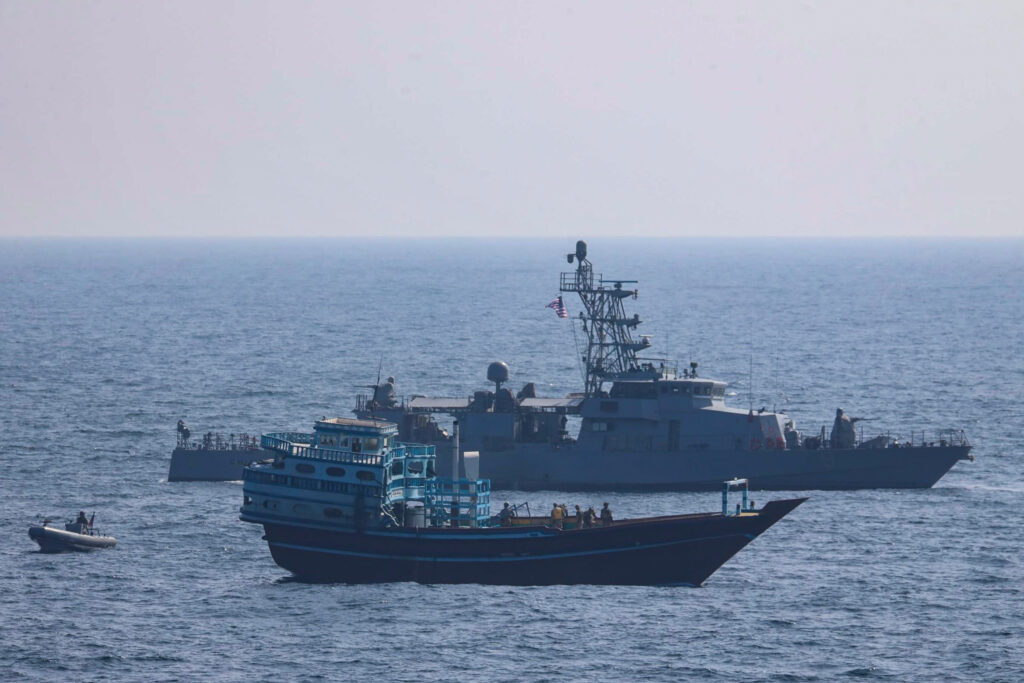
U.S. service members conduct a boarding on a stateless fishing vessel transiting international waters the Gulf of Oman as a rigid-hull inflatable boat and patrol coastal ship USS Chinook (PC 9) sail nearby. U.S. NAVY

MANAMA, Bahrain – On Jan. 18, U.S. 5th Fleet ships interdicted a stateless fishing vessel in the Gulf of Oman that was caught smuggling illicit weapons off the coast of Somalia last year, U.S. Naval Forces Central Command / U.S. 5th Fleet said Jan. 23. 

Guided-missile destroyer USS Cole (DDG 67) and patrol coastal ship USS Chinook (PC 9) interdicted the stateless vessel transiting from Iran in waters outside of any state’s territorial sea along a route historically used to traffic weapons to the Houthis in Yemen. 

During a flag verification boarding and subsequent search, U.S. forces discovered 40 tons of urea fertilizer, a chemical compound with agricultural applications that is also known to be used as an explosive precursor. 

The vessel was the same stateless dhow interdicted in February 2021 off the coast of Somalia by guided-missile destroyer USS Winston S. Churchill (DDG 81) and discovered to be carrying weapons. Among the cache of weapons seized during the February 2021 interdiction were thousands of AK-47 assault rifles, light machine guns, heavy sniper rifles, rocket-propelled grenade launchers and crew served weapons. The inventory also included barrels, stocks, optical scopes and weapon systems. 

Following the Jan. 18 interdiction, the U.S. Navy transferred the vessel, cargo and five Yemeni crewmembers to Yemen coast guard officials Jan. 21. 

U.S. naval forces regularly perform maritime security operations in the Middle East to ensure the free flow of legitimate trade and to disrupt the transport of illicit cargo that often funds terrorism and other unlawful activity. 

The U.S. 5th Fleet area of operations encompasses approximately 2.5 million square miles of water area and includes the Arabian Gulf, Gulf of Oman, Red Sea, parts of the Indian Ocean and three critical choke points at the Strait of Hormuz, Suez Canal and Strait of Bab al Mandeb. 


Navy’s Newest Fire Scout UAV Version Apparently on First Deployment

 An MQ-8C Fire Scout attached to the “Sea Knights” of Helicopter Sea Combat Squadron (HSC) 22, Detachment 5, takes off from the flight deck of the Freedom-variant littoral combat ship USS Milwaukee (LCS 5), Jan. 6, 2022. U.S. NAVY / Petty Officer 2nd Class Danielle Baker

ARLINGTON, Va. — The U.S. Navy has not officially announced it yet, but its newest version of the Navy’s Fire Scout unmanned helicopter — the MQ-8C — apparently is on its first deployment, according to Navy photographs. 

An MQ-8C Fire Scout was depicted in series of Navy photographs taken Jan. 6 while the MQ-8C was operating from the Freedom-class littoral combat ship USS Milwaukee (LCS 5) in the Caribbean Sea. The ship was deployed in the U.S. 4th Fleet’s area of operations in support of Joint Interagency Task Force South’s mission, which includes counter-illicit drug trafficking missions in the Caribbean and Eastern Pacific, according to the caption. 

The MQ-8C was being operated by the “Sea Knights” of Helicopter Sea Combat Squadron (HSC) 22, Detachment 5. The squadron also operates the MH-60S Seahawk manned helicopter. 

The Milwaukee had departed Naval Station Guantanamo Bay, Cuba, on Jan. 3 after two weeks in port following an outbreak of the COVID-19 virus in the crew.  

In December, an MQ-8C was photographed on the deck of Independence-class littoral combat ship USS Jackson (LCS 6) while in port in Apra Harbor, Guam. The caption stated the Jackson was part of Destroyer Squadron Seven “on a rotational deployment in the U.S. 7th Fleet area of operation to enhance interoperability with partners and serve as a ready-response force in support of a free and open Indo-Pacific region.” 

The MQ-8C in the Guam photograph was going through pre-deployment functional ground checks for a detachment of Helicopter Sea Combat Squadron 23 — based at Naval Air Station North Island, California — that will operate the MQ-8C from the USS Jackson.  

The MQ-8C, which achieved initial operational capability in June 2019, is an upgrade to the Fire Scout System mainly in that it uses a Bell 407 airframe, which is larger than the earlier-design MQ-8B’s airframe and equipped with more powerful engines, thus having a greater payload and endurance, up to 12 hours on station. 

The MQ-8C can carry the ZPY-8 search radar or an electro-optical/infrared sensor and uses the same ground control station and the MQ-8B. The Navy plans to add more capability in the form of Link 16 data link, passive targeting, and a mine-countermeasures payload. 

Northrop Grumman was under contract to deliver 38 MQ-8Cs, all of which have been delivered. The company has delivered 30 of the earlier MQ-8B version. 


USS George Washington Next Carrier in Line for F-35C Capability

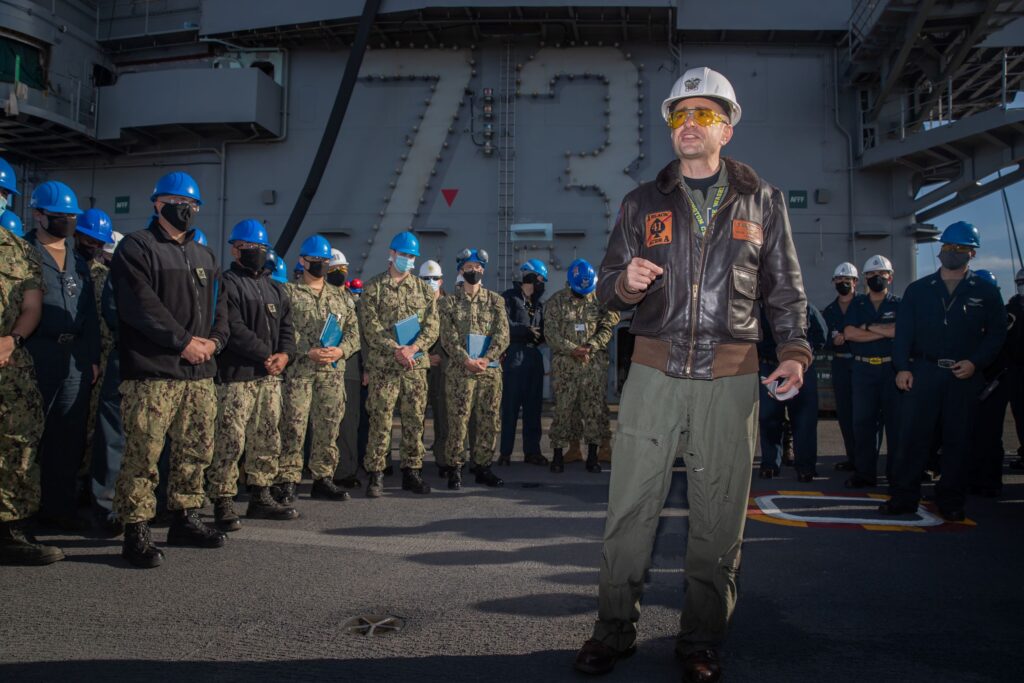
Capt. Joshua Appezzato, air boss, aboard the Nimitz-class aircraft carrier USS George Washington (CVN 73), delivers motivating remarks to the air department at quarters on the flight deck in this 2021 photo. The carrier will be the next to receive modifications to operate the F-35C Lightning II. U.S. NAVY / Mass Communication Specialist 2nd Class Robert Stamer

ARLINGTON, Va. — The U.S. Navy’s next aircraft carrier to receive modifications to operate the F-35C Lightning II strike fighter is the Nimitz-class aircraft carrier USS George Washington (CVN 73), according to a Navy official. 

USS Carl Vinson (CVN 70) — the first carrier to deploy with the F-35C — and USS Abraham Lincoln (CVN 72) currently are deployed to the Western Pacific with F-35Cs as part of their air wings. USS George H. W. Bush (CVN 77), having emerged in August from a Drydock Planned Incremental Availability at Norfolk Naval Shipyard, Portsmouth, Virginia, operated the F-35C in mid-December for the first time. 

Rear Adm. Jim Downey, program executive officer for carriers, speaking Jan. 21 to reporters, detailing the plan through fiscal 2025, said the George Washington was in the final stages of its mid-life Refueling and Complex Overhaul at Newport News Shipbuilding in Newport News, Virginia. The USS Theodore Roosevelt (CVN 71) would follow George Washington in receiving the F-35C modifications and would be followed by USS John C. Stennis (CVN 74), which recently began RCOH.  

The second Gerald R. Ford-class aircraft carrier, the future USS John F. Kennedy (CVN 79), will be the first ship of its class to receive F-35C modifications. The lead ship, USS Gerald R. Ford (CVN 78), is scheduled to receive the modifications during a Planned Incremental Availability period in fiscal 2025.