Fairbanks Morse Defense Acquires Maxim Watermakers

BELOIT, Wis. — Fairbanks Morse Defense, a portfolio company of Arcline Investment Management, has acquired Maxim Watermakers, a privately owned provider of desalination and water treatment technologies for marine defense applications based in Shreveport, Louisiana.

The company’s water treatments systems, which provide life-sustaining water for crews during ship deployments, position Maxim as an essential addition for FMD to provide turnkey onboard solutions and global technical support that ensure crews are always mission ready.  

“What we do is critically important to the safety of our nation and the world, and FMD is firmly committed to being a single-source partner who can deliver turnkey services when and where our customers need us with no time to spare,” said FMD CEO George Whittier. “Maxim has a strong reputation of producing high-quality water treatment systems with a customer-centric approach, which makes it a great addition to our rapidly growing array of best-in-class marine technologies.” 

Operating from a 50,000 square foot manufacturing facility in Shreveport, Lousiana, Maxim currently delivers two lines of seawater reverse osmosis desalination systems and one brackish water reverse osmosis desalination system. Its heat recovery evaporators utilize waste heat to make high-quality potable water from seawater, brackish water, or contaminated feed water sources. Maxim’s products and services include evaporators, reverse osmosis systems, salinity monitoring equipment, cleaning solutions, engineering, parts fabrication and technical services.  

“Like FMD, Maxim does not take lightly the role that we play in making sure our military marine customers are mission-ready,” said Brian Herbert, Maxim CEO. “Our commitment to quality has already earned us the trust of military leadership and becoming part of FMD further strengthens that trust. As part of the FMD brand, we will be able to deploy our technology and expand to more ship classes more quickly.”  

The acquisition of Maxim Watermakers continues to solidify Fairbanks Morse Defense’s position as an integrated defense contractor and turnkey solutions provider to the U.S. Navy and U.S. Coast Guard. In recent months, FMD has completed multiple acquisitions to better serve defense customers, including its acquisitions of Federal Equipment Co., Hunt Valve Co., Ward Leonard and Welin Lambie. 


7th Fleet Destroyer Conducts Freedom of Navigation Operation in South China Sea

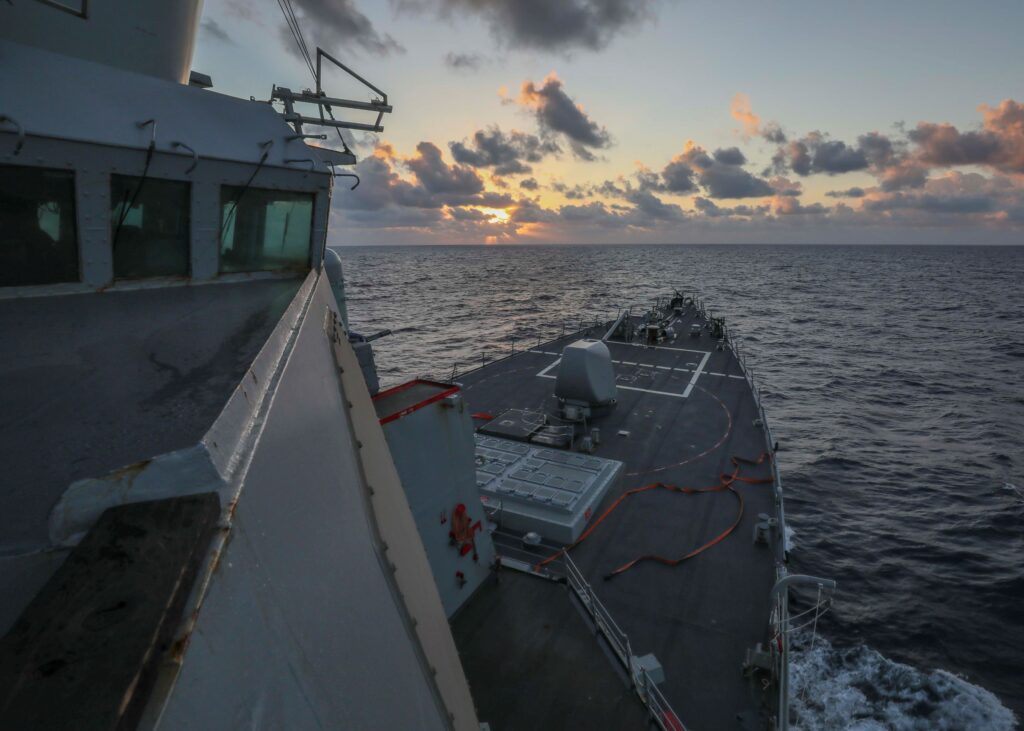
On Jan. 20, USS Benfold (DDG 65) asserted navigational rights and freedoms in the vicinity of the Paracel Islands, consistent with international law. U.S NAVY

YOKOSUKA, Japan — On Jan. 20, USS Benfold (DDG 65) asserted navigational rights and freedoms in the vicinity of the Paracel Islands, consistent with international law. At the conclusion of the operation, USS Benfold exited the excessive claim and continued operations in the South China Sea, the U.S. 7th Fleet said in a release. 

This freedom of navigation operation, or FONOP, upheld the rights, freedoms and lawful uses of the sea recognized in international law by challenging restrictions on innocent passage imposed by the People’s Republic of China, Taiwan and Vietnam and also by challenging the PRC’s claim to straight baselines enclosing the Paracel Islands. 

The PRC’s statement about this mission is false, the 7th Fleet said, adding that USS Benfold conducted this FONOP in accordance with international law and then continued on to conduct normal operations in international waters. The operation reflects its commitment to uphold freedom of navigation and lawful uses of the sea as a principle. The United States is defending every nation’s right to fly, sail, and operate wherever international law allows, as USS Benfold did this week.

The People’s Liberation Army Navy Southern Theater’s statement is the latest in a long string of PRC actions to misrepresent lawful U.S. maritime operations and assert its excessive and illegitimate maritime claims at the expense of its Southeast Asian neighbors in the South China Sea, 7th Fleet said. The PRC’s behavior stands in contrast to the United States’ adherence to international law and our vision for a free and open Indo-Pacific region. All nations, large and small, should be secure in their sovereignty, free from coercion, and able to pursue economic growth consistent with accepted international rules and norms. To this end, the United States works with a broad range of allies and partners across the region to promote and enable cooperative approaches to regional security challenges. 

Unlawful and sweeping maritime claims in the South China Sea pose a serious threat to the freedom of the seas, including the freedoms of navigation and overflight, free trade and unimpeded commerce, and freedom of economic opportunity for South China Sea littoral nations. 

Paracel Islands

The PRC, Taiwan and Vietnam each claim sovereignty over the Paracel Islands. All three claimants require either permission or advance notification before a military vessel engages in “innocent passage” through the territorial sea. Under international law as reflected in the Law of the Sea Convention, the ships of all states, including their warships, enjoy the right of innocent passage through the territorial sea. The unilateral imposition of any authorization or advance-notification requirement for innocent passage is unlawful. By engaging in innocent passage without giving prior notification to or asking permission from any of the claimants, the United States challenged the unlawful restrictions imposed by the PRC, Taiwan, and Vietnam, 7th Fleet said. The United States demonstrated that innocent passage is not subject to such restrictions.  

The United States also challenged the People’s Republic of China’s 1996 declaration of straight baselines encompassing the Paracel Islands. Regardless of which claimant has sovereignty over these features, it is unlawful to draw straight baselines around the Paracel Islands in their entirety, 7th Fleet said. With these baselines, the PRC has attempted to claim more internal waters, territorial sea, exclusive economic zone, and continental shelf than it is entitled to under international law. By conducting this operation, the United States demonstrated these waters are beyond what the PRC can lawfully claim as its territorial sea, and the PRC claimed straight baselines around the Paracel Islands are inconsistent with international law. 


CNO Visits Stennis Space Center

Chief of Naval Operations Adm. Mike Gilday talks to Aerographer’s Mate 2nd Class Kevin Rolka in the oceanographic high bay of Fleet Survey Team headquarters during his first visit to Naval Oceanography and Meteorology Command at Stennis Space Center, Mississippi, Jan. 20. NAVAL METEOROLOGY AND OCEANOGRAPHY / Lt. Bobby Dixon

STENNIS, Miss. — Chief of Naval Operations Adm. Mike Gilday and Vice Adm. Jeffrey Trussler, the deputy chief of naval operations for information warfare and director of naval intelligence, visited Navy commands at Stennis Space Center, Mississippi, Jan. 20, the CNO’s public affairs officer said in a release. 

Gilday met with Sailors and civilians and toured Commander, Naval Meteorology and Oceanography Command (CNMOC) facilities where he received updates about unmanned capabilities, electromagnetic maneuver warfare and undersea warfare.  

“As we find ourselves in the breach of strategic competition, the Navy’s role in this competition remains clear,” said Gilday. “We need to control the seas and project power across all domains, and to support that we will leverage innovation, technology and our people to maintain our competitive advantage.” 

During the visit to the Glider Operations Center, Gilday observed glider pilots directing unmanned littoral battlespace gliders deployed worldwide using satellite communications. The Naval Oceanographic Office, a subordinate command of CNMOC that maximizes seapower by applying relevant oceanographic knowledge in support of U.S. national security, currently has the largest fleet of gliders in the world. 

Throughout the visit, Gilday received updates about unmanned underwater vehicles, unmanned sensor operations and various ocean projects. 

“Unmanned systems have and will continue to play a key part in future operations on, above and under the sea,” Gilday added. “I’m thankful for the work and dedication of Naval Oceanography who continues to help ensure the Navy can meet the demands and challenges of today and tomorrow.”   

This visit marked CNO’s first trip to CNMOC, the Department of Defense’s authoritative source for environmental characterization and transforming knowledge of physical battlespace into winning decisions. 

Naval Meteorology and Oceanography Command directs and oversees more than 2,500 globally distributed military and civilian personnel who collect, process, and exploit environmental information to assist fleet and joint commanders in all warfare areas in making better decisions faster than the adversary. The Sailors and civilians who support the mission serve in a wide range of operational, technical, scientific and service support billets around the globe. 


Navy Still Plans to Start New Frigate Construction in April 2022

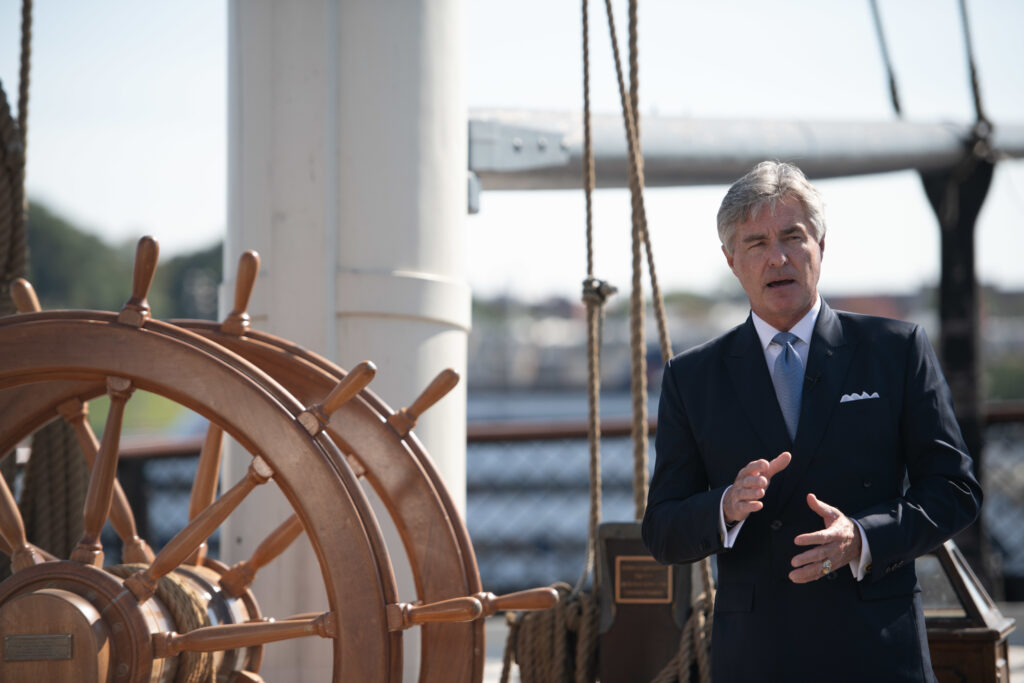
Then-Secretary of the Navy Kenneth J. Braithwaite announces USS Constellation (FFG 62) as the name for the first ship in the new guided missile frigate class of ships while aboard the museum ship Constellation in Baltimore Inner Harbor, Baltimore, Md., Oct. 7, 2020. U.S. NAVY / Mass Communication Specialist 2nd Class Levingston Lewis

ARLINGTON, Va. — As the first new U.S. Navy frigate works its way through detailed and functional design phases, officials still plan an April start for building the lead ship of the Constellation class.

“Right now, as far as construction, we’re targeting that date,” Capt. Kevin Smith, the frigate program manager told a briefing at the Surface Navy Association annual symposium. However, “there could be some risk to that [during the detailed design phase] but we’re looking hard at that,” he said, adding, “the one thing that we want to make sure of is, that we don’t start building a ship where the design is not mature.”

After the design phases are completed, a critical design review and a production readiness review are slated to follow in fiscal 2022. Only “then, when we’re ready” will construction begin on what will become the USS Constellation guided missile frigate (FFG 62), Smith told the Jan. 11 briefing.

The Navy began the acquisition process for a new multi-mission frigate FFG(X) in 2017, awarding a $795 million detailed design and construction contract in April 2020 to Marinette Marine, a Fincantieri company based in Marinette, Wisconsin. Marinette based its design on the Fincantieri FREMM frigate, which is in service with the French and Italian navies.

Among the capital improvements Fincantieri is making at Marinette to accommodate the first frigate’s construction is a syncrolift platform to move the 496-foot hull from dry land into the water. Unlike the littoral combat ships Marinette is building in Wisconsin, the Constellation will be too big for a side launch down a slipway. Frigate construction will be in Marinette’s Building 34, the new hull erection building, which Smith predicted would be a game changer. Big enough to accommodate two full-size frigate hulls and one-third of another, it will allow work to continue indoors during  Wisconsin winters. The frigate will  be “probably close to near completion before they float it off,” and move on to integration of the propulsion plant and combat systems, Smith said.

The frigate will have a combination diesel electric and gas turbine propulsion system, which will be tried and assessed at a Land Based Engineering Test Site being built near the Naval Surface Warfare Center in Philadelphia. Testing on land will feature a full configuration of the frigate’s power plant so “we’re not learning at the waterfront where it’s a little more expensive” to fix problems, Smith said.

The Constellation will also have a beam of 64.6 feet, a draft of 18 feet and a fully loaded displacement of 7,300 tons. “The only thing aluminum on this ship is the mast. Everything else is steel,” Smith said.

The layout is very similar to the FREMM frigate, although to meet U.S. Navy standards for reliability, survivability, maintainability, habitability and lethality, Fincantieri designers “had to lengthen the hull a bit” before submitting their proposal, Smith said. The only changes the Navy made after awarding the contract were to include “buy America” provisions mandated by Congress, he said.


Coast Guard Cutters Begin Operation Aiga in Oceania

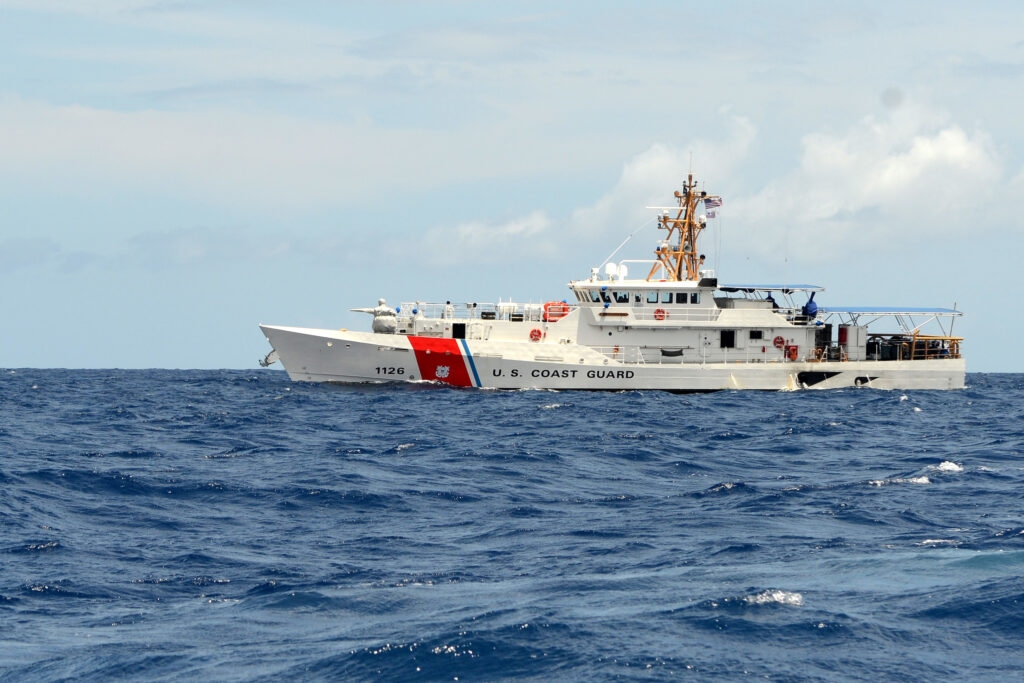
The crew of the U.S. Coast Guard Cutter Joseph Gerczak (WPC 1126), shown here on patrol off the coast of Waikiki, July 4, 2018. U.S. COAST GUARD / Petty Officer 3rd Class Matthew West

HONOLULU — The crews of the Coast Guard Cutter Juniper (WLB 201) and Joseph Gerczak (WPC 1126) will aim to extend the Coast Guard’s at-sea enforcement presence in the region through a 40-day patrol, the Coast Guard 14th District said Jan. 19.  

“Aiga,” the Samoan word for family, is designed to integrate Coast Guard capabilities and operations with Pacific Island Country partners to protect shared national interests, combat illegal, unreported, and unregulated fishing and strengthen maritime governance in Oceania.   

“Responsible fisheries management is vital to the Pacific’s well-being, prosperity, and security,” said Lt. Cmdr. Jessica Conway, the 14th District’s current operations officer. “The Coast Guard is an adaptable, responsive military force of maritime professionals whose broad legal authorities, capable assets, and expansive partnerships provide a persistent presence throughout our exclusive economic zones and on the high seas.” 

IUU fishing operates outside the rules adopted at the national and international level. It threatens the ocean’s ecosystem, food security, and economic growth around the world by undercutting law-abiding fishermen and communities that depend on fish and fish products. 

“An essential protein source for more than 40% of the world’s population, fish stocks are critical to maritime sovereignty and resource security of many nations,” said Cmdr. Christopher Jasnoch, the Juniper’s commanding officer.  

As part of Operation Blue Pacific 2022, the crews of the Juniper and Joseph Gerczak will conduct information sharing activities to advance the U.S.’s bilateral and cultural relationships with Melanesia and Polynesia. 

The Coast Guard regularly exercises bilateral shiprider agreements with partner nations. These agreements help to host foreign law enforcement personnel to better exercise their authority, close any global maritime law enforcement gaps, and improve cooperation, coordination, and interoperability.  

Operation Blue Pacific is an overarching multi-mission Coast Guard endeavor seeking to promote maritime security, safety, sovereignty and economic prosperity in Oceania while also strengthening relationships with our partners in the region.  

“To ensure a free and open Indo-Pacific, the U.S. remains committed to strengthening regional alliances and enhancing emerging partnerships,” said Lt. Joseph Blinsky, Joseph Gerczak’s commanding officer. “Leading global deterrence efforts, the Coast Guard likewise remains committed to combating IUU fishing and our crews look forward to collaborating with PICs to better address this growing national security concern.”   


SECNAV: Allies, Partners Are ‘Huge Advantage’ for U.S.

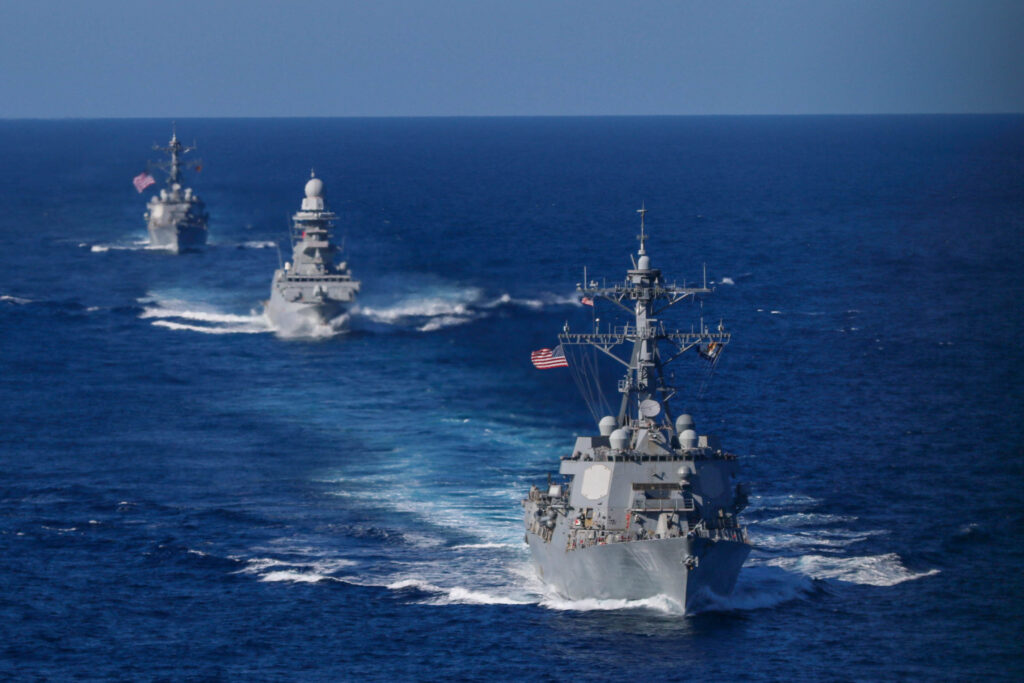
U.S. Navy Arleigh Burke-class guided-missile destroyers USS Gravely (DDG 107), front, and USS Roosevelt (DDG 80), rear, conduct maneuvering operations in the Mediterranean Sea in formation with Italian Carlo Bergamini-class frigate Carlo Margottini (F 592), Jan. 2, 2022. The Harry S. Truman Carrier Strike Group is on a regularly scheduled deployment in the U.S. 6th Fleet area of operations, which Navy Secretary Carlos Del Toro cited as an example of Navy flexibility. U.S. NAVY / Mass Communication Specialist 3rd Class Theoplis Stewart II

WASHINGTON — The secretary of the Navy stressed forward presence and engagement with U.S. allies and partners as advantageous in pacing the threat of China and Russia in the maritime domain.  

Allies and partners “are our huge advantage,” said Navy Secretary Carlos Del Toro, speaking Jan. 18 at the U.S. Navy Memorial in Washington. The Chinese and Russians don’t have that.” 

Det Toro noted the integrated defense strategy as an all-of-government approach to execution of foreign policy, “using all of the capabilities that the United States has,” plus those of allies and partners.   

The U.S. Navy in recent years has increased its presence and patrols in the South China Sea and the Black Sea, both areas of international tension. Del Toro noted the current presence of the USS Harry S. Truman carrier strike group in the Mediterranean Sea — normally absent of a CSG in recent years — and the presence of the USS Carl Vinson CSG in the South China Sea as examples of the flexibility of naval forces and their presence that potential adversaries have to take into account.  

“You’ve got to be present,” Del Toro said. 

The SECNAV, himself a former destroyer skipper, stressed the importance of building relationships with allies and partner nations. He also praised the initiatives of Chief of Naval Operations Michael Gilday and Marine Corps Commandant David Berger to “rethink strategy” and make U.S. naval forces more expeditionary, with the ability to move distributed forces more quickly to an area of operations. He cited the Marine littoral regiments being formed as an example of mobility and ability to operate within the Pacific island chain closest to China. 


Record Seizures in 2021 after NAVCENT and CMF Increase Patrols

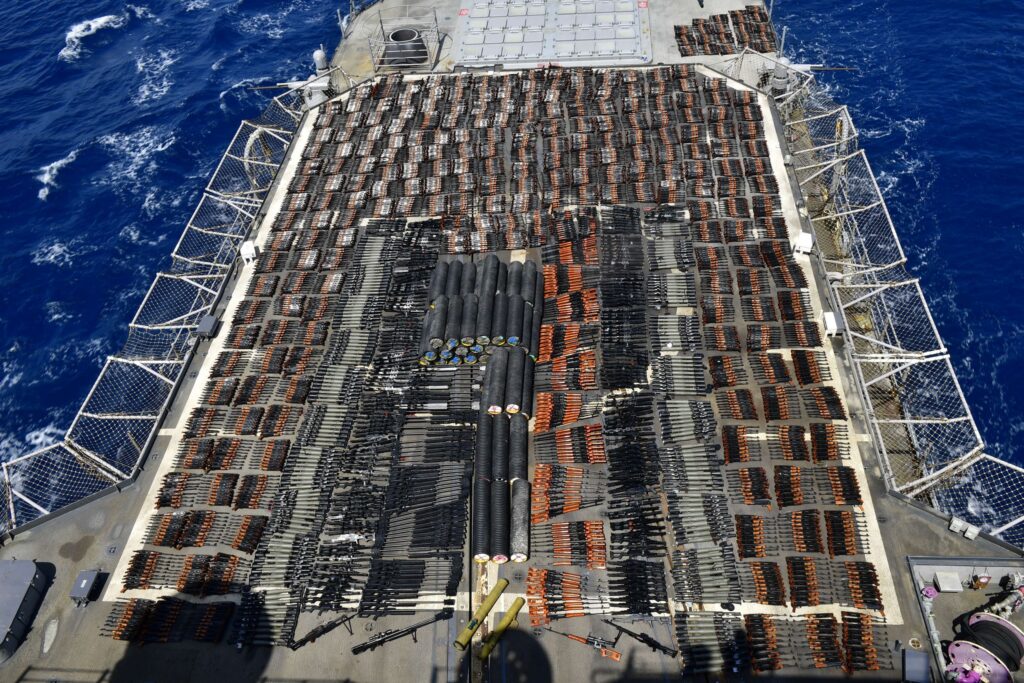
U.S. and international forces operating under U.S. Naval Forces Central Command, U.S. 5th Fleet and Combined Maritime Forces have seized record amounts of illicit cargo during maritime interdictions in 2021. U.S. NAVY

MANAMA, Bahrain — U.S. and international forces operating under U.S. Naval Forces Central Command, U.S. 5th Fleet and Combined Maritime Forces have seized record amounts of illicit cargo during maritime interdictions in 2021, the forces said Jan. 18. 

Led by Vice Adm. Brad Cooper, the maritime organizations conducted more seizures in 2021 after increasing patrols in the Gulf of Oman and Arabian Sea. 
 
CMF seized illegal drugs worth more than $193 million (at regional wholesale prices) during counter-narcotics operations at sea in 2021. This is a higher total value than the drugs CMF interdicted in the previous four years combined. 
 
CMF is the world’s largest multinational naval partnership and includes 34 nations. It is headquartered in Bahrain with U.S. Naval Forces Central Command and U.S. 5th Fleet. 
 
U.S. 5th Fleet warships seized approximately 8,700 illicit weapons in 2021, including 1,400 AK-47 assault rifles confiscated from a stateless fishing vessel in the North Arabian Sea, Dec. 20. 
 
The stateless vessel was assessed to have originated in Iran and transited international waters along a route historically used to traffic weapons unlawfully to the Houthis in Yemen. The direct or indirect supply, sale or transfer of weapons to the Houthis violates U.N. Security Council Resolutions and U.S. sanctions. 
 
Guided-missile cruiser USS Monterey (CG 61) seized dozens of advanced Russian-made anti-tank guided missiles, thousands of Chinese Type 56 assault rifles, and hundreds of PKM machine guns, sniper rifles and rocket-propelled grenade launchers from a stateless vessel transiting the North Arabian Sea in May. 
 
In February, guided-missile destroyer USS Winston S. Churchill (DDG 81) seized a cache of weapons off the coast of Somalia, including thousands of AK-47 assault rifles, light machine guns, heavy sniper rifles, rocket-propelled grenade launchers and crew-served weapons. The inventory also included barrels, stocks, optical scopes and weapon systems. 
 
Since mid-July, U.S. and international maritime forces under CMF have conducted more than 50 boardings of vessels suspected of smuggling illicit cargo in the Gulf of Oman and Arabian Sea, resulting in 14 narcotics seizures and the Dec. 20 weapons seizure. 
 
“We have enhanced our presence and vigilance across regional waters,” said Cooper. “This reflects our continued commitment to confront destabilizing activities that disrupt the rules-based international order which underlies maritime security in the Middle East.” 
 
U.S. and international naval forces regularly conduct maritime security and counter-terrorism operations across the region to disrupt criminal and terrorist organizations and their related illicit activities, including the movement of personnel, weapons, narcotics and charcoal. These efforts help ensure legitimate commercial shipping transits the region free from non-state threats. 


Cooper: LCS Deploying to U.S. 5th Fleet in 2022

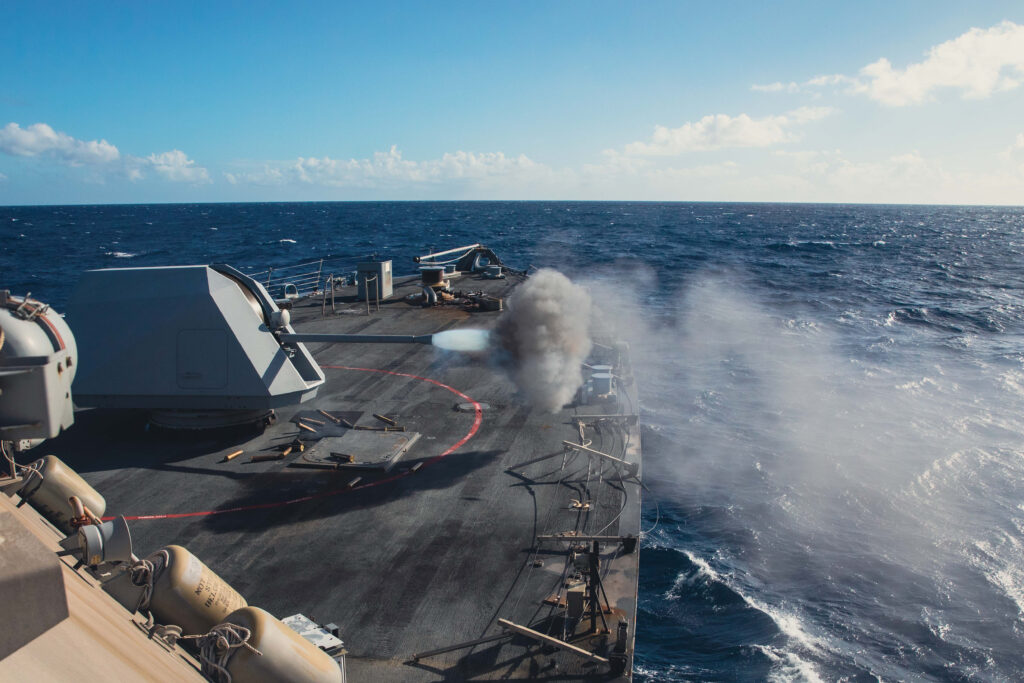
The Freedom-variant littoral combat ship USS Billings (LCS 15) fires a 57mm MK 110 gun from the fo’c’sle, Jan. 8, 2022. U.S. NAVY / Mass Communication Specialist 3rd Class Aaron Lau

ARLINGTON, Va. — The long-planned forward deployment of littoral combat ships to the Persian Gulf is approaching execution, with the anticipated first deployment of an LCS to the U.S. 5th Fleet, the fleet commander said.  

Vice Adm. Brad Cooper, commander, U.S 5th Fleet; commander, Naval Forces U.S. Central Command; and commander, Maritime Forces, speaking in a moderated discussion sponsored by the U.S. Naval Institute and the Center for Strategic and International Studies, a Washington think tank, said the fleet expects to welcome its first LCS in 2022. The ship will be a Freedom-class LCS. 

Cooper said planning is underway to receive and support the ship. 

“We’re in a much better position today than we were last year” to receive the LCS, he said. “I’m very familiar with all of the nuances from my last job at SurfLant [Naval Surface Force, Atlantic]. 

The LCS is slated to replace the Cyclone-class coastal patrol ships and Avenger-class mine countermeasures ships in the 5th Fleet. 

Cooper said there is “no comparison between a PC and what an LCS will bring,” noting the littoral combat ship’s aviation component with MH-60 helicopters and Fire Scout unmanned helicopters, more kinetic strike capability and greater range and endurance.  

“The Navy, over a period of time, has bought the logistics and sustainment component of this that is already prepositioned at Bahrain,” he said.  

The LCS would be the latest ship modernization of the U.S. naval forces in the 5th Fleet area of responsibility. The Coast Guard’s Patrol Force Southwest Asia has received two Sentinel-class fast response cutters — with two more en route and two more planned — to replace the six Island-class patrol cutters.  

An expeditionary sea base ship — the USS Lewis B. Puller — is serving as a platform for mine countermeasures and naval special warfare forces. Cooper said the ship is operating in the North Arabian Sea in addition to the Persian Gulf. 

In addition, the newly organized Task Force 59 is experimenting with unmanned vessels, including persistent surveillance of the Gulf of Aqaba with Saildrone unmanned surface vessels. Cooper said the 23-foot-long Saildrones have been operated in the area for more than 30 days.  

Task Force 59 also has integrated and evaluated Mantas T-12 and T-38 unmanned surface vessels in the region. 


Navy Trains to Counter Drone Threats at Point Mugu

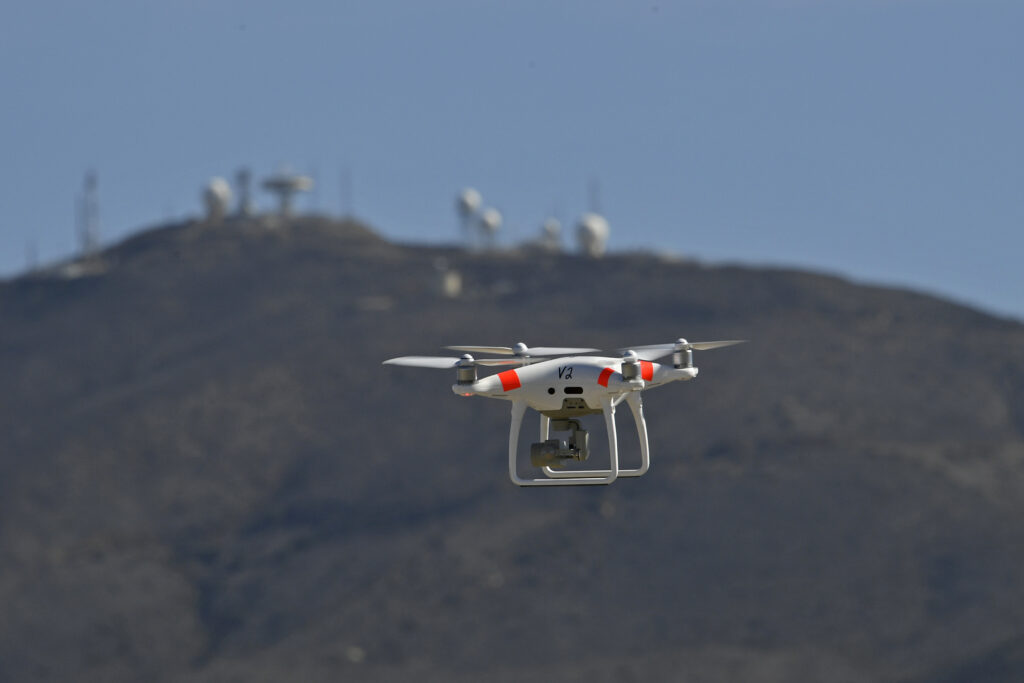
Naval Air Warfare Center Weapons Division’s Pacific Target Marine Operations and Threat/Target Systems Department recently deployed small drones over Naval Base Ventura County, Point Mugu to provide cost-effective unmanned aerial system familiarization and threat training. U.S. NAVY / Ensign Drew Verbis

VENTURA COUNTY, Calif. — The Pacific Target Marine Operations, a division of Naval Air Warfare Center Weapons Division’s Threat/Target Systems Department, recently deployed small drones over Naval Base Ventura County, Point Mugu, to provide cost-effective unmanned aerial system familiarization and threat training. 

“The Low-Speed Aerial Target- Small [LSAT-S] program developed a cost-effective target training and deployment program that directly represents the UAS threat the fleet faces daily,” said Pete Pena, PTMO program lead. “UAS are classified by their size, range, and speed, and are broken into five groups based on those attributes. We’re flying group 1 drones which are considered to be the greatest threat to military forces across the globe due to their unique range of capabilities as well as their relatively low cost and small size.” 
 
In 2021, speaking at a U.S. Senate committee, Gen. Kenneth McKenzie, commander of U.S. Central Command, referred to the proliferation of small drones as the “most concerning tactical development” since the emergence of improvised explosive devices. 
 
Groups 1-3 can range from over-the-counter handheld drones to medium sized drones with sensors and the capacity to deliver weaponized payloads. However, the main threat that comes from groups 1-3 is intelligence, surveillance, and reconnaissance. These drones can be difficult to detect and destroy due to their low flying altitude and small size. 
 
“Point Mugu is a no drone zone,” said Fire Controlman 1st Class Petty Officer Michael Jordan, assigned to NBVC. “It is difficult to obtain authorization to operate drones in this controlled airspace, even for military units. So, this demonstration provided a rare opportunity for watch standers to experience live drone flights and provide identification, which is the first step in countering threats.” 
 
In 2019, Ellen Lord, the former undersecretary of defense for acquisition and sustainment, established a waiver system to authorize drone operations on military ranges in highly controlled conditions, to test the U.S. military’s counter-UAS capabilities. 
 
Civilian and military operators had a chance to fly multiple different scenarios onboard Point Mugu, Pena added. Each test presented a range of conditions, spanning from the direction a UAS was flying to a variance in flight patterns, altitudes, airspeeds, and representative threats. 
 
“This demo is a force multiplier which allows us to offer more frequent and robust counter-UAS presentations to the fleet and installation commanders,” said Cmdr. Todd “Jazz Hands” Faurot, LSAT-S pilot. “This increases our defenses during peacetime and also providing for a war time surge capability.” 
 
The first step in countering the rising threat from UAS is target acquisition and identification. The proliferation of UAS, especially group 1-3, the downsizing of the technology, and its decreasing costs of production will make threat detection difficult. 
 
“Our demonstrations provide the fleet with important UAS familiarization and training to face this increasing airborne threat,” added Pena. 
 
NBVC is comprised of three distinct operational facilities: Point Mugu, Port Hueneme and San Nicolas Island. It is Ventura County’s largest employer and protects Southern California’s largest coastal wetlands through its award-winning environmental program. 


General: Undersea Domain Critical to Marines’ Role as Maritime Chokepoint Defenders

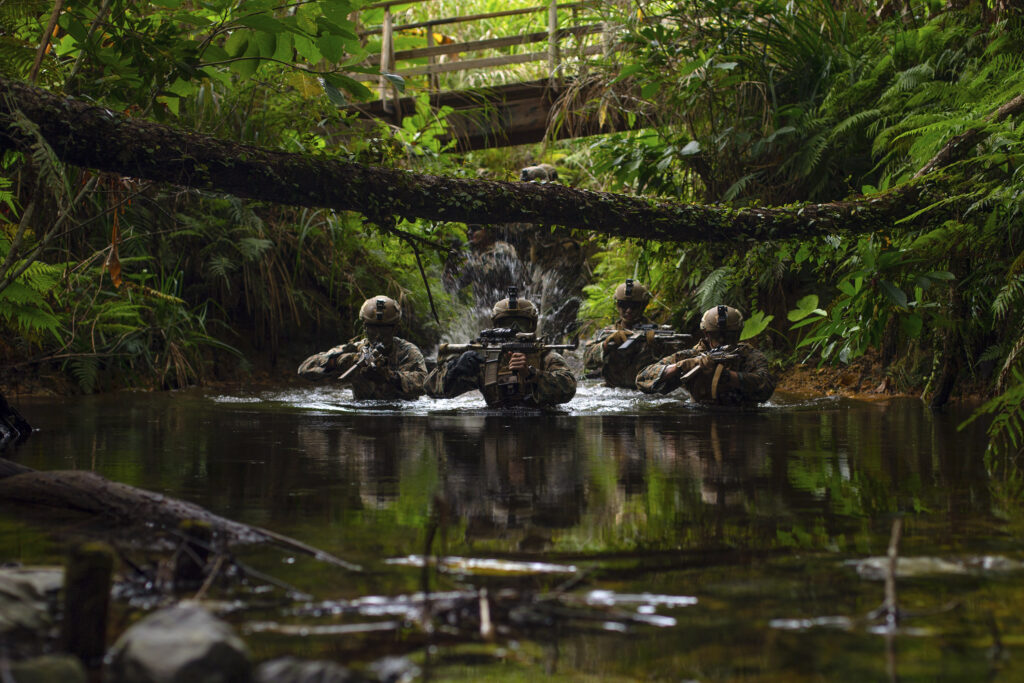
Marines participate in a squad competition at Camp Gonsalves, Okinawa, Japan, Jan. 6, 2022. U.S. MARINE CORPS / Lance Cpl. Jonathan Willcox

ARLINGTON, Va. — The Marine Corps’ role in distributed maritime operations will require technology that can identify underwater threats as well as dangers posed by surface vessels and long range aircraft and missiles, a top commander says.

Speaking Jan. 13 at the Surface Navy Association’s annual symposium in Arlington, Lt. Gen. Karsten S. Heckl, head of the Marine Corps Combat Development Command and deputy commandant for Combat Development and Integration, explained the Marines’ evolving expeditionary warfare role in the Navy strategy for dealing with potential adversaries in the Indo-Pacific region.

The Expeditionary Advanced Base Operations concept envisions littoral operations by specialized  mobile, low signature units within larger distributed maritime operations areas. New Marine Littoral Regiments “uniquely designed to maneuver and persist inside a contested maritime environment,” will have a primary mission “to conduct sea control and denial operations as part of a larger naval expeditionary force,” Heckl said. Equipped with rockets, missiles and other long range fires, as well as surface and amphibious craft to increase their mobility, EABO units will control access to choke points while limiting an adversary’s ability to target them.

But “if you’re telling me that we’re going to occupy and control — sea control, sea denial — critical maritime slots, that means probably more critical than anything, the undersea domain,” Heckl said.

Drawing on his experience as a former commander of I Marine Expeditionary Force, Heckl said, “there are things that exist today to sense underwater. Not expensive, persistent, in fact for the price of probably one P-8 I could sense the majority of the first island chain.”

The subsurface is very important, Heckl said. “We are continuing efforts on that in conjunction with [Marine Corps commandant’s] force design.” A “kill web” of Navy and Marine Corps sea-based and land-based sensors and shooters that gives “a fleet commander the capability to sense a critical slot or a critical piece of maritime terrain, and not have to use a capital asset is pretty significant.”