16-year-old Sea Cadet Participates in Historic World War II Dive in Pearl Harbor
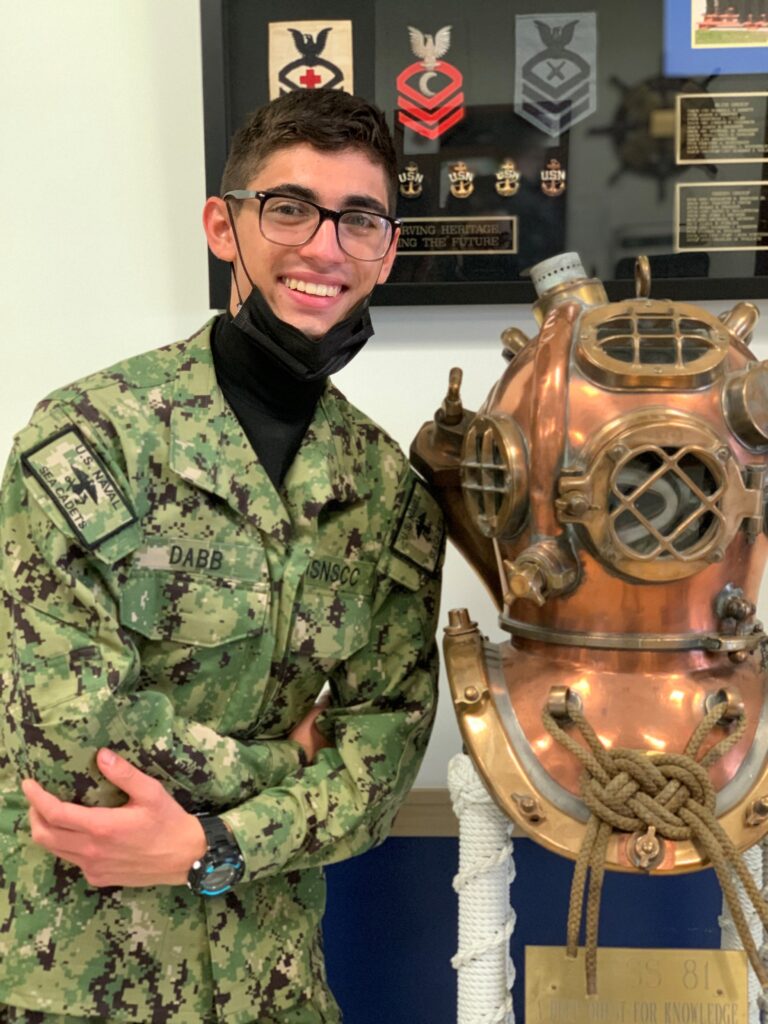
Sea Cadet Petty Officer 3rd Class Jack Dabb participated in the first dive to USS Utah, submerged in Pearl Harbor for 80 years. U.S. NAVAL SEA CADET CORPS / Brittany DiPippo

NEWPORT, Rhode Island – Sixteen-year-old Sea Cadet Petty Officer 3rd Class Jack Dabb, from Battleship New Jersey (BB-62) Division in Camden, New Jersey, attended a Sea Cadet Leadership Training in Newport and had an opportunity to share a once-in-a-lifetime experience on Dec. 28.

The commanding officer of the training, retired Master Chief Avionics Maintenance Technician (AW/IW) Barry Crawford, realized a rare convergence of history was about to occur and saw an opportunity for Dabb to bring a little of his personal story to his classmates.

Dabb is also the youngest member of the Classic Diving Organization, LLC, and participates in deep-sea dives on historic vessels. In December 2021, just a couple of weeks before attending POLA in Newport, he had the privilege of participating in the first live dive to USS Utah (BB-31), submerged in Pearl Harbor for 80 years. Watch the historic dive: https://youtu.be/zjQipLBHohU.

“This leadership training event in Newport is held at Tomich Hall, which is where the U.S. Navy teaches advanced leadership to senior enlisted members of the military. The school’s namesake refers to Chief Watertender Peter Tomich, who posthumously received the Medal of Honor for his actions on board USS Utah on Dec. 7, 1941,” said Crawford.

Tomich and his fellow shipmates remain entombed onboard Utah. Still, Tomich is credited with saving the lives of hundreds of men through his heroic and selfless actions. For the Chief Petty Officers, Tomich is an iconic hero of our Navy’s past we reference when developing the leaders of today.”
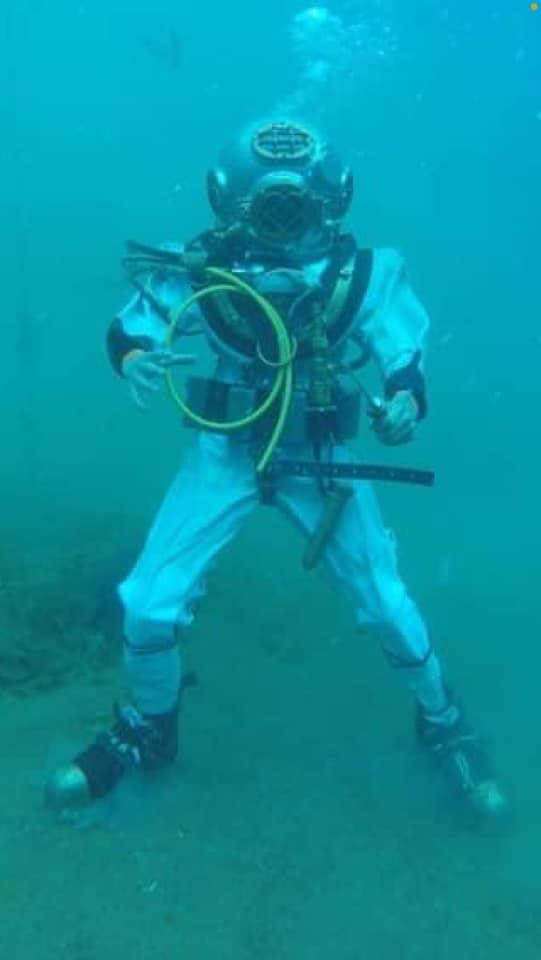
Sea Cadet Dabb during the dive to the USS Utah. SEA CADETS

With cooperation between the U.S. Navy and the National Park Service, the Classic Diving Organization chose Dabb to participate in this rare event. Watch Dabb on Facebook live on Dec. 28, 2021 at 1 p.m. EST, share his diving experience.

“Jack was selected to participate as a crew member and safety diver for the USS Utah live dive broadcast with the National Park Service due to his vast experience with the MK-V diving apparatus,” said U.S. Navy Master Diver John Hopkins, Jr., and co-founder of the Classic Diving Organization, who is stationed at Hickam Air Force Base in Pearl Harbor.

“Jack was an important team member, and with his assistance, it made the event so much easier. This event was to bring back attention to the salvage efforts that took place after the attack on Dec. 7, 1941. This was the first live dive event for Utah, and it was the final piece for the remembrance events for the 80th anniversary of the attack.”

Hopkins added that Dabb has participated with the diving organization on other events in the past.

“He flawlessly folded into our team, and all of us, including the Park Service personnel, appreciated his time, effort, and great work ethic. It is always a joy to work with Jack, and I look forward to working with him again in the future,” said Hopkins.

Crawford added that having the opportunity to present pictures and Dabb’s experience diving to USS Utah and inside Tomich Hall was amazing.

“The faculty assigned to the U.S. Navy Senior Enlisted Academy were invited to the presentation, making a rare connection to things they walk by each day at work,” said Crawford. “Chief Tomich’s Medal of Honor, citation from President Roosevelt, and relics from Utah are on the hallowed quarterdeck at Tomich Hall.”

Crawford added that thousands of Navy leaders have walked by these cherished objects and could only imagine what Tomich sacrificed for his shipmates. “And here we have this 16-year-old Sea Cadet who saw it and shared it with us. What a great experience for us and the 85 participants of POLA Newport 2021.”

What does Dabb think about all this? “Diving on the USS Utah was an experience like no other. I truly can never express what this opportunity means to me because it was so monumental. It made me realize that without history, we have no future.”

For more information about U.S. Naval Sea Cadet Corps, visit www.seacadets.org.


Advanced Weapons Elevators Completed Aboard USS Gerald R. Ford

The aircraft carrier USS Gerald R. Ford (CVN 78) departed Naval Station Norfolk to make the transit to Newport News Shipyard in support of its planned incremental availability, a six-month period of modernization, maintenance, and repairs, Aug. 20. U.S. NAVY / Mass Communication Specialist 1st Class Ryan Seelbach

WASHINGTON — On Dec. 22, the 11th and final advanced weapons elevator aboard USS Gerald R. Ford (CVN 78) was turned over to the ship’s crew, according to Program Executive Office Aircraft Carriers public affairs.

AWEs on this first-of-class aircraft carrier operate using several advanced technologies, including electromagnetic motors instead of more labor intensive, hydraulic systems. The advanced technology enables fewer sailors to safely move ordnance from weapons magazines to the flight deck with unparalleled speed and agility.

“This is a significant milestone for the Navy, ship, and her crew,” said Rear Adm. James P. Downey, Program Executive Officer for Aircraft Carriers. “With completion of this final AWE, we now have the entire system to operate and train with.”

Downey added the Navy-industry AWE team worked tirelessly in port and at sea to complete the elevators to ensure the availability of needed materials and engineering expertise. Multiple vendors have collaborated along the way to ensure seamless support to multi-shift, shipboard production efforts.

“The Navy-industry teaming provided the opportunities for hundreds of craftsmen, technicians and engineers, working around the clock — through multiple underway and holiday periods — to get these advanced systems on line and operational,” said Downey.

The team logged the milestone in the midst of the ship’s six-month planned incremental availability at Huntington Ingalls Industries-Newport News Shipbuilding facility in Hampton Roads, Virginia. Gerald R. Ford is scheduled to complete the PIA this spring, followed by training and deployment.

“The end game is always operational readiness,” added Downey, “and Ford is on track to complete this PIA on schedule, conduct sea trials, and to move on to follow-on tasking.”


Austal Delivers Future USS Canberra to U.S. Navy

The future USS Canberra (LCS 3). AUSTAL USA

MOBILE, Ala. — The U.S. Navy took delivery of the future USS Canberra (LCS 30) at Austal USA on Dec. 21, the company announced, the second Independence-variant littoral combat ship Austal delivered to the Navy in 2021.

“With two ship launches, two christenings, and now the successful completion of sea trials and delivery for LCS 30, it has been a busy last couple of months at Austal USA,” said Austal USA President Rusty Murdaugh. “All of these milestones require extensive coordination between Austal, our vendors and our Navy teammates and I’m proud to say that these partnerships grow stronger with each milestone achievement.”

Acceptance Trials for LCS 30 were completed in early November, demonstrating to the Navy the successful operation of the ship’s major systems and equipment. Delivery documents were signed onboard the future USS Canberra and the crew will now begin preparing the ship for her commissioning into the fleet.

Four LCSs are currently under construction by the company, including the future USS Santa Barbara (LCS 32). Final assembly is underway on the future USS Augusta (LCS 34) and modules are under construction on the future USS Kingsville (LCS 36) and the future USS Pierre (LCS 38).

Two Expeditionary Fast Transports are also under construction at the shipyard, with a third under contract. In October, Austal USA was awarded a contract for the detailed design and construction of two U.S. Navy Towing, Salvage, and Rescue Ships (T-ATS), the first contract for Austal’s new steel construction facility.

Austal has recently been awarded several post-delivery service-related contracts for the LCS program including sustainment execution contracts for both variants of LCS on the East and West coasts and an indefinite delivery indefinite quantity contract to support LCS deployed to the western Pacific and Indian Ocean.


Biden Permits Defense Production Act to be Used to Strengthen Submarine Industrial Base

Tugboats guide the USS Minnesota (SSN 783) to the pier as the Virginia-class nuclear-powered fast-attack submarine returns to Naval Submarine Base New London following a regularly-scheduled deployment in 2021. The Defense Production Act can now be used to scale production of Virginia-class subs. U.S. NAVY / Mass Communication Specialist 2nd Class Tristan B. Lotz

On Dec. 21, President Biden signed three determinations permitting the use of the Defense Production Act to strengthen the U.S. submarine industrial base, the Department of Defense announced Dec. 22.

The expansion of the authority will allow the U.S. Navy to maintain its maritime superiority, the DoD said.

Scaling the production of Virginia-class attack submarines will ensure the U.S. Navy can meet its missions to maintain open sea lanes for global communication and commerce, enhance diplomatic partnerships and grow a robust underwater warfare capability, the DoD said. Through the DPA, the U.S. Navy can make key investments with the manufacturers and suppliers executing the submarine shipbuilding plan.

These activities will strengthen the shipbuilding industrial base and allow its heavy manufacturing and large scale fabrication suppliers to meet growing demand and expand the maritime workforce training pipeline.

“Ensuring a robust, resilient and competitive domestic defense industrial base that has the capability, capacity and workforce to meet the Virginia-class submarine undersea warfighting mission is essential to our national security,” said a memo attributed to Biden.

The DoD said it continues to work with key stakeholders to use Defense Production Act authorities to address risks and challenges across the submarine enterprise supply chain. These authorities expand options and opportunities to accelerate and scale critical investments across key markets.

More information about the DPA is available here, and the presidential determination can be found here.


Austal USA Awarded Contract for Next Generation Logistics Ship Design Studies

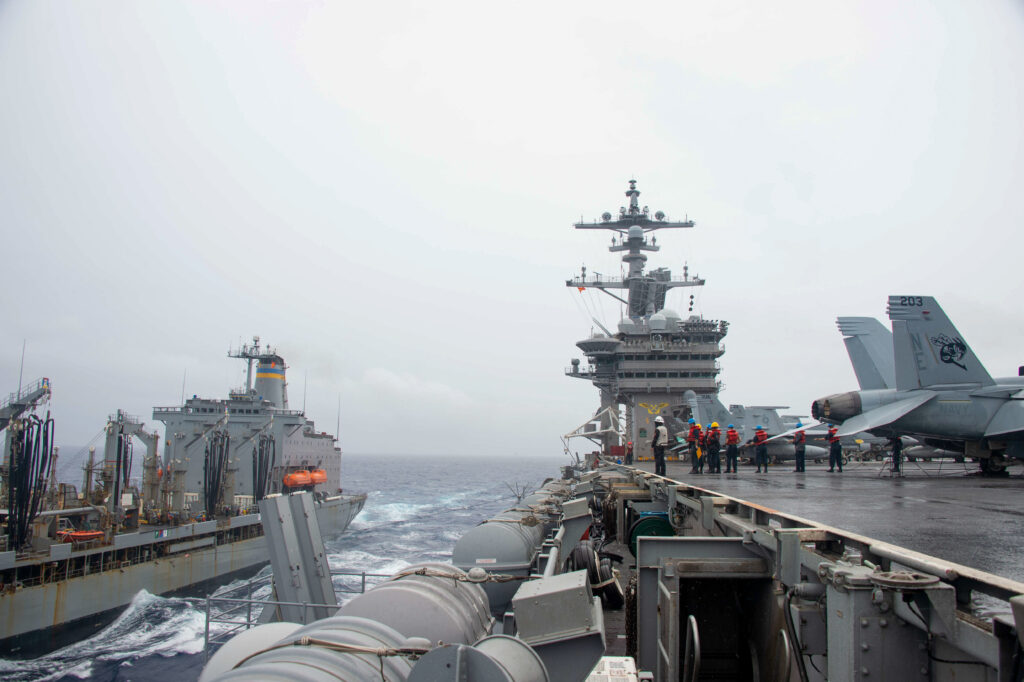
Nimitz-class aircraft carrier USS Carl Vinson (CVN 70) conducts a replenishment-at-sea with Henry J. Kaiser-class fleet replenishment oiler USNS Rappahannock (T-AO 204), The next-generation logistics ship is intended to be a smaller than current combat logistics force ships such as the Rappahannock. U.S. NAVY / Mass Communication Specialist Seaman Elizabeth Grubbs

MOBILE, Ala. — Austal USA was awarded a contract to perform design studies for the U.S. Navy’s next generation logistics ship program Dec. 20, the company announced.

This contract requires Austal to develop a new baseline design and perform specific trade studies for the Navy’s newest logistics ship. Austal, as the shipbuilder and design agent, will be the prime contractor.

“Austal is excited to begin work on another U.S. Navy steel shipbuilding program,” Austal USA President Rusty Murdaugh said. “This contract, combined with our recent T-ATS ship construction contract award and the concept studies we are performing on the LAW p[light amphibious warships] rogram, demonstrate our commitment to bring the same industry leading quality to steel ships as we have been delivering for aluminum ships.”

The next generation logistics ship program represents a new class of medium-sized at-sea supply ships intended to support small surface combatants such as littoral combat ships and frigates as well as the Navy’s planned LAW. The mission of the NGLS fleet will include refueling, rearming, and resupply of naval assets.

Austal USA’s reputation of completing major military vessel contracts on schedule and on budget gives the company a strong foundation to provide a highly capable and cost effective NGLS design to the Navy.


MRIC Live Fire Tests Deemed a Success, Marine Corps Says

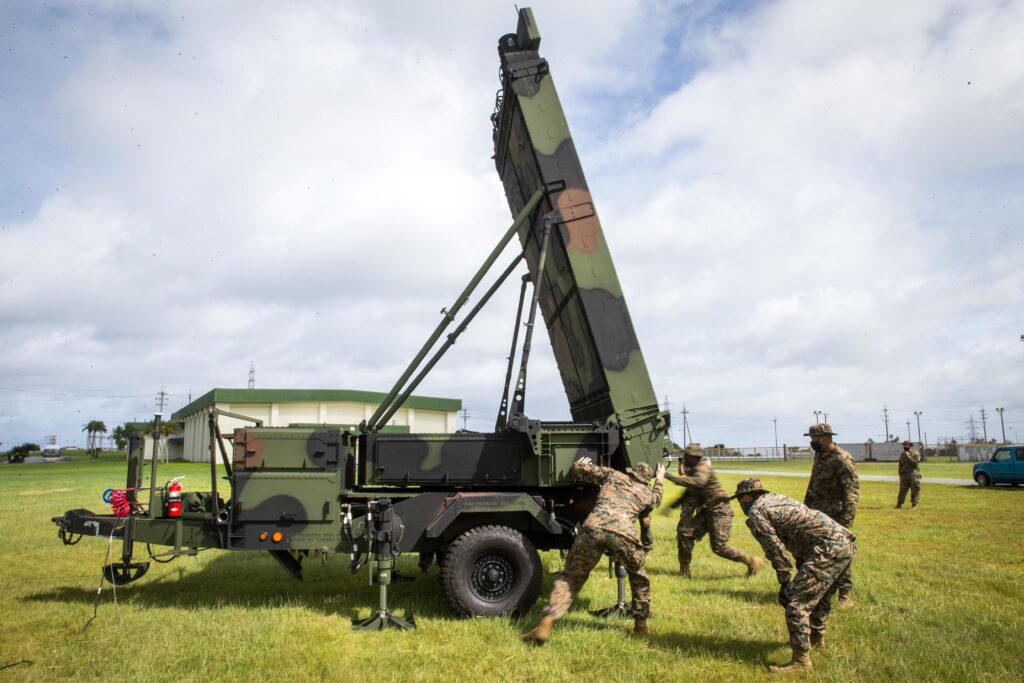
U.S. Marines with 12th Marine Regiment, 3rd Marine Division, adjust a Ground and Air Task Oriented Radar system at Marine Corps Air Station Futenma, Okinawa, Japan, Aug. 10, 2020. The G/ATOR is part of the Corps’ Medium Range Intercept Capability, tested Dec. 16. U.S. MARINE CORPS / Cpl. Savannah Mesimer

The U.S. Marine Corps’ Medium Range Intercept Capability prototype, developed as part of a mid-tier acquisition rapid prototyping effort, successfully engaged targets Dec. 16, 2021, at White Sands Missile Range, the Corps announced.

This first round of tests is part of a series of live fire events scheduled for fiscal year 2022 all of which will be carried out against relevant and increasingly more challenging cruise missile profiles. This test series will stress the system and define the system’s proficiency and potential.

The MRIC prototype is being developed by the Ground Based Air Defense program office at Program Executive Officer Land Systems in support of a Fleet Marine Forces modernization initiative. The effort will inform counter-air defense requirements and any subsequent acquisition activities.

“The MRIC is a missile system which detects, tracks, identifies and defeats enemy cruise missiles threats and other manned and other unmanned aerial threats,” said program manager Don Kelley. “It is planned to provide ground based air defense for permanently fixed and operationally semi-fixed sites.”

The MRIC currently integrates existing Marine Corps systems — specifically, the Ground/Air Task Oriented Radar and Common Aviation Command and Control System — with the Israeli Iron Dome mini-Battle Management Control and Tamir missile.

The project team built upon the lessons learned from an initial demonstration in Aug. 2019. Since then, MRIC has been formally designated a middle tier acquisition–rapid prototype program.

Additional live fire testing is planned during the remainder of fiscal 2022. Pending results, the Marine Corps will decide whether to potentially certify the prototype for deployment, establish an MRIC program of record or both.


USCGC Mohawk Returns from Eastern Pacific Patrol, Conducts International Collaboration

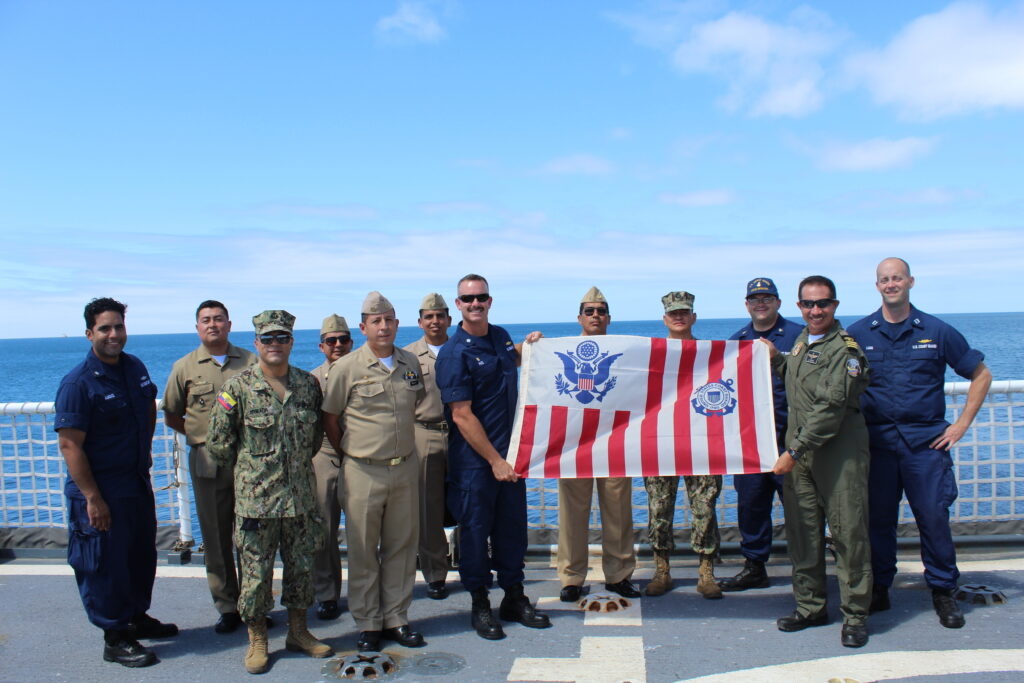
The USCGC Mohawk (WMEC 913) hosts senior officials from the coast guard, navy, and marines of Ecuador for a professional exchange on Nov. 28, 2021, at sea off Ecuador. The Famous-class medium endurance cutter returned to homeport in Key West Sunday after completing a groundbreaking 45-day deployment to the Eastern Pacific Ocean. U.S. COAST GUARD

KEY WEST, Florida — The Famous-class medium endurance cutter USCGC Mohawk (WMEC 913) returned to homeport in Key West Dec. 19 after completing a groundbreaking 45-day deployment to the Eastern Pacific Ocean, U.S. Coast Guard Atlantic Area said Dec. 20.

While on patrol, the Mohawk crew disrupted illegal narcotics smuggling, interdicting more than 3,200 pounds of cocaine. The team conducted joint training missions with crews from Panama and Ecuador to strengthen regional partnerships in the Western Hemisphere.

Patrolling in support of Joint Interagency Task Force South, the Mohawk team interdicted a low-profile drug smuggling vessel with approximately 3,200 pounds of cocaine aboard and apprehended three suspected narcotics smugglers. These low-profile vessels are purpose-built to evade detection and transport illicit contraband across thousand-mile stretches of ocean. The drugs, worth more than $60 million, were seized in international waters of the Eastern Pacific Ocean off the coast of Ecuador. While in theater, Mohawk aided in stopping 17 suspected drug smugglers, contributing directly to U.S. Southern Command objectives to combat transnational criminal organizations.

During the Mohawk’s deployment, the crew took multiple opportunities to strengthen ties with partner nations in the region, including conducting joint rescue and assistance drills, exchanging law enforcement and boarding techniques, and practicing towing with Panamanian Servicio Nacional Aeronaval vessels. Mohawk’s crew also completed a passing exercise with the Armada del Ecuador offshore patrol vessel LAE Isla San Cristobal (LG 30) and conducted a two-day joint counter-narcotics patrol through Ecuador’s exclusive economic zone in the Galápagos Islands.

“International partnerships are critical to detecting and deterring illicit narcotics smuggling; engagements such as these with foreign partners enhance interoperability and interdiction capabilities,” said Cmdr. Andrew Pate, commanding officer of the Mohawk.

Mohawk made history during its deployment as the first U.S. Coast Guard cutter to visit and anchor in the Galápagos Islands. The islands are a province of Ecuador and a UNESCO World Heritage site, made famous for species diversity and unique terrain. While at anchor in San Cristobal, Galápagos, Mohawk conducted a professional exchange with senior ranking officials from Armada del Ecuador, held joint law enforcement training, enjoyed a cultural exchange ashore, and took part in a friendly U.S. versus Ecuador game of soccer.

“The U.S. Coast Guard’s ability to forge strong and lasting international partnerships that further the national interest is what makes us such a unique instrument of national security. I am very proud of the Mohawk crew for their work as envoys of the U.S. Coast Guard. The opportunity to work alongside the maritime professionals of Ecuador and Panama during this deployment, as well as our interdiction success sends a strong signal to transnational criminal organizations that the United States values enduring commitments in the region,” Pate said. “Our interactions with the Armada del Ecuador in Galápagos left a profound impression on my crew. Choosing to go to sea and serve on a U.S. Coast Guard cutter opens the door to experiences and camaraderie that you don’t get in a normal nine to five job.”

While underway, the cutter’s crew completed aviation, damage control, engineering, seamanship, navigation, and combat systems training to maintain operational readiness and prepare for future multi-mission deployments.

Commissioned in March of 1991, Mohawk is the 13th and final of the 270-foot Famous-class cutters built. The medium endurance cutters fall under the command of the U.S. Coast Guard Atlantic Area. Based in Portsmouth, Virginia, U.S. Coast Guard Atlantic Area oversees all Coast Guard operations east of the Rocky Mountains to the Arabian Gulf. In addition to surge operations, they also allocate ships to deploy to the Caribbean and Eastern Pacific to combat transnational organized crime and illicit maritime activity.


AUSTAL Places Order for Floating Dry Dock

SAN DIEGO — Immediately after finalizing a deal on a new repair facility in the Port of San Diego, Austal USA placed an order for a floating dry dock. The new floating dry dock, optimized to efficiently dock small surface combatants and similar sized ships, will be the centerpiece of the new repair facility.

“This dry dock will greatly enhance Austal’s ability to provide the Navy and other customers a highly capable full-service repair facility located in the homeport of San Diego,” Austal USA President Rusty Murdaugh said. “It will be invaluable to our customers, and we are eager to satisfy their growing demand for West coast repair facilities that include dry docks.”

The dry dock will have a 9,000 light ton lifting capacity. It will be 531 feet (162 meters) long, 154 feet (47 meters) wide, with a maximum draft of 36 feet (11 meters). Construction on the dry dock began today and the completed vessel is scheduled to be fully operational in Austal’s new San Diego repair facility by August 2023.

This contract is one of several milestones Austal USA has achieved over the last several weeks to grow the capability and capacity of its Services business. The acquisition of the San Diego facility and the dry dock, combined with recent contract awards, further cement Austal USA’s role in maintaining and repairing ships throughout the United States and INDOPACOM region.


U.S. Navy, Boeing Complete First Carrier Tests for MQ-25

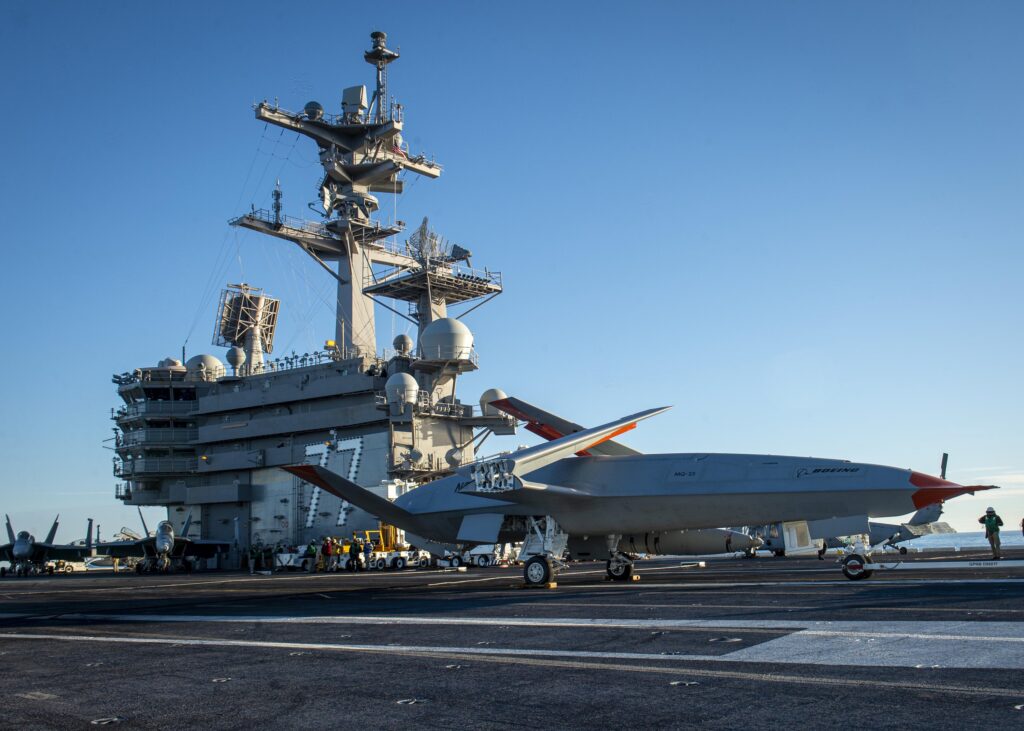
An MQ-25 Stingray test asset conducts deck handling maneuvers Dec. 12 while underway aboard USS George H.W. Bush (CVN -77). This unmanned carrier aviation demonstration marked the first time the Navy conducted testing with the MQ-25 at sea. U.S. NAVY

NORFOLK, Va. — The U.S. Navy and Boeing have successfully maneuvered the Boeing-owned T1 test asset on a U.S. Navy aircraft carrier for the first time, an early step forward in ensuring the MQ-25 unmanned aerial refueler will seamlessly integrate into carrier operations.

During an underway demonstration aboard the USS George H.W. Bush (CVN 77), Navy flight deck directors — known as “yellow shirts” — used standard hand signals to direct T1 just like any other carrier-based aircraft. Instead of a pilot receiving the commands, however, it was a Boeing MQ-25 Deck Handling Operator (DHO) right beside the yellow shirt who commanded the aircraft using a new handheld deck control device.

“This is another significant step forward in demonstrating MQ-25’s integration into the Carrier Air Wing on the flight deck of our fleet’s aircraft carriers,” said Capt. Chad Reed, Unmanned Carrier Aviation program manager. “The success of this event is a testament to the hard work of our engineers, testers, operators and the close collaboration and teaming from Naval Air Force Atlantic and the crew aboard CVN 77.”

The demonstration was intended to ensure the design of the MQ-25 will successfully integrate into the carrier environment and to evaluate the functionality, capability and handling qualities of the deck handling system both in day and night conditions. Maneuvers included taxiing on the deck, connecting to the catapult, clearing the landing area and parking on the deck.

“The Navy has a rigorous, well-established process for moving aircraft on the carrier. Our goal was to ensure the MQ-25 fits into the process without changing it,” said Jim Young, MQ-25 chief engineer. “From the design of the aircraft to the design of the system moving it, our team has worked hard to make the MQ-25 carrier suitable in every way.”

DHO’s trained in Boeing’s deck handling simulation lab in St. Louis, where they practiced entering commands from simulated yellow shirts into the real handheld device. A simulated MQ-25, running the aircraft’s real operational flight code and interfaces, would move accordingly. The handheld controller is a simple, easy-to-use device designed specifically for a generation of sailors who natively understand such handheld technology and have experience with controllers used in the gaming industry today.

The deck handling demonstration followed a two-year flight test campaign for the Boeing-owned T1 test asset, during which the Boeing and Navy team refueled three different carrier-based aircraft — an F/A-18 Super Hornet, an E-2D Hawkeye and an F-35C Lightning II.

“The Navy gave us two key performance parameters for the program — aerial refueling and integration onto the carrier deck,” said Dave Bujold, Boeing MQ-25 program director. “We’ve shown that the MQ-25 can meet both requirements, and we’ve done it years earlier than traditional acquisition programs.”


Navy Secretary Sees Climate Change, Illegal Fishing as Global Maritime Security Challenges

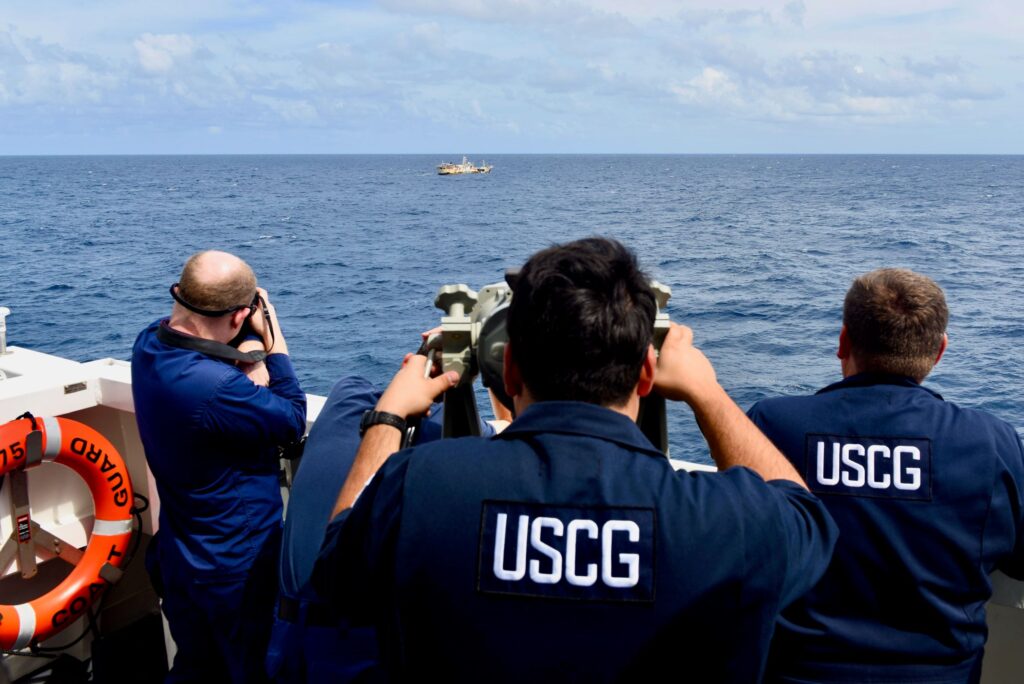
USCGC Stone (WMSL 758) patrols high seas observing fishing activity to support Operation Southern Cross in the South Atlantic, Feb. 6, 2021. U.S. COAST GUARD / Petty Officer 3rd Class John Hightower

ARLINGTON, Va. — Linking climate change’s impact on trade, fishing, energy and employment with the economic and environmental toll of illegal, unreported and unregulated fishing, U.S. Navy Secretary Carlos Del Toro says the world’s “blue economy” has never been more important or more challenging.

“From climate change to illegal and unreported fishing, the environmental challenges facing our oceans are global challenges that require truly a global response,” Del Toro told an ocean security forum at a Washington think tank Dec. 16.

The Navy secretary told a live audience at the Center for Strategic and International Studies, and others watching remotely, that the Navy-Marine Corps team “is determined to do our part.”

The World Bank defines the blue economy as the “sustainable use of ocean resources for economic growth, improved livelihoods, and jobs while preserving the health of ocean ecosystem.”

On climate change, Del Toro said the marine environment is under threat from receding shorelines, melting sea ice, extreme weather and “a more aggressive competition for resources” like fish stocks and underwater energy and mineral deposits.

Prompted by President Joe Biden and Defense Secretary Lloyd Austin’s concerns about the climate challenge, Del Toro said the Navy Department, among other actions, is implementing hybrid technology to power five classes of combat ships and eight classes of logistics ships, purchasing zero emission vehicles and assessing a renewable energy system at Marine Air Station Miramar, California, to reduce reliance on San Diego’s power grid.

Del Toro said IUUF is having “profoundly destabilizing effects on many regions. This is happening on an industrial scale as nations like China not only refuse to restrain their distant waters fishing fleet, but actively subsidize the devastation they’re actively causing,” he said.

IUUF has taken such a toll on the economies of small maritime nations and world fish stocks — while increasing geo-political tensions and spawning instability — that the U.S. Coast Guard says it’s a greater security threat today than piracy at sea.

The combined Navy, Marine Corps and Coast Guard Maritime Strategy includes IUUF as part of the threat posed by near peer competitors China and Russia. The document notes China’s “state-subsidized distant water fishing fleet steals vital resources from nations unable to defend their own exclusive economic zones.”

Del Toro noted Coast Guard law enforcement teams have been deployed aboard several Navy ships as part of the Oceania Maritime Security Initiative.

Also speaking at the forum, Coast Guard Commandant Adm. Karl Schultz said his agency has taken an increasing leadership role in building trust and partnerships with foreign maritime states, particularly with the small island nations of the Pacific who lack the resources to enforce sovereignty over their resources and waters. Ocean-going Coast Guard cutters have trained partner nation coastal protection forces and aided them with situational awareness.

He noted the National Security Cutter Stone (WMSL 758), on its first voyage sailed down the east coast of South America, partnering with the maritime forces of Guyana and Brazil, and later with Ecuador and Colombia on the Pacific coast.

The Coast Guard, with approximately 57,000 personnel, does not have the capacity to be “the world’s fish cops,” Schultz said, “but I think we could bring some leadership. We could stitch together partners. We have a recognized brand that’s sort of known across the globe.”