NAVSEA to Proceed with COBRA II Littoral Mine-Countermeasures System
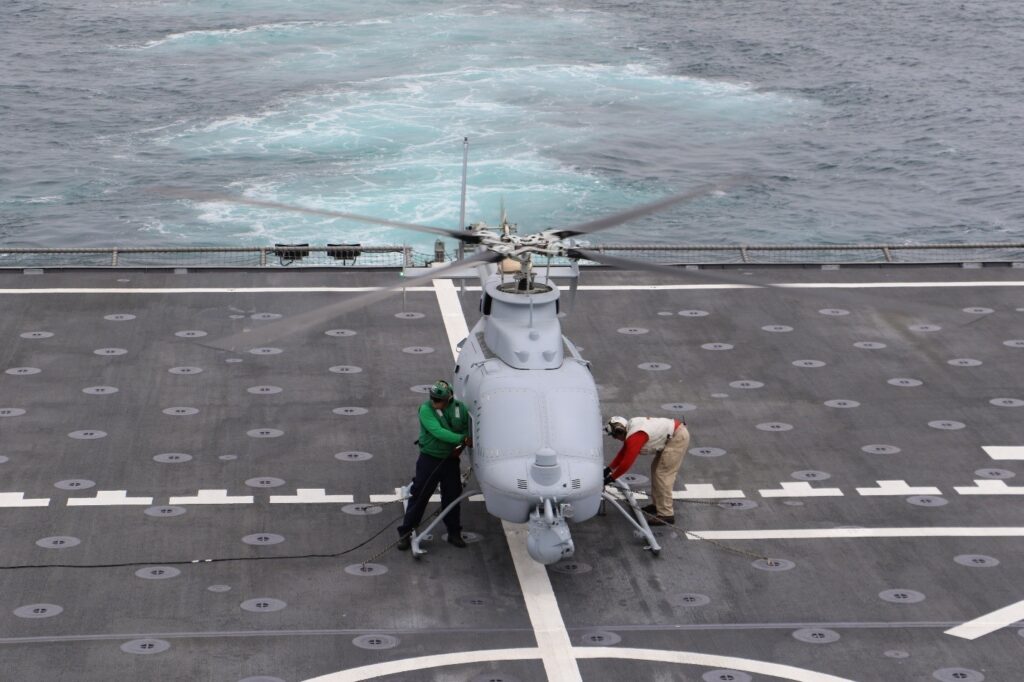
COBRA Block II is planned for installation on MQ-8C Fire Scout unmanned aerial vehicles, such as the one shown here on littoral combat ship USS Jackson (LCS 6) in April, 2021. U.S. NAVY / Ens. Alexandra Green
ARLINGTON, Va. — Naval Sea Systems Command announced it intends to solicit bids for a contract to design, develop and build a Block II version of the Coastal Battlefield Reconnaissance and Analysis system.
The COBRA Block I is a mine- and obstacle-detection multispectral sensor that is a modular component of the mine warfare mission package for littoral combat ships. It is designed to detect mines from the beach through the surf zone. The COBRA is the intelligence, surveillance and reconnaissance technology component of the planned Assault Breaching System. In March 2009, COBRA Block I was rated mature enough to enter low-rate initial production. The COBRA was tested on an MQ-8B Fire Scout unmanned helicopter in October 2010. Initial operational capability was achieved in July 2017. Operational testing was completed in April 2018. The Block I was built by Arete Associates.
Block II, planned for installation on the MQ-8C Fire Scout unmanned helicopter, will add night operation capability and full-detection capability of mines in the surf zone out to 200 feet of water depth during a single pass with a high coverage rate.
The COBRA Block II system, when fully developed, will be a battlefield reconnaissance and analysis system designed to conduct aerial tactical reconnaissance in the littoral battlespace for the detection and localization of individual mine-like objects, minefields, minelines and obstacles in the surf zone and beach zone; for the detection and localization of surface and near-surface mine-like objects in very shallow water; and for the detection and localization of surface and near-surface mine-like objects, moored or drifting in shallow water through deep water in day or night, the NAVSEA announcement said.
NAVSEA anticipates the contract award will be for up to three engineering and manufacturing development models and up to five low-rate initial production units of the COBRA Block II.
NAVSEA anticipates releasing a request for proposals in the second quarter of fiscal 2022.
Canadian Patrol Ship Circumnavigates North America on First Voyage
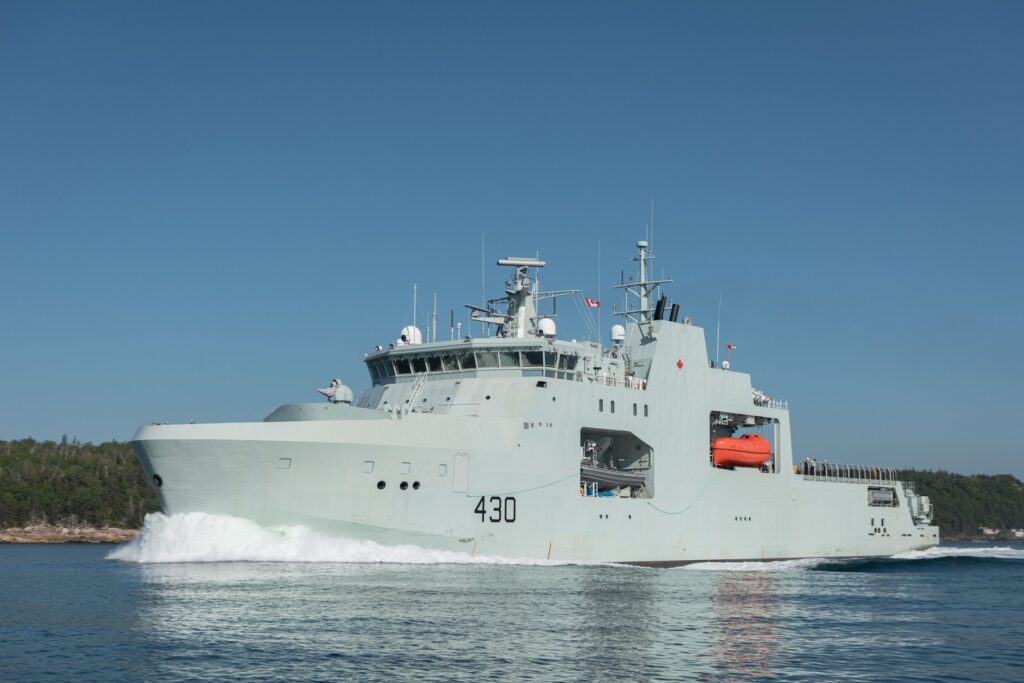
HMCS Harry DeWolf, which recently called at Naval Station Norfolk as part of its circumnavigation of North America. WIKIPEDIA / Hken 167
The Royal Canadian Navy Arctic and offshore patrol ship HMCS Harry DeWolf (AOPV 430) recently called at Naval Station Norfolk, Virginia, as the final stop on its historic circumnavigation of North America.
Commissioned in June, Harry DeWolf is the Royal Canadian Navy’s first new warship in 25 years and its first ice-capable vessel since HMCS Labrador in 1958.
For its first voyage, Harry DeWolf transited to the Arctic to participate in Canada’s Operation Nanook annual training exercises in the high north, then continued through the Northwest Passage and working with the U.S. Coast Guard in Alaskan waters. From there the patrol vessel proceeded to San Diego and embarked a U.S. Coast Guard law enforcement detachment and conducted counter-narcotics operations in the Eastern Pacific and the Caribbean Basin.
In Alaska, the ship participated in a mass casualty drill with the U.S. Coast Guard. Further south, the crew took part in Op Caribbe, Canada’s contribution to U.S. enhanced counter-narcotics operations under U.S. Joint Interagency Task Force South in the Eastern Pacific and Caribbean. Working with an embarked U.S. Coast Guard Law Enforcement Detachment, Harry DeWolf helped with the seizure and offload of approximately 26,250 pounds of cocaine and 3,700 pounds of marijuana worth about $504 million from the USCGC Hamilton (WMSL 753) in Port Everglades, Florida, Nov. 22.
The ship arrived in Norfolk Dec. 9 and departed Dec. 12.
While highly capable for polar operations, the ship is also designed to conduct patrols wherever needed in the world. HMCS Harry DeWolf Commanding Officer Cmdr. Corey Gleason said the unique ship design is specific to Canadian needs.
“Our allies all have offshore patrol vessels, but they don’t have the Arctic stamp on it. If we are truly going to operate our domestic waters, we have to be to go north, not just during the navigable between July and October, but any time. Earlier this year we were up in the dead of winter breaking ice, with no other ships,” he said.
The deployment also demonstrated the endurance of the ship as it visited ports and communities in Nunavut, Northwest Territories and Yukon Territory. While the ship did take on fuel during port visits to Nuuk, Greenland, and Dutch Harbor, Alaska, Gleason said the ship has the range to sail from Halifax to the Esquimalt naval base in British Columbia on a single tank of fuel.
“I always knew that this ship had an incredible capability anywhere in the world. And we demonstrated that tenfold in the four and a half months that were deployed,” he said.
Gleason said the Royal Canadian Navy doesn’t have a great deal of experience operating in the ice. As the skipper of the first Arctic and offshore patrol ship, Gleason said he spent a lot of time providing ship-handling experience to his officers, and he’s been training the commanding officers, executive officers and navigators of the other ships to help them get ready for the Arctic when their ships are commissioned.
During the deployment, the ship underscored the close working relationship between maritime services of Canada and the U.S.
“In terms of our cooperation, the United States is really is our premier partner in the Arctic,” said Martin Loken, deputy head of mission for foreign policy and national security at the Embassy of Canada in Washington. “Canada’s Arctic and Northern Policy Framework sets out our overall government approach to the north and to the Arctic. There are a lot of elements there, and almost every single one of them aligns with U.S. interests in the Arctic, whether it’s providing economic opportunities for populations, building and investing in stronger, more resilient infrastructure, preparing for the impacts of climate change, advancing indigenous reconciliation, and the list goes on.”
A U.S. naval officer joined the ship for its first deployment. Lt. j.g. Kyle Luchau of the guided-missile destroyer USS Winston S. Churchill (DDG 80), served as a liaison officer and completed the circumnavigation of North America.
The RCN plans to build six Arctic and offshore patrol ships at the Irving Shipyard in Halifax, which are being constructed as part of Canada’s National Shipbuilding Strategy. Two more AOPS will be built for the Canadian Coast Guard.
MQ-4C Triton UAS Arrives in Florida as Australian Triton Takes Shape
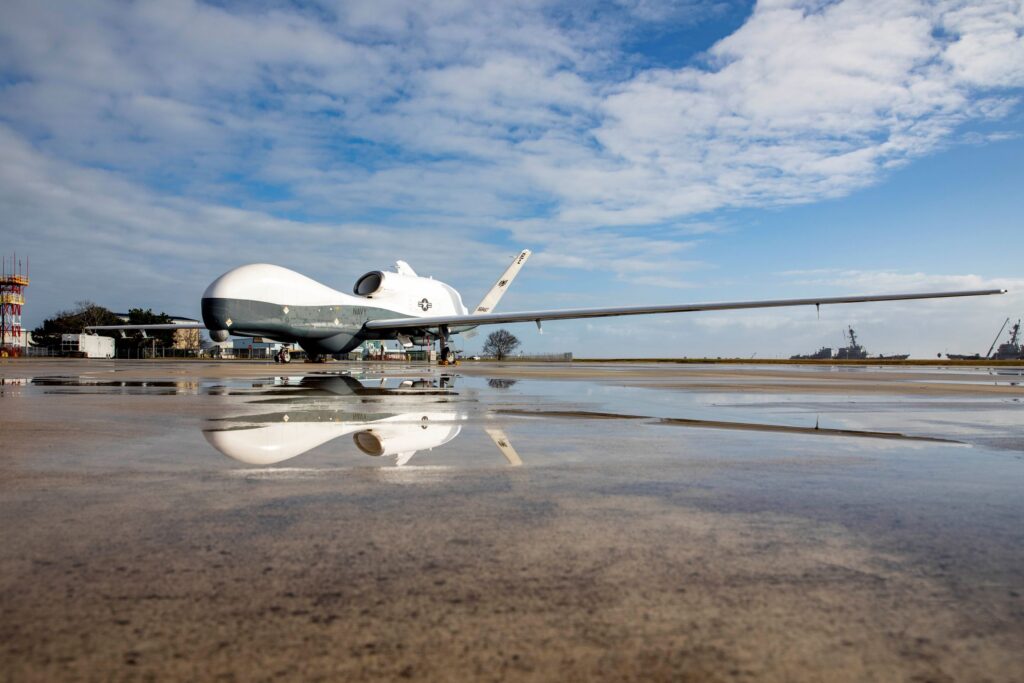
The Navy’s MQ-4C Triton unmanned aircraft arrived in Mayport, Florida, Dec. 16, as part of early operational capability efforts. U.S. NAVY
MAYPORT, Fla. — The Navy’s MQ-4C Triton unmanned aircraft system arrived in Mayport, Florida, Dec. 16, following its initial deployment in the Pacific theater, the office of Commander, Naval Force Atlantic said Dec. 17.
This air vehicle was one of two MQ-4C Triton UAS that operated from Andersen Air Force Base in Guam, after completing their first rotational deployment to Japan Oct. 12, 2021.
“The MQ-4C Triton demonstrates the significance of manned and unmanned integration to support national security interests,” said Cmdr. Brian Conlan, commander, Unmanned Patrol Squadron (VUP) 19. “The VUP-19 and MQ-4C Triton deployment to the 7th Fleet area of responsibility provided an opportunity to apply and refine the tactics, techniques, and procedures to expand our concept of operations and inform planning for future deployments around the world.”
VUP-19, the first Triton UAS squadron, operates and maintains two aircraft as part of an early operational capability to further refine the concept of operations, including expeditionary basing, and complement manned systems to better locate, identify, and track contacts of interest in the maritime domain.
The MQ-4 Triton’s arrival at Naval Station Mayport will support unit-level training and preparation for the next variant of MQ-4C.
The Navy conducted its first test flight of the MQ-4C Triton in its upgraded hardware and software configuration, known as integrated functional capability 4, July 29 at Naval Air Station Patuxent River, Maryland. IFC-4 brings an enhanced multi-mission sensor capability as part of the Navy’s maritime intelligence, surveillance, reconnaissance and targeting transition plan.
The MQ-4C Triton conducts intelligence, surveillance and reconnaissance missions that pair with the P-8A Poseidon and it brings increased persistence, capability, and capacity through its multi-sensor mission payload.
Australia’s first MQ-4C Triton fuselage is lowered onto the unique one-piece wing. NORTHROP GRUMMAN
Australian MQ-4C Triton Takes Shape
Meanwhile, Northrop Grumman Corp. recently completed a significant milestone in the production of Australia’s first MQ-4C Triton when the aircraft fuselage was mounted onto Triton’s unique one-piece wing, the company said. Once completed and delivered, Triton’s powerful payload and endurance will provide the Royal Australian Air Force the ability to detect and analyze threats that were previously undetectable.
“This production milestone further demonstrates our commitment to both sides of the cooperative program between the Royal Australian Air Force and the U.S. Navy,” said Rho Cauley-Bruner, Triton program manager at Northrop Grumman. “We are on schedule to deliver Triton’s powerful capability in support of Australia’s national security.”
Australia’s first Triton is on track to be delivered just as the U.S. Navy expects to achieve initial operating capability with its multi-intelligence Tritons, the same configuration Australia is receiving. The identical capabilities will allow the RAAF and U.S. Navy to share data and maintain an unblinking autonomous intelligence, surveillance, reconnaissance and targeting capability over some of the world’s most critical maritime regions.
“I am looking forward to seeing our first Triton roll off the production line and then commence flying in Australian skies in 2024,” said Group Captain Jason Lind, director of Intelligence, Surveillance, Reconnaissance and Electronic Warfare at RAAF headquarters. “This capability will extend Australia’s ability to see and understand our maritime approaches to the north and also as far south as Antarctica.”
PEO Columbia Recognized for Acquisition Excellence
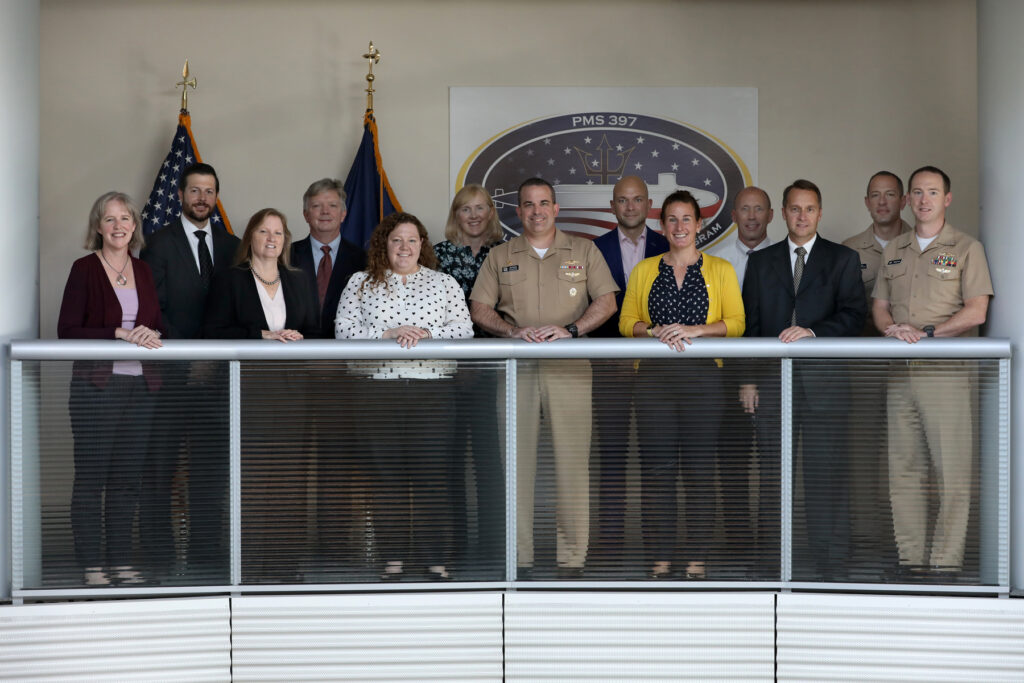
NAVSEA’s PMS 397 Columbia Class Submarine Program team photo for the Packard Award. U.S. NAVY / Laura Lakeway
WASHINGTON — Deputy Defense Secretary Kathleen H. Hicks named the Columbia-class submarine program office (PMS 397) winner of the 2021 David Packard Acquisition Excellence Award during the virtual 2021 Defense Acquisition Workforce Awards on Dec. 15.
The Columbia-class submarine program is developing the follow-on to the Ohio-class ballistic missile submarines (SSBNs) which currently serve as the cornerstone for the nation’s strategic deterrence force. The David Packard Excellence in Acquisition Award recognizes Department of Defense acquisition programs and their teams that have demonstrated exemplary acquisition excellence, innovation and reform.
“Our winners this year are the best of the best among our nation’s public service professionals,” said Hicks, adding that the work of the department’s acquisition professionals “is vital to supporting our nation’s military.”
The Columbia-class submarine program stood out from other DoD acquisition efforts by developing and executing acquisition, contracting, supply chain, workforce development and sustainment improvements. The Columbia-class team negotiated and awarded the first modern-era, two-submarine purchase for the first and second-of-class submarines.
“Traditionally, we buy the first-of-class submarine under a single contract. With Columbia, though, we’re confident that we can project the total costs for both the first and second hulls and therefore put both PCU Columbia (SSBN 826) and the SSBN 827 on a single contract to maximize efficiencies and help ensure the on-time delivery of these national assets. In doing so, we avoided about $1.5 billion in costs,” said Rear Adm. Scott Pappano, Program Executive Officer, Strategic Submarines.
According to Columbia-class program manager, Capt. Jonathan Rucker, “As the Department of Defense’s highest-priority acquisition program, the Columbia team and its industry partners continue to design, build, test, and sustain the nation’s high quality, sea-based strategic deterrent on schedule within budget. The program continues to try to be a leader within the acquisition community executing program efforts and supporting other programs through the acquisition community.”
Pre-commissioning unit Columbia is scheduled to deliver in 2027 and conduct its first strategic deterrence patrol in 2030.
USS Portland Tests High Energy Laser Weapon System in Gulf of Aden
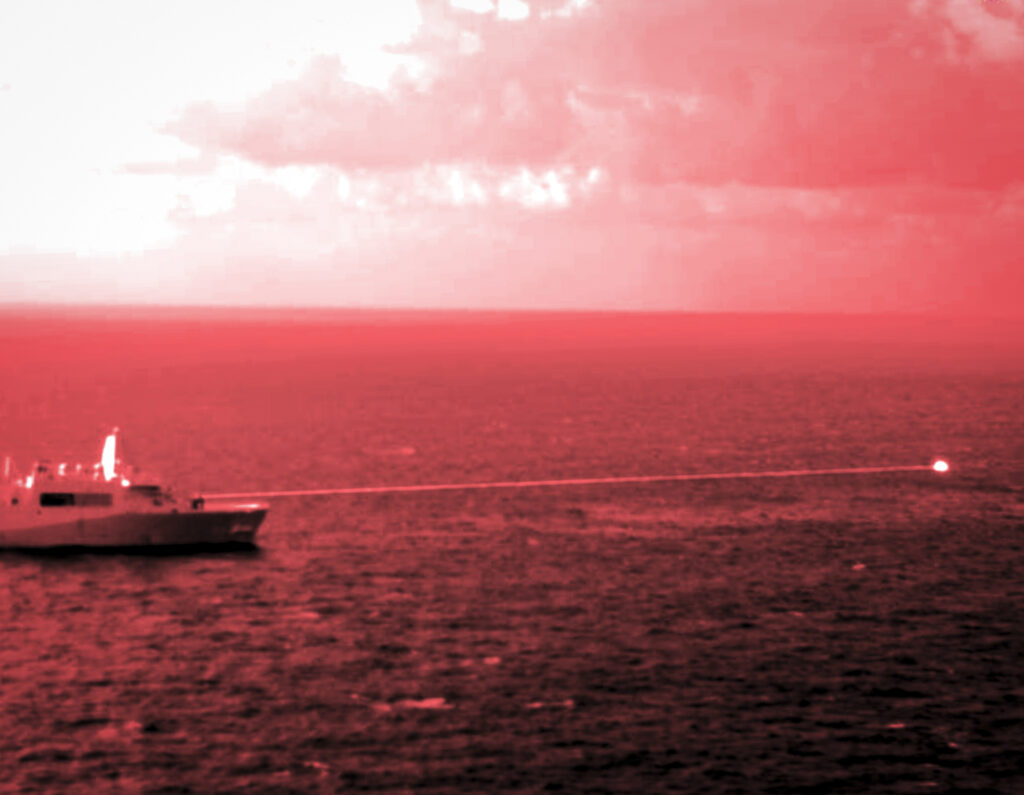
Amphibious transport dock ship USS Portland (LPD 27) conducts a high-energy laser weapon system demonstration on a static surface training target Dec. 14 while sailing in the Gulf of Aden. U.S. MARINE CORPS / Staff Sgt. Donald Holbert
MANAMA, Bahrain — Amphibious transport dock ship USS Portland (LPD 27) conducted a high-energy laser weapon system demonstration Dec. 14 while sailing in the Gulf of Aden, U.S. 5th Fleet Public Affairs said Dec. 15.
During the demonstration, the Solid-State Laser – Technology Maturation Laser Weapons System Demonstrator Mark 2 MOD 0 aboard Portland successfully engaged a static surface training target. Portland previously tested the LWSD in May 2020 when it successfully disabled a small unmanned aerial system while operating in the Pacific Ocean.
The Office of Naval Research selected Portland to host the laser weapon technology in 2018. The LWSD is considered a next-generation follow-on to the Laser Weapon System that afloat forward staging base USS Ponce (AFSB(I)-15) tested for three years while operating in the Middle East.
Portland is part of the Essex Amphibious Ready Group that includes amphibious assault ship USS Essex (LHD 2), dock landing ship USS Pearl Harbor (LSD 52) and embarked Marines from the 11th Marine Expeditionary Unit. The units departed San Diego in August and began operating in the U.S. 5th Fleet region in September.
The region’s geography, climate, and strategic importance offer a unique environment for technology innovation. U.S. 5th Fleet’s area of operations includes the world’s largest standing maritime partnership, Arabian Gulf, Red Sea, Gulf of Aden, Gulf of Oman and parts of the Indian Ocean.
USCGC Vigilant Offloads 17,000 Pounds of Illegal Narcotics in Port Everglades
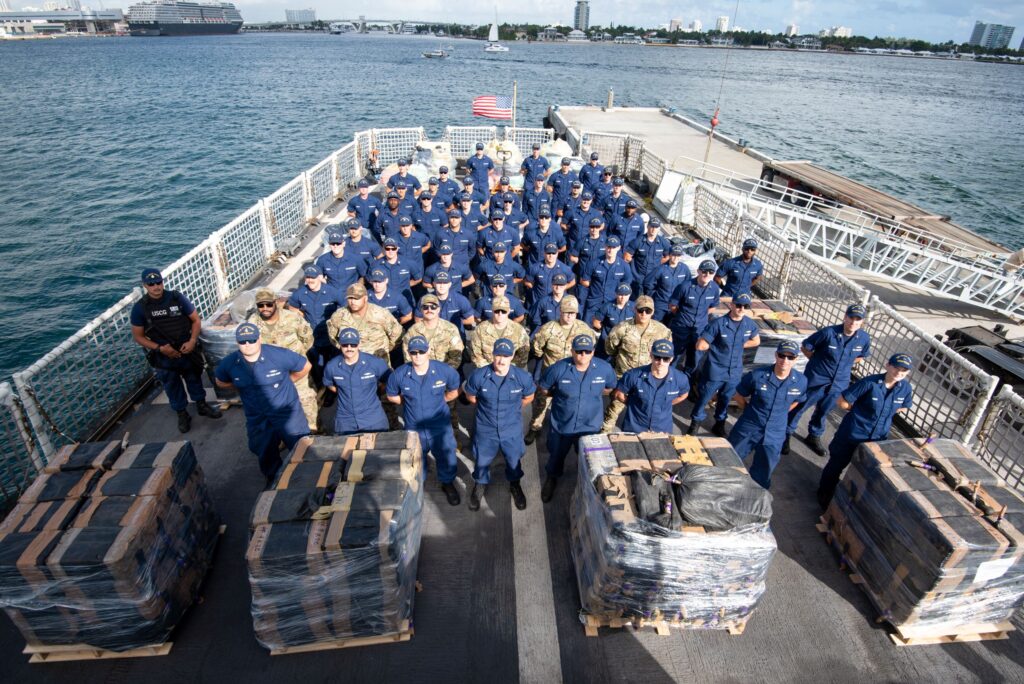
U.S. Coast Guard Cutter Vigilant (WMEC-624) crewmembers pose with approximately 17,000 pounds of illegal narcotics at Port Everglades, Florida, Dec. 15. U.S. COAST GUARD / Petty Officer 3rd Class Ryan Estrada
PORT EVERGLADES, Fla. — The USCGC Vigilant crew (WMEC 617) offloaded illegal narcotics worth an estimated $236 million on Wednesday in Port Everglades before returning to homeport in Port Canaveral, the Coast Guard 7th District said in a release.
The crew of the 67-year-old Vigilant offloaded more than 17,000 pounds of cocaine and marijuana following a 45-day patrol in the Eastern Pacific Ocean. An embarked U.S. Coast Guard law enforcement detachment augmented the ship’s crew, leveraging the service’s unique capabilities and authorities to perform law enforcement operations in international waters.
The drugs, which include nearly 12,000 pounds of cocaine and more than 5,000 pounds of marijuana, were seized during five interdictions conducted by crews of the Vigilant, USCGC Tampa (WMEC 902), and the Royal Canadian Navy’s HMCS Harry Dewolf (AOPV 430) in international waters off the coasts of Mexico, Central and South America.
Numerous U.S. and partner nation agencies cooperate to combat transnational organized crime.
“The successful interdiction of over 17,000 pounds of illegal narcotics and the apprehension of 17 suspected traffickers are the result of tremendous teamwork,” said Cmdr. Jay Guyer, commanding officer of the Vigilant. “We are thankful for coordinated efforts across the U.S. Coast Guard, the Department of Defense, Customs and Border Protection, as well as our international partners from Canada and throughout Central and South America.”
Vigilant, a 210-foot Reliance-class medium endurance cutter, patrols the Caribbean Sea and Eastern Pacific Ocean, performing counter-drug operations, migrant interdiction operations, search and rescue and fisheries enforcement.
Corps Discharging 103 Marines for Refusing COVID vaccine; Navy to Separate Sailors Who Stay Unvaccinated
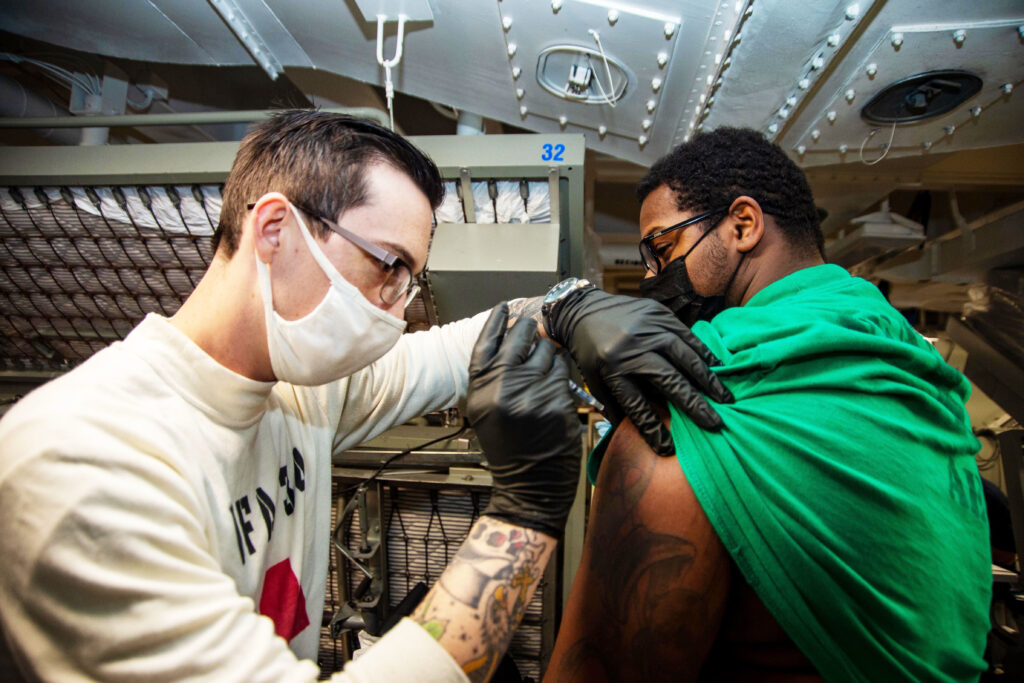
Hospital Corpsman 2nd Class Cory Troche, left, assigned to the “Blue Blasters” of Strike Fighter Squadron (VFA) 34, administers a COVID-19 booster vaccination to Aviation Electronics Mate 3rd Class Mark Galloway, assigned to the “Sunliners” of Strike Fighter Squadron (VFA) 81, aboard the Nimitz-class aircraft carrier USS Harry S. Truman (CVN 75). U.S. NAVY / Mass Communication 3rd Class Bela Chambers
ARLINGTON, Va. — The U.S. Marine Corps has discharged 103 Marines for refusing to be vaccinated against the coronavirus COVID-19, officials announced Dec. 16.
“Per Marine Corps policy (MARADMINs 462/21, 533/21, and 612/21), any active-duty Marine and Ready Reserve Marine in an active duty status who did not receive a final vaccination dose by Nov. 14 is considered unvaccinated,” Maj. Jim Stenger, a Marine Corps spokesperson, said in a statement. “All unvaccinated Marines without a pending or approved administrative exemption, medical exemption, or religious accommodation, or appeal, will be processed for administrative separation.”
Marine Corps guidance directed units to document a specific code in the Marine Corps Total Force System upon separation for vaccine refusal. “To date, 103 Marines have been separated from the Marine Corps with the vaccine refusal discharge code,” Stenger’s statement noted.
The Marines’ decision came a day after the Navy announced plans to remove Sailors who refuse to comply with the Navy’s vaccine mandate. In addition to separation from the service, Sailors and officers rejecting vaccination will not be eligible to promote or advance. Enlisted personnel will not be able to re-enlist and could lose education benefits and bonus pay. As of Dec. 16, 2021, 5,472 active component Sailors remain unvaccinated, according to the Navy.
The Navy removed the executive officer of the Arleigh Burke-class missile destroyer USS Winston S. Churchill for rejecting COVID vaccination and refusing to be tested for the virus.
In late August, Defense Secretary Lloyd Austin, with the approval of President Joe Biden, ordered mandatory COVID vaccines for all U.S. military personnel. Both the Navy and Marine Corps set a Nov. 28 deadline for active duty Sailors and Marines to be fully vaccinated.
“The Marine Corps recognizes COVID-19 as a readiness issue. The speed with which the disease transmits among individuals has increased risk to our Marines and the Marine Corps’ mission,” Stenger’s statement says.
As of Dec. 15, 94% of the active duty Marine Corps is fully vaccinated, with 95% at least partially vaccinated. Marine Corps Reserve components account for 81% fully vaccinated and 84% at least partially vaccinated. That was a big jump from Nov. 5, when Marine Corps Commandant Gen. David Berger expressed concern that 56% of Marines in the Ready Reserve had not been vaccinated and faced a Dec. 28 deadline to do so. “We are one Marine Corps, active duty and Reserve, so it is important for them to get vaccinated as well,” Berger said.
Both the Marine Corps and the Navy require active and reserve component service members to be fully vaccinated against COVID-19, unless medically or administratively exempt. The Marines report there have been 1,007 approved exemptions.
There have been 3,144 requests for religious accommodation to avoid the COVID-19 vaccine mandate. At this time, 2,863 have been processed and zero requests have been approved, according to Stenger.
The Navy has granted seven permanent medical exemptions, 296 temporary medical exemptions, 216 administrative exemptions and zero religious accommodation requests for vaccine exemptions. None of the 2,751 active-duty requests for a religious accommodation from COVID immunization have been granted.
Marine Corps to Cease Deployments, Water Ops of AAV7 Vehicles
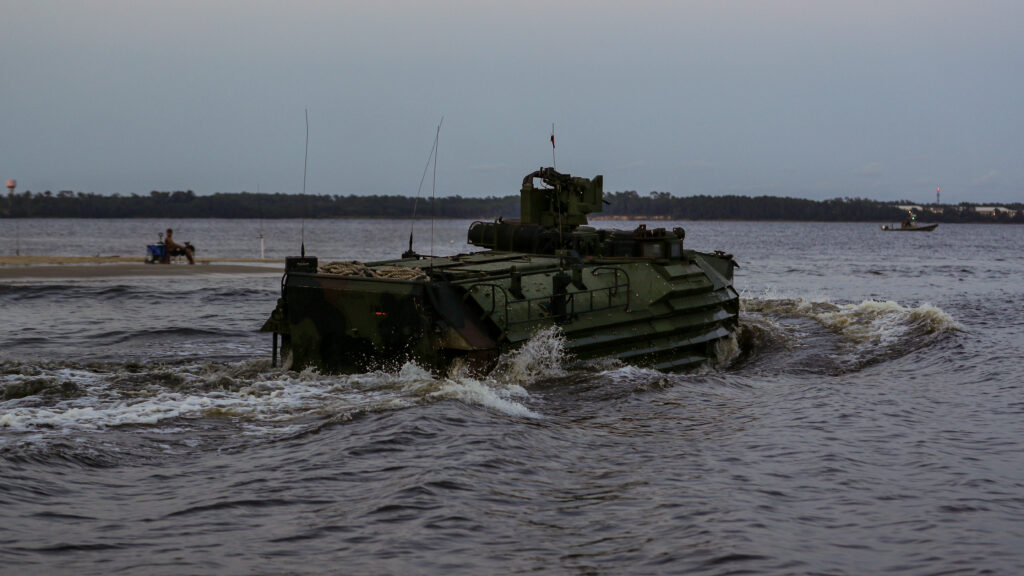
An AAV7A1 assault amphibious vehicle conducts a wet-gap amphibious crossing as part of a company-sized infiltration on Camp Lejeune, North Carolina, Aug. 10, 2021. U.S. MARINE CORPS / Lance Cpl. Jacqueline C. Arre
ARLINGTON, Va. — The Marine Corps has decided to cease deploying AAV7 assault amphibious vehicles as well as operating them in water during exercises, the Corps said in a release.
The decision is a consequence of a fatal mishap on July 30, 2020, with the sinking of an AAV7 off California, resulting in the deaths of eight Marines and a Navy corpsman.
The AAV7, which entered service in 1972, is the prime amphibious vehicle of the Marine Corps. It has gone through upgrades since. It is being replaced by the Amphibious Combat Vehicle.
The following statement was released by Maj. Jim Stenger, a Marine Corps spokesman:
“The Marine Corps stands by the efficacy of the recommendations that came from the multiple investigations into the AAV mishap from the summer of 2020, and with those recommendations implemented and sustained, the AAV is a safe and effective vehicle for amphibious operations.
“That said, given the current state of the amphibious vehicle program [the program that manages both AAVs and ACVs], the commandant of the Marine Corps has decided the AAV will no longer serve as part of regularly scheduled deployments or train in the water during military exercises; AAVs will only return to operating in the water if needed for crisis response. This decision was made in the interest of the long-term health of the amphibious vehicle programs and future capabilities. The AAV will continue to operate on land; 76% of its tasks are land-based. In doing so, we reserve the capability to reverse this decision should the need arise.
“The Marine Corps will continue deployments with myriad lethal capabilities which currently exist, and we remain committed to fielding the Amphibious Combat Vehicle.
“ACVs were temporarily suspended from open-ocean waterborne operations as we worked to solve an issue that was identified with the towing mechanism. We expect that issue to be resolved soon and for ACVs to return to the water early in the New Year.”
Austal Finalizes Deal for San Diego Waterfront Ship Repair Facility
The Independence-variant littoral combat ships USS Gabrielle Giffords (LCS 10), bottom, and USS Montgomery (LCS 8) operate in the South China Sea. Shipbuilder Austal USA has finalized a deal to establish a repair facility in the Port of San Diego, including for littoral combat ships. U.S. NAVY / Mass Communication Specialist 2nd Class Chris Roys
SAN DIEGO — Austal USA has finalized a deal to establish a repair facility in the Port of San Diego, the company said Dec. 15.
The deal includes a long-term lease of a waterfront site in National City adjacent to Naval Base San Diego. Austal USA’s 15-acre site will focus on ship repair for U.S. Navy, Military Sealift Command and U.S. Coast Guard ships. The site will be centered on a newly built dry dock designed to efficiently dock small surface combatants and similar sized ships.
“This agreement marks a major milestone in the continued growth of Austal USA’s services business. When the dry dock is delivered, we will be able to provide the Navy a highly capable full-service repair facility located in the homeport of San Diego,” Austal USA President Rusty Murdaugh said. “We know how valuable this additional repair facility is to our customers, the Navy, Coast Guard, and Military Sealift Command, and we are ready to meet the growing demand. We are also looking forward to working closely with the National City community as we expand our presence in the area.”
Austal USA will establish a full-service ship repair capability providing maintenance and modernization for small surface combatants, unmanned and autonomous vessels, and other ships. The site will include a dry dock optimized to execute availabilities on littoral combat ships and other small surface combatants. Services will include technical and material support, topside work, and drydocking availabilities. The new facility will enable more availabilities to be completed in their home port of San Diego reducing the strain on the fleet and Sailors.
This lease agreement follows a string of maintenance contract awards for Austal USA. In August, the Navy awarded Austal SEC East and West contracts positioning the company to service all Littoral Combat Ships. In November, Austal received a contract to provide services and support for LCS deployed to the Western Pacific and Indian Ocean. These contracts are the result of the company’s significant investment in and continued focus on growing its service business and centers in Mobile, San Diego and Singapore.
BELOIT, Wis. — Fairbanks Morse Defense, a portfolio company of Arcline Investment Management, has acquired Fluid Filtration Specialists LLC, a leader in flushing and filtration services for marine vessels and other facilities that operate large, highly sophisticated engines and systems.
The acquisition of FFS further expands FMD’s capabilities and service solutions for shipyard, defense, and commercial marine customers, including the U.S. Navy, the U.S. Coast Guard and the Canadian Coast Guard.
“Fluid Filtration Specialists has a stellar reputation for doing quality work correctly and on time, which makes it a natural fit for our turnkey service offerings,” said George Whittier, CEO of FMD. “Our growing shipbuilding solutions are operating on the military’s most advanced naval vessels and adding services like those provided by FFS helps us serve as a single, proven partner who knows those ships from stem to stern. This allows us to respond faster with just the right parts, services, and maintenance solutions.”
Founded by engineering experts, FFS focuses on proven fluid separation and cleaning systems that were specifically designed to address the maintenance and reliability concerns of heavy equipment used in critical operational systems, often under challenging conditions.
“Quality care of high-performance mechanical systems creates opportunities to lower costs, reduce downtime, and prolong the reliability and lifespan of valuable assets,” said Shane Sims, owner of FFS. “Becoming part of Fairbanks Morse Defense enables us to leverage its robust service center network to expand our reach among defense customers that so many communities depend on.”
Over the past year, FMD has expanded its capabilities, inventory, and geographic presence with several key acquisitions to become a single-source provider of equipment and services to the marine defense industry. In 2021, FMD acquired Welin Lambie, a military and commercial davit manufacturer; Hunt Valve, a specialty naval valve manufacturer; and in 2020, FMD acquired Ward Leonard, a motor and control solutions provider. FMD also acquired diesel engine repair and rebuilding service provider BRECO International in November 2020.