AN/TPS-80 G/ATOR Software Upgrade Boosts Air Surveillance Range and Fire Control Precision
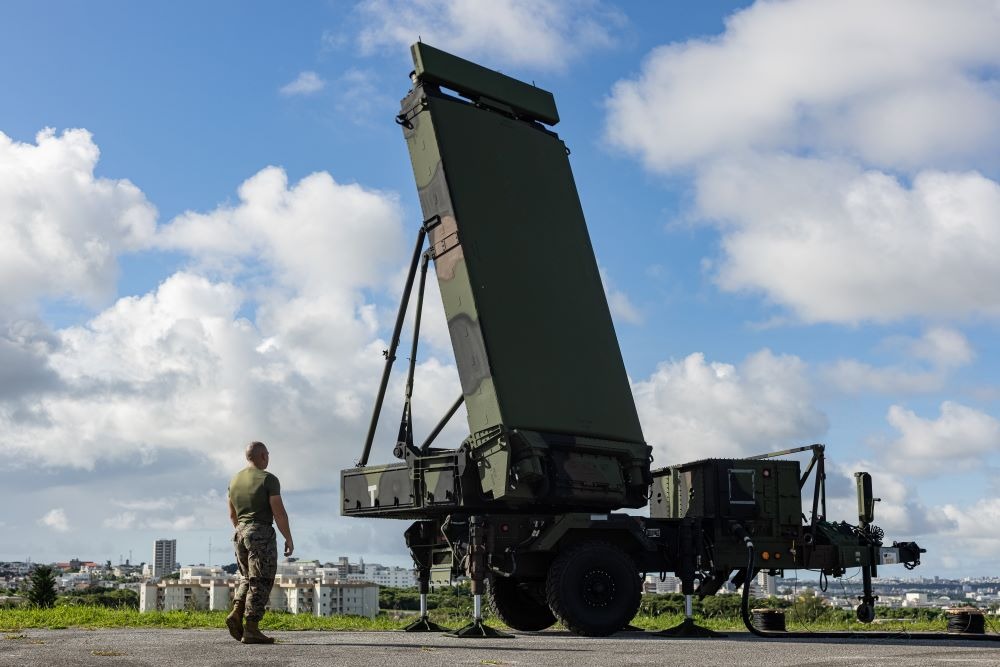
USMC Lance Cpl. Tanner Angiletta readies a G/ATOR during a joint fire support rehearsal training in August. (Photo Credit: USMC Cpl. Evelyn Doherty)
BALTIMORE, Md. – Dec. 9, 2025 – A software update to Northrop Grumman Corporation’s (NYSE: NOC) AN/TPS-80 Ground/Air Task-Oriented Radar (G/ATOR) has enabled new, extended range capabilities, allowing the U.S. Marine Corps (USMC) and U.S. Air Force (USAF) to detect threats at greater distances and respond more swiftly.
In addition to a new extended range mode, this update refines G/ATOR’s identification friend or foe system and enhances interoperability. These improvements enable the radar to better categorize detected threats and share intelligence with friendly assets through an open architecture command and control connection. All currently deployed G/ATOR systems received this update.
“G/ATOR’s extended range and improved identification systems provide U.S. and allied forces with a crucial tactical advantage,” said Bob Gough, vice president, maritime and land systems and sensors, Northrop Grumman. “Our radar system is designed to perform in the most complex air defense environments – detecting, tracking and targeting threats in real time.”
G/ATOR is a highly mobile, long range active electronically scanned array (AESA) radar system that operates in the S-band frequency range. G/ATOR provides precise fire control and real-time 360-degree, four-dimensional tracking of a wide range of airborne threats, including cruise missiles, hypersonic missiles, crewed aircraft and uncrewed aerial systems.
Currently, thirty-nine G/ATOR radars have been delivered to the USMC and USAF, with the 40th delivery anticipated later this year. The radar incorporates Northrop Grumman’s U.S.-manufactured microelectronics to support advanced multifunction and multi-mission capability.
Northrop Grumman is a leading global aerospace and defense technology company. Our pioneering solutions equip our customers with the capabilities they need to connect and protect the world, and push the boundaries of human exploration across the universe. Driven by a shared purpose to solve our customers’ toughest problems, our employees define possible every day.
HII Hosts Keel Laying of Virginia-Class Attack Submarine Barb (SSN 804)
From HII NEWPORT NEWS, Va., Dec. 09, 2025 (GLOBE NEWSWIRE) — HII’s (NYSE: HII) Newport News Shipbuilding (NNS) division hosted the keel laying ceremony today for Virginia-class attack submarine Barb (SSN 804).
“Our reason to come together this morning represents not only the laying down of our next submarine keel, but a solemn commitment we are making to our country,” NNS President Kari Wilkinson said. “It marks the beginning of a construction journey, and while it is a journey measured in inches of weld, amount of pipe, and amount of cable pulled, it is fueled by the strength and determination of shipbuilders and our partners working together toward a common objective.”
SSN 804 will be the third U.S. Navy submarine to carry the name Barb. The first, SS 220, was commissioned in 1942. During World War II, the submarine conducted missions under the command of Eugene “Lucky” Fluckey, earning the submarine four Presidential Citations, a Navy Unit Commendation and eight battle stars for outstanding service. The second, SSN 596, was a nuclear-powered submarine commissioned in 1963. It was sponsored by Marjorie Fluckey, the wife of Rear Adm. Fluckey. The submarine took part in special operations during the Vietnam War.
Pamela Bove serves as ship’s sponsor for the newest Barb. Bove began her analytical career working as a civilian within the submarine division at the Navy Operational Intelligence Center. She later accepted a position with a defense company where she met her husband Thomas “Tom” Bove, grandson of Rear Adm. Fluckey.
“It is an honor to serve as sponsor for Barb and see the legacy of this historic submarine carried forward to a new generation,” Bove said. “I am humbled knowing that the third Barb and her crew will soon serve silently in the depths of the world’s oceans and seas protecting this great nation of ours. I am grateful for the shipbuilders who are working diligently to construct this mighty vessel and all the sailors who will selflessly serve aboard her for decades to come.”
During Tuesday’s ceremony, NNS welder Andrew Kahler etched Bove’s initials onto a metal plate, signifying the keel of SSN 804 as being “truly and fairly laid.” The metal plate will remain affixed to the submarine throughout its life.
Barb is the 31st Virginia-class fast attack submarine and will be the 15th delivered by NNS.
The advanced capabilities of Virginia-class submarines increase firepower, maneuverability and stealth.
U.S. Navy UAS surpass one million hours in ISR operations
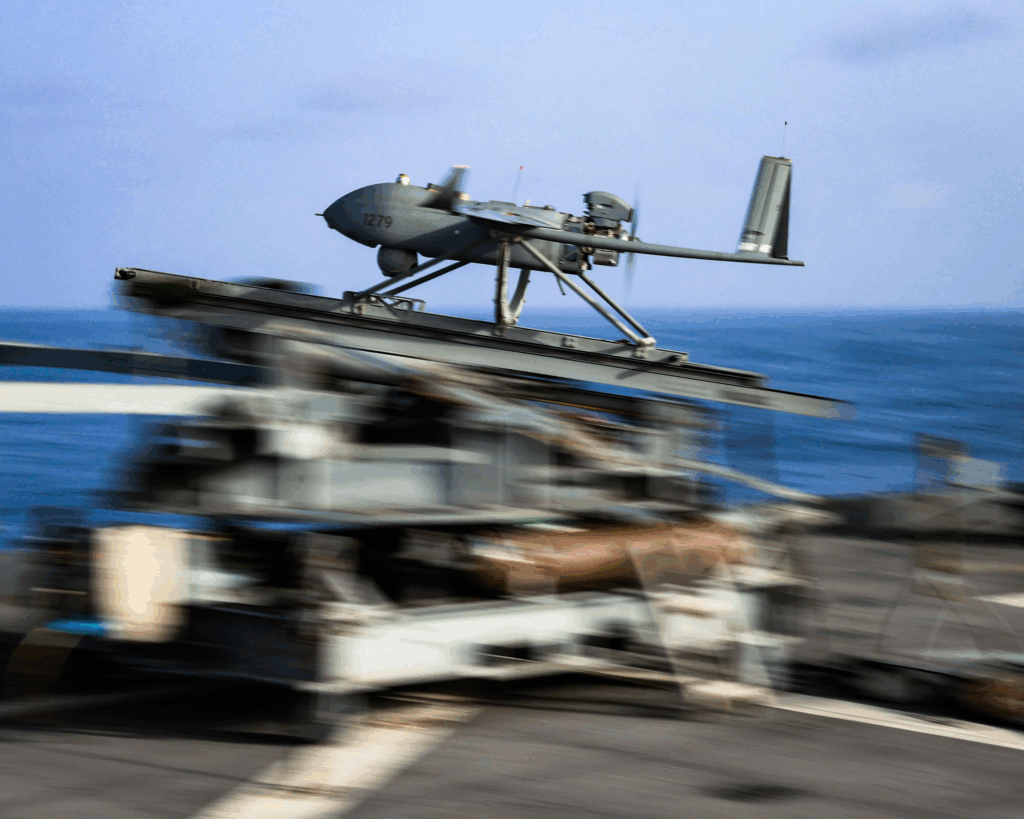
A Textron MQ-19 Aerosonde Unmanned Aircraft system is launched from the expeditionary sea base USS Hershel “Woody” Williams. (U.S. Navy photo)
From Naval Air Systems Command, Dec. 9, 2025
NAS PATUXENT RIVER, Md. — The Navy and Marine Corps Small Tactical Unmanned Aircraft Systems (UAS) program office (PMA-263) recently announced that the Intelligence, Surveillance, and Reconnaissance (ISR) Services UAS surpassed one million flight hours in support of operations on land and at sea.
Sailors aboard achieved the one million flight hours milestone during routine mission support in the 6th Fleet.
Since the program’s inception in 2005, PMA-263 has successfully completed more than 50 UAS installations aboard Navy and Military Sealift Command (MSC) ships and operated from more than 50 land-based locations worldwide. The ISR Services team ensures ships in the 4th, 5th,6th and 7th fleets, as well as land-based operations worldwide are equipped to provide day and night ISR support to joint force and coalition partners.
“Every hour flown represents more than mission success – it reflects the resilience of our people, the trust of our partners and the impact we’ve had on history,” said Gregg Skinner, PMA-263 program manager. “Together, we’ve supported operations in every corner of the globe, advanced unmanned systems into the fight, and stood ready in times of uncertainty”
Currently, more than a dozen ships are equipped with ISR Services UAS, enabling naval vessels to deploy and retrieve aircraft in support of missions. Sea- and land-based systems include the Boeing Insitu MQ-27 ScanEagle and the Textron MQ-19 Aerosonde, both delivering unique capabilities to the warfighter. They provide day and night surveillance, supporting around the clock mission support.
The UAS installations are optimized to facilitate the seamless transfer of full-motion video and other sensor data to personnel in critical locations. The information gathered by these systems plays a vital role in tactical operational decision-making and long-term intelligence gathering, enhancing the Navy and Marine Corps’ ability to maintain maritime domain awareness and operational readiness.
PMA-263 manages a portfolio of small unmanned systems for U.S. and international partners and leads training operations for all service branches.
Navy Demonstrates Multi-Day Solar UAS Flight
The Navy, in partnership with Skydweller Aero, recently achieved continuous solar-powered unmanned flight during a nonstop three-day test from Stennis, Mississippi. Led by the Naval Air Warfare Center Aircraft Division (NAWCAD), the test of Skydweller UAS marks a significant advancement in both long-endurance solar-powered UAS technology and its potential to enhance maritime intelligence, surveillance, and reconnaissance (ISR). (U.S. Navy)
From Naval Air Warfare Center Aircraft Division, Dec. 5. 2025
PATUXENT RIVER, Md. – The Navy, in partnership with Skydweller Aero, recently achieved continuous solar-powered unmanned flight during a nonstop three-day test from Stennis, Mississippi.
Led by the Naval Air Warfare Center Aircraft Division (NAWCAD), the test of Skydweller UAS marks a significant advancement in both long-endurance solar-powered unmanned air systems (UAS) technology and its potential to enhance maritime intelligence, surveillance and reconnaissance (ISR).
“This demonstration is a prime example of how NAWCAD partners with industry to deliver what the fleet needs,” said NAWCAD Commander Rear Adm. Todd Evans. “It also reflects the technical depth of our workforce and our ability to translate ideas into capability.”
The 73-hour flight proved Skydweller’s ability to maintain continuous solar-powered operation and demonstrated the feasibility of achieving a positive energy balance to power the aircraft during extended flights. It also validated the system’s communication links, autonomous real-time decision making and ability to adapt to turbulent weather.
“Integrating Skydweller into the Navy’s ISR architecture creates a layered and resilient network that maximizes the capabilities of all our assets,” says NAWCAD’s Special Purpose UAS lead Bill Macchione. “This collaborative approach ensures we have the right platform for the right mission, optimizing our resources and enhancing our overall maritime domain awareness.”
Skydweller’s strength lies in its ability to provide continuous, wide-area surveillance over extended periods, enabling more advanced systems to focus on missions that require such specialized capabilities as rapid response and advanced sensor packages.
NAWCAD began experimentation with Skydweller’s solar-powered UAS capabilities in 2020 to address U.S. Southern Command (SOUTHCOM) operational challenges, including drug trafficking and border security. This technology provides continuous surveillance over vast areas, enabling the U.S. and its allies to enhance maritime security and disrupt illicit activities.
Coast Guard seizes 150,000 pounds of cocaine through Operation Pacific Viper, interdicts drug smuggling vessel loaded with over 20,000 pounds of cocaine
From U.S. Coast Guard Headquarters, Dec. 9, 2025
WASHINGTON —The U.S. Coast Guard announced Tuesday it has seized more than 150,000 pounds of cocaine in the Eastern Pacific Ocean since launching Operation Pacific Viper in early August.
With a dose of 1.2 grams of cocaine being enough to kill a person, the amount seized through Operation Pacific Viper equates to over 57 million potentially lethal doses.
“Operation Pacific Viper has proven to be a crucial weapon in the fight against foreign drug traffickers and cartels in Latin America and has sent a clear message that we will disrupt, dismantle and destroy their deadly business exploits wherever we find them,” U.S. Department of Homeland Security Secretary Kristi Noem said. “In cutting off the flow of these deadly drugs, the Coast Guard is saving countless American lives and delivering on President Trump’s promise to Make America Safe Again and reestablish our maritime dominance.”
Through Operation Pacific Viper, the Coast Guard has been accelerating counter-drug operations in the Eastern Pacific Ocean, where significant transport of illicit narcotics continues from Central and South America. The Coast Guard surged additional assets — cutters, aircraft and tactical teams — to interdict, seize and disrupt transshipments of cocaine and other bulk illicit drugs. Operation Pacific Viper continues the Coast Guard’s efforts to protect the Homeland, counter narco-terrorism and disrupt Foreign Terrorist Organizations, Transnational Criminal Organizations and cartels seeking to produce and traffic illicit drugs into the United States. 80% of all U.S.-bound narcotics seizures occur at sea, highlighting the impact of maritime drug interdiction.
“This milestone is a testament to the vigilance and tenacity of our crews,” said Adm. Kevin Lunday, the Coast Guard’s acting commandant. “When we say we own the sea, it reflects our relentless pursuit to securing the maritime domain and disrupting the criminal networks that threaten our communities.”
Recent operations have highlighted the effectiveness of this surged posture, including multiple record-setting efforts. On Dec. 2, Coast Guard Cutter Munro seized over 20,000 pounds of cocaine in a single interdiction, after utilizing disabling fire on a heavily laden go-fast vessel. This was the Coast Guard’s largest at-sea interdiction since March 2007. The crew of the Coast Guard Cutter James executed a remarkable run of four significant seizures across 10 days in November, netting 19,819 pounds of cocaine. This series of interdictions included 9,581 pounds on Nov. 15, 3,225 pounds on Nov. 23, and two separate seizures on Nov. 25 totaling 7,055 in coordination with Coast Guard Cutter Active.
These continuous interdictions deny criminal organizations more than $1.1 billion dollars in illicit revenue. By disrupting the flow of cocaine and other bulk illicit drugs, the Coast Guard is cutting off revenue that fuels the ability for narco-terrorists to produce and traffic illegal fentanyl, threatening American communities.
Detecting and interdicting narco-terrorism on the high seas involves significant interagency and international coordination. U.S. Southern Command’s Joint Interagency Task Force-South, based in Key West, Florida, detects and monitors both aerial and maritime transit of illegal drugs. Once interdiction becomes imminent, the law enforcement phase of the operation begins, and control of the operation shifts to the U.S. Coast Guard throughout the interdiction and apprehension. Interdictions in the Eastern Pacific Ocean are performed by members of the U.S. Coast Guard under the authority and control of the Coast Guard’s Southwest District, headquartered in Alameda, California.
The Coast Guard is the United States’ lead federal agency for maritime drug interdiction. We are part of the Department of Homeland Security team protecting our nation and are at all times a military service and part of the joint force defending it.
AUSTAL USA Lays Keel of Its First Offshore Patrol Cutter
From Austal USA, Dec. 8, 2025
MOBILE, Ala. – Austal USA hosted a keel laying ceremony today for the first U.S. Coast Guard (USCG) Heritage-class Offshore Patrol Cutter (OPC) to be built at the company’s Mobile, Ala. ship manufacturing facility. Pickering (WMSM 919) is being built under a contract that includes up to 11 cutters and has a potential value of $3.3 billion. The Coast Guard has executed contract options for six of the 11 cutters to date.
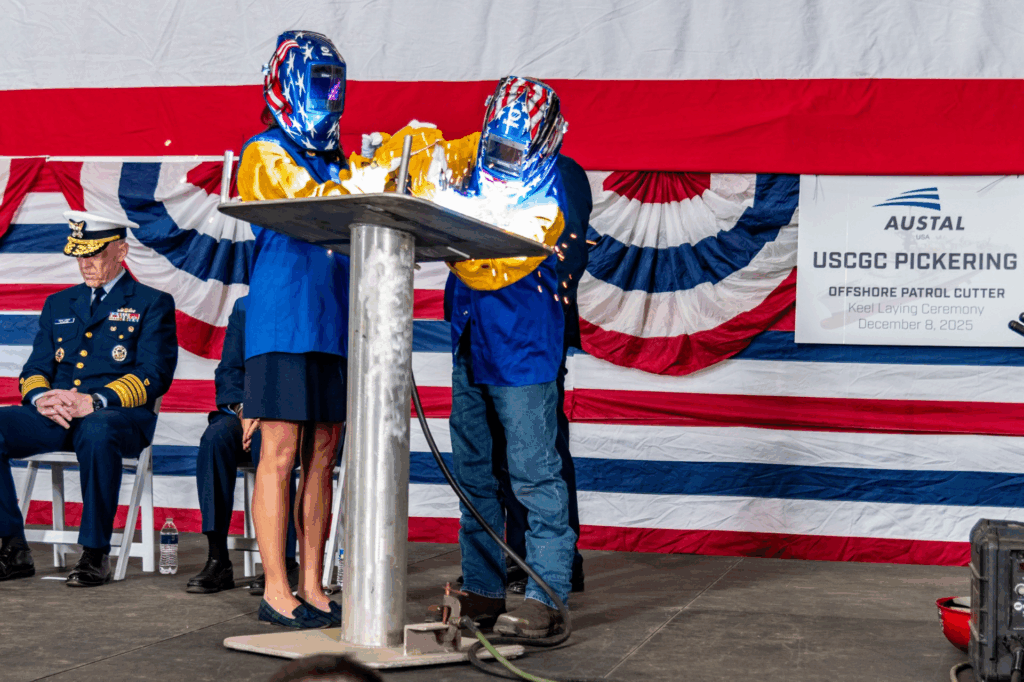
Ship sponsor Dr. Meghan Pickering Seymour authenticated Pickering’s keel by welding her initials onto a keel plate in front of over a hundred distinguished guests including The Honorable Mike Ezell, House of Representatives Mississippi’s 4th District and Chair of House Transportation & Infrastructure Subcommittee on Coast Guard and Maritime Transportation, Admiral Kevin Lunday, Commandant (acting) U.S. Coast Guard, as well as Mobile community leaders and members of the Austal USA and USCG shipbuilding team.
Dr. Seymour is the great-great-great-great-great-granddaughter of Colonel Timothy Pickering, the namesake of the first USCGC Cutter Pickering launched in 1798. She was assisted in welding her initials by one of Austal USA’s advanced welders, Mr. Ravi Khamsourin.
The OPC program will recapitalize the Coast Guard’s aging medium endurance cutters and provide a capability bridge between the service’s national security cutters, which operate in the open ocean, and the fast response cutters which operate closer to shore.
“Meeting this important milestone for the Coast Guard’s Offshore Patrol Cutter program is a significant achievement that underscores our commitment to the on-time delivery of the cutters the USCG needs,” stated Austal USA President Michelle Kruger. “Today’s ceremony is representative of the hard work and dedication of our skilled workforce and the strength of the shipbuilding team of Austal USA, the Coast Guard and our suppliers. We are proud to be building these critically important cutters that will help ensure the security of our Nation.”
The 360-foot OPC will provide the majority of the Coast Guard’s offshore presence conducting a variety of missions including law enforcement, drug and migrant interdiction, and search and rescue. With a range of 10,200 nautical miles at 14 knots and a 60-day endurance period, each OPC will be capable of deploying independently or as part of task groups, serving as a mobile command and control platform for surge operations such as hurricane response, mass migration incidents and other events. The cutters will also support Arctic objectives by helping regulate and protect emerging commerce and energy exploration in Alaska.
Pickering is one of two Coast Guard OPCs, and one of ten total surface vessels, under construction at Austal USA’s Mobile, Ala. ship manufacturing facility. Austal USA started construction on its second Heritage-class Offshore Patrol Cutter (OPC), Icarus (WMSM 920), in August 2025.
One Size Doesn’t Fit All: Building U.S. Navy Hedges Against Rising threats
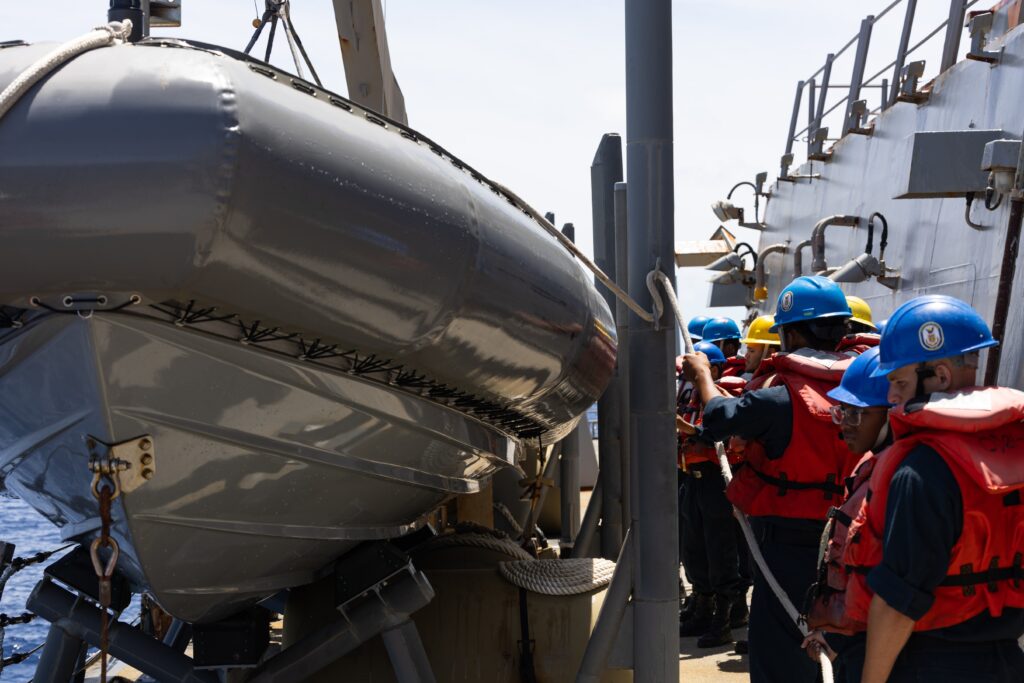
Sailors secure the rigid-hull inflatable boat on the midship of the Arleigh Burke-class guided-missile destroyer USS Curtis Wilbur (DDG 54) during small boat operations in the South China Sea, Sept. 4. 2025. Photo credit: U.S. Navy | Mass Communication Specialist Seaman Mark Bergado
The U.S. Navy faces challenges on multiple fronts. At sea, the fleet is stretched thin responding to China’s continued gray-zone aggression and defending shipping in the Middle East from drone or missile attacks. At home, new ship deliveries fall further behind, fleet readiness is slipping, and recruiters are playing catch up after years of missing goals.
More money and industry innovation could help the Navy mitigate its challenges. But they don’t tackle the root cause of a shrinking, less-ready fleet — the Navy’s force design, which emphasizes large, multi-mission crewed warships and aircraft over robotic and autonomous systems (RAS) or less-complex vessels.
The Navy’s preference for large, crewed platforms is logical. Smaller ships lack the endurance for transoceanic deployments, RAS can’t perform peacetime missions like search and rescue or counter-piracy, and the cost of long-endurance crewed ships or aircraft suggests each one should be multi-mission.
But the Navy cannot afford a fleet of highly survivable warships large enough to address the its global responsibilities. Rising costs and delays in maintaining aging guided missile destroyers (DDGs), amphibious ships, and nuclear-powered attack submarines (SSNs) are already shrinking the operational fleet by forcing the Navy to retire ships early or sideline them for years.
Rather than continuing to field a shrinking force of exquisite ships and aircraft, the Navy should field a larger force of crewed and uncrewed platforms that gain an edge over opponents through their payloads and ability to combine in a diverse array of changing effects chains across domains. By shifting complexity from inside individual ships and aircraft to the kill chains between them, this fleet could gain decision-making advantages over adversaries and generate capacity or capability when and where it is needed.
Deterring without Dominance
After three decades of being the largest, most capable fleet on Earth, the U.S. Navy faces adversaries who are exploiting technology proliferation to field forces that can threaten U.S. military dominance. China is the most prominent example. With the world’s largest rocket force and navy, the People’s Liberation Army could keep Taiwan’s allies at bay long enough to blockade Taiwan or attempt an invasion.
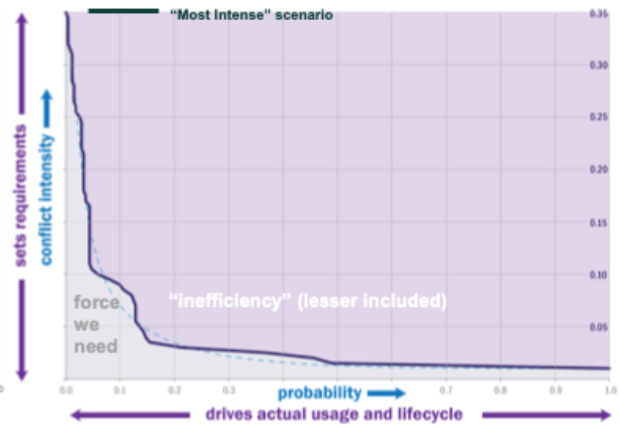
There are a small number of intense scenarios that would require a substantial portion of the fleet, or of key elements of the fleet. The U.S. Navy has traditionally designed the fleet to meet the demands of these scenarios. In its post-Cold War period of dominance, the Navy could build a force able to counter a Taiwan invasion and retain enough residual capability to handle any other situation, albeit much less efficiently than a purpose-built force.
Figure 1
Figure 1 illustrates this approach. It shows U.S. combat deployments from 1943 to 2011 in terms of the probability a given portion of the force is deployed on any given day. (This chart is based primarily on U.S. Air Force data, which is the most comprehensive). The peak on the chart represents World War II, but the speed and scale of a Taiwan invasion would preclude significant mobilization. Navy leaders logically sized the active fleet for that scenario.
But the PRC’s improving and growing military is driving up the capability and capacity needed to defend Taiwan. In the early 2020s, the Navy began to retire or slow production of ships and aircraft that were less relevant to a Taiwan invasion scenario. The one-size-fits all fleet started looking like a one-trick pony fit for one situation and ill-suited for many others.
Other stressing scenarios soon emerged as adversaries began exploiting military-relevant commercial technology and geography. Russia expanded its invasion of Ukraine beyond Crimea and is growing its submarine fleet, Iran’s Houthi proxies attacked shipping across the Red Sea and Bab El Mandeb, and China intensified air and maritime incursions into Philippine and Japanese territory.
This expanding set of challenges leaves the Navy in a strategic cul-de-sac: It doesn’t have enough forces with sufficient capability to be dominant in each region, but it cannot grow in its current form under any realistic budgets. In his opening speech during his assumption of office, new Chief of Naval Operations Admiral Daryl Caudle argued the Navy should use “hedge forces” to solve this force planning challenge.
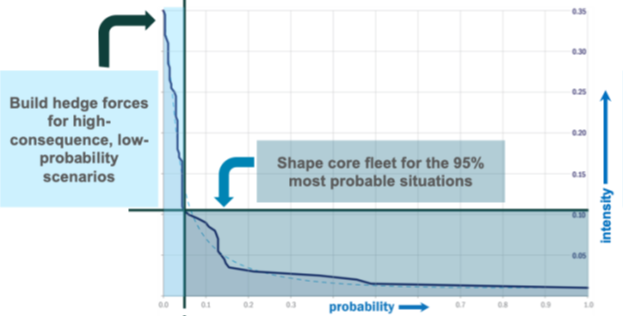
Hedge forces are specialized groups of units designed to address high-consequence, low-probability situations like those on the left side of figure 1. These forces would provide the additional capability and capacity needed for a specific scenario but may not have broad utility in other regions or situations. Figure 2 depicts this force design paradigm using the data of Figure 1.
Figure 2
Under this paradigm, the Navy would size its core fleet — or the traditional Navy of today — for the bulk of scenarios that could emerge, including high-probability day-to-day conditions such as homeland defense or responding to gray-zone provocations. The core fleet should also be able to mount relatively large campaigns like Operations Desert Storm or Iraqi Freedom by surging additional deployments for the duration of operation. The Navy would build hedge forces to address the 5% of operational problems that would overstretch the core fleet.
The Navy should forward base hedge forces at allied facilities in their region of interest and organize them separately from the rotationally deployed core fleet. Because they are composed for a specific scenario, hedge forces will generally not be relevant to other theaters and scenarios, although some units may move in response to changing capability and capacity needs among hedge forces. Forward basing helps deter opponents by showing that hedge forces can quickly, potentially automatically, respond to aggression. And from a fiscal perspective, forward basing reduces the number of hedge force units needed compared to rotationally deploying them from U.S. territory.
The Navy’s need for hedge forces to be specialized and forward based suggests they should be predominantly composed of RAS. Conflicts in Ukraine, Nagorno-Karabakh and the Middle East show that RAS can be relevant in high-end conflict. For example, after losing its navy to attack or capture, Ukraine’s military restored access to vital shipping lanes by pushing the Russian Black Sea Fleet to the far side of Crimea using uncrewed attack boats and undersea vehicles.
RAS also offer dramatically lower costs of procurement and, most importantly, sustainment. By shifting some functions of traditional crewed platforms onto uncrewed systems, the Navy could gain scale at lower costs than it would take to achieve the same capacity through crewed ships or aircraft.
The Navy is pursuing RAS and associated operational concepts through an accelerating set of experiments. These initiatives — including Task Force 59 in the Middle East, 4th Fleet in Central and South America and the Integrated Battle Problems in the Indo-Pacific — are great examples of applying new technologies to thorny operational problems. But the Navy needs to go further and stop treating uncrewed systems as merely an additive to the crewed force.
The U.S. Department of Defense is experimenting with concepts like those used by Ukraine and Iran’s proxies to create a “hellscape” for Chinese invaders in the Taiwan Strait. By attacking troop transports with drone boats, undersea vehicles and loitering munitions, a hedge force of RAS could slow or disrupt the invasion, giving U.S. and allied forces targeting information and time to destroy PLA ships with long-range missiles and torpedo fires.
But the hellscape cannot stop an invasion alone. It will need missile attacks from aircraft, submarines and surface combatants to defeat the invasion fleet and its escorts. However, surface forces will be hard-pressed to get close enough to deliver weapons and survive. The Navy could fill the gap by instead relying on a distributed fires hedge force of Modular Attack Surface Craft and submarines in the early phases of the fight.
The MASC program includes three RAS vessels, the largest of which would carry 16 missiles. Hudson Institute’s wargaming and modeling suggests distributed uncrewed missile launchers with between 16 and 32 weapons offer an effective balance between undermining adversary planning and creating risks to adversary objectives. RAS vessels with larger magazines are easier to detect, have difficulty efficiently using their weapons before coming under attack and are large enough to be worth multiple enemy missile salvos. RAS vessels with fewer weapons are often unable to successfully attack a defended target alone, creating a need for coordinated attacks that can be difficult if communications are degraded.
The Navy could benefit from building RAS-based hedge forces to address other stressing situations. For example, deployments by quiet Russian SSNs through the Greenland-Iceland-United Kingdom (G-I-UK) gap could quickly overwhelm U.S. antisubmarine warfare (ASW) forces, especially if other operations in Europe demand attention from U.S. SSNs, P-8A maritime patrol aircraft and DDGs. And a renewed campaign of drone attacks by the Houthis in the Red Sea could once again stretch a Navy surface combatant fleet that is also defending U.S. carriers, territory and other sea lanes.
A Dramatically Different Surface Fleet
This new force design paradigm implies changes in the makeup of the core force. For example, if a largely uncrewed hedge force can slow and disrupt a Chinese invasion, the Navy may need a lower rate of fires from surface combatants, strike-fighters, and SSNs. As a result, the Navy could reduce the number of crewed platforms it buys or delay their next generation.
But the changing threat environment also matters. The fleet’s successful air defense actions in the Middle East during the last two years showed that countering drone and missile attacks is getting harder. These operations already stress the capacity of today’s DDGs. Hudson Institute’s wargaming with U.S., Australian and Japanese officers during the last year suggest China could overwhelm U.S. DDGs and successfully engage U.S. carriers well into a conflict in the Western Pacific.
DDGs will soon have to focus on air and missile defense and forgo other missions like ASW or strike due to combat system and magazine limits. Despite their reach, Tomahawk missiles still require DDGs to approach adversaries like Iran, Russia and China within anti-ship missile range and each adversary would be willing to expend substantial numbers of $20 million ballistic missiles on a $3 billion DDG.
This suggests the surface force will need to both increase its magazine capacity and the range of its weapons to conduct offense and defense during tomorrow’s conflicts. The Navy could realize those characteristics by renewing its pursuit of a CG(X) guided missile cruiser. A CG(X) could, like today’s Ticonderoga CGs, carry 130-plus missiles in a vertical launch system magazine. Like the Navy’s planned DDG(X), a CG(X) could also carry larger missiles like the Navy’s planned hypersonic conventional prompt strike weapon that can reach targets more than 1,500 nautical miles away.
But with a cost of likely more than $5 billion per ship, the Navy will not be able to replace today’s DDG-51s with new CG(X) or DDG(X) hulls on a one-for-one basis. While today’s DDG-51s will be in the fleet for decades to come, the Navy will need to complement its new, larger surface combatants with smaller, less expensive vessels.
Unfortunately, the Constellation guided missile frigate cannot become that more affordable counterpart to the DDG-51. Originally planned to cost less than $800 million per hull, the FFG-62 class has been plagued by production delays and cost overruns driven in large part by Navy design revisions. The Congressional Budget Office now estimates each FFG will cost at least $1.4 billion.
With a cost nearly twice that of its parent FREMM FFG design or the Navy’s original estimates, the FFG-62 no longer has a role in the Navy fleet. Its 32-cell vertical launch system magazine lacks the capacity to defend another ship against even the Houthi threat. The FFG-62’s very low frequency sonar will generate long detection ranges against quiet submarines but still would place the ship well within submarine-launched anti-ship missile range. And the FFG-62’s cost and complexity prevent the Navy from automating the ship or buying it in sufficient numbers to be considered expendable or attritable.
Surface force leaders could use the Navy’s budget constraints to reshape the fleet for deterrence in a post-dominance era. Instead of continuing the flawed and overpriced FFG-62 program, the Navy could pursue a smaller missile corvette like the Israeli Sa’ar-6 or Swedish Visby. A corvette would not be multimission capable like the FFG-62, but it could carry the same 32-cell VLS magazine for offensive weapons. With a reloadable Rolling Airframe Missile air defense system, it would be survivable against realistic missile salvos.
If the Navy used an existing design without significant modifications, it could purchase at least two corvettes for the cost of each planned FFG-62. This is not a novel approach. The Navy is beginning procurement this year of a new medium landing ship based on the Israeli logistics support vessel, which itself was derived from a U.S. Army landing ship.
Corvettes could conduct coastal defense around the United States and across the Western Hemisphere. But they could also lead and manage hedge forces overseas that are defending Taiwan, countering submarines at the G-I-UK gap, clearing mines in the Strait of Hormuz or defeating air attacks in the red Sea. Although hedge forces will be predominantly composed of RAS, human operators will still need to maintain, command and protect them when not in use. Corvettes could help provide those functions while also providing maritime security and addressing other threats.
With their lower complexity and smaller size, the Navy could also automate corvettes enough for them to be remote missile launchers during wartime, as it did with the fast troop transport USNS Apalachicola. They could then join the distributed fires hedge force in defeating amphibious assaults or blockades.
The Navy’s fleet design needs dramatic change to deter in a post-dominance era. Instead of relying on the broad overmatch of its one-size-fits-all fleet, the Navy should pivot to a smaller core fleet complemented by hedge forces to address its most challenging operational problems. Without a change like this, the Navy will lose relevance as opponents exploit proliferation and geography to threaten America’s allies and interests. .
Bryan Clark is a Senior Fellow at the Hudson Institute. This story originally appeared in the December issue of Seapower magazine.
Navy Selects Damen to Build New Medium Landing Ship
By Richard R. Burgess, Senior Editor
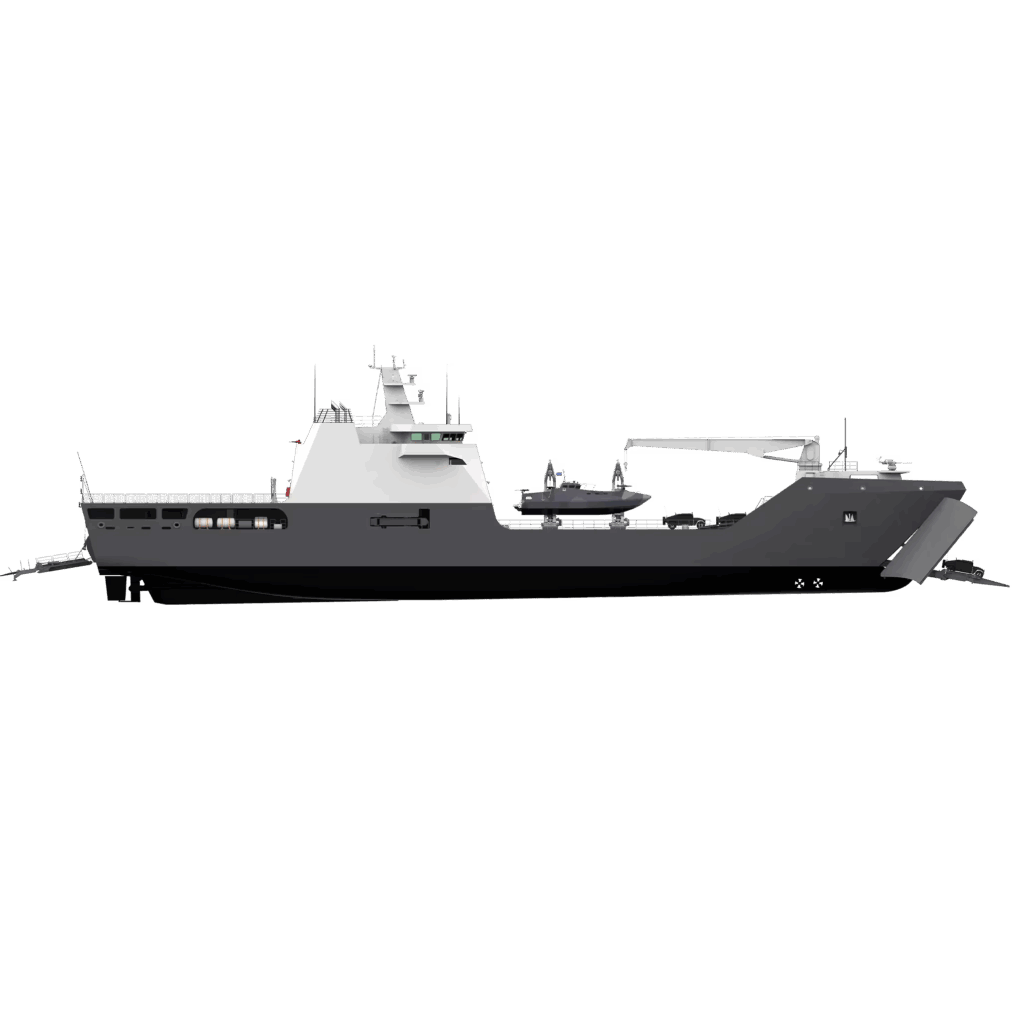
ARLINGTON, Va. — The U.S. Navy has selected Damen to build the new medium landing ship (LSM) for the service. The ship will be a version of Damen’s LST 100 class.
Damen is a shipbuilder headquartered in The Netherlands. Its LST 100 class is in production for Australia and other customers.
The selection was announced on Dec. 5 on X in a video of Navy Secretary John C. Phelan, who said that the move was the second initiative is support of re-designing the U.S. fleet. The first was the truncation of the Constellation-class guided-missile frigate program to only the two ships currently under construction. The truncation, announced a week earlier, was the result of delays in the program. Phelan announced that a new class of frigates will be designed to give the Navy the small surface combatants that it needs.
The Navy plans to build 35 LSMs to transport Marines and their equipment within theaters of war with an “organic, littoral mobility capability in the Indo-Pacific and around the world and provides with a critical intra-theater maneuver asset that is able to embark, transport, and land Marines, weapons supplies and equipment around the theater without requiring access to a pier,” said General Eric Smith, commandant of the Marine Corps, in the same X video. “The medium landing ships will enable our Marines to be more agile and flexible in austere where there are no ports … within the adversary’s engagement zone.”
The LST 100 resembles in concept the LSTs of World War II, equipped with bow doors and a ramp to discharge vehicles onto a beach. Damen’s design is an intra-theater transport that displaces approximately 4,000 tons. According to Damen’s website, the ship is 100 meters long and has a beam of 16 meters and a draft of 3.5 to 3.9 meters. The ship is designed with berthing for a landing force, cargo space of 1,020 square meters of roll-on/roll-off cargo space and to be operated by a crew of 18. The ship features a large crane and a helicopter landing pad. Phelan said the LSM would have a range of more than 3,400 nautical miles.
The selection of an “off-the-shelf” design came as the Navy determined that other proposals with new designs were too costly and would take too long to join the fleet. In the same video, Admiral Daryl Caudle, chief of naval operations, stressed producibility and maintainability after an era of shipbuilding in which the delivery of new ships took too long.
Navy Establishes First Information Warfare Squadron
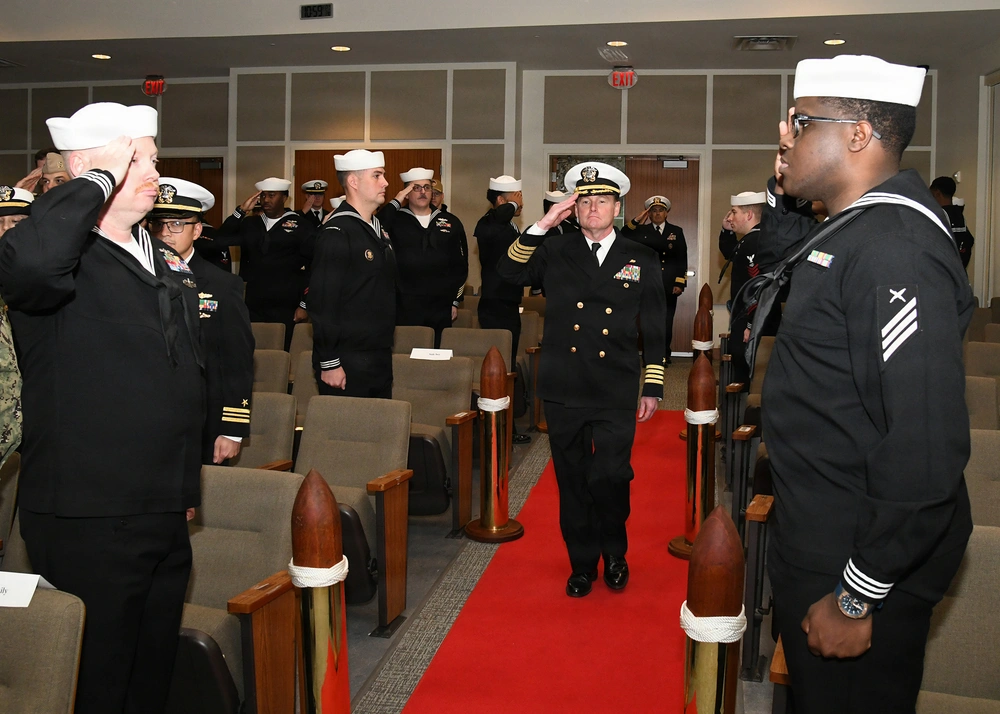
Capt. Jon O’Connor, prospective Commanding Officer, Information Warfare Squadron (IWRON) Two, renders a salute as he arrives with the official party during an assumption of command ceremony for IWRON Two in Norfolk, Virginia. (U.S. Navy photo by Robert Fluegel)
From Naval Information Forces, Dec. 5, 2025
NORFOLK, Va. – Information Warfare Squadron (IWRON) Two, a first-of-its-kind unit designed to operationalize Information Warfare (IW) capabilities and provide decisive decision advantage to Carrier Strike Group Commanders, was established, Dec. 5.
This command is being stood up as part of a 48-month pilot program that received unanimous approval at the Fleet Commanders’ Readiness Council (FCRC) in June of 2025. The FCRC is a forum where top Navy leaders develop integrated solutions to Fleet-wide issues necessary to support warfighting, mission effectiveness, and sustain readiness wholeness. This pilot program will be a period of learning, adaptation, and innovation, with a focus on improving readiness, refining doctrine, evaluating the effectiveness of integrated IW capabilities and increasing lethality across the Carrier Strike Group.
“This isn’t just another ceremony, this is a paradigm shift in how we fight and win in the 21st century,” said Vice Adm. Mike Vernazza, commander, Naval Information Forces. “For too long, Information Warfare has been a collection of vital but often disparate capabilities. Today, we change that. Today, we forge a unified force, a sharpened spear, ready to deliver the necessary decisive decision advantage to our Carrier Strike Group Commanders in any environment.”
The establishment of IWRON Two addresses the increasing complexity and sophistication of global threats, which actively seek to exploit vulnerabilities from seabed to space. The IWRON construct, modeled after the successes of Air Wings and Destroyer Squadrons, streamlines the chain of command, aligns warfare commander authorities, and consolidates responsibilities under a single accountable commander, thereby enhancing speed, agility, and decisive action.
“The IWRON construct represents a bold step forward,” said Vernazza. “We are integrating and employing advanced IW capabilities and delivering them as a unified force across the spectrum of conflict. We are employing IW warfighting effects in a way that has never been demonstrated before. To get to outcomes we haven’t had, we need to do things we haven’t done…this is one of them.”
IWRON TWO brings together talent from across the IW community, including the Carrier Strike Group staff, the Strike Group Oceanography Team, the Fleet Intelligence Detachment DC, the Navy Cyber Defense Operations Command, the Navy Information Operations Command, and the Naval Information Warfare Training Group.
CAPT Jon O’Connor assumed command of IWRON Two.
“IWRON-2 will not only meet, but exceed the standards of excellence because we must. Our mission demands it. We are here to strengthen the readiness, lethality, and survivability of our Carrier Strike Groups by integrating our advanced IW capabilities,” said O’Connor. “This is about warfighting, pure and simple.
The Sailors who comprise the initial cadre of IWRON Two were recognized for their pivotal part of this new command.
“Your willingness to embrace this challenge, to be pioneers in this new frontier of warfare, is a testament to your dedication and your commitment to our Navy. You are the lifeblood and decisive warfighting advantage of our Navy. Your work here will pave the way for future generations of Information Warfare professionals for years to come.” said Vernazza.
IWRON Two will serve as the pilot squadron on the East Coast, with another squadron being established on the West Coast in 2026.
The establishment of Information Warfare Squadron Two marks a crucial step forward in ensuring the U.S. Navy remains the premier warfighting force – ready, capable, and unmatched.
NAVIFOR’s mission is to generate, directly and through our leadership of the IW Enterprise, agile and technically superior manned, trained, equipped, and certified combat-ready IW forces to ensure our Navy will decisively DETER, COMPETE, and WIN.
For more information on NAVIFOR, visit the command Facebook page at https://www.facebook.com/NavalInformationForces/ or the public web page at https://www.navifor.usff.navy.mil.
USCG, CBP, HSI seize vessel with $28M in illicit narcotics off Miami Beach
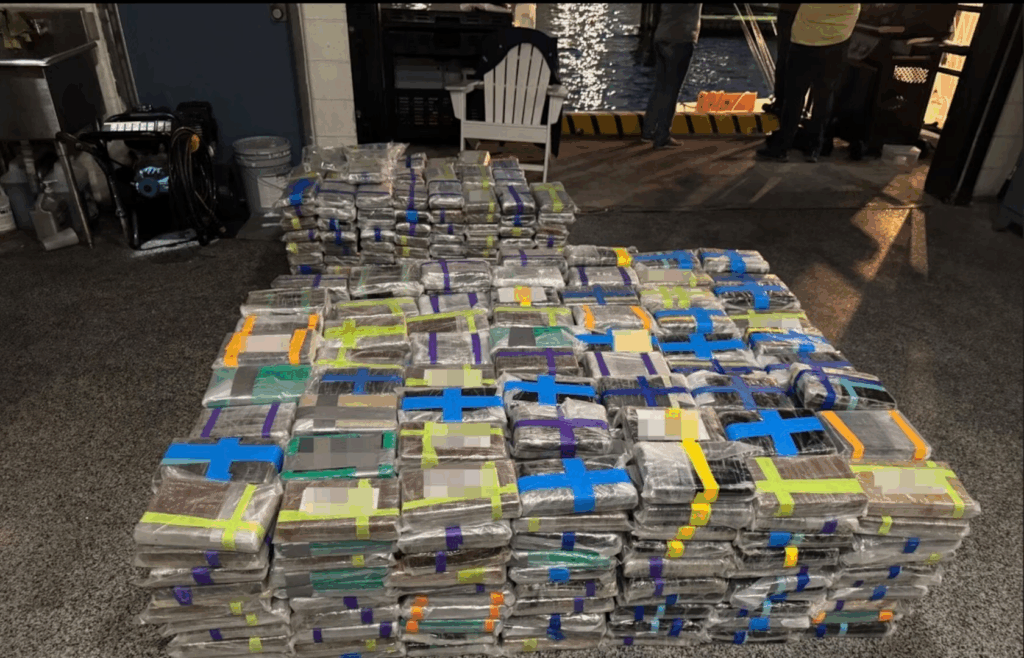
Law enforcement crews from U.S. Coast Guard Station Miami Beach and CBP Air and Marine Operations seized approximately 3,715 pounds of cocaine, worth an estimated $28 million, from a suspected drug smuggling vessel 2 miles east of government cut, Nov. 2, 2025. (U.S. Coast Guard photo by Coast Guard Station Miami Beach)
From Coast Guard Southeast District, Dec. 5, 2025
MIAMI – A U.S. Coast Guard Station Miami Beach law enforcement boat crew along with CBP Air and Marine Operations (AMO) and HSI seized approximately 3,715 pounds of cocaine, worth an estimated $28 million, from a suspected drug smuggling vessel 2 miles east of government cut, Tuesday.
CBP AMO law enforcement boat crews provided assistance with multiple marine units and specialized search tools upon initial interdiction by Coast Guard Station Miami Beach crew.
“This was the largest USCG Small boat station cocaine seizure since 1995,” said Lt. Matthew Ross, Coast Guard Station Miami Beach commanding officer. “Protecting our maritime borders from illicit drug trafficking and transnational criminal organizations remains one of our highest priorities. The Coast Guard and our federal, state and local law enforcement partners remain vigilant in our shared efforts to keep our maritime borders safe by preventing illicit narcotics from reaching our communities.”
CBP’s Office of Field Operations (OFO) Miami Seaport also responded with a K9 team once the vessel was brought pierside. The OFO K9 alerted to multiple locations within the vessel. A physical search by AMO agents uncovered more than 1,000 concealed packages of cocaine, weighing over 3,700 lbs. Federal agents took custody of three subjects and transported them.
“Disrupting maritime narcotics smuggling like this demonstrates the power of teamwork in safeguarding our nation and holding criminals accountable,” said Executive Director Andy Blanco, CBP Air and Marine Operations Southeast Region. “Smugglers should be warned that our whole-of-government team is watching, and they will be caught.”
We are part of a whole-of-government approach to secure our borders by dismantling Foreign Terrorist Organizations (FTO) and Transnational Criminal Organizations (TCO), including narco-trafficking and human smuggling operations.