Gilday: Large Scale Exercise 2021 Will Provide ‘Path to the Future’ for U.S. Navy
Gilday, second from left, appeared on the Tri-Service Maritime Leadership panel that kicked off Sea-Air-Space 2021. NAVY LEAGUE / Lisa Nipp
NATIONAL HARBOR, Md. — The Navy’s massive Large Scale Exercise 2021 kicks off this week and the sea service’s top officer said Monday the exercise represents a “path to the future” for the service.
It’s the “biggest exercise we’ve done in a generation,” and the Navy will benefit from its lessons for years to come, Chief of Naval Operations Adm. Michael Gilday said while speaking at the Navy League’s Sea-Air-Space Expo in National Harbor, Maryland.
The exercise will involve 25,000 sailors and Marines and will span 17 time zones in the Pacific Ocean, Atlantic Ocean, and Mediterranean Sea. The exercise begins Aug. 3 and will finish on Aug. 16.
While the Navy plans to test warfighting concepts like it would with any exercise, one of the main purposes of the event is to put Sailors and Marines in a two-week live virtual constructive exercise, Gilday said.
“At an individual level, it allows sailors and combatant commanders” to experiment with warfighting concepts and generate lessons learned, he said.
“That’s the key to this,” he said. “It’s to take this warfighting concept, which is quite frankly going to be foundational to everything that we buy, everything we invest in, and it’s going to inform how we’re going to fight.”
The exercise provides a rare opportunity where service members can train together regardless of their role.
“We think this constructive training is really a path to the future for us,” Gilday said. “You can imagine that sailors and lieutenant commanders and their COs can conduct integrated training — air wing and submarines and surface ships and cyber units. Any time they want thousands of repetitions, we can learn from that, and bring back those lessons to how we fight.”
Saildrone Voyager: A Unique Solution for 24/7/365 Maritime Domain Awareness
The Saildrone Voyager, a 33-foot sailboat-like vehicle primarily powered by wind and solar energy. SAILDRONE
According to the U.S. Coast Guard’s 2020 “Illegal, Unreported and Unregulated Fishing Strategic Outlook,” IUU fishing has replaced piracy as the leading global maritime security threat. Saildrone uncrewed surface vehicles (USVs) have sailed more than 500,000 nautical miles collecting valuable data about the marine environment for fisheries research, climate science, and ocean mapping. Now, a new class of Saildrone vehicles equipped with radar, 360-degree cameras, Automatic Identification System (AIS) and proprietary machine learning algorithms makes Saildrone a unique solution for combating IUU fishing, narcotics interdiction, and other maritime domain awareness (MDA) activities, anytime and in any ocean.
The Saildrone Voyager is a 33-foot sailboat-like vehicle predominantly powered by wind for propulsion and solar energy for electronics, communications, and navigation. With an average speed of up to five knots, the Saildrone Voyager can operate continuously in the open ocean for up to 180 days while producing a minimal carbon footprint. Saildrone USVs can be deployed and retrieved from any oceanside dock and transit autonomously to and from the operating area.
Global Fishing Watch uses a combination of publicly available AIS data and satellite imagery to expose areas of illegal fishing activity. The Voyager fuses optical data and machine learning to detect targets that are otherwise not transmitting their position in real time. These detection events are then fused with other data sources — AIS and acoustics — to deliver a fully informed picture of the surrounding maritime domain. Stationed strategically, a group of Voyagers can deliver 24/7/365 protection of marine assets.
Saildrone possesses the world’s largest data set of images of the open ocean. Tens of millions of images, collected by the Saildrone fleet deployed all over the world during more than six years of operational missions, have been annotated with human analysis highlighting anything of interest — vessels, birds, icebergs, etc. With this enormous data set, Saildrone’s ML model automatically recognizes objects in real time, providing unprecedented situational awareness to remote command centers.
In October 2020, Saildrone performed a successful 30-day demonstration of MDA capabilities for the U.S. Coast Guard off the coast of Hawaii. Each week highlighted a specific real-world use case for persistent MDA: general traffic monitoring, IUU fishing, search and patrol and port security. Additionally, Saildrone USVs can conduct long-duration intelligence, surveillance and reconnaissance missions enabling narcotics interdictions.
Saildrone USVs also carry a robust payload of oceanographic and meteorological sensors for continuous high-resolution environmental monitoring above and below the sea surface. Optional sensors include an Acoustic Doppler Current Profiler (ADCP), which can help to identify conditions in which a loitering vessel might drift into a protected area, and multibeam sonar for high-resolution ocean mapping, necessary for improving safety of navigation.
Data is transferred in real time via a secure satellite network. Saildrone data can be viewed in the proprietary Saildrone Mission Portal or linked directly into existing architecture, for example, Minotaur via an API interface. The Saildrone Mission Portal provides a variety of tools — overlays of satellite products, model GRIB files, and ingestion of other assets such as ships, buoys, tagged animals, or other autonomous platforms — for on-the-fly mission analysis and fleet management.
Saildrone USVs are rugged and have a proven track record of performing long-duration missions in remote areas and extreme conditions. The Saildrone fleet has logged more than 13,000 days at sea in some of the most extreme weather conditions on the planet. They have tracked fish in the North Sea, surveyed ocean eddies off Africa, air-sea heat transfer in the Gulf Stream and discovered a shipwreck in the Gulf of Mexico. They have crossed the Atlantic Ocean in both directions, sailed up to the Arctic ice edge setting a northern latitude record for an autonomous vehicle of 75.49°N and survived Southern Ocean storms to circumnavigate Antarctica.
The robustness of the underlying core components, a wind-powered vehicle capable of long-duration missions and a machine learning-based approach to vessel detection, makes Saildrone an ideal solution for persistent maritime domain awareness in any ocean.
NSS-Supply: Transforming the Navy’s Supply Chains
NSS-Supply is a hugely ambitious project for the Navy, due both to its broad scope and the speed at which it moves. NAVSUP
The Navy requires a single, strategic-scale, sustainable design for supply-chain management, with the right mix of commercial and organic activities to project and sustain the force required for war fighting.
With that in mind, Naval Supply Systems Command (NAVSUP) kicked off the newest vice chief of naval operations-led naval sustainment system in October 2020. Naval Sustainment System-Supply (NSS-Supply) aims to unify numerous independent supply-chain functions under the leadership of NAVSUP Commander Rear Adm. Pete Stamatopolous, with the goal of improving end-to-end supply chain readiness and affordability.
As NSS-Supply nears its first anniversary in operation momentum continues to build as NAVSUP and mission partners have progressed through several waves of deliberate transformation.
“The Navy’s supply chains lacked end-to-end coordination and alignment for decades, which has created numerous issues: insufficient and inefficient organic repair capacity, high rates of part cannibalization, an excess of unrepaired parts, a cash shortfall and, ultimately, degraded readiness,” Stamatopoulos said.
“Over the past several years, uncoordinated decisions made upstream were constricting our supply chains and causing significant downstream inefficiencies. NSS-Supply is working to better orchestrate, integrate and synchronize the many functions of our supply chains to correct these issues and deliver higher readiness at lower costs throughout the lifecycle of the weapons systems.”
Grounded in commercial best practices pioneered by industrial companies such as Caterpillar, Delta Tech Ops and John Deere, NSS-Supply elevates supply chain management into the Navy “C-Suite.” Designated as the Navy’s single end-to-end supply chain integrator, Stamatopolous is responsible for elevating the visibility of supply-chain performance by holding supporting functions accountable.
Stamatopoulos leads an organization of supply chain professionals responsible for providing responsive logistical support worldwide, through a global network with a presence in more than 17 countries and 21 states, districts and territories.
NSS-Supply is also moving supply-chain decisions upstream to better shape and design life-cycle logistics strategies for which the costs are lower. To hold the Navy accountable, NSS-Supply has created a cash-based metric to evaluate the efficiency and effectiveness of its supply chain in the long term. This north-star metric, the Supply Chain Effectiveness Figure of Merit (SeFOM), is the Navy’s first enterprise-level metric that balances readiness and costs. For every dollar put into sustaining a platform, the SeFOM measures the value of readiness generated.
In addition, NSS-Supply is driving unity of effort across six pillars that dissect and transform different functions of the supply chain.
• The Achieve End-to-End Integration pillar. • The Demand Management pillar aims to reduce demand fleet-wide and increase predictability through improving reliability and maintenance. • The End-to-End Velocity pillar focuses on accelerating the movement of material and parts in the Navy supply chain by lowering repair turnaround times and repair, overhaul or reconditioning queue times. • The Optimize Working Capital Fund pillar reorients financial management to a commercial cash flow-centric approach designed to improve transparency of cash allocation, collections, expenditures and pricing for long-term stability. • The Optimize Organic Repair pillar rebalances organic depot repair volume to fully utilize capability and capacity. • The Shape Industrial Base pillar, the most aspirational pillar, aims to expand competition and deepen partnerships with strategic suppliers to make acquisition and sustainment more efficient, cost-effective and affordable.
NSS-Supply is a hugely ambitious project for the Navy, due both to its broad scope and the speed at which it moves. While NSS-Supply is a multiyear undertaking, it’s divided into three-month “waves” during which three to five initiatives run simultaneously across the six pillars.
The timelines for the waves’ initiatives are based on an agile framework (another commercial best practice). Each initiative has multiple two- to four-week sprints, with clear outcomes at the end of each sprint that define and shape the work of the subsequent sprints.
Although this is a new approach for the Navy, it’s already yielding positive change and realizable gains since launching last fall. With each wave and sprint, NAVSUP and Navy are gaining new supply-chain competencies and confidence in the effectiveness of this way of doing business.
“These first several months of NSS-Supply have given me great confidence and optimism that we are finally within reach of a decades-long goal of achieving a fully integrated and sustainable Navy-wide supply chain,” Stamatopoulos said. “I look forward to its continued success.”
Navy Conducts First MQ-4C Triton Test Flight with Multi-Intelligence Upgrade
A Northrop Grumman Corp.-built MQ-4C Triton took to the skies for the first time in the highly upgraded multi-intelligence configuration known as integrated functional capability four (IFC-4). U.S. NAVY
PATUXENT RIVER, Md. — The Navy conducted its first test flight of the MQ-4C Triton in its upgraded hardware and software configuration July 29 at NAS Patuxent River, beginning the next phase of the unmanned aircraft’s development, the Naval Air Systems Command said in a July 29 release.
The MQ-4C Triton flew in its new configuration, known as Integrated Functional Capability (IFC)-4, which will bring an enhanced multi-mission sensor capability as part of the Navy’s Maritime Intelligence, Surveillance, Reconnaissance and Targeting (MISR&T) transition plan.
Triton’s Integrated Test Team (ITT) comprised of the U.S. Navy, Australian cooperative partners, and government/industry teams completed a functional check flight and initial aeromechanical test points, demonstrating stability and control of the MQ-4C after a 30-month modification period.
“Today’s flight is a significant milestone for the program and a testament to the resolve of the entire ITT, their hard work, and passion for test execution and program success,” said Capt. Dan Mackin, Persistent Maritime Unmanned Aircraft Systems program manager. “This flight proves that the program is making significant progress toward Triton’s advanced multi-intelligence upgrade and it brings us closer to achieving the initial operational capability (IOC) milestone.”
Multiple Triton assets have been modified into the IFC-4 configuration in support of IOC in 2023. A single test asset is in the current IFC-3 configuration to support sustainment of deployed systems as well as risk reduction for IFC-4.
Currently, two MQ-4C Triton aircraft in the baseline configuration known as IFC-3 are forward deployed to 7th Fleet in support of early operational capability (EOC) and Commander Task Force (CTF)-72 tasking. VUP-19 will operate Triton to further develop the concept of operations and fleet learning associated with operating a high-altitude, long-endurance system in the maritime domain.
“The MQ-4C Triton has already had a tremendous positive impact on operations in [U.S. Indo-Pacific Command] and will continue to provide unprecedented maritime intelligence, surveillance and reconnaissance capabilities which are especially critical to national interests with the increased focus in the Pacific,” Mackin said.
Triton is the first high-altitude, long-endurance aircraft that can conduct persistent Intelligence, Surveillance and Reconnaissance (ISR) missions to complement the P-8 in the maritime domain. The Navy plans to deploy Triton to five orbits worldwide.
USS Independence First LCS to Be Decommissioned
The crew of USS Independence (LCS 2), the lead ship of the Independence-variant Littoral Combat Ship, recognized more than a decade of naval service during a decommissioning ceremony at Naval Base San Diego, July 29. U.S. NAVY
SAN DIEGO — The crew of USS Independence (LCS 2), the lead ship of the Independence-variant Littoral Combat Ship, recognized more than a decade of naval service during a decommissioning ceremony at Naval Base San Diego, July 29, commander, Littoral Combat Ship Squadron One, said in a July 30 release.
Due to public health and safety restrictions on large public events resulting from the novel coronavirus (COVID-19) pandemic, the ceremony was a private event celebrated alongside ship plankowners and former crew members.
During the ceremony, keynote speaker, Vice Adm. Roy Kitchener, Commander, Naval Surface Force, U.S. Pacific Fleet, wished the crew of Independence fair winds and following seas as they said farewell to their ship.
“The Independence crew shouldered a heavy responsibility. Since the ship’s introduction into the fleet we asked her to serve for a specific purpose; to test emerging equipment and concepts,” said Kitchener. “The crew accomplished that and so much more. Without their efforts and experiences, the ship class would not be where it is today with six ships deployed throughout the world. Those improvements, made largely in part due to this crew’s experience and input, will continue to carry the LCS class into the future.”
The commissioning commanding officer of USS Independence gold crew, Capt. Michael Riley said it was the Sailors who rose to the occasion that made Independence prosperous.
“What made Independence successful wasn’t the program managers, industry professionals or even her two captains. It was the officers, chiefs and Sailors of the blue and gold crews that made it operational. They shouldered the burden of shifting programmatic guidance, incomplete documentation or one-of-a-kind systems, and got it to sea,” said Riley. “They were honest in pointing out when system performances or operational processes failed to live up to their expectations. At the same time, they discovered hidden capabilities in the ship, repurposing equipment and systems to suit the situation.”
Independence maintained a crew of nine officers and 41 enlisted Sailors. The ship was built in Mobile, Alabama, by Austal USA and commissioned Jan. 16, 2010.
Independence is the sixth ship to carry the name, recognizing the cornerstone of our nation’s foundation for which so many Americans have fought and died. The first Independence was a 10-gun sloop that served during the American Revolution. The second Independence, the first ship of the line in the Navy, was launched in 1814 as a 74-gun ship, but later refitted to a 54-gun frigate. The third Independence served with the Naval Overseas Transportation Service (NOTS) following the end of World War I. The fourth Independence (CVL 22), a small aircraft carrier commissioned in 1943, earned eight battle stars during World War II. The fifth Independence (CV 62) was an aircraft carrier commissioned in 1959 and decommissioned in 1998.
Independence has been a test and training ship and was key in developing the operational concepts foundational to the current configuration and deployment of LCS today. The decommissioning of LCS 2 supports department-wide business process reform initiatives to free up time, resources, and manpower in support of increased lethality. The LCS remains a fast, agile, and networked surface combatant, designed to operate in near-shore environments, while capable of open-ocean tasking and winning against 21st-century coastal threats.
The LCS class consists of two variants, the Freedom variant and the Independence variant, designed and built by two industry teams. The Freedom variant team is led by Lockheed Martin and is a steel monohull design constructed in the Fincantieri Marinette Marine Corporation’s shipyard in Marinette, Wisconsin. The Independence variant is an aluminum trimaran design originally built by an industry team led by General Dynamics Bath Iron Works for LCS 2 and LCS 4. Currently, Independence variant LCS are constructed by Austal USA in the company’s Mobile, Alabama shipyard.
LCS are outfitted with mission packages (made up of mission systems and support equipment) that deploy manned and unmanned vehicles and sensors in support of mine countermeasures, anti-submarine warfare or surface warfare missions.
After the decommissioning of Independence, 22 littoral combat ships remain in service to the fleet.
Lockheed Martin’s HELIOS Shipboard Laser Being Tested at Wallops Island
Artist’s rendering of Lockheed Martin’s HELIOS system. LOCKHEED MARTIN
ARLINGTON, Va. — The shipboard laser weapon system built for the U. S. Navy by Lockheed Martin is being tested at Wallops Island, Virginia, a company official said.
The first High-Energy Laser with Integrated Optical-dazzler and Surveillance, or HELIOS, was delivered to the Navy in January 2021 and was shipped to the Navy’s test site at Wallops Island.
The HELIOS is being test-fired and real-world test data from the weapon is being collected to confirm the models, said Jon Rambeau, vice president and general manager for Integrated Warfare Systems & Sensors at Lockheed Martin.
The single 60-kilowatt HELIOS unit is scheduled to be installed on the Flight IIA Arleigh Burke-class guided missile destroyer USS Preble in line with its deployment schedule, Rambeau said.
Lockheed Martin built one HELIOS under the Navy contract, which has options for multiple units.
Rambeau said the HELIOS, which is fully integrated into the Aegis Combat System, has the potential to be a significant counter to anti-ship cruise missiles. The weapon is scalable with additional of fiber-optic laser modules. The HELIOS is adaptable to the Ship Self-Defense System (SSDS) on aircraft carriers and most amphibious warfare ships.
Future Maritime Center of Excellence to Transform Coast Guard Academy Waterfront
The U.S. Coast Guard Academy is situated along the Thames River in New London, Connecticut. U.S. COAST GUARD
NEW LONDON, Conn. — A more than $23 million project is now underway at the U.S. Coast Guard Academy that will transform the waterfront area of the 90-year-old campus, the academy’s public affairs office said in a July 29 release.
The future Maritime Center of Excellence (MCOE) will enhance the waterfront facilities at the Academy by offering interactive and high-tech classrooms for a variety of educational and leadership development courses.
The 20,000 square foot structure will be the Academy’s first Leadership in Energy and Environmental Design (LEED) certified building and will highlight the unique waterfront leadership programs and nationally prominent intercollegiate sailing program.
In a twist on the traditional groundbreaking ceremony, leaders signed a ceremonial steel beam which will be used in the construction of the future center during a July 29 event to commemorate the start of the project.
Present at the event were Rear Adm. Bill Kelly, superintendent of the Coast Guard Academy, retired Coast Guard Capt. Andrea Marcille, president of the U.S. Coast Guard Academy Alumni Association and retired Coast Guard Vice Adm. Manson Brown, chair of the Alumni Association Board of Directors.
The modern design of the MCOE includes ambitious sustainability design goals in line with coordinated climate resiliency efforts across the service, and one of several lines of effort that the Department of Homeland Security and its component agencies have taken to address the dangers posed by global climate change.
The construction is targeting LEED Gold certification. LEED certification involves a set of rating systems for the design, construction, operation, and maintenance of modern buildings to achieve sustainability and resource efficiency goals.
“This LEED certified, multi-purpose facility will serve as gathering spot for cadets and officer candidates from across our great nation,” said Rear Adm. Kelly. “It will be a space where young women and men can gather to learn and grow and I am certain it will serve as a facility that will enhance an appreciation for the water and all its power and beauty and ultimately it will help us instill a liking for the sea and its lore.”
The interior spaces of the future center have been designed with access to daylight, and natural ventilation to minimize reliance on artificial lighting and air conditioning. Double-height spaces for vessel maintenance, office space, and an atrium will provide natural ventilation. Other sustainability goals include the exploration of ground-source heating and cooling, solar panels, and rainwater harvesting. The building exterior will also feature durable, resilient materials that are easily maintained.
With a curvilinear vaulted roof, wooden decks, and true north orientation the building is designed to highlight the waterfront landscape. The new facility will also feature interactive and high-tech classrooms such as the Science and Engineering Innovation Laboratory designed to encourage collaboration in areas of digital processing, robotics, alternative fuels and emissions, and environmental and coastal resiliency among others.
This represents a significant step forward as the Academy works to recapitalize 1930’s infrastructure and build modernized training and education venues to deliver the knowledge, skills, experience and values necessary to develop the future Coast Guard workforce.
Navy Christens Future USS Hyman G. Rickover
The Navy’s newest Virginia-class attack submarine, future USS Hyman G. Rickover (SSN 795), was christened during a ceremony at General Dynamics’ Electric Boat shipyard facility in Groton, Connecticut, July 31. U.S. NAVY
GROTON, Connecticut – The Navy’s newest Virginia-class attack submarine, future USS Hyman G. Rickover (SSN 795), was christened during a ceremony at General Dynamics’ Electric Boat shipyard facility in Groton, Connecticut, July 31, the U.S. Navy said in a release.
“This submarine is a fitting tribute to Admiral Rickover, who truly transformed our Navy,” said Adm. James Caldwell, director, Naval Nuclear Propulsion Program, during his remarks at the celebration.
Caldwell credited Rickover — who served for 63 years in the Navy and is credited with spurring the service to adopt nuclear propulsion after World War II — with not only technological advances but cultural ones. He lauded Rickover’s legendary work ethic, frankness, attention to detail and commitment to excellence, which he said has since permeated throughout the Navy.
“It’s really great to see this ship come together, and to see so many people here to celebrate the christening of the Hyman G. Rickover and honor the Hyman G. Rickover legacy,” said Cmdr. Thomas Niebel, commanding officer of the newly christened submarine.
The Honorable James F. Geurts, performing the duties of Under Secretary of the Navy, told those in attendance that the construction of the future USS Hyman G. Rickover is a testament to the dedication of America’s shipbuilders and sailors.
“We did not close a shipyard, public or private, for one day during the pandemic,” Geurts said. “The sustained commitment to excellence displayed by this workforce shows in the construction of this boat and adheres to the culture of excellence promoted by Hyman G. Rickover.
“It’s not just a matter of having the world’s best ships,” he continued, “you have to have the world’s best Sailors to maintain the world’s best Navy, and we have both.”
Darleen Greenert, the submarine’s sponsor, a Navy veteran, and wife of former Chief of Naval Operations Jonathan Greenert, highlighted the sacrifice of military families during her remarks, and remembered the late Eleonore Rickover, the namesake admiral’s wife.
“She set the bar [for ship sponsors],” Greenert said of Eleonore Rickover, who was the sponsor for a previous Los Angeles-class submarine to bear the Hyman G. Rickover name, SSN 709. “She loved her crew.”
The first Hyman G. Rickover was commissioned at Submarine Base, New London, in Groton, on July 21, 1984. SSN 709 and its crew deployed 12 times until its decommissioning in December 2007. Over the years, its decorations included the Atlantic Fleet Golden Anchor Award, Submarine Squadron Eight’s anti-submarine warfare white “A” and engineering red “E” awards and the prestigious Sixth Fleet “Hook ‘Em” award for anti-submarine warfare excellence.
Greenert asked family members of the crew of the future USS Hyman G. Rickover to stand together when her daughter, Matron of Honor Sarah Greenert McNichol, broke the ceremonial bottle of sparkling wine across the bow.
Other speakers at the ceremony included Electric Boat President Kevin Graney, Newport News Shipbuilding President Jennifer Boykin, U.S. Rep. Joe Courtney, D-CT and U.S. Rep. Jim Langevin, D-RI.
Rickover will eventually joint the fleet with a displacement of 7,835 tons, crew of 132, and a weapons payload of 12 vertical launch systems and four torpedo tubes.
Fast-attack submarines like Rickover are multi-mission platforms enabling five of the six Navy maritime strategy core capabilities — sea control, power projection, forward presence, maritime security, and deterrence. The submarine is designed to excel in anti-submarine warfare; anti-ship warfare; strike warfare; special operations; intelligence, surveillance, and reconnaissance; irregular warfare; and mine warfare – from open ocean anti-submarine warfare to intelligence, surveillance and reconnaissance, to projecting power ashore with Special Operation Forces and Tomahawk cruise missiles in the prevention or preparation of regional crises.
Jones Act Seen as Key Hedge Against China’s Growing Merchant Might
Naval Air Crewman (Helicopter) 2nd Class Benjamin Whitney, from Syracuse, New York, lowers a litter during rescue training with a merchant ship in the Gulf of Aden, March 1, 2019, during Lucky Mariner 19. Lucky Mariner is an annual exercise led by Naval Coordination and Guidance for Shipping (NCAGS) alongside shipping and coalition maritime forces designed to exercise command and control and provide standardized direction during periods of increased tension to protect the free flow of commerce. U.S. NAVY / Mass Communication Specialist 2nd Class Logan C. Kellums
The Jones Act and commercial cargo operations in general must be strengthened to avoid further erosion of U.S. shipping strength versus commercial powerhouse China, said speakers at a Navy League Sea-Air-Space Prequel “Lunch and Learn” virtual session on July 21.
Dr. Sal Mercogliano, associate professor of history at Campbell University in North Carolina and a former merchant mariner, led a panel discussion entitled “The Jones Act, Where Commerce and Defense Converge.”
Mercogliano and the speakers sounded the alarm about the status of the U.S. merchant marine, particularly when compared to China.
“Are we a true proponent of sea power if we have the No. 1 Navy in the world and the No. 21 merchant marine in the world, when China is basically No. 2 in both and growing?” Mercogliano asked.
China has the largest merchant fleet, “which dwarfs ours,” the largest coast guard, the world’s only maritime militia, produces 96% of the world’s shipping containers and owns seven of the 10 busiest ports in the world, said panelist Tony Padilla, director of the Office of Cargo and Commercial Sealift at the Department of Transportation’s Maritime Administration.
On an average day in the United States, 23 U.S.-flagged vessels call at ports, compared with 2,800 foreign-flagged vessels, he said. In the critical Indo-Pacific region, 35 U.S.-flagged vessels call at ports on an average day, compared with 20,000 foreign-flagged vessels.
“This should be a wake-up call,” he said. “This is a major issue that we need to get to like yesterday, like last year, like 10 years ago.”
Panelist Mike Roberts, senior vice president of government relations for Crowley Maritime Corp. and president of the American Maritime Partnership, joined Padilla in pointing out the dangers posed by China, an authoritarian country.
“China’s advantage in the commercial maritime sector is simply overwhelming in sheer numbers. The Navy League reported last December that there were roughly 6,000 large commercial ships controlled by China internationally. The corresponding number of American-flagged ships is below 200 and that includes ships operating in U.S. domestic trades,” Roberts said.
“It’s all about policy — laissez faire on steroids on the U.S. side, versus mercantilism on steroids on the China side.”
The Jones Act — officially known as the Merchant Marine Act of 1920 — ensures that only U.S.-built, flagged and crewed ships can operate in domestic commerce, although it does allow for waivers of those requirements. Roberts said it is sometimes derided as a protectionist law aimed at bolstering the defense market, but one big value is promoting U.S. industry and workers.
“Foreign ships don’t obey American rules, hire American workers or pay American taxes. They should not be allowed to trade in our domestic markets, and that’s simply a function of American sovereignty, and not protectionism,” he said.
Costs are higher using U.S. workers versus developing nations’ labor, but “it’s simply not OK to replace American workers with foreign workers right here in America,” he said. “Those who complain about the cost of the Jones Act invariably miss that point.”
Jennifer Carpenter, president and CEO of the American Waterways Operators, a trade association for the tugboat, towboat and barge industry, said the U.S. commercial fleet showed its worth during the darkest days of the COVID-19 pandemic by keeping goods flowing.
Throughout the worst days of the pandemic, “tugboats, towboats, barges and other domestic vessels continued to move the commodities that kept a weakened economy afloat,” not least by delivering equipment to fight the virus.
“How much worse could things have been if we’d had to rely on foreign vessels to move supplies on our domestic waters and if we had to deal with the potential to the disruption to our maritime commerce in the middle of contending with COVID?” Carpenter said. “Thanks to the Jones Act, we didn’t have to find out.”
Carpenter said commercial shipping can respond quickly in the case of disaster, such as when ships stepped up to deliver oil to riverine ports in the wake of the Colonial Pipeline shutdown. Jones Act opponents sometimes call for waivers in the wake of such events, but she said the recent National Defense Authorization Act puts new requirements on such waivers and includes transparency and accountability as to who is asking for them, “so Congress can provide oversight.”
The act also specifies that renewable energy projects — mainly, offshore wind farms — are subject to the Jones Act, just like oil and gas work is.
Building wind farms is a “generational opportunity,” Carpenter said. “Let’s let American maritime companies and American mariners make this tremendous investment that is going to serve our country and our economy and our security so well.”
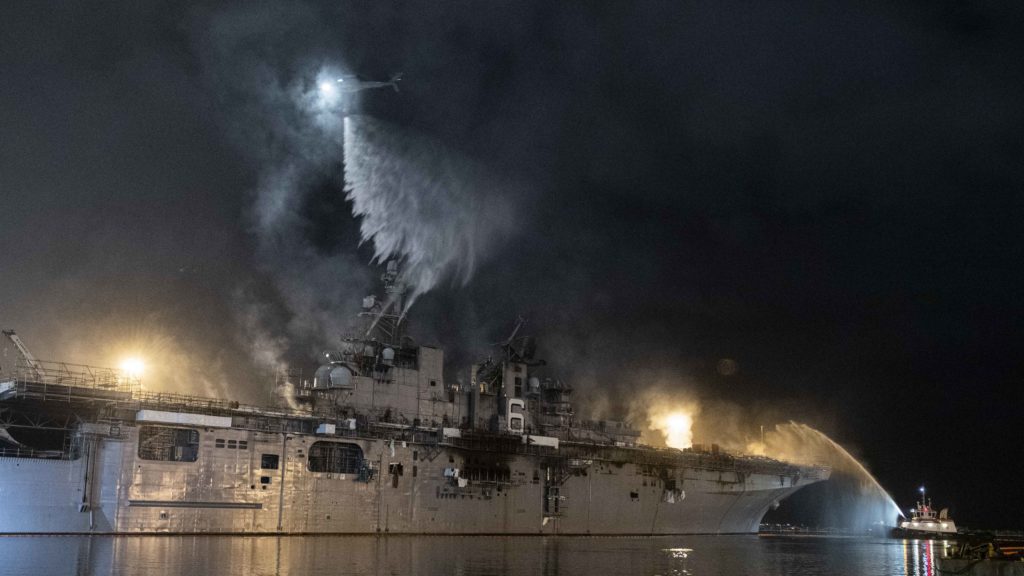
Navy Charges Crew Member for Bonhomme Richard Fire
A helicopter from Helicopter Sea Combat Squadron (HSC) 3 combats a fire aboard the amphibious assault ship USS Bonhomme Richard (LHD 6) at Naval Base San Diego, July 14, 2020. U.S. NAVY / Mass Communication Specialist 3rd Class Garrett LaBarge
ARLINGTON, Va. — The U.S. Navy has brought charges against a Sailor who was a crew member of the amphibious assault ship USS Bonhomme Richard for starting the fire that resulted in the devastation of the ship, the U.S. 3rd Fleet said in a July 29 release.
“On July 29, charges under the Uniform Code of Military Justice [UCMJ] were brought forth against a Navy Sailor in response to evidence found during the criminal investigation into the fire started on USS Bonhomme Richard (LHD 6) on July 12, 2020,” said Cmdr. Sean Robertson, U.S. 3rd Fleet spokesperson. “Evidence collected during the investigation is sufficient to direct a preliminary hearing in accordance with due process under the military justice system. The Sailor was a member of Bonhomme Richard’s crew at the time and is accused of starting the fire.
“Vice Adm. Steve Koehler, commander, U.S. 3rd Fleet is considering court-martial charges and has directed a preliminary hearing at which an impartial hearing officer will make determinations and recommendations required by the UCMJ prior to any further trial proceedings — including whether or not there is probable cause to believe an offense has been committed and to offer a recommendation as to the disposition of the case.”
The Bonhomme Richard was pierside at the naval base in San Diego going through modernization when a fire started and spread through much of the ship over a period of days. The Navy considered several options to repair the ship, possibly in another role, but the service decided to decommission and scrap it.
“Following an extensive material assessment in which various courses of action were considered and evaluated, we came to the conclusion that it is not fiscally responsible to restore her, then-Navy Secretary Kenneth Braithwaite said in a Nov. 30 release.