Bollinger Shipyards Delivers 45th Fast Response Cutter to Coast Guard
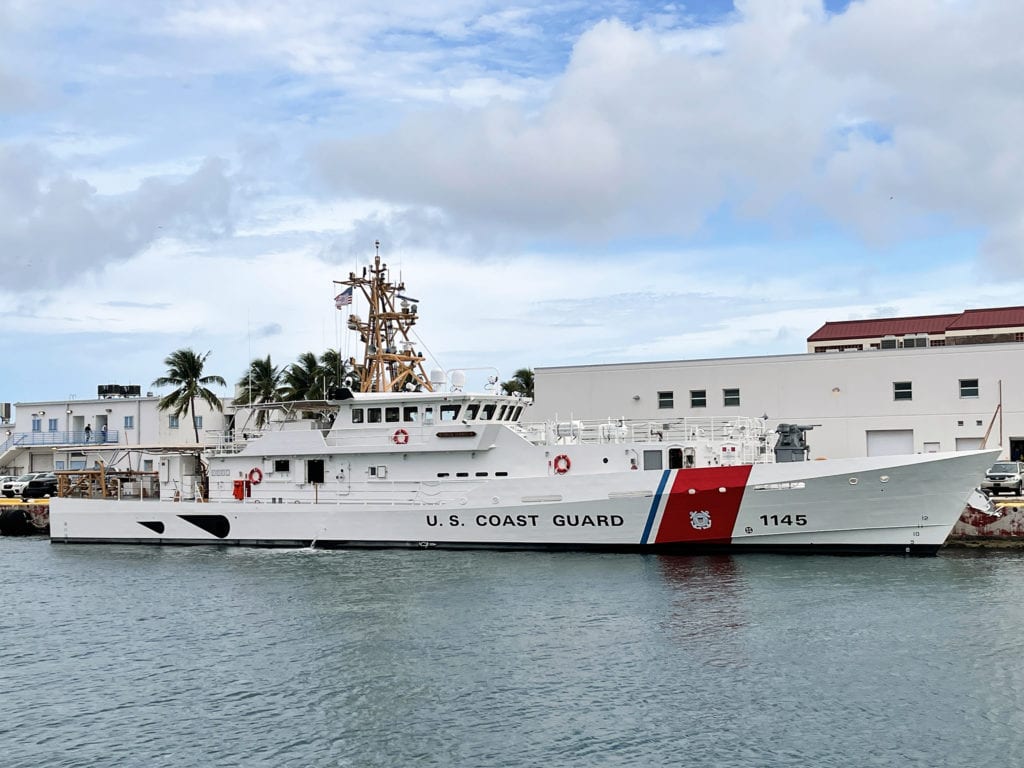
USCGC Emlen Tunnell in Key West, Florida. BOLLINGER SHIPYARDS

LOCKPORT, La. — Bollinger Shipyards LLC has delivered the USCGC Emlen Tunnell to the U.S. Coast Guard in Key West, Florida, the company said in a July 1 release. This is the 168th vessel Bollinger has delivered to the U.S. Coast Guard over a 35-year period and the 45th Fast Response Cutter (FRC) delivered under the current program.  

Named in honor of Coast Guard hero and National Football League great Emlen Tunnell, the cutter is the fourth of six FRCs to be home-ported in Manama, Bahrain. They will replace the aging 110-foot Island Class Patrol Boats, built by Bollinger Shipyards 30 years ago, supporting the Patrol Forces Southwest Asia (PATFORSWA), the U.S. Coast Guard’s largest overseas presence outside the United States. 

“With recent incursions in the Arabian Gulf, it is a top priority to ensure that the brave men and women of the Coast Guard have the most state-of-the-art, advanced vessels as they work to ensure maritime security in the region,” said Bollinger President and CEO Ben Bordelon. “Bollinger is proud to continue enhancing and supporting the U.S. Coast Guard’s operational presence in the Middle East and ensuring it remains the preferred partner around the world.” 

Earlier this year at the commissioning ceremony of the USCGC Charles Moulthrope, U.S. Coast Guard Commandant Adm. Karl Schultz lauded the “enhanced seakeeping” capabilities of the PATFORSWA-bound FRCs, saying “these ships are truly going to be game changing in their new theater of operations” and “offer increased opportunities for integrated joint operations with our Navy and Marine Corps colleagues” as the Coast Guard seeks to be part of the whole-of-government solution set in the region. 

PATFORSWA is composed of six cutters, shoreside support personnel, and the Maritime Engagement Team. The unit’s mission is to train, organize, equip, support and deploy combat-ready Coast Guard Forces in support of U.S. Central Command and national security objectives. PATFORSWA works with Naval Forces Central Command in furthering their goals to conduct persistent maritime operations to forward U.S. interests, deter and counter disruptive countries, defeat violent extremism and strengthen partner nations’ maritime capabilities in order to promote a secure maritime environment. 

Each FRC is named for an enlisted Coast Guard hero who distinguished themselves in the line of duty. Emlen Tunnell was instrumental in saving the lives of two shipmates in two different heroic actions. His exploits as a Coast Guardsman and then as a ground-breaking African American in the world of professional sports, Tunnell, through his incredible achievements both on and off the field, demonstrated the Coast Guard’s core values of honor, respect and devotion to duty. 

Tunnell played college football at Toledo before and after World War II — he enlisted from 1943 to 1946 — and continued his collegiate career at the University of Iowa. After leaving college in 1948, he hitchhiked from his home in Pennsylvania to New York for a tryout with the New York Giants. Tunnell was the first Black player signed by the Giants and later played for the Green Bay Packers. He ended up playing 14 seasons in the NFL and when he retired as a player, he held league records with 1,282 interception return yards, 258 punt returns, 2,209 punt return yards, and 79 interceptions, the second most interceptions in NFL history today. He then became a scout and one of the league’s first Black assistant coaches, helping fully integrate both the Giants and the Packers. In 1967, Tunnell was the first Black man and the first defensive specialist to be enshrined in Canton. 

The FRC is an operational “game changer,” according to senior Coast Guard officials. FRCs are consistently being deployed in support of the full range of missions within the United States Coast Guard and other branches of our armed services.  This is due to its exceptional performance, expanded operational reach and capabilities, and ability to transform and adapt to the mission. FRCs have conducted operations as far as the Marshall Islands — a 4,400 nautical mile trip from their homeport. Measuring in at 154-feet, FRCs have a flank speed of 28 knots, state of the art C4ISR suite and stern launch and recovery ramp for a 26-foot, over-the-horizon interceptor cutter boat. 


Pacific Fleet Commander Says He Has a Duty To Prevent Seizure of Taiwan

Commander, U.S. Pacific Fleet Adm. Sam Paparo speaks to Forward Deployed Naval Forces, Commander, Fleet Activities Sasebo and tenant command leadership onboard CFAS June 9, 2021. U.S. NAVY / Mass Communication Specialist 3rd Class Jasmine Ikusebiala

ARLINGTON, Va. —  The commander of U.S. Pacific Fleet says he is concerned about People’s Republic of China (PRC) as a pacing threat, but he is also confident in his forces, allies and operational designs to thwart any attempt by China to seize Taiwan by force.

“China is a pacing threat,” Adm. Sam Paparo said June 29 during the final webinar of the West 2021 symposium of the Armed Forces Communications and Electronics Association, and the U.S. Naval Institute. Paparo said he interpreted that to mean China’s development of its own combat capability, particularly maritime capability, “is the factor that we’re taking into account in making our own investments in our own combat capabilities.”

Paparo, who took command of the Pacific Fleet in May, said he completely agreed with the former head of Indo-Pacific Command, Adm. Philip Davidson, who told a Senate hearing in March that China might attempt to take over Taiwan in six years, as part of its aim to expand its influence across the region and supplant the U.S. leadership role in the rules-based international order by 2050. China claims Taiwan, a position officially supported by the United States.

“I worry about China’s intentions,” Paparo said. “It doesn’t make a difference to me, whether it is tomorrow, next year  or whether it is in six years. At Pacific Fleet and Indo-Pacific Command we have a duty to be ready to respond to threats to U.S. security.”

That duty includes delivering a fleet “capable of thwarting any effort on the part of the Chinese to upend that [world] order, to include the unification by force of Taiwan to the People’s Republic of China,” the admiral said. “But I also feel confident in our Sailors, Marines and Coast Guardsmen … as well as our operational designs to thwart such an effort with the teamwork of our allies and partners.” 

Asked if there was any further discussion of creating a numbered fleet for the Indian Ocean, Paparo noted that by Navy doctrine, every numbered fleet is a tactical three star headquarters that can be deployed worldwide against any task.

“No numbered fleet, anywhere in the world has a monopoly on any battle space. They are broadly associated with bits of geography by convention,” he said. While hard to imagine the 5th, 6th or 7th fleets being separated from the geographic areas where they have deep relationships as a function of their placement, the 4th, 2nd and 3rd fleets “are up and ready rounds that can be deployed to the point of need.”


CH-53K Helicopter Cost Trending Downward, Marine General Says

U.S. Marine Corps Maj. Gen. Michael S. Cederholm flies the CH-53K “King Stallion” at Marine Corps Base Camp Lejeune, North Carolina, June 12, 2021. U.S. MARINE CORPS / Cpl. Yuritzy Gomez

ARLINGTON, Va. — The unit cost of the Marine Corps’ new heavy-lift helicopter is trending in the right direction as the helicopter prepares for its Initial Operational Test and Evaluation (IOT&E), a senior Marine Corps officer told Congress. 

Rep. Vicki Hartzler, R-Missouri, during a June 30 hearing of the subcommittee on Tactical Air and Land Forces for the House Armed Services Committee, asked Lt. Gen. Mark Wise, the Corps’ deputy commandant for aviation, about the cost of a CH-53K King Stallion being $125 million, more than the cost of an F-35 strike fighter. She noted the proposed 2022 budget requested nine CH-53Ks, down from the 11 planned earlier for 2022. She also asked if the Marine Corps’ requirement for 200 CH-53Ks would be reduced in light of the Corps’ planned reduction of heavy helicopter squadrons from eight to five.     

Wise replied that unit cost for the CH-53Ks in Low-Rate Production Lot 5 in fiscal 2021 was $97 million and for Lot 6 in fiscal 2022 was projected to be $94 million, lower than the cost of an F-35, “and trending in the right direction.” 

The general also said the Corps originally determined the requirement for CH-53Ks to be about 220 aircraft but reduced the official number to 200 because of affordability. He said the requirement will remain at 200 aircraft for the foreseeable future. 

“If there is a reduction, it will probably be less than we would normally think had we actually bought the program of record that was the requirement to begin with,” Wise said. “As we get to determining what that number is, any reduction would not happen until the end of program buys. That would reduce the likelihood that the cost would rise, depending on the last lot buys.” 

The general noted the 200 number was based on an projected attrition rate that had not been updated. 

“So, it could go below 200 — and it ma y— but I’m not sure it’s going to go grossly below” 200, he said. 

Wise said progress has been made through risk-reduction initiatives in dealing with technical issues such as engine gas re-ingestion. 

“As we get ready to start into IOT&E — we’re actually starting next month — we’re seeing some fairly impressive readiness rates for the test birds that are going to be doing that operational test,” he said.  


Representative Suggests Including Lawmakers in Navy War Gaming to Help Inform Advocacy

Naval Postgraduate School students participate in analytic wargames they designed to explore solutions for some of the Defense Department’s most pressing national security concerns. Rep. Mike Gallagher (R-Wisconsin) says he’d like to see some congressional participation in Navy wargaming allowed this year. NAVAL POSTGRADUATE SCHOOL / Javier Chagoya

ARLINGTON, Va. — The U.S. Department of the Navy (DoN) should invite supporters in Congress to the wargaming process “so we can better advocate for the Navy,” a House Armed Services Committee member has suggested.

During a Washington think tank event June 28 on the state of the U.S. maritime industrial base and competition with China, Rep. Mike Gallagher (R-Wisconsin) said he would like to see Chief of Naval Operations Adm. Mike Gilday, Marine Corps Commandant Gen. David Berger and other Pentagon officials “join a few of us navalists in Congress,” in a room with just a map  “and just in simple terms, have them walk us through their theory of the case for what they think the PLA [People’s Liberation Army] is trying to do. What we need to do to counter.”

Irritated by the limited time lawmakers get to question military leaders during public committee hearings, Gallagher called for better communication between Navy and Marine Corps leaders and congressional supporters during a virtual joint appearance with fellow HASC member, Rep. Rob Wittman (R-Virginia), presented by the Hudson Institute.  “So, I’m an advocate for allowing some congressional participation in Navy wargaming this year,” Gallagher said.

Without directly commenting on Gallagher’s idea, Wittman acknowledged “folks want to know and hear more, especially, as Rep. Gallagher said, outside the committee hearing side.”

Wittman and Gallagher joined several senators in introducing the Supplying Help to Infrastructure in Ports, Yards, and America’s Repair Docks (SHIPYARD) Act of 2021 in April. The proposed legislation would provide $25 billion to make investments needed to optimize, improve, and rebuild shipyard facilities, electrical infrastructure, environmental systems, and the equipment of public and private shipyards in the U.S. that support the U.S. Navy fleet.

The act would designate $21 billion for the Navy’s four public shipyards in Virginia, Maine, Hawaii, and Washington, $2 billion for major Navy private new construction shipyards, and $2 billion for Navy private repair shipyards. 

Wittman and Gallagher noted U.S. shipyards were having trouble servicing the current 296-ship fleet and would be insufficient to maintain a 355-ship needed to counter the PLA Navy (PLAN) in China, which now has the world’s largest navy with an overall battle force of 350 ships and submarines.

“We are far behind China in the trajectory of building our Navy. We are far behind China in the shipyard infrastructure that we need,” Wittman said.

He noted the U.S. Navy’s fiscal 2022 budget request seeks only eight ships, but plans to retire 15 ships, seven of them cruisers. “The question is, if you’re going to be reducing the number of ships you build, how do you sustain an industrial base — not just the physical facilities but also the manpower?”

Gallagher said PLAN has grown its battle force by 117 ships since 2005 and over the same period, the U.S. Navy battle force has grown by just five ships.

“That is not the right trendline,” he said.


ONR Awards Charles River Analytics Contract to Bring Intelligent Adaptive Training to Marines

Charles River Analytics was awarded a contract to develop Marine Adaptive Schoolhouse Training with eLearning Repetition Technology (MASTERY). CHARLES RIVER ANALYTICS

CAMBRIDGE, Mass. — Charles River Analytics was awarded a contract of approximately $1 million from the U.S. Navy Office of Naval Research to develop Marine Adaptive Schoolhouse Training with eLearning Repetition Technology (MASTERY), the company said in a June 30 release.

MASTERY brings principles of intelligent tutoring and learning sciences to Marine Corps courses, with an adaptation engine that quizzes students as they learn, monitoring knowledge acquisition and tailoring the presentation of content to focus students on the material they haven’t yet mastered. 

MASTERY is designed to interface with the existing Marine Corps Learning Management System (LMS), which gives students access to online course materials, quizzes, and course examinations. MASTERY will allow an instructor to easily apply intelligent, adaptive training to existing content in the LMS and seamlessly incorporates the student’s results into existing instructor and student workflows. 


10,000th AIM-9X Air-to-Air Missile Delivered

An AIM-9X Sidewinder missile. U.S. NAVY

PATUXENT RIVER, Md. — The Navy’s Air-to-Air Missiles program office (PMA-259) has accepted delivery of the 10,000th AIM-9X Sidewinder air intercept missile for on May 27, the Naval Air Systems Command said in a June 29 release. 

As a joint program with the U.S. Air Force, the Navy-led AIM-9X Block II missile is the most advanced short-range air-to-air missile in the world. The AIM-9X Block II+ missile is one of multiple variants that make up the fifth-generation Infra-red AIM-9X weapon system family. 

“To reach this milestone is a great privilege and showcases our team’s ability to continuously produce and distribute quality products in support of the U.S. warfighter and our international partners,” said Cmdr. Sarah Abbott, PMA-259 deputy program manager for AIM-9X. 

Nearly 3,000 AIM-9X Block II/II+ missiles have been procured on behalf of 25 countries globally. The program’s Foreign Military Sales team has accounted for an average of over 250 FMS missiles procured annually since 2012. 

PMA-259 will join Raytheon in Tucson, Arizona later this year to celebrate this milestone achievement. 


Coast Guard Repatriates 29 Migrants to Cuba

Coast Guard law enforcement crews interdicted 11 migrants off Carysfort Reef, Florida June 23, 2021. Coast Guard Cutter Charles David Jr’s crew repatriated 11 Cubans to Cuba. U.S. COAST GUARD

MIAMI — Coast Guard Cutter Charles Sexton’s crew repatriated 18 Cubans to Cuba, June 29, following three interdictions off Florida’s coast, and Coast Guard Cutter Charles David Jr.’s crew repatriated 11 Cubans to Cuba, June 30, following an interdiction near Carysfort Reef, Florida, the Coast Guard 7th District said in two releases.  

A good Samaritan reported a wooden vessel with four people aboard to Coast Guard Sector Key West watchstanders at 1:40 a.m. June 25. They were brought aboard Coast Guard Cutter Charles Sexton and reported in good health.  

A good Samaritan reported a 16-foot wooden vessel with five people aboard to Coast Guard Sector Miami watchstanders at 4:20 p.m. June 25. Customs and Border Protection Air and Marine Operation law enforcement officers picked up the five people and brought them to the Charles Sexton. They were reported in good health.  

A good Samaritan reported an adrift vessel with nine people aboard to Coast Guard Sector Key West watchstanders at 2:30 p.m. June 26. They were brought aboard Coast Guard Cutter Charles Sexton and reported in good health.  

A good Samaritan reported a vessel with 11 people aboard to Coast Guard Sector Key West watchstanders at 12:20 p.m. June 28. Charles David Jr.’s crews arrived on scene and the migrants were brought aboard and reported in good health. 

“The Florida Straits, especially during hurricane season, makes the seas even more unpredictable than usual,” said Lt. Cmdr. Mario Gil, Coast Guard Liaison Officer, Cuba. “These voyages can cost you your life.” 

Since Oct. 1, 2020, Coast Guard crews have interdicted 512 Cubans compared to:  

  • 5,396 Cuban Migrants in Fiscal Year 2016  
  • 1,468 Cuban Migrants in Fiscal Year 2017  
  • 259 Cuban Migrants in Fiscal Year 2018  
  • 313 Cuban Migrants in Fiscal Year 2019  
  • 49 Cuban Migrants in Fiscal Year 2020  

Once aboard a Coast Guard cutter, all migrants receive food, water, shelter and basic medical attention. Throughout the interdiction, Coast Guard crew members were equipped with personal protective equipment to minimize potential exposure to any possible case of COVID-19.  


USS Theodore Roosevelt to Change Homeport for Planned Maintenance, Upgrades

The Nimitz-class aircraft carrier USS Theodore Roosevelt (CVN 71) will depart San Diego July 16 to change its homeport to Bremerton, Washington and conduct a docking planned incremental availability. U.S. NAVY

SAN DIEGO – The Nimitz-class aircraft carrier USS Theodore Roosevelt (CVN 71) will depart San Diego July 16 to change its homeport to Bremerton, Washington and conduct a docking planned incremental availability (DPIA) at Puget Sound Naval Shipyard, Washington, the commander, Naval Air Force, U.S. Pacific Fleet said in a June 29 release. 

The DPIA is scheduled to commence this September and will include a system retrofit to accommodate the F-35C Lightning II mission capabilities, as well as upgrades to the ship self-defense system, the Consolidated Afloat Networks and Enterprise Services network and the Mk 38 25mm machine gun, as well as refurbishment and preservation of the ship’s hull, rudder, propulsion shaft, anchor, and 25 berthing spaces. 
 
Approximately 3,000 Sailors and their families will relocate from San Diego to Bremerton as part of the homeport shift. Theodore Roosevelt is scheduled to arrive in Bremerton July 20. 
 
Theodore Roosevelt returned to San Diego May 25, following a six-month deployment conducting maritime security operations, and ensuring freedom of navigation and economic trade in the Indo-Pacific region. 


Germany Signs on for Five Boeing P-8A Poseidon Aircraft

Germany has signed a letter of offer and acceptance for five Boeing P-8A Poseidon aircraft under the Foreign Military Sales program. BOEING

BERLIN — The German Ministry of Defense signed a letter of offer and acceptance for five Boeing P-8A Poseidon aircraft under the U.S. government’s Foreign Military Sales (FMS) process, the company said in a June 30 release. With this order, Germany becomes the eighth customer of the multimission maritime surveillance aircraft, joining the United States, Australia, India, the United Kingdom, Norway, Korea and New Zealand. 

“Boeing is honored to provide Germany with the world’s most capable maritime surveillance aircraft,” said Michael Hostetter, Boeing Defense, Space & Security vice president in Germany. “We will continue to work with the U.S. government, the German government and industry to establish a robust sustainment package that will ensure the German Navy’s P-8A fleet is mission ready.” 

The P-8A Poseidon offers unique multimission capability and is the only aircraft in service and in production that meets the full range of maritime challenges faced by European nations. Deployed around the world with more than 130 aircraft in service, and over 300,000 collective flight hours, the P-8A is vital for global anti-submarine warfare, intelligence, surveillance and reconnaissance and search-and-rescue operations. 

“Bringing this capability to Germany is not possible without the contributions of German industry,” said Dr. Michael Haidinger, president of Boeing Germany, Central & Eastern Europe, Benelux and the Nordics. “With the P-8A, we will expand our collaboration with German companies, create new jobs and contribute to long-term local economic growth.” 

German companies that already supply parts for the P-8A include Aljo Aluminum-Bau Jonischeit GmbH and Nord-Micro GmbH. Recently, Boeing signed agreements with ESG Elektroniksystem-und Logistik-GmbH and Lufthansa Technik to collaborate in systems integration, training, support and sustainment work. By working with local suppliers, Boeing will provide support, training and maintenance solutions that will bring the highest operational availability to fulfill the German Navy’s missions. 


Air Boss: Navy-Marine TACAIR Integration ‘Alive and Well’

An F-35C Lighting II assigned to the “Black Knights” from the Marine Fighter Attack Squadron (VMFA) 314 makes an arrested landing on the flight deck of the aircraft carrier USS Abraham Lincoln (CVN 72). U.S. NAVY / Mass Communication Specialist 3rd Class Michael Singley

ARLINGTON, Va. — The Navy’s plan to deploy Marine Corps fighter-attack squadrons (VMFAs) on its aircraft carriers is very much in force as the two services continue to equip some of their tactical jet squadrons with F-35C Lightning II strike fighters. 

“TACAIR Integration is alive and well,” said Vice Adm. Kenneth R. Whitesell, commander, Naval Air Forces, answering a question during a June 29 webinar of the West 21 symposium of the Armed Forces Communications and Electronics Association and the U.S. Naval Institute. 

He noted that VMFA-314, the Marine Corp’s first F-35C squadron, is beginning workups this summer with Carrier Air Wing 9 on board USS Abraham Lincoln for a deployment in 2022. It will be the second deployment of the F-35C on a carrier.  

The USS Carl Vinson is deploying this summer with the Navy’s first fleet F-35C squadron, Strike Fighter Squadron 147 (VFA-147). VFA-97 has been in transition to the F-35C since April to become the fleet’s second F-35C squadron.  

Whereas Marine Corps VMFA squadrons have deployed on carriers with some frequency for decades, the practice was institutionalized two decades ago with the implementation of the TACAIR Integration plan, which originally planned for four VMFA squadrons embedded in carrier air wings, with some Navy VFA squadrons serving in sequence with a Marine aircraft group in Japan under the Unit Deployment Plan. 

Whitesell said that the TACAIR Integration Plan was modified four or five months ago to provide a total of two VMFA squadrons to embed in the Navy’s carrier air wings. 

“It’s critical for us as we keep that naval warfighting concept alive and well,” Whitesell said.  

The latest deployment of a VMFA squadron ended Feb. 25 when VMFA-323 returned to its home base after a deployment with Carrier Air Wing 17 on board USS Nimitz. It was the last deployment of the legacy F/A-18C Hornet on an aircraft carrier.