STATCOM Chief Defends Low-Yield Warhead on Submarine-Launched Ballistic Missiles
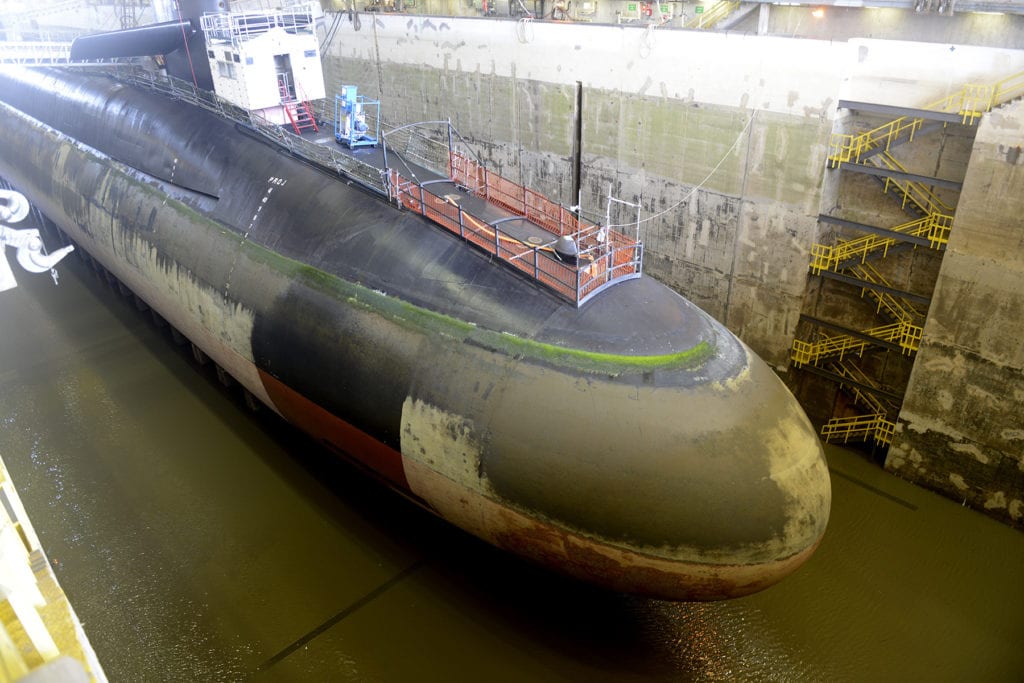
The Ohio-class ballistic-missile submarine USS Tennessee (SSBN 734) (Blue) arrives at the Trident Refit Facility (TRF) dry dock berthing at Naval Submarine Base Kings Bay, Ga., for a planned maintenance period, August 13. Tennessee is one of five ballistic-missile submarines stationed at the base and is capable of carrying up to 20 submarine-launched ballistic missiles with multiple warheads. U.S. NAVY / Mass Communication Specialist 1st Class Ashley Berumen
ARLINGTON, Va. — The commander of the nation’s strategic deterrent forces again defended the low-yield nuclear warhead that the Navy has deployed at sea on Trident submarine-launched ballistic missiles on board ballistic-missile submarines (SSBNs). This time he cited analysis to support the deployment.
Adm. Charles A. Richard, commander, U.S. Strategic Command (STRATCOM), testified April 22 before the Strategic Forces subcommittee of the House Armed Services Committee (HASC) on the status of the nation’s strategic forces.
“Within the last year, STRATCOM started formally measuring risk of strategic deterrence failure,” Richard said. “This is a formal risk assessment designed to make sure that we are analytically rigorous in all the things that we do, acknowledging that this is fundamentally trying to measure a subjective process, the decision making of another country. Our assessment is that the deployment of a low-yield [warhead] improved the risk of strategic deterrence, i.e., it lowered it because of the deterrent effect it achieved.”
The submarine-launched low-yield warhead became a requirement noted in the 2018 Nuclear Posture Review. The result was the W76-2 warhead, which was deployed in 2019 on the tips of some Trident submarine-launched ballistic missiles carried by Ohio-class SSBNs.
With the change in presidential administrations and the leadership of the Congress, critics, including HASC Chairman Adam Smith, D-Washington, have been bolder in expressing long-held opposition to the W76-2 low yield warhead as de-stabilizing to the nuclear balance.
In hearings this week before subcommittees of the Senate and House armed forces committees and in a Pentagon news conference, Richard noted that this era was the first in which the United States was faced with deterring two peer competitors — Russia and China. He termed China as the greatest strategic threat to the United States, but that Russia was the greatest nuclear threat to the United States.
He said the United States requires the total capacity of the nuclear triad — intercontinental ballistic missiles, bombers and submarine-launched ballistic missiles — to maintain strategic deterrence.
Rescue Effort Underway for KRI Nanggala: Indonesian Submarine, Crew of 53, Missing Off Bali
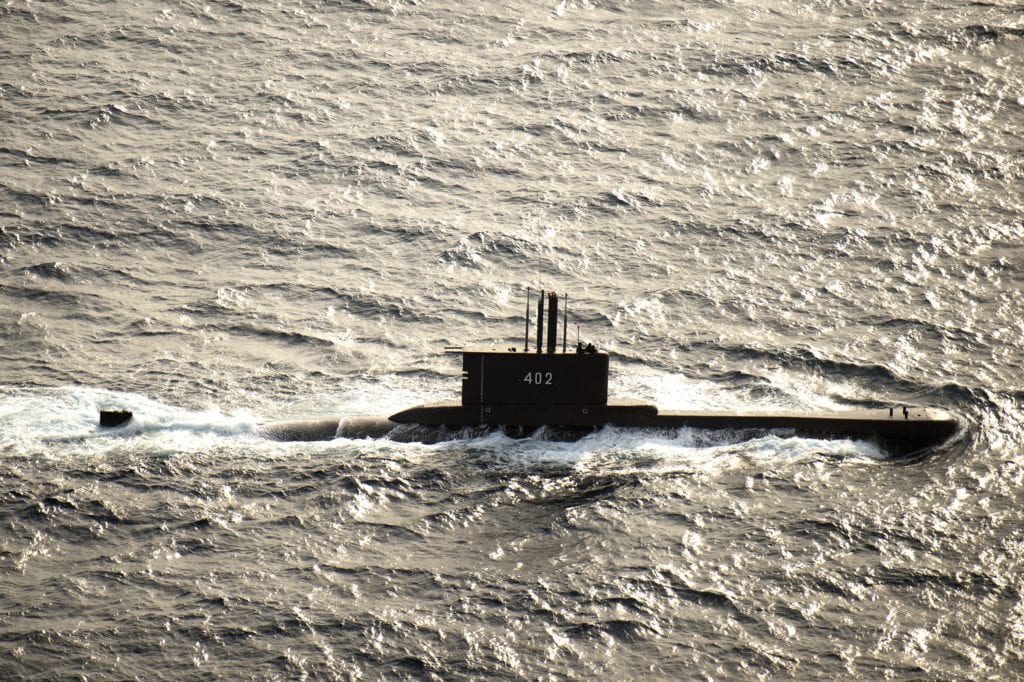
KRI Nanggala in the Java Sea in 2015. WIKIPEDIA
The Indonesian Navy has confirmed that one of its submarines, KRI Nanggala (402), and its crew of 53, is missing. Reports quoting Indonesian defense officials say KRI Nanggala was participating in scheduled naval exercises about 60 miles north of the island of Bali when it submerged in waters about 2,300 feet deep. Nanggala had requested and received clearance to dive to conduct a live-torpedo firing drill. When communications were lost, the navy immediately commenced a search with ships and aircraft.
International media quoted Adm. Yudo Margono, the chief of staff of the Tentara Nasional Indonesia-Angkatan Laut (TNI-AL), saying that Nanggala had fired two torpedoes during the exercise. He said the crew had enough oxygen to support the crew for 72 hours.
Tentara Nasional Indonesia-Angkatan Laut (TNI-AL), which translates to “Indonesian National Military-Naval Force,” commissioned ships have the prefix KRI, which means Kapal Republik Indonesia or “Republic of Indonesia Ship.”
“It is true that the KRI Nanggala-402 lost contact since early this morning around 3:00 a.m. [Wednesday local time],” said 1st Adm. Julius Widjojono.
A TNI statement said: “It is possible that during static diving, a blackout occurred so control was lost and emergency procedures cannot be carried out and the ship falls to a depth of 600-700 meters (about 2,000 to 2,300 feet).”
“We know the area but it’s quite deep,” Widjojono told reporters.
However, Widjojono told the independent Indonesian TV network, KompasTV, that the diesel-electric submarine was built to sustain pressure at a maximum depth of around 250 to 500 meters (820 to 1,640 feet). “Anything more than that can be pretty fatal,” he said.
Searchers noted an oil slick near where Nanggala submerged, which may have come from the missing submarine. Indonesia has requested support from several nations, including Singapore, Australia and Malaysia. The United States, Germany, France, Turkey, India and have also offered to help search for the missing submarine.
“It’s very distressing for families and particularly for the Indonesian navy,” said Australian Foreign Minister Marise Payne. “We have indicated that we will help in any way we can. We operate very different submarines from this one, but the Australian Defence Force and our Australian Defence organisation will work with defence operations in Indonesia to determine what we may be able to do. We will go to the support of our neighbour in any way we can.”
Singapore has dispatched M/V Swift Rescue, a commercial ship under charter to the Republic of Singapore Navy carrying sophisticated submarine rescue equipment, including a Deep-Submergence Rescue Vessel (DSRV), hyperbaric chamber and a medical team.
The TNI operates five submarines. Nanggala is one of two 1,300-ton,195-foot Cakra-class boats were built in Germany by Howaldtswerke, commissioned in the Indonesian Navy in 1981. The two Type 209 submarines have undergone periodic refits.
Indonesia has three newer Type 209 submarines from South Korea, with the first being commissioned in 2017. The newest, KTI Alugoro, built at DSME in South Korea and the government-owned PT PAL in Indonesia, was commissioned last month on March 21. Three more boats are on order, to be completed at PT PAL.
The International Submarine Escape and Rescue Liaison Office (ISMERLO) sent an alert stating that it had been notified of the missing submarine and was standing by to support any response.
ISMERLO was established in 2003 by NATO and the Submarine Escape and Rescue Working Group to coordinate international submarine search and rescue operations.
ISMERLO’s international team of submarine escape and rescue are based at COMSUBNATO, part of the NATO Allied Maritime Command at Northwood, U.K., and on call 24/7/365.
“We have a wide variety of open communications capabilities to respond to a crisis,” said Italian Navy Cmdr. Gennaro Vitagliano, head of the ISMRERLO Branch at COMSUBNATO. “We are free to talk to everybody, because we are talking about saving lives at sea.”
Vitagliano said there are 41 member nations who operate submarines, including Indonesia. The only two nations that have submarines and are not members of ISMERLO are Iran and North Korea. “The rest of the world is fully involved with ISMERLO. Each nation has their points of contact and they are always accessible. We are a worldwide network to save lives at sea. We train and operate to a common standard, as set forth in A/MTP-57, the Submarine Search and Rescue Manual, or Global SUBSAR Manual. Our organization and our system must be functional, tested and ready at all times. We conduct periodic exercises, and when we do, we can identify shortfalls is our rescue plans and procedures. Our goal is to minimize time to first rescue.”
NSWC Dahlgren Tests G/ATOR System Capabilities for U.S. Marine Corps
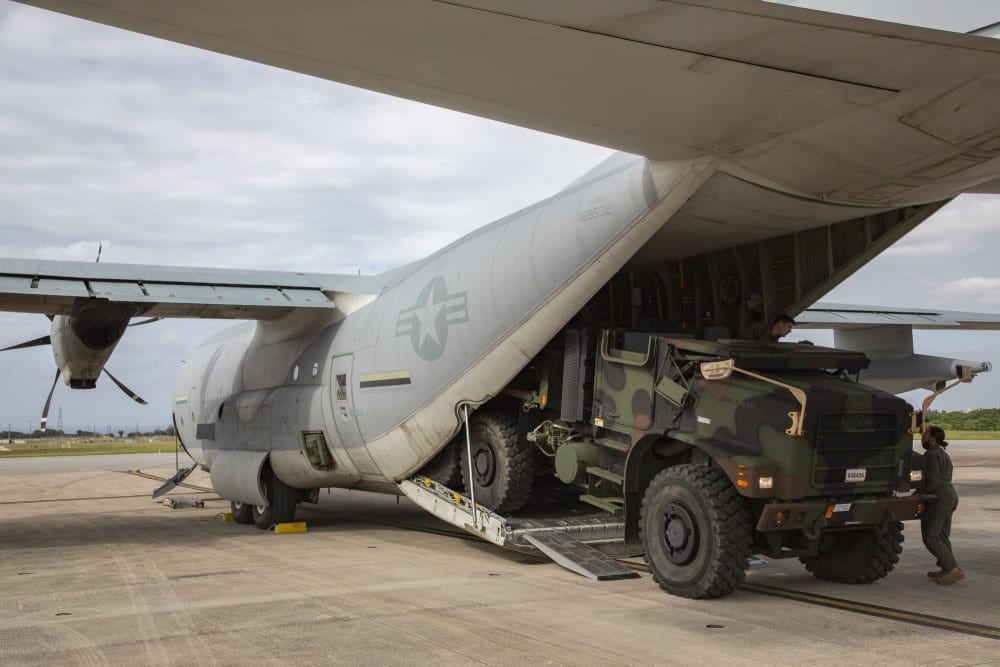
U.S. Marines with Marine Aerial Refueler Transport Squadron 152 (VMGR-152) and Marine Air Control Group 18 (MACG-18) conduct load operations at Marine Corps Air Station Futenma, Okinawa, Japan, Nov. 9, 2020. This is the first time VMGR-152 and MACG-18 have worked together to load an AN/TPS-80 Ground/Air Task Oriented Radar system onto a KC-130J Super Hercules aircraft. U.S. MARINE CORPS / Lance Cpl. Dalton J. Payne
DAHLGREN, Va. — Navy engineer Danny Mudd looked forward to the arrival of a new U.S. Marine Corps radar system after working on the program for years. When the AN/TPS-80 Ground/Air Task-Oriented Radar (G/ATOR) system – a mobile unit designed to be stationed anywhere while providing air surveillance and ground weapons locating capabilities — arrived at Naval Surface Warfare Center Dahlgren Division (NSWCDD), Mudd and his team were ready to provide five weeks of test and evaluation, the NSWCDD said in release.
“It’s exciting to be able to test an actual system when you’ve been working on it for years,” said Mudd, G/ATOR program team lead and radar operations manager for the Sensor Software Engineering Branch at NSWCDD. “Having the radar in our backyard is a game changer and makes you really appreciate the work that we’ve done here and continue to do.”
Mudd and his team manage the lab productivity that maintains and updates the test assets with the branch’s software support activity lead, Bradley Payne, who provides software development for the G/ATOR system.
“We provide government support to the program office, located in Quantico, and develop test procedures for the radar system,” said Bill Shea, G/ATOR technical program manager in the NSWCDD Sensor Software Engineering Branch. “Our G/ATOR team has supported this program for well over 10 years.”
Shea and his team collaborate with other naval warfare centers, the primary contractor Northrop Grumman and several branches across Dahlgren.
Before participating in integrated field tests, a new version of G/ATOR was brought to NSWCDD to perform interoperability testing with other systems. Shea and his team prepared for the G/ATOR’s testing schedule by verifying the command’s infrastructure functionality, including power accessibility, radar data recording abilities and data analysis capabilities.
“Having a tactical radar at Dahlgren for our engineering team to utilize, allows the team to develop expert knowledge of the radar’s functionality and capability,” said Shea. “In collaboration across the warfare center and the contractor, the G/ATOR team achieved that ability to field test, collect data and verify theories to improve the radar’s performance and support the warfighter.”
Within the first week of the G/ATOR system’s arrival, command, senior leadership and essential team leads conducted walkthroughs of safety protocols and complete range safety validations before live testing.
For many team members supporting the G/ATOR project, the opportunity to work directly with the system and have accessibility to calculate theories proved beneficial for the warfare center.
“Many people working on the radar program have only seen the G/ATOR in pictures since one wasn’t available until this test event,” said Shea. “The opportunity to engage with the unit at Dahlgren helps software developers understand some of the interfaces they’re building. They can see firsthand how the software is being used.”
Through collaborative efforts within the department and other divisions across NSWCDD, the G/ATOR team performed central testing evaluations that verified the radar systems detection functionalities and software capabilities. During the test schedule, the G/ATOR team conducted evaluations around the clock during the workweek.
Dahlgren’s G/ATOR team is already planning to expand the sustainment of software capabilities for the G/ATOR system through integrated test evaluations.
LOCKPORT, La. — Bollinger Shipyards LLC has delivered the USCGC Glenn Harris to the U.S. Coast Guard in Key West, Florida, the company said in an April 22 release. This is the 167th vessel Bollinger has delivered to the U.S. Coast Guard over a 35-year period and the 44th fast response cutter (FRC) delivered under the current program.
The Glenn Harris is the third of six FRCs to be home-ported in Manama, Bahrain, which will replace the aging 110-foot Island-class Patrol Boats, built by Bollinger Shipyards 30 years ago, supporting the Patrol Forces Southwest Asia (PATFORSWA), the U.S. Coast Guard’s largest overseas presence outside the United States.
“Bollinger is proud to continue enhancing and supporting the U.S. Coast Guard’s operational presence and ensuring it remains the preferred partner around the world,” said Bollinger President and Chief Executive Ben Bordelon. “It is our top priority to ensure that the brave men and women of the Coast Guard stationed in PATFORSWA have the most state-of-the-art, advanced vessels as they work to build and maintain the necessary regional alliances to ensure maritime security in the region. Building ships for the Coast Guard provides critical assets to bolster our national security and advance America’s interests, both at home and abroad.”
Earlier this year at the commissioning ceremony of the USCGC Charles Moulthrope, U.S. Coast Guard Commandant Adm. Karl Schultz lauded the “enhanced seakeeping” capabilities of the PATFORSWA-bound FRCs, saying “these ships are truly going to be game changing in their new theater of operations” and “offer increased opportunities for integrated joint operations with our Navy and Marine Corps colleagues” as the Coast Guard seeks to be part of the whole-of-government solution set in the region.
PATFORSWA is composed of six cutters, shoreside support personnel and the Maritime Engagement Team. The unit’s mission is to train, organize, equip, support and deploy combat-ready Coast Guard Forces in support of U.S. Central Command and national security objectives. PATFORSWA works with Naval Forces Central Command in furthering their goals to conduct persistent maritime operations to forward U.S. interests, deter and counter disruptive countries, defeat violent extremism and strengthen partner nations’ maritime capabilities in order to promote a secure maritime environment.
Earlier this week, Bollinger announced the acquisition of Gulf Island Fabrication Inc.’s Terrebonne Parish shipyard facilities, expanding the company’s new construction and repair capacity and capabilities to better serve its key defense and commercial customers. The acquisition increases the shipyard’s growing new construction and repair portfolio. Gulf Island had been building the Towing, Salvage and Rescue Ships (T-ATS) for the U.S. Navy and Regional Class Research Vessels for the National Science Foundation and Oregon State University. These projects conveyed with the transaction.
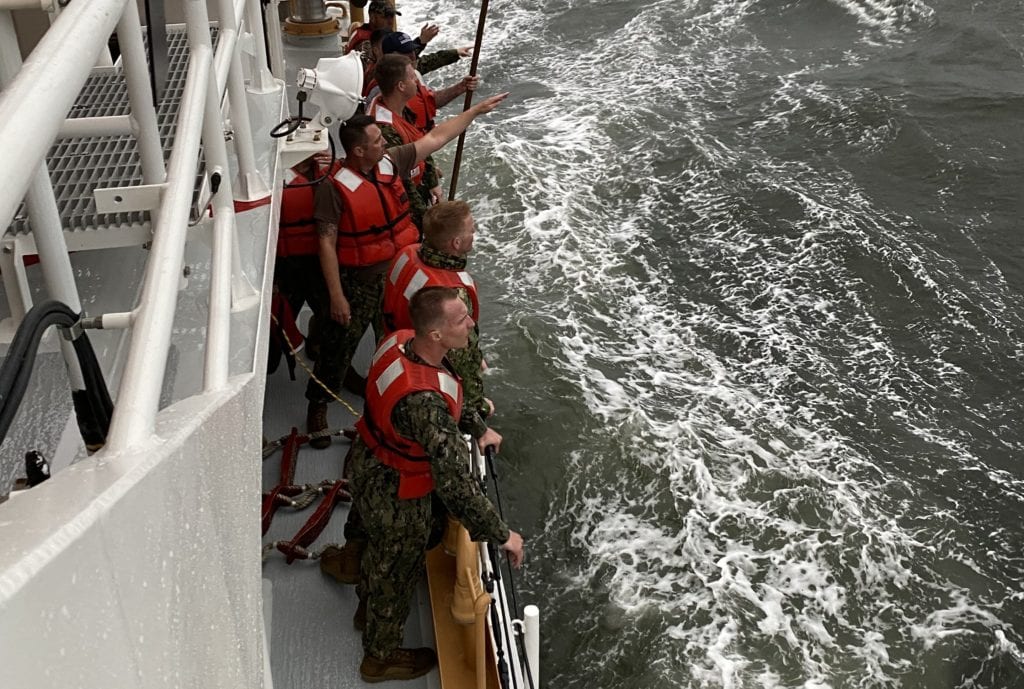
The crew of the Coast Guard Cutter Glenn Harris, a pre-commissioned 154-foot Fast Response Cutter, pulls a person from the water April 13, 2021, after a 175-foot commercial lift boat capsized 8 miles south of Grand Isle, Louisiana. The Coast Guard and multiple good Samaritan vessels responded to the capsized vessel and searched for multiple missing people in the water. U.S. COAST GUARD / Coast Guard Cutter Glenn Harris
Each FRC is named for an enlisted Coast Guard hero who distinguished themselves in the line of duty. Surfman Glen Harris piloted the first wave of landing craft on Tulagi Island in the Pacific Theater during World War II, and also made a landing against a Japanese force on Guadalcanal Island. Harris was awarded a Silver Star medal by Adm. Chester Nimitz for his heroic combat actions.
The FRC is an operational “game changer,” according to senior Coast Guard officials. FRCs are consistently being deployed in support of the full range of missions within the United States Coast Guard and other branches of our armed services. This is due to its exceptional performance, expanded operational reach and capabilities, and ability to transform and adapt to the mission. FRCs have conducted operations as far as the Marshall Islands—a 4,400 nautical mile trip from their homeport. Measuring in at 154 feet, FRCs have a flank speed of 28 knots, state of the art C4ISR suite (command, control, communications, computers, intelligence, surveillance and reconnaissance) and stern launch and recovery ramp for a 26-foot, over-the-horizon interceptor cutter boat.
Sea Guardian UAV Operates With Naval Assets
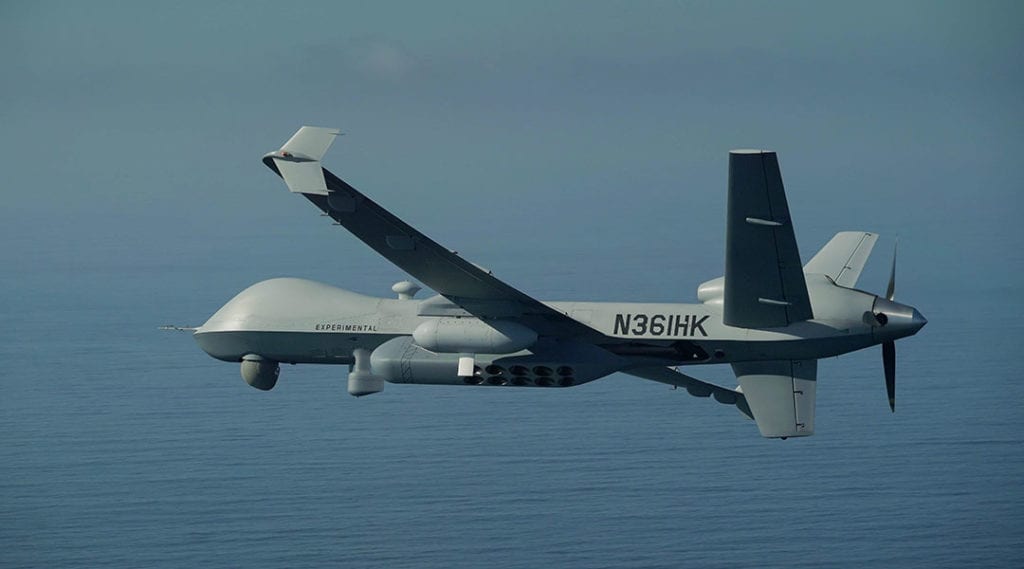
An unmanned MQ-9B Sea Guardian operated in conjunction with a guided-missile cruiser, executing long-range, over-the-horizon targeting, during the Unmanned Systems Integrated Battle Problem 21. GA-ASI
SAN DIEGO — The U.S. Navy demonstrated the successful integration of an unmanned maritime surveillance aircraft system with manned capabilities during the Unmanned Systems Integrated Battle Problem 21 (UxS IBP 21) off the coast of San Diego, April 21, U.S. 3rd Fleet Public Affairs said in a release.
The unmanned MQ-9B Sea Guardian operated in conjunction with a guided-missile cruiser, executing long-range, over-the-horizon targeting. Using sonobuoys and other assets, the Sea Guardian identified contacts and reported locations remotely to the commander on board the cruiser.
“The integration between unmanned and manned capabilities shown today provides an operations approach to strengthening our manned unmanned teaming,” said Rear Adm. James A. Aiken, UxS IBP 21 tactical commander. “Putting our newest technology into our Sailors’ hands directly enhances our fleet.”
Operational synchronization between unmanned capabilities and traditional manned naval assets ensures the Navy maintains its technological and warfighting advantage. Sea Guardian enhances the Navy’s antisubmarine and anti-surface warfare capabilities, among many others.
UxS IBP 21 is a U.S. Pacific Fleet exercise, executed by U.S. 3rd Fleet, designed to integrate manned and unmanned capabilities into operational scenarios to generate warfighting advantages. The week-long event involves surface, subsurface and aerial unmanned assets, operating with littoral combat ships, guided-missile destroyers, guided-missile cruisers, submarines and helicopter squadrons.
Pentagon IT Challenge: Introducing New Technology, While Still Using Legacy Systems
Sailors simulate the navigation of a littoral combat ship inside Integrated Tactical Team Trainer 2 at the Center for Surface Combat Systems LCS Training Facility, April 6, 2021. In 2007 the LTF became the first surface warfare training facility to provide integrated bridge and combat systems tactical-scenario training for Sailors assigned to a littoral combat ship. U.S. NAVY / Mass Communication Specialist 2nd Class Kevin C. Leitner
ARLINGTON, Va. — As the U.S. Defense Department races to develop a 21st century systems of systems linking all services, commanders, platforms and personnel, two top Pentagon officials say the challenge won’t be just acquiring new technology, but getting rid of the old 20th century stuff.
The Defense Department’s Joint All-Domain Command and Control (JADC2) strategy aims to connect sensors from all of the military services — Air Force, Army, Marine Corps, Navy and Space Force — into a single network to share intelligence, surveillance and reconnaissance (ISR) data to enable faster decision making. The change is needed because in a digital-driven world, decisions in future conflicts with degraded environments will have to be made swiftly, perhaps within seconds, say Pentagon officials.
An unclassified version of the strategy for public release is still awaiting approval by Defense Secretary Lloyd Austin and other leaders, Marine Corps Lt. Gen. Dennis Crall, the chief information officer for the Joint Chiefs of Staff (J6), told the virtual C4ISRNET conference April 21. Crall, who is overseeing JADC2, said Army Gen. Mark Milley, the chairman of the Joint Chiefs, and Deputy Defense Secretary Kathleen Hicks have already been briefed on the document. “We’re making some final revisions on that draft and it should move quickly” from Milley to Hicks and then on to Austin, he said, possibly “in days.”
The massive shift to artificial intelligence and machine learning across the department presents a test for a decades-old, platform-centric culture, Crall said. “The biggest challenge is our own history,” he added, noting that once legacy platforms and technologies are rolling, “it is incredibly difficult” to bring the new thing on-board.
“Then you have a resource problem. You’ve got to keep the legacy alive while you’re on-boarding the very thing you’re trying to do,” Crall said, adding that there comes a curve in the cost continuum where “it’s the most expensive to operate during that transition.” How funding streams are made available should get a hard look, the general said. “We need to collapse those things that are both expensive and not delivering results.”
In the conference’s last session, Vice Adm. Jeffrey Trussler, the director of Naval Intelligence, made a similar point about Project Overmatch, the Navy’s plan to develop a new fleet architecture using artificial intelligence and manned/unmanned teaming to enable Distributed Maritime Operations.
“The Navy is a platform-centric service, big capital ships and submarines. That’s what we do, and it enables us to operate around the world 24/7/365,” Trussler said. “As we’ve gotten into the Information Age in the 21st century, the Navy has discovered, as have all the services, we ought to be able to connect those sensors and pass data seamlessly among each other.
“It’s not really a technological problem we have,” Trussler said, “our challenge in that technology is the legacy platforms and systems we have now,” and replacing them across a 298-ship Navy with software-defined radios and other digital systems.
From Saving Habitats and Endangered Species to Preserving Ancient Artifacts, the Department of the Navy is Responsible and Proactive
Navy professionals recovered this small boat carving, or effigy, on San Clemente Island in 2013, as part of a Navy cultural resources management program that has been in place for more than 40 years. The carving represents a canoe used prehistorically by Native Americans who traveled from the mainland to the Southern Channel Islands. The Navy works with modern-day tribes to help identify, protect, and manage cultural resources on Navy lands. U.S. NAVY / Mass Communication Specialist 2nd Class Shawnte Bryan
The Department of the Navy is steward to some of America’s most precious archeological sites as well as natural habitats for migratory and endangered species.
On the archeological front, there are some spectacular examples. At Naval Air Weapons Station China Lake, California, the public can see one of the largest collections of Native American Rock Art at Little Petroglyph Canyon, where more than 6,000 images were left by the ancient Coso people of California.
The Foxtrot Petroglyph Site at Marine Corps Air Ground Combat Center, Twentynine Palms, California, is listed in the National Register of Historic Places, and has a variety of different types of rock art, including both petroglyphs (images created through pecking, scratching, or rubbing onto the stone surface) and pictographs (images painted onto stone) at the same site.
Naval Base Pearl Harbor is the site of ancient native Hawaiian fishponds, such as the Okiokiolepe Fishpond, listed in the National Register of Historic Places.
Numerous other prehistoric archeological sites in the Western U.S. are protected by the Navy at Naval Air Station (NAS) Fallon, Nevada, NAS Whidbey Island, Washington and NAS North Island, California, and other installations.
Artifacts at the Posey Site at Naval Surface Weapons Center, Indian Head, Maryland, provide evidence of intensive Indian trade with Europeans. NAS Pensacola is the site of one of the earliest European settlements in Florida, Santa Maria de Galve, established in 1698.
As these examples indicate, Navy and Marine Corps installations are often established located on lands previously occupied by various cultures and ethnic groups in the past.
“It is DoN policy to locate and identify these sites, which number in the tens of thousands, and to protect them and any artifacts and collections that may be excavated or erode from them,” said W. Brock During, environmental program director for Commander, Navy Installations Command.
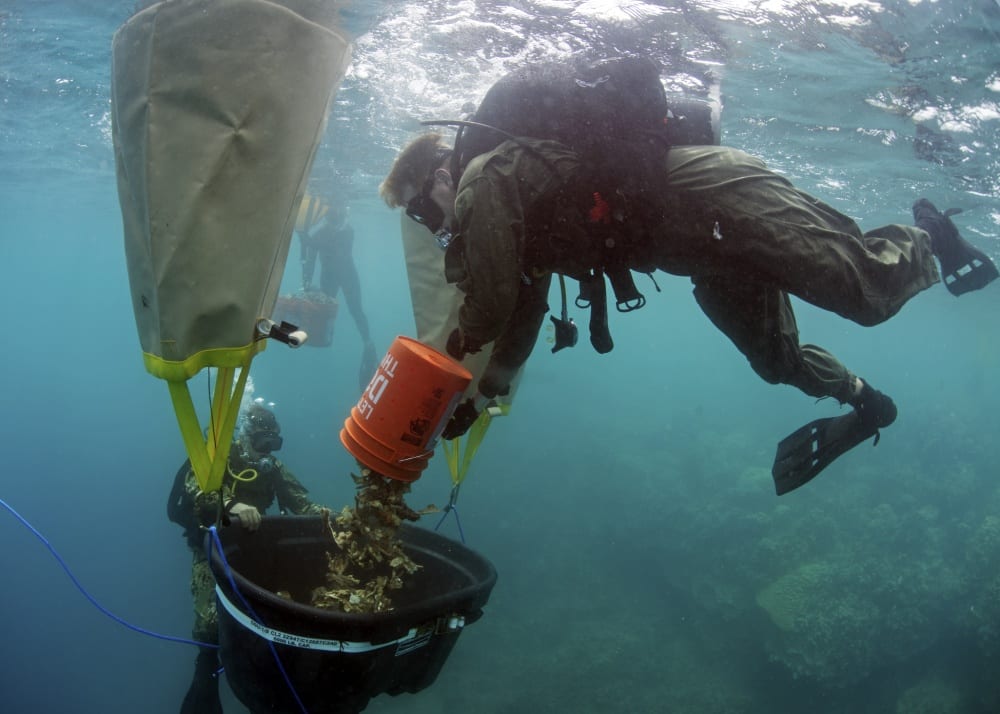
Explosive ordnance disposal technicians assigned to Explosive Ordnance Disposal Mobile Unit (EODMU) 5 help repair a damaged coral reef in Apra Harbor June 29, 2017. EODMU 5 coordinated with Guam’s Department of Agriculture, Division of Aquatic and Wildlife Resources (DAWR) and Guam Environmental Protection Agency (EPA) to assist in the coral reef restoration. U.S. NAVY / Mass Communication Specialist 3rd Class Alfred A. Coffield
Moving coral
The Department of the Navy is also steward of a number of sensitive ecological areas, and being a good environmental steward also means restoring, protecting and enhancing the quality of the environment for current and future generations.
In fiscal year 2021, Joint Region Marianas (JRM) expects to spend millions for conservation projects, primarily associated with military construction, military training and ungulate management. For example, a wharf improvement project at Apra Harbor on U.S. Naval Base Guam involves relocation of approximately 4,500 coral colonies. Future projects include plans to relocate an additional 150,000 coral colonies.
The Navy and other DoD services partner with other federal, state and local partners, specifically U.S. Department of Agriculture Animal and Plant Health Inspection Service Wildlife Services, to coordinate and conduct brown tree snake inspections of all units and their equipment that come to the Mariana Islands to train. Brown tree snakes are an invasive species that can wipe out native birds and animals.
Ungulate fencing projects on military installations on Guam is protecting native habitats from two specific non-native invasive species — feral pigs and deer — which destroy natural vegetation, increase rates of erosion, contribute to the loss of native plant and animal species and increase the spread of invasive plants.
JRM is working to protect the endangered Serianthes nelsonii, commonly known as the fire tree, endemic to Guam and the Commonwealth of the Northern Mariana Islands. Guam’s only mature Serianthes nelsonii tree is located on Andersen Air Force Base. The preservation efforts, including the planting of numerous saplings, are aimed at increasing the Serianthes nelsonii population conserving Guam’s unique limestone forests. JRM’s habitat conservation and watershed management activities are helping to reduce erosion and improve water quality.
“Taking a proactive approach to protecting the region’s natural and cultural resources remains a priority for DoD,” said Rear Adm. John Menoni, JRM commander. “We recognize that the stewardship of the region’s cultural and natural resources is a significant responsibility and it is one we take seriously.”
Helping Habitats
In and around Naval District Washington, wildlife biologists at NSF Dahlgren are conducting Atlantic and Shortnose Sturgeon surveys where the fish are being tagged with radio-frequency identification, or RFID transmitters, to track their movements in the Potomac River.
Yearly bird surveys counting Rufus red knots and great blue herons are conducted at NAS Patuxent River’s Bloodsworth Island Range. NSF Dahlgren, NSF Indian Head and NAS Patuxent River have been working together on a five-year survey of tricolored, little brown, Indiana, and northern long-eared bats.
A number of facilities are creating pollinator habitats to benefit the rusty-patched bumble bee and the monarch butterfly. The bases are also conducting bald eagle and spotted turtle and diamondback terrapin surveys are ongoing at NAS Patuxent River, and NSA Bethesda is conducting species inventories of herpetofauna, small mammals, benthic macroinvertebrates, and avian species.
Naval Station Guantanamo Bay, Cuba, is a safe habitat for endangered species, such as the Hutia, known locally as “banana rats,” Cuban rock iguana and Cuban boa.
In Navy Region Northwest, the restricted access to beaches at Naval Magazine Indian Island at Kilisut Harbor — home to protected bald eagle nests, endangered newts and cougars — and clam harvesting agreements with local tribes have resulted in some of the best tribal clamming in the Puget Sound and Sailish Sea.
One of the largest old growth forests in the “Evergreen State” is the Navy-managed old growth forest at the Jim Creek communications facility and recreation area near Naval Station Everett. The Navy owns the 4,827-acre property, purchased in 1950, but a paper company owned the timber rights. In 1992, the Navy purchased the timber rights to the land it already owned for $3 million, which at that time was the single largest natural resource conservation project ever funded by the DoD.
Working with the San Diego Zoo Wildlife Alliance, California Department of Fish and Wildilfe, U.S. Fish and Wildlife Service (USFWS) and others, the Navy’s California least terns and western snowy plover protection program has protecting nest sites and hatchlings to ensure the survival of these federally protected species.
Once a remote ammo depot, Naval Weapons Station Seal Beach is now surrounded by dense urban development, yet this base, located in the Los Angeles metropolitan area, is the only military installation that has a National Wildlife Refuge completely enclosed within the fence line. The 965 acres of coastal wetlands has been a sanctuary for local and migratory wildlife since 1972.
In the San Diego Bay, the Navy has partnered the Port of San Diego and nonprofits to improve the natural habitat and expand the eelgrass, a fundamental resource for sustaining life in the bay.
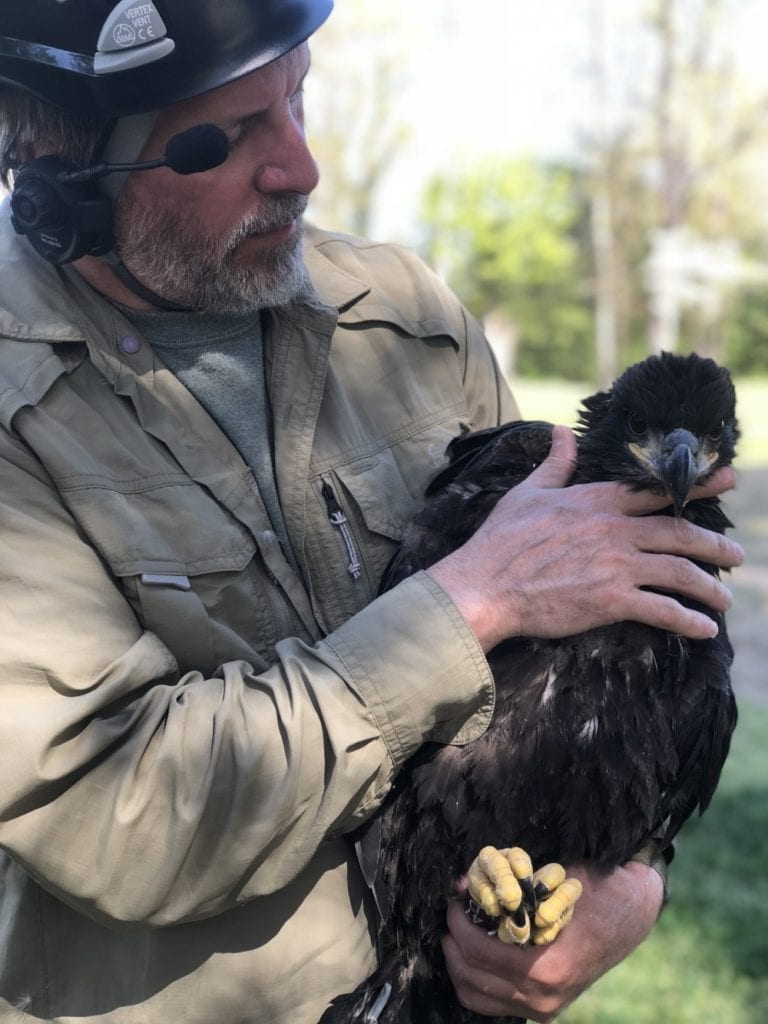
The Center for Conservation Biology from the College of William and Mary band eagles at Naval Air Station Patuxent River, Md., to monitor the nesting successes of the species on base and to know the impacts of eagles on the mission. U.S. NAVY / Mass Communication Specialist 2nd Class Anita C. Newman
‘We care’
Some wildlife protection programs are simple and low-cost. In 1986, it was estimated that the eastern bluebird population had declined by 90 percent in its historic range over the preceding 50 years due to changes in agriculture practices, competition from invasive bird species and loss of nest sites. So, Alisha Sutton of the U.S. Naval Research Laboratory’s Explosive Safety & Environmental Branch with her colleagues to establish a nest box trail for eastern bluebirds at NRL’s Chesapeake Beach facility.
Most recently, Sutton and her team moved the nest boxes from fencing to stand-alone posts with predator guards to prevent snakes and other predators from getting into the box and eating the young bluebirds.
NRL is also helping the Chesapeake Bay’s oyster population recover. Oysters play a unique role in the health of the bay by their ability to filter water and improve water quality. But in recent years, the bay’s oyster population has declined dramatically because of overharvesting, pollution, disease, and habitat loss, and with it the health of bay’s ecosystem.
NRL is working in partnership with the Chesapeake Beach Oyster Cultivation Society (CBOCS) to cultivate oysters. CBOCS provides tiny oyster “spat” to sink in cages near NRL’s Chesapeake Bay Detachment docks where the oysters can grow. After about a year in this “nursery,” the cages are hauled out of the water, the oysters counted and then taken to deeper water to be spread on a reef.
“The work is as muddy and tedious as it is rewarding,” said Alisha Sutton. “This summer we spread 7,000 matured spat on the reef.
“The Navy has a lot of acreage all over the world,” Sutton said. “We’re members of the community and we’re dedicated to taking good care of the land which are entrusted with. We care about the land, the water and the air in the environment where we are working.”
Navy Orders LRASM Integration into P-8 Aircraft
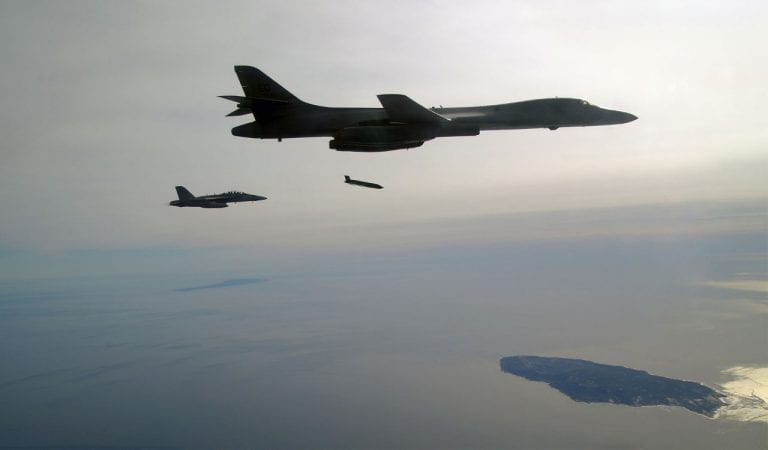
An LRASM being dropped from a B-1B Lancer bomber. LOCKHEED MARTIN
ARLINGGTON, Va. — The Navy has awarded a contract to Boeing to integrate the AGM-158C Long-Range Anti-Ship Missile (LRASM) into the P-8A Poseidon maritime patrol reconnaissance aircraft.
The Naval Air Systems Command awarded Boeing a $74 million cost-plus-fixed-fee order for “the design, development, and test of software and ancillary hardware necessary for the integration of the Long-Range Anti-Ship Missile onto the P-8A aircraft for the Navy,” an April 21 Defense Department contract announcement said.
The LRASM, a derivative of the Air Force’s AGM-158B Joint Air-to-Surface Strike Missile-Extended Range cruise missile, fills an air-launch capability gap and provides flexible, long-range, advanced anti-surface capability against high-threat maritime targets. The weapon reduces dependency on intelligence, surveillance and reconnaissance platforms, network links and GPS navigation in electronic warfare environments. Semi-autonomous guidance algorithms will allow it to use less-precise target cueing data to pinpoint specific targets in the contested domain.
The P-8A currently can be armed with AGM-84 Harpoon cruise missiles and Mk54 antisubmarine torpedoes. The addition of the LRASM will expand its anti-surface capability in terms of range and ability to operate in a GPS-denied environment.
Work on the order is expected to be completed in October 2024.
Coast Guard Cutter Tampa Offloads $94.6M in Cocaine in Miami
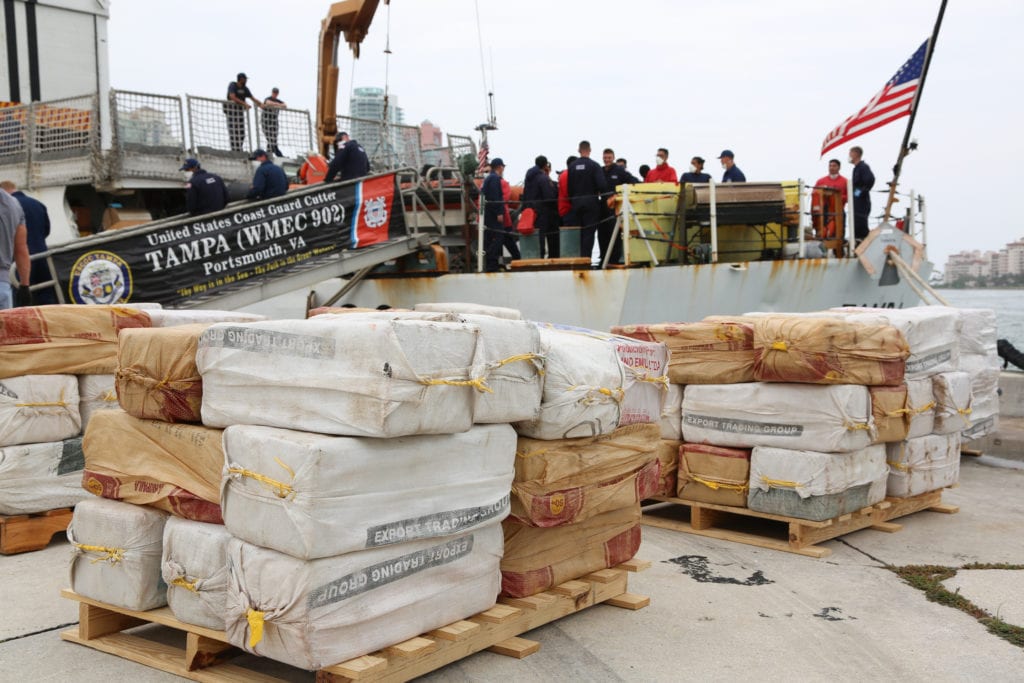
Coast Guard Cutter Tampa crew offloads approximately 5,500 pounds of cocaine, worth an estimated $94.6 million, at Base Miami Beach, Miami, Florida, April 20, 2021. On April 9, a maritime patrol flight spotted a vessel, and a Tampa law enforcement team interdicted a low profile vesseloff the coast of Punta Gallinas, Colombia. U.S. COAST GUARD / Chief Petty Officer Charly Tautfest
MIAMI — Coast Guard Cutter Tampa’s crew offloaded approximately 5,500 pounds of cocaine, worth an estimated $94.6 million, in Miami, April 20, after interdicting a low-profile vessel off the coast of Punta Gallinas, Colombia, the Coast Guard 7th District said in a release.
A maritime patrol flight spotted the vessel on April 9, and a law enforcement team from the cutter detained three suspects and discovered 87 bales of cocaine. The vessel was destroyed as a hazard to navigation and the suspects are reported to be in good health.
“This event is the perfect example of numerous key partners unifying our efforts to counter transnational criminal organizations who look to exploit the maritime environment,” said Lt. Cmdr. Jason Neiman, Seventh District public affairs officer. “By strengthening partnerships, we counter threats together.”
The interdiction was the result of multi-agency efforts in support of U.S. Southern Command’s enhanced counter-narcotics operations in the Western Hemisphere, the Organized Crime Drug Enforcement Task Force and High Intensity Drug Trafficking Area programs, and the Caribbean Corridor Strike Force.
Once aboard a Coast Guard cutter, all suspects receive food, water, shelter and basic medical attention. Throughout the interdiction, Coast Guard crew members were equipped with personal protective equipment to minimize potential exposure to any possible case of COVID-19. There were no suspects in these cases reported to have any COVID-19 related symptoms.
Philippines Looks to Bolster Fleet with Retired Patrol Coastal Boats
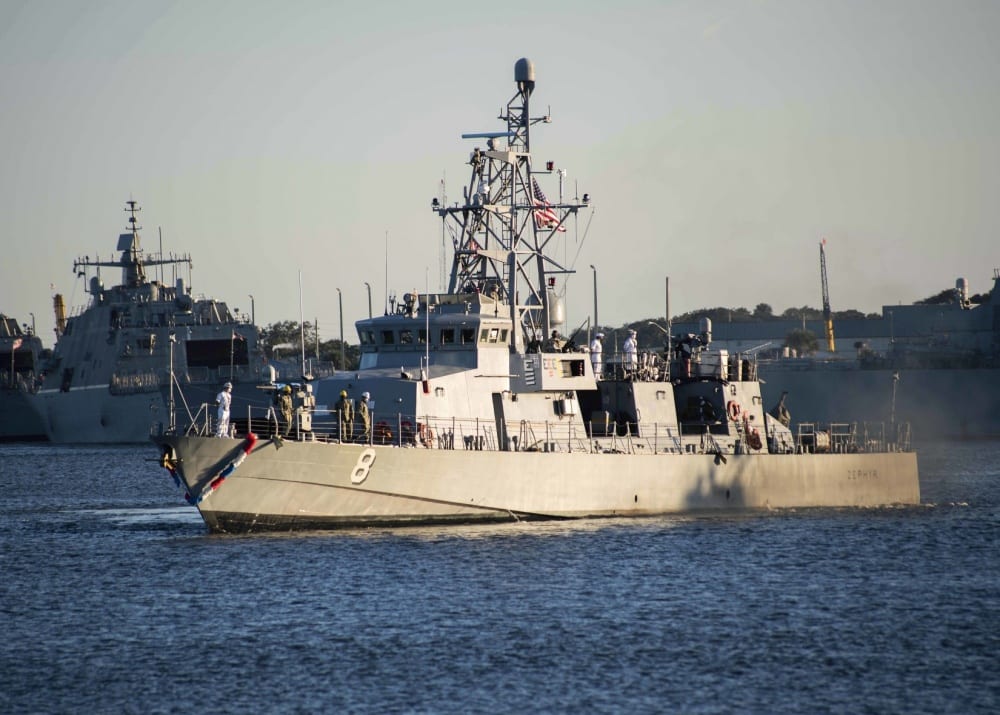
The Cyclone-class coastal patrol ship USS Zephyr (PC 8), shown here returning to Naval Station Mayport after a 2016 deployment to the U.S. 4th Fleet area of operations in support of Joint Interagency Task Force South’s mission, which included counter illicit drug trafficking in the Caribbean. U.S. NAVY / Mass Communication Specialist 1st Class Brian G. Reynolds
As the U.S. Navy divests itself of its Cyclone-class of Patrol Coastal (PC) boats, the Philippine navy (PN) has said the PCs would be welcome in its fleet.
In a statement, PN chief Vice Adm. Giovanni Carlo Bacordo said, “The PN has manifested its interest in the decommissioned Cyclone-class patrol vessels [CCPVs] of the U.S. Navy as a stop-gap to the decommissioned legacy PN ships. As to how many, that depends on the seaworthiness and efficiency of the CCPVs that will be offered, and this will be determined by the PN Joint Visual Inspection Team.
“We have manifested our interest with JUSMAG [Joint U.S. Military Assistance Group] and U.S. INDOPACOM,” the Indo-Pacific Command, he added.
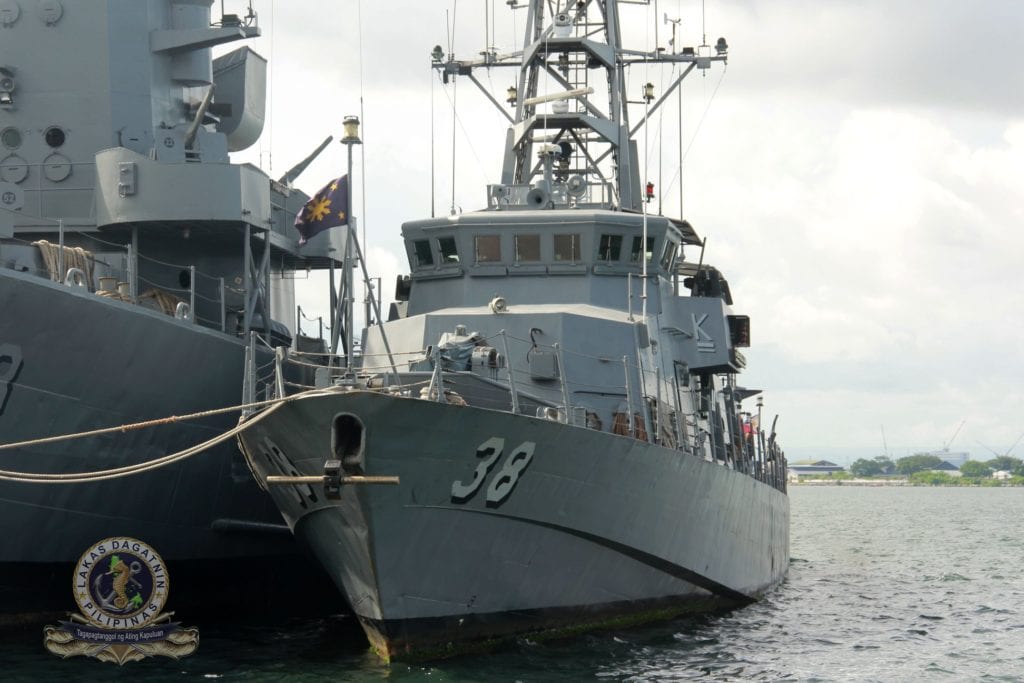
At present, the PN has one Cyclone-class patrol vessel in its service, the BRP General Mariano Alvarez (PS 38), formerly the ex-USS Cyclone (PC 1), which was transferred to the PN in 2004.
Of the 14 ships in the class, four were loaned to the Coast Guard but later returned. The lead ship, Cyclone, then was transferred to the Philippines in 2004.
Three of the remaining 13 USN PCs were recently decommissioned. Ten more remain in service in Bahrain as part of the U.S. 5th Fleet. Of the three retired ships, the U.S. Navy said one would be made available for foreign military sale, but the other two would be scrapped.
USS Zephyr (PC-8), USS Shamal (PC-13) and USS Tornado (PC-14) were decommissioned in March. All three ships were based in Mayport, Florida, where they supported the U.S. 4th Fleet with counter-drug trafficking and illegal migration patrols in the Eastern Pacific, off Central America and in the Caribbean.
“These three warships have served our Navy and our country well,” said Capt. Mike Meyer, commander, Naval Surface Squadron Fourteen. “Each of them has operated well past their designed service life, with their crews contributing demonstrably to meeting our national objectives.”
The Navy said Zephyr and Shamal would be scrapped, while Tornado would be considered for possible foreign military sale.
BRP General Mariano Alvarez (PS38) at Naval Base Cavite, Philippines, in 2019. DEFENSE OF THE REPUBLIC OF THE PHILIPPINES
According to a USN release, the decision to decommission these three ships stems from the fact they all exceeded their designed service life. “Based on the rising cost of modernization efforts, the Navy will receive a better return by decommissioning and freeing up funds to invest in other platforms,” the statement said.
The PCs were specifically tailored to support Special Operations Forces insertion and extraction and related duties. In that role, however, the PCs were too large for covert missions, but too small to effectively serve as surface combatants. So, the Navy planned to divest itself of the class, transferring the lead ship to the Philippines, and loaning three more to the Coast Guard. Events surrounding 9/11, however, made clear the need for ships able to operate in littoral waters.
PCs have four diesel engines and four screws, capable of speeds up to 35 knots. They have a range of 2,000 to 2,500 nautical miles and an endurance of 10 days.
For their size, they are well armed. The U.S. ships were upgraded with remotely-operated stabilized 25 mm guns, and carried unmanned aircraft for surveillance and monitoring of boarding parties. Griffin missiles were installed on 5th Fleet ships to be used against surface threats.
And unlike many patrol vessels, PCs look like a surface combatant. “We’ve got a beautiful silhouette coming over the horizon with the sun in the background,” said Lt. Cmdr. Roger Young, who commanded officer of USS Firebolt (PC 10) in 2018. “I mean, you say, ‘that’s a warship.’”
Increased interoperability
The top military officer in the Indo-Pacific theater said the U.S. is committed to its Philippine ally and treaty partner. That means a more capable navy.
In Congressional testimony, Commander of U.S. Indo-Pacific Command Adm. Phil Davidson said his command is focused on strengthening allies and partners.
“The United States’ network of allies and partners is our principal advantage against any adversary. USINDOPACOM depends upon the collective capabilities of our allies and partners to address the challenges to a Free and Open Indo-Pacific,” Davidson said. “Through increased interoperability, information-sharing, and expanded access across the region, we will present a compatible and interoperable coalition to our adversaries in crisis and armed conflict. Terrorism continues to pose a security challenge in the Philippines, and USINDOPACOM is committed to helping the Philippines ensure that the southern Philippines does not become a safe-haven for terrorists that would threaten the entire region. I am also focused on helping to develop the territorial defense capability of the Armed Forces Philippines and look forward to re-engaging with the Philippines National Police Maritime Group to continue improving their ability to protect their sovereign interests.”
PN modernization
The PCs were designed for a 15-year life service. But Zephyr, for example, served for 26 years.
While the PCs are more than two decades old, they are decades newer than a pair of recently deactivated ships in the PN, the 221-foot BRP Quezon (the former USS Vigilance (AM-324),) and 185-foot BRP Pangasinan (formerly USS PCE 891). Both ships were commissioned in the U.S. Navy in 1944. Quezon was commissioned in the PN in 1967, and served for 53 of years with the Philippine Navy. Transferred from the U.S. to the Philippines in 1948, Pangasinan had 72 years of service with the Philippine navy when she was decommissioned.
Even as older ships are retired, the PCs would be among the newer and more capable ships in the PN.
“This makes sense for the Philippine navy,” said retired Capt. Brian Buzzell, who is very familiar with the Philippine navy and the regional security issues. “They have had the lead boat for years. The issue will be what armaments will come with the boats.”
Buzzell notes that China has been ratcheting up the pressure on the Philippine government to accept their incursions into their economic zones. “The Cyclone-class PC would be a perfect vessel to patrol the disputed fishing areas,” he said. “Additionally, the PCs would complement the two new South Korean frigates.”
The PN recently added two new Jose Rizal-class frigates built in South Korea, the BRP Jose Rizal (FF 150), commissioned in 2020; and BRP Antonio Luna (FF 151), commissioned at Subic Bay in March of this year.