Curtiss-Wright Awarded Contract to Support Ford-Class CVN Elevators
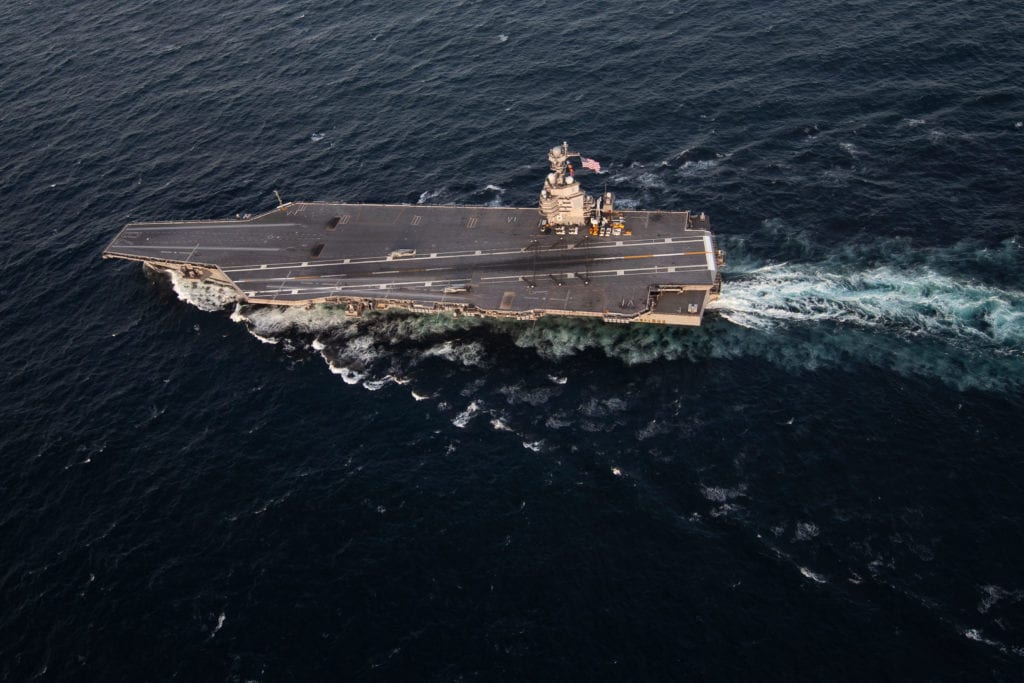
USS Gerald R. Ford (CVN 78) transits the Atlantic Ocean March 20, 2021. U.S. NAVY / Seaman Jackson Adkins
SHELBY, N.C. — Curtiss-Wright Actuation Division has been awarded a contract to provide Exlar Electro-Mechanical Actuators to Federal Equipment Co. (FEC) to support its weapons elevator systems for the Ford-class aircraft carrier program, the company said in a release.
Exlar actuators are used in several other mission critical areas on the Ford-class carriers, including the Jet Blast Defector, Integrated Catapult Control Station and Landing Signal Officer station actuation systems.
Exlar’s field-proven, commercial off-the-shelf (COTS) actuation products are used in a variety of industries and applications providing robust, reliable and energy efficient solutions. These COTS and modified COTS products and technologies are used in numerous naval and ground defense applications, as well as offering alternatives to fluid power options while providing lower total cost of ownership through energy efficiency, lower maintenance costs and integration with automated control systems.
FEC also uses the Exlar GSM Series integrated products as lock actuators for the weapons elevator systems they provide to the Ford carrier program on their CVN-78 and CVN-79 ships.
“We are proud to be able to continue to support both FEC, the U.S. Navy and its shipbuilder as the Navy modernizes its carrier fleet,” said Phil Bowker, Curtiss-Wright senior general manager, Actuation Division.
Exlar is a business unit of Curtiss-Wright’s Actuation Division.
Submarine Day Observance Calls Attention to Growing Opportunities in Submarine Construction
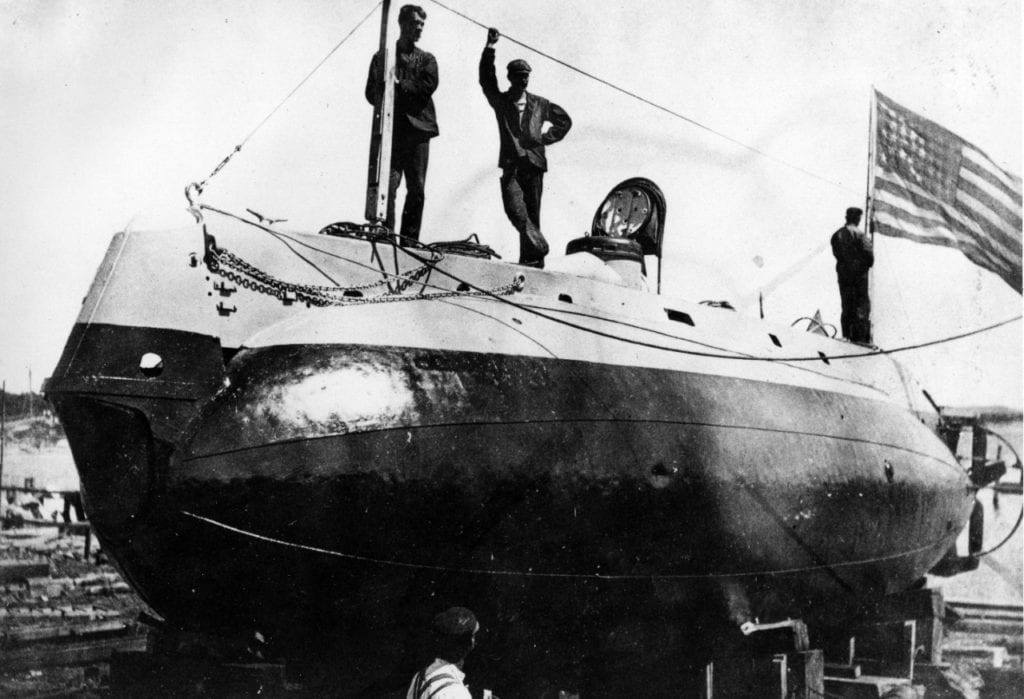
USS Holland (SS-1), the U.S. Navy’s first commissioned submarine, joined the fleet in 1900. SUBMARINE FORCE LIBRARY & MUSEUM COLLECTION
The Southeastern New England Defense Industry Alliance (SENEDIA) is recognizing National Submarine Day with a “TechTalk” featuring senior leaders from General Dynamics Electric Boat, as well highlighting men and women in the region who are employed in submarine construction related careers.
“Southeastern New England is the nation’s hub for submarine shipbuilding and undersea technology, and although the COVID-19 pandemic posed challenges for all businesses, our industry remains strong, with more rewarding opportunities ahead for those interested in the high-wage, high-growth, high-demand career pathways that are available across the defense landscape,” said Molly Donohue Magee, SENEDIA’s executive director. “National Submarine Day is a great opportunity for our colleagues across the industry to come together to celebrate our successes, share innovation, and grow the talent pipeline we need to continue to thrive.”
“National Submarine Day is an opportunity to remember the origins of the nation’s submarine shipbuilding industry, and to recognize the critical role that submarines have played in our national defense,” Magee said.
National Submarine Day, normally celebrated on April 11, commemorates the acquisition of the U.S. Navy’s first modern submarine, USS Holland (SS-1) in 1900. She was designed by inventor John Phillip Holland and built in Elizabeth, New Jersey, and commissioned in the US Navy on Oct. 12, 1900, at Newport, Rhode Island.
Holland was the first submarine with the seakeeping ability and endurance to conduct long transits, and the power to run submerged for any considerable distance. She had a six-man crew and could dive and maintain a depth of 75 feet. After the Navy purchased and evaluated USS Holland, they ordered six more of her type.
The inventor’s company, the Holland Torpedo Boat Company, later became Electric Boat.
General Dynamic Electric Boat executives, Sean Davies, vice president of Quonset Operations, and Andrew Bond, vice president of human resources, presented a virtual “TechTalk” on the scope, magnitude and growth of the U.S. Navy’s Columbia and Virginia-class submarine programs.
Electric Boat is experiencing significant hiring of trade and industrial skilled employees and growth and expansion at Electric Boat. In 2020, EB hired 2,000 people, mostly in the second half of the year due to earlier COVID limitations. In 2021, Bond said EB expects to hire 2,400 engineers, tradesmen and support personnel.
A network of partnerships of government, academic, nonprofit and business organization in Connecticut and Rhode Island are helping develop the qualified workforce that design and build the submarines of today and the future.
“We will put more than 1,000 people through those pipelines in Rhode Island, and we have a parallel pipeline in Connecticut,” said Davies. “Our training programs used to focus on either Connecticut or Rhode Island, but SENEDIA brings a cross state and region perspective, so we can expand into Massachusetts and further into New England.”
According to Magee, SENEDIA membership includes 130 companies, mostly in southeastern new England, but beyond as well supporting submarine construction and undersea technology. The organization has a contract from the DoD Industrial Base and Sustainment Office focused on submarine workforce development, specifically related to the trades and industrial skilled employees.
“The shipyards offer high-tech and high-wage jobs, and they are in high demand,” she said. “The Navy wants to make sure there is a strong pipeline of current and future workers for submarine construction and other naval shipbuilding needs. We can solve the need today, but we have to make sure we have the pipeline for tomorrow.”
Admiral: Artificial Intelligence Will Be A Wingman, Not a Lead
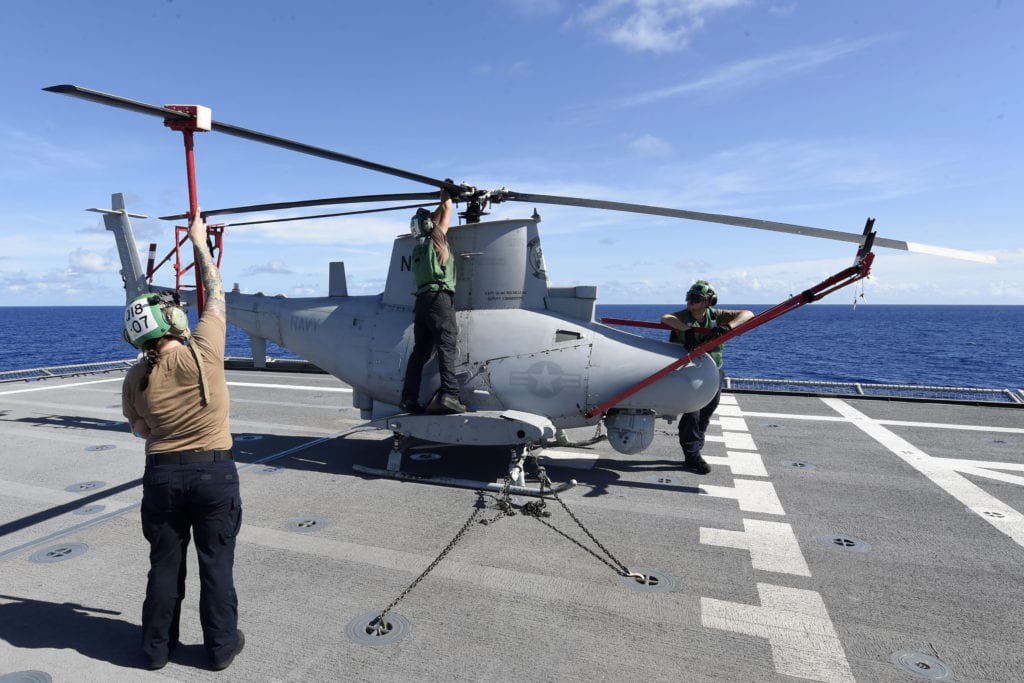
Sailors assigned to the “Wildcards” of Helicopter Sea Combat Squadron (HSC) 23 prepare an MQ-8B unmanned helicopter for routine flight operations on the flight deck of the Independence-variant littoral combat ship USS Gabrielle Giffords (LCS 10), July 7, 2020. U.S. NAVY / Mass Communication Specialist 2nd Class Brenton Poyser
ARLINGTON, Va. — The Navy is very much on board for integrating artificial intelligence (AI) and machine learning into its networks, but human decision makers must always be part of the decision process in warfighting, an admiral said.
“From a warfighting perspective, artificial intelligence subsets would be enablers or augments to the human in the loop,” said Rear Adm. Paul Spedero Jr., director, Fleet Integrated Readiness and Analysis, U.S. Fleet Forces Command, speaking April 8 during a Navy League webinar sponsored by Deloitte. “That has always been our approach. I don’t see that changing. There are some things that can’t be replaced; the experience of a seasoned warfighter in the field being able to assess things that a machine — no matter how much we teach it — may never be able to pick up on. There’s always going to be a necessity for [experience-based decision making]. That necessity for war fighting will never go away — to have a human in the loop.
“AI will be our wingmen,” he said. “It will not be the lead in a fight.”
Spedero said in the world of data analysis, his current focus, there “certainly is a place for AI, particularly machine learning, as we try to get to that predictive and prescriptive level of data analytics. We’re entering into mathematical equations and regressions that just can’t be done manually and algorithms you want [machines] to learn with demonstrated performance and adjust the coefficients within that [so] you can tighten your tolerance and lower your upper and lower limits of variance get closer to each other.”
The admiral, who is on the staff of Adm. Chris Grady, said his office is using data analytics “to identify barriers to force readiness,” to make sure the Optimized Fleet Readiness Plan is working correctly, continually assessing it “to get it right.” He is working to determine the metrics down to the unit level that will define what the readiness of the force is.
Also speaking in the webinar was Dr. Patrick O’Connell, chief digital transformation officer for the Navy, who said as the Navy confronts the challenge of processing massive amounts of data to make decisions, transformation works best when it it is both pushed down from the top of the organization and pushed up from the bottom. Institutional culture is one of the hardest things to change when trying to implement a revolutionary transformation, he said.
Cutter Returns Home following Eastern Pacific Law-Enforcement Patrol
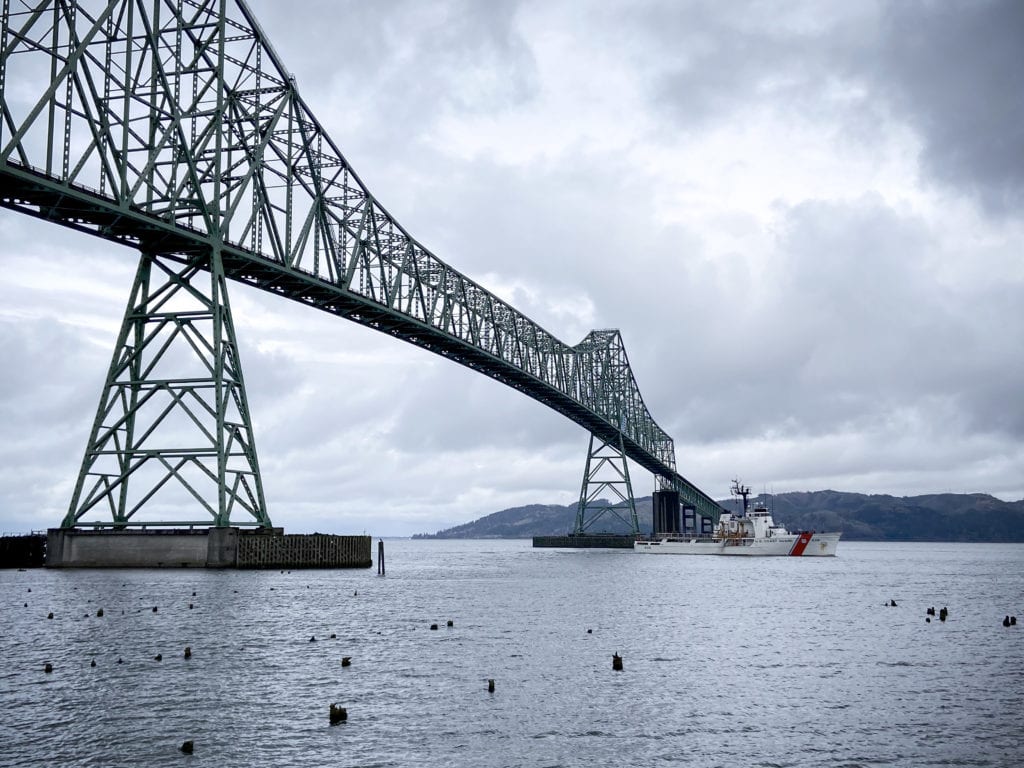
The USCGC Alert (WMEC 127) and its crew return to homeport in Astoria, Oregon, Wednesday, April 7, 2021, following a 63-day patrol that began in early February. The cutter and crew patrolled off the coast of Mexico and in the vicinity of the United States-Mexico Maritime Boundary Line enforcing international laws and treaties to disrupt illegal narcotics and migrant smuggling. U.S. Coast Guard photo by Petty Officer 1st Class Cynthia Oldham.
ASTORIA, Ore. — The Coast Guard Cutter Alert (WMEC 630) returned home to Astoria, Oregon, April 7 following a 63-day counterdrug patrol in the Eastern Pacific Ocean, the Coast Guard Pacific Area said in a release.
Working in conjunction with different Coast Guard and Mexican law enforcement agencies, Alert’s crew disrupted more than 2,100 pounds of cocaine, valued at over $41 million wholesale, from entering the United States.
The Oregon-based cutter and crew patrolled international waters off the coast of Mexico and the United States-Mexico Maritime Boundary Line, enforcing international laws and treaties throughout their deployment and disrupting the flow of illegal narcotics and migrant smuggling.
While on patrol, a maritime patrol aircraft spotted a suspected smuggling vessel. Alert’s crews launched both cutter small boats and pursued the vessel until it ran out of fuel. The case was transferred to Mexican law enforcement officials from the Secretaría de Marina (SEMAR).
Through the collaborative and international team effort, the smugglers were successfully apprehended, and 1,600 pounds of illegal narcotics seized by Mexican Law Enforcement.
Within 48 hours, Alert’s crew identified another law enforcement case for interdiction and changed course to intercept the suspected smuggling vessel. After a multi-hour pursuit, the crew successfully interdicted approximately 550 pounds of cocaine and apprehended six suspected narco-traffickers for prosecution in the United States.
Numerous U.S. agencies from the Departments of Defense, Justice and Homeland Security cooperated in the effort to combat transnational organized crime. The Coast Guard, Navy, Customs and Border Protection, FBI, Drug Enforcement Administration, and Immigration and Customs Enforcement, along with allied and international partner agencies, play a role in counter-drug operations.
Alert’s crew transferred the seized narcotics and suspected drug traffickers to the Department of Justice, via Coast Guard Station San Diego March 1 before steaming north to complete their three-week Tailored Ship Training Assessment, a bi-annual assessment designed to evaluate the cutter’s training teams and operational readiness.
“Once again, the crew of Alert was able to overcome the challenges of the COVID-19 pandemic and equipment failures on a 50-year-old ship to execute a wide range of Coast Guard missions from the US-Canada Border to the Mexico-Guatemala border over a two-month period,” said Cmdr. Tyson Scofield, Alert’s commanding officer. “Overall, Coast Guard Cutter Alert successfully completed a variety of operations through the combined effort of every member of the crew.”
While patrolling the Eastern Pacific, Alert’s watchstanders identified a sea turtle entangled in fishing debris. The cutter maneuvered into position and launched its small boat to help the endangered sea animal, ultimately setting the sea turtle free from the entwined debris. Marine environmental protection is a statutory mission of the Coast Guard and every year approximately 300 sea turtles are saved by the Coast Guard.
“Marine life has always had a special place in my heart. When the opportunity to save a turtle arose, I was beyond excited to help,” said Petty Officer Third Class Timothy Waters who was aboard the small board to help free the entangled sea turtle. “I am honored to have done something so small that contributes to something much larger than me.”
VTG Awarded Navy Contract to Modernize Combat Systems Across the Fleet
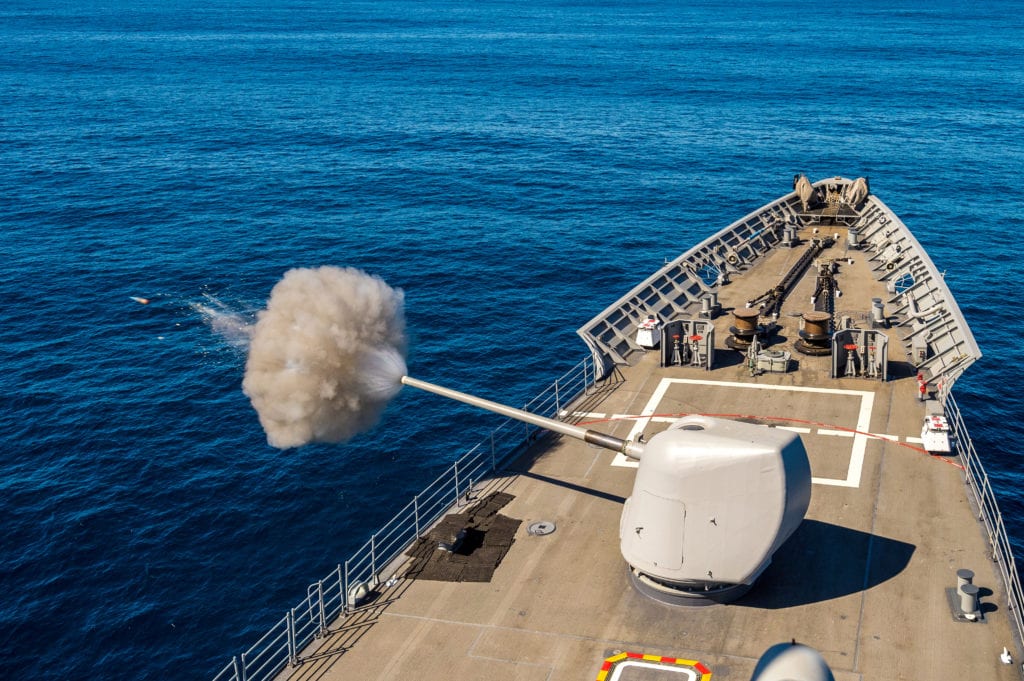
VTG has been awarded a $188 million Navy contract to help modernize combat systems across the fleet, including the Aegis Combat System, shown here in 2017 undergoing a test on the guided-missile cruiser USS Mobile Bay (CG 53). U.S NAVY Mass Communication Specialist 1st Class Chad M. Butler
CHANTILLY, Va. — VTG has been awarded the Technical Insertion 16 Sustainment, Installation, Procurement and Engineering Services contract by the Naval Surface Warfare Center Port Hueneme Division, a field activity of the Naval Sea Systems Command (NAVSEA), the company said in an April 7 release. The indefinite delivery, indefinite quantity contract has a potential value of $188 million and a five-year period of performance.
“VTG has a proud legacy of closely collaborating with the Navy to engineer the next generation of sea power,” said John Hassoun, VTG president and chief executive officer. “The TI16 program enables VTG to build upon that legacy, expanding our technical expertise, strengthening our partnership with NSWC Port Hueneme and NAVSEA, and — most importantly — modernizing the fleet.”
The TI16 program is the U.S. Navy’s enterprise approach to modernizing combat systems across the surface fleet, most notably the Aegis Combat System, and includes all cruisers and destroyers, aircraft carriers, and amphibious ships. TI16 also enables the Navy to introduce the latest commercial off-the-shelf technologies and open architecture designs into its combat systems.
VTG will leverage its robust, full-lifecycle combat-systems engineering capabilities to fulfill TI16 program requirements. The company currently provides prime contract warfare, control, and C5I engineering services to the NAVSEA Naval Sea Systems Engineering Directorate and has over 50 years of experience installing and integrating advanced C5ISR systems aboard every existing U.S. Navy surface ship and submarine class.
Most recently, VTG completed the successful installation and integration of the ODIN directed-energy laser weapon system aboard two Arleigh Burke-class destroyers. The company will also leverage its growing digital and software engineering capabilities. Earlier this month, VTG announced that it had begun work on a prime contract to develop the future state of the Navy Operational Architecture and to optimize fleet interoperability. The company also introduced the VTG Battle Lab, an industry-integrated model-based systems engineering environment for next-generation warfare systems.
Elbit Systems Completes the Acquisition of Sonobouy Manufacturer Sparton Corp.
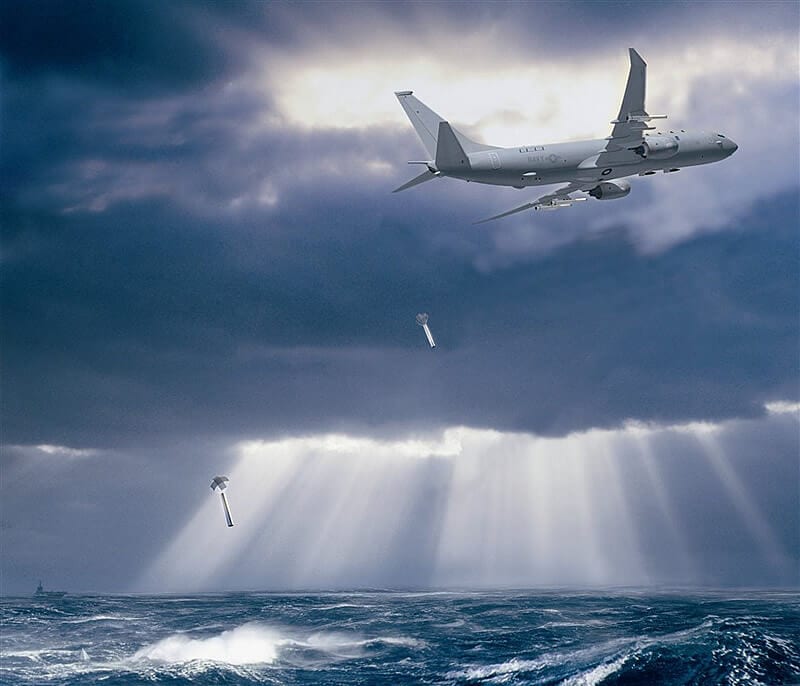
An artist’s conception of a P-8A aircraft dropping Sparton-built sonobuoys. ELBIT SYSTEMS OF AMERICA
HAIFA, Israel — Elbit Systems announced April 6 its U.S. subsidiary, Elbit Systems of America, completed the acquisition of Sparton Corp. from an affiliate of Cerberus Capital Management for $380 million. The closing follows receipt of all the required approvals, including U.S. government and regulatory approvals.
Headquartered in De Leon Springs, Florida, U.S., Sparton is a premier developer, producer and supplier of systems supporting undersea warfare for the U.S. Navy and allied military forces. Sparton is well-known as a manufacturer od sonobuoys for anti-submarine search and tracking by aircraft.
“The growing importance of the maritime arena and the market position and technological strength of Sparton make this acquisition significant to our long-term growth strategy, with a particular focus on the U.S. We believe that the completion of this acquisition will be beneficial for both Elbit Systems’ and Sparton’s employees and customers,” said Bezhalel “Butzi” Machlis, Elbit Systems president and chief executive officer.
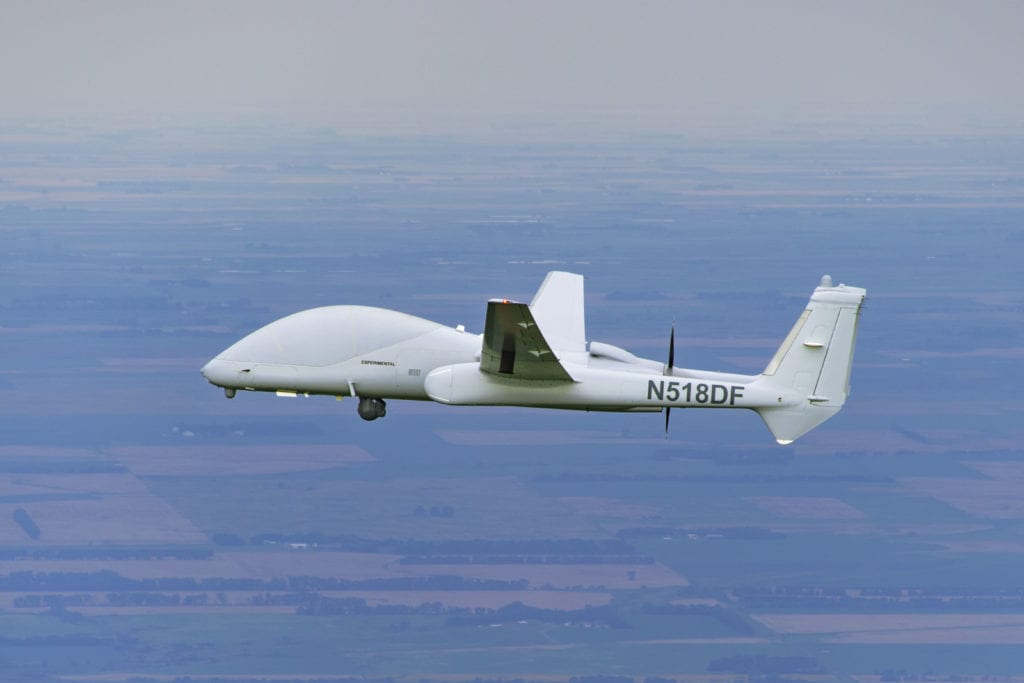
Northrop Grumman’s optionally manned Firebird, which flew to various locations around the United States to showcase its flexibility and ability to fly in national airspace. NORTHROP GRUMMAN
SAN DIEGO — Northrop Grumman Corp.’s Firebird multi-sensor aircraft showcased the versatility of the optionally manned autonomous system as it flew to various locations across the United States last month, the company said in an April 6 release.
The ability of Firebird to be flown manned through national airspace is a demonstration of its unique operational flexibility for self-deployment and its rapid relocation ability to adapt to specific user needs and operational requirements.
The company flew Firebird almost 9,000 miles around the US with stops in Dayton, Ohio, Washington D.C., Patuxent River, Maryland, as well as Tampa, Miami and Key West, Florida.
“Our flights showcased one of its key differentiators — the ability to position the system in a manned configuration, then convert to autonomous operations for persistent ISR in under two hours,” said Jane Bishop, vice president and general manager, autonomous systems, Northrop Grumman. “At each stop, plane-side briefings provided customers the opportunity to see first-hand the operational versatility of the platform, its large sensor bay, and rapid configurability for changing mission needs.”
Firebird is a medium-altitude, long-endurance unmanned aircraft system designed for flexibility and affordability. Customers can install new payloads in as little as one day and swap payloads in 30 minutes, making the system suitable for numerous domains and missions.
The flights concluded in Key West, where the team conducted a series of manned maritime operational events that included a four-sensor package containing two high-definition electro-optical sensors, a maritime configured multi-spectral sensor for small target detection and an Automatic Information System receiver.
Leidos Completes Delivery of Seahawk MDUSV to U.S. Navy
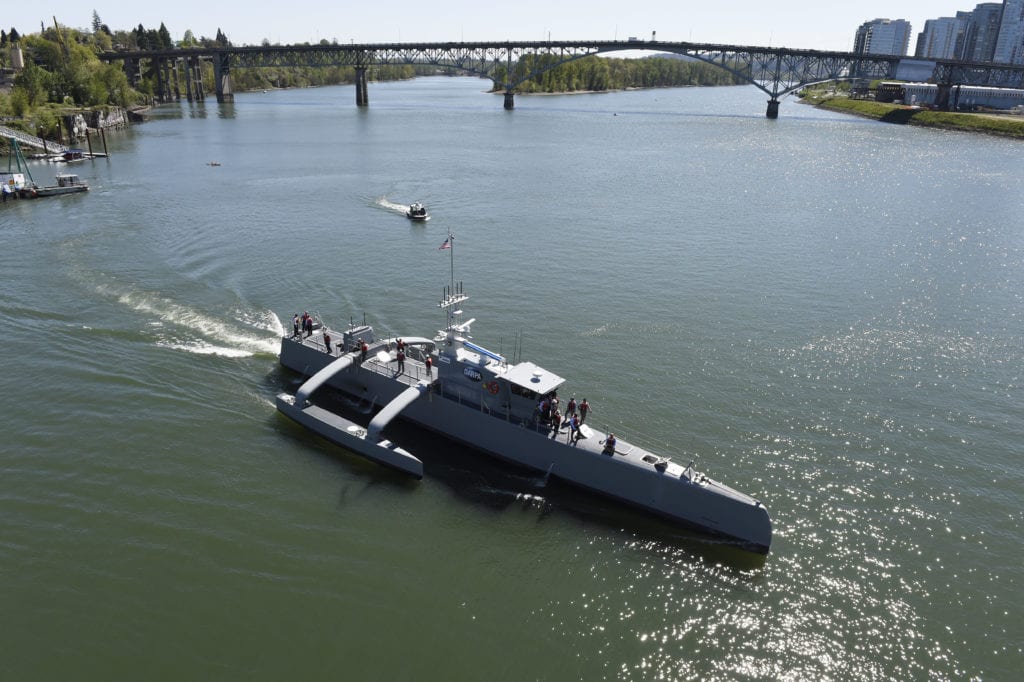
Leidos has completed delivery of a cutting-edge autonomous vessel, the Seahawk, an upgraded design from the earlier Sea Hunter vessel shown here getting underway following its christening ceremony in 2016. U.S. NAVY / John F. Williams
RESTON, Va. — Leidos has completed delivery of a cutting-edge autonomous vessel to the U.S. Navy, known as Seahawk, the company said in an April 7 release. The Office of Naval Research awarded Leidos the cost-plus-fixed fee contract to build the vessel, with an approximate value of $35.5 million, in December 2017. Work was principally performed on the Mississippi Gulf Coast.
“As technology continues to accelerate and adversaries become more sophisticated, our customers must constantly evolve,” said retired Rear Adm. Nevin Carr, Leidos vice president and Navy strategic account executive. “We are honored to provide this latest technological advancement to America’s sailors who fight to keep the seas open and free.”
Seahawk is a long-range, high-availability autonomous surface vessel with a composite trimaran hull. This medium-displacement unmanned surface vehicle (MDUSV) will enhance capabilities for naval operations. Like Leidos’ MDUSV Sea Hunter, Seahawk is substantially larger than other U.S. Navy USVs and has significantly increased capabilities compared to smaller USVs in terms of range, seakeeping and payload capacity. Seahawk is designed to operate with little human involvement, thus providing a forward-deployed and rapid-response asset in the global maritime surveillance network.
“We didn’t just put an autonomous navigation system onto an existing ship,” said Dan Brintzinghoffer, Leidos vice president for Maritime Solutions. “Every mechanical and electrical system on Seahawk has unique configurations designed to run for months at a time without maintenance or a crew.”
The trimaran’s displacement (fully loaded) is 145 long tons. This includes 14,000 gallons of fuel that can power the twin diesel engines for a substantial length of time. Seahawk’s upgraded design follows an evaluation of over 300 lessons learned from Sea Hunter. These upgrades were based on joint evaluations by Leidos and the Navy and include upgraded electrical systems, a payload mounting system and test operator control station.
Seahawk will join Surface Development Squadron One in San Diego, California.
CNO: Programs Must Advance the Navy’s Core Missions
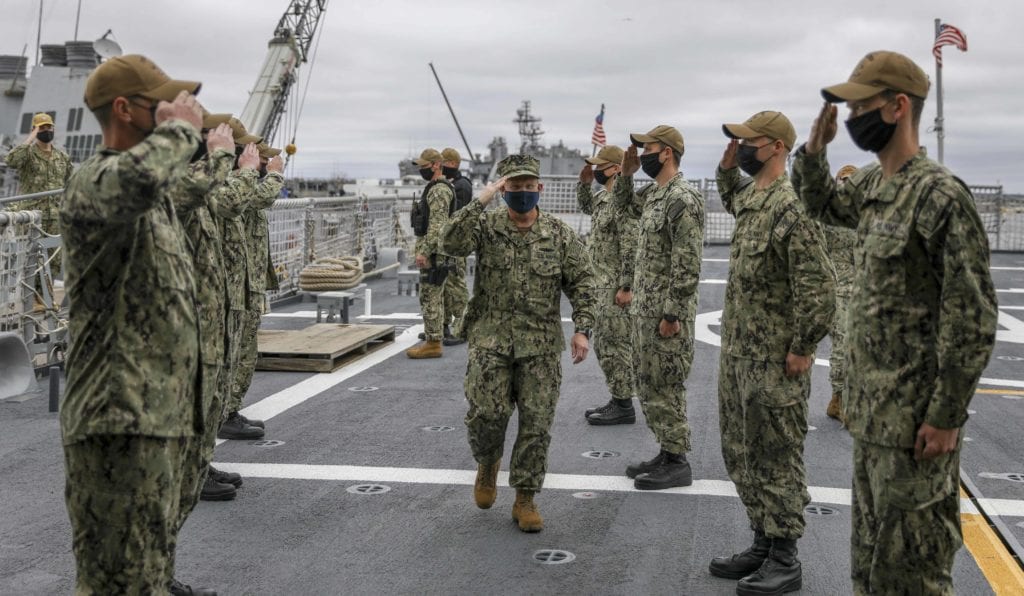
Chief of Naval Operations (CNO) Adm. Mike Gilday, center, renders a salute to Sailors as he embarks the Freedom-class littoral combat ship USS Billings (LCS 15) in Florida in March. U.S. NAVY / Mass Communication Specialist 3rd Class Austin Collins
ARLINGTON, Va. — The Navy’s top officer emphasized the need to focus on the Navy’s reasons for being to avoid tangents that ultimately detract from its role in the defense of the nation.
Chief of Naval Operations Adm. Michael Gilday, speaking in a webinar of the Center for a New American Security, a Washington think tank, said the Navy missions of sea control and power projection are so obvious as to be trite to emphasize, but needed constant attention to perform.
“There have been cases in the past of where you lose sight of those ends — what your main thing is — you can get off track and put precious resources against big programs that don’t advance the Navy or any service with respect of those ends,” Gilday said.
“The things that we’re going to spend money on are going to make us more lethal and more effective with respect to sea control and power projection, and that goes hand-in-glove with the Distributed Maritime Operations concept and how that fits into the broader Joint Warfighting Concept that the chairman of the Joint Chiefs is working with his staff that I expect the secretary of defense to ultimately endorse.”
Gilday emphasized that recent studies of the force structure said the nation needed a larger, more capable Navy.
“Over the past two decades, we have tended not to put strategic investments behind the fleet than we probably should have, so we put ourselves in a situation where we’re falling behind,” he said, noting that while the size of the fleet matters, it was “easy to get seduced by numbers. What we really need to be focused on is capabilities, particularly what capabilities the Navy can close for the joint force.”
The CNO said the Navy’s shipbuilding plan, which was based on the Naval Force Structure Study, “was really focused on operationally relevant metrics — things like lethality, survivability, operational reach — things that are going to allow the Navy to synergistically be much more effective within the joint force.”
The admiral also said factors that can’t be ignored include “total ownership cost, maintenance cost, technical risk of new programs versus operational risk of in the transition of sun-downing legacy programs, industrial base capacity and what the art of the possible is or is not with respect to certain platforms.
“In the end, what we become more focused on with respect to the analysis that we’ve done is the composition of the fleet with respect to capabilities that then translates into platforms,” Gilday said.
The CNO said the force structure studies show more emphasis on undersea capabilities and smaller ships that are more distributed than on larger ships, and more emphasis on offensive hypersonics, directed energy weapons and logistics ships.
“That analysis is sound,” he said. “My take on discussions inside the Pentagon with OSD [the Office of the Secretary of Defense] as we close on the [fiscal 2022] budget, we are grounding decisions on that analysis that was done last year under [Defense] Secretary [Mark] Esper. “That analysis is not static. We have ongoing experiments, fleet battle problems, exercises, war games and analysis.”
Gilday said in a few weeks, the Navy will conduct an exercise off California that will “further inform our understanding of where we need to go with unmanned capabilities, and then the numbers.”
Keel Laid for Future USS Harvey C. Barnum Jr.
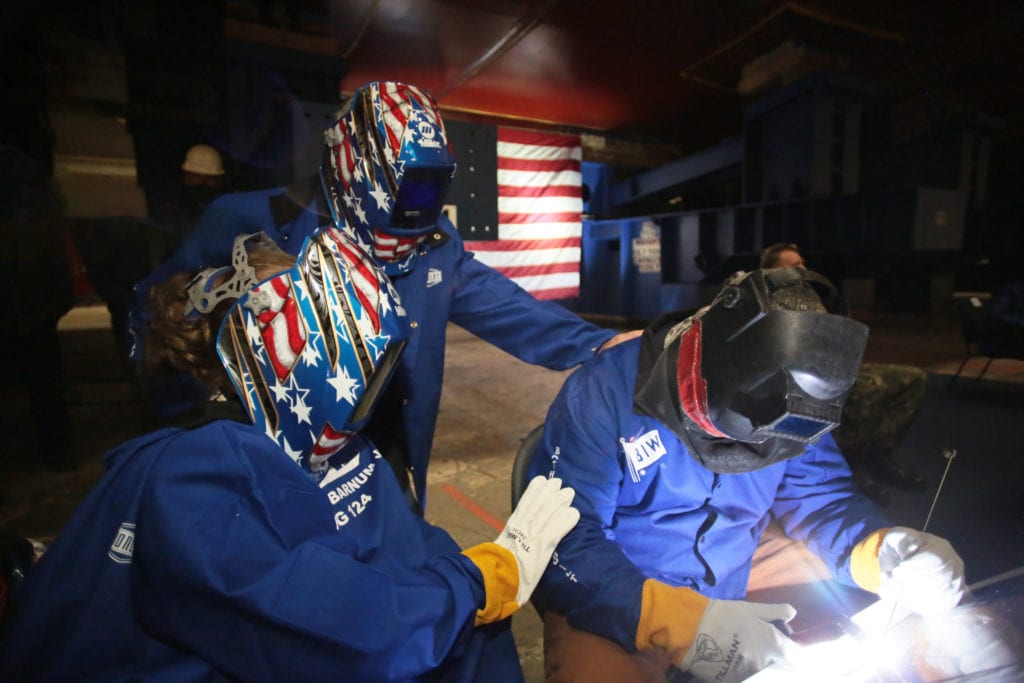
The future USS Harvey C. Barnum Jr. (DDG 124) namesake, Col. Harvey “Barney” Barnum, Jr. (USMC, Ret.) (center) and his wife and ship sponsor, Martha Hill (left) monitor as Bath Iron Works welder Marty Fish (right) inscribes Col. Barnum’s signature onto the keel plate at General Dynamics Bath Iron Works (BIW) shipyard, April 6. BATH IRON WORKS
BATH, Maine – The keel of the future USS Harvey C. Barnum Jr. (DDG 124) was ceremoniously laid at General Dynamics Bath Iron Works (BIW) shipyard, April 6, the Navy’s Team Ships Public Affairs said in an April 7 release.
The ship’s namesake, Col. Harvey “Barney” Barnum Jr. (USMC, Ret.) and his wife and ship sponsor, Martha Hill, attended the event. Acting Secretary of the Navy, Thomas W. Harker, Maine Sens. Susan Collins and Angus King Jr. and Rep. Chellie Pingree were also in attendance.
With the assistance of BIW welder Marty Fish, Barnum inscribed his signature onto the keel plate. As the sponsor, Martha Hill authenticated the keel by etching her initials into the keel plate, a tradition that symbolically recognizes the joining of modular components and the ceremonial beginning of the ship.
“Col. Barnum has spent his life in service to our country and it is an honor to lay the keel of his ship,” said Capt. Seth Miller, DDG 51 class program manager. “This ship and all who serve aboard it will be a reminder of the honor, courage, and commitment that Col. Barnum embodies.”
Barnum twice served in Vietnam and is a Medal of Honor recipient for heroic actions taken against communist forces at Ky Phu in Quang Tin Province in December 1965 after his company came under enemy fire and was separated from the rest of their battalion.
DDG 124 is a Flight IIA Arleigh Burke-class destroyer equipped with Aegis Baseline 9, which provides improved integrated air and missile defense capabilities, increased computing power, and radar upgrades that improve detection range and reaction time against modern air warfare and ballistic-missile defense threats.
BIW is also in production on the future Arleigh Burke-class destroyers Carl M. Levin (DDG 120), John Basilone (DDG 122), Patrick Gallagher (DDG 127), and Flight III ships, Louis H. Wilson Jr. (DDG 126), and William Charette (DDG 130), as well as the future Zumwalt-class destroyer, Lyndon B. Johnson (DDG 1002).